Active Listening
Anand Rayudu / 2017
1
Comparison ChartComparison Chart
Meaning
What is it ?
Nature
Act
Involves
Process
Occurs at
Sense
Reason
Concentration
•Ability to perceive sounds
•An ability
•Primary continuous
•Physiological
•Receipt of messages through ears
•Passive bodily process
•Subconscious level
•Only one
•Cannot control
•Not required
•Analysis & understanding of the sounds one hears
•A skill
•Secondary and temporary
•Psychological
•Interpretation and understanding of the message
•Active mental process
•Conscious level
•More than one (ears and eyes)
•We listen to acquire knowledge and receive info
•Required
Hearing Listening
2
Listening
The process of
• receiving
• deriving meaning from, and
• responding to
a verbal and/or non-verbal message
3
Active Listening
Listening is not a passive activity
It is the most exciting part of the conversation
Listening well is the vital ingredient in a successful, productive
and interesting conversation
The quality of speech depends on the speaker; but the success of the
speech cannot be attained without good listener/s
4
Why Do We Listen?
 Converse (conversation cannot happen without listening)
 Learn
 Respect
 Build credibility and trust
 Observe
 Socialize
 Build relationship
 Human tendency to expect others to listen
 Take order
 Perform Duty
 For entertainment
One can listen more by just listening
5
Types of Listening
• Appreciative Listening
• Emphatic Listening
• Critical/Analytical Listening
• Comprehensive/Active Listening
6
Types of Listening
Appreciative Listening
• Listening for pleasure and enjoyment (listen to music, comedy show,
entertaining speech)
• Describes how well speakers choose words, use humor, ask questions, tell
stories, and argue persuasively.
7
Types of Listening
Emphatic Listening
• Listening to provide emotional support for the speaker, as when a psychiatrist
listens to a patient or when we lend a sympathetic ear to a friend
• Focuses on understanding and identifying with a person’s situation, feelings, or
motives -there is an attempt to understand what the other person is feeling
• Listener does not necessarily agree or feel the same way with the speaker
instead understand the type and intensity of feelings the speaker is experiencing
without judgment
8
Types of Listening
Critical/ Analytical Listening
- Listening to evaluate a message for purposes of accepting or rejecting it
(sales pitch by a salesman or election speech of a political leader)
- Focuses on evaluating whether a message is logical and reasonable
- Asks you to make judgements based on your evaluation of the speaker’s
arguments
- Challenges the speaker’s message by evaluating its accuracy and
meaningfulness
- Uses critical thinking skills
9
Types of Listening
Comprehensive/Active Listening
Listening to understand the message of a speaker, as when we attend a classroom lecture
or listen to directions for finding a friend’s house
Focuses on accurately understanding the meaning of the speaker’s words while
simultaneously interpreting non-verbal cues such as facial expressions, gestures, posture,
and vocal quality
Steps in Active Listening
1.listening carefully by using all available senses
2.paraphrasing what is heard both mentally and verbally
3.checking your understanding to ensure accuracy
4.providing feedback
10
Fallacies of Listening
Listening is not my problem
Listening and hearing are the same
Good readers are good listeners
Smarter people are better listeners
Listening improves with age
Listening skills are difficult to learn
11
Traits / Attributes of a GOOD LISTENER
Gives full attention to the speaker. Does not look here and there.
Remains focused. Does not allow his/her mind to wander. Concentrates on each and every word that is being spoken.
Allows the speaker to finish. Speakers love attention without any interruption. Interruption can derail the speaker.
Lets listening to be over before s/he begins to speak ! One can't really listen if one is busy thinking about what s/he wants
to say next.
Remains connected to main ideas. The points the speaker wants to get across. May come at the beginning or end of a talk,
and repeated a number of times. Like, "My point is..." or "The thing to remember is...“.
Asks questions without interrupting. If you are not sure you understood what the speaker has said, just ask.
Gives feedback
Sit up straight and look directly at the speaker. Now and then, nod to show that you understand. At appropriate points you may also
smile, frown, laugh, or be silent. These are all the ways to let the speaker know that you are really listening. Remember, you listen
with your ears as well as your face!
12
Common Prerequisites for Good Listening
Observe
Non-verbal Behaviour
Focus
Do not do anything else while listening
Acknowledge
Acknowledge the message, even if you do not agree with it
Respect
Let the speaker finish
13
An Active Listener
• A bundle of concentration
• A patient observer
• Commands respect
• Admired by the speaker
• Grasps the subject quickly and effectively
• Gives feedback that is free from prejudices
• Last but not the least, a great learner
14
Physical Barriers
• Noise
• Poor acoustics
• Defective mechanical devices
• Frequent interruptions
• Uncomfortable seating arrangements
• Uncomfortable environment
• Message overload
15
Physiological Barriers
State of Health
That of speaker or listener. Can potentially affect listening. Fever, pain or any other form of bodily
discomfort can make it difficult for a person to listen or speak comfortably.
Disability
Hearing deficiencies may lead to poor listening. Similarly, speech disorders of the speaker may
make a speech incoherent to the listener. Speaker’s accent may also make it difficult for the listener
to comprehend.
Wandering Attention
Human mind can process words @ 500 /min, whereas a speaker speaks @ 150 /min. This gap is
enough for the listener to wander at will.
16
Psychological Barriers
Apprehension About Speaker’s Ability
Past experience or inputs from sources, the listener may have a preconceived notion of the speaker’s ability/inability. Speaker’s ability
to speak, his knowledge or/and his conviction may become doubtful. At times, such notions can even lead to over expectation as well.
Personal Anxiety
Sometimes the listener is preoccupied with personal concerns and anxieties. This makes it difficult to perceive what is being said by the
speaker.
Attitude
The listener may be highly egocentric with a “know it all attitude” and may not listen as he feels that he already knows what the listener
has to say.
Impatience
The listener may not have patience to wait for the other person to finish what he has to say. He may be intolerant or may be eager to
add his own points to the discussion. As a result, his desire to speak overcomes his desire to listen, thus acting as a barrier.
Emotional Blocks
Our deep seated beliefs in certain ideas may make it difficult for us to listen to ideas which go against our belief. We may hear such an
idea wrongly or it may get distorted in our mind to match our perception or we may completely block it off by not listening to it. Many a
time, we block something off completely because of painful memories associated with it.
17
Personal Agenda
• Speaker talks more about himself/herself rather than the subject matter
• Listener seeks personal glory by jumping gun
• A group of listeners make attempts to hijack the session, thereby completely derailing the intended
objectives
• Listener syndrome “I know more than the speaker”
• Listener invents boredom by diverting towards unnecessary things
• Speaker / listener has other priorities
• Frequent interruptions through irrelevant questioning
• Listener is constantly looking towards attracting eye-balls
• Listener is hell bent to build notions about the speaker on the basis of his/her social status /
accent / educational background / antecedents etc.
• Listener gets into argumentative mode or speaker lacks persuasive skill
General Phenomenon : 20% of the participants do 80% of the talks
18
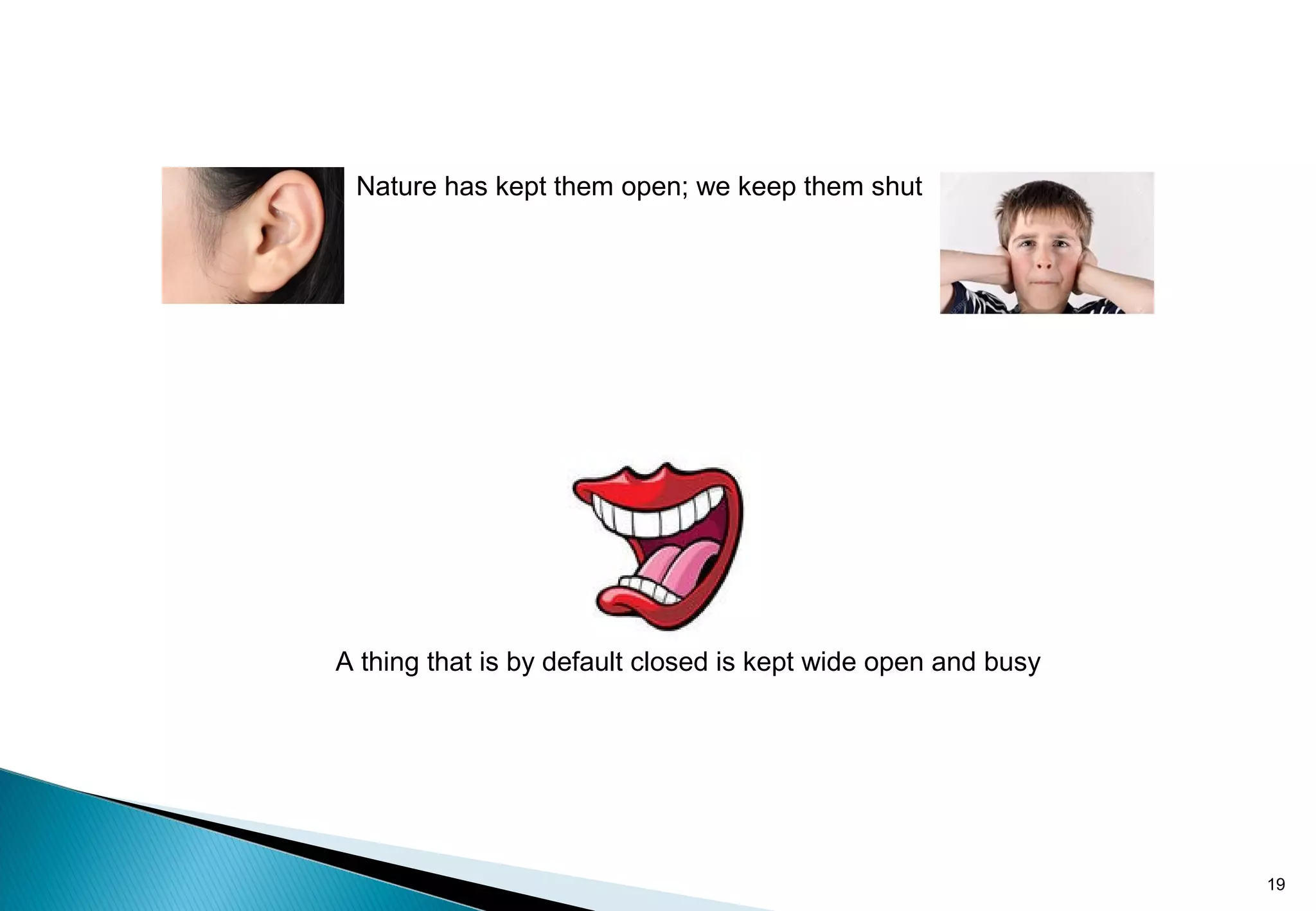
Nature has kept them open; we keep them shut
A thing that is by default closed is kept wide open and busy
19
We are blessed with two ears and one
mouth – a constant reminder that we
should listen at least twice as much as
we talk.
20
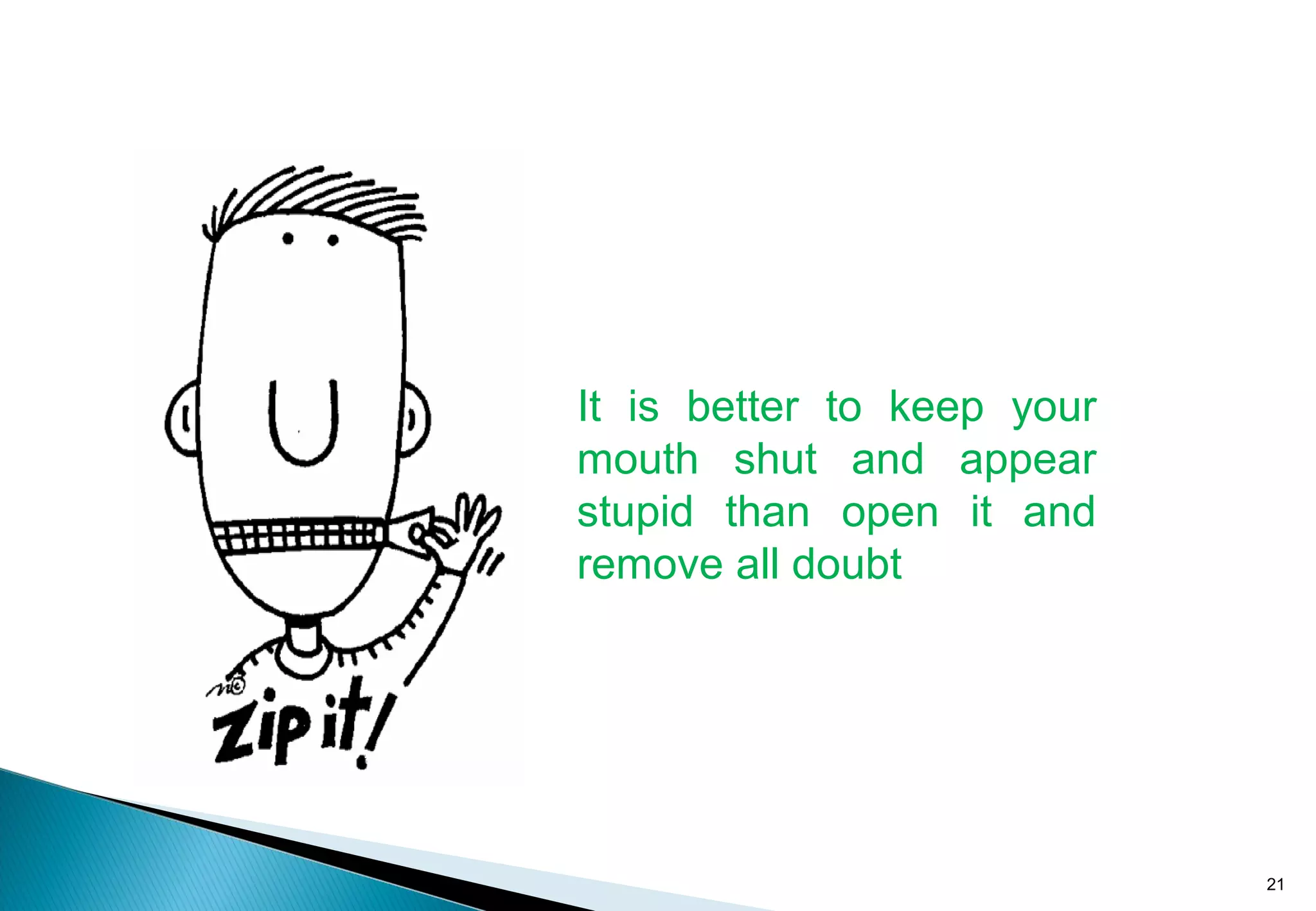
It is better to keep your
mouth shut and appear
stupid than open it and
remove all doubt
21
The ability to speak well is
an asset; but the ability to
keep your mouth shut is
priceless
22
Dear Lord,
Please put your arm around
my shoulder and your hand
over my mouth
23
Saying right thing at the right
time is a virtue; but still more
virtuous is not saying wrong
thing at the most temping
moment
24
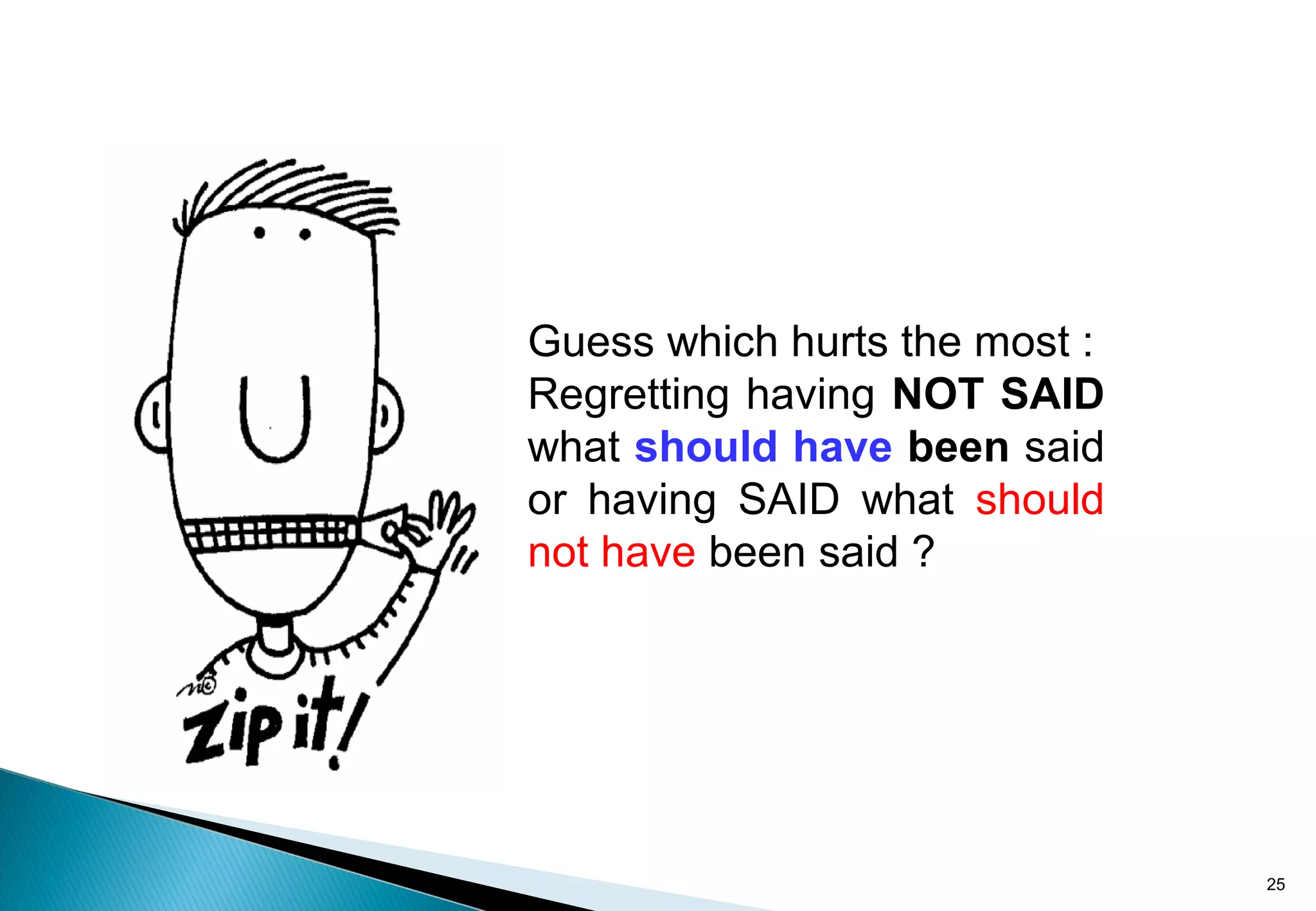
Guess which hurts the most :
Regretting having NOT SAID
what should have been said
or having SAID what should
not have been said ?
25
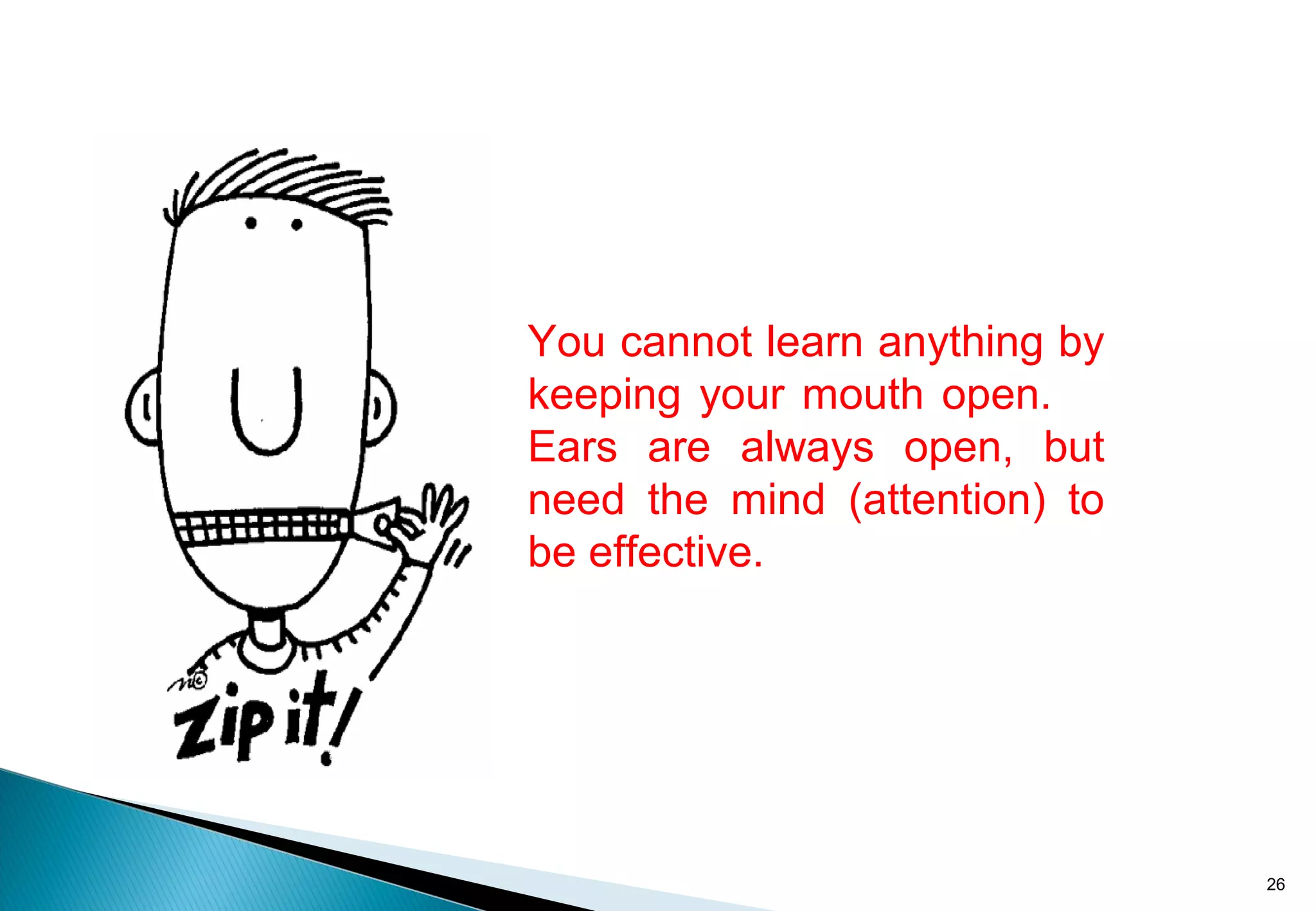
You cannot learn anything by
keeping your mouth open.
Ears are always open, but
need the mind (attention) to
be effective.
26
Thanks
27

Active Listening

  • 1.
  • 2.
    Comparison ChartComparison Chart Meaning Whatis it ? Nature Act Involves Process Occurs at Sense Reason Concentration •Ability to perceive sounds •An ability •Primary continuous •Physiological •Receipt of messages through ears •Passive bodily process •Subconscious level •Only one •Cannot control •Not required •Analysis & understanding of the sounds one hears •A skill •Secondary and temporary •Psychological •Interpretation and understanding of the message •Active mental process •Conscious level •More than one (ears and eyes) •We listen to acquire knowledge and receive info •Required Hearing Listening 2
  • 3.
    Listening The process of •receiving • deriving meaning from, and • responding to a verbal and/or non-verbal message 3
  • 4.
    Active Listening Listening isnot a passive activity It is the most exciting part of the conversation Listening well is the vital ingredient in a successful, productive and interesting conversation The quality of speech depends on the speaker; but the success of the speech cannot be attained without good listener/s 4
  • 5.
    Why Do WeListen?  Converse (conversation cannot happen without listening)  Learn  Respect  Build credibility and trust  Observe  Socialize  Build relationship  Human tendency to expect others to listen  Take order  Perform Duty  For entertainment One can listen more by just listening 5
  • 6.
    Types of Listening •Appreciative Listening • Emphatic Listening • Critical/Analytical Listening • Comprehensive/Active Listening 6
  • 7.
    Types of Listening AppreciativeListening • Listening for pleasure and enjoyment (listen to music, comedy show, entertaining speech) • Describes how well speakers choose words, use humor, ask questions, tell stories, and argue persuasively. 7
  • 8.
    Types of Listening EmphaticListening • Listening to provide emotional support for the speaker, as when a psychiatrist listens to a patient or when we lend a sympathetic ear to a friend • Focuses on understanding and identifying with a person’s situation, feelings, or motives -there is an attempt to understand what the other person is feeling • Listener does not necessarily agree or feel the same way with the speaker instead understand the type and intensity of feelings the speaker is experiencing without judgment 8
  • 9.
    Types of Listening Critical/Analytical Listening - Listening to evaluate a message for purposes of accepting or rejecting it (sales pitch by a salesman or election speech of a political leader) - Focuses on evaluating whether a message is logical and reasonable - Asks you to make judgements based on your evaluation of the speaker’s arguments - Challenges the speaker’s message by evaluating its accuracy and meaningfulness - Uses critical thinking skills 9
  • 10.
    Types of Listening Comprehensive/ActiveListening Listening to understand the message of a speaker, as when we attend a classroom lecture or listen to directions for finding a friend’s house Focuses on accurately understanding the meaning of the speaker’s words while simultaneously interpreting non-verbal cues such as facial expressions, gestures, posture, and vocal quality Steps in Active Listening 1.listening carefully by using all available senses 2.paraphrasing what is heard both mentally and verbally 3.checking your understanding to ensure accuracy 4.providing feedback 10
  • 11.
    Fallacies of Listening Listeningis not my problem Listening and hearing are the same Good readers are good listeners Smarter people are better listeners Listening improves with age Listening skills are difficult to learn 11
  • 12.
    Traits / Attributesof a GOOD LISTENER Gives full attention to the speaker. Does not look here and there. Remains focused. Does not allow his/her mind to wander. Concentrates on each and every word that is being spoken. Allows the speaker to finish. Speakers love attention without any interruption. Interruption can derail the speaker. Lets listening to be over before s/he begins to speak ! One can't really listen if one is busy thinking about what s/he wants to say next. Remains connected to main ideas. The points the speaker wants to get across. May come at the beginning or end of a talk, and repeated a number of times. Like, "My point is..." or "The thing to remember is...“. Asks questions without interrupting. If you are not sure you understood what the speaker has said, just ask. Gives feedback Sit up straight and look directly at the speaker. Now and then, nod to show that you understand. At appropriate points you may also smile, frown, laugh, or be silent. These are all the ways to let the speaker know that you are really listening. Remember, you listen with your ears as well as your face! 12
  • 13.
    Common Prerequisites forGood Listening Observe Non-verbal Behaviour Focus Do not do anything else while listening Acknowledge Acknowledge the message, even if you do not agree with it Respect Let the speaker finish 13
  • 14.
    An Active Listener •A bundle of concentration • A patient observer • Commands respect • Admired by the speaker • Grasps the subject quickly and effectively • Gives feedback that is free from prejudices • Last but not the least, a great learner 14
  • 15.
    Physical Barriers • Noise •Poor acoustics • Defective mechanical devices • Frequent interruptions • Uncomfortable seating arrangements • Uncomfortable environment • Message overload 15
  • 16.
    Physiological Barriers State ofHealth That of speaker or listener. Can potentially affect listening. Fever, pain or any other form of bodily discomfort can make it difficult for a person to listen or speak comfortably. Disability Hearing deficiencies may lead to poor listening. Similarly, speech disorders of the speaker may make a speech incoherent to the listener. Speaker’s accent may also make it difficult for the listener to comprehend. Wandering Attention Human mind can process words @ 500 /min, whereas a speaker speaks @ 150 /min. This gap is enough for the listener to wander at will. 16
  • 17.
    Psychological Barriers Apprehension AboutSpeaker’s Ability Past experience or inputs from sources, the listener may have a preconceived notion of the speaker’s ability/inability. Speaker’s ability to speak, his knowledge or/and his conviction may become doubtful. At times, such notions can even lead to over expectation as well. Personal Anxiety Sometimes the listener is preoccupied with personal concerns and anxieties. This makes it difficult to perceive what is being said by the speaker. Attitude The listener may be highly egocentric with a “know it all attitude” and may not listen as he feels that he already knows what the listener has to say. Impatience The listener may not have patience to wait for the other person to finish what he has to say. He may be intolerant or may be eager to add his own points to the discussion. As a result, his desire to speak overcomes his desire to listen, thus acting as a barrier. Emotional Blocks Our deep seated beliefs in certain ideas may make it difficult for us to listen to ideas which go against our belief. We may hear such an idea wrongly or it may get distorted in our mind to match our perception or we may completely block it off by not listening to it. Many a time, we block something off completely because of painful memories associated with it. 17
  • 18.
    Personal Agenda • Speakertalks more about himself/herself rather than the subject matter • Listener seeks personal glory by jumping gun • A group of listeners make attempts to hijack the session, thereby completely derailing the intended objectives • Listener syndrome “I know more than the speaker” • Listener invents boredom by diverting towards unnecessary things • Speaker / listener has other priorities • Frequent interruptions through irrelevant questioning • Listener is constantly looking towards attracting eye-balls • Listener is hell bent to build notions about the speaker on the basis of his/her social status / accent / educational background / antecedents etc. • Listener gets into argumentative mode or speaker lacks persuasive skill General Phenomenon : 20% of the participants do 80% of the talks 18
  • 19.
    Nature has keptthem open; we keep them shut A thing that is by default closed is kept wide open and busy 19
  • 20.
    We are blessedwith two ears and one mouth – a constant reminder that we should listen at least twice as much as we talk. 20
  • 21.
    It is betterto keep your mouth shut and appear stupid than open it and remove all doubt 21
  • 22.
    The ability tospeak well is an asset; but the ability to keep your mouth shut is priceless 22
  • 23.
    Dear Lord, Please putyour arm around my shoulder and your hand over my mouth 23
  • 24.
    Saying right thingat the right time is a virtue; but still more virtuous is not saying wrong thing at the most temping moment 24
  • 25.
    Guess which hurtsthe most : Regretting having NOT SAID what should have been said or having SAID what should not have been said ? 25
  • 26.
    You cannot learnanything by keeping your mouth open. Ears are always open, but need the mind (attention) to be effective. 26
  • 27.