Communication Skills 
By Samir Aly
Agenda 
• Introduction to communication 
• What is effective communication? 
• Uses of effective Communication 
• 7 Cs of communication 
• Barriers of effective communication 
• Activity 
• What is listening 
• Stages of listening 
• Relationship between speaking and 
Listening 
• Importance of Effective Listening 
• Techniques of Effective Listening 
• Path of good of communication 
• Conclusion
What is communication ? 
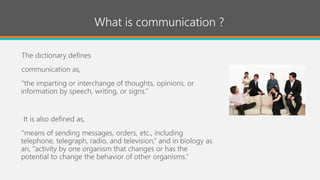
The dictionary defines 
communication as, 
“the imparting or interchange of thoughts, opinions, or 
information by speech, writing, or signs.” 
It is also defined as, 
“means of sending messages, orders, etc., including 
telephone, telegraph, radio, and television,” and in biology as 
an, “activity by one organism that changes or has the 
potential to change the behavior of other organisms.”
Process of communication 
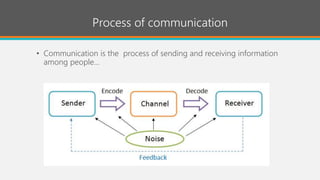
• Communication is the process of sending and receiving information 
among people…
How Do We Communicate? 
We communicate in three major ways: 
• Spoken: There are two components to spoken communication. 
o Verbal: This is what you are saying. 
o Paraverbal: This means how you say it – your tone, speed, pitch, and volume. 
.
How Do We Communicate? Cont. 
• Non-Verbal: These are the gestures and body language that 
accompany your words. Some examples: arms folded across 
your chest, tracing circles in the air, tapping your feet, or 
having a hunched-over posture. 
• Written: Communication can also take place via fax, e-mail, 
or written word
Effective communication 
“ To effectively communicate, we must realize that we are 
all different in the way we perceive the world and use this 
understanding as a guide to our communication with 
others.” Tony Robbins 
• Meaning and Definition 
• Uses of Effective Communication 
• The 7C’s of Effective Communication 
• Facts about Effective communication
Meaning and definition 
Meaning 
Effective Communication is a two way process – sending the right 
message and to the right person. 
• It is important to know the psychology of the people you are 
interacting with for communication to be effective. 
• For communication to be effective it is necessary to know the 
circumstances of the counter entity. 
• Effective communication includes all the aspects of visual, auditory 
and kinaesthetic language to appeal the listener. 
Definition 
“Effective communication is the communication which produces 
intended or desired result”
Uses of effective communication 
•Effective communication helps to understand a person or situation in a 
better way. 
•It enables us to solve the differences, build trust and respect in the 
organization. 
•Sometimes our message is misunderstood or we misunderstand the 
received message, effective communication helps us to resolve problems 
with both’s point of view. 
•Effective communication helps us to connect well with kids, spouse, boss, 
colleagues, etc. 
•It helps us in decision making.
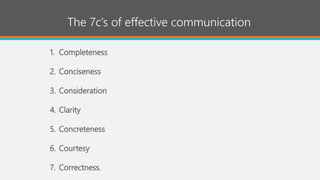
The 7c’s of effective communication 
1. Completeness 
2. Conciseness 
3. Consideration 
4. Clarity 
5. Concreteness 
6. Courtesy 
7. Correctness.
Completeness 
` 
•The information conveyed in the message should be complete for the 
communication to be effective. 
•The sender must take into consideration the receiver’s mind set and 
convey the message accordingly. 
•Complete communication enhances the reputation of the organization. 
•Complete information always gives additional information wherever 
required, it leaves no question in the minds of the receiver. 
•Complete information helps in better decision making as it serves all the 
desired and crucial information. 
•Complete information persuades the audience.
Conciseness 
•Conciseness means communicating what you want to convey 
in least possible words. 
•Conciseness is a necessity for effective communication. 
•Concise communication provides short and essential message 
in limited words. 
•Concise message is more appealing and comprehensive to 
the audience. 
•Concise messages are non repetitive in nature.
Consideration 
•Effective communication must take audience into 
consideration by knowing the viewpoints, back ground, 
mindset, educational level, etc. 
•Consideration implies ‘stepping into the shoes of others’. 
•Consideration ensures that the self respect of the audience is 
maintained and their emotions are not harmed. 
•Consider the needs and requirements of the audience to 
achieve effective communication.
Clarity 
•Clarity implies emphasizing on a specific goal or objective at a 
time, rather than trying to move away from track. 
•Clarity helps to understand the message easily. 
•Complete clarity of thoughts and ideas enhances the meaning 
of message. 
•Clarity comes with the use of exact, appropriate and concrete 
words.
Concreteness 
•Concrete communication implies being particular and clear 
rather being fuzzy and general. 
•Concrete communication shows good level of confidence. 
•Concrete information helps to strengthen the reputation of 
the organization. 
•Concrete information cannot be misinterpreted.
Courtesy 
•Courtesy means being polite, kind, judicious, enthusiastic and 
convincing. 
•Courtesy is an important element of effective communication. 
•Courtesy reflects the nature and character of the sender of the 
message. 
•It is the same as give respect and then expect the same. 
•Courtesy is not at all bias in nature.
Correctness 
•Correctness in the communication implies that the correct 
information is conveyed through message. 
•Correct communication boosts up the confidence level of the 
sender. 
•Correct information has greater impact on the audience. 
•Free from grammatical errors and use of appropriate and 
correct language. 
•Correct information includes the precision and accurateness of 
facts and figures used in the message.
Barriers to effective 
communication
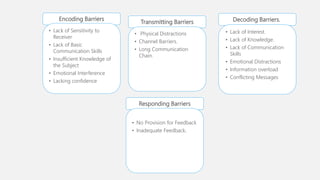
Encoding Barriers 
• Lack of Sensitivity to 
Receiver 
• Lack of Basic 
Communication Skills 
• Insufficient Knowledge of 
the Subject 
• Emotional Interference 
• Lacking confidence 
Transmitting Barriers 
• Physical Distractions 
• Channel Barriers. 
• Long Communication 
Chain. 
Decoding Barriers. 
• Lack of Interest. 
• Lack of Knowledge. 
• Lack of Communication 
Skills 
• Emotional Distractions 
• Information overload 
• Conflicting Messages 
Responding Barriers 
• No Provision for Feedback 
• Inadequate Feedback.
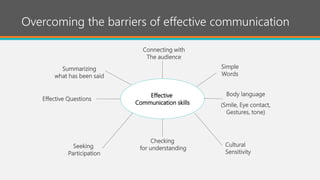
Overcoming the barriers of effective communication 
Effective 
Communication skills 
Body language 
(Smile, Eye contact, 
Gestures, tone) 
Cultural 
Sensitivity 
Checking 
for understanding 
Summarizing 
what has been said 
Effective Questions 
Seeking 
Participation 
Simple 
Words 
Connecting with 
The audience
Let’s Experience
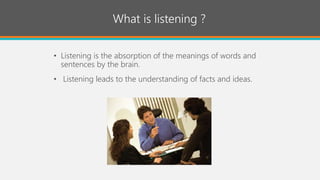
What is listening ? 
• Listening is the absorption of the meanings of words and 
sentences by the brain. 
• Listening leads to the understanding of facts and ideas.
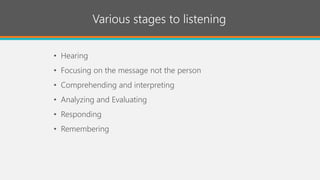
Various stages to listening 
• Hearing 
• Focusing on the message not the person 
• Comprehending and interpreting 
• Analyzing and Evaluating 
• Responding 
• Remembering
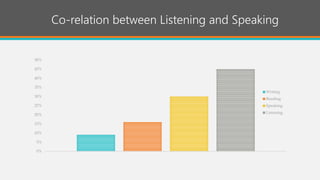
Co-relation between Listening and Speaking 
50% 
45% 
40% 
35% 
30% 
25% 
20% 
15% 
10% 
5% 
0% 
Writing 
Reading 
Speaking 
Listening
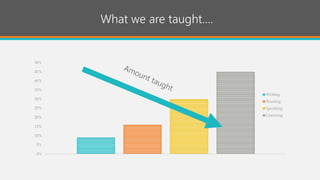
What we are taught…. 
50% 
45% 
40% 
35% 
30% 
25% 
20% 
15% 
10% 
5% 
0% 
Writing 
Reading 
Speaking 
Listening
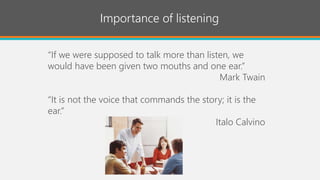
Importance of listening 
“If we were supposed to talk more than listen, we 
would have been given two mouths and one ear.” 
Mark Twain 
“It is not the voice that commands the story; it is the 
ear.” 
Italo Calvino
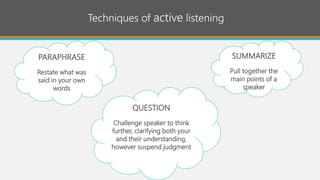
Techniques of active listening 
PARAPHRASE 
Restate what was 
said in your own 
words 
SUMMARIZE 
Pull together the 
main points of a 
speaker 
QUESTION 
Challenge speaker to think 
further, clarifying both your 
and their understanding, 
however suspend judgment
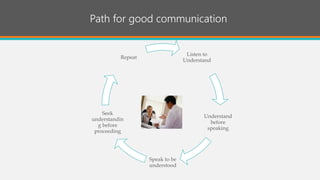
Path for good communication 
Listen to 
Understand 
Understand 
before 
speaking 
Speak to be 
understood 
Seek 
Repeat 
understandin 
g before 
proceeding
Conclusion 
• “ Words are singularly the most powerful force available to 
humanity. We can choose to use this force constructively 
with words of encouragement, or destructively using words 
of despair. Words have energy and power with the ability 
to help, to heal, to hinder, to hurt, to harm, to humiliate 
and to humble. “ Yehuda Berg 
• “ Communication - the human connection - is the key to 
personal and career success. “ Paul J. Meyer
Thank You 
• Cell Number: 0111 294 7785 
• Email: samir.aly@outlook.com 
• LinkedIn: www.linkedin.com/in/samiraly 
• Facebook: www.facebook.com/samir158 
• Twitter: @Samir_Aly