



COMMUNICATION SKILLS M. S. Xavier Pradheep Singh Assistant Professor Postgraduate Department of English V. O. Chidambaram College Thoothukudi - 628008
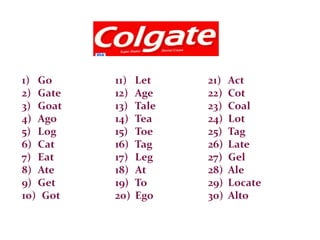
Make as many words as possible from
 
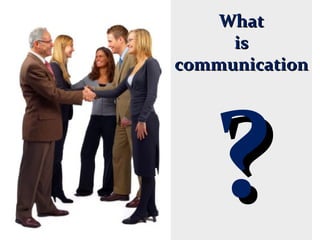
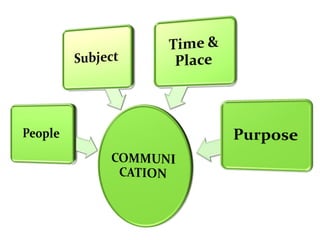
What is communication ?
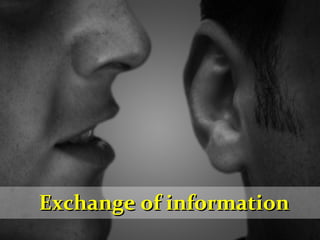
Exchange of information
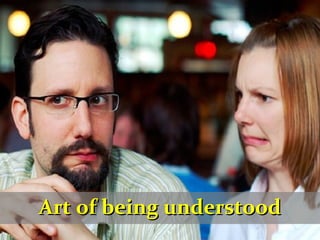
Art of being understood
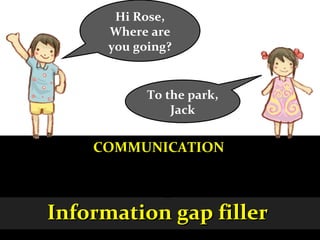
Information gap filler  COMMUNICATION Hi Rose, Where are you going? To the park, Jack Information Gap
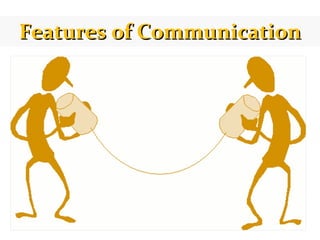
Features of Communication
 
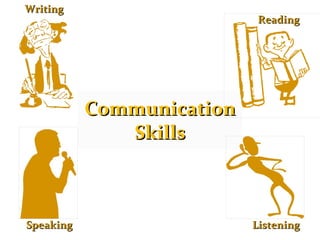
Communication Skills Listening Speaking Writing Reading
"We are given two ears but only one mouth, because listening is twice as hard as talking." Listening
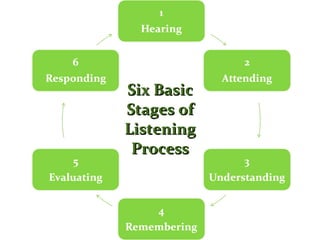
Six Basic Stages of Listening Process
These stages occur in sequence, generally with little awareness, often in a rapid succession
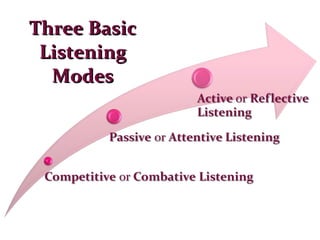
Three Basic Listening Modes
Competitive  /  Combative Listening  Happens when we are more interested in promoting our own point of view than in understanding someone else’s view We listen for finding weak points  to attack We pretend to pay attention We are impatiently waiting and planning our destructive reply that will destroy their argument and make us the victor
Passive / Attentive Listening We are genuinely interested in hearing and understanding the other person’s point of view We are attentive and passively listen We assume that we heard and understand correctly but stay passive and do not verify it
Active / Reflective Listening The most useful and important listening mode We are genuinely interested in understanding the other person’s message We are active in checking out our understanding before we respond with our own new message We restate our understanding of their message and reflect it back to the sender for verification This verification process distinguishes active listening and makes it effective
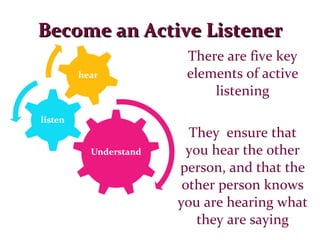
Become an Active Listener There are five key elements of active listening They  ensure that you hear the other person, and that the other person knows you are hearing what they are saying
Become an Active Listener Pay attention Give the speaker your undivided attention and acknowledge the message Look at the speaker directly Put aside distracting thoughts Avoid being distracted by environmental factors “ Listen” to the speaker’s body language Refrain from side conversations when listening in a group setting
Become an Active Listener Show that you are listening Use your own body language and gestures to convey your attention Nod occasionally Smile and use other facial expressions Note your posture and make sure it is open and inviting Encourage the speaker to continue with small verbal comments like ‘yes’
Become an Active Listener Provide feedback Our personal assumptions, judgments, and beliefs can distort what we hear. Understand what is being said. You may require to reflect what is being said and ask questions. Reflect what has been said by paraphrasing. “What I’m hearing is…” and “Sounds like you are saying…” are great ways to reflect back. Ask questions to clarify certain points. “What do you mean when you say…” “Is this what you mean?” Summarize the speaker’s comments periodically
Become an Active Listener Postpone judgment Interrupting is a waste of time. It frustrates the speaker and limits full understanding of the message Allow the speaker to finish Don’t interrupt with counter-arguments
Become an Active Listener Respond Appropriately Active listening is a model for respect and understanding. You are gaining information and perspective. Be candid, open, and honest in your response Assert your opinions respectfully Treat the other person as he or she would want to be treated
Answer these questions When was the earth born? Who hold the key to the origin of life? Where is Ethiopia? What is the meaning of Erta Ale?
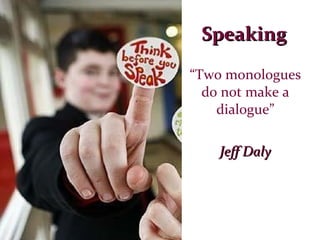
Speaking “ Two monologues do not make a dialogue” Jeff Daly
Speaking is the productive skill in the oral mode
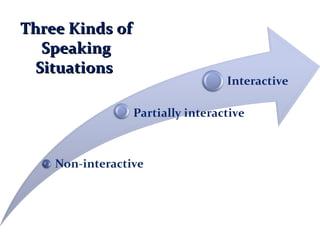
Three Kinds of Speaking Situations 
Key Elements Pronunciation Vocabulary Sentence structures Context


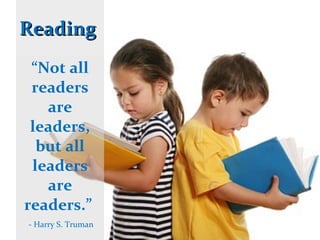
Reading “ Not all readers are leaders, but all leaders are readers.”    - Harry S. Truman
Reading Skill Reading is the receptive skill in the written mode. Reading can help build vocabulary that helps listening comprehension at the later stages, particularly.
Active Reading When you're reading for your course, you need to make sure you're actively involved with the text. It's a waste of your time to just passively read. Always make notes to keep up your concentration and understanding.
Tips for Active Reading Underlining and Highlighting Pick out the most important parts of what you are reading Use different colours to highlight different aspects of what you're reading
Tips for Active Reading Note key words Record the main headings as you read Use one or two keywords for each point When you don't want to mark the text, keep a folder of notes you make while reading
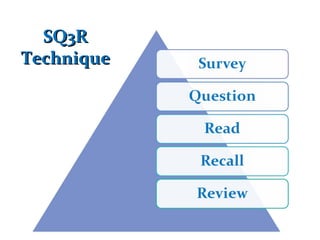
SQ3R Technique
SQ3R Survey Gather the information you need to focus on the work and set goals Read the title to help prepare for the subject Read the introduction or summary to see what the author thinks are the key points Notice the boldface headings to see what the structure is Notice any maps, graphs or charts. Notice the reading aids, italics, bold face, questions at the end of the chapter
SQ3R Question Help your mind to engage and concentrate Your mind is engaged in learning when it is actively looking for answers to questions Try turning the boldface headings into questions you think the section should answer
SQ3R Read Read the first section with your questions in mind Look for the answers, and make up new questions if necessary
SQ3R Recall After each section, stop and think back to your questions See if you can answer them from memory If not, take a look back at the text
SQ3R Review Once you have finished the whole chapter, go back over all the questions from all the headings See if you can still answer them If not, look back and refresh your memory
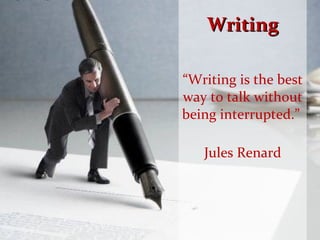
Writing “ Writing is the best way to talk without being interrupted.”  Jules Renard
Process Writing is a process of addition The more you add, the more it becomes sharp Words  in an appropriate order strengthen a sentence Inappropriate order collapses a sentence
Key Elements Vocabulary Sentence structures Punctuations
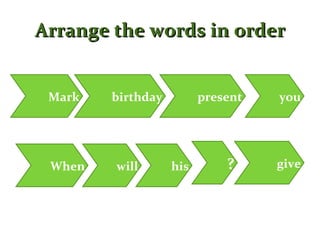
Arrange the words in order   Mark   birthday   present When will you his ? give
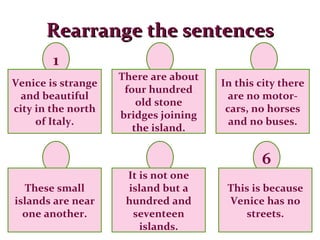
Rearrange the sentences 1 6 Venice is strange and beautiful city in the north of Italy. There are about four hundred old stone bridges joining the island. These small islands are near one another. It is not one island but a hundred and seventeen islands. This is because Venice has no streets. In this city there are no motor-cars, no horses and no buses.
Grammar “ Grammar is the logic of speech, even as logic is the grammar of reason.” Richard Chenevix Trench 
"My Heart Will Go On . . ." Titanic Every night in my dreams I see you, I feel you. That is how I know you. Go on. Far across the distance and spaces between us You have come to show you. Go on. Near, Far, wherever you are, I believe that the heart does go on. Once more you opened the door And you're here in my heart, and my heart will go on and on.   Love can touch us one time and last for lifetime And never let go till we're gone. Love was when I loved you, one true time I hope to In my life we'll always go on.
"My Heart Will Go On . . ." Titanic Every night in my dreams I  see  you, I  feel  you. That  is  how I  know  you.  Go  on. Far across the distance and spaces between us You have  come  to  show  you.  Go  on. Near, Far, wherever you  are , I  believe  that the heart  does go  on. Once more you  open ed the door And you 're  here in my heart, and my heart will  go  on and on.   Love can  touch  us one time and last for lifetime And never  let go  till we 're  gone. Love was when I  love d you, one true time I  hope  to In my life we'll always  go  on.
"My Heart Will Go On . . ." Titanic Every night in my dreams I  see  you, I  feel  you. That is how I  know  you. Go on. Far across the distance and spaces between us You have come to show you. Go on. Near, Far, wherever you are, I  believe  that the heart does go on. Once more you opened the door And you're here in my heart, and my heart will go on and on.   Love can  touch  us one time and last for lifetime And never let go till we're gone. Love was when I  love d you, one true time I  hope  to In my life we'll always go on.
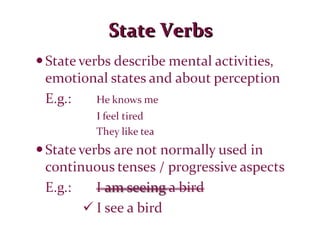
State Verbs
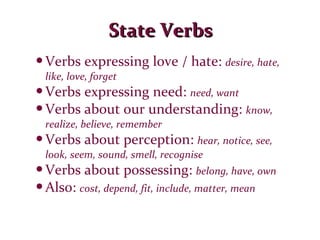
State Verbs Verbs expressing love / hate:  desire, hate, like, love, forget Verbs expressing need:  need, want Verbs about our understanding:  know, realize, believe, remember Verbs about perception:  hear, notice, see, look, seem, sound, smell, recognise Verbs about possessing:  belong, have, own Also:  cost, depend, fit, include, matter, mean
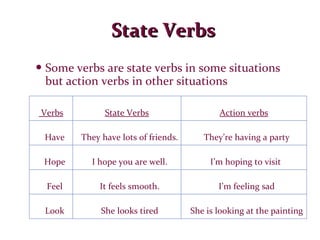
State Verbs Some verbs are state verbs in some situations but action verbs in other situations Verbs State Verbs Action verbs Have They have lots of friends. They’re having a party Hope I hope you are well. I’m hoping to visit  Feel It feels smooth. I’m feeling sad Look She looks tired She is looking at the painting
Any Queries? You can also contact me at  [email_address] Visit our Department’s website: http://sites.google.com/site/englishdepartmentvoccollege/
Thank you

Communication Skills

  • 1.
    COMMUNICATION SKILLS M.S. Xavier Pradheep Singh Assistant Professor Postgraduate Department of English V. O. Chidambaram College Thoothukudi - 628008
  • 2.
    Make as manywords as possible from
  • 3.
  • 4.
  • 5.
  • 6.
    Art of beingunderstood
  • 7.
    Information gap filler COMMUNICATION Hi Rose, Where are you going? To the park, Jack Information Gap
  • 8.
  • 9.
  • 10.
    Communication Skills ListeningSpeaking Writing Reading
  • 11.
    "We are giventwo ears but only one mouth, because listening is twice as hard as talking." Listening
  • 12.
    Six Basic Stagesof Listening Process
  • 13.
    These stages occurin sequence, generally with little awareness, often in a rapid succession
  • 14.
  • 15.
    Competitive  /  CombativeListening  Happens when we are more interested in promoting our own point of view than in understanding someone else’s view We listen for finding weak points to attack We pretend to pay attention We are impatiently waiting and planning our destructive reply that will destroy their argument and make us the victor
  • 16.
    Passive / Attentive Listening Weare genuinely interested in hearing and understanding the other person’s point of view We are attentive and passively listen We assume that we heard and understand correctly but stay passive and do not verify it
  • 17.
    Active / Reflective Listening Themost useful and important listening mode We are genuinely interested in understanding the other person’s message We are active in checking out our understanding before we respond with our own new message We restate our understanding of their message and reflect it back to the sender for verification This verification process distinguishes active listening and makes it effective
  • 18.
    Become an ActiveListener There are five key elements of active listening They ensure that you hear the other person, and that the other person knows you are hearing what they are saying
  • 19.
    Become an ActiveListener Pay attention Give the speaker your undivided attention and acknowledge the message Look at the speaker directly Put aside distracting thoughts Avoid being distracted by environmental factors “ Listen” to the speaker’s body language Refrain from side conversations when listening in a group setting
  • 20.
    Become an ActiveListener Show that you are listening Use your own body language and gestures to convey your attention Nod occasionally Smile and use other facial expressions Note your posture and make sure it is open and inviting Encourage the speaker to continue with small verbal comments like ‘yes’
  • 21.
    Become an ActiveListener Provide feedback Our personal assumptions, judgments, and beliefs can distort what we hear. Understand what is being said. You may require to reflect what is being said and ask questions. Reflect what has been said by paraphrasing. “What I’m hearing is…” and “Sounds like you are saying…” are great ways to reflect back. Ask questions to clarify certain points. “What do you mean when you say…” “Is this what you mean?” Summarize the speaker’s comments periodically
  • 22.
    Become an ActiveListener Postpone judgment Interrupting is a waste of time. It frustrates the speaker and limits full understanding of the message Allow the speaker to finish Don’t interrupt with counter-arguments
  • 23.
    Become an ActiveListener Respond Appropriately Active listening is a model for respect and understanding. You are gaining information and perspective. Be candid, open, and honest in your response Assert your opinions respectfully Treat the other person as he or she would want to be treated
  • 24.
    Answer these questionsWhen was the earth born? Who hold the key to the origin of life? Where is Ethiopia? What is the meaning of Erta Ale?
  • 25.
    Speaking “ Twomonologues do not make a dialogue” Jeff Daly
  • 26.
    Speaking is theproductive skill in the oral mode
  • 27.
    Three Kinds ofSpeaking Situations 
  • 28.
    Key Elements PronunciationVocabulary Sentence structures Context
  • 29.
  • 30.
  • 31.
  • 32.
  • 33.
  • 34.
    Reading “ Notall readers are leaders, but all leaders are readers.”    - Harry S. Truman
  • 35.
    Reading Skill Readingis the receptive skill in the written mode. Reading can help build vocabulary that helps listening comprehension at the later stages, particularly.
  • 36.
    Active Reading Whenyou're reading for your course, you need to make sure you're actively involved with the text. It's a waste of your time to just passively read. Always make notes to keep up your concentration and understanding.
  • 37.
    Tips for ActiveReading Underlining and Highlighting Pick out the most important parts of what you are reading Use different colours to highlight different aspects of what you're reading
  • 38.
    Tips for ActiveReading Note key words Record the main headings as you read Use one or two keywords for each point When you don't want to mark the text, keep a folder of notes you make while reading
  • 39.
  • 40.
    SQ3R Survey Gatherthe information you need to focus on the work and set goals Read the title to help prepare for the subject Read the introduction or summary to see what the author thinks are the key points Notice the boldface headings to see what the structure is Notice any maps, graphs or charts. Notice the reading aids, italics, bold face, questions at the end of the chapter
  • 41.
    SQ3R Question Helpyour mind to engage and concentrate Your mind is engaged in learning when it is actively looking for answers to questions Try turning the boldface headings into questions you think the section should answer
  • 42.
    SQ3R Read Readthe first section with your questions in mind Look for the answers, and make up new questions if necessary
  • 43.
    SQ3R Recall Aftereach section, stop and think back to your questions See if you can answer them from memory If not, take a look back at the text
  • 44.
    SQ3R Review Onceyou have finished the whole chapter, go back over all the questions from all the headings See if you can still answer them If not, look back and refresh your memory
  • 45.
    Writing “ Writingis the best way to talk without being interrupted.”  Jules Renard
  • 46.
    Process Writing isa process of addition The more you add, the more it becomes sharp Words in an appropriate order strengthen a sentence Inappropriate order collapses a sentence
  • 47.
    Key Elements VocabularySentence structures Punctuations
  • 48.
    Arrange the wordsin order   Mark   birthday   present When will you his ? give
  • 49.
    Rearrange the sentences1 6 Venice is strange and beautiful city in the north of Italy. There are about four hundred old stone bridges joining the island. These small islands are near one another. It is not one island but a hundred and seventeen islands. This is because Venice has no streets. In this city there are no motor-cars, no horses and no buses.
  • 50.
    Grammar “ Grammaris the logic of speech, even as logic is the grammar of reason.” Richard Chenevix Trench 
  • 51.
    "My Heart WillGo On . . ." Titanic Every night in my dreams I see you, I feel you. That is how I know you. Go on. Far across the distance and spaces between us You have come to show you. Go on. Near, Far, wherever you are, I believe that the heart does go on. Once more you opened the door And you're here in my heart, and my heart will go on and on. Love can touch us one time and last for lifetime And never let go till we're gone. Love was when I loved you, one true time I hope to In my life we'll always go on.
  • 52.
    "My Heart WillGo On . . ." Titanic Every night in my dreams I see you, I feel you. That is how I know you. Go on. Far across the distance and spaces between us You have come to show you. Go on. Near, Far, wherever you are , I believe that the heart does go on. Once more you open ed the door And you 're here in my heart, and my heart will go on and on. Love can touch us one time and last for lifetime And never let go till we 're gone. Love was when I love d you, one true time I hope to In my life we'll always go on.
  • 53.
    "My Heart WillGo On . . ." Titanic Every night in my dreams I see you, I feel you. That is how I know you. Go on. Far across the distance and spaces between us You have come to show you. Go on. Near, Far, wherever you are, I believe that the heart does go on. Once more you opened the door And you're here in my heart, and my heart will go on and on. Love can touch us one time and last for lifetime And never let go till we're gone. Love was when I love d you, one true time I hope to In my life we'll always go on.
  • 54.
  • 55.
    State Verbs Verbsexpressing love / hate: desire, hate, like, love, forget Verbs expressing need: need, want Verbs about our understanding: know, realize, believe, remember Verbs about perception: hear, notice, see, look, seem, sound, smell, recognise Verbs about possessing: belong, have, own Also: cost, depend, fit, include, matter, mean
  • 56.
    State Verbs Someverbs are state verbs in some situations but action verbs in other situations Verbs State Verbs Action verbs Have They have lots of friends. They’re having a party Hope I hope you are well. I’m hoping to visit Feel It feels smooth. I’m feeling sad Look She looks tired She is looking at the painting
  • 57.
    Any Queries? Youcan also contact me at [email_address] Visit our Department’s website: http://sites.google.com/site/englishdepartmentvoccollege/
  • 58.