‫الرحيم‬ ‫الرحمن‬ ‫هللا‬ ‫بسم‬
Course Director
Abdulkhaliq Ali Khalil
Pg in HRM & Project Planning
 Effective Communication
 The Communication Process
 Nonverbal Communication
 Representational Systems
Communication is a system of transmitting
messages using multiple components. It is
generally used to convey thoughts, feelings and/or
ideas.
It is the process of exchanging information by the
use of words, letters, symbols, or nonverbal
behavior.
Effective communication lead to:
◦ Good human relations
◦ Better cooperation and coordination between
management and workforce
◦ Improved productivity and efficiency
◦ Improved morale
◦ lower staff turnover and absenteeism
Effective
Communication
Improved
stakeholder
response
Stronger
decision
making
Steadier
work
flow
Clearer
promotional
materials
Enhanced
professional
image
Quicker
problem
solving
Stronger
business
relationships
Increased
productivity
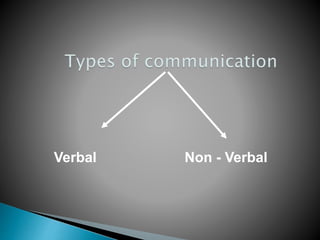
Non - VerbalVerbal
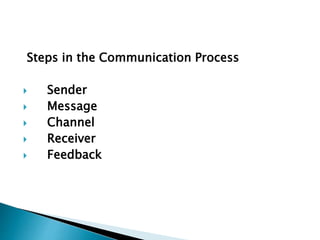
Steps in the Communication Process
 Sender
 Message
 Channel
 Receiver
 Feedback
It matters not so much what you say as it does how
you say it.
 Your communication style is a SET of
various behaviors and methods of relaying
information that impact all facets of life.
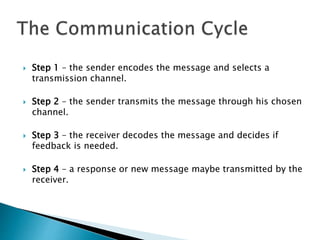
 Step 1 – the sender encodes the message and selects a
transmission channel.
 Step 2 – the sender transmits the message through his chosen
channel.
 Step 3 – the receiver decodes the message and decides if
feedback is needed.
 Step 4 – a response or new message maybe transmitted by the
receiver.
 Types of Communication
 One-Way Vs. Two-Way
 Verbal Vs. Non-Verbal
 Upward – Downward – Horizontal
 One-Way vs Two-Way Communication
◦ One-Way
 Seeing – reading
 Hearing – television, radio, etc.
◦ Two-Way
 Provides interaction and feedback
 Increases opportunity to understand
 Body Language:
 Parts of Body Language:
 Facial Expression: Eyes, Forehead, Mouth,
Nose, eyebrows..
 Hands and Limbs.
 Walk, stand, pose.
 Physical response.
 Content: Words and sentence construction used.
◦ We create words and construct sentences according to
what we (want to say).
 Context: The way you present words.
◦ Body Language
◦ Medium/Communication Environment
◦ Sentiments/Feelings
◦ Time/Place
◦ Presupposition/Prejudgment
◦ Noise (Physical/Mental)
 Things you cannot change.
 Things you can change with effort.
 Things you can easily change.
◦ Can you give examples of each?
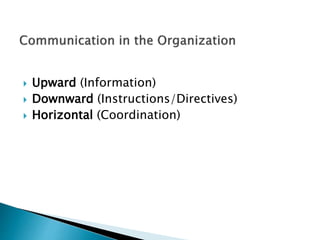
 Upward (Information)
 Downward (Instructions/Directives)
 Horizontal (Coordination)
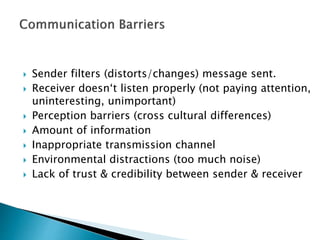
 Sender filters (distorts/changes) message sent.
 Receiver doesn‘t listen properly (not paying attention,
uninteresting, unimportant)
 Perception barriers (cross cultural differences)
 Amount of information
 Inappropriate transmission channel
 Environmental distractions (too much noise)
 Lack of trust & credibility between sender & receiver
18
 Seven Habits
 MRPT
 Dealing with Difficult People
Understanding Verbal Communication
Styles
 Allowing our own rights to be violated by failing to
express our honest feelings.
 The goal of being a passive communicator is to
avoid conflict no matter what.
 Little risk involved – very safe.
 Little eye contact, often defers to others’ opinions,
usually quiet tone, may suddenly explode after
being passive too long.
 “I don’t know.”
 “Whatever you think.”
 “You have more experience than I. You decide.”
 “I’ll go with whatever the group decides.”
 “I don’t care. It doesn’t matter to me.”
 “Yes, yes, yes, yes, yes, yes, yes. . . NO!”
 Protecting one’s own rights at the expense of others’
rights – no exceptions.
 The goal of the aggressor is to win at all costs; to be
right.
 Does not consider actions a risk because this person
thinks they will always get their way. It is risky in terms
of relationships
 Eye contact is angry and intimidating; lots of energy;
loud and belittling; never defers to others, or at least
does not admit to; manipulative and controlling. Often
uses violence or verbal abuse.
 “I don’t know why you can’t see that this is the
right way to do it.”
 “It’s going to be my way or not at all.”
 “You’re just stupid if you think that will work.”
 “ “Who cares what you feel. We’re talking about
making things work here.”
 Protecting your own rights without violating the
rights of others.
 The goal of the assertive person is to communicate
with respect and to understand each other; to find
a solution to the problem.
 Takes a risk with others in the short run, but in the
long run relationships are much stronger.
 Eye contact maintained; listens and validates
others; confident and strong, yet also flexible;
objective and unemotional; presents wishes clearly
and respectfully.
 “So what you’re saying is. . . .”
 “I can see that this is important to you,
and it is also important to me. Perhaps
we can talk more respectfully and try to
solve the problem.”
 “I think. . . I feel. . . I believe that. . . .”
 “I would appreciate it if you. . .”
 Let me understand your thoughts on
this…
 All styles have their proper place and use.
 Assertive communication is the healthiest.
◦ Boundaries of all parties are respected.
◦ Easier to problem-solve; fewer emotional outbursts.
◦ It requires skills and a philosophy change, as well
as lots of practice and hard work.
◦ When both parties do it, no one is hurt in any way
and all parties win on some level.
NON-VERBAL
COMMUNICATION
Nonverbal Communication in
Organizations
The study of non-verbal communication
examines how messages are communicated
through physical behavior, vocal cues and
spatial relationships.
NON-VERBAL
COMMUNICATION
The total impact of a message breaks down
like this:
• 7 percent verbal (words)
• 38 percent vocal (volume, pitch, rhythm, etc)
• 55 percent body movements
(mostly facial expressions)
Hello!!
 􀁺 Environment
 􀁺 Body placement
 􀁺 Posture
 􀁺 Gestures
 􀁺 Facial expressions and movement
 􀁺 Clothing, dress, appearance
• Effective communication is the
combined harmony of verbal and
nonverbal actions.
• Nonverbal communication consists of
body movement, facial expressions and
eye movement.
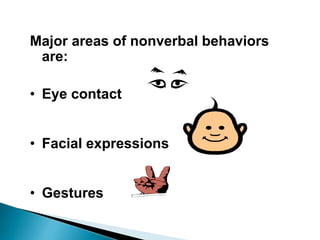
Major areas of nonverbal behaviors
are:
• Eye contact
• Facial expressions
• Gestures
• Posture and body orientation
• Proximity
• Para linguistics
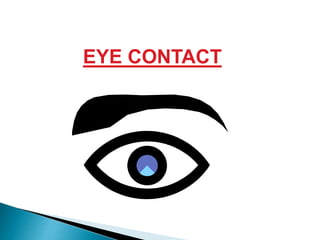
EYE CONTACT
EYE CONTACT
• The eyes can give clues to a person’s
thoughts.
• When someone is excited, his pupils
dilate to four times the normal size.
• An angry or negative mood causes the
pupils to contract.
EYE CONTACT
• Good eye contact helps the audience
develop the interest in the speaker.
• Eye-contact helps regulate the flow of
communication and reflects interest in
others.
EYE CONTACT
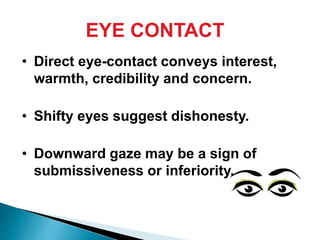
• Direct eye-contact conveys interest,
warmth, credibility and concern.
• Shifty eyes suggest dishonesty.
• Downward gaze may be a sign of
submissiveness or inferiority.
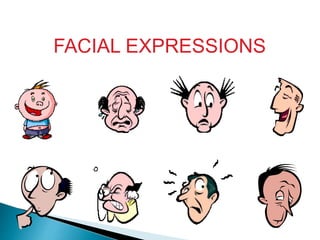
FACIAL EXPRESSIONS
FACIAL EXPRESSIONS
• You have 80 muscles in the face that
can create more than 7,000 facial
expressions.
•The facial muscles produce the varying
facial expressions that convey information
about emotion, mood, and ideas.
•Emotional expressions are one primary
result of activity by the facial muscles.
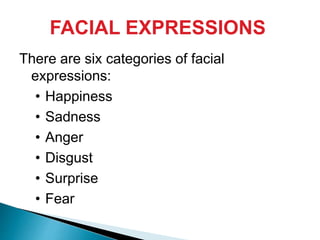
FACIAL EXPRESSIONS
There are six categories of facial
expressions:
• Happiness
• Sadness
• Anger
• Disgust
• Surprise
• Fear
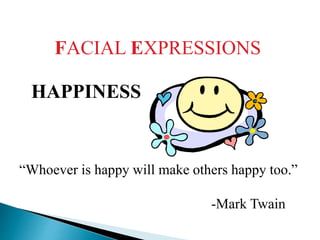
FACIAL EXPRESSIONS
HAPPINESS
“Whoever is happy will make others happy too.”
-Mark Twain
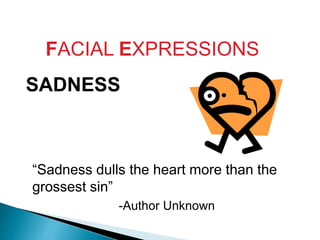
FACIAL EXPRESSIONS
SADNESS
“Sadness dulls the heart more than the
grossest sin”
-Author Unknown
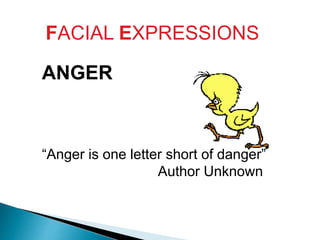
FACIAL EXPRESSIONS
ANGER
“Anger is one letter short of danger”
Author Unknown
FACIAL EXPRESSIONS
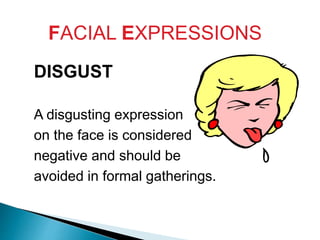
DISGUST
A disgusting expression
on the face is considered
negative and should be
avoided in formal gatherings.
FACIAL EXPRESSIONS
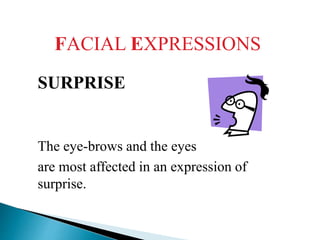
SURPRISE
The eye-brows and the eyes
are most affected in an expression of
surprise.
FACIAL EXPRESSIONS
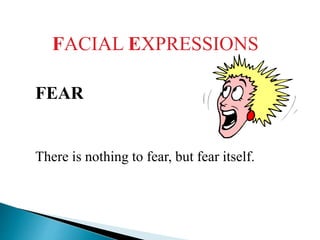
FEAR
There is nothing to fear, but fear itself.
GESTURES
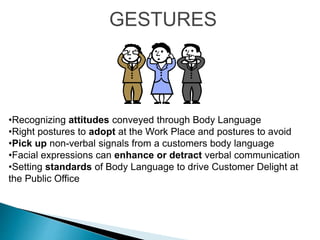
•Recognizing attitudes conveyed through Body Language
•Right postures to adopt at the Work Place and postures to avoid
•Pick up non-verbal signals from a customers body language
•Facial expressions can enhance or detract verbal communication
•Setting standards of Body Language to drive Customer Delight at
the Public Office
GESTURES
• Gestures communicate as effectively as
words, sometimes even better.
• Gestures support the verbal
communication.
• They sometimes detract from what you
say.
GESTURES
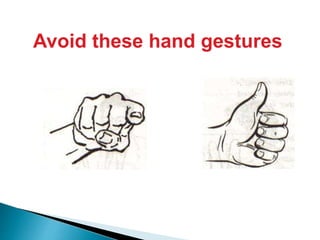
There are some negative gestures which
should be avoided:
• Pointing at people- It is perceived as
accusatory.
• Fiddling with your items-It gives the
impression that you are nervous.
• Dragging the feet-It implies lethargy.
• Head Down- It suggests timidity.
GESTURES
• Drooping shoulders- It implies
weariness and lethargy.
• Weak handshake-It implies meek and
ineffectual personality.
• Shifty eyes- It suggests nervousness.
• Arms crossed on the chest- It is a
defensive gesture.
GESTURES
• Hands in pockets- Shows disrespect,
and that you have something to hide.
• Covering your mouth- It suggests you
are lying.
• Shaking feet or legs- It shows
indifference and disinterest.
Avoid these hand gestures
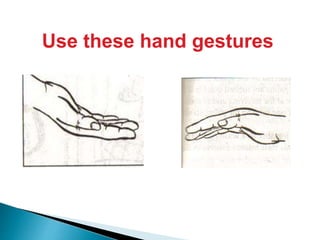
Use these hand gestures
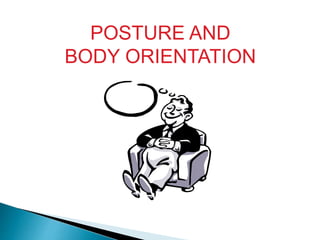
POSTURE AND
BODY ORIENTATION
POSTURE
• Body posture can be open or closed.
• Interested people pay attention and
lean forward.
• Leaning backwards demonstrates
aloofness or rejection.
POSTURE
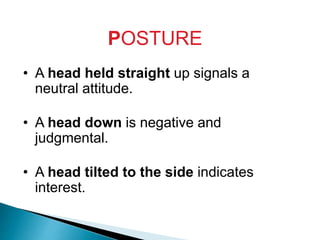
• A head held straight up signals a
neutral attitude.
• A head down is negative and
judgmental.
• A head tilted to the side indicates
interest.
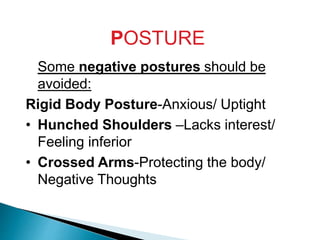
POSTURE
Some negative postures should be
avoided:
Rigid Body Posture-Anxious/ Uptight
• Hunched Shoulders –Lacks interest/
Feeling inferior
• Crossed Arms-Protecting the body/
Negative Thoughts
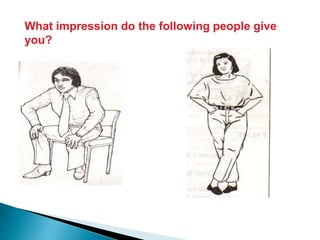
What impression do the following people give
you?
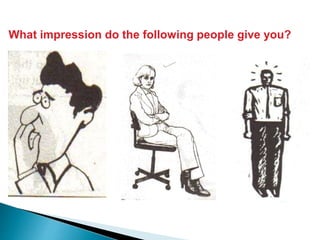
What impression do the following people give you?
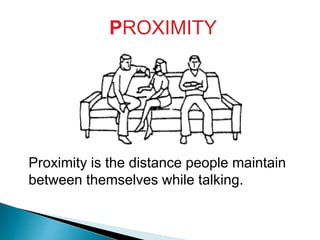
PROXIMITY
Proximity is the distance people maintain
between themselves while talking.
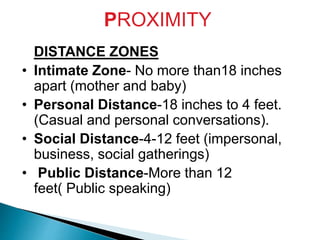
PROXIMITY
DISTANCE ZONES
• Intimate Zone- No more than18 inches
apart (mother and baby)
• Personal Distance-18 inches to 4 feet.
(Casual and personal conversations).
• Social Distance-4-12 feet (impersonal,
business, social gatherings)
• Public Distance-More than 12
feet( Public speaking)
PROXIMITY
• Space/Distance as an indicator of
intimacy-The more we get to know
each other the more we are permitted
into each other's personal space
• Space/Distance as an indicator of
status- Executives, presidents of
colleges, government officials have
large offices with big space...
secretaries have small space
PARALINGUISTICS
• Para linguistics are what accompany
your words to make up for its true
meaning.
• Paralanguage refers to the vocal aspect
of communication.
PARALINGUISTICS
Components of Para linguistics are:
• Rate of speed- When a speaker speaks too
fast, he is seen as more competent.
• Pitch-Pitch should be changed in
accordance with the context of spoken
words.
PARALINGUISTICS
• Volume- It refers to loudly we speak.
Loud people are perceived as
aggressive or over-bearing. Soft-spoken
voices are perceived as timid or polite.
• Fillers- Words like “umhh” “ah””aaa”
are used to gather thoughts.
Remember
Its Fun to be Good !
Let ‘Em Hear you are
Listening
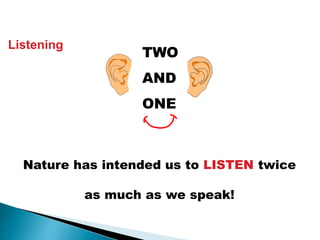
TWO
AND
ONE
Nature has intended us to LISTEN twice
as much as we speak!
Listening
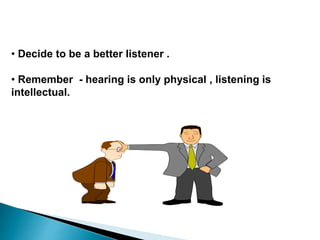
• Decide to be a better listener .
• Remember - hearing is only physical , listening is
intellectual.
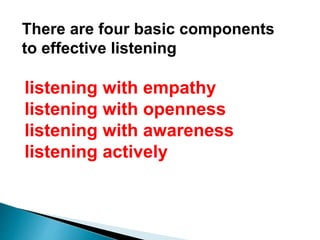
There are four basic components
to effective listening
listening with empathy
listening with openness
listening with awareness
listening actively
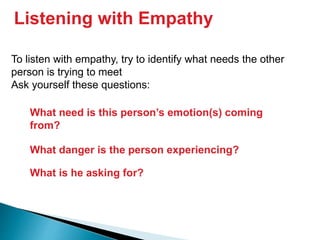
Listening with Empathy
Sometimes we do not listen to others because
we are not interested in what the other person is saying
we do not understand what the other person is saying
we do not agree with the other person
To listen with empathy, try to identify what needs the other
person is trying to meet
Ask yourself these questions:
What is he asking for?
What need is this person’s emotion(s) coming
from?
What danger is the person experiencing?
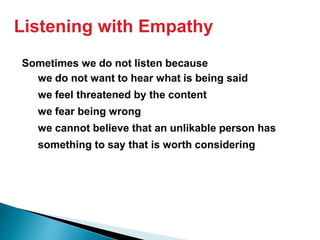
Listening with Empathy
Sometimes we do not listen because
we do not want to hear what is being said
we feel threatened by the content
we fear being wrong
we cannot believe that an unlikable person has
something to say that is worth considering
Listening with Empathy
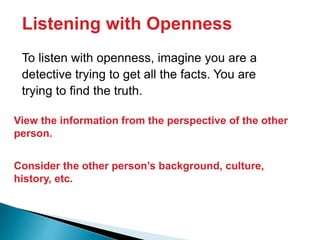
Listening with Openness
To listen with openness, imagine you are a
detective trying to get all the facts. You are
trying to find the truth.
View the information from the perspective of the other
person.
Consider the other person’s background, culture,
history, etc.
There are two components to listening with awareness:
being aware of conflicts between what is being said
and your own knowledge base
being aware of conflicts between the content of the
message and the body language of the speaker
(tone, voice inflections, stance, etc.)
Recognizing that conflicts can be a tool for making the
verbalized message more accurate.
Listening with Awareness
Active Listening
Active listening means to be verbally involved with the
communication.
Active listening helps us to keep our minds focused on
the communication.
The three elements of active listening are
paraphrasing
clarifying
feedback
 Informative Listening
 Relationship Listening
 Appreciative Listening
 Critical Listening
 Discriminative Listening
 Hearing what you want to hear called selective listening
 Thinking of what you are going to say next
 Distractions such as co-workers, noise, side conversations
etc.
 Thinking about the previous customer call
 Worrying about the next customer call or work in general
 Stress
 Getting involved emotionally (instead of logically)
 Holding preconceived ideas about the caller’s inquiry
 Thinking about personal issues
 Boredom
 Making assumptions rather than asking questions
Remember
Its Fun to be Good !
 Many definitions, but several common
themes
◦ Parties must perceive conflict
◦ Opposition or incompatibility
◦ Some form of interaction
 Our definition: A process that begins when
one party perceives that another party has
negatively affected, or is about to negatively
affect, something that the first party cares
about. The process usually involves one
party or group working for its own interests
and in opposition to the interests of the
other group or individual.
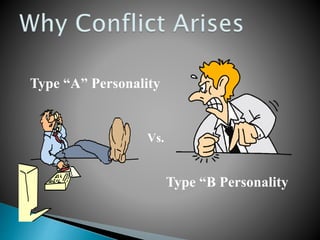
Type “A” Personality
Vs.
Type “B Personality
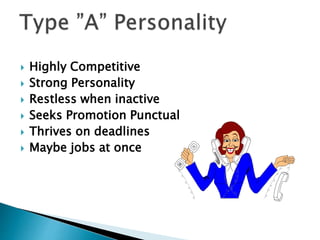
 Highly Competitive
 Strong Personality
 Restless when inactive
 Seeks Promotion Punctual
 Thrives on deadlines
 Maybe jobs at once
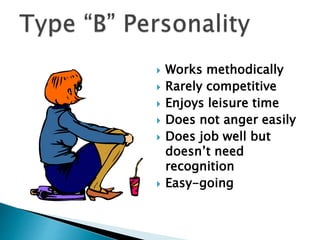
 Works methodically
 Rarely competitive
 Enjoys leisure time
 Does not anger easily
 Does job well but
doesn’t need
recognition
 Easy-going
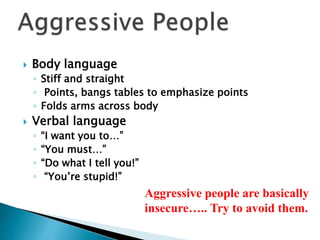
 Body language
◦ Stiff and straight
◦ Points, bangs tables to emphasize points
◦ Folds arms across body
 Verbal language
◦ “I want you to…”
◦ “You must…”
◦ “Do what I tell you!”
◦ “You’re stupid!”
Aggressive people are basically
insecure….. Try to avoid them.
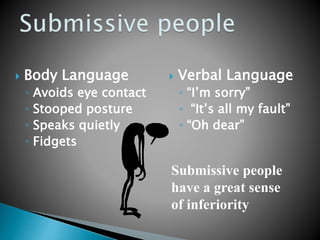
 Body Language
◦ Avoids eye contact
◦ Stooped posture
◦ Speaks quietly
◦ Fidgets
 Verbal Language
◦ “I’m sorry”
◦ “It’s all my fault”
◦ “Oh dear”
Submissive people
have a great sense
of inferiority
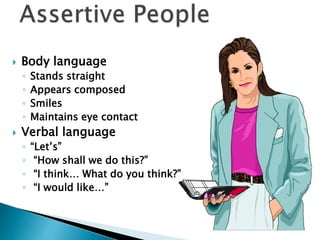
 Body language
◦ Stands straight
◦ Appears composed
◦ Smiles
◦ Maintains eye contact
 Verbal language
◦ “Let’s”
◦ “How shall we do this?”
◦ “I think… What do you think?”
◦ “I would like…”
 Within an individual
 Between two individuals
 Within a team of individuals
 Between two or more teams within an
organization
 Conflict of aims- different goals
 Conflict of ideas- different interpretations
 Conflict of attitudes - different opinions
 Conflict of behavior- different behaviors are
unacceptable
 Conflict arises
 Positions are stated and hardened
 Actions, putting into action their chosen plan
 Resolution???
 Assess positive and negative personality
traits of people involved
 Determine personality type
◦ Aggressive
◦ Submissive
◦ Assertive
 Assess if people are introvert or extroverts...
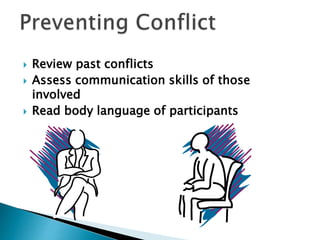
 Review past conflicts
 Assess communication skills of those
involved
 Read body language of participants
 Try to reduce conflict
◦ Realize that communication is colored by personal
experience, beliefs, fear, prejudices
◦ Try to be neutral
◦ Plan the timing and place of the conversation
◦ Realize that outside stress may add to
confrontation
◦ Eliminate/reduce external interruptions
 Manage the language used
◦ Neutral vs. loaded words
◦ Reduce technical language
◦ Allow for cultural differences in language
◦ Words may have different meanings for different
people…ask them to elaborate
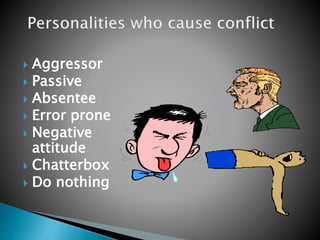
 Aggressor
 Passive
 Absentee
 Error prone
 Negative
attitude
 Chatterbox
 Do nothing
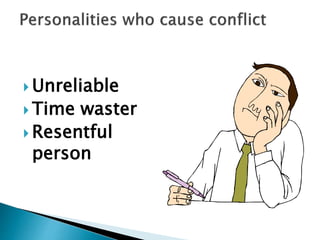
 Unreliable
 Time waster
 Resentful
person
Assertiveness of
Response
Low
High
Similarity of Goals
Low High
Compete
Avoid
Compromise
Accommodate
Collaborate
Objectives
At the completion of this module, participants will be
able to:
 Identify ways to establish and to commit to
individual purpose.
 Recognize problem behaviors or non-productive
behaviors and actions of difficult people.
 Examine coping strategies for working with non-
productive behaviors.
Definitions
Attitude- the overall way you relate to the outside
world or present yourself to others.
Paradigm or mental model- the way you think and
consequently act about something.
Personal Check-In: Reflections from the Past
 Briefly describe the situation.
 What action by another did you view as difficult
or non-productive?
 What did you do?
 What could you have done which might have
produced better results?
Icebreaker: Types of Non-Productive Behavior
1.
2.
3.
4.
5.
6.
7.
8.
Your Attitude: It’s Up to You!
 Emphasize the positive.
 Look for the silver linings.
 Accept reality and move ahead!
 Seek the lesson, learning, or legacy.
 Recognize the long view.
 Focus on possibilities, not problems.
 Maintain a willingness to change.
 Remember, you always have a choice of ways to
respond.
Your Attitude: It’s Up to You!
 Offer an enthusiastic greeting.
 Be more positive with those you see every day.
 Smile when you talk on the telephone (a smile can
be heard!).
 Laugh so others will laugh, too.
 Share uplifting personal stories.
 Set a positive example.
Clarify Your Purpose and Your Goals
Take a few minutes to think about your whole life,
the personal and professional life you enjoy.
1. Write down what is most important to you.
2. What do you want to be or do in your life?
3. What roles are most significant for you?
4. What is one goal you have for each role you listed
in question 3?
Non-Productive What you need to do
Behavior (Management Goal)
-----------------------------------------------------
Arguing Help to consider other ideas.
Withdrawing Persuade to contribute/be involved.
Aggression Persuade to contribute/be involved.
Complaining Shift to problem solving.
Zapping Focus on the possibilities
Attention-Seeking Shift focus to task at hand.
Arrogance Open mind to group task or to new
information.
Reality Practice: Responses to Non-Productive Behaviors
Action Non-Productive
Behavior
Your Best Response
Example:
Employee responds
to you with anger
and hostility about
how you
reorganized the
work schedule after
a new lunch period
was added to the
schedule.
Aggression and
Arrogance
Refocus on group task and
purpose. State, “Our job is
to feed students. I want
every student to have the
opportunity to purchase a
meal. The new schedule is
one way we can serve all the
students.”
Example:
Checking Out: Analysis and Action
 Write the initials of a person whose behaviors you
currently view as difficult.
 What action or behavior seems “difficult” to you?
 What attitude or action of yours is contributing negatively
to the situation?
 What could you change about you?
 What strategies could you use to make the situation more
agreeable to you and the other person?
 Check out your analysis with another participant. Share
with the intent to identify the best options available to
you.
Thank You

Effective communication

  • 1.
    ‫الرحيم‬ ‫الرحمن‬ ‫هللا‬‫بسم‬ Course Director Abdulkhaliq Ali Khalil Pg in HRM & Project Planning
  • 2.
     Effective Communication The Communication Process  Nonverbal Communication  Representational Systems
  • 3.
    Communication is asystem of transmitting messages using multiple components. It is generally used to convey thoughts, feelings and/or ideas. It is the process of exchanging information by the use of words, letters, symbols, or nonverbal behavior.
  • 4.
    Effective communication leadto: ◦ Good human relations ◦ Better cooperation and coordination between management and workforce ◦ Improved productivity and efficiency ◦ Improved morale ◦ lower staff turnover and absenteeism
  • 5.
  • 6.
  • 7.
    Steps in theCommunication Process  Sender  Message  Channel  Receiver  Feedback
  • 8.
    It matters notso much what you say as it does how you say it.  Your communication style is a SET of various behaviors and methods of relaying information that impact all facets of life.
  • 9.
     Step 1– the sender encodes the message and selects a transmission channel.  Step 2 – the sender transmits the message through his chosen channel.  Step 3 – the receiver decodes the message and decides if feedback is needed.  Step 4 – a response or new message maybe transmitted by the receiver.
  • 10.
     Types ofCommunication  One-Way Vs. Two-Way  Verbal Vs. Non-Verbal  Upward – Downward – Horizontal  One-Way vs Two-Way Communication ◦ One-Way  Seeing – reading  Hearing – television, radio, etc. ◦ Two-Way  Provides interaction and feedback  Increases opportunity to understand
  • 11.
     Body Language: Parts of Body Language:  Facial Expression: Eyes, Forehead, Mouth, Nose, eyebrows..  Hands and Limbs.  Walk, stand, pose.  Physical response.
  • 12.
     Content: Wordsand sentence construction used. ◦ We create words and construct sentences according to what we (want to say).  Context: The way you present words. ◦ Body Language ◦ Medium/Communication Environment ◦ Sentiments/Feelings ◦ Time/Place ◦ Presupposition/Prejudgment ◦ Noise (Physical/Mental)
  • 13.
     Things youcannot change.  Things you can change with effort.  Things you can easily change. ◦ Can you give examples of each?
  • 14.
     Upward (Information) Downward (Instructions/Directives)  Horizontal (Coordination)
  • 16.
     Sender filters(distorts/changes) message sent.  Receiver doesn‘t listen properly (not paying attention, uninteresting, unimportant)  Perception barriers (cross cultural differences)  Amount of information  Inappropriate transmission channel  Environmental distractions (too much noise)  Lack of trust & credibility between sender & receiver
  • 18.
  • 19.
     Seven Habits MRPT  Dealing with Difficult People
  • 20.
  • 21.
     Allowing ourown rights to be violated by failing to express our honest feelings.  The goal of being a passive communicator is to avoid conflict no matter what.  Little risk involved – very safe.  Little eye contact, often defers to others’ opinions, usually quiet tone, may suddenly explode after being passive too long.
  • 22.
     “I don’tknow.”  “Whatever you think.”  “You have more experience than I. You decide.”  “I’ll go with whatever the group decides.”  “I don’t care. It doesn’t matter to me.”  “Yes, yes, yes, yes, yes, yes, yes. . . NO!”
  • 23.
     Protecting one’sown rights at the expense of others’ rights – no exceptions.  The goal of the aggressor is to win at all costs; to be right.  Does not consider actions a risk because this person thinks they will always get their way. It is risky in terms of relationships  Eye contact is angry and intimidating; lots of energy; loud and belittling; never defers to others, or at least does not admit to; manipulative and controlling. Often uses violence or verbal abuse.
  • 24.
     “I don’tknow why you can’t see that this is the right way to do it.”  “It’s going to be my way or not at all.”  “You’re just stupid if you think that will work.”  “ “Who cares what you feel. We’re talking about making things work here.”
  • 25.
     Protecting yourown rights without violating the rights of others.  The goal of the assertive person is to communicate with respect and to understand each other; to find a solution to the problem.  Takes a risk with others in the short run, but in the long run relationships are much stronger.  Eye contact maintained; listens and validates others; confident and strong, yet also flexible; objective and unemotional; presents wishes clearly and respectfully.
  • 26.
     “So whatyou’re saying is. . . .”  “I can see that this is important to you, and it is also important to me. Perhaps we can talk more respectfully and try to solve the problem.”  “I think. . . I feel. . . I believe that. . . .”  “I would appreciate it if you. . .”  Let me understand your thoughts on this…
  • 27.
     All styleshave their proper place and use.  Assertive communication is the healthiest. ◦ Boundaries of all parties are respected. ◦ Easier to problem-solve; fewer emotional outbursts. ◦ It requires skills and a philosophy change, as well as lots of practice and hard work. ◦ When both parties do it, no one is hurt in any way and all parties win on some level.
  • 28.
  • 29.
    The study ofnon-verbal communication examines how messages are communicated through physical behavior, vocal cues and spatial relationships. NON-VERBAL COMMUNICATION
  • 30.
    The total impactof a message breaks down like this: • 7 percent verbal (words) • 38 percent vocal (volume, pitch, rhythm, etc) • 55 percent body movements (mostly facial expressions) Hello!!
  • 31.
     􀁺 Environment 􀁺 Body placement  􀁺 Posture  􀁺 Gestures  􀁺 Facial expressions and movement  􀁺 Clothing, dress, appearance
  • 32.
    • Effective communicationis the combined harmony of verbal and nonverbal actions. • Nonverbal communication consists of body movement, facial expressions and eye movement.
  • 33.
    Major areas ofnonverbal behaviors are: • Eye contact • Facial expressions • Gestures
  • 34.
    • Posture andbody orientation • Proximity • Para linguistics
  • 35.
  • 36.
    EYE CONTACT • Theeyes can give clues to a person’s thoughts. • When someone is excited, his pupils dilate to four times the normal size. • An angry or negative mood causes the pupils to contract.
  • 37.
    EYE CONTACT • Goodeye contact helps the audience develop the interest in the speaker. • Eye-contact helps regulate the flow of communication and reflects interest in others.
  • 38.
    EYE CONTACT • Directeye-contact conveys interest, warmth, credibility and concern. • Shifty eyes suggest dishonesty. • Downward gaze may be a sign of submissiveness or inferiority.
  • 39.
  • 40.
    FACIAL EXPRESSIONS • Youhave 80 muscles in the face that can create more than 7,000 facial expressions. •The facial muscles produce the varying facial expressions that convey information about emotion, mood, and ideas. •Emotional expressions are one primary result of activity by the facial muscles.
  • 41.
    FACIAL EXPRESSIONS There aresix categories of facial expressions: • Happiness • Sadness • Anger • Disgust • Surprise • Fear
  • 42.
    FACIAL EXPRESSIONS HAPPINESS “Whoever ishappy will make others happy too.” -Mark Twain
  • 43.
    FACIAL EXPRESSIONS SADNESS “Sadness dullsthe heart more than the grossest sin” -Author Unknown
  • 44.
    FACIAL EXPRESSIONS ANGER “Anger isone letter short of danger” Author Unknown
  • 45.
    FACIAL EXPRESSIONS DISGUST A disgustingexpression on the face is considered negative and should be avoided in formal gatherings.
  • 46.
    FACIAL EXPRESSIONS SURPRISE The eye-browsand the eyes are most affected in an expression of surprise.
  • 47.
    FACIAL EXPRESSIONS FEAR There isnothing to fear, but fear itself.
  • 48.
    GESTURES •Recognizing attitudes conveyedthrough Body Language •Right postures to adopt at the Work Place and postures to avoid •Pick up non-verbal signals from a customers body language •Facial expressions can enhance or detract verbal communication •Setting standards of Body Language to drive Customer Delight at the Public Office
  • 49.
    GESTURES • Gestures communicateas effectively as words, sometimes even better. • Gestures support the verbal communication. • They sometimes detract from what you say.
  • 50.
    GESTURES There are somenegative gestures which should be avoided: • Pointing at people- It is perceived as accusatory. • Fiddling with your items-It gives the impression that you are nervous. • Dragging the feet-It implies lethargy. • Head Down- It suggests timidity.
  • 51.
    GESTURES • Drooping shoulders-It implies weariness and lethargy. • Weak handshake-It implies meek and ineffectual personality. • Shifty eyes- It suggests nervousness. • Arms crossed on the chest- It is a defensive gesture.
  • 52.
    GESTURES • Hands inpockets- Shows disrespect, and that you have something to hide. • Covering your mouth- It suggests you are lying. • Shaking feet or legs- It shows indifference and disinterest.
  • 53.
  • 54.
  • 55.
  • 56.
    POSTURE • Body posturecan be open or closed. • Interested people pay attention and lean forward. • Leaning backwards demonstrates aloofness or rejection.
  • 57.
    POSTURE • A headheld straight up signals a neutral attitude. • A head down is negative and judgmental. • A head tilted to the side indicates interest.
  • 58.
    POSTURE Some negative posturesshould be avoided: Rigid Body Posture-Anxious/ Uptight • Hunched Shoulders –Lacks interest/ Feeling inferior • Crossed Arms-Protecting the body/ Negative Thoughts
  • 59.
    What impression dothe following people give you?
  • 60.
    What impression dothe following people give you?
  • 61.
    PROXIMITY Proximity is thedistance people maintain between themselves while talking.
  • 62.
    PROXIMITY DISTANCE ZONES • IntimateZone- No more than18 inches apart (mother and baby) • Personal Distance-18 inches to 4 feet. (Casual and personal conversations). • Social Distance-4-12 feet (impersonal, business, social gatherings) • Public Distance-More than 12 feet( Public speaking)
  • 63.
    PROXIMITY • Space/Distance asan indicator of intimacy-The more we get to know each other the more we are permitted into each other's personal space • Space/Distance as an indicator of status- Executives, presidents of colleges, government officials have large offices with big space... secretaries have small space
  • 64.
    PARALINGUISTICS • Para linguisticsare what accompany your words to make up for its true meaning. • Paralanguage refers to the vocal aspect of communication.
  • 65.
    PARALINGUISTICS Components of Paralinguistics are: • Rate of speed- When a speaker speaks too fast, he is seen as more competent. • Pitch-Pitch should be changed in accordance with the context of spoken words.
  • 66.
    PARALINGUISTICS • Volume- Itrefers to loudly we speak. Loud people are perceived as aggressive or over-bearing. Soft-spoken voices are perceived as timid or polite. • Fillers- Words like “umhh” “ah””aaa” are used to gather thoughts.
  • 67.
  • 68.
    Let ‘Em Hearyou are Listening
  • 69.
    TWO AND ONE Nature has intendedus to LISTEN twice as much as we speak! Listening
  • 70.
    • Decide tobe a better listener . • Remember - hearing is only physical , listening is intellectual.
  • 71.
    There are fourbasic components to effective listening listening with empathy listening with openness listening with awareness listening actively
  • 72.
    Listening with Empathy Sometimeswe do not listen to others because we are not interested in what the other person is saying we do not understand what the other person is saying we do not agree with the other person
  • 73.
    To listen withempathy, try to identify what needs the other person is trying to meet Ask yourself these questions: What is he asking for? What need is this person’s emotion(s) coming from? What danger is the person experiencing? Listening with Empathy
  • 74.
    Sometimes we donot listen because we do not want to hear what is being said we feel threatened by the content we fear being wrong we cannot believe that an unlikable person has something to say that is worth considering Listening with Empathy
  • 75.
    Listening with Openness Tolisten with openness, imagine you are a detective trying to get all the facts. You are trying to find the truth. View the information from the perspective of the other person. Consider the other person’s background, culture, history, etc.
  • 76.
    There are twocomponents to listening with awareness: being aware of conflicts between what is being said and your own knowledge base being aware of conflicts between the content of the message and the body language of the speaker (tone, voice inflections, stance, etc.) Recognizing that conflicts can be a tool for making the verbalized message more accurate. Listening with Awareness
  • 77.
    Active Listening Active listeningmeans to be verbally involved with the communication. Active listening helps us to keep our minds focused on the communication. The three elements of active listening are paraphrasing clarifying feedback
  • 78.
     Informative Listening Relationship Listening  Appreciative Listening  Critical Listening  Discriminative Listening
  • 79.
     Hearing whatyou want to hear called selective listening  Thinking of what you are going to say next  Distractions such as co-workers, noise, side conversations etc.  Thinking about the previous customer call  Worrying about the next customer call or work in general  Stress  Getting involved emotionally (instead of logically)  Holding preconceived ideas about the caller’s inquiry  Thinking about personal issues  Boredom  Making assumptions rather than asking questions
  • 80.
  • 84.
     Many definitions,but several common themes ◦ Parties must perceive conflict ◦ Opposition or incompatibility ◦ Some form of interaction  Our definition: A process that begins when one party perceives that another party has negatively affected, or is about to negatively affect, something that the first party cares about. The process usually involves one party or group working for its own interests and in opposition to the interests of the other group or individual.
  • 85.
  • 86.
     Highly Competitive Strong Personality  Restless when inactive  Seeks Promotion Punctual  Thrives on deadlines  Maybe jobs at once
  • 87.
     Works methodically Rarely competitive  Enjoys leisure time  Does not anger easily  Does job well but doesn’t need recognition  Easy-going
  • 88.
     Body language ◦Stiff and straight ◦ Points, bangs tables to emphasize points ◦ Folds arms across body  Verbal language ◦ “I want you to…” ◦ “You must…” ◦ “Do what I tell you!” ◦ “You’re stupid!” Aggressive people are basically insecure….. Try to avoid them.
  • 89.
     Body Language ◦Avoids eye contact ◦ Stooped posture ◦ Speaks quietly ◦ Fidgets  Verbal Language ◦ “I’m sorry” ◦ “It’s all my fault” ◦ “Oh dear” Submissive people have a great sense of inferiority
  • 90.
     Body language ◦Stands straight ◦ Appears composed ◦ Smiles ◦ Maintains eye contact  Verbal language ◦ “Let’s” ◦ “How shall we do this?” ◦ “I think… What do you think?” ◦ “I would like…”
  • 92.
     Within anindividual  Between two individuals  Within a team of individuals  Between two or more teams within an organization
  • 93.
     Conflict ofaims- different goals  Conflict of ideas- different interpretations  Conflict of attitudes - different opinions  Conflict of behavior- different behaviors are unacceptable
  • 94.
     Conflict arises Positions are stated and hardened  Actions, putting into action their chosen plan  Resolution???
  • 95.
     Assess positiveand negative personality traits of people involved  Determine personality type ◦ Aggressive ◦ Submissive ◦ Assertive  Assess if people are introvert or extroverts...
  • 96.
     Review pastconflicts  Assess communication skills of those involved  Read body language of participants
  • 97.
     Try toreduce conflict ◦ Realize that communication is colored by personal experience, beliefs, fear, prejudices ◦ Try to be neutral ◦ Plan the timing and place of the conversation ◦ Realize that outside stress may add to confrontation ◦ Eliminate/reduce external interruptions
  • 98.
     Manage thelanguage used ◦ Neutral vs. loaded words ◦ Reduce technical language ◦ Allow for cultural differences in language ◦ Words may have different meanings for different people…ask them to elaborate
  • 99.
     Aggressor  Passive Absentee  Error prone  Negative attitude  Chatterbox  Do nothing
  • 100.
     Unreliable  Timewaster  Resentful person
  • 101.
    Assertiveness of Response Low High Similarity ofGoals Low High Compete Avoid Compromise Accommodate Collaborate
  • 102.
    Objectives At the completionof this module, participants will be able to:  Identify ways to establish and to commit to individual purpose.  Recognize problem behaviors or non-productive behaviors and actions of difficult people.  Examine coping strategies for working with non- productive behaviors.
  • 103.
    Definitions Attitude- the overallway you relate to the outside world or present yourself to others. Paradigm or mental model- the way you think and consequently act about something.
  • 104.
    Personal Check-In: Reflectionsfrom the Past  Briefly describe the situation.  What action by another did you view as difficult or non-productive?  What did you do?  What could you have done which might have produced better results?
  • 105.
    Icebreaker: Types ofNon-Productive Behavior 1. 2. 3. 4. 5. 6. 7. 8.
  • 106.
    Your Attitude: It’sUp to You!  Emphasize the positive.  Look for the silver linings.  Accept reality and move ahead!  Seek the lesson, learning, or legacy.  Recognize the long view.  Focus on possibilities, not problems.  Maintain a willingness to change.  Remember, you always have a choice of ways to respond.
  • 107.
    Your Attitude: It’sUp to You!  Offer an enthusiastic greeting.  Be more positive with those you see every day.  Smile when you talk on the telephone (a smile can be heard!).  Laugh so others will laugh, too.  Share uplifting personal stories.  Set a positive example.
  • 108.
    Clarify Your Purposeand Your Goals Take a few minutes to think about your whole life, the personal and professional life you enjoy. 1. Write down what is most important to you. 2. What do you want to be or do in your life? 3. What roles are most significant for you? 4. What is one goal you have for each role you listed in question 3?
  • 109.
    Non-Productive What youneed to do Behavior (Management Goal) ----------------------------------------------------- Arguing Help to consider other ideas. Withdrawing Persuade to contribute/be involved. Aggression Persuade to contribute/be involved. Complaining Shift to problem solving. Zapping Focus on the possibilities Attention-Seeking Shift focus to task at hand. Arrogance Open mind to group task or to new information.
  • 110.
    Reality Practice: Responsesto Non-Productive Behaviors Action Non-Productive Behavior Your Best Response Example: Employee responds to you with anger and hostility about how you reorganized the work schedule after a new lunch period was added to the schedule. Aggression and Arrogance Refocus on group task and purpose. State, “Our job is to feed students. I want every student to have the opportunity to purchase a meal. The new schedule is one way we can serve all the students.” Example:
  • 111.
    Checking Out: Analysisand Action  Write the initials of a person whose behaviors you currently view as difficult.  What action or behavior seems “difficult” to you?  What attitude or action of yours is contributing negatively to the situation?  What could you change about you?  What strategies could you use to make the situation more agreeable to you and the other person?  Check out your analysis with another participant. Share with the intent to identify the best options available to you.
  • 112.