Distance Education in Nursing
L ANAND
Research Scholar
Ph.D Nursing(External),
Annamalai University
anandmscn@hotmail.com
Introduction
As a result of technological advances, distance education for nurses is flourishing
in 21st
Century. The technological advancements refined the educational system and
approaches. Distance education act as blessing to all nurses to continue their education
and update their skills in their work setting with limited costs, which directly benefitted
quality of patient care and health care system as whole.
The following section discusses the various aspects of distance education programmes.
Definition of Distance Education:
1.Distance education is defined as planned learning that occurs in different place
from teaching, requiring real time(synchronous) or delayed (asynchronous) interactive
technology and a needing a course design supportive of students – Escoffery,Miner &
Alperin 2003.
2.Distance education is defined as any learning experience that takes place a
distance away from the parent institution. It implements curriculum through a planned
strategy for the delivery of course or classes that include off- site satellite class
managed by faculty, broadcast of classes through video conferencing, teleconferencing
to off campus sites,Web based instruction and faculty supervised clinical experience
including preceptorship and interships. –Keating
3.Distance education refers to the forms of study where a geographic distance
between learner and teacher exists. – Iwasiw
4. Distance education is defined as a formal educational process in which the
majority of the instruction occurs when student and instructor are not in the same place.
Instruction may be synchronous or asynchronous. Distance education may employ
correspondence study, or audio, video, or computer technologies (Regional
Accrediting Commissions).
5.Distance education is defined as "institutionally based formal education where
the learning group is separated and where telecommunications technologies are used
to unite the learning group" (Simonson, Smaldino, Albright, & Zvacek, 2006
6.Distance education means that the teacher and the learner are separated from
one another and also from traditional class room setting - Young
7. Distance education is any educational process in which all or most of the
teaching is conducted by someone removed in space and/or time from the learner, with
the effect that all or most of the communication between teachers and learners is
through an artificial medium, either electronic or print. – UNESCO
Historical changes
360 B.C –Plato introduced “Written Word” which enable the students to experience and
interpret the words without facing teacher.
Middle age – Industrial revolution lead to technologically sound learning modalities
which increased the opportunities for teaching outside class room. Establishment of
postal services had greater influence in delivery of education at distance.
1873-Home based studies delivered via radio.
1892-Pennsylvania university started distance education programme via postal
services.
1950 -60 – Correspondence courses delivered via text book,multi media,radio and TV.
1961 - Central Advisory Board of Education decided to introduce the system of
correspondence courses and a Committee was appointed under the chairmanship of
Dr. D. S. Kothari who was the then Chairman of UGC which recommended in 1961 the
starting of correspondence courses.
1961 - The first School of Correspondence Courses was started by the University of
Delhi in 1962.
1974-Regents External Degree Programme in Nursing. Currently 16000 students
undergoing different courses through distance learning-Associate degree,Master of
Nursing.
1980- Many universities started offering correspondence courses and distance learning
courses.
1982- First Open university established in Andra Pradesh.
1985 – IGNOU established.-First University established in India which offer only
distance education and open education on various streams.
1990 – IGNOU started offering PBBSC Nursing course through open and distance
mode. This programme recognized by INC.
1992- Distance Education Council established. IGNOU had administrative powers of
DEC.
1994 – Duquesne University – opened first online distance education program on Ph.D
Nursing. In USA, currently nearly 30 institutions offer Distance education courses in
Nursing.
1995- In India, Enrollment of 200,000 students in open and distance learning,
accounting for 3% of total higher education enrollment.
2005-2014 – Establishment of State owned open universities. – Currently 13
universities offer different educational programmes.
2013 – DEC administrative powers shifted to UGC.
2014-Distance Education Bill passed.
Objectives of distance education courses
(i) “To provide an efficient and less expensive method of educational instruction at a
higher level in the context of national development of India.
(ii) To provide facilities to pursue higher education to all qualified and willing persons
who had failed to join regular university courses due to personal and economic reasons
or because of their inability to get admission to a regular college, and
(iii) To provide opportunities of academic pursuits to educated citizens through
correspondence instruction without disturbing their present employment.”
Distance education has the following important characteristics:
1. The quasi-permanent separation of teacher and learner throughout the length of
the learning process; this distinguishes it from conventional face-to-face
education.
2. The influence of an educational organisation both in planning and preparation of
learning materials and in the provision of student support services; this
distinguishes it from private study and teach yourself programmes.
3. The use of technical media; print, audio, video or computer, to unite teachers and
learners and carry the content of the course.
4. The provision of two-way communication so that the student may benefit from or
even initiate a dialogue; this distinguishes it from other uses of technology in
education.
5. The quasi-permanent absence of a learning group throughout the length of the
learning process so that people are usually taught as individuals and not in
groups, with the possibility of occasional meetings for both didactic and
socialisation purposes.
6. Each student is separated from his/her peer group in the sense that although the
learners form a fairly sizable population they do not have face-to-face interaction
among themselves. Thus distance education becomes a highly individualised
learning system. In this sense, it remains one of the most individualised of all
educational systems.
7. Education in real life setting
8. Student centered
9. Indirect education
10.Flexible approach
11.Independence to adult learner/Learners autonomy.
Benefits of Distance education
1. Balancing inequalities between age groups; extending geographical access to
education and delivering educational campaigns and other education for large
audiences
2. Providing speedy and efficient training for key target groups.
3. Expanding the capacity for education in new and multidisciplinary subject areas;
offering the combination of education with work and family life.
4. Developing multiple competencies through recurrent and continuing education;
enhancing the international dimension of educational experience.
5. Improving the quality of existing educational services.
6. To respond effectively to the growing demand of working adults or any others who
have difficulties in getting training in conventional education because of lack of flexibility
in the timing and location of courses.
7. To provide an opportunity for the empowerment of those most disadvantaged by
existing provision, the unemployed, the disabled, women and ethnic minorities.
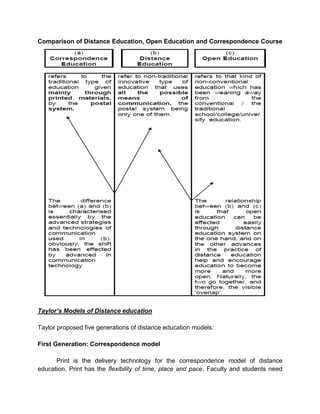
Comparison of Distance Education, Open Education and Correspondence Course
Taylor’s Models of Distance education
Taylor proposed five generations of distance education models:
First Generation: Correspondence model
Print is the delivery technology for the correspondence model of distance
education. Print has the flexibility of time, place and pace. Faculty and students need
not to be in same place at the same time for the purpose of learning. The main
disadvantage of this model is interactivity, costs in preparing and printing, and lack of
immediate feedback. It always relies on postal communication. This model is popular all
over the word 1980-1990.
Second Generation: Multimedia model
The multimedia model supplements print materials with audiotape and videotape,
computer based learning, and interactive video. These model partly encourages
interaction and flexibility of time, place and pace for both teacher and learner. The main
disadvantage of this model is cost in preparing and printing, and lack of immediate
feedback.
Third Generation: Telelearning model
In this model, real time two way communication takes place between student and
teacher. It ensures advanced interactive delivery. This offers highly refined materials
with very less cost. One of the disadvantage of this model is that the students and
teacher requires assembling at same time and same place for effective learning.
Fourth Generation: Flexible learning model
This model is referred as technology mediated flexible learning. This model uses
all forms of technology such as internet, multimedia, print and computer based
instruction.
Advantages:
1. Flexibility to time, place and pace.
2. Highly refined instructional material.
3. Interactive delivery
4. Limited costs
Fifth Generation: Intellectual Flexible learning model
It incorporates use of al technologies in the previous model, with the addition of
automated response systems for computer mediated communication and campus portal
access of resources. This model has similar advantages of fourth generation model.
Approaches of Distance Education
Synchronous Approach:
The participants in the same space at the same time in order to attend to the
material of teaching. All the students should assemble before the TV or Broadcast to
receive instructional material. It is more closure to traditional class room.
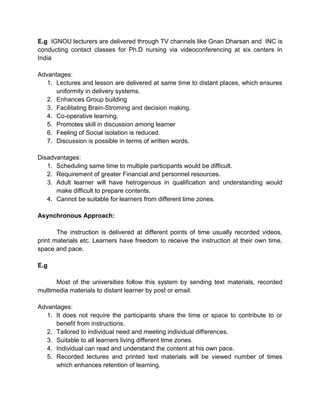
E.g IGNOU lecturers are delivered through TV channels like Gnan Dharsan and INC is
conducting contact classes for Ph.D nursing via videoconferencing at six centers in
India
Advantages:
1. Lectures and lesson are delivered at same time to distant places, which ensures
uniformity in delivery systems.
2. Enhances Group building
3. Facilitating Brain-Stroming and decision making.
4. Co-operative learning.
5. Promotes skill in discussion among learner
6. Feeling of Social isolation is reduced.
7. Discussion is possible in terms of written words.
Disadvantages:
1. Scheduling same time to multiple participants would be difficult.
2. Requirement of greater Financial and personnel resources.
3. Adult learner will have hetrogenous in qualification and understanding would
make difficult to prepare contents.
4. Cannot be suitable for learners from different time zones.
Asynchronous Approach:
The instruction is delivered at different points of time usually recorded videos,
print materials etc. Learners have freedom to receive the instruction at their own time,
space and pace.
E.g
Most of the universities follow this system by sending text materials, recorded
multimedia materials to distant learner by post or email.
Advantages:
1. It does not require the participants share the time or space to contribute to or
benefit from instructions.
2. Tailored to individual need and meeting individual differences.
3. Suitable to all learners living different time zones.
4. Individual can read and understand the content at his own pace.
5. Recorded lectures and printed text materials will be viewed number of times
which enhances retention of learning.
6. Learner can clarify their doubts through emails/post.
7. It is good for learner who has learning disabilities.
8. Online discussion boards will enhance interaction among learners.
Disadvantages:
1. Social isolation of learner.
2. Lacks active interaction.
3. Cost is higher.
4. Lack of immediate clarification and evaluation of contents.
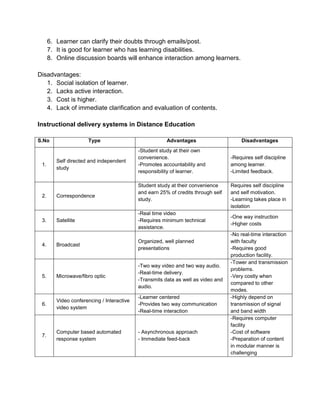
Instructional delivery systems in Distance Education
S.No Type Advantages Disadvantages
1.
Self directed and independent
study
-Student study at their own
convenience.
-Promotes accountability and
responsibility of learner.
-Requires self discipline
among learner.
-Limited feedback.
2. Correspondence
Student study at their convenience
and earn 25% of credits through self
study.
Requires self discipline
and self motivation.
-Learning takes place in
isolation
3. Satellite
-Real time video
-Requires minimum technical
assistance.
-One way instruction
-Higher costs
4. Broadcast
Organized, well planned
presentations
-No real-time interaction
with faculty
-Requires good
production facility.
5. Microwave/fibro optic
-Two way video and two way audio.
-Real-time delivery.
-Transmits data as well as video and
audio.
-Tower and transmission
problems.
-Very costly when
compared to other
modes.
6.
Video conferencing / Interactive
video system
-Learner centered
-Provides two way communication
-Real-time interaction
-Highly depend on
transmission of signal
and band width
7.
Computer based automated
response system
- Asynchronous approach
- Immediate feed-back
-Requires computer
facility
-Cost of software
-Preparation of content
in modular manner is
challenging
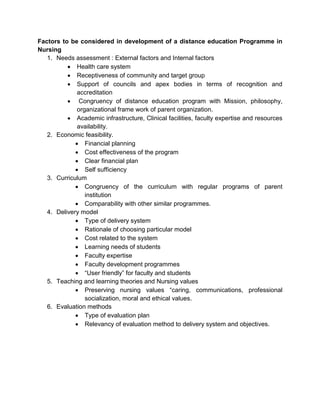
Factors to be considered in development of a distance education Programme in
Nursing
1. Needs assessment : External factors and Internal factors
 Health care system
 Receptiveness of community and target group
 Support of councils and apex bodies in terms of recognition and
accreditation
 Congruency of distance education program with Mission, philosophy,
organizational frame work of parent organization.
 Academic infrastructure, Clinical facilities, faculty expertise and resources
availability.
2. Economic feasibility.
 Financial planning
 Cost effectiveness of the program
 Clear financial plan
 Self sufficiency
3. Curriculum
 Congruency of the curriculum with regular programs of parent
institution
 Comparability with other similar programmes.
4. Delivery model
 Type of delivery system
 Rationale of choosing particular model
 Cost related to the system
 Learning needs of students
 Faculty expertise
 Faculty development programmes
 “User friendly” for faculty and students
5. Teaching and learning theories and Nursing values
 Preserving nursing values “caring, communications, professional
socialization, moral and ethical values.
6. Evaluation methods
 Type of evaluation plan
 Relevancy of evaluation method to delivery system and objectives.
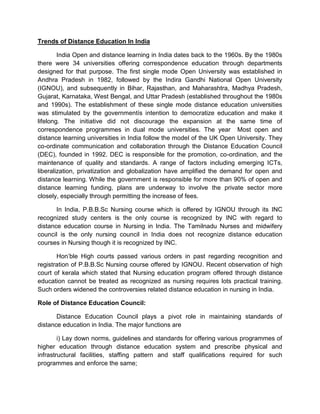
Trends of Distance Education In India
India Open and distance learning in India dates back to the 1960s. By the 1980s
there were 34 universities offering correspondence education through departments
designed for that purpose. The first single mode Open University was established in
Andhra Pradesh in 1982, followed by the Indira Gandhi National Open University
(IGNOU), and subsequently in Bihar, Rajasthan, and Maharashtra, Madhya Pradesh,
Gujarat, Karnataka, West Bengal, and Uttar Pradesh (established throughout the 1980s
and 1990s). The establishment of these single mode distance education universities
was stimulated by the governmentís intention to democratize education and make it
lifelong. The initiative did not discourage the expansion at the same time of
correspondence programmes in dual mode universities. The year Most open and
distance learning universities in India follow the model of the UK Open University. They
co-ordinate communication and collaboration through the Distance Education Council
(DEC), founded in 1992. DEC is responsible for the promotion, co-ordination, and the
maintenance of quality and standards. A range of factors including emerging ICTs,
liberalization, privatization and globalization have amplified the demand for open and
distance learning. While the government is responsible for more than 90% of open and
distance learning funding, plans are underway to involve the private sector more
closely, especially through permitting the increase of fees.
In India, P.B.B.Sc Nursing course which is offered by IGNOU through its INC
recognized study centers is the only course is recognized by INC with regard to
distance education course in Nursing in India. The Tamilnadu Nurses and midwifery
council is the only nursing council in India does not recognize distance education
courses in Nursing though it is recognized by INC.
Hon’ble High courts passed various orders in past regarding recognition and
registration of P.B.B.Sc Nursing course offered by IGNOU. Recent observation of high
court of kerala which stated that Nursing education program offered through distance
education cannot be treated as recognized as nursing requires lots practical training.
Such orders widened the controversies related distance education in nursing in India.
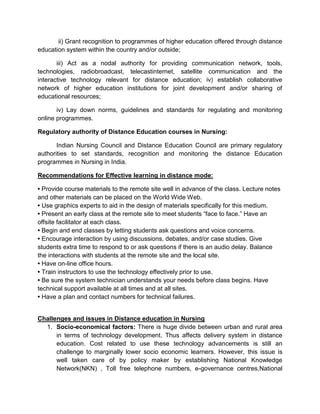
Role of Distance Education Council:
Distance Education Council plays a pivot role in maintaining standards of
distance education in India. The major functions are
i) Lay down norms, guidelines and standards for offering various programmes of
higher education through distance education system and prescribe physical and
infrastructural facilities, staffing pattern and staff qualifications required for such
programmes and enforce the same;
ii) Grant recognition to programmes of higher education offered through distance
education system within the country and/or outside;
iii) Act as a nodal authority for providing communication network, tools,
technologies, radiobroadcast, telecastinternet, satellite communication and the
interactive technology relevant for distance education; iv) establish collaborative
network of higher education institutions for joint development and/or sharing of
educational resources;
iv) Lay down norms, guidelines and standards for regulating and monitoring
online programmes.
Regulatory authority of Distance Education courses in Nursing:
Indian Nursing Council and Distance Education Council are primary regulatory
authorities to set standards, recognition and monitoring the distance Education
programmes in Nursing in India.
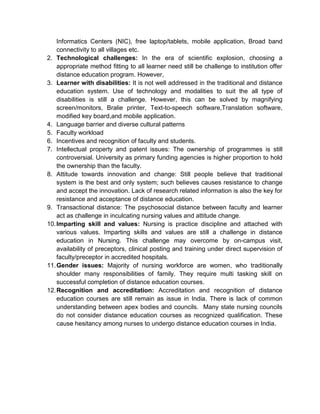
Recommendations for Effective learning in distance mode:
• Provide course materials to the remote site well in advance of the class. Lecture notes
and other materials can be placed on the World Wide Web.
• Use graphics experts to aid in the design of materials specifically for this medium.
• Present an early class at the remote site to meet students “face to face.” Have an
offsite facilitator at each class.
• Begin and end classes by letting students ask questions and voice concerns.
• Encourage interaction by using discussions, debates, and/or case studies. Give
students extra time to respond to or ask questions if there is an audio delay. Balance
the interactions with students at the remote site and the local site.
• Have on-line office hours.
• Train instructors to use the technology effectively prior to use.
• Be sure the system technician understands your needs before class begins. Have
technical support available at all times and at all sites.
• Have a plan and contact numbers for technical failures.
Challenges and issues in Distance education in Nursing
1. Socio-economical factors: There is huge divide between urban and rural area
in terms of technology development. Thus affects delivery system in distance
education. Cost related to use these technology advancements is still an
challenge to marginally lower socio economic learners. However, this issue is
well taken care of by policy maker by establishing National Knowledge
Network(NKN) , Toll free telephone numbers, e-governance centres,National
Informatics Centers (NIC), free laptop/tablets, mobile application, Broad band
connectivity to all villages etc.
2. Technological challenges: In the era of scientific explosion, choosing a
appropriate method fitting to all learner need still be challenge to institution offer
distance education program. However,
3. Learner with disabilities: It is not well addressed in the traditional and distance
education system. Use of technology and modalities to suit the all type of
disabilities is still a challenge. However, this can be solved by magnifying
screen/monitors, Bralie printer, Text-to-speech software,Translation software,
modified key board,and mobile application.
4. Language barrier and diverse cultural patterns
5. Faculty workload
6. Incentives and recognition of faculty and students.
7. Intellectual property and patent issues: The ownership of programmes is still
controversial. University as primary funding agencies is higher proportion to hold
the ownership than the faculty.
8. Attitude towards innovation and change: Still people believe that traditional
system is the best and only system; such believes causes resistance to change
and accept the innovation. Lack of research related information is also the key for
resistance and acceptance of distance education.
9. Transactional distance: The psychosocial distance between faculty and learner
act as challenge in inculcating nursing values and attitude change.
10.Imparting skill and values: Nursing is practice discipline and attached with
various values. Imparting skills and values are still a challenge in distance
education in Nursing. This challenge may overcome by on-campus visit,
availability of preceptors, clinical posting and training under direct supervision of
faculty/preceptor in accredited hospitals.
11.Gender issues: Majority of nursing workforce are women, who traditionally
shoulder many responsibilities of family. They require multi tasking skill on
successful completion of distance education courses.
12.Recognition and accreditation: Accreditation and recognition of distance
education courses are still remain as issue in India. There is lack of common
understanding between apex bodies and councils. Many state nursing councils
do not consider distance education courses as recognized qualification. These
cause hesitancy among nurses to undergo distance education courses in India.
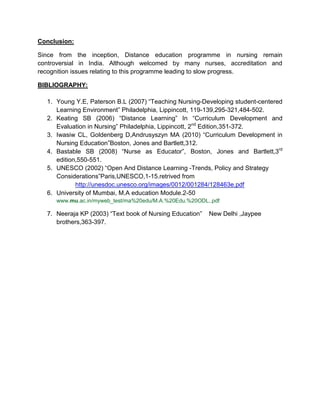
Conclusion:
Since from the inception, Distance education programme in nursing remain
controversial in India. Although welcomed by many nurses, accreditation and
recognition issues relating to this programme leading to slow progress.
BIBLIOGRAPHY:
1. Young Y.E, Paterson B.L (2007) “Teaching Nursing-Developing student-centered
Learning Environment” Philadelphia, Lippincott, 119-139,295-321,484-502.
2. Keating SB (2006) “Distance Learning” In “Curriculum Development and
Evaluation in Nursing” Philadelphia, Lippincott, 2nd
Edition,351-372.
3. Iwasiw CL, Goldenberg D,Andrusyszyn MA (2010) “Curriculum Development in
Nursing Education”Boston, Jones and Bartlett,312.
4. Bastable SB (2008) “Nurse as Educator”, Boston, Jones and Bartlett,3rd
edition,550-551.
5. UNESCO (2002) “Open And Distance Learning -Trends, Policy and Strategy
Considerations”Paris,UNESCO,1-15.retrived from
http://unesdoc.unesco.org/images/0012/001284/128463e.pdf
6. University of Mumbai, M.A education Module.2-50
www.mu.ac.in/myweb_test/ma%20edu/M.A.%20Edu.%20ODL..pdf
7. Neeraja KP (2003) “Text book of Nursing Education” New Delhi ,Jaypee
brothers,363-397.

Distance education in nursing

  • 1.
    Distance Education inNursing L ANAND Research Scholar Ph.D Nursing(External), Annamalai University anandmscn@hotmail.com Introduction As a result of technological advances, distance education for nurses is flourishing in 21st Century. The technological advancements refined the educational system and approaches. Distance education act as blessing to all nurses to continue their education and update their skills in their work setting with limited costs, which directly benefitted quality of patient care and health care system as whole. The following section discusses the various aspects of distance education programmes. Definition of Distance Education: 1.Distance education is defined as planned learning that occurs in different place from teaching, requiring real time(synchronous) or delayed (asynchronous) interactive technology and a needing a course design supportive of students – Escoffery,Miner & Alperin 2003. 2.Distance education is defined as any learning experience that takes place a distance away from the parent institution. It implements curriculum through a planned strategy for the delivery of course or classes that include off- site satellite class managed by faculty, broadcast of classes through video conferencing, teleconferencing to off campus sites,Web based instruction and faculty supervised clinical experience including preceptorship and interships. –Keating 3.Distance education refers to the forms of study where a geographic distance between learner and teacher exists. – Iwasiw 4. Distance education is defined as a formal educational process in which the majority of the instruction occurs when student and instructor are not in the same place. Instruction may be synchronous or asynchronous. Distance education may employ correspondence study, or audio, video, or computer technologies (Regional Accrediting Commissions). 5.Distance education is defined as "institutionally based formal education where the learning group is separated and where telecommunications technologies are used to unite the learning group" (Simonson, Smaldino, Albright, & Zvacek, 2006
  • 2.
    6.Distance education meansthat the teacher and the learner are separated from one another and also from traditional class room setting - Young 7. Distance education is any educational process in which all or most of the teaching is conducted by someone removed in space and/or time from the learner, with the effect that all or most of the communication between teachers and learners is through an artificial medium, either electronic or print. – UNESCO Historical changes 360 B.C –Plato introduced “Written Word” which enable the students to experience and interpret the words without facing teacher. Middle age – Industrial revolution lead to technologically sound learning modalities which increased the opportunities for teaching outside class room. Establishment of postal services had greater influence in delivery of education at distance. 1873-Home based studies delivered via radio. 1892-Pennsylvania university started distance education programme via postal services. 1950 -60 – Correspondence courses delivered via text book,multi media,radio and TV. 1961 - Central Advisory Board of Education decided to introduce the system of correspondence courses and a Committee was appointed under the chairmanship of Dr. D. S. Kothari who was the then Chairman of UGC which recommended in 1961 the starting of correspondence courses. 1961 - The first School of Correspondence Courses was started by the University of Delhi in 1962. 1974-Regents External Degree Programme in Nursing. Currently 16000 students undergoing different courses through distance learning-Associate degree,Master of Nursing. 1980- Many universities started offering correspondence courses and distance learning courses. 1982- First Open university established in Andra Pradesh. 1985 – IGNOU established.-First University established in India which offer only distance education and open education on various streams.
  • 3.
    1990 – IGNOUstarted offering PBBSC Nursing course through open and distance mode. This programme recognized by INC. 1992- Distance Education Council established. IGNOU had administrative powers of DEC. 1994 – Duquesne University – opened first online distance education program on Ph.D Nursing. In USA, currently nearly 30 institutions offer Distance education courses in Nursing. 1995- In India, Enrollment of 200,000 students in open and distance learning, accounting for 3% of total higher education enrollment. 2005-2014 – Establishment of State owned open universities. – Currently 13 universities offer different educational programmes. 2013 – DEC administrative powers shifted to UGC. 2014-Distance Education Bill passed. Objectives of distance education courses (i) “To provide an efficient and less expensive method of educational instruction at a higher level in the context of national development of India. (ii) To provide facilities to pursue higher education to all qualified and willing persons who had failed to join regular university courses due to personal and economic reasons or because of their inability to get admission to a regular college, and (iii) To provide opportunities of academic pursuits to educated citizens through correspondence instruction without disturbing their present employment.” Distance education has the following important characteristics: 1. The quasi-permanent separation of teacher and learner throughout the length of the learning process; this distinguishes it from conventional face-to-face education. 2. The influence of an educational organisation both in planning and preparation of learning materials and in the provision of student support services; this distinguishes it from private study and teach yourself programmes. 3. The use of technical media; print, audio, video or computer, to unite teachers and learners and carry the content of the course.
  • 4.
    4. The provisionof two-way communication so that the student may benefit from or even initiate a dialogue; this distinguishes it from other uses of technology in education. 5. The quasi-permanent absence of a learning group throughout the length of the learning process so that people are usually taught as individuals and not in groups, with the possibility of occasional meetings for both didactic and socialisation purposes. 6. Each student is separated from his/her peer group in the sense that although the learners form a fairly sizable population they do not have face-to-face interaction among themselves. Thus distance education becomes a highly individualised learning system. In this sense, it remains one of the most individualised of all educational systems. 7. Education in real life setting 8. Student centered 9. Indirect education 10.Flexible approach 11.Independence to adult learner/Learners autonomy. Benefits of Distance education 1. Balancing inequalities between age groups; extending geographical access to education and delivering educational campaigns and other education for large audiences 2. Providing speedy and efficient training for key target groups. 3. Expanding the capacity for education in new and multidisciplinary subject areas; offering the combination of education with work and family life. 4. Developing multiple competencies through recurrent and continuing education; enhancing the international dimension of educational experience. 5. Improving the quality of existing educational services. 6. To respond effectively to the growing demand of working adults or any others who have difficulties in getting training in conventional education because of lack of flexibility in the timing and location of courses. 7. To provide an opportunity for the empowerment of those most disadvantaged by existing provision, the unemployed, the disabled, women and ethnic minorities.
  • 5.
    Comparison of DistanceEducation, Open Education and Correspondence Course Taylor’s Models of Distance education Taylor proposed five generations of distance education models: First Generation: Correspondence model Print is the delivery technology for the correspondence model of distance education. Print has the flexibility of time, place and pace. Faculty and students need
  • 6.
    not to bein same place at the same time for the purpose of learning. The main disadvantage of this model is interactivity, costs in preparing and printing, and lack of immediate feedback. It always relies on postal communication. This model is popular all over the word 1980-1990. Second Generation: Multimedia model The multimedia model supplements print materials with audiotape and videotape, computer based learning, and interactive video. These model partly encourages interaction and flexibility of time, place and pace for both teacher and learner. The main disadvantage of this model is cost in preparing and printing, and lack of immediate feedback. Third Generation: Telelearning model In this model, real time two way communication takes place between student and teacher. It ensures advanced interactive delivery. This offers highly refined materials with very less cost. One of the disadvantage of this model is that the students and teacher requires assembling at same time and same place for effective learning. Fourth Generation: Flexible learning model This model is referred as technology mediated flexible learning. This model uses all forms of technology such as internet, multimedia, print and computer based instruction. Advantages: 1. Flexibility to time, place and pace. 2. Highly refined instructional material. 3. Interactive delivery 4. Limited costs Fifth Generation: Intellectual Flexible learning model It incorporates use of al technologies in the previous model, with the addition of automated response systems for computer mediated communication and campus portal access of resources. This model has similar advantages of fourth generation model. Approaches of Distance Education Synchronous Approach: The participants in the same space at the same time in order to attend to the material of teaching. All the students should assemble before the TV or Broadcast to receive instructional material. It is more closure to traditional class room.
  • 7.
    E.g IGNOU lecturersare delivered through TV channels like Gnan Dharsan and INC is conducting contact classes for Ph.D nursing via videoconferencing at six centers in India Advantages: 1. Lectures and lesson are delivered at same time to distant places, which ensures uniformity in delivery systems. 2. Enhances Group building 3. Facilitating Brain-Stroming and decision making. 4. Co-operative learning. 5. Promotes skill in discussion among learner 6. Feeling of Social isolation is reduced. 7. Discussion is possible in terms of written words. Disadvantages: 1. Scheduling same time to multiple participants would be difficult. 2. Requirement of greater Financial and personnel resources. 3. Adult learner will have hetrogenous in qualification and understanding would make difficult to prepare contents. 4. Cannot be suitable for learners from different time zones. Asynchronous Approach: The instruction is delivered at different points of time usually recorded videos, print materials etc. Learners have freedom to receive the instruction at their own time, space and pace. E.g Most of the universities follow this system by sending text materials, recorded multimedia materials to distant learner by post or email. Advantages: 1. It does not require the participants share the time or space to contribute to or benefit from instructions. 2. Tailored to individual need and meeting individual differences. 3. Suitable to all learners living different time zones. 4. Individual can read and understand the content at his own pace. 5. Recorded lectures and printed text materials will be viewed number of times which enhances retention of learning.
  • 8.
    6. Learner canclarify their doubts through emails/post. 7. It is good for learner who has learning disabilities. 8. Online discussion boards will enhance interaction among learners. Disadvantages: 1. Social isolation of learner. 2. Lacks active interaction. 3. Cost is higher. 4. Lack of immediate clarification and evaluation of contents. Instructional delivery systems in Distance Education S.No Type Advantages Disadvantages 1. Self directed and independent study -Student study at their own convenience. -Promotes accountability and responsibility of learner. -Requires self discipline among learner. -Limited feedback. 2. Correspondence Student study at their convenience and earn 25% of credits through self study. Requires self discipline and self motivation. -Learning takes place in isolation 3. Satellite -Real time video -Requires minimum technical assistance. -One way instruction -Higher costs 4. Broadcast Organized, well planned presentations -No real-time interaction with faculty -Requires good production facility. 5. Microwave/fibro optic -Two way video and two way audio. -Real-time delivery. -Transmits data as well as video and audio. -Tower and transmission problems. -Very costly when compared to other modes. 6. Video conferencing / Interactive video system -Learner centered -Provides two way communication -Real-time interaction -Highly depend on transmission of signal and band width 7. Computer based automated response system - Asynchronous approach - Immediate feed-back -Requires computer facility -Cost of software -Preparation of content in modular manner is challenging
  • 9.
    Factors to beconsidered in development of a distance education Programme in Nursing 1. Needs assessment : External factors and Internal factors  Health care system  Receptiveness of community and target group  Support of councils and apex bodies in terms of recognition and accreditation  Congruency of distance education program with Mission, philosophy, organizational frame work of parent organization.  Academic infrastructure, Clinical facilities, faculty expertise and resources availability. 2. Economic feasibility.  Financial planning  Cost effectiveness of the program  Clear financial plan  Self sufficiency 3. Curriculum  Congruency of the curriculum with regular programs of parent institution  Comparability with other similar programmes. 4. Delivery model  Type of delivery system  Rationale of choosing particular model  Cost related to the system  Learning needs of students  Faculty expertise  Faculty development programmes  “User friendly” for faculty and students 5. Teaching and learning theories and Nursing values  Preserving nursing values “caring, communications, professional socialization, moral and ethical values. 6. Evaluation methods  Type of evaluation plan  Relevancy of evaluation method to delivery system and objectives.
  • 10.
    Trends of DistanceEducation In India India Open and distance learning in India dates back to the 1960s. By the 1980s there were 34 universities offering correspondence education through departments designed for that purpose. The first single mode Open University was established in Andhra Pradesh in 1982, followed by the Indira Gandhi National Open University (IGNOU), and subsequently in Bihar, Rajasthan, and Maharashtra, Madhya Pradesh, Gujarat, Karnataka, West Bengal, and Uttar Pradesh (established throughout the 1980s and 1990s). The establishment of these single mode distance education universities was stimulated by the governmentís intention to democratize education and make it lifelong. The initiative did not discourage the expansion at the same time of correspondence programmes in dual mode universities. The year Most open and distance learning universities in India follow the model of the UK Open University. They co-ordinate communication and collaboration through the Distance Education Council (DEC), founded in 1992. DEC is responsible for the promotion, co-ordination, and the maintenance of quality and standards. A range of factors including emerging ICTs, liberalization, privatization and globalization have amplified the demand for open and distance learning. While the government is responsible for more than 90% of open and distance learning funding, plans are underway to involve the private sector more closely, especially through permitting the increase of fees. In India, P.B.B.Sc Nursing course which is offered by IGNOU through its INC recognized study centers is the only course is recognized by INC with regard to distance education course in Nursing in India. The Tamilnadu Nurses and midwifery council is the only nursing council in India does not recognize distance education courses in Nursing though it is recognized by INC. Hon’ble High courts passed various orders in past regarding recognition and registration of P.B.B.Sc Nursing course offered by IGNOU. Recent observation of high court of kerala which stated that Nursing education program offered through distance education cannot be treated as recognized as nursing requires lots practical training. Such orders widened the controversies related distance education in nursing in India. Role of Distance Education Council: Distance Education Council plays a pivot role in maintaining standards of distance education in India. The major functions are i) Lay down norms, guidelines and standards for offering various programmes of higher education through distance education system and prescribe physical and infrastructural facilities, staffing pattern and staff qualifications required for such programmes and enforce the same;
  • 11.
    ii) Grant recognitionto programmes of higher education offered through distance education system within the country and/or outside; iii) Act as a nodal authority for providing communication network, tools, technologies, radiobroadcast, telecastinternet, satellite communication and the interactive technology relevant for distance education; iv) establish collaborative network of higher education institutions for joint development and/or sharing of educational resources; iv) Lay down norms, guidelines and standards for regulating and monitoring online programmes. Regulatory authority of Distance Education courses in Nursing: Indian Nursing Council and Distance Education Council are primary regulatory authorities to set standards, recognition and monitoring the distance Education programmes in Nursing in India. Recommendations for Effective learning in distance mode: • Provide course materials to the remote site well in advance of the class. Lecture notes and other materials can be placed on the World Wide Web. • Use graphics experts to aid in the design of materials specifically for this medium. • Present an early class at the remote site to meet students “face to face.” Have an offsite facilitator at each class. • Begin and end classes by letting students ask questions and voice concerns. • Encourage interaction by using discussions, debates, and/or case studies. Give students extra time to respond to or ask questions if there is an audio delay. Balance the interactions with students at the remote site and the local site. • Have on-line office hours. • Train instructors to use the technology effectively prior to use. • Be sure the system technician understands your needs before class begins. Have technical support available at all times and at all sites. • Have a plan and contact numbers for technical failures. Challenges and issues in Distance education in Nursing 1. Socio-economical factors: There is huge divide between urban and rural area in terms of technology development. Thus affects delivery system in distance education. Cost related to use these technology advancements is still an challenge to marginally lower socio economic learners. However, this issue is well taken care of by policy maker by establishing National Knowledge Network(NKN) , Toll free telephone numbers, e-governance centres,National
  • 12.
    Informatics Centers (NIC),free laptop/tablets, mobile application, Broad band connectivity to all villages etc. 2. Technological challenges: In the era of scientific explosion, choosing a appropriate method fitting to all learner need still be challenge to institution offer distance education program. However, 3. Learner with disabilities: It is not well addressed in the traditional and distance education system. Use of technology and modalities to suit the all type of disabilities is still a challenge. However, this can be solved by magnifying screen/monitors, Bralie printer, Text-to-speech software,Translation software, modified key board,and mobile application. 4. Language barrier and diverse cultural patterns 5. Faculty workload 6. Incentives and recognition of faculty and students. 7. Intellectual property and patent issues: The ownership of programmes is still controversial. University as primary funding agencies is higher proportion to hold the ownership than the faculty. 8. Attitude towards innovation and change: Still people believe that traditional system is the best and only system; such believes causes resistance to change and accept the innovation. Lack of research related information is also the key for resistance and acceptance of distance education. 9. Transactional distance: The psychosocial distance between faculty and learner act as challenge in inculcating nursing values and attitude change. 10.Imparting skill and values: Nursing is practice discipline and attached with various values. Imparting skills and values are still a challenge in distance education in Nursing. This challenge may overcome by on-campus visit, availability of preceptors, clinical posting and training under direct supervision of faculty/preceptor in accredited hospitals. 11.Gender issues: Majority of nursing workforce are women, who traditionally shoulder many responsibilities of family. They require multi tasking skill on successful completion of distance education courses. 12.Recognition and accreditation: Accreditation and recognition of distance education courses are still remain as issue in India. There is lack of common understanding between apex bodies and councils. Many state nursing councils do not consider distance education courses as recognized qualification. These cause hesitancy among nurses to undergo distance education courses in India.
  • 13.
    Conclusion: Since from theinception, Distance education programme in nursing remain controversial in India. Although welcomed by many nurses, accreditation and recognition issues relating to this programme leading to slow progress. BIBLIOGRAPHY: 1. Young Y.E, Paterson B.L (2007) “Teaching Nursing-Developing student-centered Learning Environment” Philadelphia, Lippincott, 119-139,295-321,484-502. 2. Keating SB (2006) “Distance Learning” In “Curriculum Development and Evaluation in Nursing” Philadelphia, Lippincott, 2nd Edition,351-372. 3. Iwasiw CL, Goldenberg D,Andrusyszyn MA (2010) “Curriculum Development in Nursing Education”Boston, Jones and Bartlett,312. 4. Bastable SB (2008) “Nurse as Educator”, Boston, Jones and Bartlett,3rd edition,550-551. 5. UNESCO (2002) “Open And Distance Learning -Trends, Policy and Strategy Considerations”Paris,UNESCO,1-15.retrived from http://unesdoc.unesco.org/images/0012/001284/128463e.pdf 6. University of Mumbai, M.A education Module.2-50 www.mu.ac.in/myweb_test/ma%20edu/M.A.%20Edu.%20ODL..pdf 7. Neeraja KP (2003) “Text book of Nursing Education” New Delhi ,Jaypee brothers,363-397.