Mr. BJ R. AMBAT
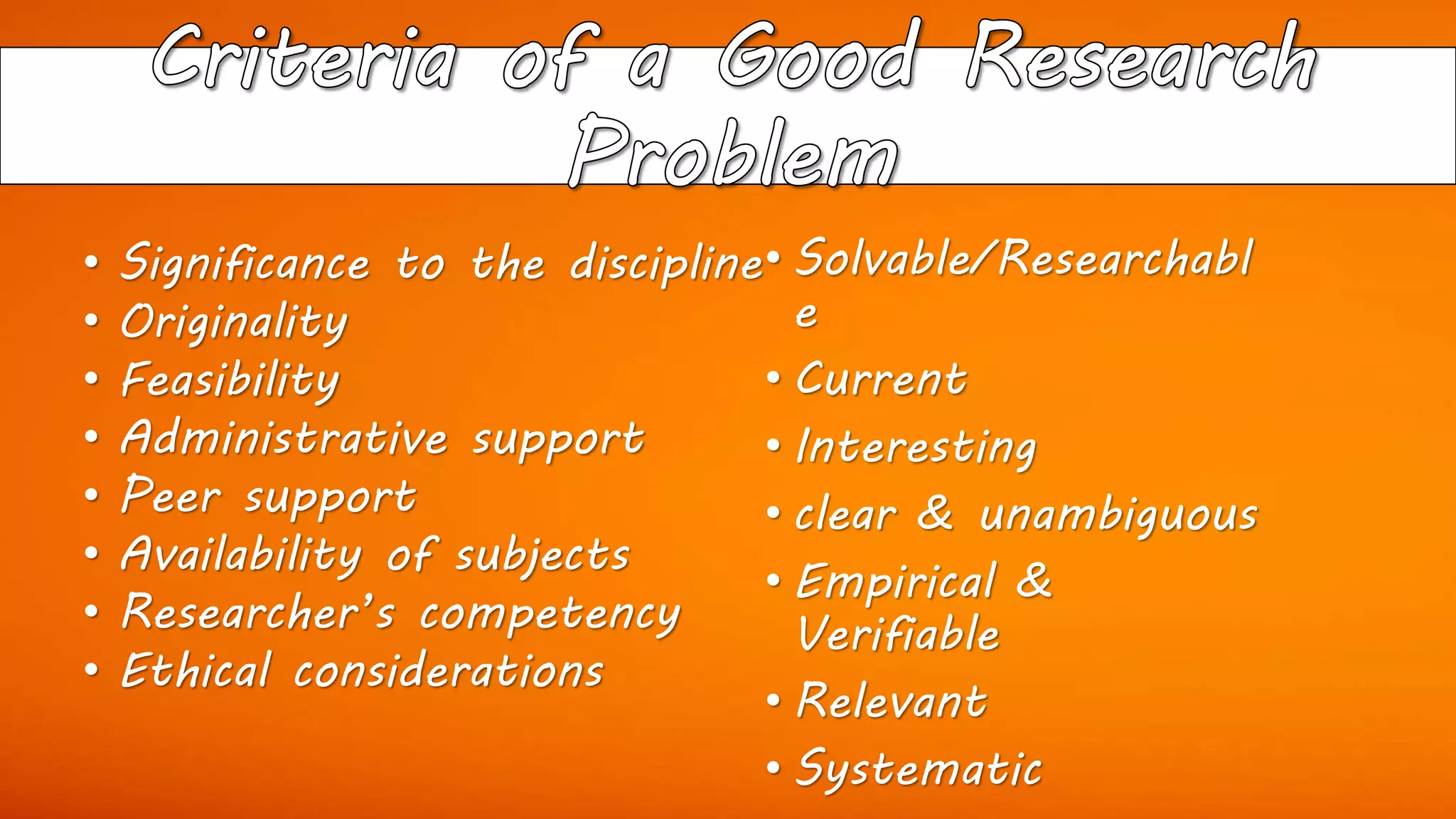
• Solvable/Researchabl
e
• Current
• Interesting
• clear & unambiguous
• Empirical &
Verifiable
• Relevant
• Systematic
• Significance to the discipline
• Originality
• Feasibility
• Administrative support
• Peer support
• Availability of subjects
• Researcher’s competency
• Ethical considerations
a research problem is significant for a
discipline when it is directed to
develop or refine the body of
professional knowledge.
Every research should be new and unique in
itself. Therefore, it is the responsibility of
the
researcher that innovative knowledge is used
for selecting a research problem so as to
extend the growth of existing body of
knowledge in a profession.
A research should be feasible in
terms of time, availability of
subjects, facilities, equipment &
money and ethical considerations.
Financial & psychological support
from the administrations is
essential to conduct research.
A climate of shared interest among
the professional members promote
research activities smoothly
Sometimes the potential subjects may
not meet the study criteria or may be
unwilling to participate in the study or may
be already participating in another studies.
Therefore, the availability of the subjects
should be well ensured in advance.
A research problem can only be feasible
if it is in accordance with the
researcher’s competence. A researcher
should be capable to handle a given
research problem.
Sometimes the potential subjects may not
meet the study criteria or may be unwilling
to participate in the study or may be
already participating in another studies.
Therefore, the availability of the subjects
should be well ensured in advance.
the research problem selected should be
cleared by the ethical committee without
undue hurdles. A very important topic of
research cannot be considered feasible until &
unless it is in accordance with the ethical
guidelines.
-only a research problem that is solvable is
considered to be good. A researcher should
minimize the chances of insolvability
-this aspect of the problem may pose
ambiguity and hence a researcher should
ensure the solvability of the problem that
is selected.
A good research problem must be based on the
current problems and needs of the profession.
Thus the result generated will be of more use.
Furthermore, more number of the professionals
will be interested in the research conducted on
the current issues of their profession.
a research problem must be as per the
motivation of the researcher and it should
be fascinating to the researcher. Thus a
research will be conducted with full
enthusiasm and not merely for its
accomplishment.
the research problem selected should be clear in
its ability to reflect or give clues regarding the
various aspects of methodology.
the research problem selected to be
researched should amenable to
scientific inquiry. The research should
be verifiable by scientific calculations.
the research problem chosen to be
researched should be relevant to the
profession, time, need the competency
of the researcher.
the research problem should be systematic-
in the sense the researcher should have
arrived at the problem statement following
relevant selection parameters or criteria.
THE RESEARCH
OBJECTIVES
THE RESEARCH OBJECTIVES
 is a clear, concise, declarative statement, which
provides direction to investigate the variables
under the study
 the objectives of a research project summarize
what is to be achieved by the study
 without a clear objective a researcher is aimless
and directionless in conducting the study.
THE RESEARCH OBJECTIVES
 without focused objectives, no replicable
scientific findings can be expected.
 is a purpose that can be reasonably
achieved within the expected timeframe and
with the available resources
Focus
Avoid Unnecessary Data
Organization
Gives Direction
need of research objective
TYPES of research objectives
 General Objective
-statement of the long-term or overall goal of the
study
- the general objectives of the study states what
the researcher expects to achieve by the study in
general terms.
 Specific Objectives
– specific statements or questions derived from the
general objective which are to be answered by
the study.
EXAMPLE
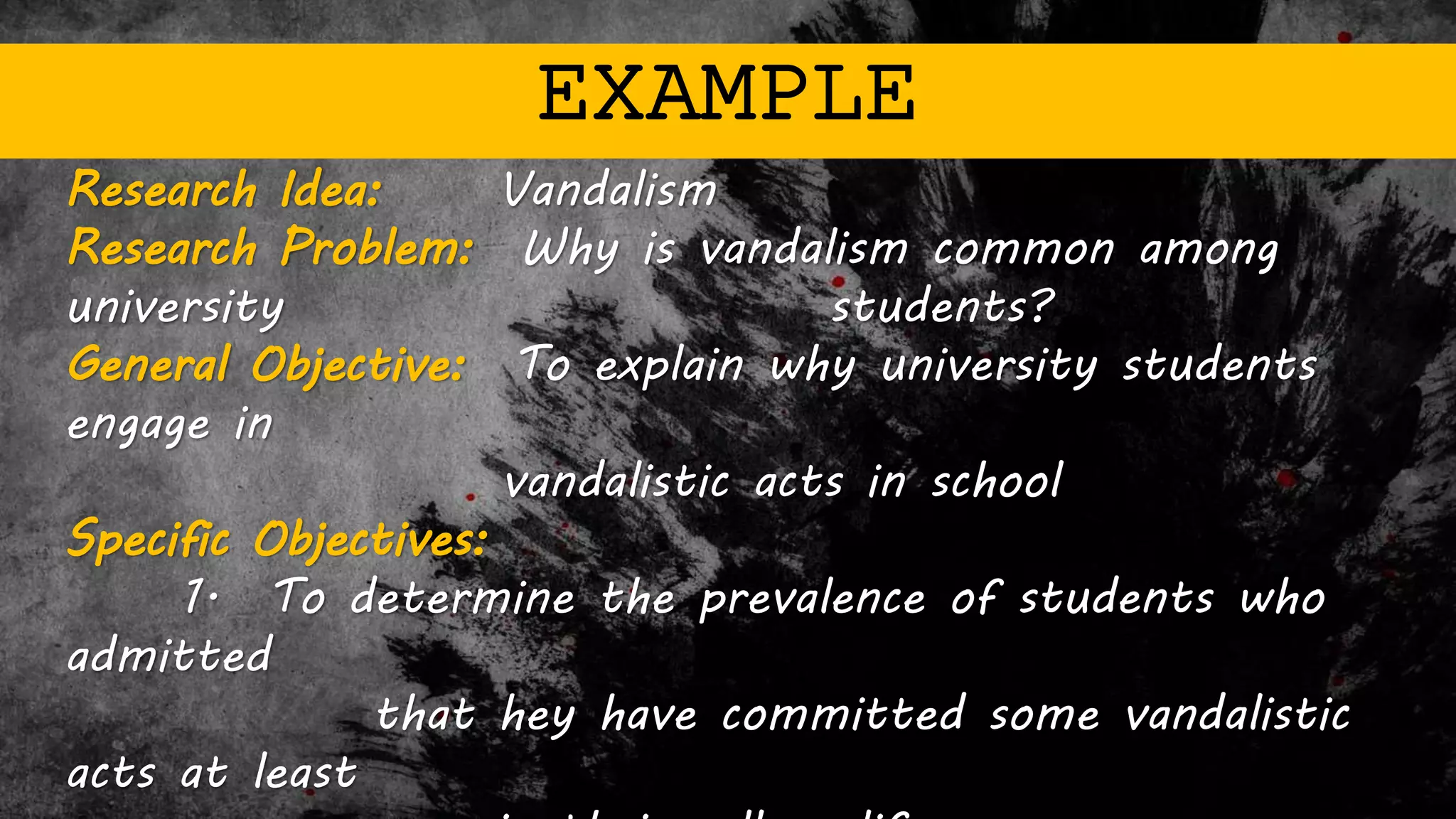
Research Idea: Vandalism
Research Problem: Why is vandalism common among
university students?
General Objective: To explain why university students
engage in
vandalistic acts in school
Specific Objectives:
1. To determine the prevalence of students who
admitted
that hey have committed some vandalistic
acts at least
EXAMPLE
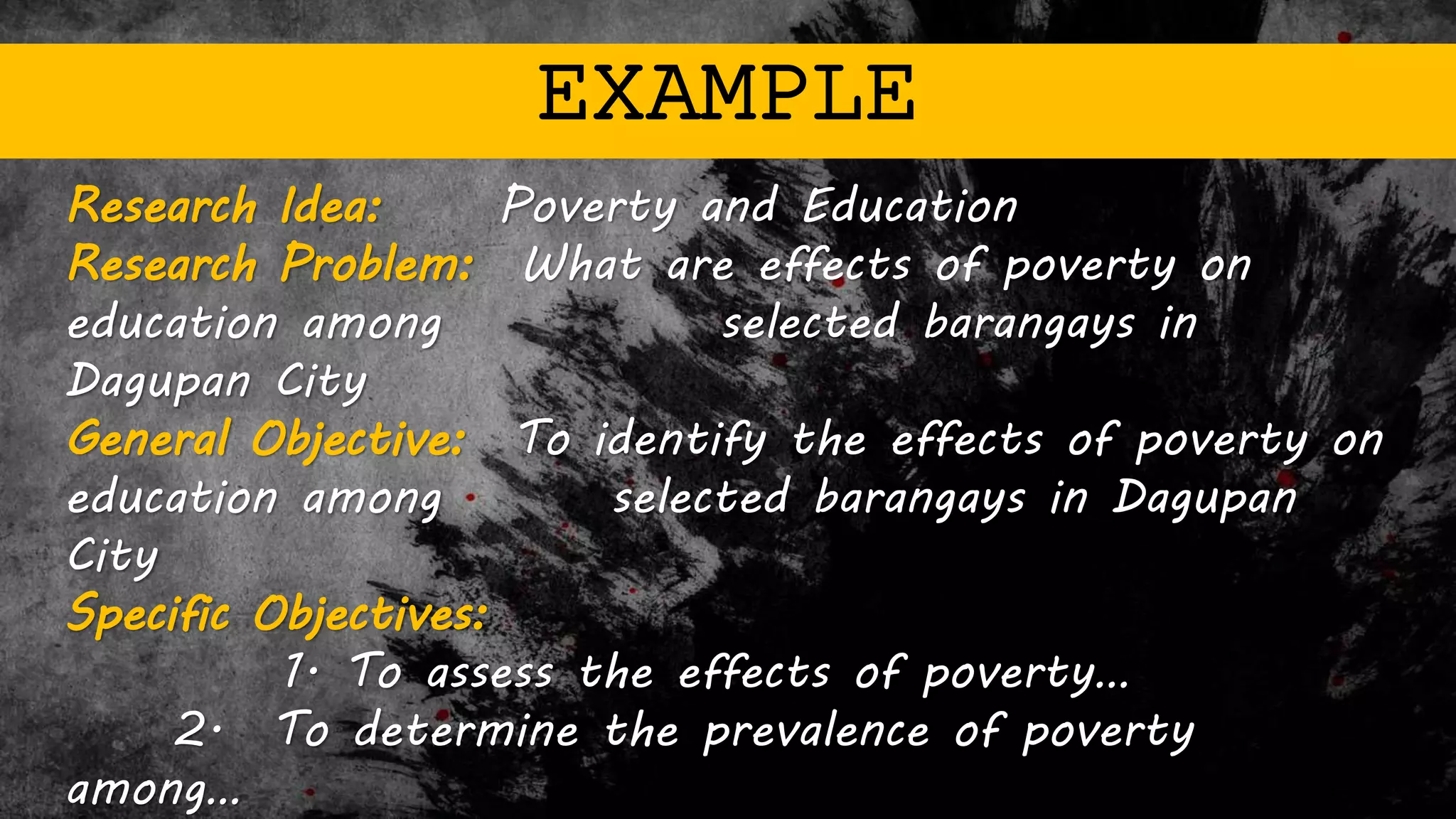
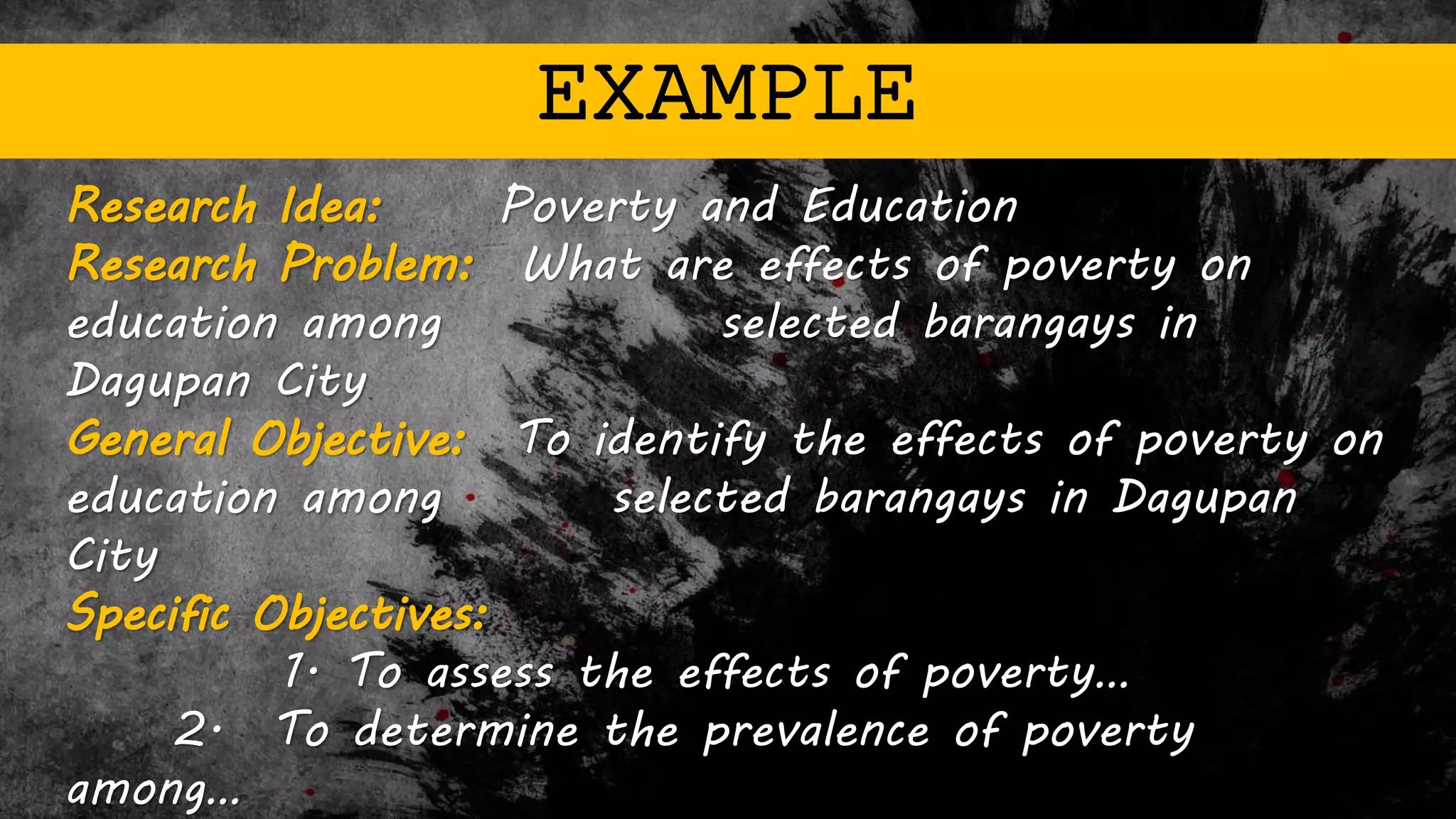
Research Idea: Poverty and Education
Research Problem: What are effects of poverty on
education among selected barangays in
Dagupan City
General Objective: To identify the effects of poverty on
education among selected barangays in Dagupan
City
Specific Objectives:
1. To assess the effects of poverty…
2. To determine the prevalence of poverty
among…
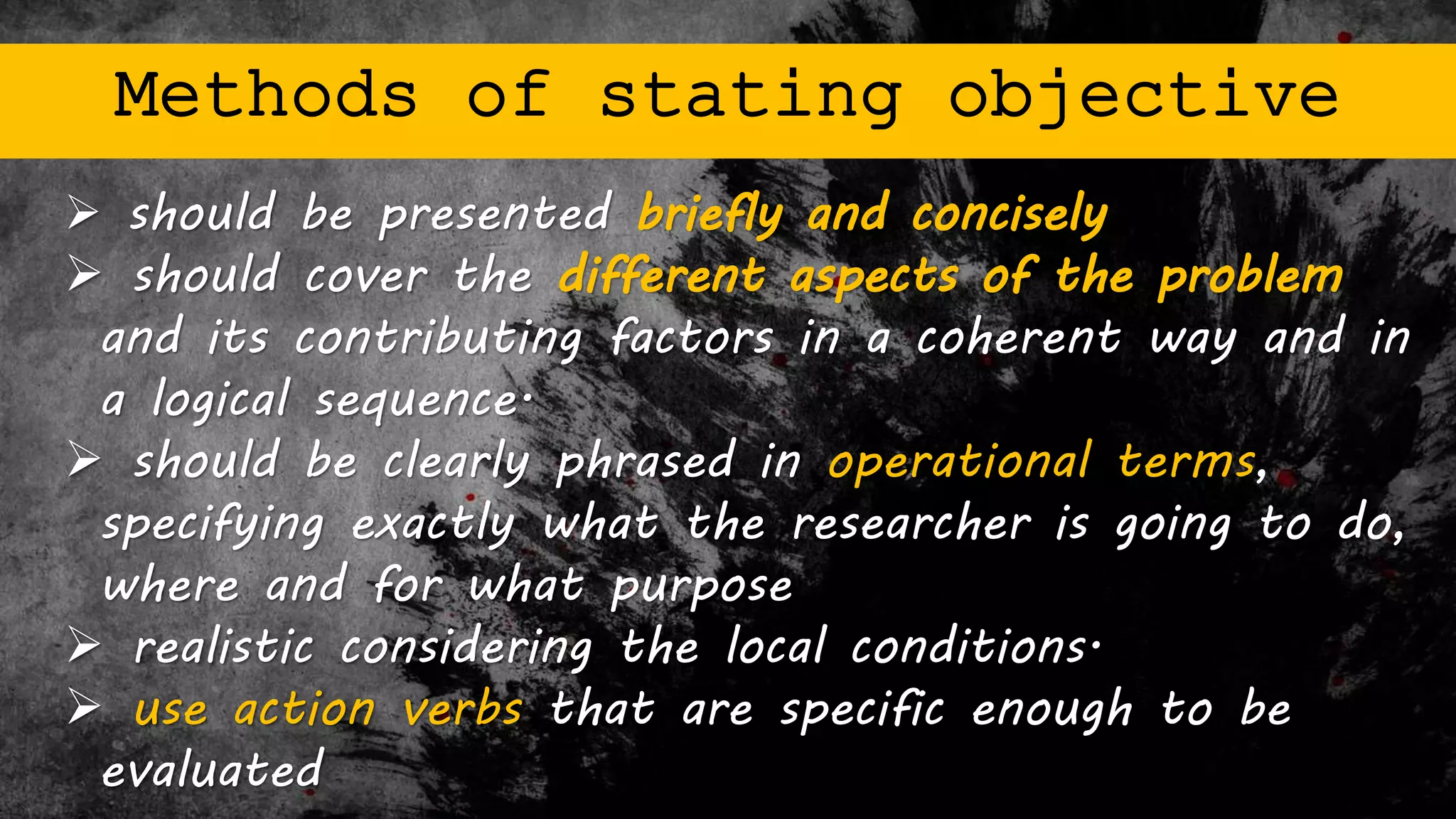
Methods of stating objective
 should be presented briefly and concisely
 should cover the different aspects of the problem
and its contributing factors in a coherent way and in
a logical sequence.
 should be clearly phrased in operational terms,
specifying exactly what the researcher is going to do,
where and for what purpose
 realistic considering the local conditions.
 use action verbs that are specific enough to be
evaluated
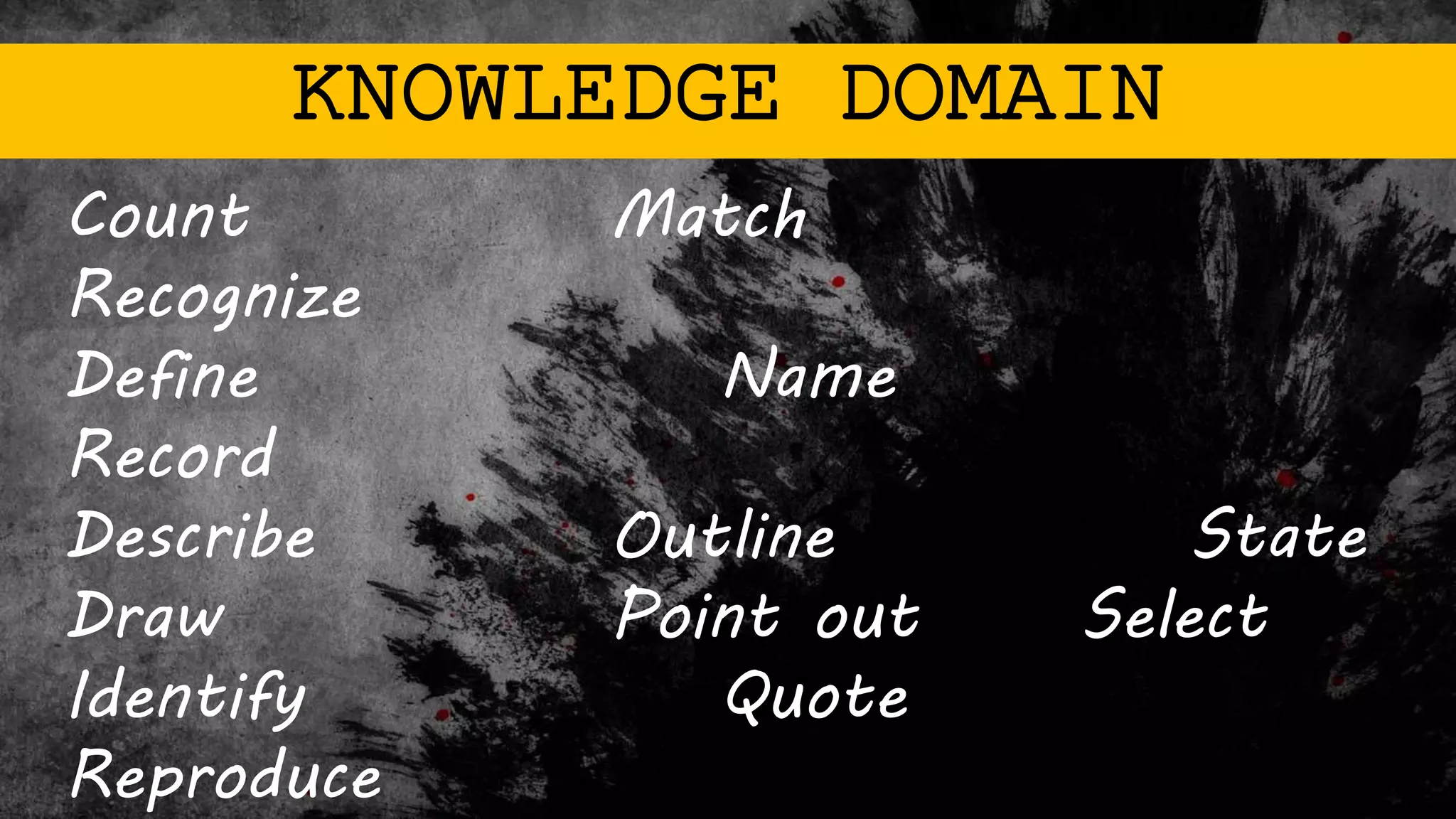
KNOWLEDGE DOMAIN
Count Match
Recognize
Define Name
Record
Describe Outline State
Draw Point out Select
Identify Quote
Reproduce
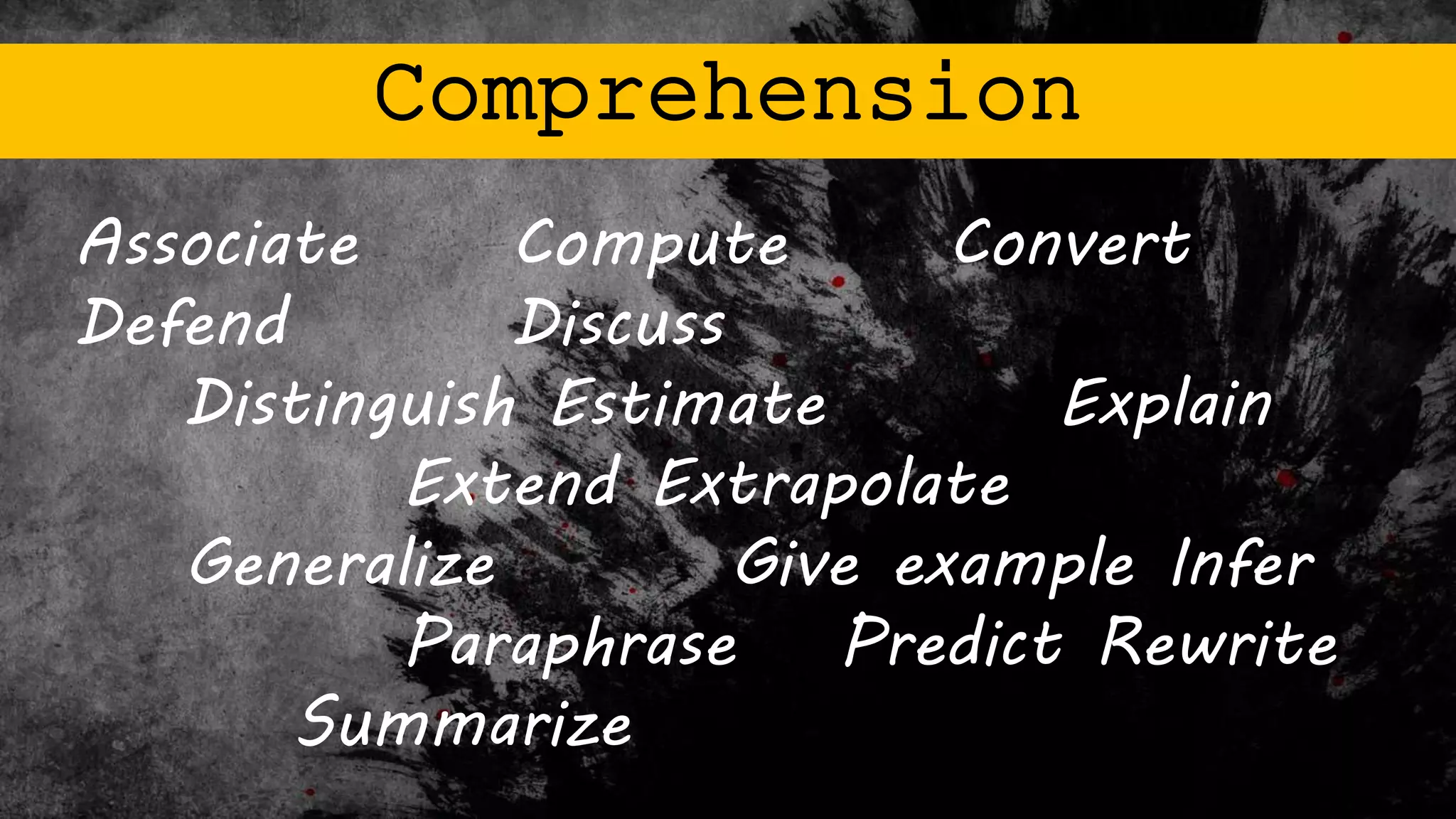
Comprehension
Associate Compute Convert
Defend Discuss
Distinguish Estimate Explain
Extend Extrapolate
Generalize Give example Infer
Paraphrase Predict Rewrite
Summarize
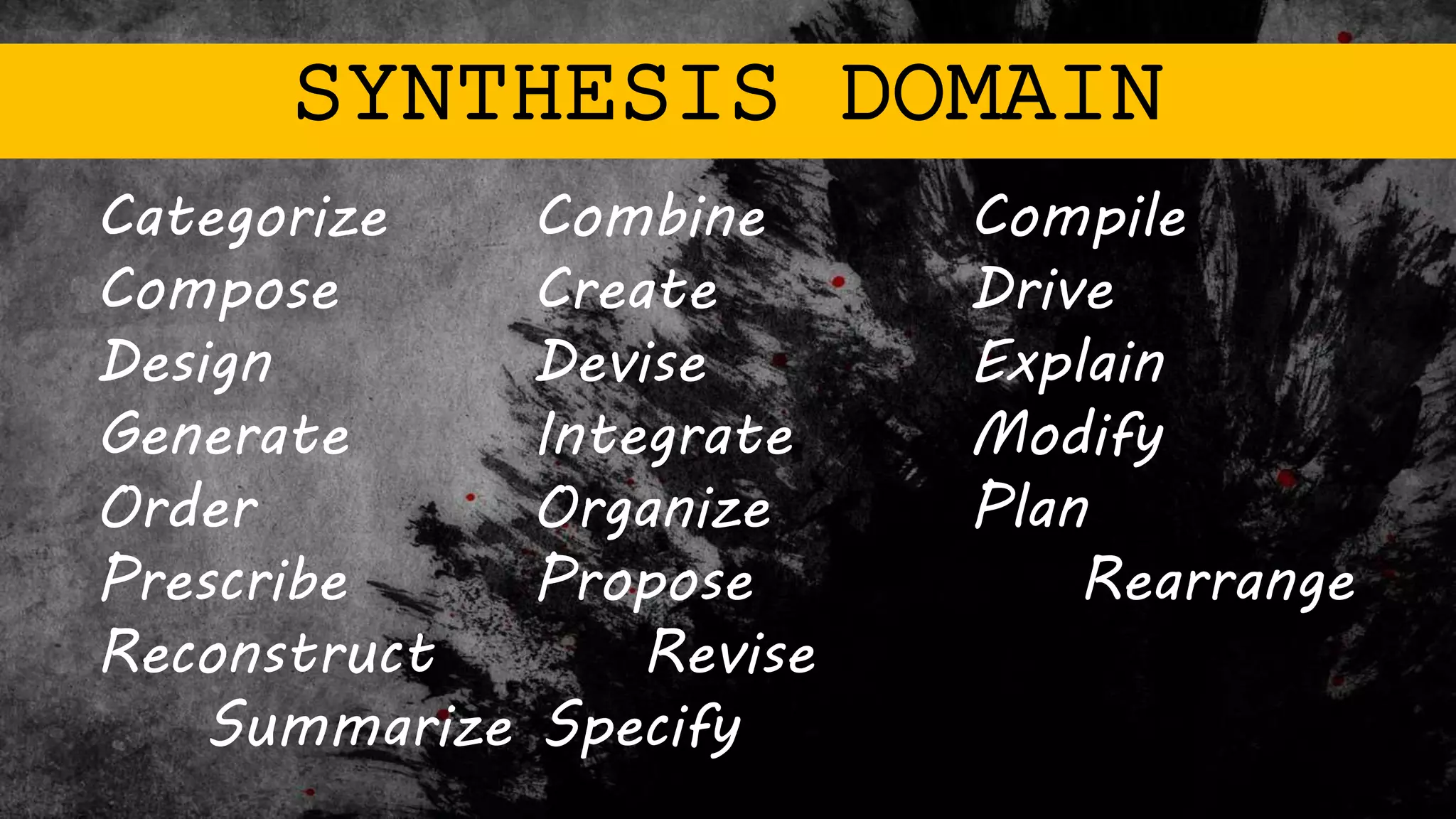
SYNTHESIS DOMAIN
Categorize Combine Compile
Compose Create Drive
Design Devise Explain
Generate Integrate Modify
Order Organize Plan
Prescribe Propose Rearrange
Reconstruct Revise
Summarize Specify
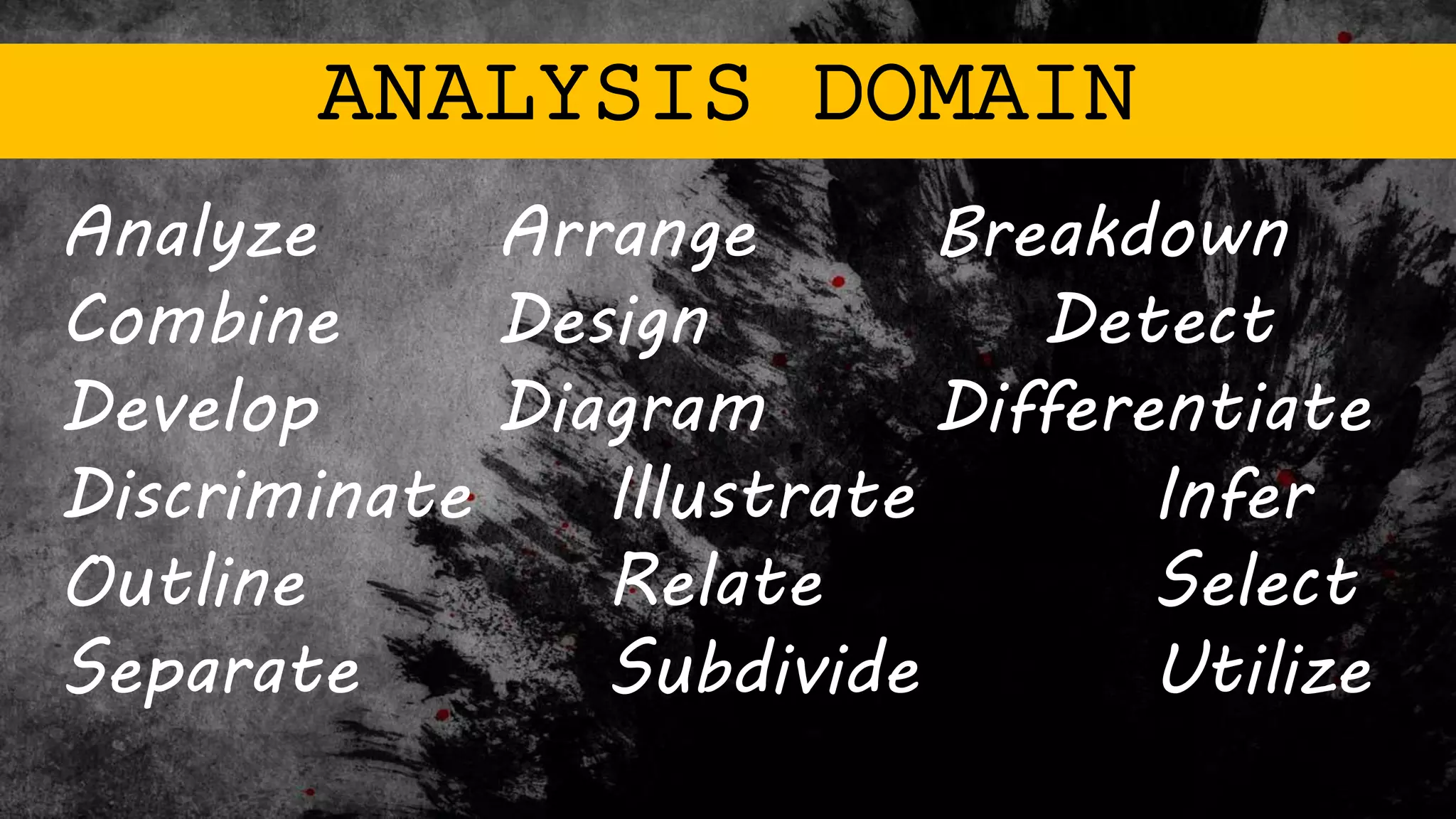
ANALYSIS DOMAIN
Analyze Arrange Breakdown
Combine Design Detect
Develop Diagram Differentiate
Discriminate Illustrate Infer
Outline Relate Select
Separate Subdivide Utilize
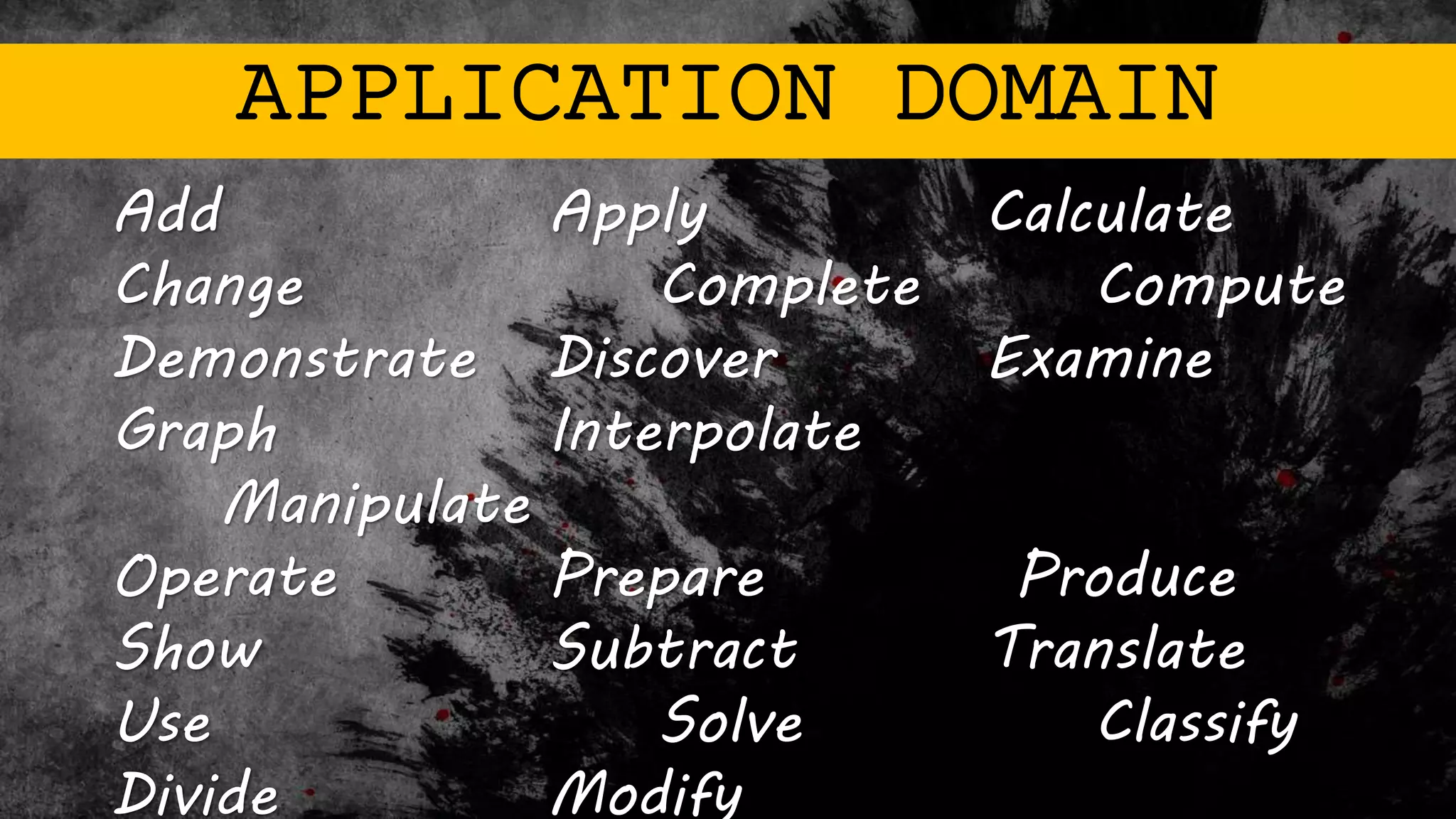
APPLICATION DOMAIN
Add Apply Calculate
Change Complete Compute
Demonstrate Discover Examine
Graph Interpolate
Manipulate
Operate Prepare Produce
Show Subtract Translate
Use Solve Classify
Divide Modify
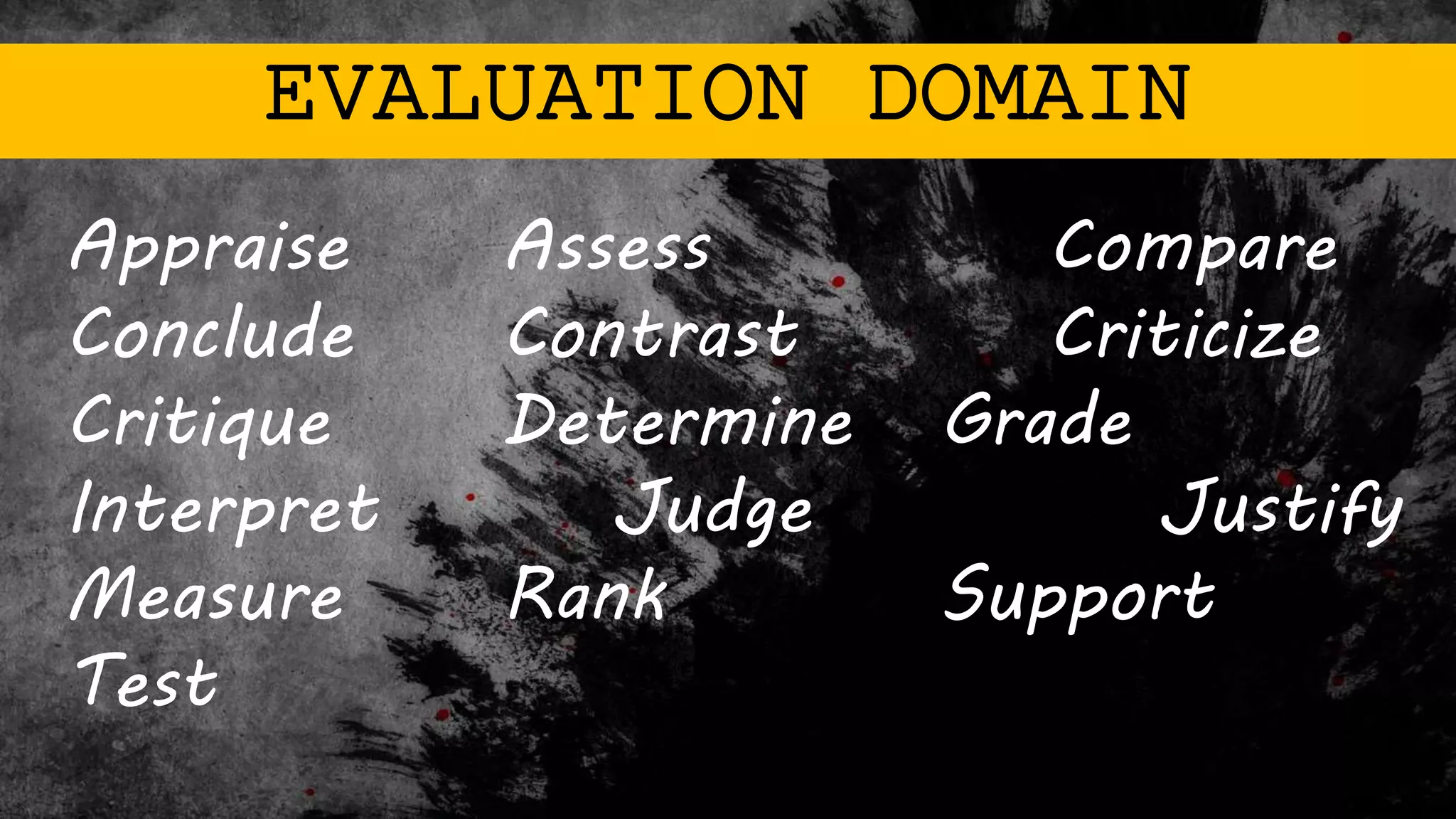
EVALUATION DOMAIN
Appraise Assess Compare
Conclude Contrast Criticize
Critique Determine Grade
Interpret Judge Justify
Measure Rank Support
Test
EXAMPLE
Research Idea: Poverty and Education
Research Problem: What are effects of poverty on
education among selected barangays in
Dagupan City
General Objective: To identify the effects of poverty on
education among selected barangays in Dagupan
City
Specific Objectives:
1. To assess the effects of poverty…
2. To determine the prevalence of poverty
among…
Statement of
Research
Problem
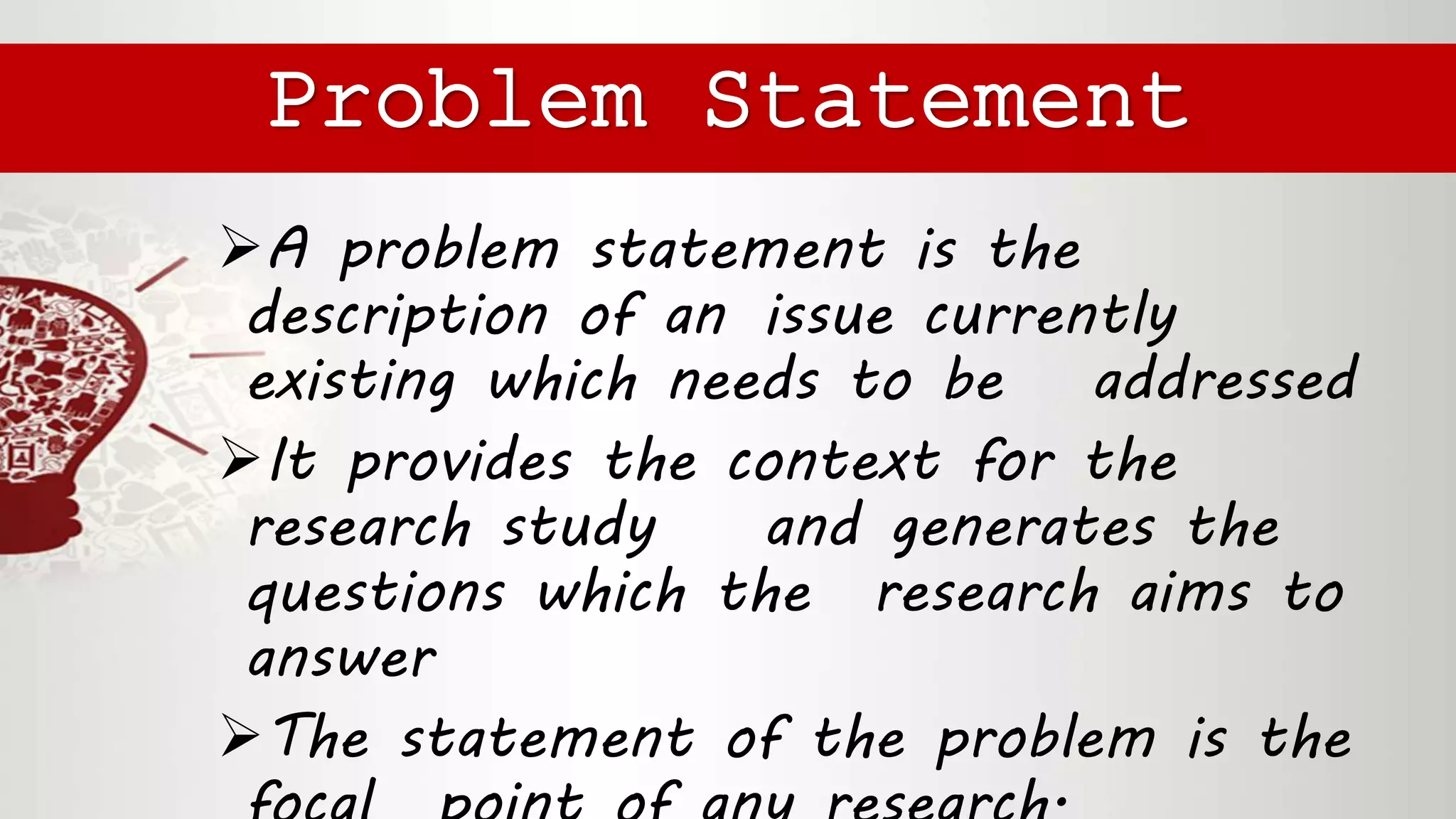
A problem statement is the
description of an issue currently
existing which needs to be addressed
It provides the context for the
research study and generates the
questions which the research aims to
answer
The statement of the problem is the
Problem Statement
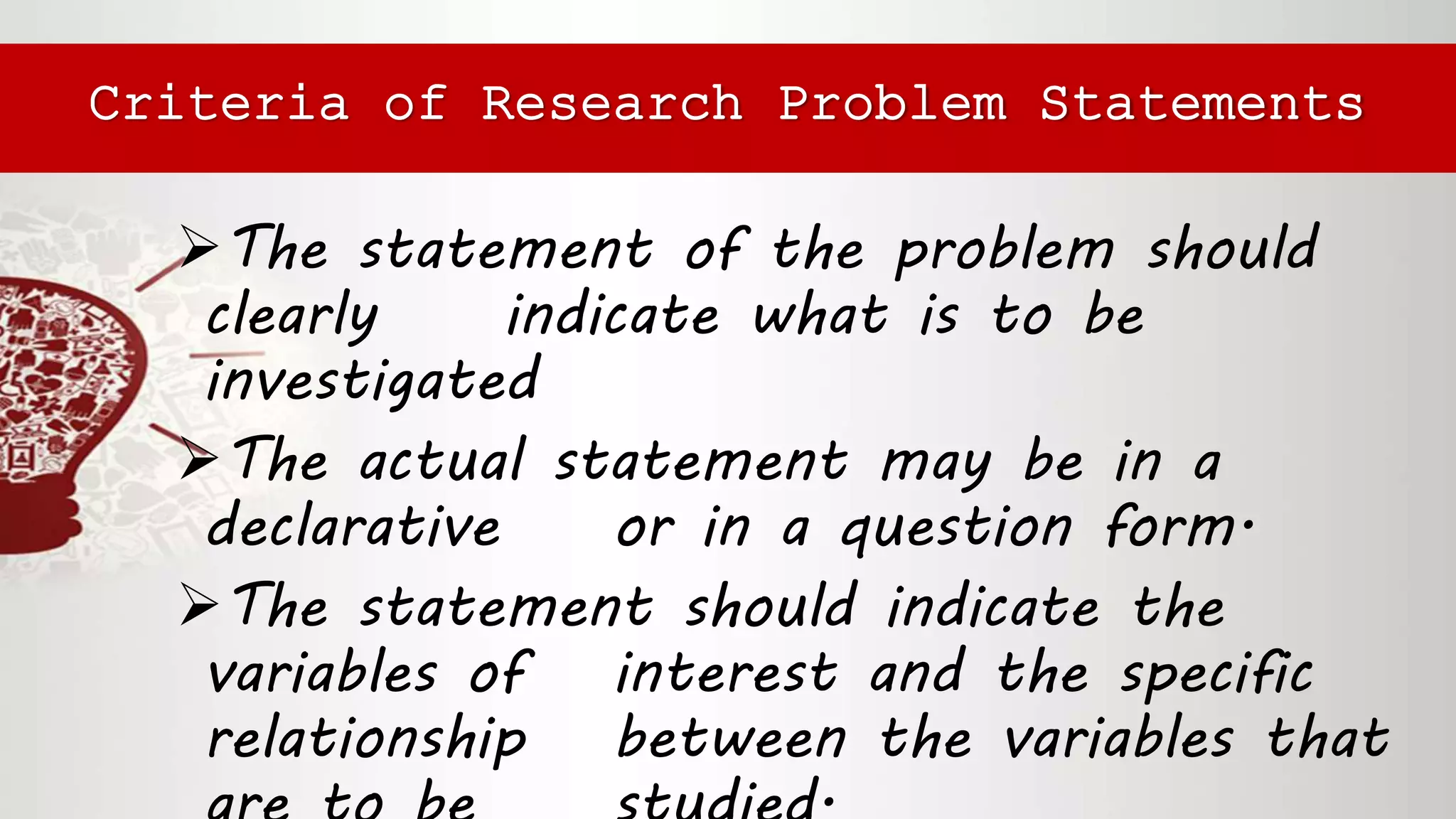
The statement of the problem should
clearly indicate what is to be
investigated
The actual statement may be in a
declarative or in a question form.
The statement should indicate the
variables of interest and the specific
relationship between the variables that
Criteria of Research Problem Statements
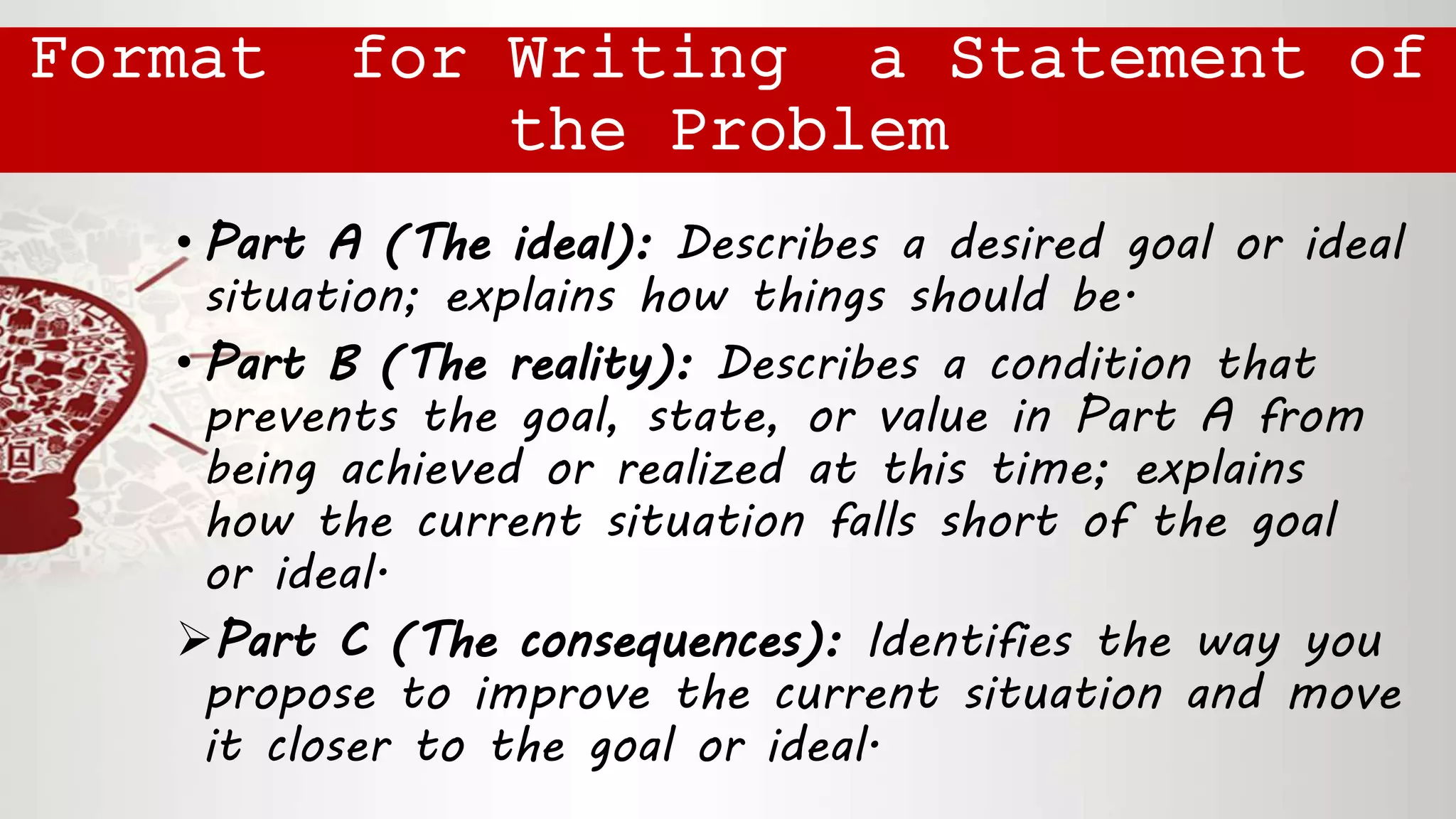
• Part A (The ideal): Describes a desired goal or ideal
situation; explains how things should be.
• Part B (The reality): Describes a condition that
prevents the goal, state, or value in Part A from
being achieved or realized at this time; explains
how the current situation falls short of the goal
or ideal.
Part C (The consequences): Identifies the way you
propose to improve the current situation and move
it closer to the goal or ideal.
Format for Writing a Statement of
the Problem
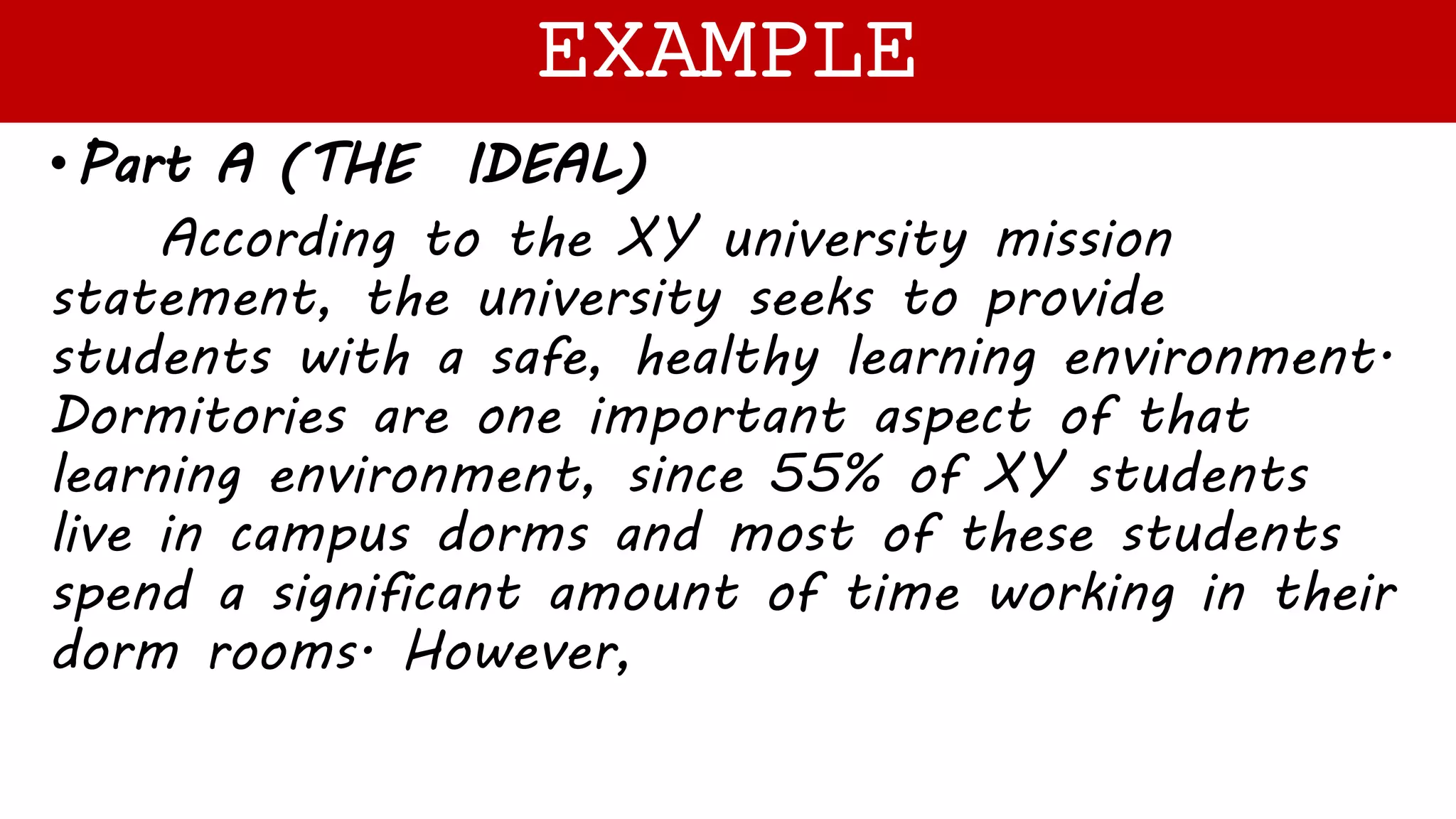
•Part A (THE IDEAL)
According to the XY university mission
statement, the university seeks to provide
students with a safe, healthy learning environment.
Dormitories are one important aspect of that
learning environment, since 55% of XY students
live in campus dorms and most of these students
spend a significant amount of time working in their
dorm rooms. However,
EXAMPLE
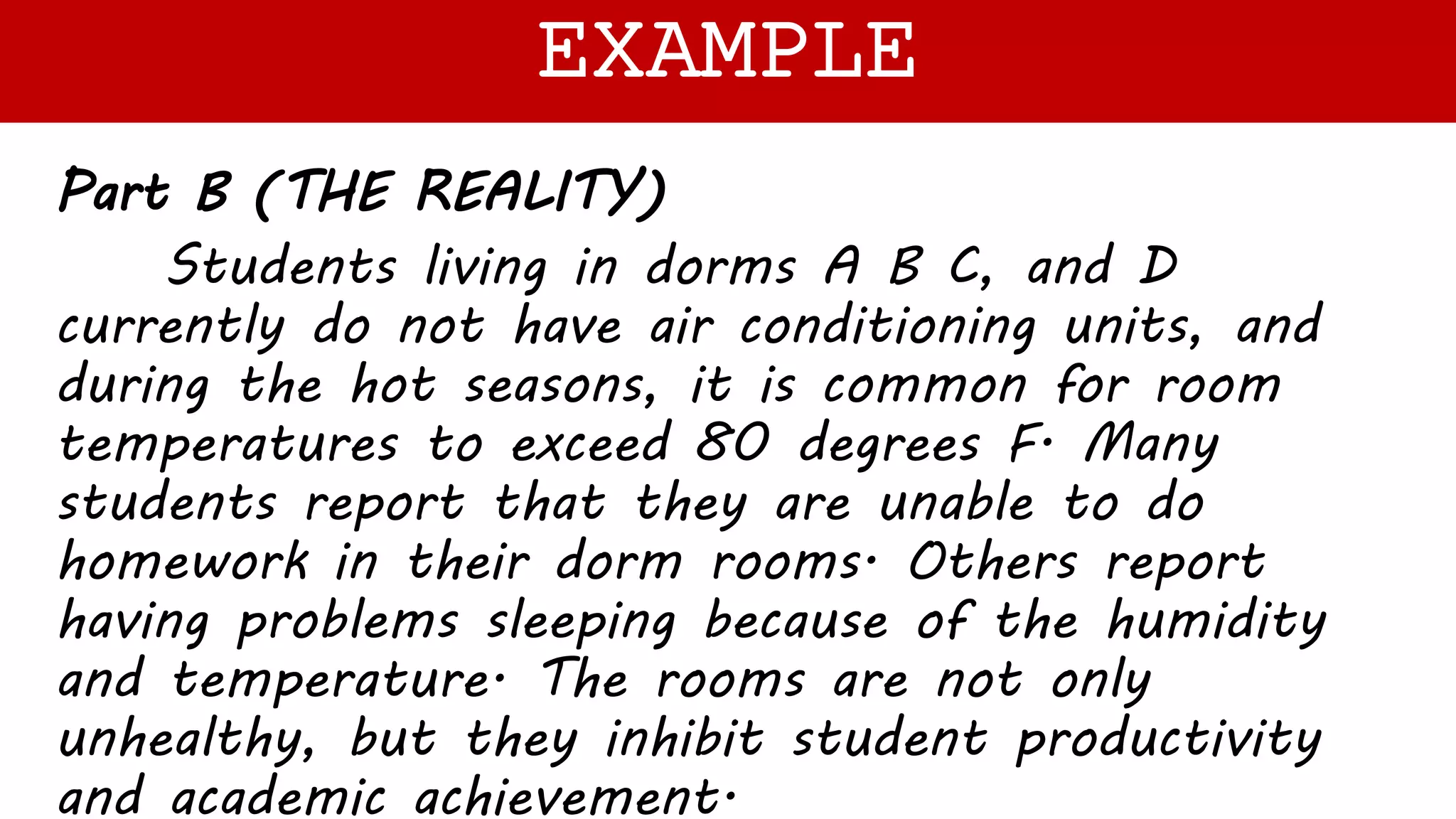
Part B (THE REALITY)
Students living in dorms A B C, and D
currently do not have air conditioning units, and
during the hot seasons, it is common for room
temperatures to exceed 80 degrees F. Many
students report that they are unable to do
homework in their dorm rooms. Others report
having problems sleeping because of the humidity
and temperature. The rooms are not only
unhealthy, but they inhibit student productivity
and academic achievement.
EXAMPLE
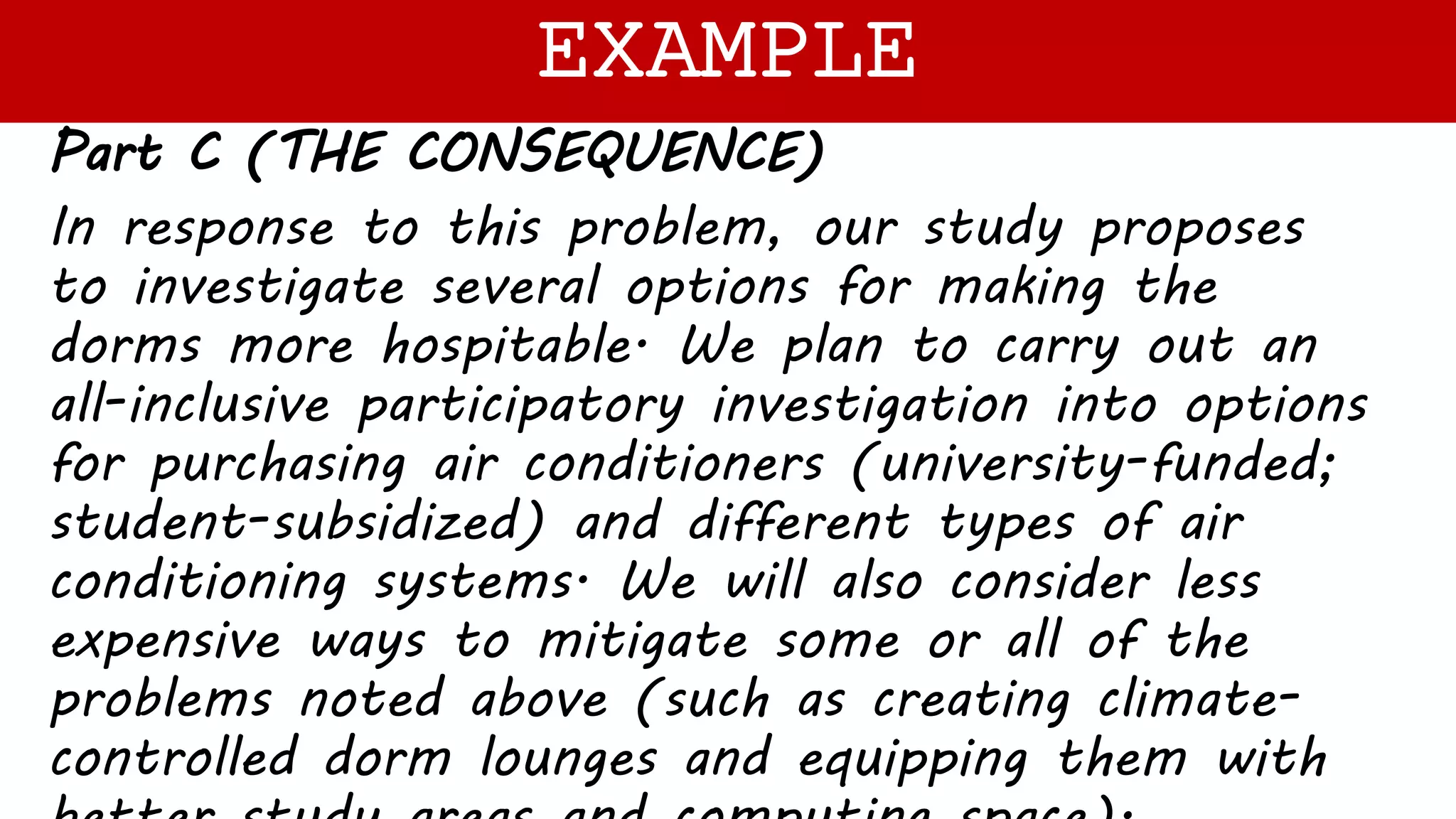
Part C (THE CONSEQUENCE)
In response to this problem, our study proposes
to investigate several options for making the
dorms more hospitable. We plan to carry out an
all-inclusive participatory investigation into options
for purchasing air conditioners (university-funded;
student-subsidized) and different types of air
conditioning systems. We will also consider less
expensive ways to mitigate some or all of the
problems noted above (such as creating climate-
controlled dorm lounges and equipping them with
EXAMPLE
Thank You
and
God Bless!

Criteria of a Good Research Problem/Objectives

  • 1.
    Mr. BJ R.AMBAT
  • 2.
    • Solvable/Researchabl e • Current •Interesting • clear & unambiguous • Empirical & Verifiable • Relevant • Systematic • Significance to the discipline • Originality • Feasibility • Administrative support • Peer support • Availability of subjects • Researcher’s competency • Ethical considerations
  • 3.
    a research problemis significant for a discipline when it is directed to develop or refine the body of professional knowledge.
  • 4.
    Every research shouldbe new and unique in itself. Therefore, it is the responsibility of the researcher that innovative knowledge is used for selecting a research problem so as to extend the growth of existing body of knowledge in a profession.
  • 5.
    A research shouldbe feasible in terms of time, availability of subjects, facilities, equipment & money and ethical considerations.
  • 6.
    Financial & psychologicalsupport from the administrations is essential to conduct research.
  • 7.
    A climate ofshared interest among the professional members promote research activities smoothly
  • 8.
    Sometimes the potentialsubjects may not meet the study criteria or may be unwilling to participate in the study or may be already participating in another studies. Therefore, the availability of the subjects should be well ensured in advance.
  • 9.
    A research problemcan only be feasible if it is in accordance with the researcher’s competence. A researcher should be capable to handle a given research problem.
  • 10.
    Sometimes the potentialsubjects may not meet the study criteria or may be unwilling to participate in the study or may be already participating in another studies. Therefore, the availability of the subjects should be well ensured in advance.
  • 11.
    the research problemselected should be cleared by the ethical committee without undue hurdles. A very important topic of research cannot be considered feasible until & unless it is in accordance with the ethical guidelines.
  • 12.
    -only a researchproblem that is solvable is considered to be good. A researcher should minimize the chances of insolvability -this aspect of the problem may pose ambiguity and hence a researcher should ensure the solvability of the problem that is selected.
  • 13.
    A good researchproblem must be based on the current problems and needs of the profession. Thus the result generated will be of more use. Furthermore, more number of the professionals will be interested in the research conducted on the current issues of their profession.
  • 14.
    a research problemmust be as per the motivation of the researcher and it should be fascinating to the researcher. Thus a research will be conducted with full enthusiasm and not merely for its accomplishment.
  • 15.
    the research problemselected should be clear in its ability to reflect or give clues regarding the various aspects of methodology.
  • 16.
    the research problemselected to be researched should amenable to scientific inquiry. The research should be verifiable by scientific calculations.
  • 17.
    the research problemchosen to be researched should be relevant to the profession, time, need the competency of the researcher.
  • 18.
    the research problemshould be systematic- in the sense the researcher should have arrived at the problem statement following relevant selection parameters or criteria.
  • 19.
  • 20.
    THE RESEARCH OBJECTIVES is a clear, concise, declarative statement, which provides direction to investigate the variables under the study  the objectives of a research project summarize what is to be achieved by the study  without a clear objective a researcher is aimless and directionless in conducting the study.
  • 21.
    THE RESEARCH OBJECTIVES without focused objectives, no replicable scientific findings can be expected.  is a purpose that can be reasonably achieved within the expected timeframe and with the available resources
  • 22.
  • 23.
    TYPES of researchobjectives  General Objective -statement of the long-term or overall goal of the study - the general objectives of the study states what the researcher expects to achieve by the study in general terms.  Specific Objectives – specific statements or questions derived from the general objective which are to be answered by the study.
  • 24.
    EXAMPLE Research Idea: Vandalism ResearchProblem: Why is vandalism common among university students? General Objective: To explain why university students engage in vandalistic acts in school Specific Objectives: 1. To determine the prevalence of students who admitted that hey have committed some vandalistic acts at least
  • 25.
    EXAMPLE Research Idea: Povertyand Education Research Problem: What are effects of poverty on education among selected barangays in Dagupan City General Objective: To identify the effects of poverty on education among selected barangays in Dagupan City Specific Objectives: 1. To assess the effects of poverty… 2. To determine the prevalence of poverty among…
  • 26.
    Methods of statingobjective  should be presented briefly and concisely  should cover the different aspects of the problem and its contributing factors in a coherent way and in a logical sequence.  should be clearly phrased in operational terms, specifying exactly what the researcher is going to do, where and for what purpose  realistic considering the local conditions.  use action verbs that are specific enough to be evaluated
  • 27.
    KNOWLEDGE DOMAIN Count Match Recognize DefineName Record Describe Outline State Draw Point out Select Identify Quote Reproduce
  • 28.
    Comprehension Associate Compute Convert DefendDiscuss Distinguish Estimate Explain Extend Extrapolate Generalize Give example Infer Paraphrase Predict Rewrite Summarize
  • 29.
    SYNTHESIS DOMAIN Categorize CombineCompile Compose Create Drive Design Devise Explain Generate Integrate Modify Order Organize Plan Prescribe Propose Rearrange Reconstruct Revise Summarize Specify
  • 30.
    ANALYSIS DOMAIN Analyze ArrangeBreakdown Combine Design Detect Develop Diagram Differentiate Discriminate Illustrate Infer Outline Relate Select Separate Subdivide Utilize
  • 31.
    APPLICATION DOMAIN Add ApplyCalculate Change Complete Compute Demonstrate Discover Examine Graph Interpolate Manipulate Operate Prepare Produce Show Subtract Translate Use Solve Classify Divide Modify
  • 32.
    EVALUATION DOMAIN Appraise AssessCompare Conclude Contrast Criticize Critique Determine Grade Interpret Judge Justify Measure Rank Support Test
  • 33.
    EXAMPLE Research Idea: Povertyand Education Research Problem: What are effects of poverty on education among selected barangays in Dagupan City General Objective: To identify the effects of poverty on education among selected barangays in Dagupan City Specific Objectives: 1. To assess the effects of poverty… 2. To determine the prevalence of poverty among…
  • 34.
  • 35.
    A problem statementis the description of an issue currently existing which needs to be addressed It provides the context for the research study and generates the questions which the research aims to answer The statement of the problem is the Problem Statement
  • 36.
    The statement ofthe problem should clearly indicate what is to be investigated The actual statement may be in a declarative or in a question form. The statement should indicate the variables of interest and the specific relationship between the variables that Criteria of Research Problem Statements
  • 37.
    • Part A(The ideal): Describes a desired goal or ideal situation; explains how things should be. • Part B (The reality): Describes a condition that prevents the goal, state, or value in Part A from being achieved or realized at this time; explains how the current situation falls short of the goal or ideal. Part C (The consequences): Identifies the way you propose to improve the current situation and move it closer to the goal or ideal. Format for Writing a Statement of the Problem
  • 38.
    •Part A (THEIDEAL) According to the XY university mission statement, the university seeks to provide students with a safe, healthy learning environment. Dormitories are one important aspect of that learning environment, since 55% of XY students live in campus dorms and most of these students spend a significant amount of time working in their dorm rooms. However, EXAMPLE
  • 39.
    Part B (THEREALITY) Students living in dorms A B C, and D currently do not have air conditioning units, and during the hot seasons, it is common for room temperatures to exceed 80 degrees F. Many students report that they are unable to do homework in their dorm rooms. Others report having problems sleeping because of the humidity and temperature. The rooms are not only unhealthy, but they inhibit student productivity and academic achievement. EXAMPLE
  • 40.
    Part C (THECONSEQUENCE) In response to this problem, our study proposes to investigate several options for making the dorms more hospitable. We plan to carry out an all-inclusive participatory investigation into options for purchasing air conditioners (university-funded; student-subsidized) and different types of air conditioning systems. We will also consider less expensive ways to mitigate some or all of the problems noted above (such as creating climate- controlled dorm lounges and equipping them with EXAMPLE
  • 41.