


Research approaches and
designs
Mr. Sushil Humane MSN, RN
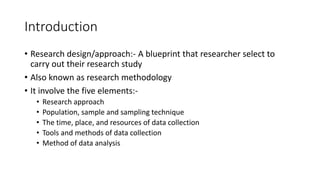
Introduction
• Research design/approach:- A blueprint that researcher select to
carry out their research study
• Also known as research methodology
• It involve the five elements:-
• Research approach
• Population, sample and sampling technique
• The time, place, and resources of data collection
• Tools and methods of data collection
• Method of data analysis
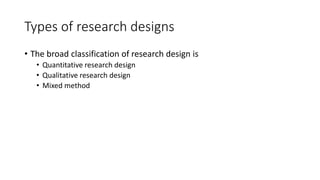
Types of research designs
• The broad classification of research design is
• Quantitative research design
• Qualitative research design
• Mixed method
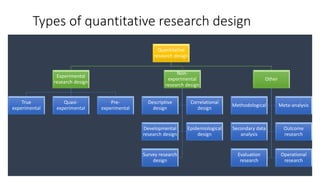
Types of quantitative research design
Quantitative
research design
Experimental
research design
True
experimental
Quasi-
experimental
Pre-
experimental
Non-
experimental
research design
Descriptive
design
Correlational
design
Developmental
research design
Epidemiological
design
Survey research
design
Other
Methodological Meta-analysis
Secondary data
analysis
Outcome
research
Evaluation
research
Operational
research
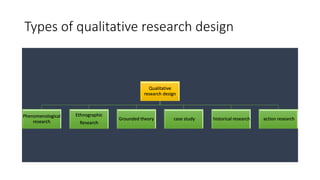
Types of qualitative research design
Qualitative
research design
Phenomenological
research
Ethnographic
Research
Grounded theory case study historical research action research
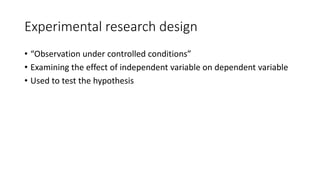
Experimental research design
• “Observation under controlled conditions”
• Examining the effect of independent variable on dependent variable
• Used to test the hypothesis
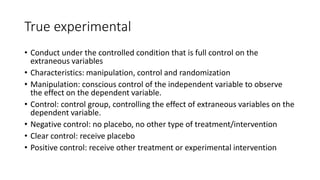
True experimental
• Conduct under the controlled condition that is full control on the
extraneous variables
• Characteristics: manipulation, control and randomization
• Manipulation: conscious control of the independent variable to observe
the effect on the dependent variable.
• Control: control group, controlling the effect of extraneous variables on the
dependent variable.
• Negative control: no placebo, no other type of treatment/intervention
• Clear control: receive placebo
• Positive control: receive other treatment or experimental intervention
True experimental
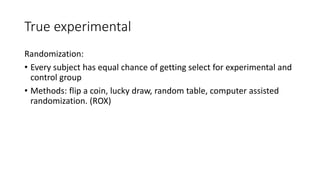
Randomization:
• Every subject has equal chance of getting select for experimental and
control group
• Methods: flip a coin, lucky draw, random table, computer assisted
randomization. (ROX)
Types of true experimental
Post test only
Pretest post-test only
Solomon 4 group
Factorial
Randomize block
Crossover
Latin square
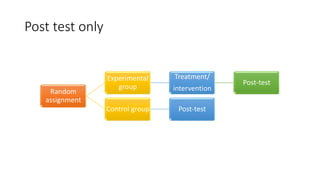
Post test only
Random
assignment
Experimental
group
Treatment/
intervention
Post-test
Control group Post-test
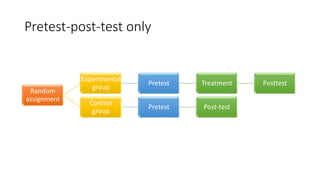
Pretest-post-test only
Random
assignment
Experimental
group
Pretest Treatment Posttest
Control
group
Pretest Post-test
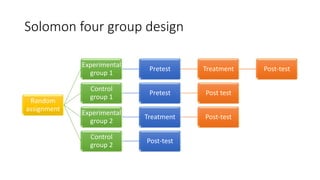
Solomon four group design
Random
assignment
Experimental
group 1
Pretest Treatment Post-test
Control
group 1
Pretest Post test
Experimental
group 2
Treatment Post-test
Control
group 2
Post-test
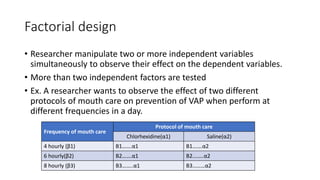
Factorial design
• Researcher manipulate two or more independent variables
simultaneously to observe their effect on the dependent variables.
• More than two independent factors are tested
• Ex. A researcher wants to observe the effect of two different
protocols of mouth care on prevention of VAP when perform at
different frequencies in a day.
Frequency of mouth care
Protocol of mouth care
Chlorhexidine(α1) Saline(α2)
4 hourly (β1) Β1…….α1 Β1…….α2
6 hourly(β2) Β2…….α1 Β2……..α2
8 hourly (β3) Β3……..α1 Β3………α2
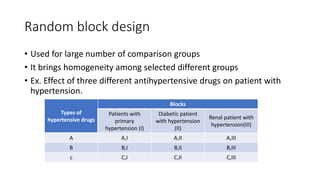
Random block design
• Used for large number of comparison groups
• It brings homogeneity among selected different groups
• Ex. Effect of three different antihypertensive drugs on patient with
hypertension.
Types of
hypertensive drugs
Blocks
Patients with
primary
hypertension (I)
Diabetic patient
with hypertension
(II)
Renal patient with
hypertension(III)
A A,I A,II A,III
B B,I B,II B,III
c C,I C,II C,III
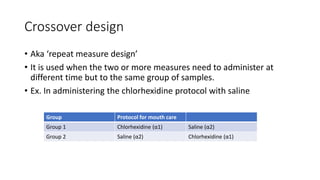
Crossover design
• Aka ‘repeat measure design’
• It is used when the two or more measures need to administer at
different time but to the same group of samples.
• Ex. In administering the chlorhexidine protocol with saline
Group Protocol for mouth care
Group 1 Chlorhexidine (α1) Saline (α2)
Group 2 Saline (α2) Chlorhexidine (α1)
Advantages of true experimental design
• Most powerful design for finding the relationship between
independent and dependent variables
• Due to advantage of using control environment Yield greater degree
of purity in observation.
• Condition that not found in natural setting can be created in the
experimental setting
• We can create a control environment in short period of time which
may take very long time naturally
• The research can be conducted in an environment where the
researcher get the leisure, care and concentration in study
Disadvantage of true experimental design
• Result cannot be replicated in human population due to ethical
problems
• In some cases, the danger can be occur to samples physical or mental
health
• Some of the criteria does not have any tool to measure. Ex. Level of
wellness.
• Sometime the extraneous variables are out of control
• If the intervention/effect then the process become time consuming
• Study participants may generate the difficulty or change
Quasi-experimental research
design
Mr. Sushil Humane MSN. RN
Features
• The manipulation of independent variable to observe the effect on
dependent variable
• Lacks at least one of characteristic of true experimental design:
randomization or control group.
• used when there is no random assignment of subject and difficult to
form control group.
Types of quasi-experimental design
• Nonrandomized control group design
• Time series design
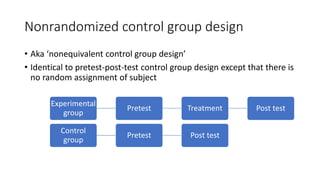
Nonrandomized control group design
• Aka ‘nonequivalent control group design’
• Identical to pretest-post-test control group design except that there is
no random assignment of subject
Experimental
group
Pretest Treatment Post test
Control
group
Pretest Post test
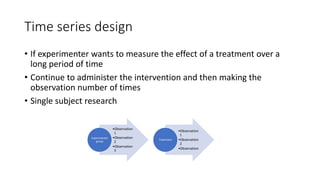
Time series design
• If experimenter wants to measure the effect of a treatment over a
long period of time
• Continue to administer the intervention and then making the
observation number of times
• Single subject research
•Observation
1
•Observation
2
•Observation
3
Experimental
group
•Observation
1
•Observation
2
•Observation
Treatment
Advantages of quasi-experimental group
• More practical and feasible
• More realistic than true experimental
• Evaluation of impact under natural setting
Disadvantages of quasi-experimental design
• No control over extraneous variables
• The absence of control group or a lack of control over the research
setting makes the result of this design less reliable and weak for the
establishment of causal relationship.
Pre-experimental research design
• Very weak because researcher has very little control over the
experiment.
Types
• One shot case design
• One group pretest-post-test design
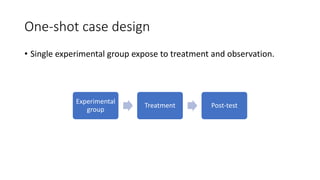
One-shot case design
• Single experimental group expose to treatment and observation.
Experimental
group
Treatment Post-test
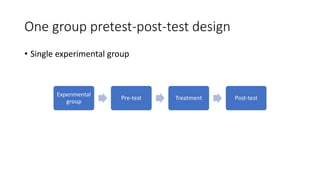
One group pretest-post-test design
• Single experimental group
Experimental
group
Pre-test Treatment Post-test
Advantages
• Very simple and convenient to conduct the study in natural setting
• Most suitable design for beginners
Disadvantages
• Considered very weak
• it has very little control over the research
• Higher threat to internal validity of the research
• May cause selection bias
Non-experimental design
Mr. Sushil Humane MSN. RN
Features
• Observation of the phenomenon in the natural setting and no
external variable introduce
• No manipulation or control
Types of non-experimental research design
• Descriptive design
• Correlational/ex-post facto design
• Developmental research design
• Epidemiological design
• Survey research design
Descriptive design
• Observe, document and describe
• Collection of information related to characteristics
• Usually has large sample size to prevent bias
Types:
1. Univariant descriptive design
2. Exploratory design
3. Comparative design
Univariant descriptive design
• Describe the frequency of occurrence of phenomenon
• It not only describe the variables but also find the relationship
between the variables
• Mainly used to describe the perception, awareness, behavior,
attitude, knowledge and practice
Exploratory research design
• Identify, explore and describe the existing phenomenon and its
related factors
• Example: an exploratory study to assess the multifactorial dimensions
of falls and home safety measures for elderly people living in selected
communities in Amravati.
Comparative study
• Involves comparing and contrasting two or more of the sample of
study subjects on one or more variables, often at a single point of
time.
• Two attributes are compaired
• Ex. Knowledge level and perception
Correlational study
• Non-experimental design where the researcher examines the
relationship between two or more variables in natural setting
• No manipulation
• Ex. Correlational study to assess/investigate the study habits and
visual acuity among the school children.
• Direction of relationship between variables: positive, negative or zero
• Types: prospective, retrospective and ambispective
Developmental research design
• Examination of phenomenon with reference of time
• Types: cross-sectional, longitudinal
• Cross-sectional research design: data collection is done at a point of
time
• Longitudinal research design: data collection over an extended period
of time.
• Types: trend study, panel study, follow-up study.
Epidemiological research design
• Investigate the distribution and causes of disease in population
• Types: cohort study, case-control study
• Cohort study:- incidence study are design to measure the exposure
and outcome in the context of time.
Survey research design
• Collection of information from different subjects within a given
population
• Sample survey, population survey/census
• Collected information is about prevalence, distribution and
interrelationship of variables within a population.
•
Advantages of non-experimental research
design
• Closest to real life situation.
• Most suitable for the nursing research studies
• Some human characteristics are subjected to experimental
manipulation(e.g. blood type, personality, health belief, medical
diagnosis etc.)
Disadvantage of non-experimental research
• The relationship between the independent and dependent variable
can never be absolutely clear and error free.
• Authenticity and generalizability of the study is less as compare to
other designs
Other additional research design
• Methodological research: develop, validate, test and evaluate the
research instrument and method.
• Meta-analysis: quantitatively combining and integrating the finding of
the multiple research studies on a particular topic
• Secondary data analysis: new researcher testing the data with new
hypothesis.
References
• Suresh k. sharma. nursing research and statistics. 2nd edition.
• Polit, D.F. & Beck, C.T. (2017). Nursing research: Generating and
assessing evidence for nursing practice.

Research approches and designs

  • 1.
  • 2.
    Introduction • Research design/approach:-A blueprint that researcher select to carry out their research study • Also known as research methodology • It involve the five elements:- • Research approach • Population, sample and sampling technique • The time, place, and resources of data collection • Tools and methods of data collection • Method of data analysis
  • 3.
    Types of researchdesigns • The broad classification of research design is • Quantitative research design • Qualitative research design • Mixed method
  • 4.
    Types of quantitativeresearch design Quantitative research design Experimental research design True experimental Quasi- experimental Pre- experimental Non- experimental research design Descriptive design Correlational design Developmental research design Epidemiological design Survey research design Other Methodological Meta-analysis Secondary data analysis Outcome research Evaluation research Operational research
  • 5.
    Types of qualitativeresearch design Qualitative research design Phenomenological research Ethnographic Research Grounded theory case study historical research action research
  • 6.
    Experimental research design •“Observation under controlled conditions” • Examining the effect of independent variable on dependent variable • Used to test the hypothesis
  • 7.
    True experimental • Conductunder the controlled condition that is full control on the extraneous variables • Characteristics: manipulation, control and randomization • Manipulation: conscious control of the independent variable to observe the effect on the dependent variable. • Control: control group, controlling the effect of extraneous variables on the dependent variable. • Negative control: no placebo, no other type of treatment/intervention • Clear control: receive placebo • Positive control: receive other treatment or experimental intervention
  • 8.
    True experimental Randomization: • Everysubject has equal chance of getting select for experimental and control group • Methods: flip a coin, lucky draw, random table, computer assisted randomization. (ROX)
  • 9.
    Types of trueexperimental Post test only Pretest post-test only Solomon 4 group Factorial Randomize block Crossover Latin square
  • 10.
  • 11.
  • 12.
    Solomon four groupdesign Random assignment Experimental group 1 Pretest Treatment Post-test Control group 1 Pretest Post test Experimental group 2 Treatment Post-test Control group 2 Post-test
  • 13.
    Factorial design • Researchermanipulate two or more independent variables simultaneously to observe their effect on the dependent variables. • More than two independent factors are tested • Ex. A researcher wants to observe the effect of two different protocols of mouth care on prevention of VAP when perform at different frequencies in a day. Frequency of mouth care Protocol of mouth care Chlorhexidine(α1) Saline(α2) 4 hourly (β1) Β1…….α1 Β1…….α2 6 hourly(β2) Β2…….α1 Β2……..α2 8 hourly (β3) Β3……..α1 Β3………α2
  • 14.
    Random block design •Used for large number of comparison groups • It brings homogeneity among selected different groups • Ex. Effect of three different antihypertensive drugs on patient with hypertension. Types of hypertensive drugs Blocks Patients with primary hypertension (I) Diabetic patient with hypertension (II) Renal patient with hypertension(III) A A,I A,II A,III B B,I B,II B,III c C,I C,II C,III
  • 15.
    Crossover design • Aka‘repeat measure design’ • It is used when the two or more measures need to administer at different time but to the same group of samples. • Ex. In administering the chlorhexidine protocol with saline Group Protocol for mouth care Group 1 Chlorhexidine (α1) Saline (α2) Group 2 Saline (α2) Chlorhexidine (α1)
  • 16.
    Advantages of trueexperimental design • Most powerful design for finding the relationship between independent and dependent variables • Due to advantage of using control environment Yield greater degree of purity in observation. • Condition that not found in natural setting can be created in the experimental setting • We can create a control environment in short period of time which may take very long time naturally • The research can be conducted in an environment where the researcher get the leisure, care and concentration in study
  • 17.
    Disadvantage of trueexperimental design • Result cannot be replicated in human population due to ethical problems • In some cases, the danger can be occur to samples physical or mental health • Some of the criteria does not have any tool to measure. Ex. Level of wellness. • Sometime the extraneous variables are out of control • If the intervention/effect then the process become time consuming • Study participants may generate the difficulty or change
  • 18.
  • 19.
    Features • The manipulationof independent variable to observe the effect on dependent variable • Lacks at least one of characteristic of true experimental design: randomization or control group. • used when there is no random assignment of subject and difficult to form control group.
  • 20.
    Types of quasi-experimentaldesign • Nonrandomized control group design • Time series design
  • 21.
    Nonrandomized control groupdesign • Aka ‘nonequivalent control group design’ • Identical to pretest-post-test control group design except that there is no random assignment of subject Experimental group Pretest Treatment Post test Control group Pretest Post test
  • 22.
    Time series design •If experimenter wants to measure the effect of a treatment over a long period of time • Continue to administer the intervention and then making the observation number of times • Single subject research •Observation 1 •Observation 2 •Observation 3 Experimental group •Observation 1 •Observation 2 •Observation Treatment
  • 23.
    Advantages of quasi-experimentalgroup • More practical and feasible • More realistic than true experimental • Evaluation of impact under natural setting
  • 24.
    Disadvantages of quasi-experimentaldesign • No control over extraneous variables • The absence of control group or a lack of control over the research setting makes the result of this design less reliable and weak for the establishment of causal relationship.
  • 25.
    Pre-experimental research design •Very weak because researcher has very little control over the experiment. Types • One shot case design • One group pretest-post-test design
  • 26.
    One-shot case design •Single experimental group expose to treatment and observation. Experimental group Treatment Post-test
  • 27.
    One group pretest-post-testdesign • Single experimental group Experimental group Pre-test Treatment Post-test
  • 28.
    Advantages • Very simpleand convenient to conduct the study in natural setting • Most suitable design for beginners
  • 29.
    Disadvantages • Considered veryweak • it has very little control over the research • Higher threat to internal validity of the research • May cause selection bias
  • 30.
  • 31.
    Features • Observation ofthe phenomenon in the natural setting and no external variable introduce • No manipulation or control
  • 32.
    Types of non-experimentalresearch design • Descriptive design • Correlational/ex-post facto design • Developmental research design • Epidemiological design • Survey research design
  • 33.
    Descriptive design • Observe,document and describe • Collection of information related to characteristics • Usually has large sample size to prevent bias Types: 1. Univariant descriptive design 2. Exploratory design 3. Comparative design
  • 34.
    Univariant descriptive design •Describe the frequency of occurrence of phenomenon • It not only describe the variables but also find the relationship between the variables • Mainly used to describe the perception, awareness, behavior, attitude, knowledge and practice
  • 35.
    Exploratory research design •Identify, explore and describe the existing phenomenon and its related factors • Example: an exploratory study to assess the multifactorial dimensions of falls and home safety measures for elderly people living in selected communities in Amravati.
  • 36.
    Comparative study • Involvescomparing and contrasting two or more of the sample of study subjects on one or more variables, often at a single point of time. • Two attributes are compaired • Ex. Knowledge level and perception
  • 37.
    Correlational study • Non-experimentaldesign where the researcher examines the relationship between two or more variables in natural setting • No manipulation • Ex. Correlational study to assess/investigate the study habits and visual acuity among the school children. • Direction of relationship between variables: positive, negative or zero • Types: prospective, retrospective and ambispective
  • 38.
    Developmental research design •Examination of phenomenon with reference of time • Types: cross-sectional, longitudinal • Cross-sectional research design: data collection is done at a point of time • Longitudinal research design: data collection over an extended period of time. • Types: trend study, panel study, follow-up study.
  • 39.
    Epidemiological research design •Investigate the distribution and causes of disease in population • Types: cohort study, case-control study • Cohort study:- incidence study are design to measure the exposure and outcome in the context of time.
  • 40.
    Survey research design •Collection of information from different subjects within a given population • Sample survey, population survey/census • Collected information is about prevalence, distribution and interrelationship of variables within a population. •
  • 41.
    Advantages of non-experimentalresearch design • Closest to real life situation. • Most suitable for the nursing research studies • Some human characteristics are subjected to experimental manipulation(e.g. blood type, personality, health belief, medical diagnosis etc.)
  • 42.
    Disadvantage of non-experimentalresearch • The relationship between the independent and dependent variable can never be absolutely clear and error free. • Authenticity and generalizability of the study is less as compare to other designs
  • 43.
    Other additional researchdesign • Methodological research: develop, validate, test and evaluate the research instrument and method. • Meta-analysis: quantitatively combining and integrating the finding of the multiple research studies on a particular topic • Secondary data analysis: new researcher testing the data with new hypothesis.
  • 44.
    References • Suresh k.sharma. nursing research and statistics. 2nd edition. • Polit, D.F. & Beck, C.T. (2017). Nursing research: Generating and assessing evidence for nursing practice.