Download as PPSX, PPTX


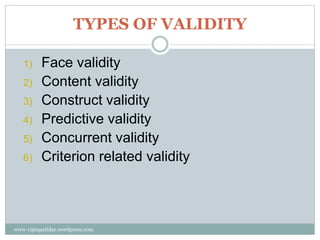

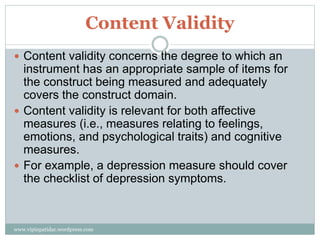

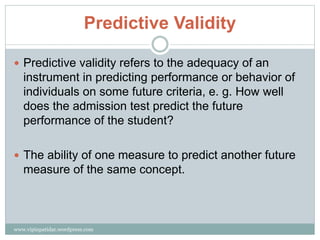
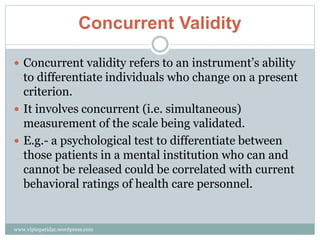

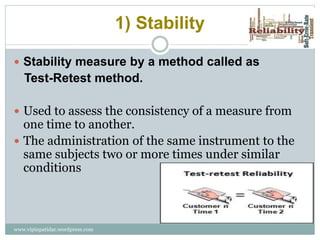
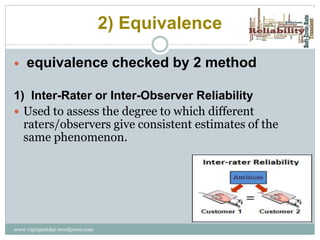


This document discusses validity and reliability in psychological measurement. It defines validity as the degree to which a tool measures what it intends to measure. There are several types of validity discussed, including face validity, content validity, construct validity, predictive validity, concurrent validity, and criterion-related validity. Reliability refers to the consistency and repeatability of a measure. The main types of reliability covered are stability, equivalence, and internal consistency. Stability is assessed through test-retest methods, equivalence through inter-rater reliability and parallel forms, and internal consistency through split-half reliability.


