S. D. Kavitha Devaraj
Research Design
 Blue print
 Back bone
 Overall Plan
 Framework
 Master plan
 A Strategy
Purposes of Research Design
 Scheme for answering the question
 Control bias
 Organize the study
Characteristics of a good design
 Control of bias.
 Capable of obtaining the most reliable and valid data.
 Helps an investigator avoid making mistaken
conclusions
 Control the various threats of validity, both internal
and external.
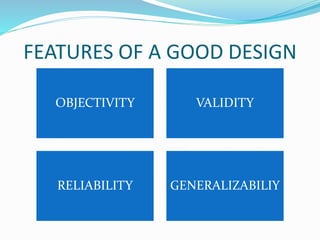
FEATURES OF A GOOD DESIGN
OBJECTIVITY VALIDITY
RELIABILITY GENERALIZABILIY
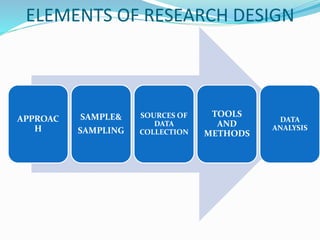
ELEMENTS OF RESEARCH DESIGN
APPROAC
H
SAMPLE&
SAMPLING
SOURCES OF
DATA
COLLECTION
TOOLS
AND
METHODS
DATA
ANALYSIS
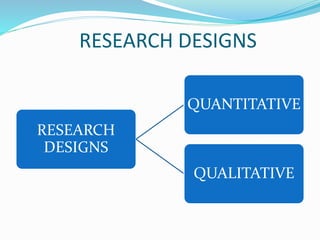
RESEARCH DESIGNS
RESEARCH
DESIGNS
QUANTITATIVE
QUALITATIVE
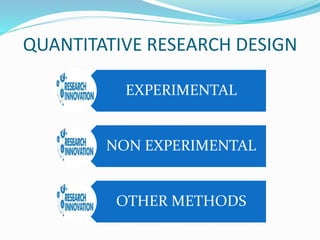
QUANTITATIVE RESEARCH DESIGN
EXPERIMENTAL
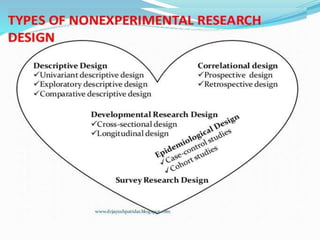
NON EXPERIMENTAL
OTHER METHODS
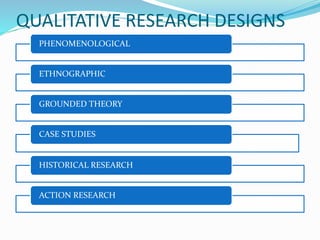
QUALITATIVE RESEARCH DESIGNS
PHENOMENOLOGICAL
ETHNOGRAPHIC
GROUNDED THEORY
CASE STUDIES
HISTORICAL RESEARCH
ACTION RESEARCH
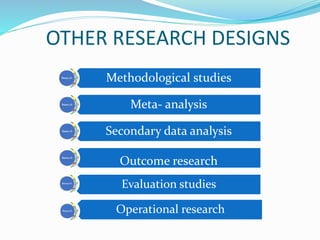
OTHER RESEARCH DESIGNS
Methodological studies
Meta- analysis
Secondary data analysis
Outcome research
Evaluation studies
Operational research
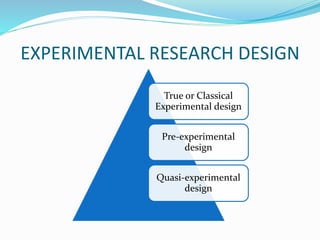
EXPERIMENTAL RESEARCH DESIGN
True or Classical
Experimental design
Pre-experimental
design
Quasi-experimental
design
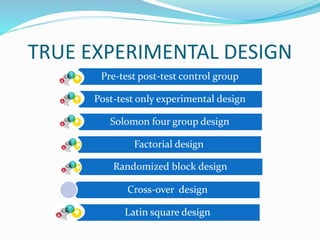
TRUE EXPERIMENTAL DESIGN
Pre-test post-test control group
Post-test only experimental design
Solomon four group design
Factorial design
Randomized block design
Cross-over design
Latin square design
QUASI EXPERIMENTAL DESIGN
Non randomized
/non equivalent
control group design
Time series design
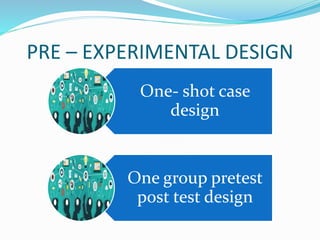
PRE – EXPERIMENTAL DESIGN
One- shot case
design
One group pretest
post test design
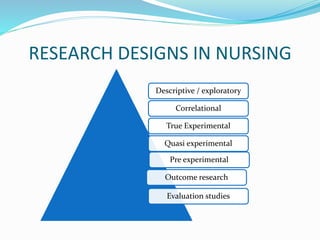
RESEARCH DESIGNS IN NURSING
Descriptive / exploratory
Correlational
True Experimental
Quasi experimental
Pre experimental
Outcome research
Evaluation studies
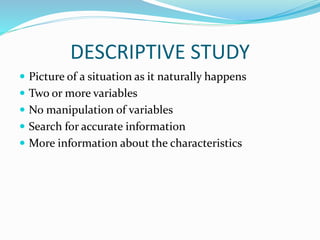
DESCRIPTIVE STUDY
 Picture of a situation as it naturally happens
 Two or more variables
 No manipulation of variables
 Search for accurate information
 More information about the characteristics
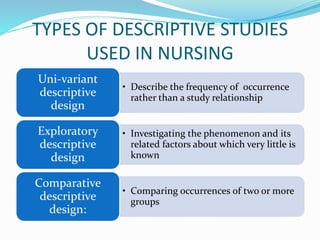
TYPES OF DESCRIPTIVE STUDIES
USED IN NURSING
• Describe the frequency of occurrence
rather than a study relationship
Uni-variant
descriptive
design
• Investigating the phenomenon and its
related factors about which very little is
known
Exploratory
descriptive
design
• Comparing occurrences of two or more
groups
Comparative
descriptive
design:
Advantages of descriptive study
Develop theories
Identify problems with current practices
Justify current practices
Accurate information
Disadvantages
Information collected is very brief and
superficial
Time consuming process
CORRELATIONAL /EX-POST FACTO
DESIGN
The researcher examines the
relationship between two or
more variables in a natural
setting without manipulation or
control.
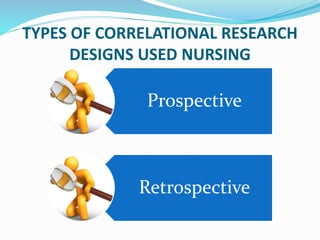
TYPES OF CORRELATIONAL RESEARCH
DESIGNS USED NURSING
Prospective
Retrospective
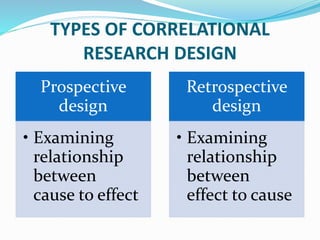
TYPES OF CORRELATIONAL
RESEARCH DESIGN
Prospective
design
• Examining
relationship
between
cause to effect
Retrospective
design
• Examining
relationship
between
effect to cause
Advantages:
Increase flexibility during examining the
relationship
Effective and efficient method in collecting large
amount of data
Exploring a relationship between variables.
Opens up further research
Disadvantages:
Only uncovers a relationship
Cannot provide reason for relationship
No randomization
Unable to determine causal relationship
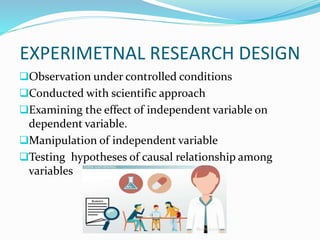
EXPERIMETNAL RESEARCH DESIGN
Observation under controlled conditions
Conducted with scientific approach
Examining the effect of independent variable on
dependent variable.
Manipulation of independent variable
Testing hypotheses of causal relationship among
variables
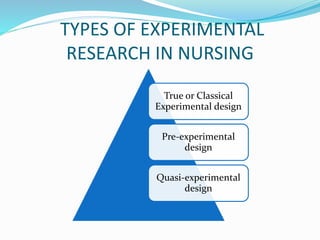
TYPES OF EXPERIMENTAL
RESEARCH IN NURSING
True or Classical
Experimental design
Pre-experimental
design
Quasi-experimental
design
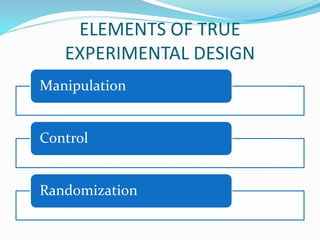
ELEMENTS OF TRUE
EXPERIMENTAL DESIGN
Manipulation
Control
Randomization
TRUE EXPERIMENTAL RESEARCH
DESIGN
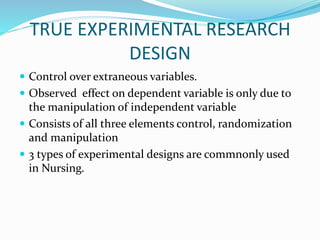
 Control over extraneous variables.
 Observed effect on dependent variable is only due to
the manipulation of independent variable
 Consists of all three elements control, randomization
and manipulation
 3 types of experimental designs are commnonly used
in Nursing.
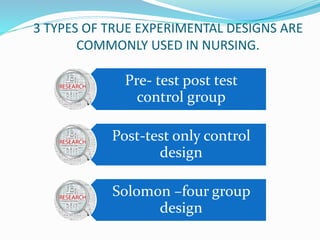
3 TYPES OF TRUE EXPERIMENTAL DESIGNS ARE
COMMONLY USED IN NURSING.
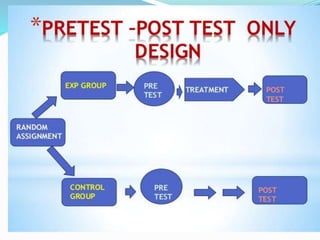
Pre- test post test
control group
Post-test only control
design
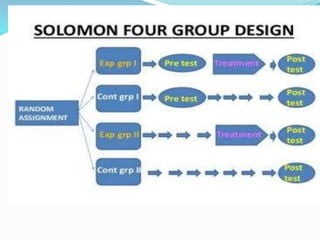
Solomon –four group
design
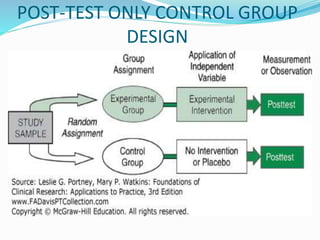
POST-TEST ONLY CONTROL GROUP
DESIGN
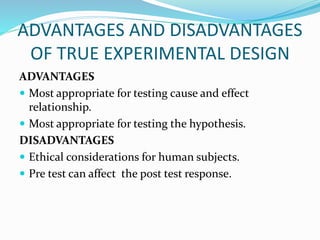
ADVANTAGES AND DISADVANTAGES
OF TRUE EXPERIMENTAL DESIGN
ADVANTAGES
 Most appropriate for testing cause and effect
relationship.
 Most appropriate for testing the hypothesis.
DISADVANTAGES
 Ethical considerations for human subjects.
 Pre test can affect the post test response.
QUASI EXPERIMENTAL DESIGN
 Involves manipulation of independent variable.
 Lack one characteristics of true experimental design.
 Either randomization or control exists.
 Test cause and effect relationship.
TYPES OF QUASI EXPERIMENTAL
DESIGN
Non randomized
/non equivalent
control group design
Time series design
QUASI EXPERIMENTAL DESIGNS
USED IN NURSING RESEARH
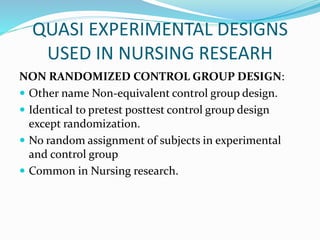
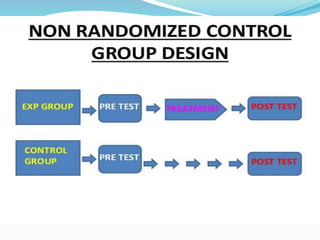
NON RANDOMIZED CONTROL GROUP DESIGN:
 Other name Non-equivalent control group design.
 Identical to pretest posttest control group design
except randomization.
 No random assignment of subjects in experimental
and control group
 Common in Nursing research.
Advantages and Disadvantages
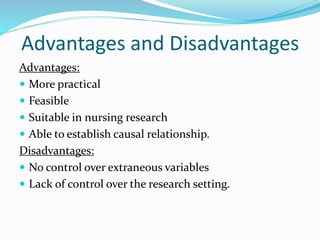
Advantages:
 More practical
 Feasible
 Suitable in nursing research
 Able to establish causal relationship.
Disadvantages:
 No control over extraneous variables
 Lack of control over the research setting.
PRE EXPERIMENTAL RESEARCH
DESIGN
This design is considered as very weak, as the researcher
has very little control over the experiment
Types
One- shot case
design
One group pretest
post test design
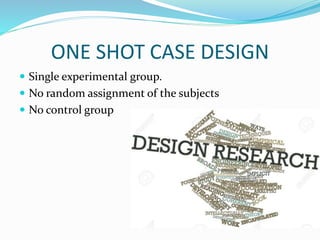
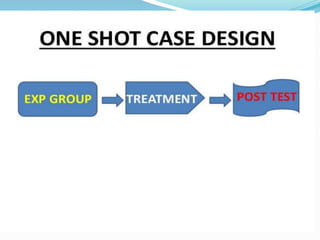
ONE SHOT CASE DESIGN
 Single experimental group.
 No random assignment of the subjects
 No control group
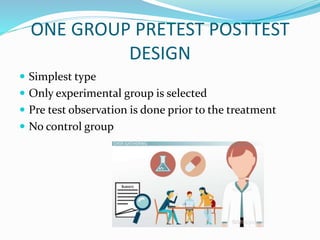
ONE GROUP PRETEST POSTTEST
DESIGN
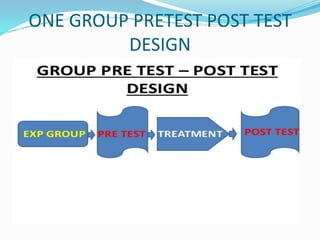
 Simplest type
 Only experimental group is selected
 Pre test observation is done prior to the treatment
 No control group
ONE GROUP PRETEST POST TEST
DESIGN
ADVANTAGES AND
DISADVANTAGES
Advantages
 Very simple
 Convenient
 Suitable for the beginners
Disadvantages:
 Very weak experimental design
 Selection bias
 Higher threat of internal validity
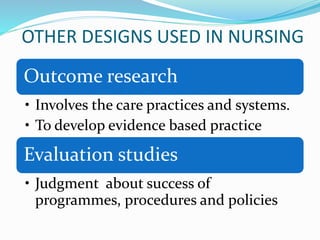
OTHER DESIGNS USED IN NURSING
Outcome research
• Involves the care practices and systems.
• To develop evidence based practice
Evaluation studies
• Judgment about success of
programmes, procedures and policies
FACTORS AFFECTING RESEARCH
DESIGN
 Nature of the research problem
 Purpose of the study
 Researcher’s knowledge and experience
 Researcher’s interest & motivation
 Research ethics and principles
 Subjects and participants
 Resources
 Time
 Extraneous variables.
CURRENT CHALLENGES OF
RESEARCH DESIGNS IN NURSING
FIELD
 Selecting the best research design
 Performing the collection of data without errors
 Use experimental Research
 Use qualitative Research
 Studies to support Nursing practice, education,
administration, health promotion etc..
 Feasible
 Relevant
 Time consuming studies
Research designs in nursing

Research designs in nursing

  • 1.
  • 2.
    Research Design  Blueprint  Back bone  Overall Plan  Framework  Master plan  A Strategy
  • 3.
    Purposes of ResearchDesign  Scheme for answering the question  Control bias  Organize the study
  • 4.
    Characteristics of agood design  Control of bias.  Capable of obtaining the most reliable and valid data.  Helps an investigator avoid making mistaken conclusions  Control the various threats of validity, both internal and external.
  • 5.
    FEATURES OF AGOOD DESIGN OBJECTIVITY VALIDITY RELIABILITY GENERALIZABILIY
  • 6.
    ELEMENTS OF RESEARCHDESIGN APPROAC H SAMPLE& SAMPLING SOURCES OF DATA COLLECTION TOOLS AND METHODS DATA ANALYSIS
  • 7.
  • 8.
  • 9.
    QUALITATIVE RESEARCH DESIGNS PHENOMENOLOGICAL ETHNOGRAPHIC GROUNDEDTHEORY CASE STUDIES HISTORICAL RESEARCH ACTION RESEARCH
  • 10.
    OTHER RESEARCH DESIGNS Methodologicalstudies Meta- analysis Secondary data analysis Outcome research Evaluation studies Operational research
  • 11.
    EXPERIMENTAL RESEARCH DESIGN Trueor Classical Experimental design Pre-experimental design Quasi-experimental design
  • 12.
    TRUE EXPERIMENTAL DESIGN Pre-testpost-test control group Post-test only experimental design Solomon four group design Factorial design Randomized block design Cross-over design Latin square design
  • 13.
    QUASI EXPERIMENTAL DESIGN Nonrandomized /non equivalent control group design Time series design
  • 14.
    PRE – EXPERIMENTALDESIGN One- shot case design One group pretest post test design
  • 16.
    RESEARCH DESIGNS INNURSING Descriptive / exploratory Correlational True Experimental Quasi experimental Pre experimental Outcome research Evaluation studies
  • 17.
    DESCRIPTIVE STUDY  Pictureof a situation as it naturally happens  Two or more variables  No manipulation of variables  Search for accurate information  More information about the characteristics
  • 18.
    TYPES OF DESCRIPTIVESTUDIES USED IN NURSING • Describe the frequency of occurrence rather than a study relationship Uni-variant descriptive design • Investigating the phenomenon and its related factors about which very little is known Exploratory descriptive design • Comparing occurrences of two or more groups Comparative descriptive design:
  • 19.
    Advantages of descriptivestudy Develop theories Identify problems with current practices Justify current practices Accurate information Disadvantages Information collected is very brief and superficial Time consuming process
  • 20.
    CORRELATIONAL /EX-POST FACTO DESIGN Theresearcher examines the relationship between two or more variables in a natural setting without manipulation or control.
  • 21.
    TYPES OF CORRELATIONALRESEARCH DESIGNS USED NURSING Prospective Retrospective
  • 22.
    TYPES OF CORRELATIONAL RESEARCHDESIGN Prospective design • Examining relationship between cause to effect Retrospective design • Examining relationship between effect to cause
  • 23.
    Advantages: Increase flexibility duringexamining the relationship Effective and efficient method in collecting large amount of data Exploring a relationship between variables. Opens up further research Disadvantages: Only uncovers a relationship Cannot provide reason for relationship No randomization Unable to determine causal relationship
  • 24.
    EXPERIMETNAL RESEARCH DESIGN Observationunder controlled conditions Conducted with scientific approach Examining the effect of independent variable on dependent variable. Manipulation of independent variable Testing hypotheses of causal relationship among variables
  • 25.
    TYPES OF EXPERIMENTAL RESEARCHIN NURSING True or Classical Experimental design Pre-experimental design Quasi-experimental design
  • 26.
    ELEMENTS OF TRUE EXPERIMENTALDESIGN Manipulation Control Randomization
  • 27.
    TRUE EXPERIMENTAL RESEARCH DESIGN Control over extraneous variables.  Observed effect on dependent variable is only due to the manipulation of independent variable  Consists of all three elements control, randomization and manipulation  3 types of experimental designs are commnonly used in Nursing.
  • 28.
    3 TYPES OFTRUE EXPERIMENTAL DESIGNS ARE COMMONLY USED IN NURSING. Pre- test post test control group Post-test only control design Solomon –four group design
  • 30.
  • 32.
    ADVANTAGES AND DISADVANTAGES OFTRUE EXPERIMENTAL DESIGN ADVANTAGES  Most appropriate for testing cause and effect relationship.  Most appropriate for testing the hypothesis. DISADVANTAGES  Ethical considerations for human subjects.  Pre test can affect the post test response.
  • 33.
    QUASI EXPERIMENTAL DESIGN Involves manipulation of independent variable.  Lack one characteristics of true experimental design.  Either randomization or control exists.  Test cause and effect relationship.
  • 34.
    TYPES OF QUASIEXPERIMENTAL DESIGN Non randomized /non equivalent control group design Time series design
  • 35.
    QUASI EXPERIMENTAL DESIGNS USEDIN NURSING RESEARH NON RANDOMIZED CONTROL GROUP DESIGN:  Other name Non-equivalent control group design.  Identical to pretest posttest control group design except randomization.  No random assignment of subjects in experimental and control group  Common in Nursing research.
  • 37.
    Advantages and Disadvantages Advantages: More practical  Feasible  Suitable in nursing research  Able to establish causal relationship. Disadvantages:  No control over extraneous variables  Lack of control over the research setting.
  • 38.
    PRE EXPERIMENTAL RESEARCH DESIGN Thisdesign is considered as very weak, as the researcher has very little control over the experiment Types One- shot case design One group pretest post test design
  • 39.
    ONE SHOT CASEDESIGN  Single experimental group.  No random assignment of the subjects  No control group
  • 41.
    ONE GROUP PRETESTPOSTTEST DESIGN  Simplest type  Only experimental group is selected  Pre test observation is done prior to the treatment  No control group
  • 42.
    ONE GROUP PRETESTPOST TEST DESIGN
  • 43.
    ADVANTAGES AND DISADVANTAGES Advantages  Verysimple  Convenient  Suitable for the beginners Disadvantages:  Very weak experimental design  Selection bias  Higher threat of internal validity
  • 44.
    OTHER DESIGNS USEDIN NURSING Outcome research • Involves the care practices and systems. • To develop evidence based practice Evaluation studies • Judgment about success of programmes, procedures and policies
  • 45.
    FACTORS AFFECTING RESEARCH DESIGN Nature of the research problem  Purpose of the study  Researcher’s knowledge and experience  Researcher’s interest & motivation  Research ethics and principles  Subjects and participants  Resources  Time  Extraneous variables.
  • 46.
    CURRENT CHALLENGES OF RESEARCHDESIGNS IN NURSING FIELD  Selecting the best research design  Performing the collection of data without errors  Use experimental Research  Use qualitative Research  Studies to support Nursing practice, education, administration, health promotion etc..  Feasible  Relevant  Time consuming studies