Ionization Potential
And Electron Affinity
Subject: Chemistry
Course code: Chem-101
Submitted By: Aqsa Manzoor
Discipline: Zoology
Semester: I
Roll No: 2180
Submitted To: Mrs. Uzma Imtiaz
Periodic TrendsPeriodic Trends
 Ionization Energy, Electron
Affinity and Atomic Radii.
The valence electron structure
of atoms can be used to
explain various properties of
atoms.
In general, properties correlate
down a group of elements.
In this Assignment I will
discuss the trends of Ionization
potential and electron affinity
in the periodic table.
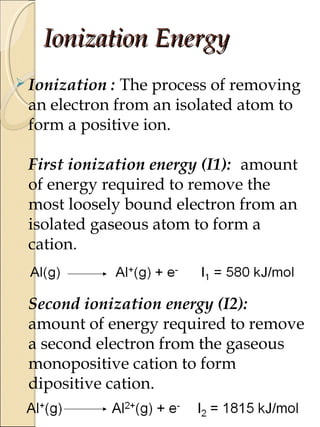
Ionization EnergyIonization Energy
 Ionization : The process of removing
an electron from an isolated atom to
form a positive ion.
First ionization energy (I1): amount
of energy required to remove the
most loosely bound electron from an
isolated gaseous atom to form a
cation.
Second ionization energy (I2):
amount of energy required to remove
a second electron from the gaseous
monopositive cation to form
dipositive cation.
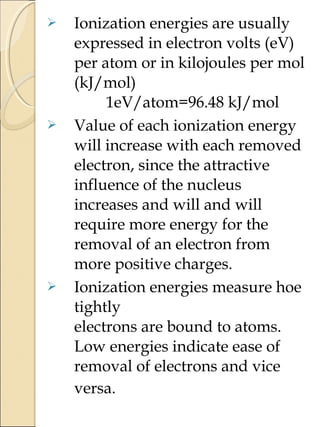
 Ionization energies are usually
expressed in electron volts (eV)
per atom or in kilojoules per mol
(kJ/mol)
1eV/atom=96.48 kJ/mol
 Value of each ionization energy
will increase with each removed
electron, since the attractive
influence of the nucleus
increases and will and will
require more energy for the
removal of an electron from
more positive charges.
 Ionization energies measure hoe
tightly
electrons are bound to atoms.
Low energies indicate ease of
removal of electrons and vice
versa.
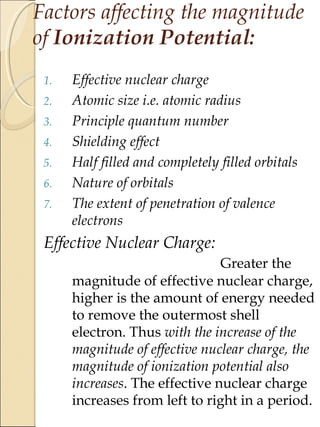
Factors affecting the magnitude
of Ionization Potential:
1. Effective nuclear charge
2. Atomic size i.e. atomic radius
3. Principle quantum number
4. Shielding effect
5. Half filled and completely filled orbitals
6. Nature of orbitals
7. The extent of penetration of valence
electrons
Effective Nuclear Charge:
Greater the
magnitude of effective nuclear charge,
higher is the amount of energy needed
to remove the outermost shell
electron. Thus with the increase of the
magnitude of effective nuclear charge, the
magnitude of ionization potential also
increases. The effective nuclear charge
increases from left to right in a period.
Atomic size:
Greater is the atomic size of
an atom, more far is the outermost
shell electron from the nucleus and
hence lesser will be the force of
attraction exerted by the nucleus on
the outermost shell electron. Thus
higher the value of atomic radius of an
atom, lower will be the ionization
energy.
Principal Quantum Number (n):
Greater is the
value of n for the valence shell
electron of an atom, further away
this electron will be from the nucleus
and hence lesser will be the force of
attraction exerted by the nucleus on
it so lesser energy will be required to
remove the valence shell electron.
Thus with the increase ot the principal
quantum number of the orbital from
which the electron is to be removed, the
magnitude of ionization potential
decreases.
Shielding Affect:
The magnitude of
shielding effect determines the
magnitude of the force of attraction
between the nucleus and the valence-
shell electron. Greater is the magnitude
of shielding effect working on the
valence shell electron. Thus with the
increase of shielding effect ionization
potential increases.
Half-filled and completely-filled
orbitals:
According to Hund’s rule, half-
filled (ns1, np3, nd5) or completely-
filled (ns2. ns6, nd10) orbitals are
comparatively more stable and hence
more energy is needed to remove an
electron from such orbitals. Thus the
ionization potential of an atom having half-
filled or completely-filled orbitals in its
electronic configuration is relatively higher
than that expected normally from its
position in the periodic table .
Nature Of Orbitals:
The nature of
orbitals of the valence-shell from which
the electron is to be removed also
influences the magnitude of ionization
potential. The relative order of energy
of s, p, d and f orbitals of a given nth
shell is as:
ns < np < nd < nf
This order clearly shows that to remove
an electron from f-orbital will be easiest
while to remove the same from s-orbital
will be the most difficult.
The extent of penetration of
valence electrons:
The degree of
penetration of valence electrons in a
given principal energy level decreases
in the order s>p>d>f, since ns electron is
more tightly bound than any np
electron, which in turn is more tightly
bound than any nd electron etc.
Trends in Ionization
Potential:
 Ionization energy generally
increases from left to right in a
period because of the increase in
nuclear charge and decrease in
atomic radius.
 Ionization energies generally
decrease down a group due to the
shielding effect and increase in
atomic size.
 Departures from these trends can
usually be traced to repulsion
between electrons, particularly
electrons occupying the same
orbitals.
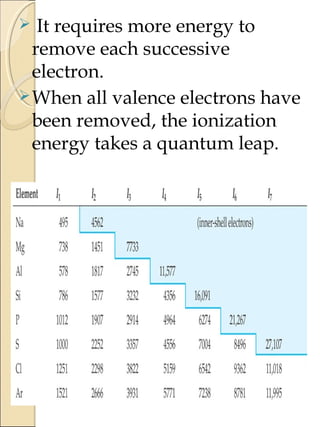
 It requires more energy to
remove each successive
electron.
When all valence electrons have
been removed, the ionization
energy takes a quantum leap.
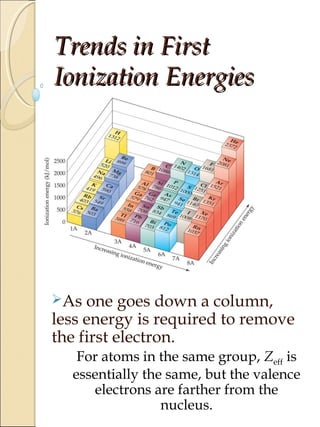
Trends in FirstTrends in First
Ionization EnergiesIonization Energies
As one goes down a column,
less energy is required to remove
the first electron.
For atoms in the same group, Zeff is
essentially the same, but the valence
electrons are farther from the
nucleus.
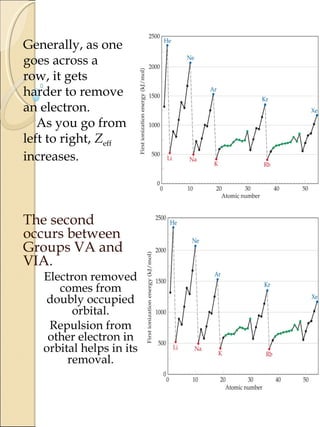
Generally, as one
goes across a
row, it gets
harder to remove
an electron.
As you go from
left to right, Zeff
increases.
The second
occurs between
Groups VA and
VIA.
Electron removed
comes from
doubly occupied
orbital.
Repulsion from
other electron in
orbital helps in its
removal.
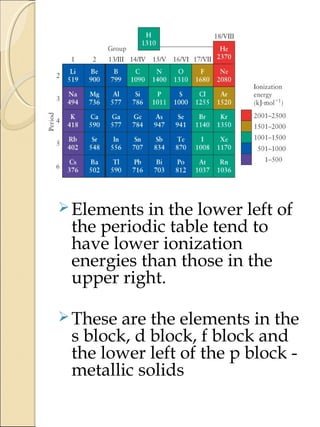
Elements in the lower left of
the periodic table tend to
have lower ionization
energies than those in the
upper right.
These are the elements in the
s block, d block, f block and
the lower left of the p block -
metallic solids
Electron AffinityElectron Affinity
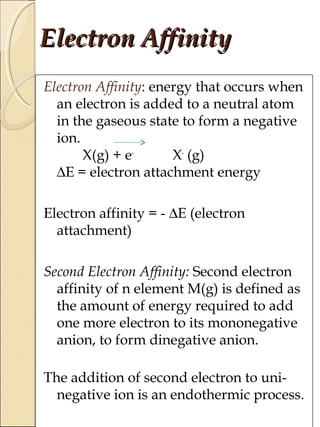
Electron Affinity: energy that occurs when
an electron is added to a neutral atom
in the gaseous state to form a negative
ion.
X(g) + e-
X-
(g)
∆E = electron attachment energy
Electron affinity = - ∆E (electron
attachment)
Second Electron Affinity: Second electron
affinity of n element M(g) is defined as
the amount of energy required to add
one more electron to its mononegative
anion, to form dinegative anion.
The addition of second electron to uni-
negative ion is an endothermic process.
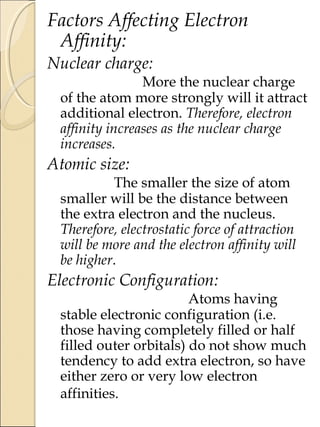
Factors Affecting Electron
Affinity:
Nuclear charge:
More the nuclear charge
of the atom more strongly will it attract
additional electron. Therefore, electron
affinity increases as the nuclear charge
increases.
Atomic size:
The smaller the size of atom
smaller will be the distance between
the extra electron and the nucleus.
Therefore, electrostatic force of attraction
will be more and the electron affinity will
be higher.
Electronic Configuration:
Atoms having
stable electronic configuration (i.e.
those having completely filled or half
filled outer orbitals) do not show much
tendency to add extra electron, so have
either zero or very low electron
affinities.
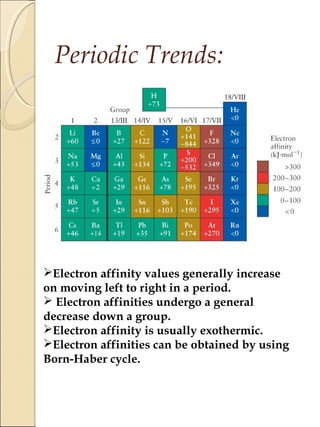
Periodic Trends:
Electron affinity values generally increase
on moving left to right in a period.
 Electron affinities undergo a general
decrease down a group.
Electron affinity is usually exothermic.
Electron affinities can be obtained by using
Born-Haber cycle.
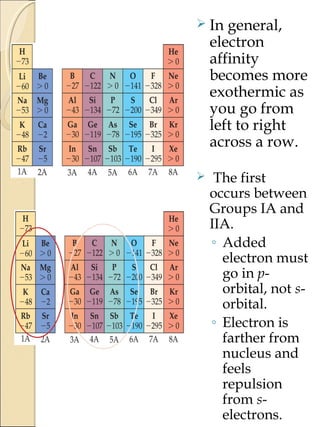
 In general,
electron
affinity
becomes more
exothermic as
you go from
left to right
across a row.
 The first
occurs between
Groups IA and
IIA.
◦ Added
electron must
go in p-
orbital, not s-
orbital.
◦ Electron is
farther from
nucleus and
feels
repulsion
from s-
electrons.
Main Group ElementsMain Group Elements
(s and p)(s and p)
 An s-block element has low
ionization energy; outer electrons
can easily be lost.
 Group 1 form +1 ions;
Group 2 form +2 ions
An s block element is likely to be a
reactive metal
 p- block
Elements on the left have low
enough ionization energies to be
metallic, but higher than the s-
block elements and so are less
reactive
Elements on the right have high
electron affinities (tend to gain
electrons to form closed shell ions)

Ionization potential and electron affinity

  • 1.
    Ionization Potential And ElectronAffinity Subject: Chemistry Course code: Chem-101 Submitted By: Aqsa Manzoor Discipline: Zoology Semester: I Roll No: 2180 Submitted To: Mrs. Uzma Imtiaz
  • 2.
    Periodic TrendsPeriodic Trends Ionization Energy, Electron Affinity and Atomic Radii. The valence electron structure of atoms can be used to explain various properties of atoms. In general, properties correlate down a group of elements. In this Assignment I will discuss the trends of Ionization potential and electron affinity in the periodic table.
  • 3.
    Ionization EnergyIonization Energy Ionization : The process of removing an electron from an isolated atom to form a positive ion. First ionization energy (I1): amount of energy required to remove the most loosely bound electron from an isolated gaseous atom to form a cation. Second ionization energy (I2): amount of energy required to remove a second electron from the gaseous monopositive cation to form dipositive cation.
  • 4.
     Ionization energiesare usually expressed in electron volts (eV) per atom or in kilojoules per mol (kJ/mol) 1eV/atom=96.48 kJ/mol  Value of each ionization energy will increase with each removed electron, since the attractive influence of the nucleus increases and will and will require more energy for the removal of an electron from more positive charges.  Ionization energies measure hoe tightly electrons are bound to atoms. Low energies indicate ease of removal of electrons and vice versa.
  • 5.
    Factors affecting themagnitude of Ionization Potential: 1. Effective nuclear charge 2. Atomic size i.e. atomic radius 3. Principle quantum number 4. Shielding effect 5. Half filled and completely filled orbitals 6. Nature of orbitals 7. The extent of penetration of valence electrons Effective Nuclear Charge: Greater the magnitude of effective nuclear charge, higher is the amount of energy needed to remove the outermost shell electron. Thus with the increase of the magnitude of effective nuclear charge, the magnitude of ionization potential also increases. The effective nuclear charge increases from left to right in a period.
  • 6.
    Atomic size: Greater isthe atomic size of an atom, more far is the outermost shell electron from the nucleus and hence lesser will be the force of attraction exerted by the nucleus on the outermost shell electron. Thus higher the value of atomic radius of an atom, lower will be the ionization energy. Principal Quantum Number (n): Greater is the value of n for the valence shell electron of an atom, further away this electron will be from the nucleus and hence lesser will be the force of attraction exerted by the nucleus on it so lesser energy will be required to remove the valence shell electron. Thus with the increase ot the principal quantum number of the orbital from which the electron is to be removed, the magnitude of ionization potential decreases.
  • 7.
    Shielding Affect: The magnitudeof shielding effect determines the magnitude of the force of attraction between the nucleus and the valence- shell electron. Greater is the magnitude of shielding effect working on the valence shell electron. Thus with the increase of shielding effect ionization potential increases. Half-filled and completely-filled orbitals: According to Hund’s rule, half- filled (ns1, np3, nd5) or completely- filled (ns2. ns6, nd10) orbitals are comparatively more stable and hence more energy is needed to remove an electron from such orbitals. Thus the ionization potential of an atom having half- filled or completely-filled orbitals in its electronic configuration is relatively higher than that expected normally from its position in the periodic table .
  • 8.
    Nature Of Orbitals: Thenature of orbitals of the valence-shell from which the electron is to be removed also influences the magnitude of ionization potential. The relative order of energy of s, p, d and f orbitals of a given nth shell is as: ns < np < nd < nf This order clearly shows that to remove an electron from f-orbital will be easiest while to remove the same from s-orbital will be the most difficult. The extent of penetration of valence electrons: The degree of penetration of valence electrons in a given principal energy level decreases in the order s>p>d>f, since ns electron is more tightly bound than any np electron, which in turn is more tightly bound than any nd electron etc.
  • 9.
    Trends in Ionization Potential: Ionization energy generally increases from left to right in a period because of the increase in nuclear charge and decrease in atomic radius.  Ionization energies generally decrease down a group due to the shielding effect and increase in atomic size.  Departures from these trends can usually be traced to repulsion between electrons, particularly electrons occupying the same orbitals.
  • 10.
     It requiresmore energy to remove each successive electron. When all valence electrons have been removed, the ionization energy takes a quantum leap.
  • 11.
    Trends in FirstTrendsin First Ionization EnergiesIonization Energies As one goes down a column, less energy is required to remove the first electron. For atoms in the same group, Zeff is essentially the same, but the valence electrons are farther from the nucleus.
  • 12.
    Generally, as one goesacross a row, it gets harder to remove an electron. As you go from left to right, Zeff increases. The second occurs between Groups VA and VIA. Electron removed comes from doubly occupied orbital. Repulsion from other electron in orbital helps in its removal.
  • 13.
    Elements in thelower left of the periodic table tend to have lower ionization energies than those in the upper right. These are the elements in the s block, d block, f block and the lower left of the p block - metallic solids
  • 14.
    Electron AffinityElectron Affinity ElectronAffinity: energy that occurs when an electron is added to a neutral atom in the gaseous state to form a negative ion. X(g) + e- X- (g) ∆E = electron attachment energy Electron affinity = - ∆E (electron attachment) Second Electron Affinity: Second electron affinity of n element M(g) is defined as the amount of energy required to add one more electron to its mononegative anion, to form dinegative anion. The addition of second electron to uni- negative ion is an endothermic process.
  • 15.
    Factors Affecting Electron Affinity: Nuclearcharge: More the nuclear charge of the atom more strongly will it attract additional electron. Therefore, electron affinity increases as the nuclear charge increases. Atomic size: The smaller the size of atom smaller will be the distance between the extra electron and the nucleus. Therefore, electrostatic force of attraction will be more and the electron affinity will be higher. Electronic Configuration: Atoms having stable electronic configuration (i.e. those having completely filled or half filled outer orbitals) do not show much tendency to add extra electron, so have either zero or very low electron affinities.
  • 16.
    Periodic Trends: Electron affinityvalues generally increase on moving left to right in a period.  Electron affinities undergo a general decrease down a group. Electron affinity is usually exothermic. Electron affinities can be obtained by using Born-Haber cycle.
  • 17.
     In general, electron affinity becomesmore exothermic as you go from left to right across a row.  The first occurs between Groups IA and IIA. ◦ Added electron must go in p- orbital, not s- orbital. ◦ Electron is farther from nucleus and feels repulsion from s- electrons.
  • 18.
    Main Group ElementsMainGroup Elements (s and p)(s and p)  An s-block element has low ionization energy; outer electrons can easily be lost.  Group 1 form +1 ions; Group 2 form +2 ions An s block element is likely to be a reactive metal  p- block Elements on the left have low enough ionization energies to be metallic, but higher than the s- block elements and so are less reactive Elements on the right have high electron affinities (tend to gain electrons to form closed shell ions)