Separation of Lanthanides
(ion-exchange & solvent extraction)
D. JIM LIVINGSTON
Asst. Prof. of Chemistry
St. John’s College.
Ion-Exchange method
Ion-Exchange method
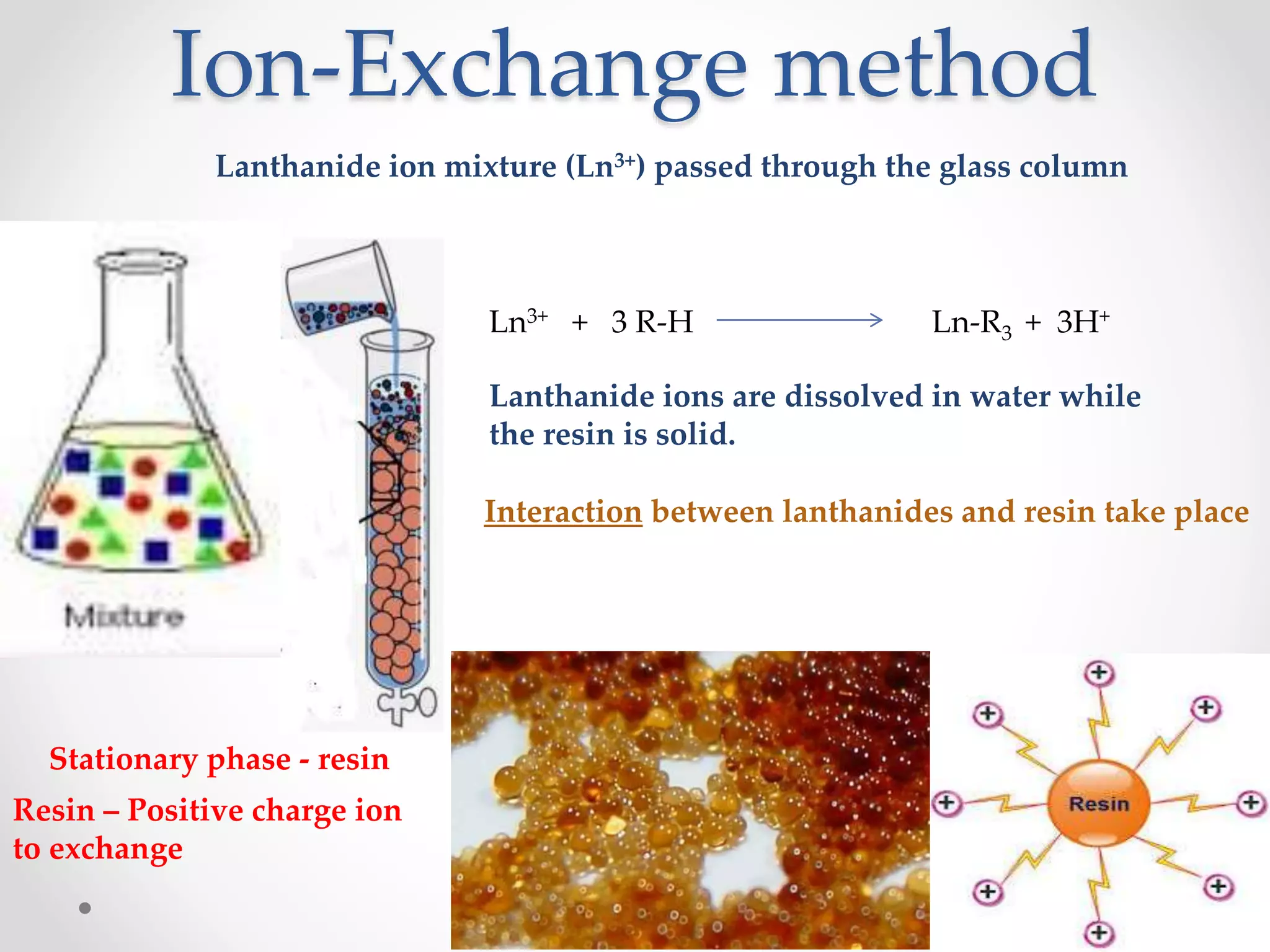
Lanthanide ion mixture (Ln3+) passed through the glass column
Stationary phase - resin
Resin – Positive charge ion
to exchange
Ln3+ + 3 R-H Ln-R3 + 3H+
Lanthanide ions are dissolved in water while
the resin is solid.
Interaction between lanthanides and resin take place
Ion-Exchange method
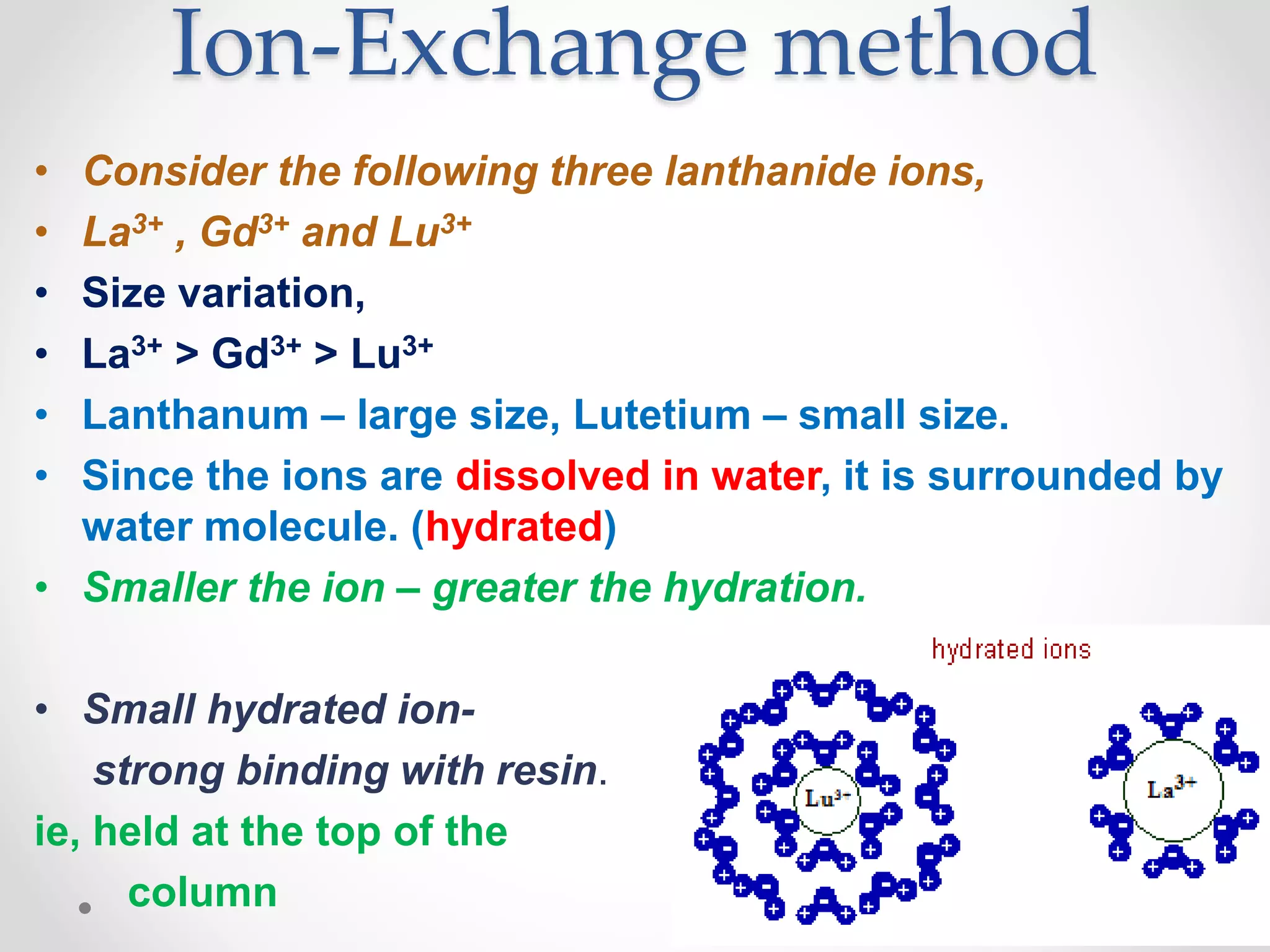
• Consider the following three lanthanide ions,
• La3+ , Gd3+ and Lu3+
• Size variation,
• La3+ > Gd3+ > Lu3+
• Lanthanum – large size, Lutetium – small size.
• Since the ions are dissolved in water, it is surrounded by
water molecule. (hydrated)
• Smaller the ion – greater the hydration.
• Small hydrated ion-
strong binding with resin.
ie, held at the top of the
column
Ion-Exchange method
La3+
Gd3+
Lu3+
Eluent – citric acid / ammonium citrate buffer.
La-R3 + 3NH4+ 3 NH4-R + La3+
Lu3+ - comes first, La3+ - comes last
Solvent Extraction
"Extraction" refers to transference of compound(s) from a solid or liquid into a
different solvent or phase
Types of extraction
Liquid–liquid extraction (Solvent extraction)
Solid-phase extraction
Acid-base extraction
Supercritical fluid extraction
When a tea bag is added to hot water, the compounds
responsible for the flavor and color of tea are extracted
from the grounds into the water
Liquid-liquid extractions in the
laboratory usually make use of a
separatory funnel, where two immiscible
solvents are combined to separate a solute
from one solvent into the other, according
to the relative solubility in each of the
solvents
Example : Gd3+ from La3+
Gd(NO3)3 and La(NO3)3 in water
Organic solvent:
tributylphosphate in kerosene
Partition Coefficient
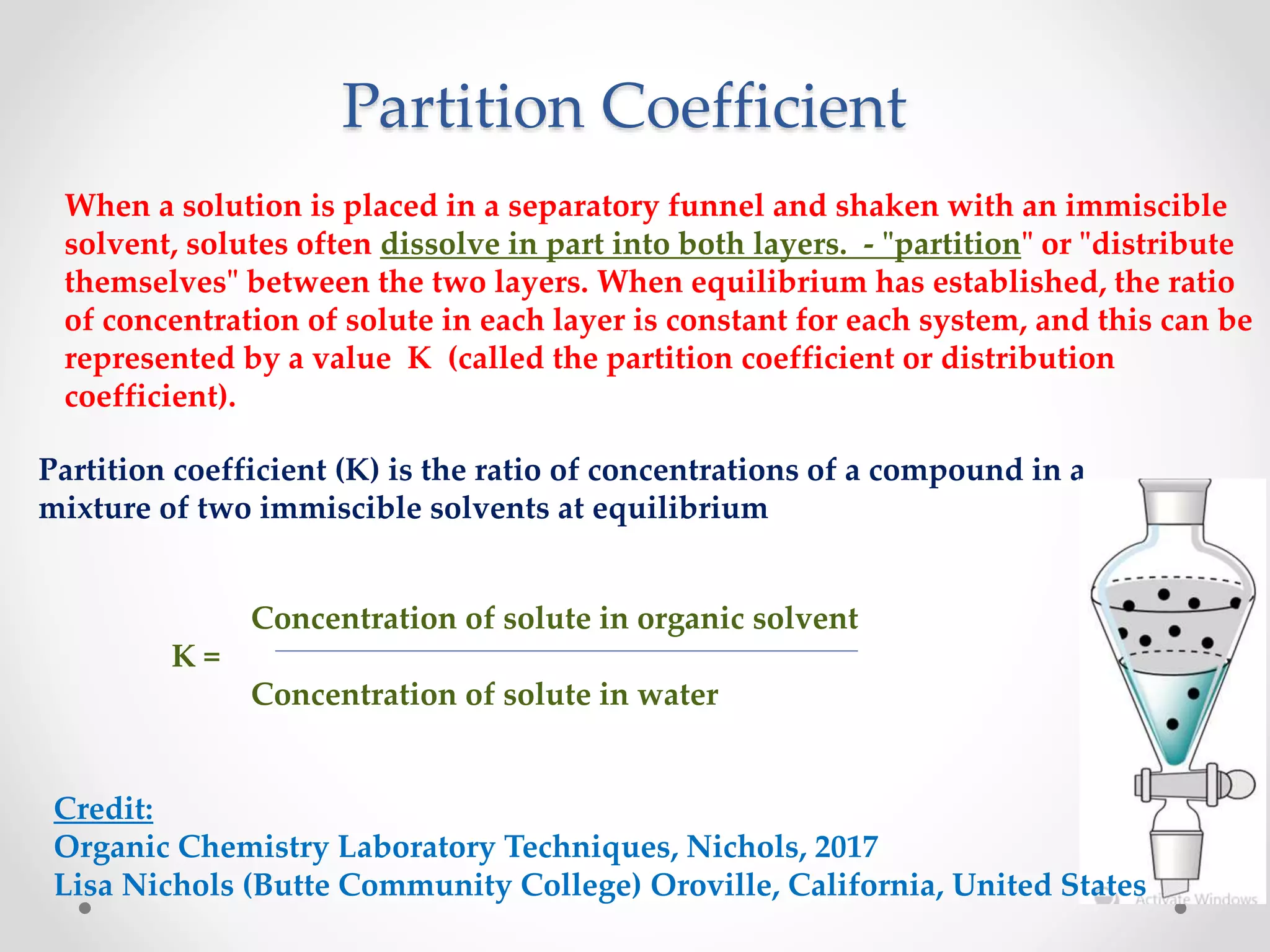
When a solution is placed in a separatory funnel and shaken with an immiscible
solvent, solutes often dissolve in part into both layers. - "partition" or "distribute
themselves" between the two layers. When equilibrium has established, the ratio
of concentration of solute in each layer is constant for each system, and this can be
represented by a value K (called the partition coefficient or distribution
coefficient).
Partition coefficient (K) is the ratio of concentrations of a compound in a
mixture of two immiscible solvents at equilibrium
Concentration of solute in organic solvent
K =
Concentration of solute in water
Credit:
Organic Chemistry Laboratory Techniques, Nichols, 2017
Lisa Nichols (Butte Community College) Oroville, California, United States
Value of K is constant for a particular solvent
system
Multiple extraction
• Partition coefficient of gadolinium and lanthanum
are different.
• By make use of the multiple extraction,
• Gadolinium and lanthanum can be separated.
References
https://chem.libretexts.org/Bookshelves/Organic_Chemistry/Book%3A_
Organic_Chemistry_Lab_Techniques_(Nichols)/04%3A_Extraction
Separation of lanthanides

Separation of lanthanides

  • 1.
    Separation of Lanthanides (ion-exchange& solvent extraction) D. JIM LIVINGSTON Asst. Prof. of Chemistry St. John’s College.
  • 2.
  • 3.
    Ion-Exchange method Lanthanide ionmixture (Ln3+) passed through the glass column Stationary phase - resin Resin – Positive charge ion to exchange Ln3+ + 3 R-H Ln-R3 + 3H+ Lanthanide ions are dissolved in water while the resin is solid. Interaction between lanthanides and resin take place
  • 4.
    Ion-Exchange method • Considerthe following three lanthanide ions, • La3+ , Gd3+ and Lu3+ • Size variation, • La3+ > Gd3+ > Lu3+ • Lanthanum – large size, Lutetium – small size. • Since the ions are dissolved in water, it is surrounded by water molecule. (hydrated) • Smaller the ion – greater the hydration. • Small hydrated ion- strong binding with resin. ie, held at the top of the column
  • 5.
    Ion-Exchange method La3+ Gd3+ Lu3+ Eluent –citric acid / ammonium citrate buffer. La-R3 + 3NH4+ 3 NH4-R + La3+ Lu3+ - comes first, La3+ - comes last
  • 6.
    Solvent Extraction "Extraction" refersto transference of compound(s) from a solid or liquid into a different solvent or phase Types of extraction Liquid–liquid extraction (Solvent extraction) Solid-phase extraction Acid-base extraction Supercritical fluid extraction When a tea bag is added to hot water, the compounds responsible for the flavor and color of tea are extracted from the grounds into the water Liquid-liquid extractions in the laboratory usually make use of a separatory funnel, where two immiscible solvents are combined to separate a solute from one solvent into the other, according to the relative solubility in each of the solvents
  • 7.
    Example : Gd3+from La3+ Gd(NO3)3 and La(NO3)3 in water Organic solvent: tributylphosphate in kerosene
  • 8.
    Partition Coefficient When asolution is placed in a separatory funnel and shaken with an immiscible solvent, solutes often dissolve in part into both layers. - "partition" or "distribute themselves" between the two layers. When equilibrium has established, the ratio of concentration of solute in each layer is constant for each system, and this can be represented by a value K (called the partition coefficient or distribution coefficient). Partition coefficient (K) is the ratio of concentrations of a compound in a mixture of two immiscible solvents at equilibrium Concentration of solute in organic solvent K = Concentration of solute in water Credit: Organic Chemistry Laboratory Techniques, Nichols, 2017 Lisa Nichols (Butte Community College) Oroville, California, United States
  • 9.
    Value of Kis constant for a particular solvent system
  • 10.
  • 11.
    • Partition coefficientof gadolinium and lanthanum are different. • By make use of the multiple extraction, • Gadolinium and lanthanum can be separated.
  • 12.