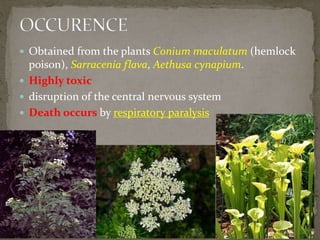
 Obtained from the plants Conium maculatum (hemlock
poison), Sarracenia flava, Aethusa cynapium.
 Highly toxic
 disruption of the central nervous system
 Death occurs by respiratory paralysis
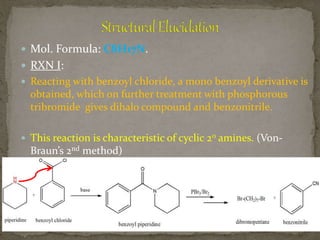
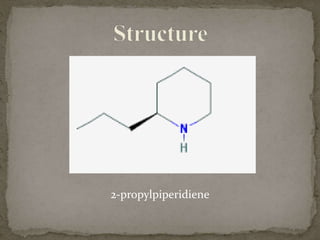
 Mol. Formula: C8H17N.
 RXN I:
 Reacting with benzoyl chloride, a mono benzoyl derivative is
obtained, which on further treatment with phosphorous
tribromide gives dihalo compound and benzonitrile.
 This reaction is characteristic of cyclic 20 amines. (Von-
Braun’s 2nd method)
 Hence, this reaction indicated the presence of
secondary nitrogen atom in the ring.
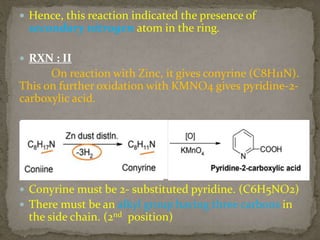
 RXN : II
On reaction with Zinc, it gives conyrine (C8H11N).
This on further oxidation with KMNO4 gives pyridine-2-
carboxylic acid.
 Conyrine must be 2- substituted pyridine. (C6H5NO2)
 There must be an alkyl group having three carbons in
the side chain. (2nd position)
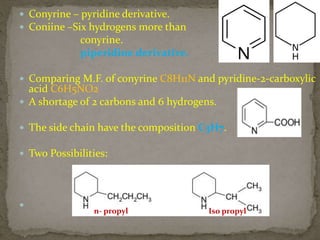
 Conyrine – pyridine derivative.
 Coniine –Six hydrogens more than
conyrine.
piperidine derivative.
 Comparing M.F. of conyrine C8H11N and pyridine-2-carboxylic
acid C6H5NO2
 A shortage of 2 carbons and 6 hydrogens.
 The side chain have the composition C3H7.
 Two Possibilities:

n- propyl Iso propyl
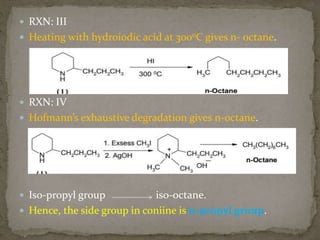
 RXN: III
 Heating with hydroiodic acid at 3000C gives n- octane.
 RXN: IV
 Hofmann’s exhaustive degradation gives n-octane.
 Iso-propyl group iso-octane.
 Hence, the side group in coniine is n-propyl group.
2-propylpiperidiene
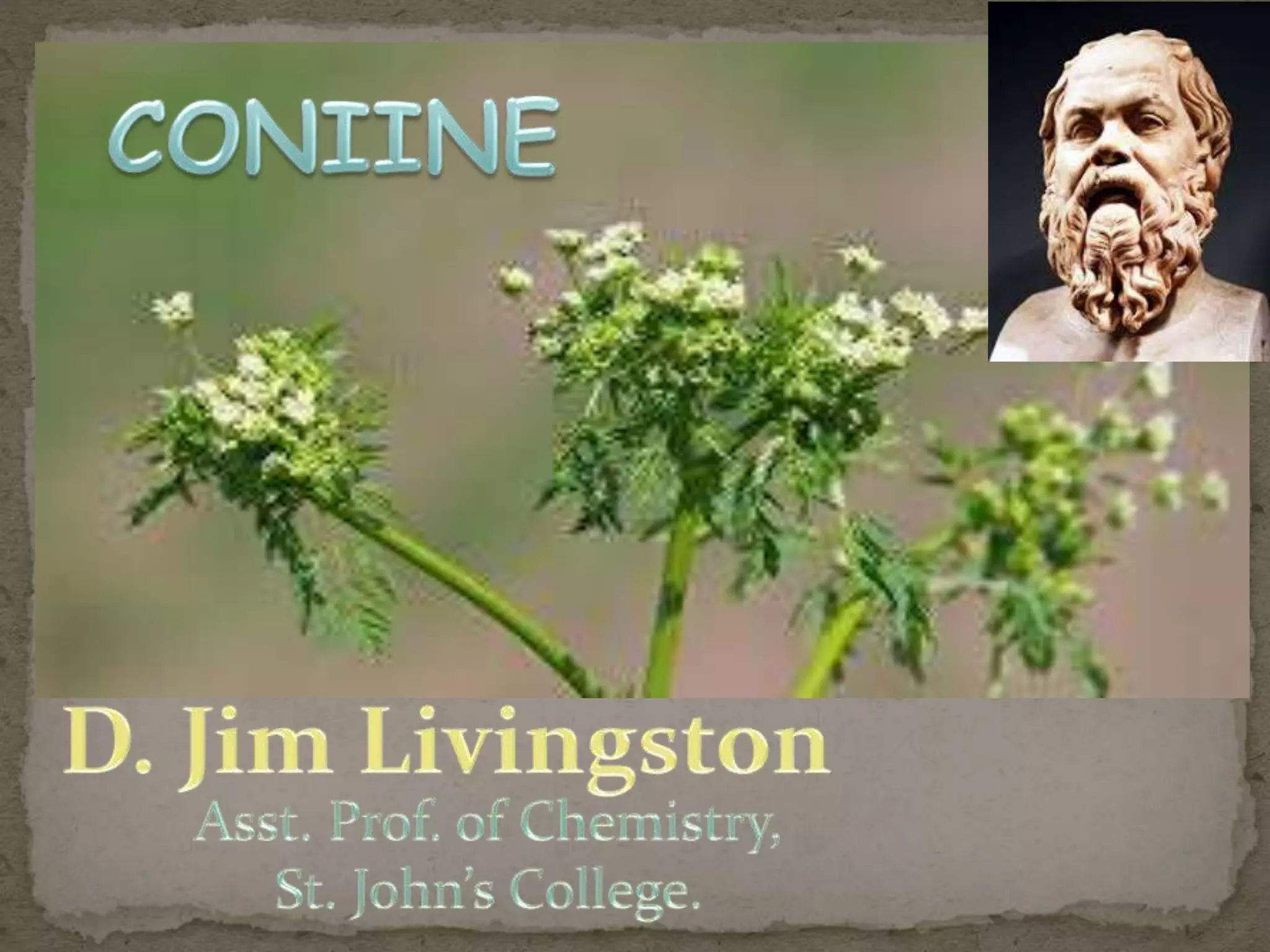
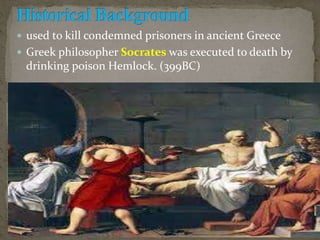
 used to kill condemned prisoners in ancient Greece
 Greek philosopher Socrates was executed to death by
drinking poison Hemlock. (399BC)
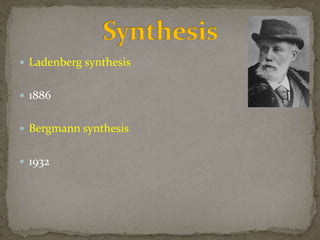
 Ladenberg synthesis
 1886
 Bergmann synthesis
 1932
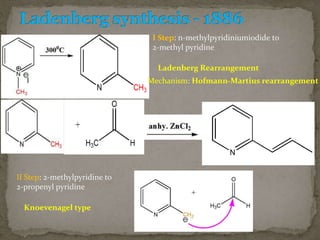
I Step: n-methylpyridiniumiodide to
2-methyl pyridine
Ladenberg Rearrangement
Mechanism: Hofmann-Martius rearrangement
II Step: 2-methylpyridine to
2-propenyl pyridine
Knoevenagel type
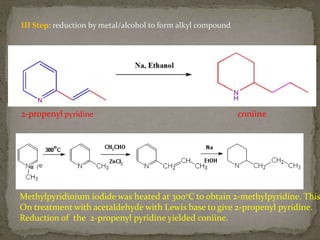
Methylpyridinium iodide was heated at 3000C to obtain 2-methylpyridine. This
On treatment with acetaldehyde with Lewis base to give 2-propenyl pyridine.
Reduction of the 2-propenyl pyridine yielded coniine.
2-propenyl pyridine coniine
III Step: reduction by metal/alcohol to form alkyl compound
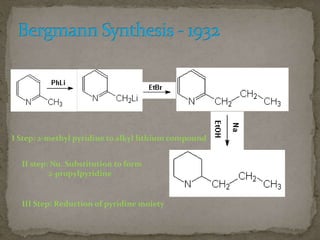
I Step: 2-methyl pyridine to alkyl lithium compound
II step: Nu. Substitution to form
2-propylpyridine
III Step: Reduction of pyridine moiety
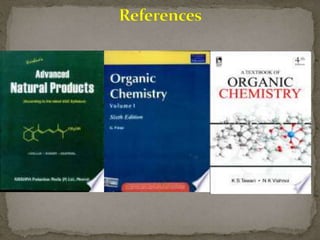
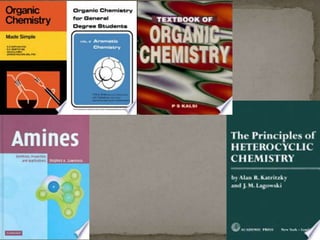
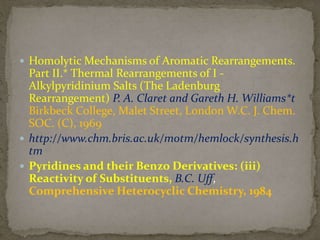
 Homolytic Mechanisms of Aromatic Rearrangements.
Part II.* Thermal Rearrangements of I -
Alkylpyridinium Salts (The Ladenburg
Rearrangement) P. A. Claret and Gareth H. Williams*t
Birkbeck College, Malet Street, London W.C. J. Chem.
SOC. (C), 1969
 http://www.chm.bris.ac.uk/motm/hemlock/synthesis.h
tm
 Pyridines and their Benzo Derivatives: (iii)
Reactivity of Substituents, B.C. Uff,
Comprehensive Heterocyclic Chemistry, 1984

Coniine - Structural elucidation

  • 2.
     Obtained fromthe plants Conium maculatum (hemlock poison), Sarracenia flava, Aethusa cynapium.  Highly toxic  disruption of the central nervous system  Death occurs by respiratory paralysis
  • 3.
     Mol. Formula:C8H17N.  RXN I:  Reacting with benzoyl chloride, a mono benzoyl derivative is obtained, which on further treatment with phosphorous tribromide gives dihalo compound and benzonitrile.  This reaction is characteristic of cyclic 20 amines. (Von- Braun’s 2nd method)
  • 4.
     Hence, thisreaction indicated the presence of secondary nitrogen atom in the ring.  RXN : II On reaction with Zinc, it gives conyrine (C8H11N). This on further oxidation with KMNO4 gives pyridine-2- carboxylic acid.  Conyrine must be 2- substituted pyridine. (C6H5NO2)  There must be an alkyl group having three carbons in the side chain. (2nd position)
  • 5.
     Conyrine –pyridine derivative.  Coniine –Six hydrogens more than conyrine. piperidine derivative.  Comparing M.F. of conyrine C8H11N and pyridine-2-carboxylic acid C6H5NO2  A shortage of 2 carbons and 6 hydrogens.  The side chain have the composition C3H7.  Two Possibilities:  n- propyl Iso propyl
  • 6.
     RXN: III Heating with hydroiodic acid at 3000C gives n- octane.  RXN: IV  Hofmann’s exhaustive degradation gives n-octane.  Iso-propyl group iso-octane.  Hence, the side group in coniine is n-propyl group.
  • 7.
  • 8.
     used tokill condemned prisoners in ancient Greece  Greek philosopher Socrates was executed to death by drinking poison Hemlock. (399BC)
  • 9.
     Ladenberg synthesis 1886  Bergmann synthesis  1932
  • 10.
    I Step: n-methylpyridiniumiodideto 2-methyl pyridine Ladenberg Rearrangement Mechanism: Hofmann-Martius rearrangement II Step: 2-methylpyridine to 2-propenyl pyridine Knoevenagel type
  • 11.
    Methylpyridinium iodide washeated at 3000C to obtain 2-methylpyridine. This On treatment with acetaldehyde with Lewis base to give 2-propenyl pyridine. Reduction of the 2-propenyl pyridine yielded coniine. 2-propenyl pyridine coniine III Step: reduction by metal/alcohol to form alkyl compound
  • 12.
    I Step: 2-methylpyridine to alkyl lithium compound II step: Nu. Substitution to form 2-propylpyridine III Step: Reduction of pyridine moiety
  • 15.
     Homolytic Mechanismsof Aromatic Rearrangements. Part II.* Thermal Rearrangements of I - Alkylpyridinium Salts (The Ladenburg Rearrangement) P. A. Claret and Gareth H. Williams*t Birkbeck College, Malet Street, London W.C. J. Chem. SOC. (C), 1969  http://www.chm.bris.ac.uk/motm/hemlock/synthesis.h tm  Pyridines and their Benzo Derivatives: (iii) Reactivity of Substituents, B.C. Uff, Comprehensive Heterocyclic Chemistry, 1984