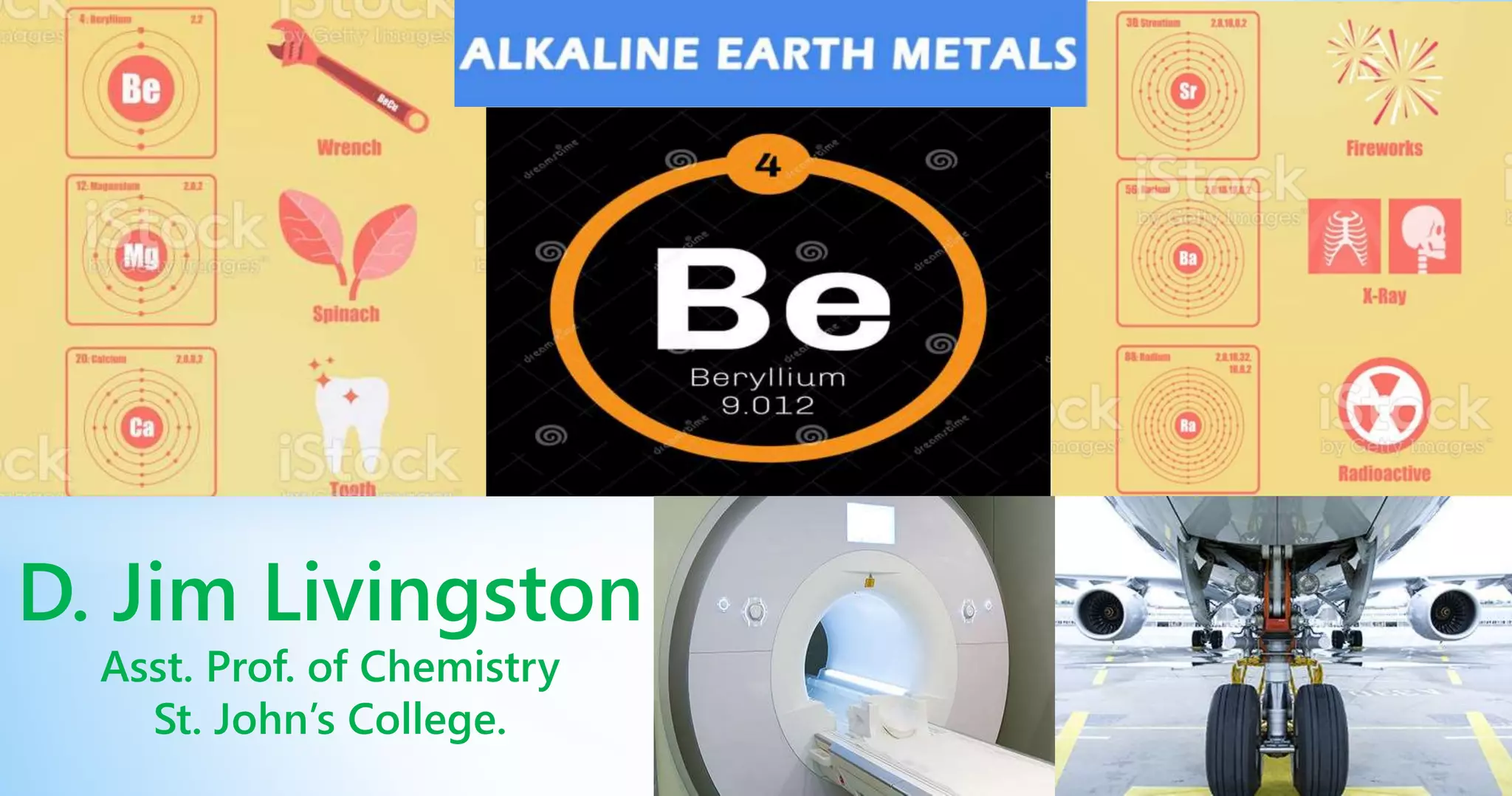
D. Jim Livingston
Asst. Prof. of Chemistry
St. John’s College.
The Alkaline Earth Metals
IIA [ns2] group elements are called alkaline earth
metals.
Mg -second most abundant metallic element in the sea,
and carnallite (KCl.MgCl2.6H2O) in earth crust.
Ca- occurs as calcium carbonate (marble, chalk etc) and
with magnesium as dolomite (CaCO3.MgCO3).
Sr and Ba - rare and are found as carbonates and
sulphates.
Be- rare and is found as beryl (Be3Al2(SiO3)6).
Occurrence
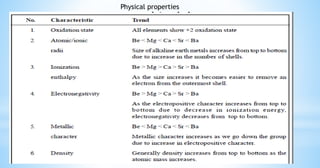
Physical properties
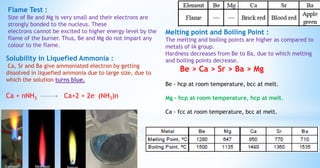
Flame Test :
Size of Be and Mg is very small and their electrons are
strongly bonded to the nucleus. These
electrons cannot be excited to higher energy level by the
flame of the burner. Thus, Be and Mg do not impart any
colour to the flame.
Solubility in Liquefied Ammonia :
Ca, Sr and Ba give ammoniated electron by getting
dissolved in liquefied ammonia due to large size, due to
which the solution turns blue.
Ca + nNH3 Ca+2 + 2e– (NH3)n
Melting point and Boiling Point :
The melting and boiling points are higher as compared to
metals of IA group.
Hardness decreases from Be to Ba, due to which melting
and boiling points decrease.
Be > Ca > Sr > Ba > Mg
Be - hcp at room temperature, bcc at melt.
Mg - hcp at room temperature, hcp at melt.
Ca - fcc at room temperature, bcc at melt.
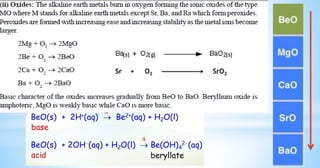
Sr + O2 SrO2
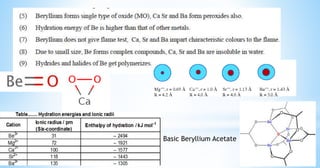
Basic Beryllium Acetate
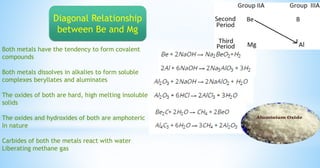
Both metals have the tendency to form covalent
compounds
Both metals dissolves in alkalies to form soluble
complexes beryllates and aluminates
The oxides of both are hard, high melting insoluble
solids
The oxides and hydroxides of both are amphoteric
In nature
Carbides of both the metals react with water
Liberating methane gas
Diagonal Relationship
between Be and Mg
Both Be and Al form polymeric covalent hydrides
while hydrides of other alkaline earth are ionic.
BeCl2 and AlCl3 both have a bridged polymeric
structure.
Be and Al both form fluoro complex ions [BeF4]2-
and [AlF6]3- in solution state whereas other
members of 2nd group do not form such
complexes.
Both forms hydrated ions in aqueous solution
Alkaline earth metals

Alkaline earth metals

  • 1.
    D. Jim Livingston Asst.Prof. of Chemistry St. John’s College.
  • 2.
    The Alkaline EarthMetals IIA [ns2] group elements are called alkaline earth metals. Mg -second most abundant metallic element in the sea, and carnallite (KCl.MgCl2.6H2O) in earth crust. Ca- occurs as calcium carbonate (marble, chalk etc) and with magnesium as dolomite (CaCO3.MgCO3). Sr and Ba - rare and are found as carbonates and sulphates. Be- rare and is found as beryl (Be3Al2(SiO3)6). Occurrence
  • 3.
  • 4.
    Flame Test : Sizeof Be and Mg is very small and their electrons are strongly bonded to the nucleus. These electrons cannot be excited to higher energy level by the flame of the burner. Thus, Be and Mg do not impart any colour to the flame. Solubility in Liquefied Ammonia : Ca, Sr and Ba give ammoniated electron by getting dissolved in liquefied ammonia due to large size, due to which the solution turns blue. Ca + nNH3 Ca+2 + 2e– (NH3)n Melting point and Boiling Point : The melting and boiling points are higher as compared to metals of IA group. Hardness decreases from Be to Ba, due to which melting and boiling points decrease. Be > Ca > Sr > Ba > Mg Be - hcp at room temperature, bcc at melt. Mg - hcp at room temperature, hcp at melt. Ca - fcc at room temperature, bcc at melt.
  • 5.
    Sr + O2SrO2
  • 9.
  • 10.
    Both metals havethe tendency to form covalent compounds Both metals dissolves in alkalies to form soluble complexes beryllates and aluminates The oxides of both are hard, high melting insoluble solids The oxides and hydroxides of both are amphoteric In nature Carbides of both the metals react with water Liberating methane gas Diagonal Relationship between Be and Mg
  • 11.
    Both Be andAl form polymeric covalent hydrides while hydrides of other alkaline earth are ionic. BeCl2 and AlCl3 both have a bridged polymeric structure. Be and Al both form fluoro complex ions [BeF4]2- and [AlF6]3- in solution state whereas other members of 2nd group do not form such complexes. Both forms hydrated ions in aqueous solution