Fluorimetry
(Introduction and Theory)
Presented by:
Atul Adhikari
M.Pharm(Pharmaceutics)
Assam down town university,
Assam
Guided By:
Arup Chakraborty
Department of Pharmacy, ADTU
Introduction
• Luminescence
• Fluorescence
• Fluorophore
• Fluorimetry
• Flurometric analysis
• Fluorescence occurs immediately after the
absorption of light and stops as soon as the
incident light is cut off.
• Phosphorescence
• Phosphorescent substance
2
Theory
• Singlet state: A molecular electronic state in
which all the electrons are paired.
• In a singlet state molecules are diamagnetic.
• Most of the electrons in ground state are paired.
• When such molecule absorbs uv/visible radiation,
one or more paired electrons reach to the excited
Singlet state/excited triplet state.
3
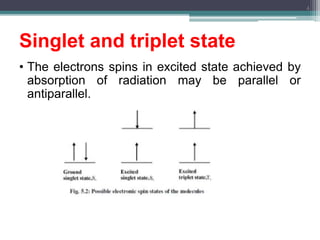
Singlet and triplet state
• The electrons spins in excited state achieved by
absorption of radiation may be parallel or
antiparallel.
4
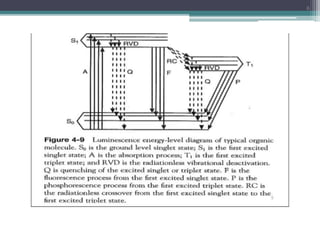
• When radiation is applied with appropriate
frequency absorption of light by the molecule
cause electrons move from ground state to the
excited first singlet state.
• Once the molecule is in excited state it will try to
move to the original state by several ways.
These are:
Radiationless vibrational deactivation
Fluorescence from the excited singlet state
Quenching of the excited singlet state
Radiationless crossover to the excited triplet
state
Quenching of the triplet state
Phosphorescence form the triplet state
5
6
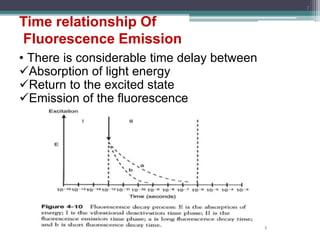
Time relationship Of
Fluorescence Emission
• There is considerable time delay between
Absorption of light energy
Return to the excited state
Emission of the fluorescence
7
Factors affecting fluorescence
and phosphorescence
• Nature of molecule:
Having conjugated double bonds.
• Temperature/viscosity:
Increase in temperature cause decrease in fluorescence.
Temperature increase viscosity which in turn decrease
fluorescent intensity.
Increase in colloision frequency between molecules will
increase probability of colloisional deactivation and
vibrational relaxation( Colloisional quenching).
Temperature of the reaction must be regulated within +/-
0.1 degree centigrade.
8
• pH
In the molecules containing acidic or basic
functional groups the change in the medium cause
change in ionization of the functional group.
Eg: aniline shows fluorescence but it does not
show due to formation of anilinium ion in acidic
medium.
Suitable buffer should be used.
9
• Dissolved oxygen
By direct oxidation of the fluorescent substance to
non-fluorescent substance.
By quenching of fluorescence.
So, useful precaution to check the deaired solution
and compare the result obtained with that from the
oxygen containing solution should be done.
10
• Solvent
Changes the polarity or H-bonding ability of the
solvent.
Different solvent have different ability to stabilize
the ground and excited states of the fluorescent
molecules.
Solvent viscosity and solvents with heavy atoms
also affects the fluorescence and
phosphorescence.
Ethanol can also cause its own fluorescence.
11
 Concentration effects:
Concentration is proportional to the emitted light energy
absorbed. At maximum concentration fluorescence peaks
and may decrease thereafter.
 Light effects:
Monochromatic light is essential for the excitation of
fluoropore because intensity will vary with wavelength.
Very long length of exposure cause decrease in
fluorescence due to photo decomposition.
Increase in intensity of light incident on sample increases
fluorescence intensity.
12
• Adsorption
Extreme sensitiveness of the method requires very
dilute solutions; 10-100 times weaker than
spectrophotometry.
Adsorption of substance on container wall is
serious problem. E.g. Quinine
Certain quartz glass and plastic materials that
contain uv adsorbants will fluorescence.
13
• Nature of substituents:
Electron donating group like -NH2, -OH enhance
fluorescence.
Electron withdrawing groups like -COOH, -NO2, -
N=N- and hallides destroy fluorescence.
If a higher atomic number atom is introduced into a
pi-electron system it enhances phosphorescence
and decrease fluorescence.
14
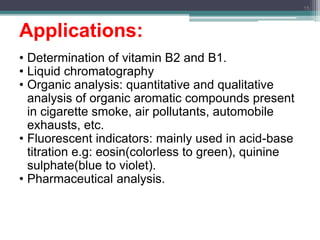
Applications:
• Determination of vitamin B2 and B1.
• Liquid chromatography
• Organic analysis: quantitative and qualitative
analysis of organic aromatic compounds present
in cigarette smoke, air pollutants, automobile
exhausts, etc.
• Fluorescent indicators: mainly used in acid-base
titration e.g: eosin(colorless to green), quinine
sulphate(blue to violet).
• Pharmaceutical analysis.
15
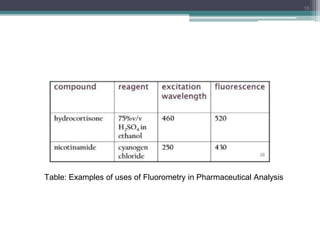
Table: Examples of uses of Fluorometry in Pharmaceutical Analysis
16
References
• Willard H., Merritt L, Settle F, Dean J,
Instrumental methods of Analysis, 7th edition,
New Delhi: CBS publishers and distributors.
• http://www.bertholdtech.com
• Ravi Shankar S, Textbook of Pharmaceutical
Analysis. Fourth edition, Tirunelveli: Rx
Publications
• http://en.wikipedia.org/wiki/Fluorescence
• Gurdeep R Chatwal, Instrumental methods of
Chemical analysis
17

Flourimetry

  • 1.
    Fluorimetry (Introduction and Theory) Presentedby: Atul Adhikari M.Pharm(Pharmaceutics) Assam down town university, Assam Guided By: Arup Chakraborty Department of Pharmacy, ADTU
  • 2.
    Introduction • Luminescence • Fluorescence •Fluorophore • Fluorimetry • Flurometric analysis • Fluorescence occurs immediately after the absorption of light and stops as soon as the incident light is cut off. • Phosphorescence • Phosphorescent substance 2
  • 3.
    Theory • Singlet state:A molecular electronic state in which all the electrons are paired. • In a singlet state molecules are diamagnetic. • Most of the electrons in ground state are paired. • When such molecule absorbs uv/visible radiation, one or more paired electrons reach to the excited Singlet state/excited triplet state. 3
  • 4.
    Singlet and tripletstate • The electrons spins in excited state achieved by absorption of radiation may be parallel or antiparallel. 4
  • 5.
    • When radiationis applied with appropriate frequency absorption of light by the molecule cause electrons move from ground state to the excited first singlet state. • Once the molecule is in excited state it will try to move to the original state by several ways. These are: Radiationless vibrational deactivation Fluorescence from the excited singlet state Quenching of the excited singlet state Radiationless crossover to the excited triplet state Quenching of the triplet state Phosphorescence form the triplet state 5
  • 6.
  • 7.
    Time relationship Of FluorescenceEmission • There is considerable time delay between Absorption of light energy Return to the excited state Emission of the fluorescence 7
  • 8.
    Factors affecting fluorescence andphosphorescence • Nature of molecule: Having conjugated double bonds. • Temperature/viscosity: Increase in temperature cause decrease in fluorescence. Temperature increase viscosity which in turn decrease fluorescent intensity. Increase in colloision frequency between molecules will increase probability of colloisional deactivation and vibrational relaxation( Colloisional quenching). Temperature of the reaction must be regulated within +/- 0.1 degree centigrade. 8
  • 9.
    • pH In themolecules containing acidic or basic functional groups the change in the medium cause change in ionization of the functional group. Eg: aniline shows fluorescence but it does not show due to formation of anilinium ion in acidic medium. Suitable buffer should be used. 9
  • 10.
    • Dissolved oxygen Bydirect oxidation of the fluorescent substance to non-fluorescent substance. By quenching of fluorescence. So, useful precaution to check the deaired solution and compare the result obtained with that from the oxygen containing solution should be done. 10
  • 11.
    • Solvent Changes thepolarity or H-bonding ability of the solvent. Different solvent have different ability to stabilize the ground and excited states of the fluorescent molecules. Solvent viscosity and solvents with heavy atoms also affects the fluorescence and phosphorescence. Ethanol can also cause its own fluorescence. 11
  • 12.
     Concentration effects: Concentrationis proportional to the emitted light energy absorbed. At maximum concentration fluorescence peaks and may decrease thereafter.  Light effects: Monochromatic light is essential for the excitation of fluoropore because intensity will vary with wavelength. Very long length of exposure cause decrease in fluorescence due to photo decomposition. Increase in intensity of light incident on sample increases fluorescence intensity. 12
  • 13.
    • Adsorption Extreme sensitivenessof the method requires very dilute solutions; 10-100 times weaker than spectrophotometry. Adsorption of substance on container wall is serious problem. E.g. Quinine Certain quartz glass and plastic materials that contain uv adsorbants will fluorescence. 13
  • 14.
    • Nature ofsubstituents: Electron donating group like -NH2, -OH enhance fluorescence. Electron withdrawing groups like -COOH, -NO2, - N=N- and hallides destroy fluorescence. If a higher atomic number atom is introduced into a pi-electron system it enhances phosphorescence and decrease fluorescence. 14
  • 15.
    Applications: • Determination ofvitamin B2 and B1. • Liquid chromatography • Organic analysis: quantitative and qualitative analysis of organic aromatic compounds present in cigarette smoke, air pollutants, automobile exhausts, etc. • Fluorescent indicators: mainly used in acid-base titration e.g: eosin(colorless to green), quinine sulphate(blue to violet). • Pharmaceutical analysis. 15
  • 16.
    Table: Examples ofuses of Fluorometry in Pharmaceutical Analysis 16
  • 17.
    References • Willard H.,Merritt L, Settle F, Dean J, Instrumental methods of Analysis, 7th edition, New Delhi: CBS publishers and distributors. • http://www.bertholdtech.com • Ravi Shankar S, Textbook of Pharmaceutical Analysis. Fourth edition, Tirunelveli: Rx Publications • http://en.wikipedia.org/wiki/Fluorescence • Gurdeep R Chatwal, Instrumental methods of Chemical analysis 17