Quality in
Construction
Works
An Introduction to QA/QC
Concept and Quality
Management System Based on
ISO 9001:2008
Typical Slogan
“Open Challenge
Quick Response”
The BIG QUESTION is:
How do we meet the challenge and
achieve the benefits?
Our Only Answer
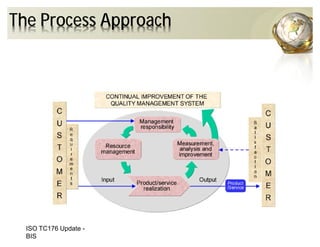
ISO TC176 Update -
BIS
The Process Approach
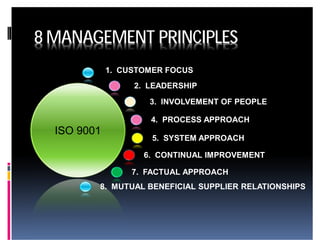
ISO 9001
1. CUSTOMER FOCUS
2. LEADERSHIP
8 MANAGEMENT PRINCIPLES
3. INVOLVEMENT OF PEOPLE
4. PROCESS APPROACH
5. SYSTEM APPROACH
6. CONTINUAL IMPROVEMENT
7. FACTUAL APPROACH
8. MUTUAL BENEFICIAL SUPPLIER RELATIONSHIPS
6
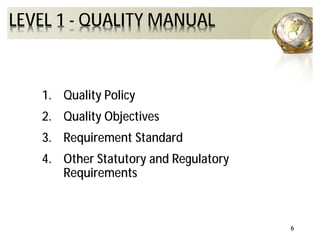
LEVEL 1 - QUALITY MANUAL
1. Quality Policy
2. Quality Objectives
3. Requirement Standard
4. Other Statutory and Regulatory
Requirements
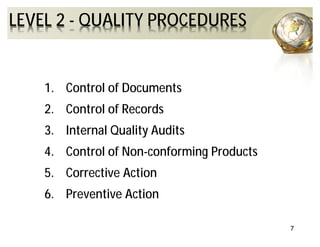
LEVEL 2 - QUALITY PROCEDURES
1. Control of Documents
2. Control of Records
3. Internal Quality Audits
4. Control of Non-conforming Products
5. Corrective Action
6. Preventive Action
7
8
LEVEL 3 - QUALITY PLAN
1. Incoming Inspection Plan
2. In-Process Inspection Plan
3. Final Test Report/ Inspection Plan
4. Work Instruction
9
LEVEL 4 - FORMS / FORMATS/RECORDS
1. Testing Report forms
2. Commissioning Report Forms
3. Inspection forms
4. Check Sheets/Check List
5. Miscellaneous Documentation Forms
1. Management Review
2. Competence, Training and Awareness
3. Planning and Production
4. Review of Requirement Related to Product
5. Design and Development Input
10
23 MANDATORY RECORDS
11
23 MANDATORY RECORDS
6. Design and Development Output
7. Design and Development Review
8. Design and Development Verification
9. Design and Development Validation
10. Control of Design and Development Changes
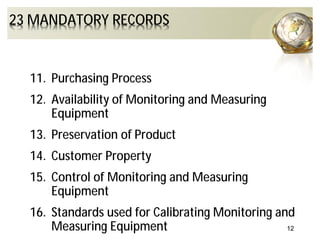
12
23 MANDATORY RECORDS
11. Purchasing Process
12. Availability of Monitoring and Measuring
Equipment
13. Preservation of Product
14. Customer Property
15. Control of Monitoring and Measuring
Equipment
16. Standards used for Calibrating Monitoring and
Measuring Equipment
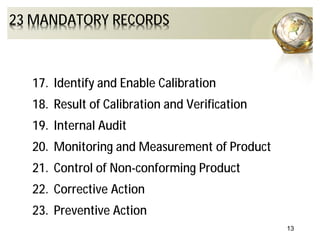
13
23 MANDATORY RECORDS
17. Identify and Enable Calibration
18. Result of Calibration and Verification
19. Internal Audit
20. Monitoring and Measurement of Product
21. Control of Non-conforming Product
22. Corrective Action
23. Preventive Action
Applying Quality
Management System
(ISO 9001) in
Construction Works
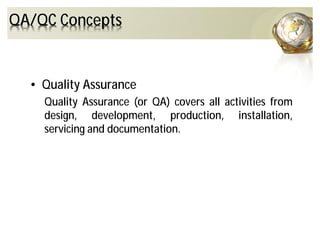
QA/QC Concepts
• Quality Assurance
Quality Assurance (or QA) covers all activities from
design, development, production, installation,
servicing and documentation.
QA/QC Concepts
• Quality Control
Quality control refers to the process,
– most often implemented in manufacturing,
– monitoring the quality of finished products through
statistical measures and
– an overall corporate commitment to producing
defect-free products.
QA/QC Concepts
• Organizational Level.
At the organizational level, QA activities ensure
that the program or organization is successful by
overseeing the system implementation necessary
for individual projects in the program, and making
sure activities have the resources they need to be
successful.
• Project Level (Design, Estimate and Initiation)
At the project level, QA activities support the success
of an individual project by ensuring that accurate
information is channeled to the right people at the
right time so that decisions can be made during
project implementation.
QA/QC Concepts
QA/QC Concepts
• Technical Level.
At the technical level, QA activities ensure that the
individual technical activities that generate,
process, or synthesize data (or other information)
for the decision process are performing within
accepted limits.
ISO 9001:2008
QUALITY MANAGEMENT
SYSTEM IS
QUALITY ASSURANCE
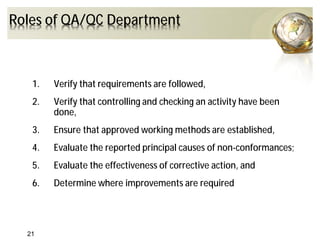
Roles of QA/QC Department
1. Verify that requirements are followed,
2. Verify that controlling and checking an activity have been
done,
3. Ensure that approved working methods are established,
4. Evaluate the reported principal causes of non-conformances;
5. Evaluate the effectiveness of corrective action, and
6. Determine where improvements are required
21
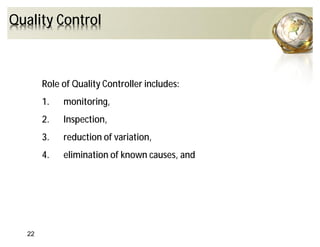
Quality Control
Role of Quality Controller includes:
1. monitoring,
2. Inspection,
3. reduction of variation,
4. elimination of known causes, and
22
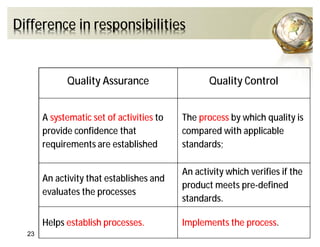
Quality Assurance Quality Control
A systematic set of activities to
provide confidence that
requirements are established
The process by which quality is
compared with applicable
standards;
An activity that establishes and
evaluates the processes
An activity which verifies if the
product meets pre-defined
standards.
Helps establish processes. Implements the process.
Difference in responsibilities
23
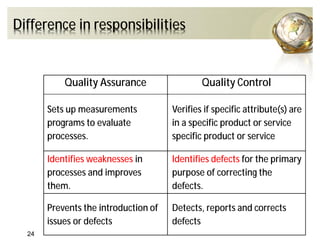
Quality Assurance Quality Control
Sets up measurements
programs to evaluate
processes.
Verifies if specific attribute(s) are
in a specific product or service
specific product or service
Identifies weaknesses in
processes and improves
them.
Identifies defects for the primary
purpose of correcting the
defects.
Prevents the introduction of
issues or defects
Detects, reports and corrects
defects
Difference in responsibilities
24
Difference in responsibilities
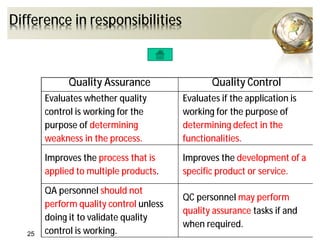
Quality Assurance Quality Control
Evaluates whether quality
control is working for the
purpose of determining
weakness in the process.
Evaluates if the application is
working for the purpose of
determining defect in the
functionalities.
Improves the process that is
applied to multiple products.
Improves the development of a
specific product or service.
QA personnel should not
perform quality control unless
doing it to validate quality
control is working.
QC personnel may perform
quality assurance tasks if and
when required.
25
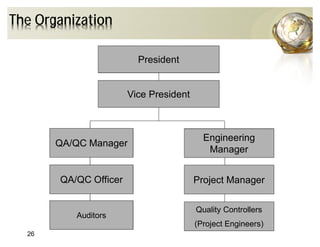
The Organization
President
26
QA/QC Manager
QA/QC Officer
Engineering
Manager
Project Manager
Quality Controllers
(Project Engineers)
Auditors
Vice President
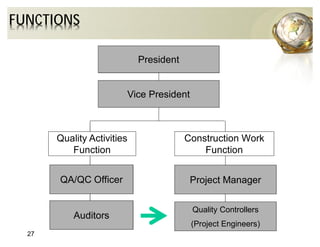
FUNCTIONS
President
Vice President
27
QA/QC Officer Project Manager
Quality Controllers
(Project Engineers)
Auditors
Quality Activities
Function
Construction Work
Function
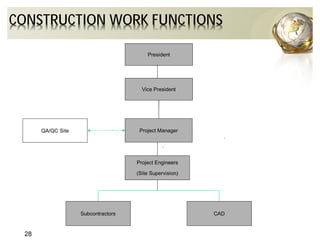
CONSTRUCTION WORK FUNCTIONS
President
28
Project ManagerQA/QC Site
Vice President
Subcontractors CAD
Project Engineers
(Site Supervision)
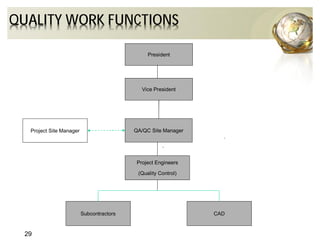
QUALITY WORK FUNCTIONS
President
29
QA/QC Site Manager
Project Engineers
(Quality Control)
Project Site Manager
Vice President
Subcontractors CAD
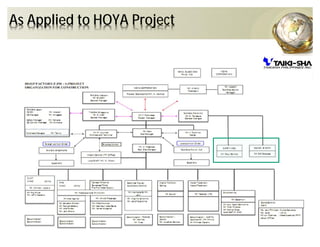
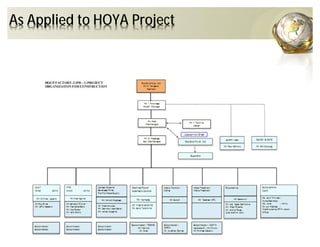
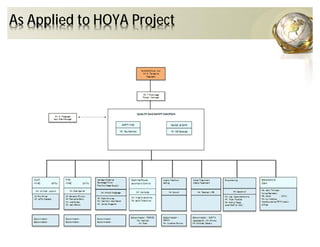
As Applied to HOYA Project
33
Quality Management Objectives
zero defect (no defects on project
hand-over)
identify and solve problems before
customer does
establish true quality control by
making quality “built in” and not
“inspected in”.
Why do we do this?
• For better efficiency,
• Fewer rejects,
• Reduce if not eliminate customer complaints,
• Improve customer relation
• Improve supplier relation.
• And to answer our slogan:
– Open Challenge Quick Response
35
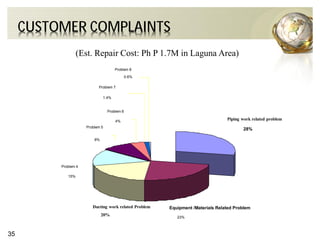
CUSTOMER COMPLAINTS
Piping work related problem
28%
Ducting work related Problem
20%
Equipment /Materials Related Problem
23%
Problem 4
15%
Problem 5
8%
Problem 6
4%
Problem 7
1.4%
Problem 8
0.6%
(Est. Repair Cost: Ph P 1.7M in Laguna Area)
36
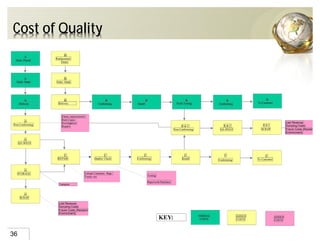
Cost of Quality
KEY: ADDED
COSTS
Lost Revenue
Dumping Costs
Future Costs (Reclaim/
Environment)
Transport
Unload Container, Bags,
Trucks etc Testing
Paperwork/Database
Future repercussions
Root Cause
Investigation
Repairs B & C
Non-Conforming QA HOLD SCRAP
B & C B & C
C
REPAIR
C
Quality Check
C
Conforming
C
Install
C C
To CustomerConforming
A
Non-Conforming
A
QA HOLD
A
STORAGE
A
SCRAP
A
Order Placed
A
Order Made
A
Delivery
B
Replacement
Order
B
Order Made
B
Delivery
B
Conforming
B
Install
B B
To CustomerField Testing
B
Conforming
NORMAL
COSTS
ADDED
COSTS
Lost Revenue
Dumping Costs
Future Costs (Reclaim/
Environment)
37
Reflection
Preventing mistakes is much more
time and cost-effective than correcting
them.
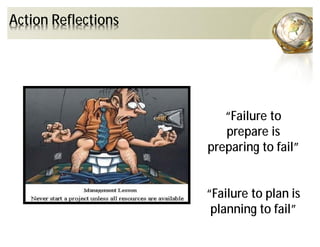
Action Reflections
“Failure to
prepare is
preparing to fail”
“Failure to plan is
planning to fail”
End Of Presentation
Prepared by: Sid Calayag
Reference:
• Quality Management System
• ISO 9001:2008

Quality management in construction

  • 1.
    Quality in Construction Works An Introductionto QA/QC Concept and Quality Management System Based on ISO 9001:2008
  • 2.
    Typical Slogan “Open Challenge QuickResponse” The BIG QUESTION is: How do we meet the challenge and achieve the benefits?
  • 3.
  • 4.
    ISO TC176 Update- BIS The Process Approach
  • 5.
    ISO 9001 1. CUSTOMERFOCUS 2. LEADERSHIP 8 MANAGEMENT PRINCIPLES 3. INVOLVEMENT OF PEOPLE 4. PROCESS APPROACH 5. SYSTEM APPROACH 6. CONTINUAL IMPROVEMENT 7. FACTUAL APPROACH 8. MUTUAL BENEFICIAL SUPPLIER RELATIONSHIPS
  • 6.
    6 LEVEL 1 -QUALITY MANUAL 1. Quality Policy 2. Quality Objectives 3. Requirement Standard 4. Other Statutory and Regulatory Requirements
  • 7.
    LEVEL 2 -QUALITY PROCEDURES 1. Control of Documents 2. Control of Records 3. Internal Quality Audits 4. Control of Non-conforming Products 5. Corrective Action 6. Preventive Action 7
  • 8.
    8 LEVEL 3 -QUALITY PLAN 1. Incoming Inspection Plan 2. In-Process Inspection Plan 3. Final Test Report/ Inspection Plan 4. Work Instruction
  • 9.
    9 LEVEL 4 -FORMS / FORMATS/RECORDS 1. Testing Report forms 2. Commissioning Report Forms 3. Inspection forms 4. Check Sheets/Check List 5. Miscellaneous Documentation Forms
  • 10.
    1. Management Review 2.Competence, Training and Awareness 3. Planning and Production 4. Review of Requirement Related to Product 5. Design and Development Input 10 23 MANDATORY RECORDS
  • 11.
    11 23 MANDATORY RECORDS 6.Design and Development Output 7. Design and Development Review 8. Design and Development Verification 9. Design and Development Validation 10. Control of Design and Development Changes
  • 12.
    12 23 MANDATORY RECORDS 11.Purchasing Process 12. Availability of Monitoring and Measuring Equipment 13. Preservation of Product 14. Customer Property 15. Control of Monitoring and Measuring Equipment 16. Standards used for Calibrating Monitoring and Measuring Equipment
  • 13.
    13 23 MANDATORY RECORDS 17.Identify and Enable Calibration 18. Result of Calibration and Verification 19. Internal Audit 20. Monitoring and Measurement of Product 21. Control of Non-conforming Product 22. Corrective Action 23. Preventive Action
  • 14.
    Applying Quality Management System (ISO9001) in Construction Works
  • 15.
    QA/QC Concepts • QualityAssurance Quality Assurance (or QA) covers all activities from design, development, production, installation, servicing and documentation.
  • 16.
    QA/QC Concepts • QualityControl Quality control refers to the process, – most often implemented in manufacturing, – monitoring the quality of finished products through statistical measures and – an overall corporate commitment to producing defect-free products.
  • 17.
    QA/QC Concepts • OrganizationalLevel. At the organizational level, QA activities ensure that the program or organization is successful by overseeing the system implementation necessary for individual projects in the program, and making sure activities have the resources they need to be successful.
  • 18.
    • Project Level(Design, Estimate and Initiation) At the project level, QA activities support the success of an individual project by ensuring that accurate information is channeled to the right people at the right time so that decisions can be made during project implementation. QA/QC Concepts
  • 19.
    QA/QC Concepts • TechnicalLevel. At the technical level, QA activities ensure that the individual technical activities that generate, process, or synthesize data (or other information) for the decision process are performing within accepted limits.
  • 20.
  • 21.
    Roles of QA/QCDepartment 1. Verify that requirements are followed, 2. Verify that controlling and checking an activity have been done, 3. Ensure that approved working methods are established, 4. Evaluate the reported principal causes of non-conformances; 5. Evaluate the effectiveness of corrective action, and 6. Determine where improvements are required 21
  • 22.
    Quality Control Role ofQuality Controller includes: 1. monitoring, 2. Inspection, 3. reduction of variation, 4. elimination of known causes, and 22
  • 23.
    Quality Assurance QualityControl A systematic set of activities to provide confidence that requirements are established The process by which quality is compared with applicable standards; An activity that establishes and evaluates the processes An activity which verifies if the product meets pre-defined standards. Helps establish processes. Implements the process. Difference in responsibilities 23
  • 24.
    Quality Assurance QualityControl Sets up measurements programs to evaluate processes. Verifies if specific attribute(s) are in a specific product or service specific product or service Identifies weaknesses in processes and improves them. Identifies defects for the primary purpose of correcting the defects. Prevents the introduction of issues or defects Detects, reports and corrects defects Difference in responsibilities 24
  • 25.
    Difference in responsibilities QualityAssurance Quality Control Evaluates whether quality control is working for the purpose of determining weakness in the process. Evaluates if the application is working for the purpose of determining defect in the functionalities. Improves the process that is applied to multiple products. Improves the development of a specific product or service. QA personnel should not perform quality control unless doing it to validate quality control is working. QC personnel may perform quality assurance tasks if and when required. 25
  • 26.
    The Organization President 26 QA/QC Manager QA/QCOfficer Engineering Manager Project Manager Quality Controllers (Project Engineers) Auditors Vice President
  • 27.
    FUNCTIONS President Vice President 27 QA/QC OfficerProject Manager Quality Controllers (Project Engineers) Auditors Quality Activities Function Construction Work Function
  • 28.
    CONSTRUCTION WORK FUNCTIONS President 28 ProjectManagerQA/QC Site Vice President Subcontractors CAD Project Engineers (Site Supervision)
  • 29.
    QUALITY WORK FUNCTIONS President 29 QA/QCSite Manager Project Engineers (Quality Control) Project Site Manager Vice President Subcontractors CAD
  • 30.
    As Applied toHOYA Project
  • 31.
    As Applied toHOYA Project
  • 32.
    As Applied toHOYA Project
  • 33.
    33 Quality Management Objectives zerodefect (no defects on project hand-over) identify and solve problems before customer does establish true quality control by making quality “built in” and not “inspected in”.
  • 34.
    Why do wedo this? • For better efficiency, • Fewer rejects, • Reduce if not eliminate customer complaints, • Improve customer relation • Improve supplier relation. • And to answer our slogan: – Open Challenge Quick Response
  • 35.
    35 CUSTOMER COMPLAINTS Piping workrelated problem 28% Ducting work related Problem 20% Equipment /Materials Related Problem 23% Problem 4 15% Problem 5 8% Problem 6 4% Problem 7 1.4% Problem 8 0.6% (Est. Repair Cost: Ph P 1.7M in Laguna Area)
  • 36.
    36 Cost of Quality KEY:ADDED COSTS Lost Revenue Dumping Costs Future Costs (Reclaim/ Environment) Transport Unload Container, Bags, Trucks etc Testing Paperwork/Database Future repercussions Root Cause Investigation Repairs B & C Non-Conforming QA HOLD SCRAP B & C B & C C REPAIR C Quality Check C Conforming C Install C C To CustomerConforming A Non-Conforming A QA HOLD A STORAGE A SCRAP A Order Placed A Order Made A Delivery B Replacement Order B Order Made B Delivery B Conforming B Install B B To CustomerField Testing B Conforming NORMAL COSTS ADDED COSTS Lost Revenue Dumping Costs Future Costs (Reclaim/ Environment)
  • 37.
    37 Reflection Preventing mistakes ismuch more time and cost-effective than correcting them.
  • 38.
    Action Reflections “Failure to prepareis preparing to fail” “Failure to plan is planning to fail”
  • 39.
  • 40.
    Prepared by: SidCalayag Reference: • Quality Management System • ISO 9001:2008