The Quality
Prepared by
Arch. Saad Al Jabri
What is Quality?
Quality is: “meeting the requirements of the
customer”.
There is a common conflict in understanding
Quality Assurance QA and Quality Control QC
Quality Assurance QA
Assure the quality of the product, service or result.
Assurance is making sure that product comes out
of defect free and confirms to stated
requirements.
QA prime objective is to prevent defects in
deliverables to avoid the rework, which cost a lot.
Quality Assurance QA
• It is a proactive process,
• is a process based approach,
• starts at the beginning of the project to
understand the product’s stated and non-stated
requirements and expectations,
• then develops the plan to meet these
requirements and expectations.
QA examples
• Quality audit
• training,
• process definition,
• selection of control tools (e.g. Affinity Diagrams,
periodization matrices)
Quality Control QA
is concerned with the operational activities and
techniques that are used to fulfill the requirements
of quality.
The quality control process includes the activities
which ensure a high quality product. These
activities focus on identifying defects in the actual
product being produced.
Quality Control QA
Quality control functions start once the project
work has begun. Quality control is a reactive
approach and helps you find defects in
deliverables.
QC objective is to make sure that the deliverables
are defect free and acceptable as per the quality
requirements set in the quality assurance process.
If the deliverables are not found as per the
requirements, a suitable corrective action will
be taken.
QC examples
• Inspection,
• product testing,
• Statistical sampling,
• 7 QTs (e.g. Flowcharting, check sheets, control
chart)
QA & QC
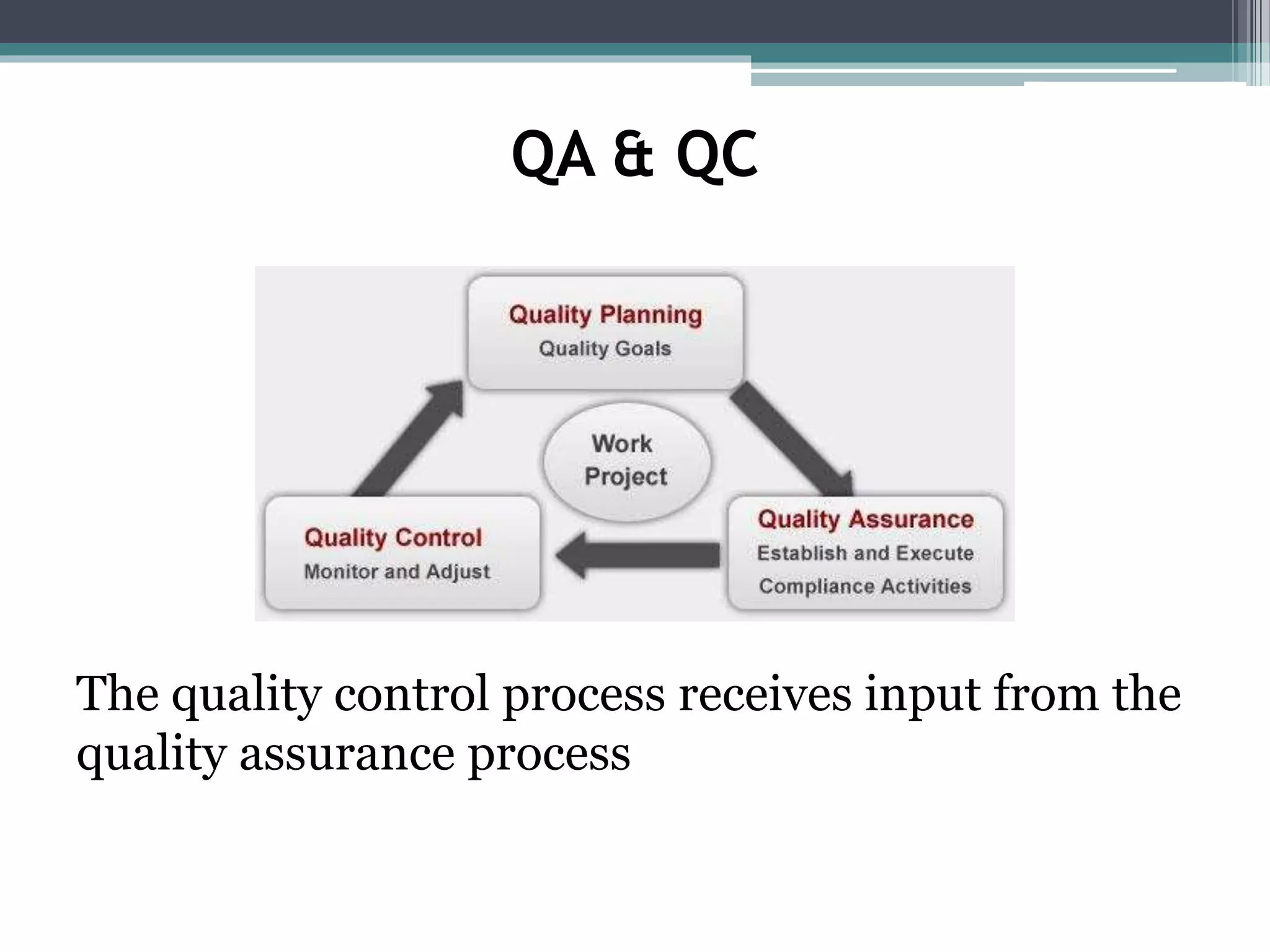
The quality control process receives input from the
quality assurance process
QA & QC
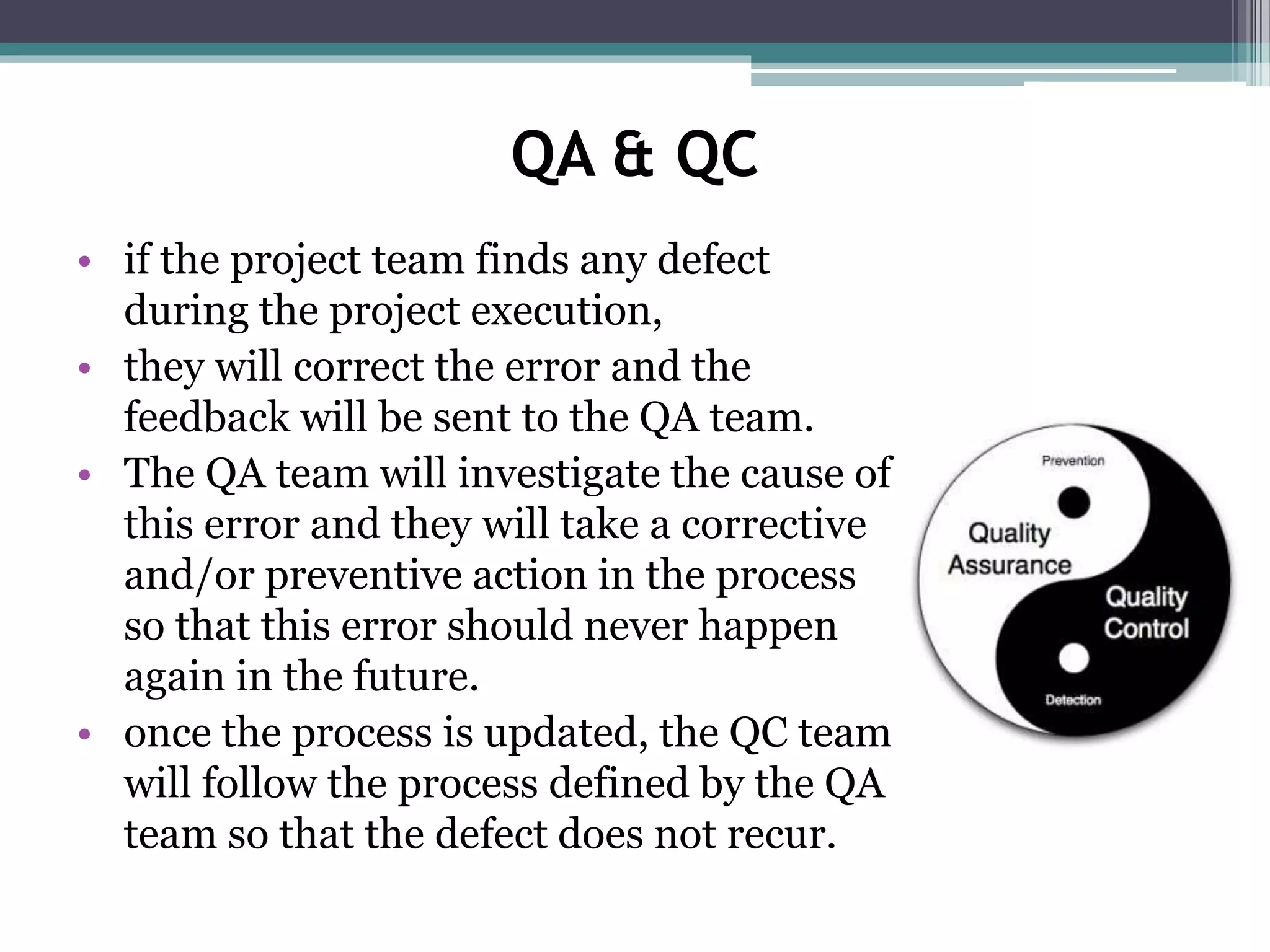
• if the project team finds any defect
during the project execution,
• they will correct the error and the
feedback will be sent to the QA team.
• The QA team will investigate the cause of
this error and they will take a corrective
and/or preventive action in the process
so that this error should never happen
again in the future.
• once the process is updated, the QC team
will follow the process defined by the QA
team so that the defect does not recur.
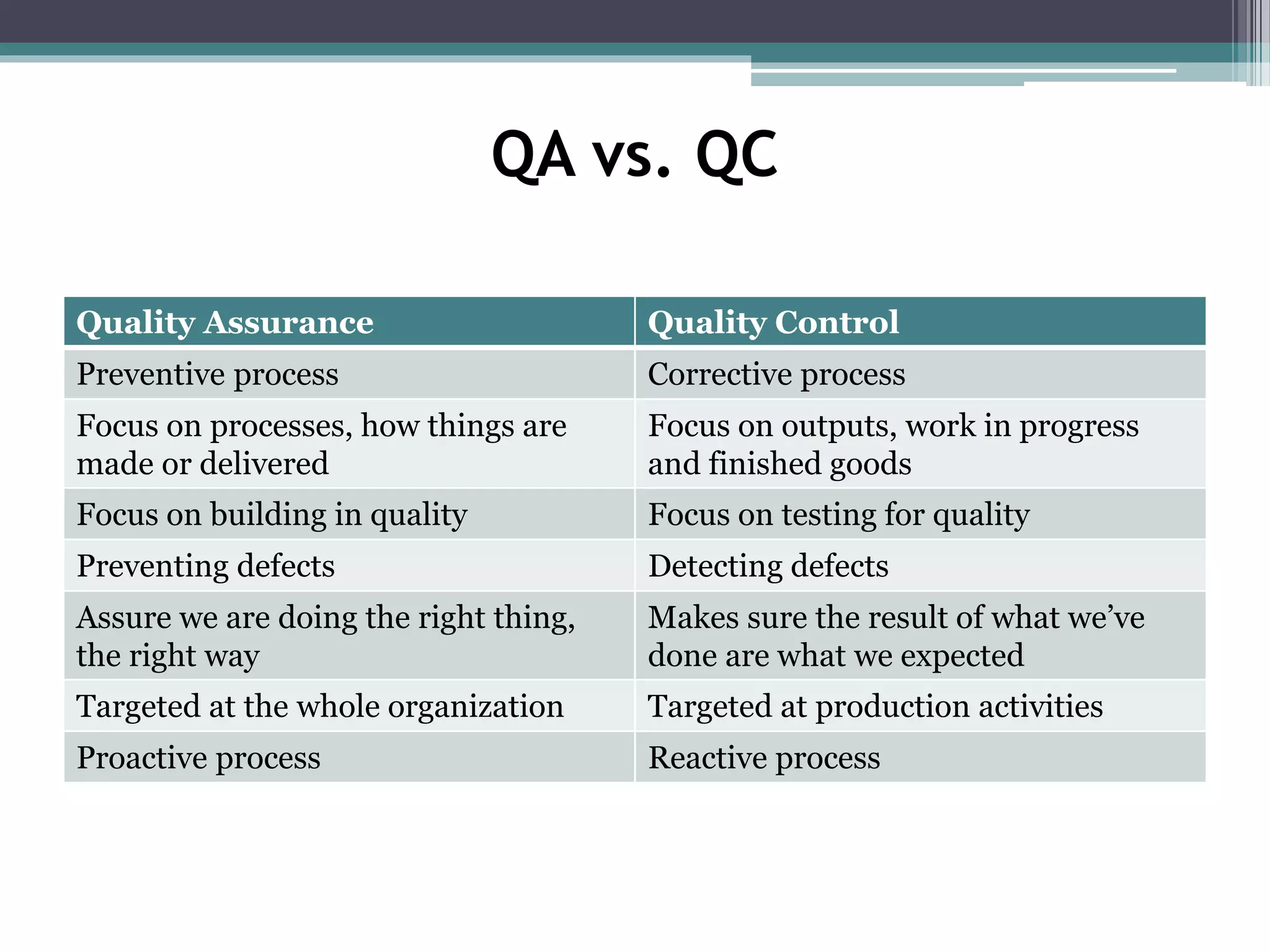
QA vs. QC
Quality Assurance Quality Control
Preventive process Corrective process
Focus on processes, how things are
made or delivered
Focus on outputs, work in progress
and finished goods
Focus on building in quality Focus on testing for quality
Preventing defects Detecting defects
Assure we are doing the right thing,
the right way
Makes sure the result of what we’ve
done are what we expected
Targeted at the whole organization Targeted at production activities
Proactive process Reactive process
What is quality

What is quality

  • 1.
  • 2.
    What is Quality? Qualityis: “meeting the requirements of the customer”. There is a common conflict in understanding Quality Assurance QA and Quality Control QC
  • 3.
    Quality Assurance QA Assurethe quality of the product, service or result. Assurance is making sure that product comes out of defect free and confirms to stated requirements. QA prime objective is to prevent defects in deliverables to avoid the rework, which cost a lot.
  • 4.
    Quality Assurance QA •It is a proactive process, • is a process based approach, • starts at the beginning of the project to understand the product’s stated and non-stated requirements and expectations, • then develops the plan to meet these requirements and expectations.
  • 5.
    QA examples • Qualityaudit • training, • process definition, • selection of control tools (e.g. Affinity Diagrams, periodization matrices)
  • 6.
    Quality Control QA isconcerned with the operational activities and techniques that are used to fulfill the requirements of quality. The quality control process includes the activities which ensure a high quality product. These activities focus on identifying defects in the actual product being produced.
  • 7.
    Quality Control QA Qualitycontrol functions start once the project work has begun. Quality control is a reactive approach and helps you find defects in deliverables. QC objective is to make sure that the deliverables are defect free and acceptable as per the quality requirements set in the quality assurance process. If the deliverables are not found as per the requirements, a suitable corrective action will be taken.
  • 8.
    QC examples • Inspection, •product testing, • Statistical sampling, • 7 QTs (e.g. Flowcharting, check sheets, control chart)
  • 9.
    QA & QC Thequality control process receives input from the quality assurance process
  • 10.
    QA & QC •if the project team finds any defect during the project execution, • they will correct the error and the feedback will be sent to the QA team. • The QA team will investigate the cause of this error and they will take a corrective and/or preventive action in the process so that this error should never happen again in the future. • once the process is updated, the QC team will follow the process defined by the QA team so that the defect does not recur.
  • 11.
    QA vs. QC QualityAssurance Quality Control Preventive process Corrective process Focus on processes, how things are made or delivered Focus on outputs, work in progress and finished goods Focus on building in quality Focus on testing for quality Preventing defects Detecting defects Assure we are doing the right thing, the right way Makes sure the result of what we’ve done are what we expected Targeted at the whole organization Targeted at production activities Proactive process Reactive process

Editor's Notes

  • #4 Elements of project charter and project scope statement
  • #11 Dividing and subdividing the project scope and project deliverables into smaller, more manageable part
  • #12 The diagram shows the important processes where deliverables are produced, verified and accepted.