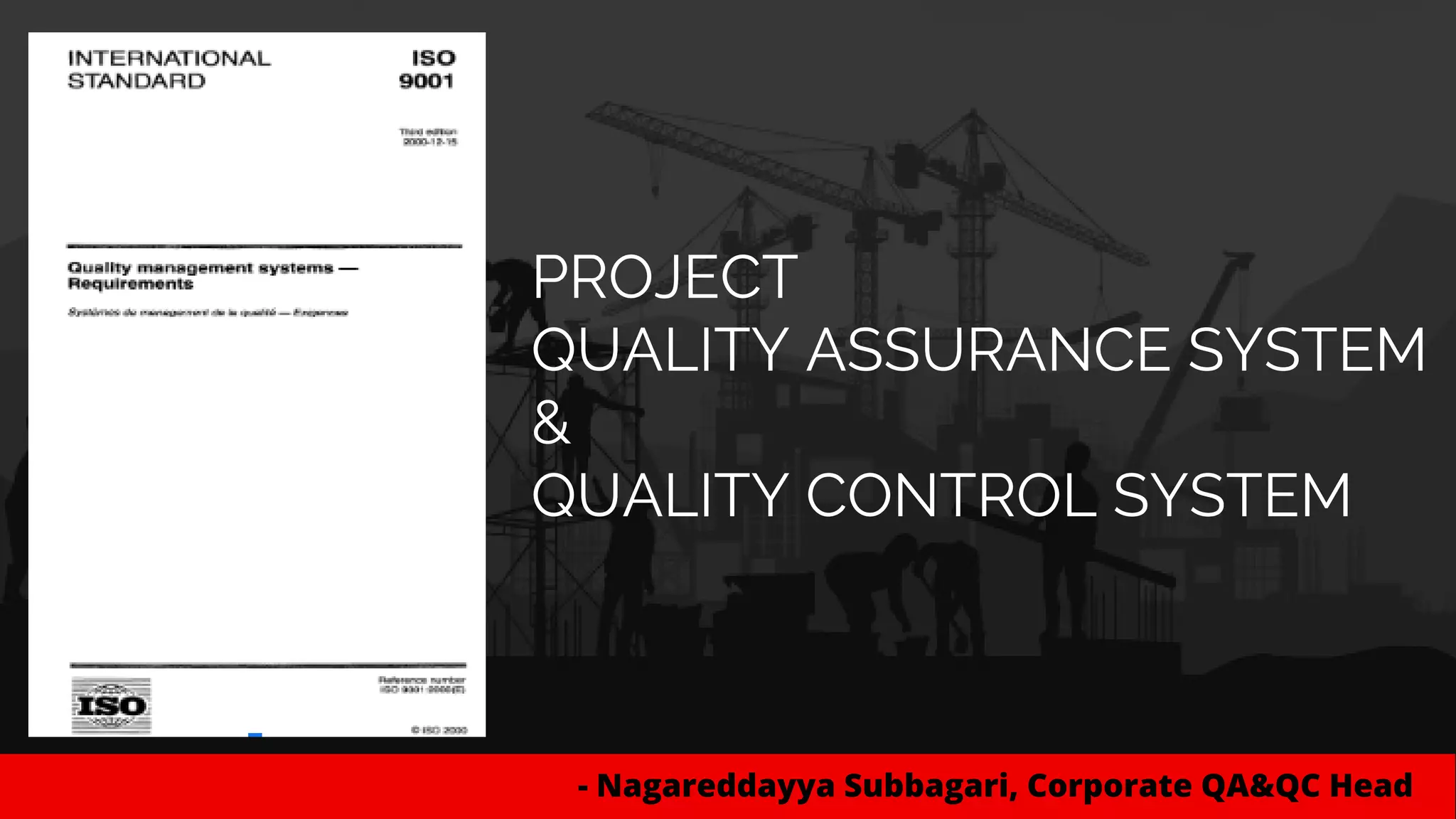
PROJECT
QUALITY ASSURANCE SYSTEM
&
QUALITY CONTROL SYSTEM
- Nagareddayya Subbagari, Corporate QA&QC Head
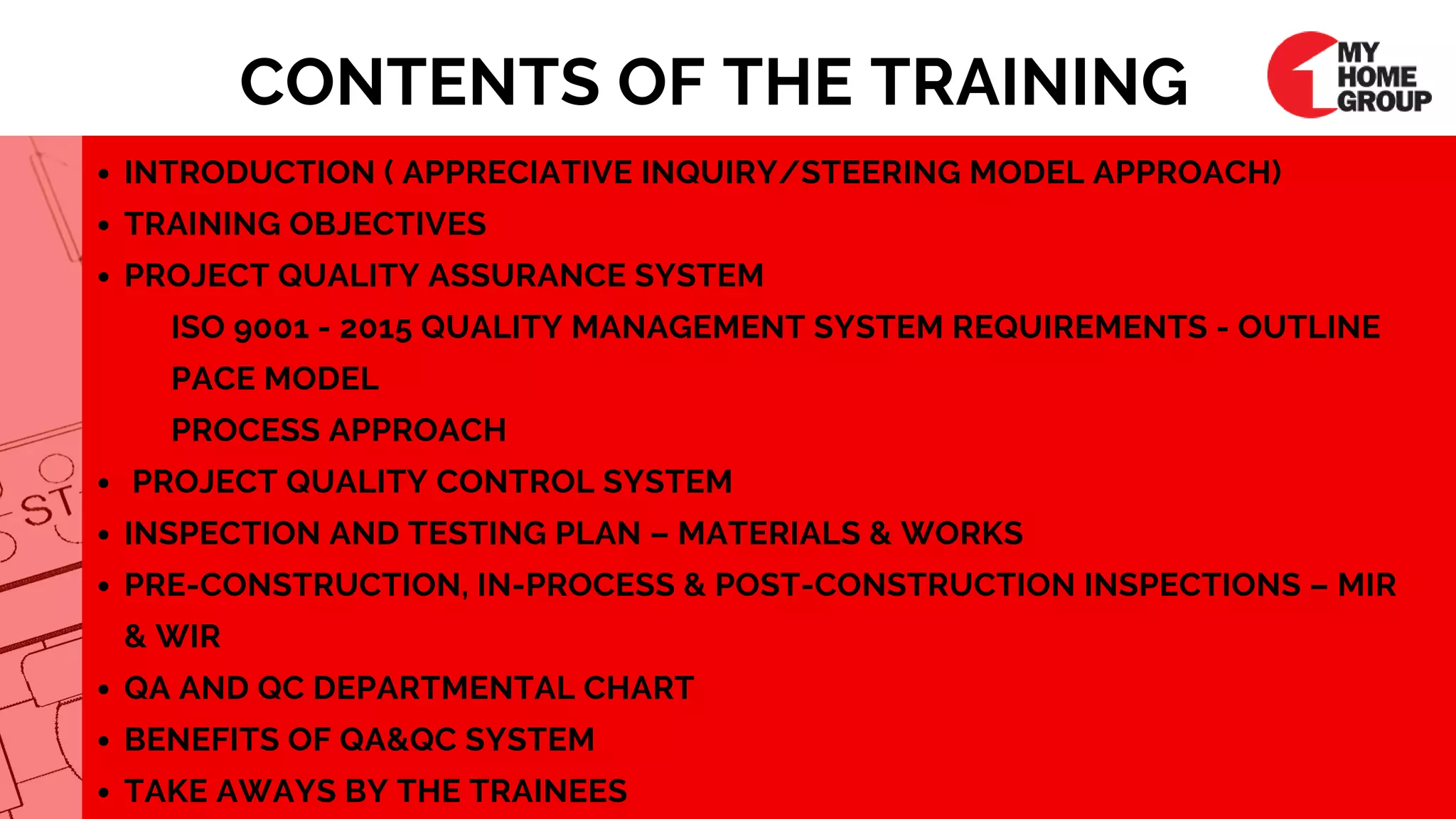
INTRODUCTION ( APPRECIATIVE INQUIRY/STEERING MODEL APPROACH)
TRAINING OBJECTIVES
PROJECT QUALITY ASSURANCE SYSTEM
PROJECT QUALITY CONTROL SYSTEM
INSPECTION AND TESTING PLAN – MATERIALS & WORKS
PRE-CONSTRUCTION, IN-PROCESS & POST-CONSTRUCTION INSPECTIONS – MIR
& WIR
QA AND QC DEPARTMENTAL CHART
BENEFITS OF QA&QC SYSTEM
TAKE AWAYS BY THE TRAINEES
ISO 9001 - 2015 QUALITY MANAGEMENT SYSTEM REQUIREMENTS - OUTLINE
PACE MODEL
PROCESS APPROACH
CONTENTS OF THE TRAINING
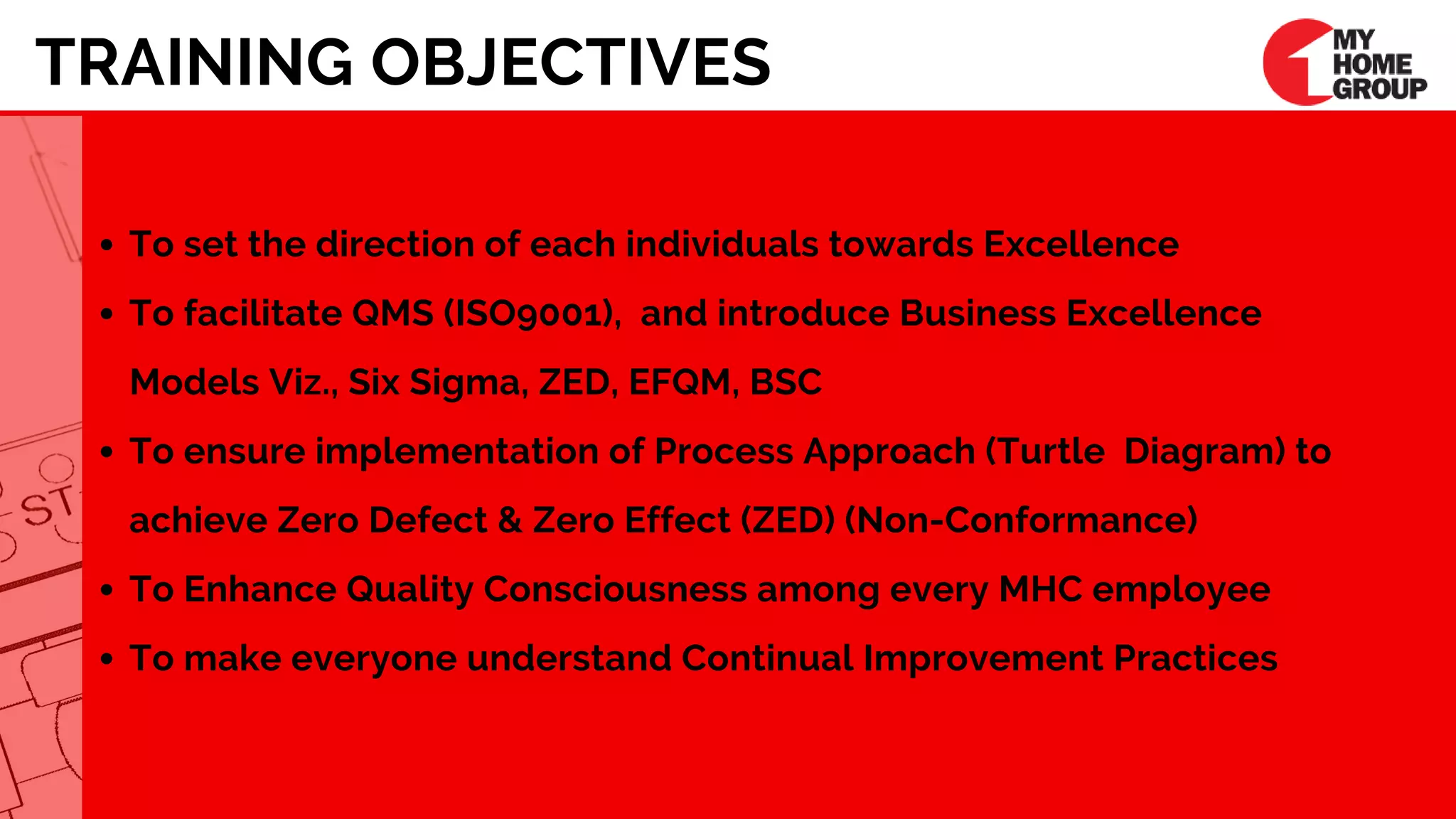
TRAINING OBJECTIVES
To set the direction of each individuals towards Excellence
To facilitate QMS (ISO9001),  and introduce Business Excellence 
Models Viz., Six Sigma, ZED, EFQM, BSC    
To ensure implementation of Process Approach (Turtle  Diagram) to
achieve Zero Defect & Zero Effect (ZED) (Non-Conformance) 
To Enhance Quality Consciousness among every MHC employee 
To make everyone understand Continual Improvement Practices
PLAN?
HOW DO YOU KNOW WHAT TO DO?
"FAILING TO PLAN = PLANNING TO FAIL"
(4+1) ASPECTS OF HUMAN LIFE
Personal Life
Professional Life
Family Life
Social Life
Spiritual Life
STEERING MODEL APPROACH
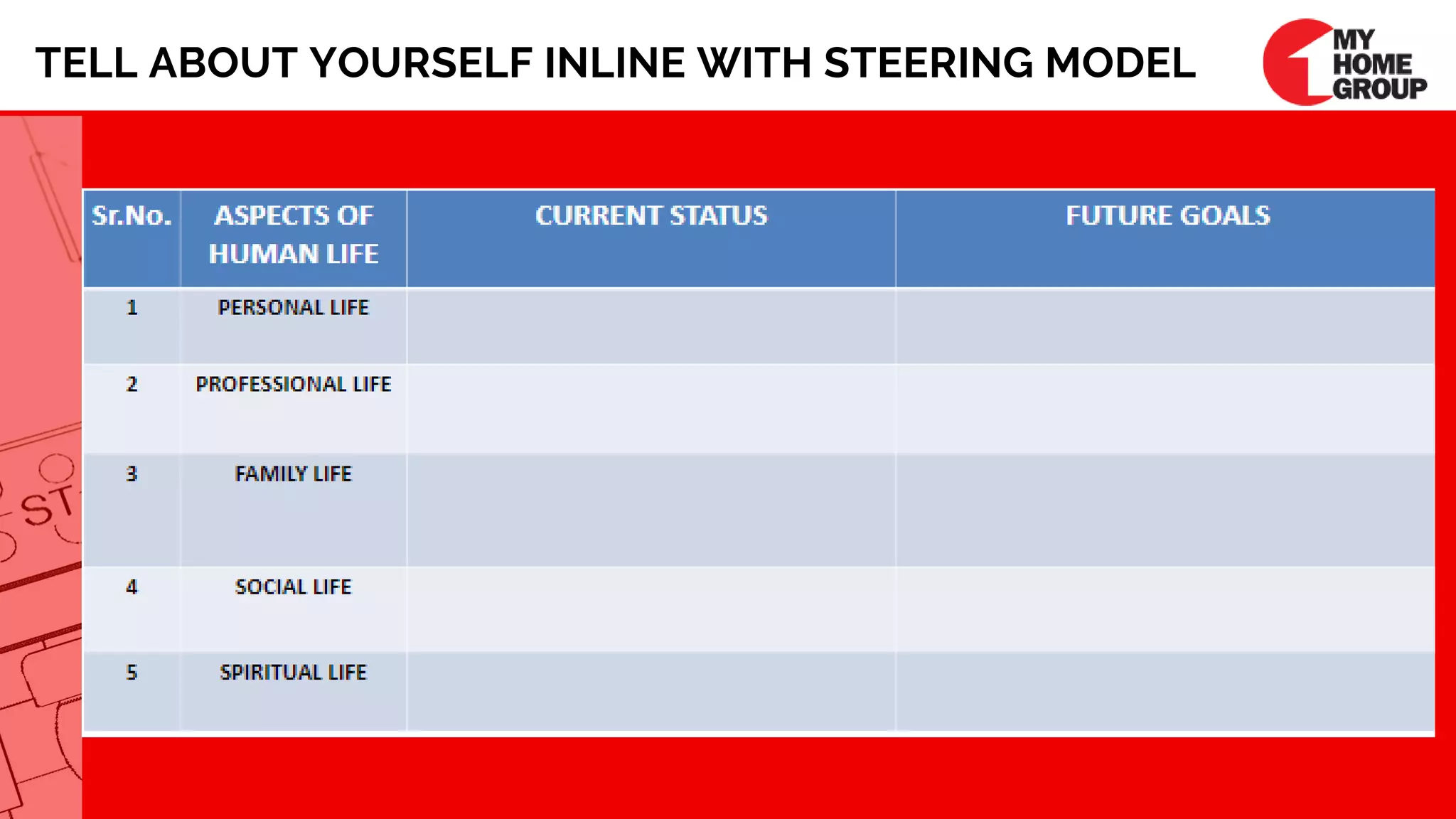
TELL ABOUT YOURSELF INLINE WITH STEERING MODEL
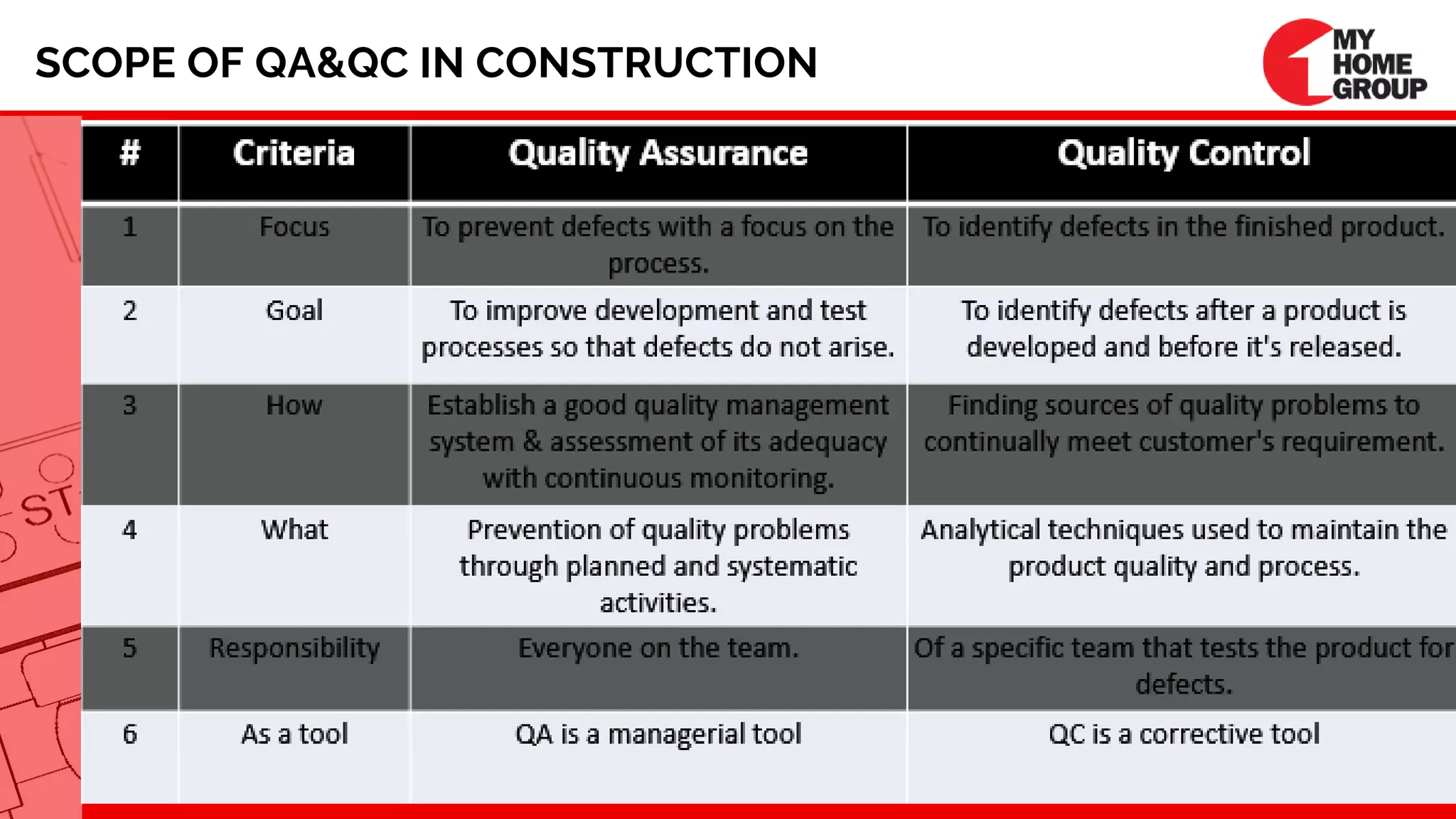
SCOPE OF QA&QC IN CONSTRUCTION
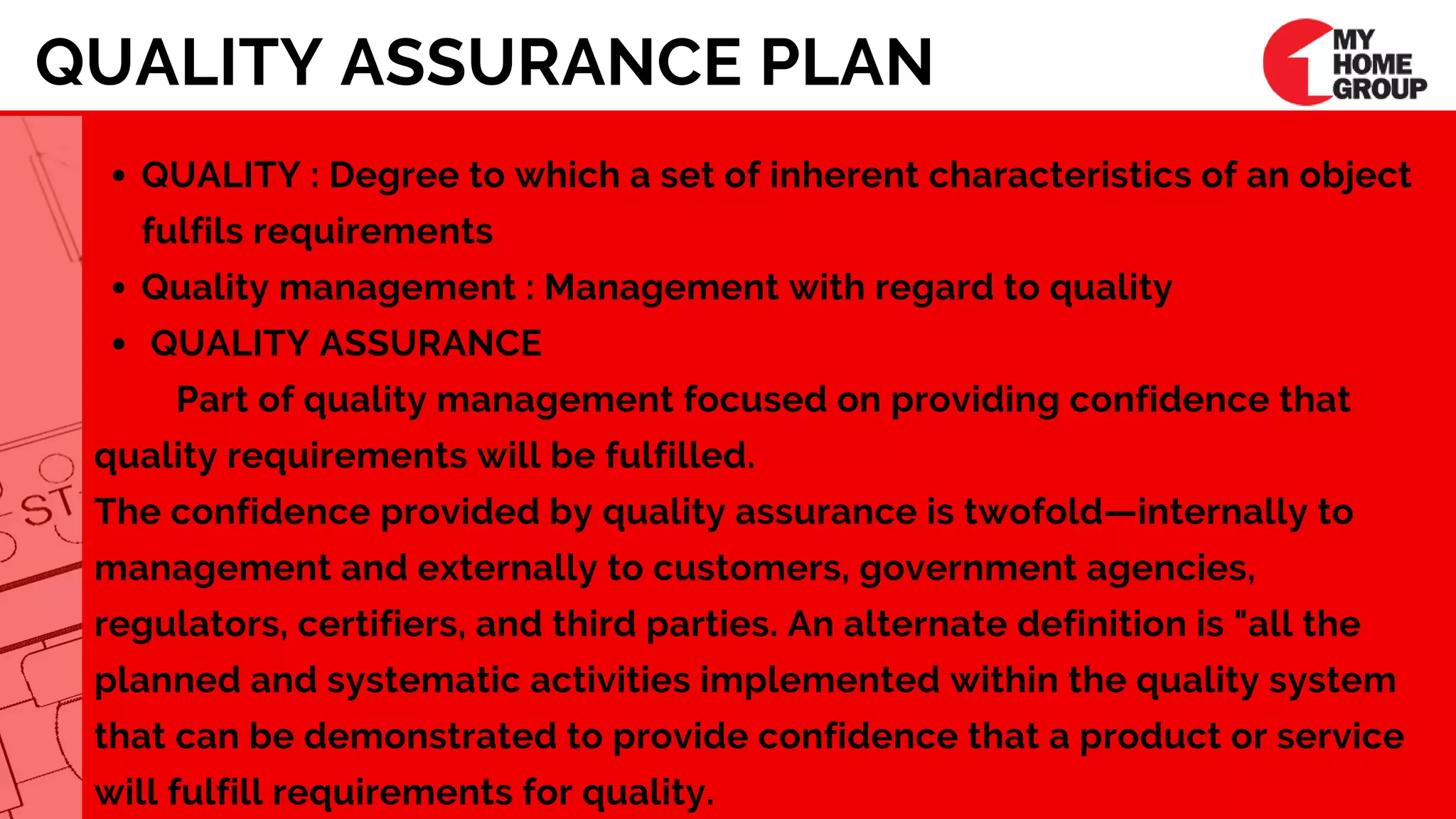
QUALITY ASSURANCE PLAN
QUALITY : Degree to which a set of inherent characteristics of an object
fulfils requirements 
Quality management : Management with regard to quality 
 QUALITY ASSURANCE
Part of quality management focused on providing confidence that
quality requirements will be fulfilled. 
The confidence provided by quality assurance is twofold—internally to
management and externally to customers, government agencies,
regulators, certifiers, and third parties. An alternate definition is "all the
planned and systematic activities implemented within the quality system
that can be demonstrated to provide confidence that a product or service
will fulfill requirements for quality.
QUALITY ASSURANCE PLAN
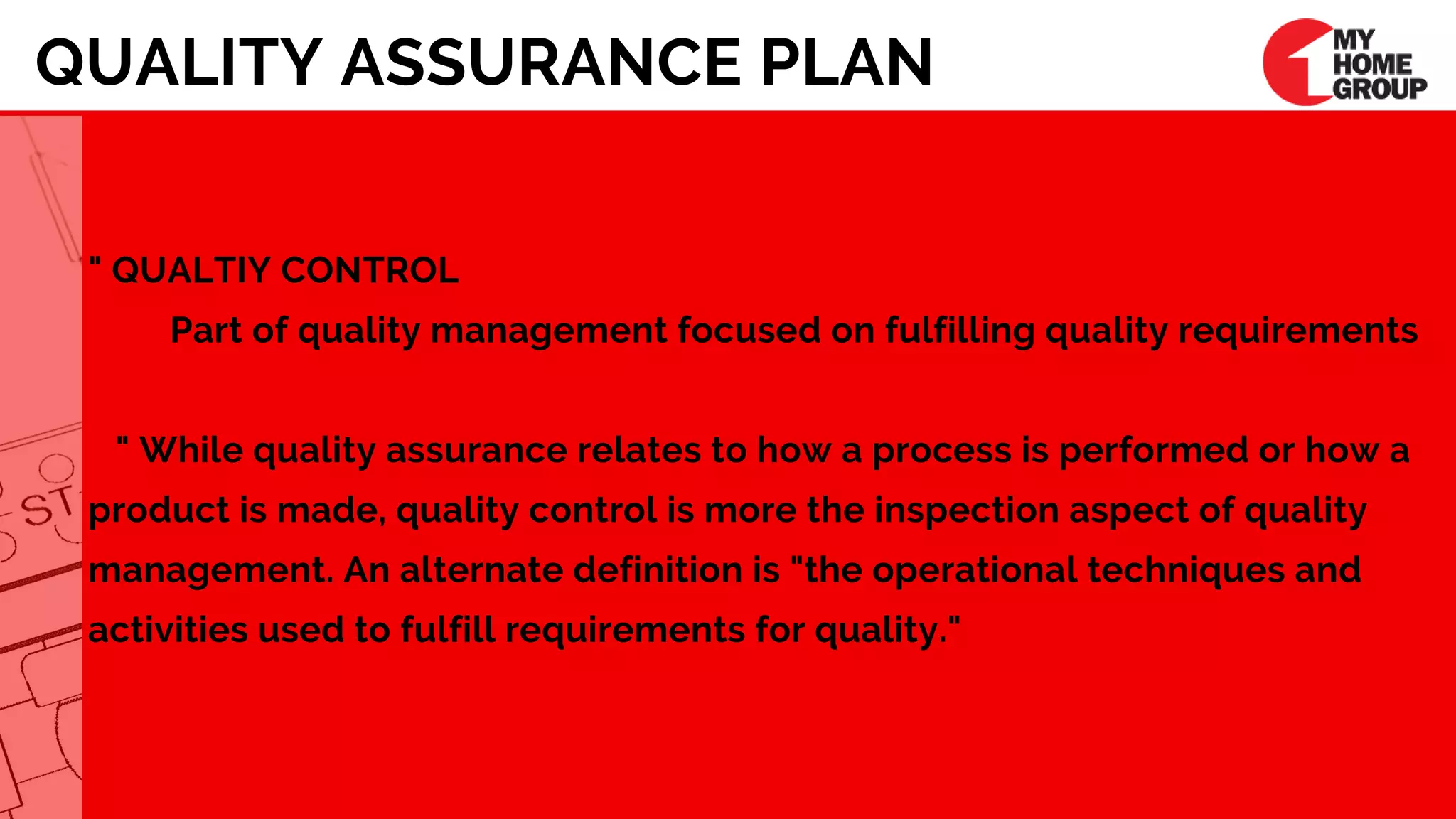
" QUALTIY CONTROL     
Part of quality management focused on fulfilling quality requirements 
       
   " While quality assurance relates to how a process is performed or how a
product is made, quality control is more the inspection aspect of quality
management. An alternate definition is "the operational techniques and

activities used to fulfill requirements for quality."
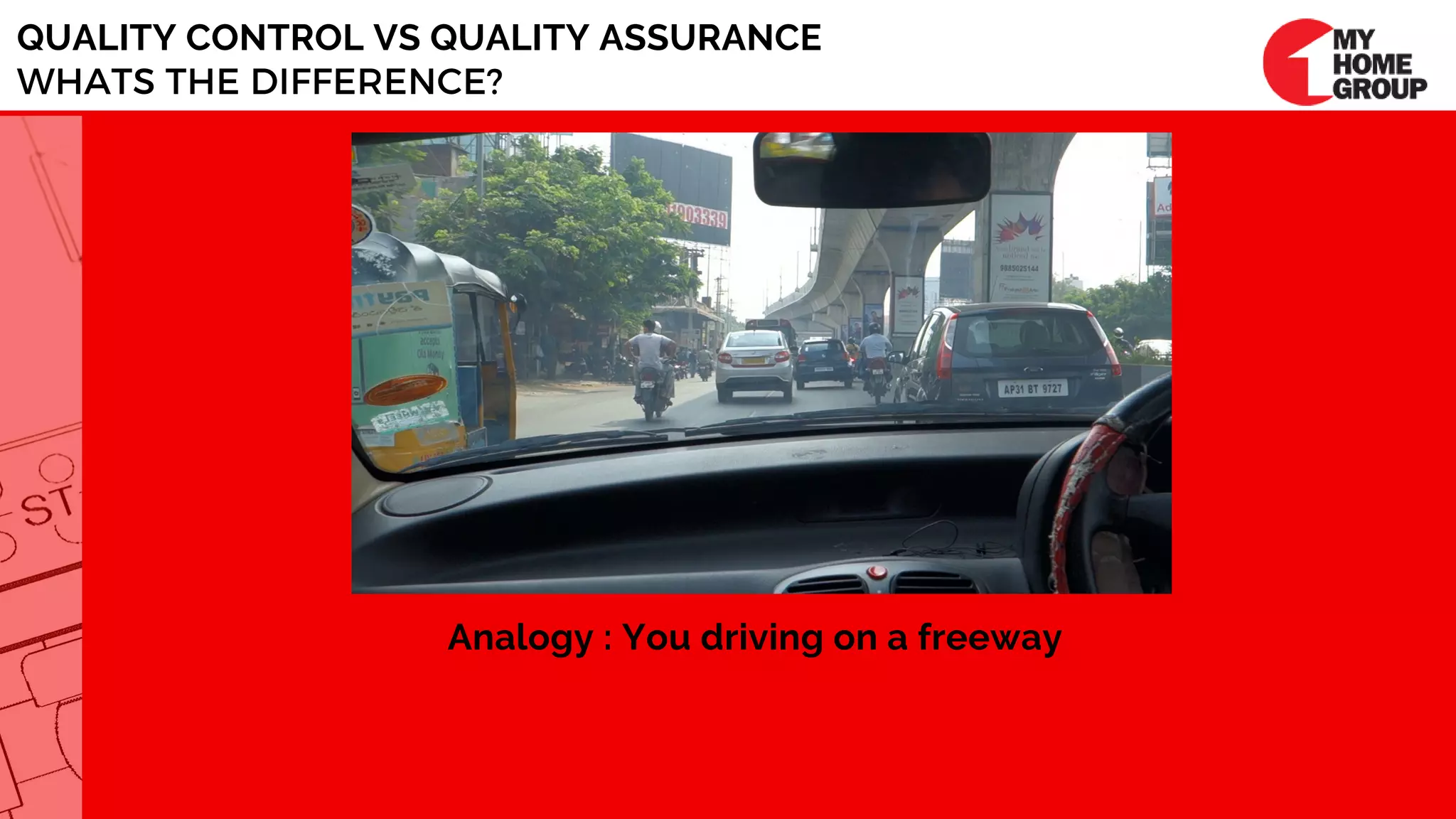
QUALITY CONTROL VS QUALITY ASSURANCE
WHATS THE DIFFERENCE?
Analogy : You driving on a freeway
QUALITY CONTROL VS QUALITY ASSURANCE
WHATS THE DIFFERENCE?
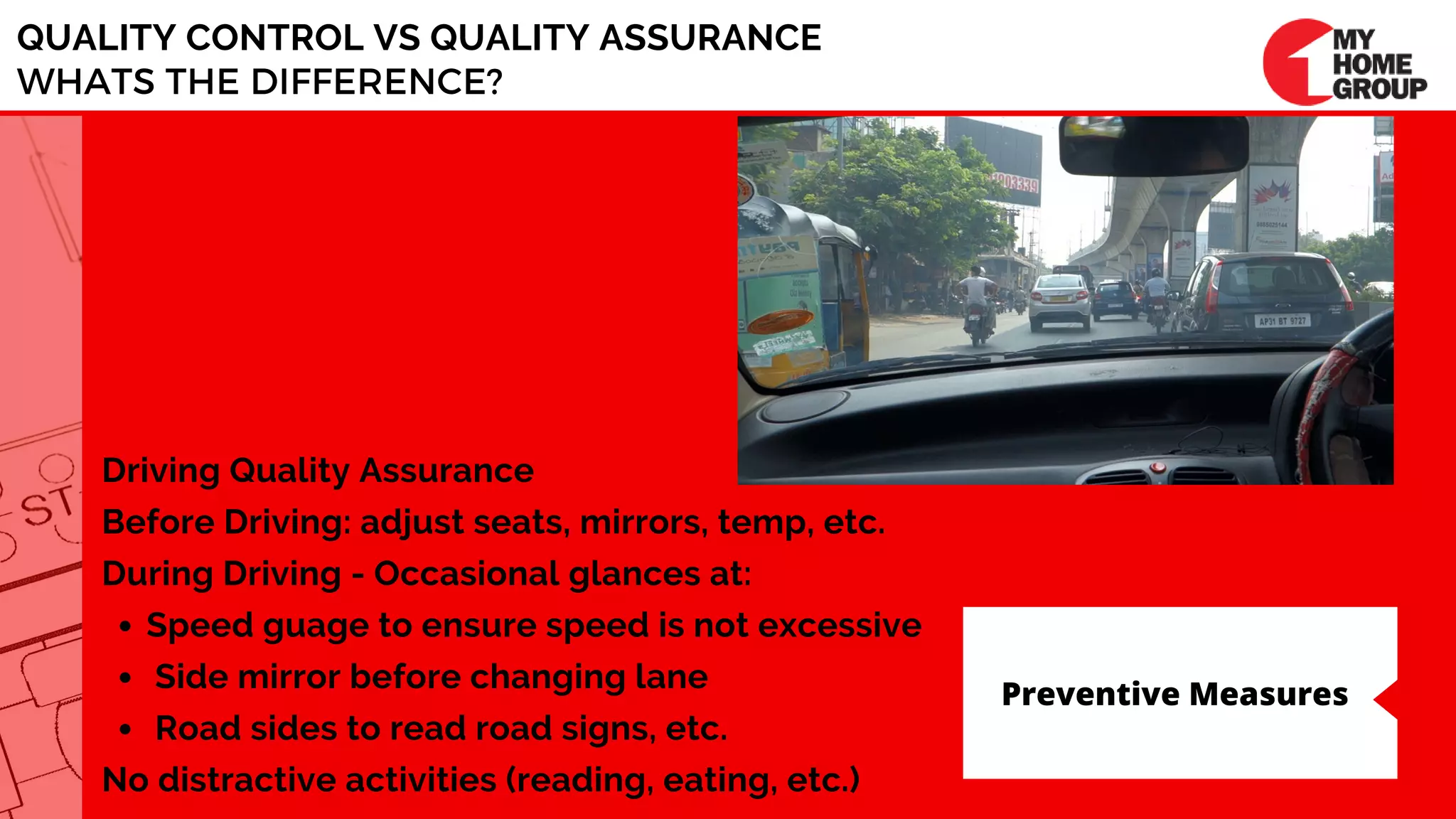
Speed guage to ensure speed is not excessive
Side mirror before changing lane      
 Road sides to read road signs, etc.
Driving Quality Assurance
Before Driving: adjust seats, mirrors, temp, etc.
During Driving - Occasional glances at:
No distractive activities (reading, eating, etc.)
Preventive Measures
QUALITY CONTROL VS QUALITY ASSURANCE
WHATS THE DIFFERENCE?
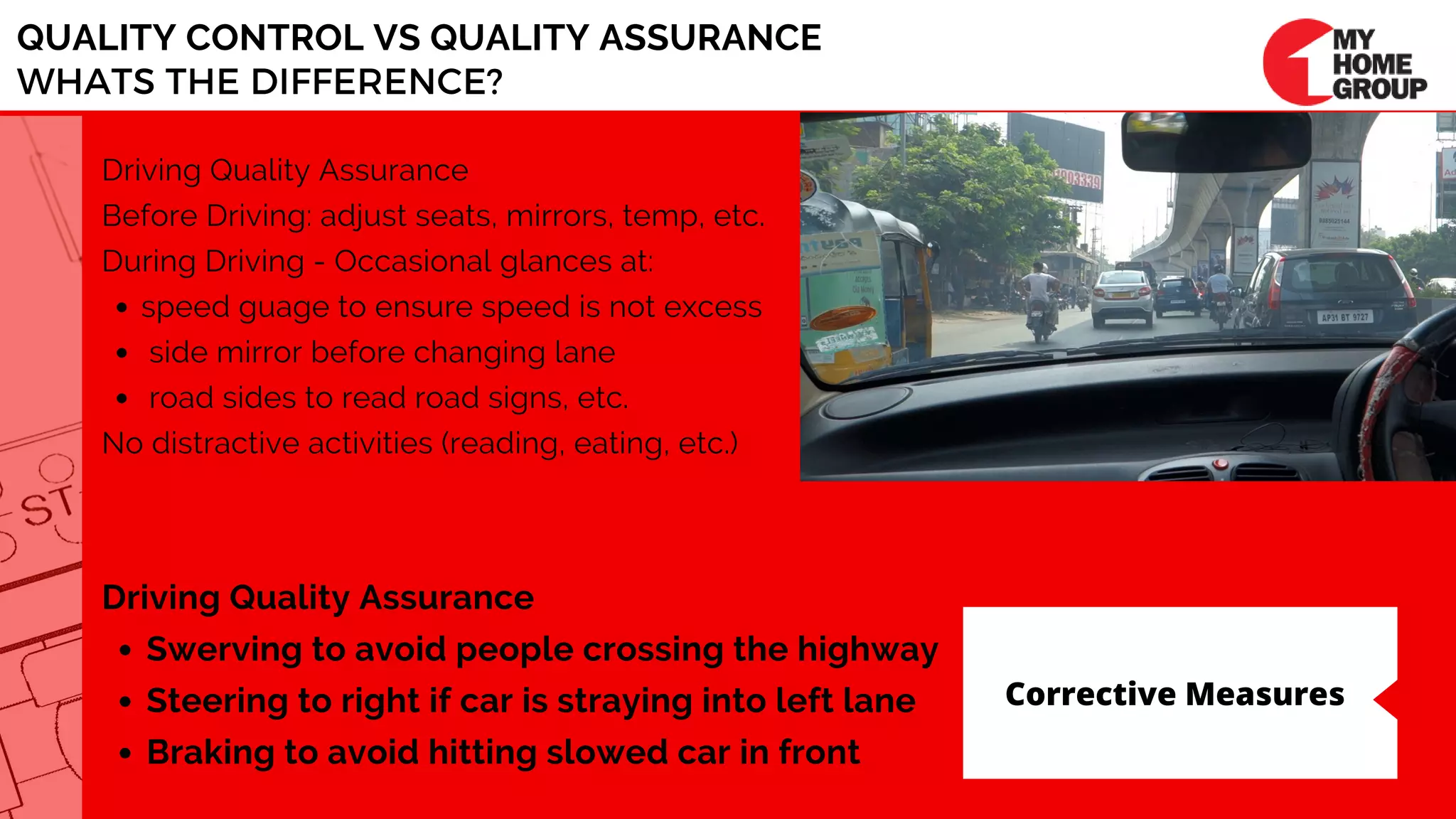
speed guage to ensure speed is not excess
side mirror before changing lane      
 road sides to read road signs, etc.
Driving Quality Assurance
Before Driving: adjust seats, mirrors, temp, etc.
During Driving - Occasional glances at:
No distractive activities (reading, eating, etc.)
Corrective Measures
Swerving to avoid people crossing the highway
Steering to right if car is straying into left lane 
Braking to avoid hitting slowed car in front
Driving Quality Assurance
WHAT IS ISO 9001:2015?
Improved product, process and service quality
Increased customer satisfaction levels
Improved productivity, less waste
Provides a competitive advantage
Quality Management System
A Quality Management System (QMS) is a set of policies, processes and procedures
required for planning and execution (production / development / service) in the core business
area of an organization.
An international standard for Quality Management Systems – An outline specification for
developing our own Quality Management System
“Process Driven” approach – Auditable by ourselves
Harmonized with HSE (OHSAS18001 / ISO14001)
Assures customers that our projects and services are delivered using a controlled approach
leading to:
Certification provided by an independent THIRD PARTY
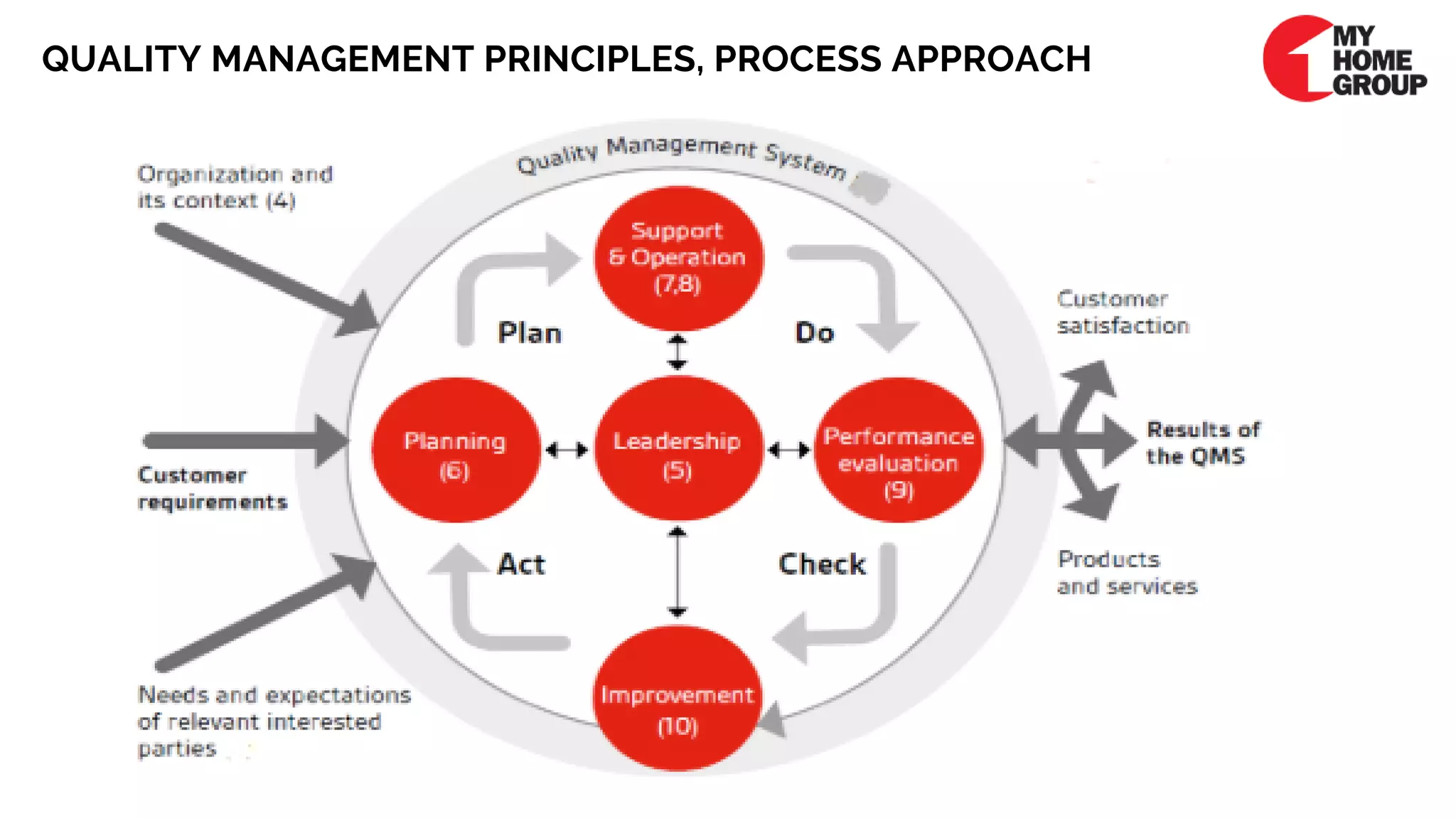
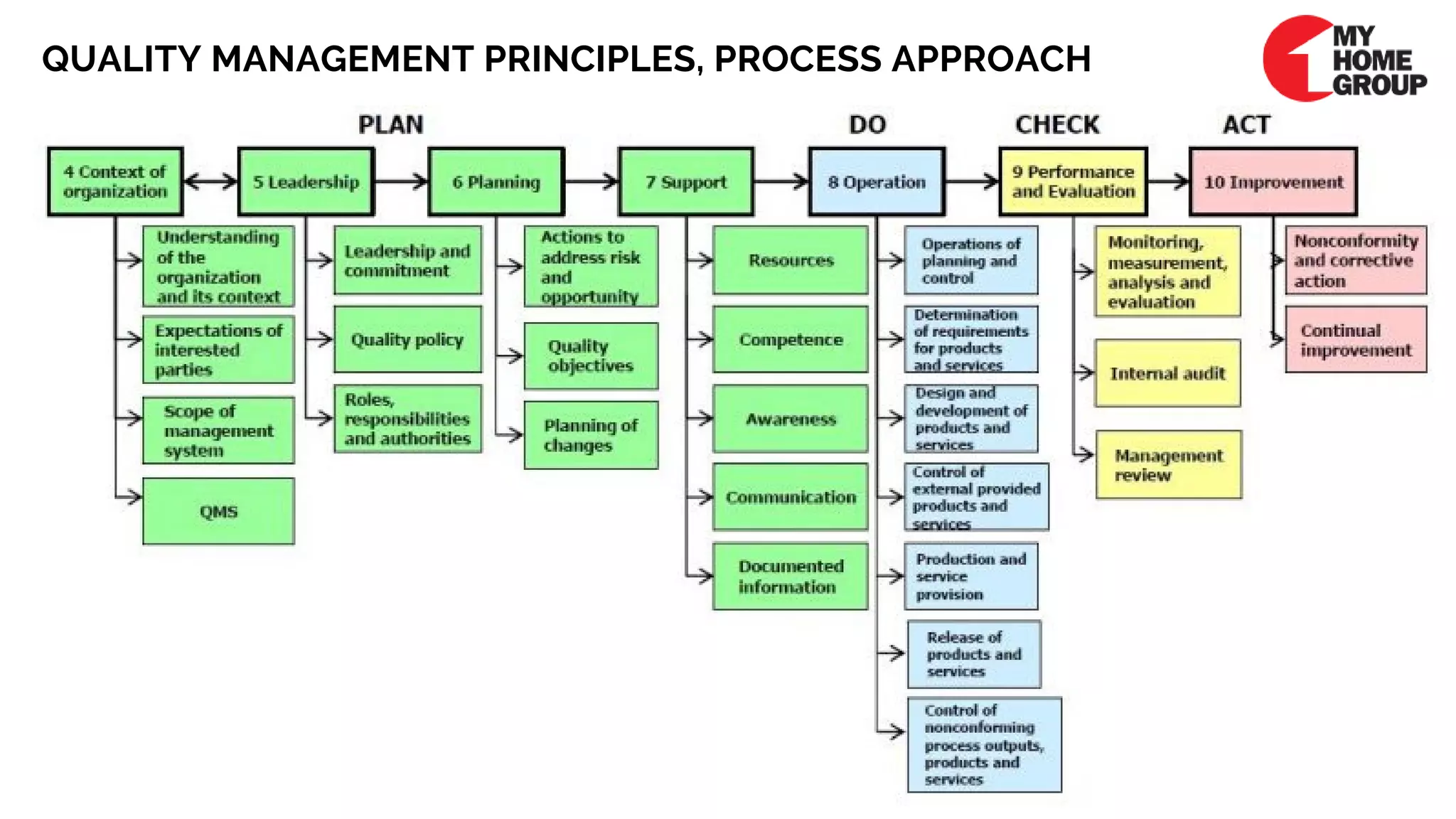
QUALITY MANAGEMENT PRINCIPLES, PROCESS APPROACH
STEERING MODEL APPROACH
P-A-C-E MODEL
PLAN - HOW DO WE KNOW WHAT TO DO
ACT - HOW DO YOU DO IT?
CHECK - HOW DO WE KNOW IT IS RIGHT?
EXCEL- HOW DO WE MAKE IT BETTER?
QUALITY MANAGEMENT PRINCIPLES, PROCESS APPROACH
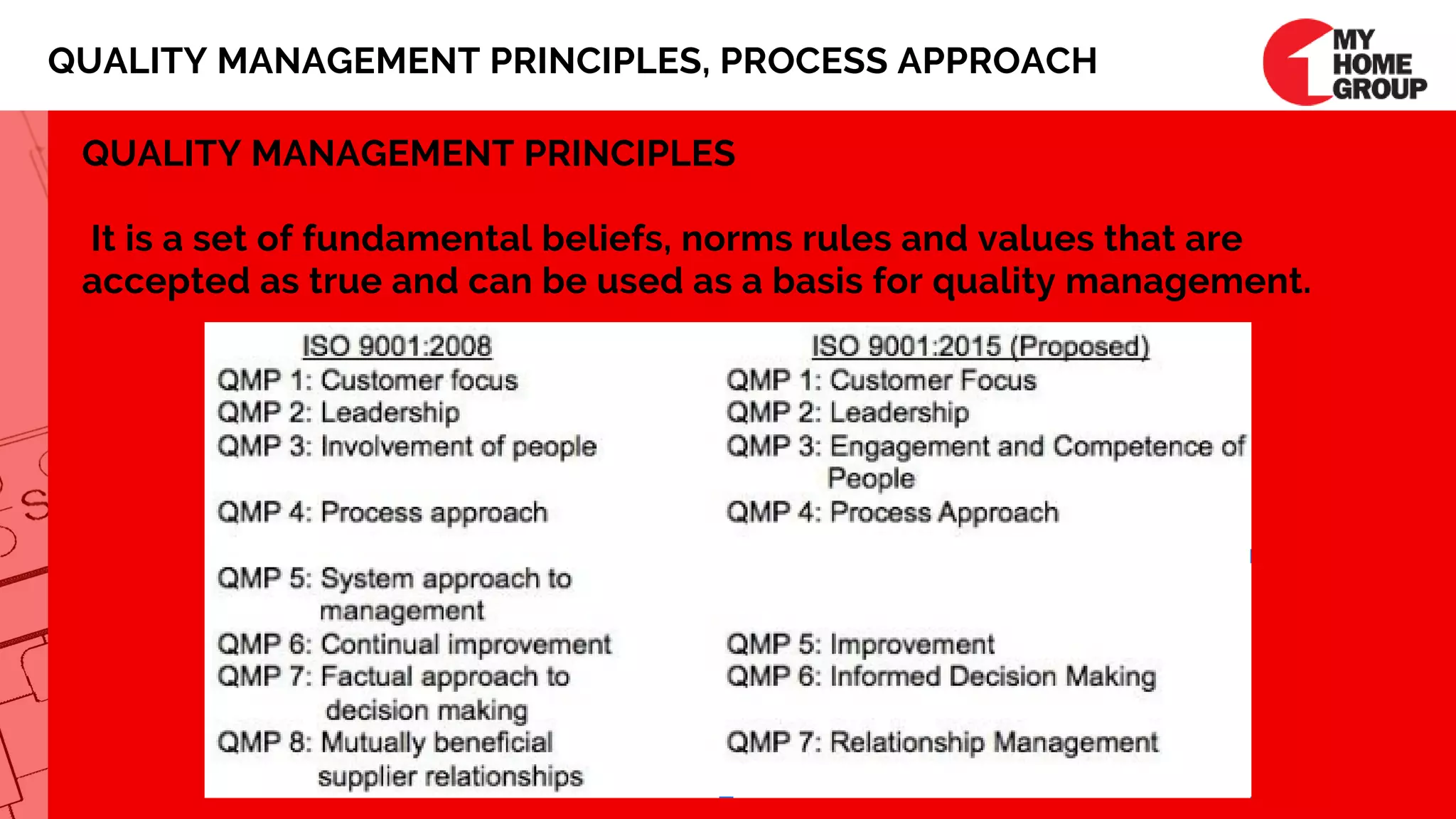
QUALITY MANAGEMENT PRINCIPLES
It is a set of fundamental beliefs, norms rules and values that are
accepted as true and can be used as a basis for quality management.
QUALITY MANAGEMENT PRINCIPLES, PROCESS APPROACH
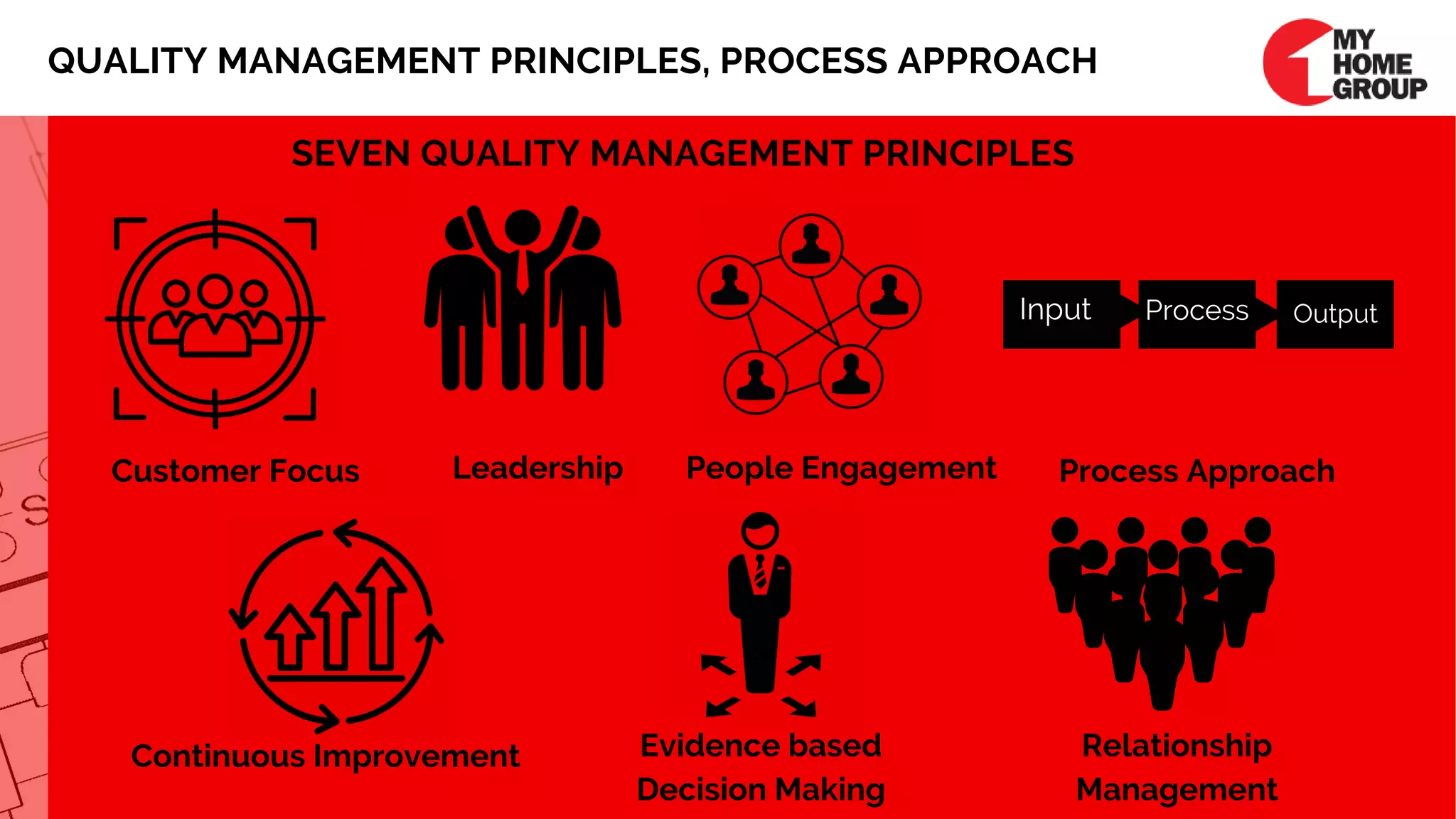
SEVEN QUALITY MANAGEMENT PRINCIPLES
Customer Focus Leadership People Engagement Process Approach
Continuous Improvement Evidence based
Decision Making
Relationship
Management
Input Process Output
General
What is the process approach?
Risk-based thinking, PDCA and the process approach
What are the possible benefits?
The process approach in ISO 9001:2015
2. Process Approach
The process approach involves the systematic definition and management
of processes, and their interactions, so as to achieve the intended results in
accordance with the quality policy and strategic direction of the organization.
QUALITY MANAGEMENT PRINCIPLES, PROCESS APPROACH
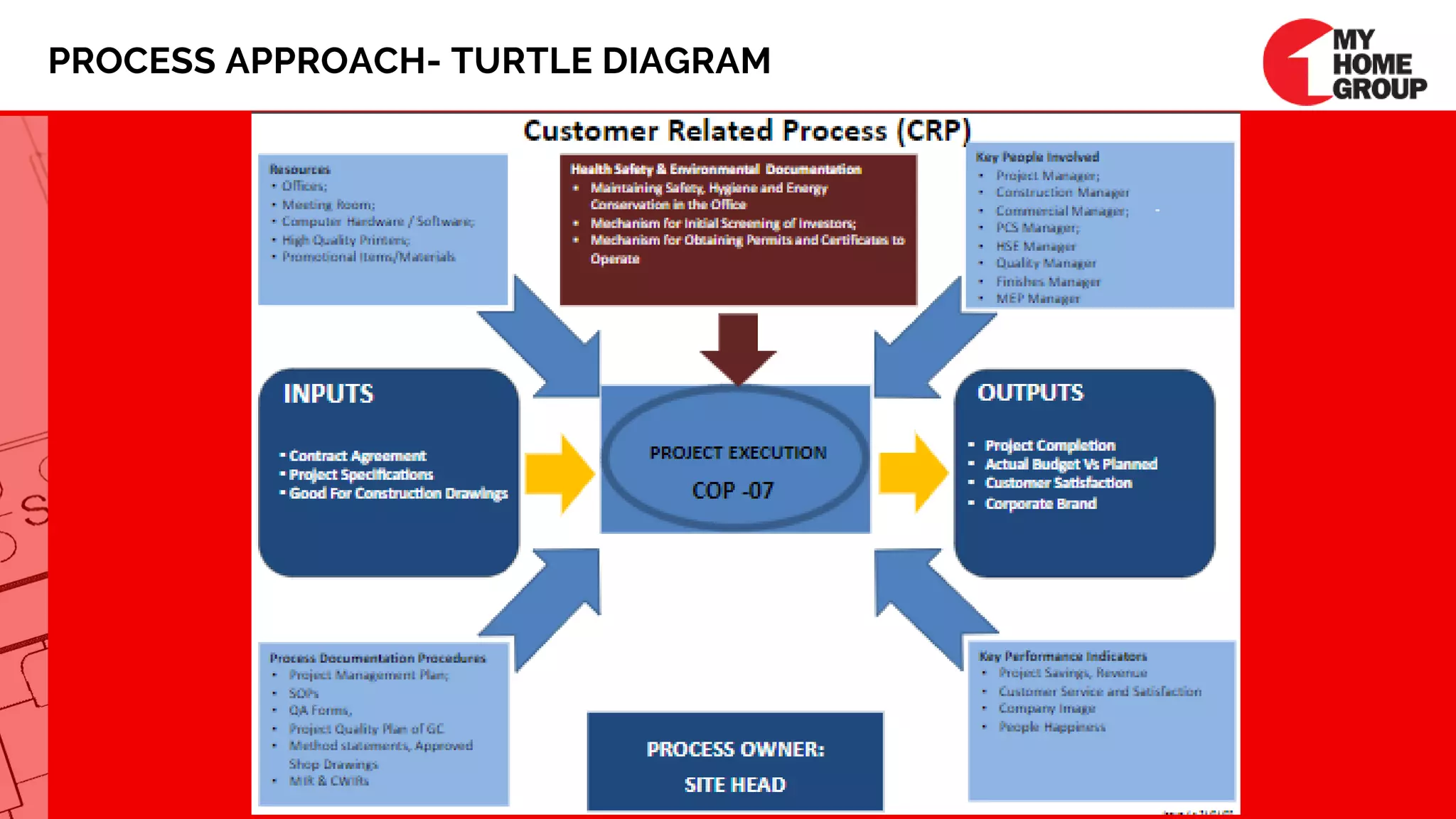
PROCESS APPROACH- TURTLE DIAGRAM
Project Management Process
Purchase Process
CLASS ROOM EXERCISE : DEVELOP A TURTLE DIAGRAM
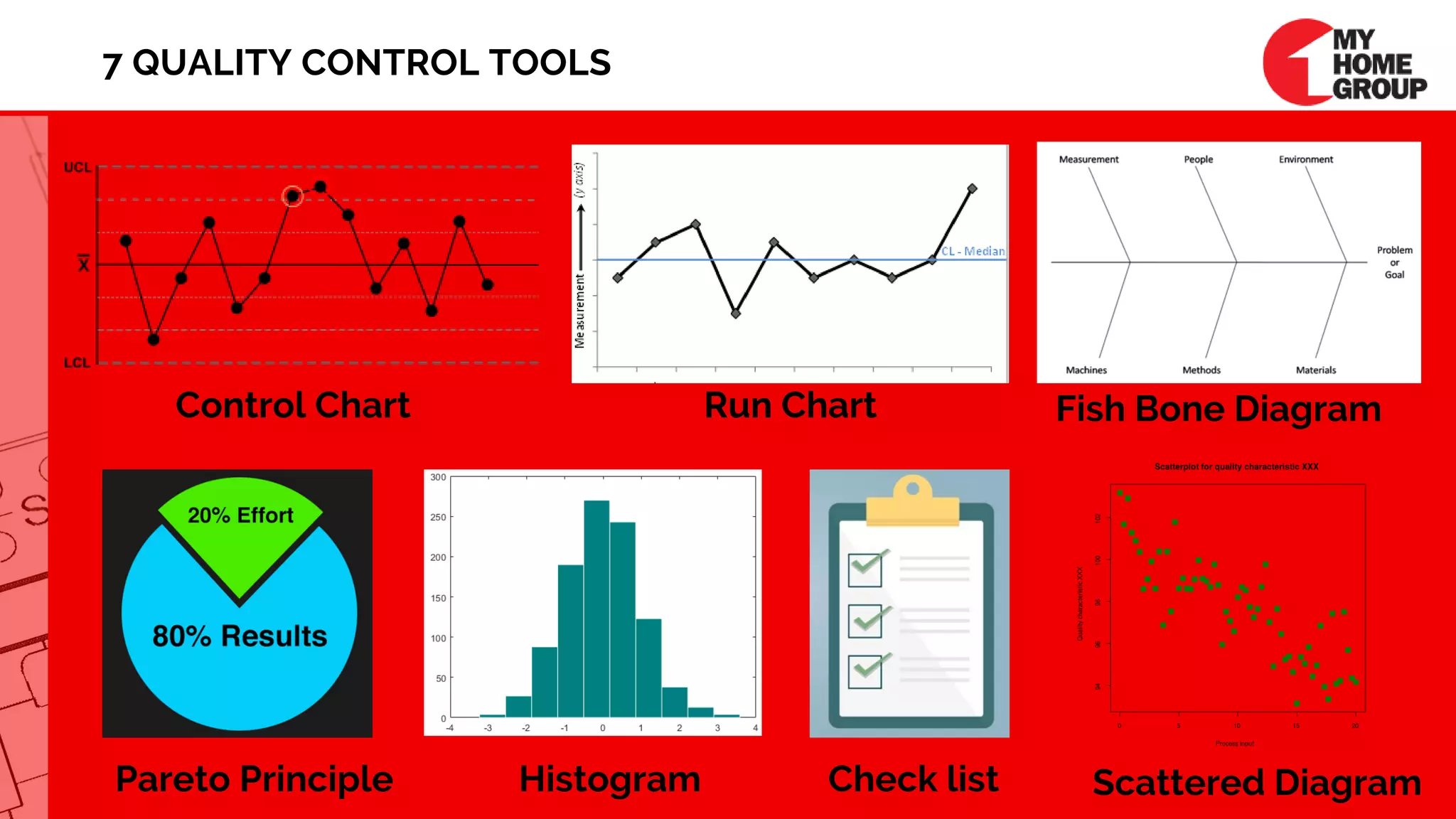
7 QUALITY CONTROL TOOLS
Control Chart Run Chart Fish Bone Diagram
Pareto Principle Histogram Check list Scattered Diagram
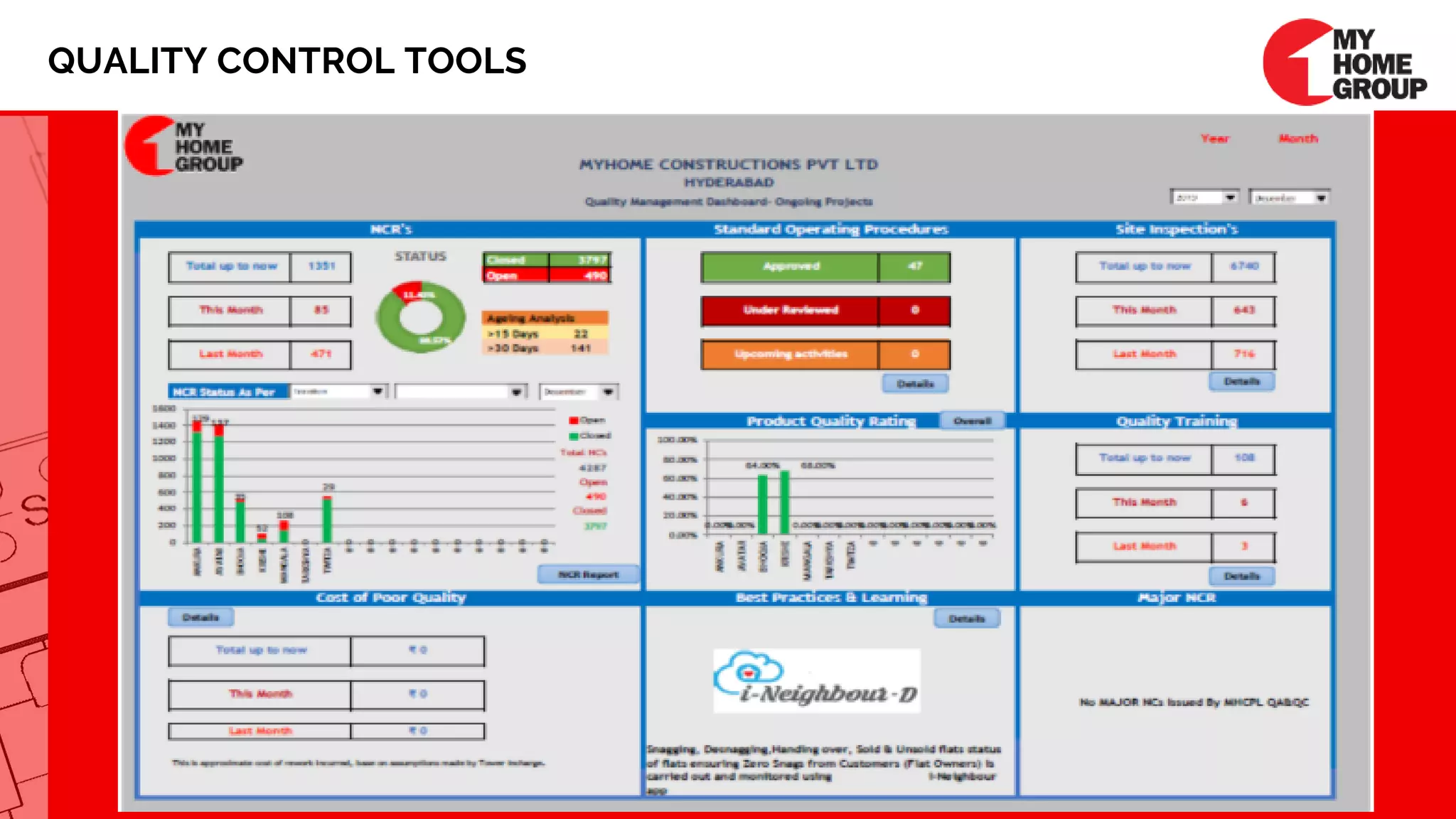
QUALITY CONTROL TOOLS
WHAT DO WE DO WHEN (NOT IF)  SOMETHING GOES WRONG?
Go into denial?
Blame others?
Deflect blame?
Quick fix and move on? – Priority is to keep project on time?
Blame lack of people / QC Staff?
Cry?
Do nothing?
Or - MAKE SURE IT CAN’T HAPPEN AGAIN?
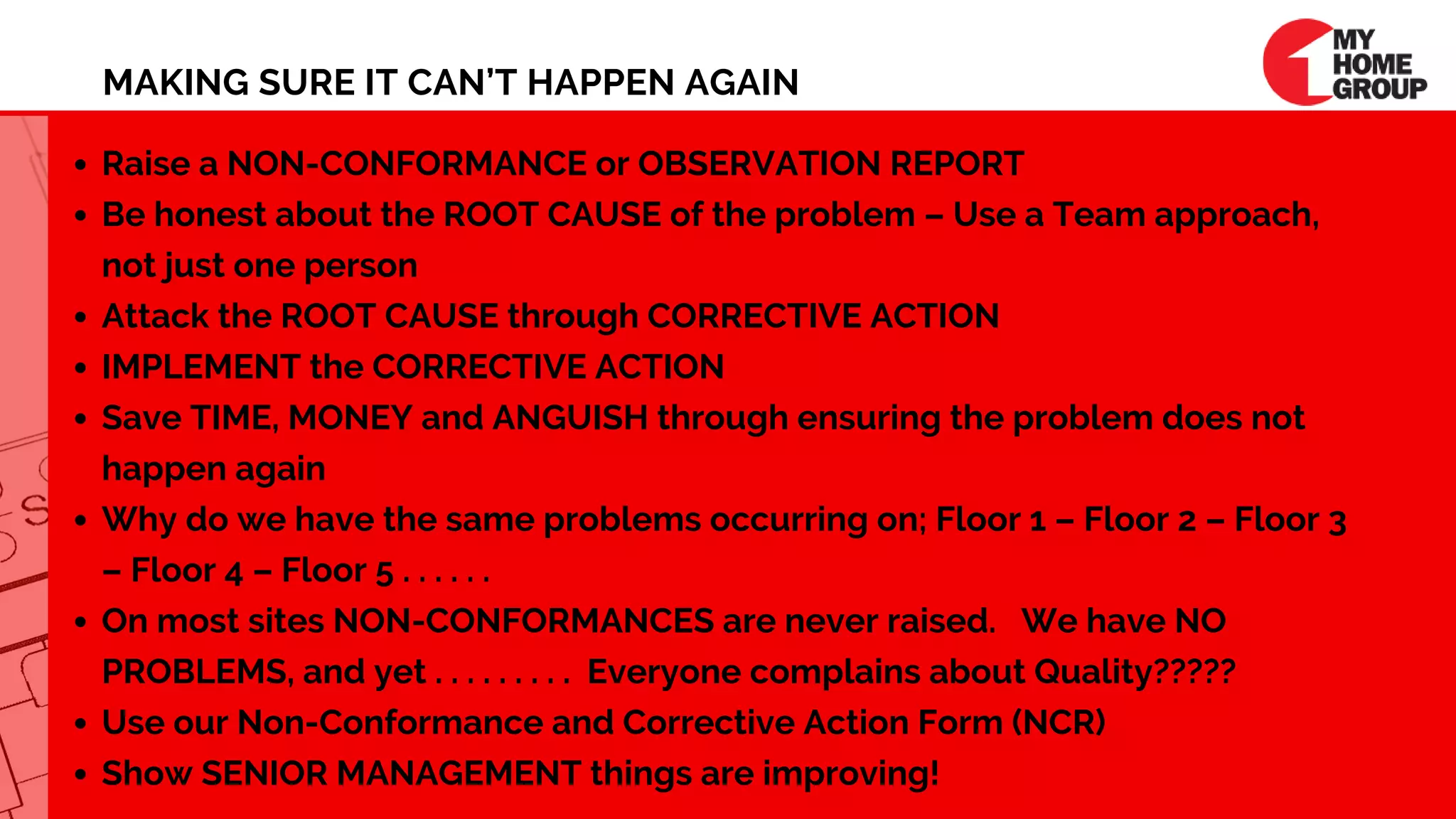
MAKING SURE IT CAN’T HAPPEN AGAIN
Raise a NON-CONFORMANCE or OBSERVATION REPORT
Be honest about the ROOT CAUSE of the problem – Use a Team approach,
not just one person
Attack the ROOT CAUSE through CORRECTIVE ACTION
IMPLEMENT the CORRECTIVE ACTION
Save TIME, MONEY and ANGUISH through ensuring the problem does not
happen again
Why do we have the same problems occurring on; Floor 1 – Floor 2 – Floor 3
– Floor 4 – Floor 5 . . . . . .
On most sites NON-CONFORMANCES are never raised.   We have NO
PROBLEMS, and yet . . . . . . . . .  Everyone complains about Quality?????
Use our Non-Conformance and Corrective Action Form (NCR)
Show SENIOR MANAGEMENT things are improving!
PACE QMS MODEL
MHCPL PROJECT QA QC GUIDELINES.docx
Annexure 4 Material Test & Frequency Plan (MTP)  MHC.xlsx
Annexure 5 List of Inspection and Test Plans for all construction
activities.xlsx
WHO IS RESPONSIBLE FOR QUALITY?
Every
Employee Of 
My Home Constructions
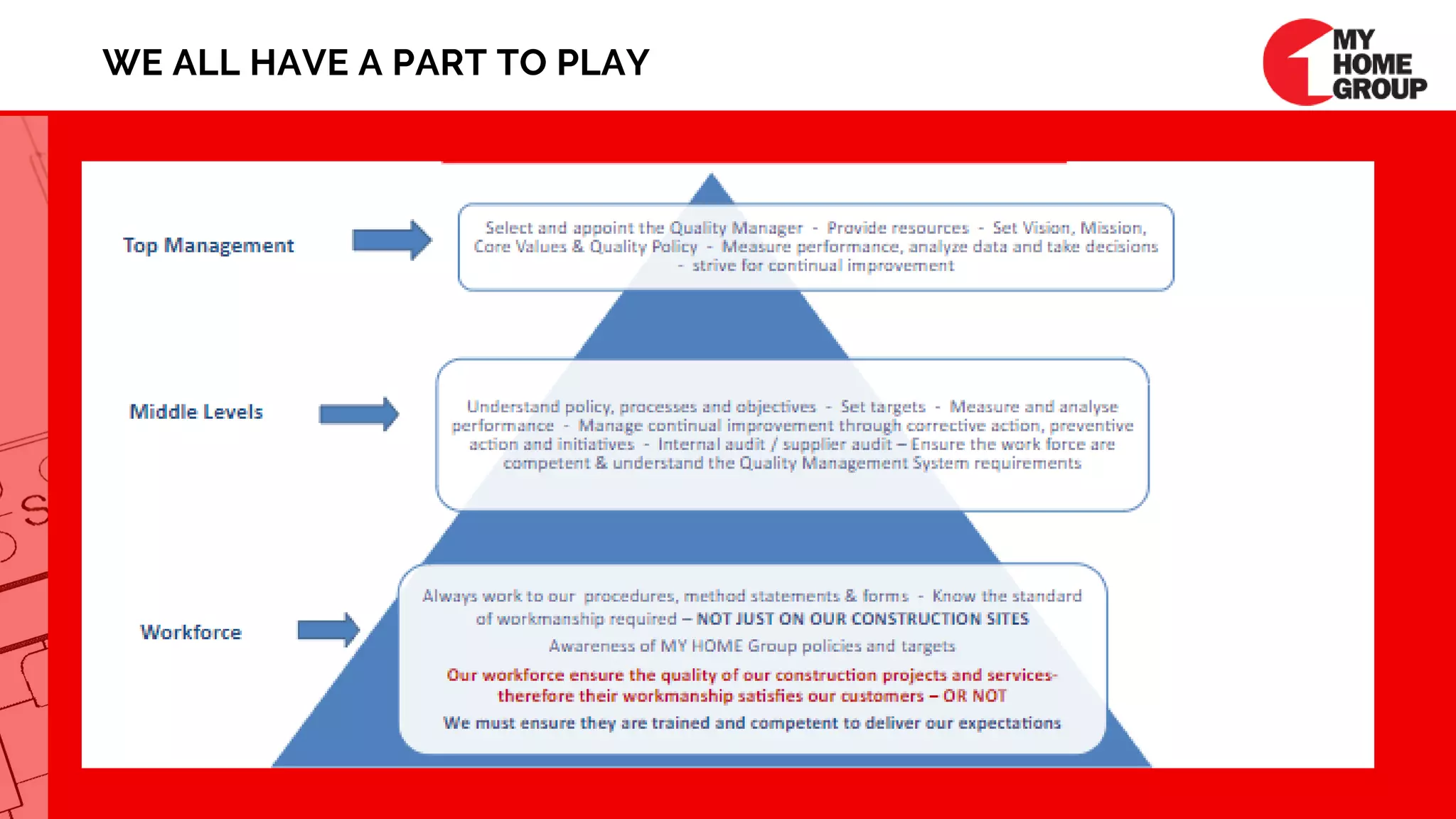
WE ALL HAVE A PART TO PLAY
HOW WE IMPLEMENT QA AND QC SYSTEM
MHCPL Quality Management Interactive Dashboard.xlsx5
Process Map - QA&QC.docx
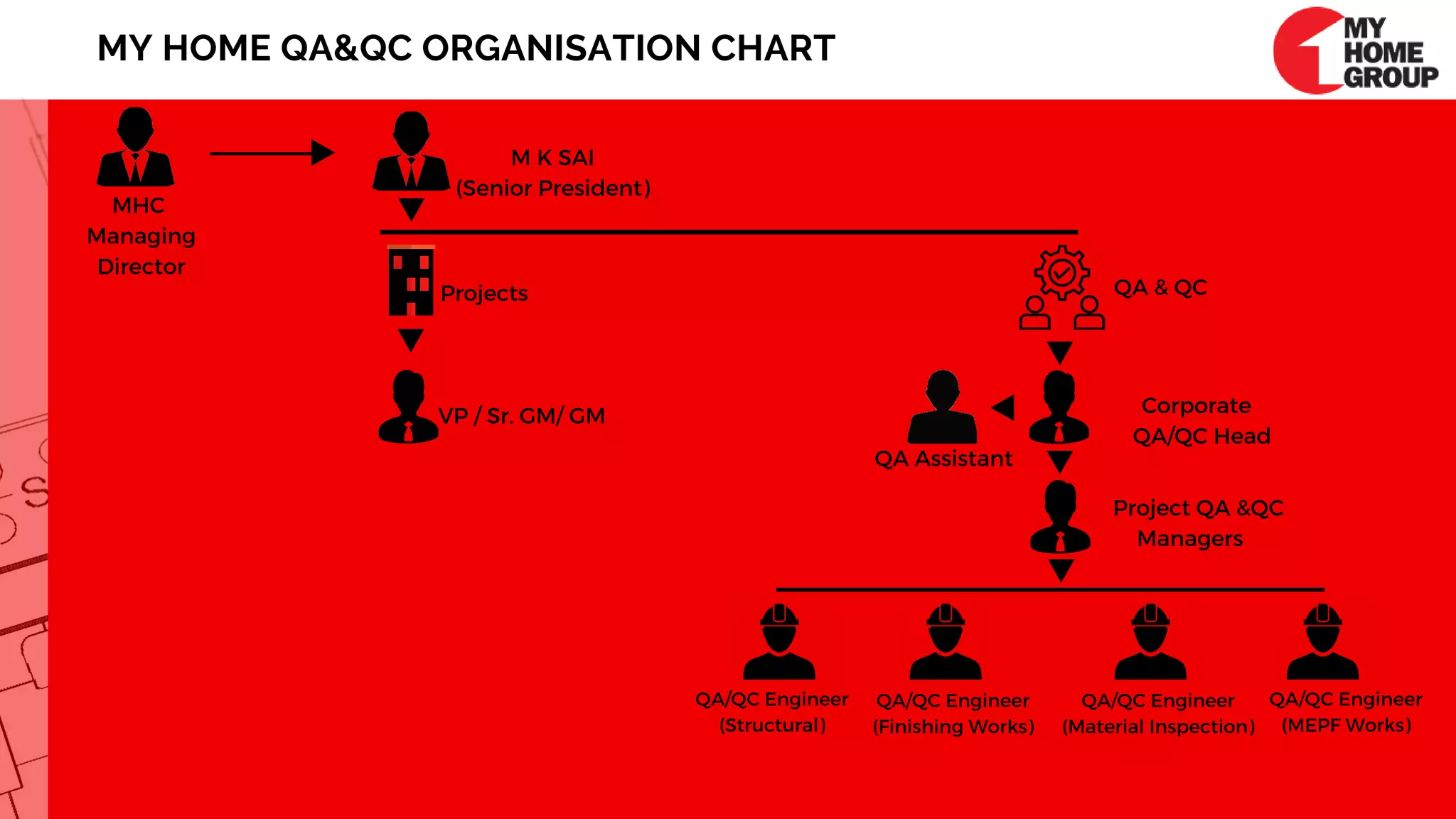
MY HOME QA&QC ORGANISATION CHART
MHC
Managing
Director
M K SAI
(Senior President)
Projects
VP / Sr. GM/ GM
QA & QC
QA Assistant
Corporate
QA/QC Head
Project QA &QC
Managers
QA/QC Engineer
(Structural)
QA/QC Engineer
(Finishing Works)
QA/QC Engineer
(Material Inspection)
QA/QC Engineer
(MEPF Works)
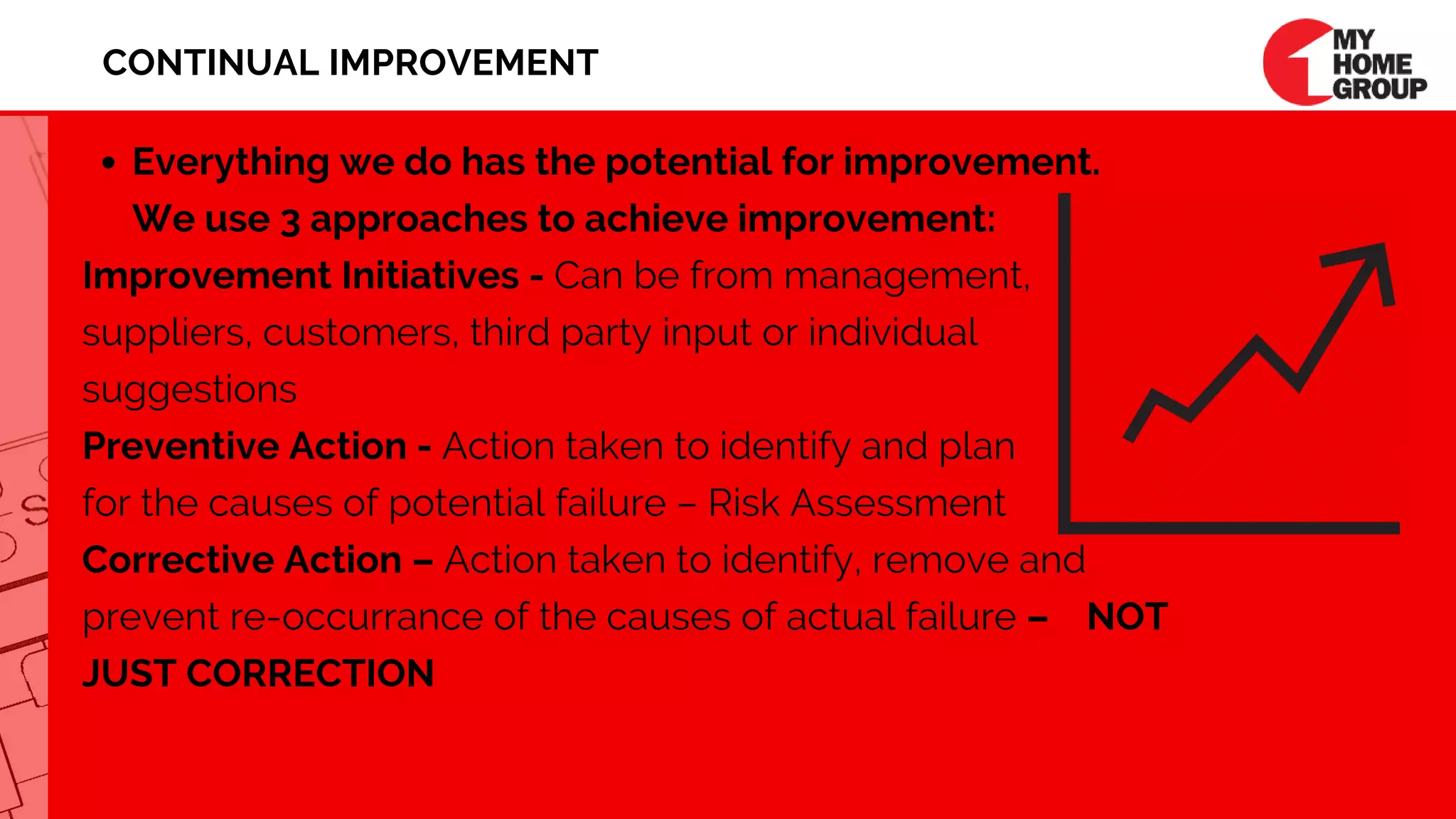
Everything we do has the potential for improvement.  
We use 3 approaches to achieve improvement:
Improvement Initiatives - Can be from management,
suppliers, customers, third party input or individual 
suggestions 
Preventive Action - Action taken to identify and plan
for the causes of potential failure – Risk Assessment
Corrective Action – Action taken to identify, remove and
prevent re-occurrance of the causes of actual failure –    NOT
JUST CORRECTION
CONTINUAL IMPROVEMENT
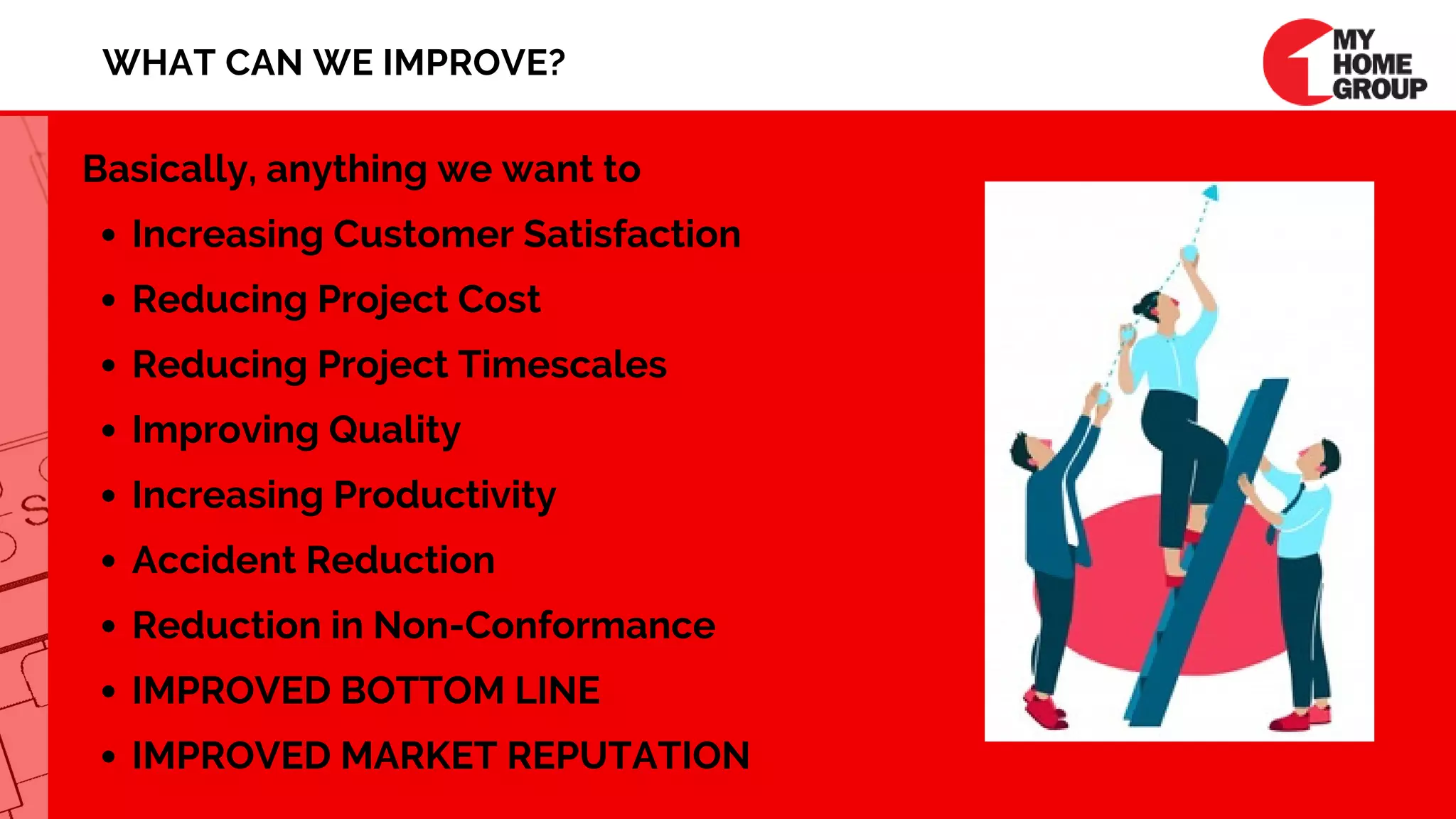
Increasing Customer Satisfaction
Reducing Project Cost
Reducing Project Timescales
Improving Quality
Increasing Productivity
Accident Reduction 
Reduction in Non-Conformance
IMPROVED BOTTOM LINE 
IMPROVED MARKET REPUTATION
Basically, anything we want to
WHAT CAN WE IMPROVE?
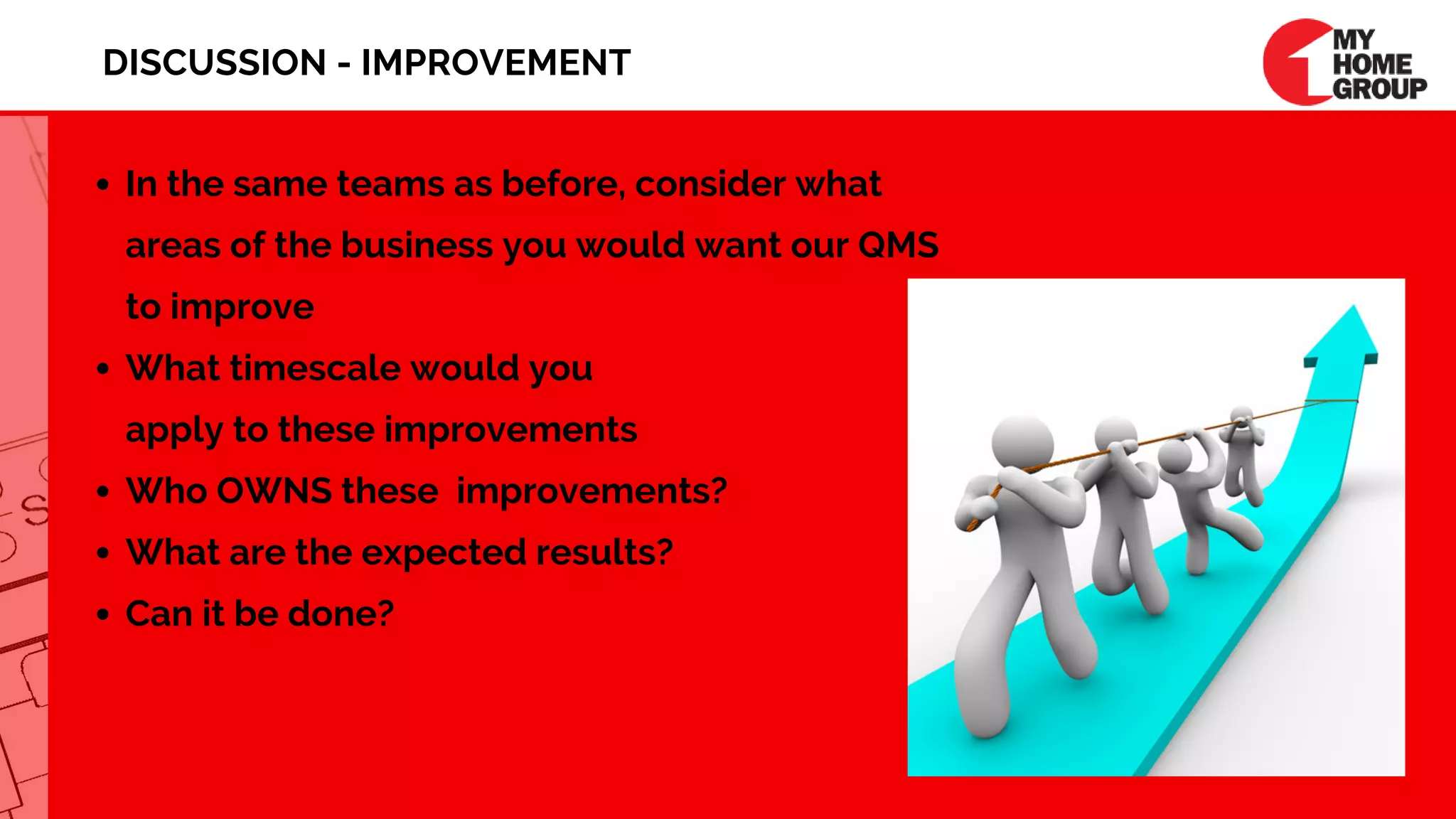
In the same teams as before, consider what
areas of the business you would want our QMS
to improve
What timescale would you                                      
apply to these improvements
Who OWNS these  improvements?
What are the expected results?
Can it be done?
DISCUSSION - IMPROVEMENT
PRE-INSPECTION –  MATERIAL SOURCE INSEPCTIONS,
PRE-DISPATCH INSPECTIONS
IN-PROCESS INSPECTION – ROUTINE SURVILLANCE
INSPECTIONS WHILE WORK IS IN PROGRESS
POST-INSPECTION – UP ON COMPLETION OF A
PARTICULAR ACTIVITY AND PRIOR TO START OF
SUBSEQUENT ACTIVITY.
MATERIAL TEST PLAN
INSPECTION TEST PLAN
WHAT IS QUALITY CONTROL?
NEW BUSINESS OPPORTUNITIES. 
ORGANIZATION CONSISTENTLY MEET THEIR NEEDS AND ENHANCE THEIR   
SATISFACTION LEADING TO REPEAT CUSTOMER, NEW CLIENTS AND   INCREASED
BUSINESS. 
INCREASES PRODUCTIVITY AND EFFICIENCY, BRINGING INTERNAL COSTS  
DOWN.
 MEET THE NECESSARY STATUTORY AND REGULATORY REQUIREMENTS. 
EXPAND INTO NEW MARKETS. 
IDENTIFY AND ADDRESS THE RISKS.
WHY QA & QC IS REQUIRED
CLEAR DIRECTION ON HOW TO GROW TO EXCELLENCE
 UNDERSTOOD P-A-C-E MATURED QMS 
ENHANCED CONFIDENCE LEVELS ON ACHIVING ZERO DEFECTS AND ZERO   
EFFECTS/ REDUCING COST OF REWORKS. 
ABILITY TO TRANSFER THE KNOWLEDGE TO COLLEAGUES
WHAT WE HAVE LEARNT
CUSTOMER REQUIREMENTS: 
“ CONSTRUCTION OF A RESIDENTIAL BUILDING WITH IN  60 MINUTES AND
DELIVER WITH ZERO DEFECTS AND
100 % CUSTOMER SATISFACTION
BUDGET APPROVED FOR CONSTRUCTION : INR 5000/- 
CUSTOMER SPECIFICATIONS: AS PER THE GFC PROVIDED BY THE CUSTOMER
CLASS ROOM EXERCISE : CONSTRUCTION OF A
RESIDENTIAL BUILDING USING PROCESS APPROACH
20 Q&A S TO BE COMPLETED IN 20 MINS. – 50
MARKS
ISSUE OF MHC CERTIFICATES TO
PARTICIPANTS ON “ A DEEP UNDERSTANDING
OF QA & QC SYSTEM APPROACHES”
ASSESSMENT TEST
THANK YOU

project QA&QC system training

  • 1.
    PROJECT QUALITY ASSURANCE SYSTEM & QUALITY CONTROLSYSTEM - Nagareddayya Subbagari, Corporate QA&QC Head
  • 2.
    INTRODUCTION ( APPRECIATIVEINQUIRY/STEERING MODEL APPROACH) TRAINING OBJECTIVES PROJECT QUALITY ASSURANCE SYSTEM PROJECT QUALITY CONTROL SYSTEM INSPECTION AND TESTING PLAN – MATERIALS & WORKS PRE-CONSTRUCTION, IN-PROCESS & POST-CONSTRUCTION INSPECTIONS – MIR & WIR QA AND QC DEPARTMENTAL CHART BENEFITS OF QA&QC SYSTEM TAKE AWAYS BY THE TRAINEES ISO 9001 - 2015 QUALITY MANAGEMENT SYSTEM REQUIREMENTS - OUTLINE PACE MODEL PROCESS APPROACH CONTENTS OF THE TRAINING
  • 3.
    TRAINING OBJECTIVES To setthe direction of each individuals towards Excellence To facilitate QMS (ISO9001),  and introduce Business Excellence  Models Viz., Six Sigma, ZED, EFQM, BSC     To ensure implementation of Process Approach (Turtle  Diagram) to achieve Zero Defect & Zero Effect (ZED) (Non-Conformance)  To Enhance Quality Consciousness among every MHC employee  To make everyone understand Continual Improvement Practices
  • 4.
    PLAN? HOW DO YOUKNOW WHAT TO DO? "FAILING TO PLAN = PLANNING TO FAIL"
  • 5.
    (4+1) ASPECTS OFHUMAN LIFE Personal Life Professional Life Family Life Social Life Spiritual Life STEERING MODEL APPROACH
  • 6.
    TELL ABOUT YOURSELFINLINE WITH STEERING MODEL
  • 7.
    SCOPE OF QA&QCIN CONSTRUCTION
  • 8.
    QUALITY ASSURANCE PLAN QUALITY: Degree to which a set of inherent characteristics of an object fulfils requirements  Quality management : Management with regard to quality   QUALITY ASSURANCE Part of quality management focused on providing confidence that quality requirements will be fulfilled.  The confidence provided by quality assurance is twofold—internally to management and externally to customers, government agencies, regulators, certifiers, and third parties. An alternate definition is "all the planned and systematic activities implemented within the quality system that can be demonstrated to provide confidence that a product or service will fulfill requirements for quality.
  • 9.
    QUALITY ASSURANCE PLAN " QUALTIYCONTROL      Part of quality management focused on fulfilling quality requirements             " While quality assurance relates to how a process is performed or how a product is made, quality control is more the inspection aspect of quality management. An alternate definition is "the operational techniques and activities used to fulfill requirements for quality."
  • 10.
    QUALITY CONTROL VSQUALITY ASSURANCE WHATS THE DIFFERENCE? Analogy : You driving on a freeway
  • 11.
    QUALITY CONTROL VSQUALITY ASSURANCE WHATS THE DIFFERENCE? Speed guage to ensure speed is not excessive Side mirror before changing lane        Road sides to read road signs, etc. Driving Quality Assurance Before Driving: adjust seats, mirrors, temp, etc. During Driving - Occasional glances at: No distractive activities (reading, eating, etc.) Preventive Measures
  • 12.
    QUALITY CONTROL VSQUALITY ASSURANCE WHATS THE DIFFERENCE? speed guage to ensure speed is not excess side mirror before changing lane        road sides to read road signs, etc. Driving Quality Assurance Before Driving: adjust seats, mirrors, temp, etc. During Driving - Occasional glances at: No distractive activities (reading, eating, etc.) Corrective Measures Swerving to avoid people crossing the highway Steering to right if car is straying into left lane  Braking to avoid hitting slowed car in front Driving Quality Assurance
  • 13.
    WHAT IS ISO9001:2015? Improved product, process and service quality Increased customer satisfaction levels Improved productivity, less waste Provides a competitive advantage Quality Management System A Quality Management System (QMS) is a set of policies, processes and procedures required for planning and execution (production / development / service) in the core business area of an organization. An international standard for Quality Management Systems – An outline specification for developing our own Quality Management System “Process Driven” approach – Auditable by ourselves Harmonized with HSE (OHSAS18001 / ISO14001) Assures customers that our projects and services are delivered using a controlled approach leading to: Certification provided by an independent THIRD PARTY
  • 14.
  • 15.
  • 16.
    STEERING MODEL APPROACH P-A-C-EMODEL PLAN - HOW DO WE KNOW WHAT TO DO ACT - HOW DO YOU DO IT? CHECK - HOW DO WE KNOW IT IS RIGHT? EXCEL- HOW DO WE MAKE IT BETTER?
  • 17.
    QUALITY MANAGEMENT PRINCIPLES,PROCESS APPROACH QUALITY MANAGEMENT PRINCIPLES It is a set of fundamental beliefs, norms rules and values that are accepted as true and can be used as a basis for quality management.
  • 18.
    QUALITY MANAGEMENT PRINCIPLES,PROCESS APPROACH SEVEN QUALITY MANAGEMENT PRINCIPLES Customer Focus Leadership People Engagement Process Approach Continuous Improvement Evidence based Decision Making Relationship Management Input Process Output
  • 19.
    General What is theprocess approach? Risk-based thinking, PDCA and the process approach What are the possible benefits? The process approach in ISO 9001:2015 2. Process Approach The process approach involves the systematic definition and management of processes, and their interactions, so as to achieve the intended results in accordance with the quality policy and strategic direction of the organization. QUALITY MANAGEMENT PRINCIPLES, PROCESS APPROACH
  • 20.
  • 21.
    Project Management Process PurchaseProcess CLASS ROOM EXERCISE : DEVELOP A TURTLE DIAGRAM
  • 22.
    7 QUALITY CONTROL TOOLS ControlChart Run Chart Fish Bone Diagram Pareto Principle Histogram Check list Scattered Diagram
  • 23.
  • 24.
    WHAT DO WEDO WHEN (NOT IF)  SOMETHING GOES WRONG? Go into denial? Blame others? Deflect blame? Quick fix and move on? – Priority is to keep project on time? Blame lack of people / QC Staff? Cry? Do nothing? Or - MAKE SURE IT CAN’T HAPPEN AGAIN?
  • 25.
    MAKING SURE ITCAN’T HAPPEN AGAIN Raise a NON-CONFORMANCE or OBSERVATION REPORT Be honest about the ROOT CAUSE of the problem – Use a Team approach, not just one person Attack the ROOT CAUSE through CORRECTIVE ACTION IMPLEMENT the CORRECTIVE ACTION Save TIME, MONEY and ANGUISH through ensuring the problem does not happen again Why do we have the same problems occurring on; Floor 1 – Floor 2 – Floor 3 – Floor 4 – Floor 5 . . . . . . On most sites NON-CONFORMANCES are never raised.   We have NO PROBLEMS, and yet . . . . . . . . .  Everyone complains about Quality????? Use our Non-Conformance and Corrective Action Form (NCR) Show SENIOR MANAGEMENT things are improving!
  • 26.
    PACE QMS MODEL MHCPLPROJECT QA QC GUIDELINES.docx Annexure 4 Material Test & Frequency Plan (MTP)  MHC.xlsx Annexure 5 List of Inspection and Test Plans for all construction activities.xlsx
  • 27.
    WHO IS RESPONSIBLEFOR QUALITY? Every Employee Of  My Home Constructions
  • 28.
    WE ALL HAVEA PART TO PLAY
  • 29.
    HOW WE IMPLEMENTQA AND QC SYSTEM MHCPL Quality Management Interactive Dashboard.xlsx5 Process Map - QA&QC.docx
  • 30.
    MY HOME QA&QCORGANISATION CHART MHC Managing Director M K SAI (Senior President) Projects VP / Sr. GM/ GM QA & QC QA Assistant Corporate QA/QC Head Project QA &QC Managers QA/QC Engineer (Structural) QA/QC Engineer (Finishing Works) QA/QC Engineer (Material Inspection) QA/QC Engineer (MEPF Works)
  • 31.
    Everything we dohas the potential for improvement.   We use 3 approaches to achieve improvement: Improvement Initiatives - Can be from management, suppliers, customers, third party input or individual  suggestions  Preventive Action - Action taken to identify and plan for the causes of potential failure – Risk Assessment Corrective Action – Action taken to identify, remove and prevent re-occurrance of the causes of actual failure –    NOT JUST CORRECTION CONTINUAL IMPROVEMENT
  • 32.
    Increasing Customer Satisfaction ReducingProject Cost Reducing Project Timescales Improving Quality Increasing Productivity Accident Reduction  Reduction in Non-Conformance IMPROVED BOTTOM LINE  IMPROVED MARKET REPUTATION Basically, anything we want to WHAT CAN WE IMPROVE?
  • 33.
    In the sameteams as before, consider what areas of the business you would want our QMS to improve What timescale would you                                       apply to these improvements Who OWNS these  improvements? What are the expected results? Can it be done? DISCUSSION - IMPROVEMENT
  • 34.
    PRE-INSPECTION –  MATERIALSOURCE INSEPCTIONS, PRE-DISPATCH INSPECTIONS IN-PROCESS INSPECTION – ROUTINE SURVILLANCE INSPECTIONS WHILE WORK IS IN PROGRESS POST-INSPECTION – UP ON COMPLETION OF A PARTICULAR ACTIVITY AND PRIOR TO START OF SUBSEQUENT ACTIVITY. MATERIAL TEST PLAN INSPECTION TEST PLAN WHAT IS QUALITY CONTROL?
  • 35.
    NEW BUSINESS OPPORTUNITIES.  ORGANIZATIONCONSISTENTLY MEET THEIR NEEDS AND ENHANCE THEIR    SATISFACTION LEADING TO REPEAT CUSTOMER, NEW CLIENTS AND   INCREASED BUSINESS.  INCREASES PRODUCTIVITY AND EFFICIENCY, BRINGING INTERNAL COSTS   DOWN.  MEET THE NECESSARY STATUTORY AND REGULATORY REQUIREMENTS.  EXPAND INTO NEW MARKETS.  IDENTIFY AND ADDRESS THE RISKS. WHY QA & QC IS REQUIRED
  • 36.
    CLEAR DIRECTION ONHOW TO GROW TO EXCELLENCE  UNDERSTOOD P-A-C-E MATURED QMS  ENHANCED CONFIDENCE LEVELS ON ACHIVING ZERO DEFECTS AND ZERO    EFFECTS/ REDUCING COST OF REWORKS.  ABILITY TO TRANSFER THE KNOWLEDGE TO COLLEAGUES WHAT WE HAVE LEARNT
  • 37.
    CUSTOMER REQUIREMENTS:  “ CONSTRUCTIONOF A RESIDENTIAL BUILDING WITH IN  60 MINUTES AND DELIVER WITH ZERO DEFECTS AND 100 % CUSTOMER SATISFACTION BUDGET APPROVED FOR CONSTRUCTION : INR 5000/-  CUSTOMER SPECIFICATIONS: AS PER THE GFC PROVIDED BY THE CUSTOMER CLASS ROOM EXERCISE : CONSTRUCTION OF A RESIDENTIAL BUILDING USING PROCESS APPROACH
  • 38.
    20 Q&A STO BE COMPLETED IN 20 MINS. – 50 MARKS ISSUE OF MHC CERTIFICATES TO PARTICIPANTS ON “ A DEEP UNDERSTANDING OF QA & QC SYSTEM APPROACHES” ASSESSMENT TEST
  • 39.