SEMINAR ON


    UNDERWATER WELDING
    TECHNOLOGY ,ART , COURAGE
1   SHOBHIT ISHAN
    474/09
• First under water welding by British
  Admiralty – Dockyard
• In 1946, special waterproof electrodes were
  developed in Holland by ‘Van der
  Willingen’


                                            2
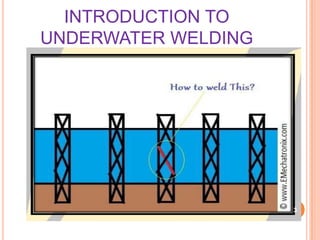
INTRODUCTION TO
UNDERWATER WELDING


                     3
We cant lift ship and then repair it. Hence comes the use of underwater
welding
                                                                          4
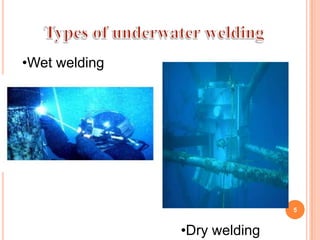
•Wet welding


                              5


               •Dry welding
Hyperbaric welding is the process in which
a chamber is sealed around the structure to
be welded and is filled with a gas ( He and
Oxygen) at the prevailing pressure.


                                              6
Dry welding can be of two types
•Large habitat
•Mini habitat


                                           7

    Mini habitat for underwater welding.
Source: north stream
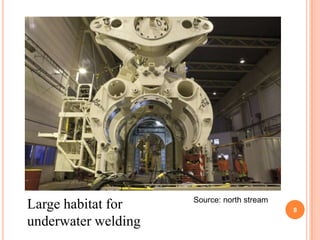
Large habitat for                           8

underwater welding
9
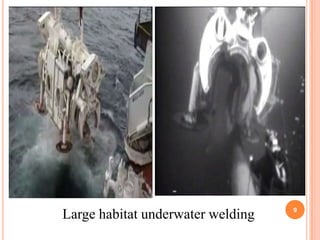
Large habitat underwater welding
•Welder /diver safety
•Good weld quality
•Surface monitoring


                        10
• Higher cost of process, training, etc
• Large quantity of costly and complex
  equipments
• More deep, more energy requirement.
• Cant weld if weld spot is at
  unreachable place


                                          11
• Simply means that job is
  performed directly in the water
• It involves using special rod and
  is similar to the process in
  ordinary air welding


                                      12
13
‹#›
•   WATER-------------HYDROGEN +
    OXYGEN
•   Dissolve in weld pool
•   Solubility decrases and then comes out -
     porosity
•   Oxygen as solid , liquid inclusions or
    gases
•   Hydrogen combines with oxygen forming
    vapour
                                               15
Chemical composition


                       16
Porosity-troubleshooted by including Calcium
carbonate


                                               17
•Microstructure
•Mechanical
 properties


                  18
• Effect of alloying elements on weld metal
  microstructure and properties
  • Managanese
  • Boron and titanium
  • Rare earth metals


                                              19
•   Cheapest
•   Fastest
•   Tensile strength is high
•   Ease of access the weld spot
•   No waste of time in constructing habitat


                                               20
• Rapid quenching decreases impact
  strength, Ductility.
• Hydrogen embrittlement.
• Poor visibility in water.
• Higher energy density of hydrogen,
 higher efficiency.


                                       21
• Power supply requrements-400 amp or larger.
  DC generators, motor generators and rectifiers
  are acceptable power supplies
• Power converters.
• Welding Generator, Pre-Setup
• Polarity.
• Diesel Driven Welding Generator Amperage
  and Voltage settings.
• Gas Manifolds.
                                                   22
• Underwater Oxygen-Arc Welding
  Torches.-
  Collet or grip
  Oxygen valve
  Flash arrester
• Waterproofing Surface Electrodes.
  Epoxy 152
  Lee lac 30-l2093
  Polyurethane
                                      23
Figure showing schematic diagram for
underwater welding or cutting


                                       24
• Hydrogen and oxygen are dissociated
  from the water and will travel separately
  as bubbles
• Oxygen cutting is about 60 percent
  efficient
• Above river beds, especially in mud,
  because trapped methane gas in the
  proper concentrations can explode.
                                              25
• There is a risk to the welder/diver of electric
  shock.
• There is a risk that defects may remain
  undetected
• The other main area of risk is to the life or
  health of the welder/diver from nitrogen
  introduced into the blood steam during exposure
  to air at increased pressure

                                               26
• Start cutting at the highest point and work
  downward
• By withdrawing the electrode every few
  seconds to allow water to enter the cut
• Gases may be vented to the surface with a vent
  tube (flexible hose) secured in place from the
  high point where gases would collect to a
  position above the waterline.
                                              27
• Precautions include achieving adequate
  electrical insulation of the welding
  equipment
• Areas and voids must be vented or made
  inert


                                           28
• Development of alternative welding methods
  like friction welding, explosive welding, and
  stud welding.
• Present trend is towards automation. THOR – 1
  (TIG Hyperbaric Orbital Robot) is developed
  where diver performs pipefitting, installs the
  track and orbital head on the pipe and the rest
  process is automated.
                                              29
30

Underwater welding

  • 1.
    SEMINAR ON UNDERWATER WELDING TECHNOLOGY ,ART , COURAGE 1 SHOBHIT ISHAN 474/09
  • 2.
    • First underwater welding by British Admiralty – Dockyard • In 1946, special waterproof electrodes were developed in Holland by ‘Van der Willingen’ 2
  • 3.
  • 4.
    We cant liftship and then repair it. Hence comes the use of underwater welding 4
  • 5.
    •Wet welding 5 •Dry welding
  • 6.
    Hyperbaric welding isthe process in which a chamber is sealed around the structure to be welded and is filled with a gas ( He and Oxygen) at the prevailing pressure. 6
  • 7.
    Dry welding canbe of two types •Large habitat •Mini habitat 7 Mini habitat for underwater welding.
  • 8.
    Source: north stream Largehabitat for 8 underwater welding
  • 9.
  • 10.
    •Welder /diver safety •Goodweld quality •Surface monitoring 10
  • 11.
    • Higher costof process, training, etc • Large quantity of costly and complex equipments • More deep, more energy requirement. • Cant weld if weld spot is at unreachable place 11
  • 12.
    • Simply meansthat job is performed directly in the water • It involves using special rod and is similar to the process in ordinary air welding 12
  • 13.
  • 14.
  • 15.
    WATER-------------HYDROGEN + OXYGEN • Dissolve in weld pool • Solubility decrases and then comes out -  porosity • Oxygen as solid , liquid inclusions or gases • Hydrogen combines with oxygen forming vapour 15
  • 16.
  • 17.
  • 18.
  • 19.
    • Effect ofalloying elements on weld metal microstructure and properties • Managanese • Boron and titanium • Rare earth metals 19
  • 20.
    Cheapest • Fastest • Tensile strength is high • Ease of access the weld spot • No waste of time in constructing habitat 20
  • 21.
    • Rapid quenchingdecreases impact strength, Ductility. • Hydrogen embrittlement. • Poor visibility in water. • Higher energy density of hydrogen, higher efficiency. 21
  • 22.
    • Power supplyrequrements-400 amp or larger. DC generators, motor generators and rectifiers are acceptable power supplies • Power converters. • Welding Generator, Pre-Setup • Polarity. • Diesel Driven Welding Generator Amperage and Voltage settings. • Gas Manifolds. 22
  • 23.
    • Underwater Oxygen-ArcWelding Torches.- Collet or grip Oxygen valve Flash arrester • Waterproofing Surface Electrodes. Epoxy 152 Lee lac 30-l2093 Polyurethane 23
  • 24.
    Figure showing schematicdiagram for underwater welding or cutting 24
  • 25.
    • Hydrogen andoxygen are dissociated from the water and will travel separately as bubbles • Oxygen cutting is about 60 percent efficient • Above river beds, especially in mud, because trapped methane gas in the proper concentrations can explode. 25
  • 26.
    • There isa risk to the welder/diver of electric shock. • There is a risk that defects may remain undetected • The other main area of risk is to the life or health of the welder/diver from nitrogen introduced into the blood steam during exposure to air at increased pressure 26
  • 27.
    • Start cuttingat the highest point and work downward • By withdrawing the electrode every few seconds to allow water to enter the cut • Gases may be vented to the surface with a vent tube (flexible hose) secured in place from the high point where gases would collect to a position above the waterline. 27
  • 28.
    • Precautions includeachieving adequate electrical insulation of the welding equipment • Areas and voids must be vented or made inert 28
  • 29.
    • Development ofalternative welding methods like friction welding, explosive welding, and stud welding. • Present trend is towards automation. THOR – 1 (TIG Hyperbaric Orbital Robot) is developed where diver performs pipefitting, installs the track and orbital head on the pipe and the rest process is automated. 29
  • 30.