Acknowledgement
This presentationis based on many
books, notes, websites and presentations
on the topic.
The presenter pays his sincere gratitude to
all authors, professors and experts for
their efforts and contributions.
2
3.
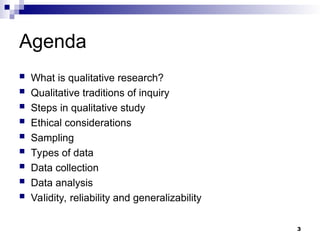
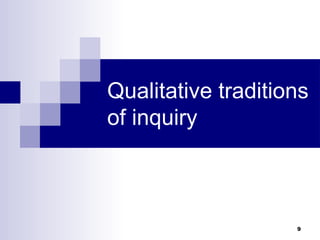
Agenda
What isqualitative research?
Qualitative traditions of inquiry
Steps in qualitative study
Ethical considerations
Sampling
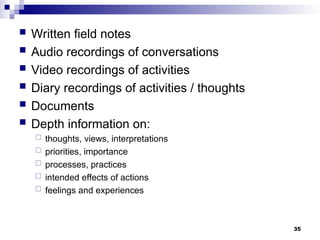
Types of data
Data collection
Data analysis
Validity, reliability and generalizability
3
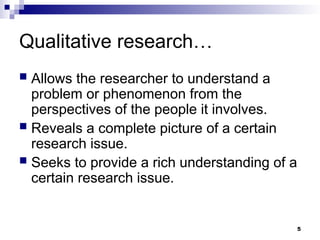
Qualitative research…
Allowsthe researcher to understand a
problem or phenomenon from the
perspectives of the people it involves.
Reveals a complete picture of a certain
research issue.
Seeks to provide a rich understanding of a
certain research issue.
5
6.
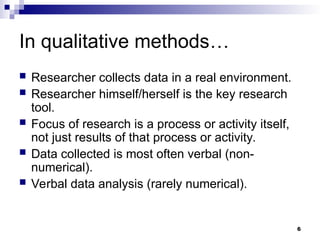
In qualitative methods…
Researcher collects data in a real environment.
Researcher himself/herself is the key research
tool.
Focus of research is a process or activity itself,
not just results of that process or activity.
Data collected is most often verbal (non-
numerical).
Verbal data analysis (rarely numerical).
6
7.
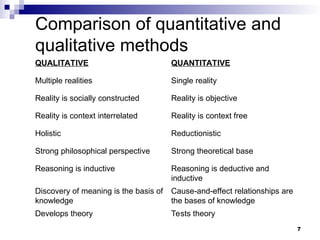
Comparison of quantitativeand
qualitative methods
QUALITATIVE QUANTITATIVE
Multiple realities Single reality
Reality is socially constructed Reality is objective
Reality is context interrelated Reality is context free
Holistic Reductionistic
Strong philosophical perspective Strong theoretical base
Reasoning is inductive Reasoning is deductive and
inductive
Discovery of meaning is the basis of
knowledge
Cause-and-effect relationships are
the bases of knowledge
Develops theory Tests theory
7
8.
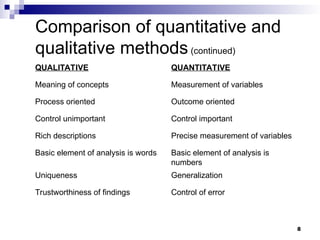
Comparison of quantitativeand
qualitative methods(continued)
QUALITATIVE QUANTITATIVE
Meaning of concepts Measurement of variables
Process oriented Outcome oriented
Control unimportant Control important
Rich descriptions Precise measurement of variables
Basic element of analysis is words Basic element of analysis is
numbers
Uniqueness Generalization
Trustworthiness of findings Control of error
8
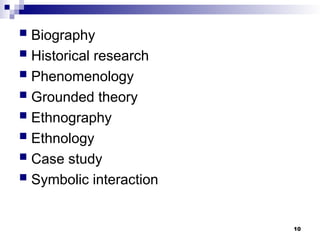
Biography
Historicalresearch
Phenomenology
Grounded theory
Ethnography
Ethnology
Case study
Symbolic interaction
10
11.
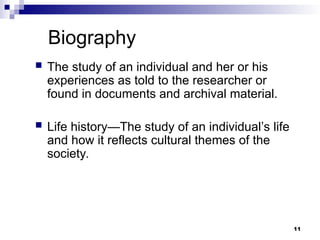
Biography
The studyof an individual and her or his
experiences as told to the researcher or
found in documents and archival material.
Life history—The study of an individual’s life
and how it reflects cultural themes of the
society.
11
12.
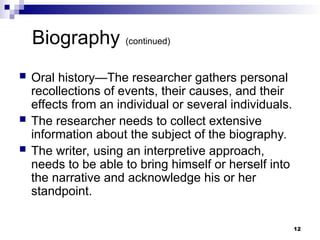
Biography (continued)
Oralhistory—The researcher gathers personal
recollections of events, their causes, and their
effects from an individual or several individuals.
The researcher needs to collect extensive
information about the subject of the biography.
The writer, using an interpretive approach,
needs to be able to bring himself or herself into
the narrative and acknowledge his or her
standpoint.
12
13.
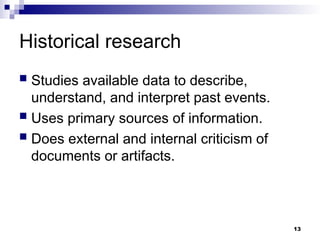
Historical research
Studiesavailable data to describe,
understand, and interpret past events.
Uses primary sources of information.
Does external and internal criticism of
documents or artifacts.
13
14.
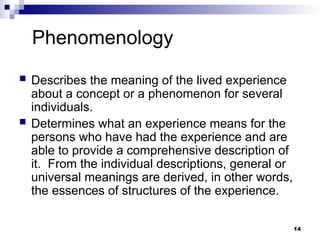
Phenomenology
Describes themeaning of the lived experience
about a concept or a phenomenon for several
individuals.
Determines what an experience means for the
persons who have had the experience and are
able to provide a comprehensive description of
it. From the individual descriptions, general or
universal meanings are derived, in other words,
the essences of structures of the experience.
14
15.
Grounded theory
Intendsto generate or discover a theory that
relates to a particular situation.
If little is known about a topic, grounded theory is
especially useful.
Because the theory emerges from the data, it is
said to be grounded in the data.
Data collection and analysis occur simultaneously,
until “saturation” is reached.
Data reviewed and coded for categories and
themes.
15
16.
Ethnography
A descriptionand interpretation of a cultural
or social group or system.
The researcher examines the group’s
observable patterns of behavior, customs,
and ways of life.
Involves prolonged observation of the group,
typically through participant observation.
16
17.
Ethnography (continued)
Fieldwork
Key informants
Thick description
Emic (insider group perspective) and Etic
(researcher’s interpretation of social life).
Context important, needs holistic view.
Needs grounding in anthropology.
17
18.
Ethnography (continued)
Manyethnographies may be written in a
narrative or story telling approach which may
be difficult for the audience accustomed to
usual social science writing.
May incorporate quantitative data and
archival documents.
18
19.
Ethnology
Compares andanalyzes the origins,
distribution, technology, religion, language,
and social structure of the ethnic, racial,
and/or national divisions of humanity.
19
20.
Case study
Anexploration of a “bounded system” or a
case (or multiple cases) over time through
detailed, in-depth data collection involving
multiple sources of information rich in context.
The context of the case involves situating the
case within its setting which may be physical,
social, historical and/or economic.
20
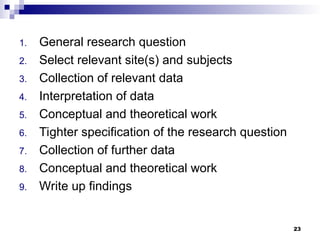
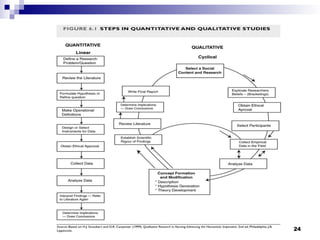
1. General researchquestion
2. Select relevant site(s) and subjects
3. Collection of relevant data
4. Interpretation of data
5. Conceptual and theoretical work
6. Tighter specification of the research question
7. Collection of further data
8. Conceptual and theoretical work
9. Write up findings
23
Mutual respectand trust
(prolonged interaction)
Respect for social and cultural contexts
Voluntary participation
Informed consent
Beneficence – doing good for others and
preventing harm
Confidentiality
26
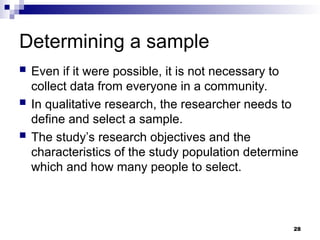
Determining a sample
Even if it were possible, it is not necessary to
collect data from everyone in a community.
In qualitative research, the researcher needs to
define and select a sample.
The study’s research objectives and the
characteristics of the study population determine
which and how many people to select.
28
29.
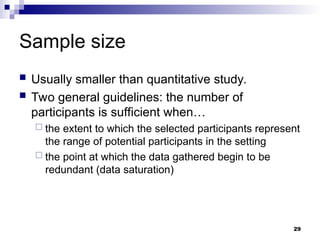
Sample size
Usuallysmaller than quantitative study.
Two general guidelines: the number of
participants is sufficient when…
the extent to which the selected participants represent
the range of potential participants in the setting
the point at which the data gathered begin to be
redundant (data saturation)
29
30.
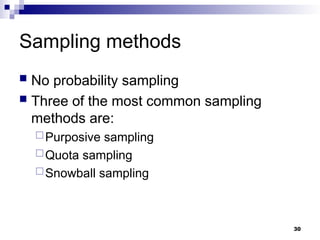
Sampling methods
Noprobability sampling
Three of the most common sampling
methods are:
Purposive sampling
Quota sampling
Snowball sampling
30
31.
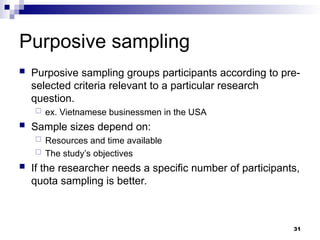
Purposive sampling
Purposivesampling groups participants according to pre-
selected criteria relevant to a particular research
question.
ex. Vietnamese businessmen in the USA
Sample sizes depend on:
Resources and time available
The study’s objectives
If the researcher needs a specific number of participants,
quota sampling is better.
31
32.
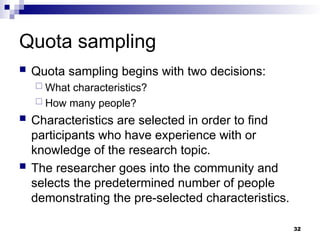
Quota sampling
Quotasampling begins with two decisions:
What characteristics?
How many people?
Characteristics are selected in order to find
participants who have experience with or
knowledge of the research topic.
The researcher goes into the community and
selects the predetermined number of people
demonstrating the pre-selected characteristics.
32
33.
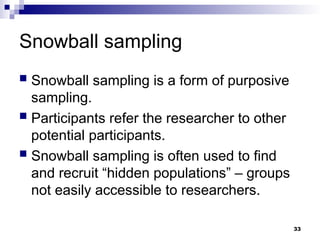
Snowball sampling
Snowballsampling is a form of purposive
sampling.
Participants refer the researcher to other
potential participants.
Snowball sampling is often used to find
and recruit “hidden populations” – groups
not easily accessible to researchers.
33
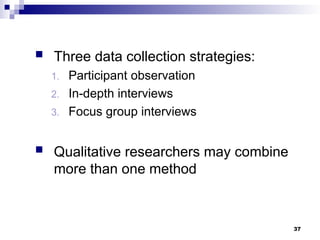
Three datacollection strategies:
1. Participant observation
2. In-depth interviews
3. Focus group interviews
Qualitative researchers may combine
more than one method
37
38.
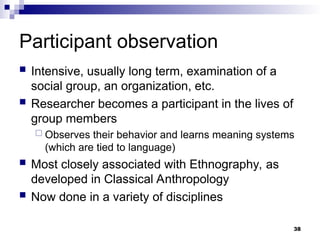
Participant observation
Intensive,usually long term, examination of a
social group, an organization, etc.
Researcher becomes a participant in the lives of
group members
Observes their behavior and learns meaning systems
(which are tied to language)
Most closely associated with Ethnography, as
developed in Classical Anthropology
Now done in a variety of disciplines
38
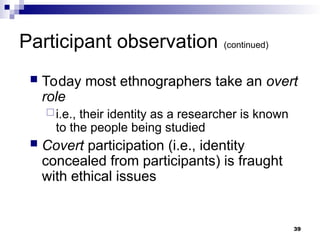
39.
Participant observation (continued)
Today most ethnographers take an overt
role
i.e., their identity as a researcher is known
to the people being studied
Covert participation (i.e., identity
concealed from participants) is fraught
with ethical issues
39
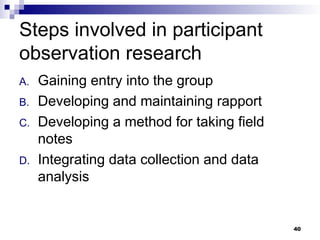
40.
Steps involved inparticipant
observation research
A. Gaining entry into the group
B. Developing and maintaining rapport
C. Developing a method for taking field
notes
D. Integrating data collection and data
analysis
40
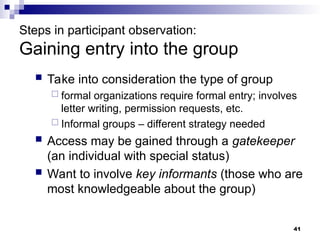
41.
Steps in participantobservation:
Gaining entry into the group
Take into consideration the type of group
formal organizations require formal entry; involves
letter writing, permission requests, etc.
Informal groups – different strategy needed
Access may be gained through a gatekeeper
(an individual with special status)
Want to involve key informants (those who are
most knowledgeable about the group)
41
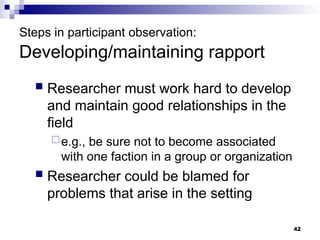
42.
Steps in participantobservation:
Developing/maintaining rapport
Researcher must work hard to develop
and maintain good relationships in the
field
e.g., be sure not to become associated
with one faction in a group or organization
Researcher could be blamed for
problems that arise in the setting
42
43.
Steps in participantobservation:
Strategies for taking field notes
Include descriptions and interpretations of
individuals, interactions, and events
Distinguish descriptions from interpretations
Record time and location of observations, as
well as key information (weather, events
happening and their significance)
Keep theoretical memos – which are the
tentative interpretations emerging and being
assessed through further data collection
43
44.
Field notes (continued)
May not be possible or advisable to take
notes while in the field
Important that they be done as soon after field
observation as possible
Note-taking is time-consuming because it is
integral to guiding the data collection and
continuing the analysis
e.g., field notes for When Prophecy Failed were
well over 1,000 typed pages
44
45.
Steps in participantobservation:
Integrating data collection and analysis
Organizing field notes into different types of files
facilitates data analysis
Master field file – complete journal of field notes;
number pages and include entry dates
Background, history file – subfile organizing
background material
Key character files – subfiles on key players in
the group or organization
Analytic files – subfiles for different types of
observations or relationships
45
46.
In-depth interviews
Somestudies cannot employ the participant
observation method
In-depth interviews allow participants to describe
their experiences and the meaning of events
taking place in their lives
Verbatim quotes capture the language and meaning
expressed by participants
Interviews are flexible and allow for probing
Interview method is quite diverse, adaptive
46
47.
In-depth interviews(continued)
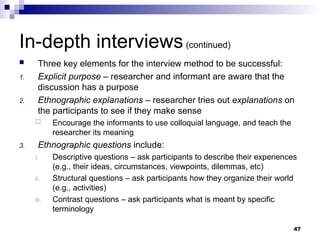
Threekey elements for the interview method to be successful:
1. Explicit purpose – researcher and informant are aware that the
discussion has a purpose
2. Ethnographic explanations – researcher tries out explanations on
the participants to see if they make sense
Encourage the informants to use colloquial language, and teach the
researcher its meaning
3. Ethnographic questions include:
i. Descriptive questions – ask participants to describe their experiences
(e.g., their ideas, circumstances, viewpoints, dilemmas, etc)
ii. Structural questions – ask participants how they organize their world
(e.g., activities)
iii. Contrast questions – ask participants what is meant by specific
terminology
47
48.
Interview do’s anddon’ts
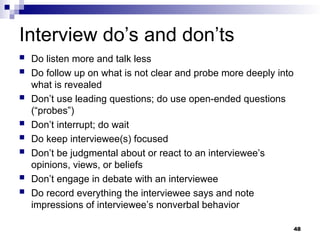
Do listen more and talk less
Do follow up on what is not clear and probe more deeply into
what is revealed
Don’t use leading questions; do use open-ended questions
(“probes”)
Don’t interrupt; do wait
Do keep interviewee(s) focused
Don’t be judgmental about or react to an interviewee’s
opinions, views, or beliefs
Don’t engage in debate with an interviewee
Do record everything the interviewee says and note
impressions of interviewee’s nonverbal behavior
48
49.
Focus group interviews
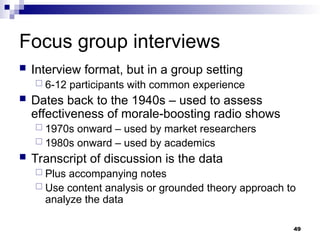
Interview format, but in a group setting
6-12 participants with common experience
Dates back to the 1940s – used to assess
effectiveness of morale-boosting radio shows
1970s onward – used by market researchers
1980s onward – used by academics
Transcript of discussion is the data
Plus accompanying notes
Use content analysis or grounded theory approach to
analyze the data
49
50.
Focus group interviews(continued)
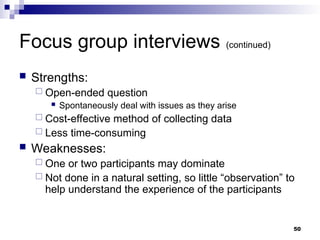
Strengths:
Open-ended question
Spontaneously deal with issues as they arise
Cost-effective method of collecting data
Less time-consuming
Weaknesses:
One or two participants may dominate
Not done in a natural setting, so little “observation” to
help understand the experience of the participants
50
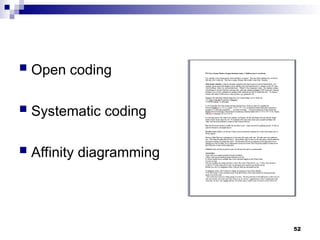
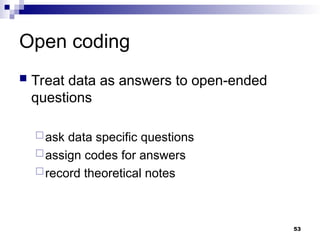
Open coding
Treatdata as answers to open-ended
questions
ask data specific questions
assign codes for answers
record theoretical notes
53
54.
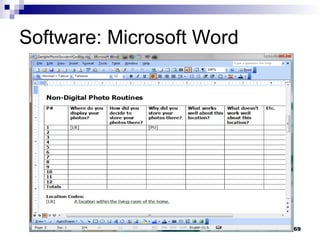
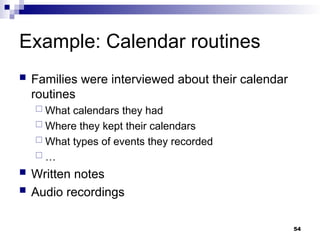
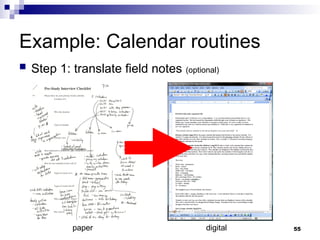
Example: Calendar routines
Families were interviewed about their calendar
routines
What calendars they had
Where they kept their calendars
What types of events they recorded
…
Written notes
Audio recordings
54
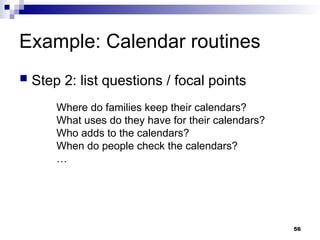
Example: Calendar routines
Step 2: list questions / focal points
Where do families keep their calendars?
What uses do they have for their calendars?
Who adds to the calendars?
When do people check the calendars?
…
56
57.
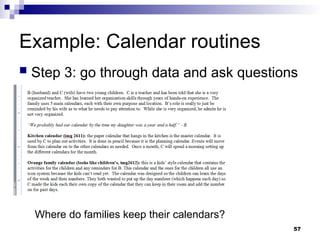
Example: Calendar routines
Step 3: go through data and ask questions
Where do families keep their calendars?
57
58.
Example: Calendar routines
Step 3: go through data and ask questions
Where do families keep their calendars?
[KI]
Calendar Locations:
[KI] – the kitchen
[KI]
[KI]
58
59.
Example: Calendar routines
Step 3: go through data and ask questions
Where do families keep their calendars?
[KI]
Calendar Locations:
[KI] – the kitchen
[CR] – child’s room
[CR]
59
60.
Example: Calendar routines
Step 3: go through data and ask questions
Continue for the remaining questions….
[KI]
Calendar Locations:
[KI] – the kitchen
[CR] – child’s room
[CR]
60
61.
Example: Calendar routines
The result:
list of codes
frequency of each code
a sense of the importance of each code
frequency != importance
61
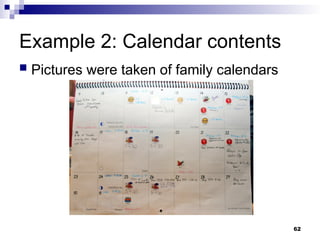
Example: Calendar contents
Step 1: list questions / focal points
What type of events are on the calendar?
Who are the events for?
What other markings are made on the calendar?
…
63
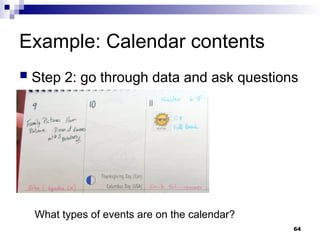
64.
Example: Calendar contents
Step 2: go through data and ask questions
What types of events are on the calendar?
64
65.
Example: Calendar contents
Step 2: go through data and ask questions
What types of events are on the calendar?
Types of Events:
[FO] – family outing
[FO]
65
66.
Example: Calendar contents
Step 2: go through data and ask questions
What types of events are on the calendar?
Types of Events:
[FO] – family outing
[AN] - anniversary
[FO]
[AN]
66
67.
Example: Calendar contents
Step 2: go through data and ask questions
Continue for the remaining questions….
Types of Events:
[FO] – family outing
[AN] - anniversary
[FO]
[AN]
67
68.
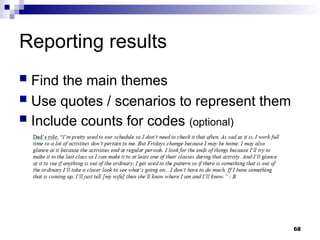
Reporting results
Findthe main themes
Use quotes / scenarios to represent them
Include counts for codes (optional)
68
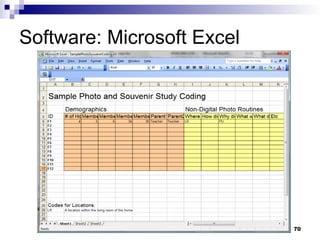
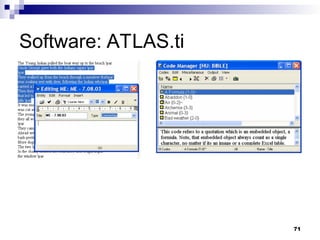
Systematic coding
Categoriesare created ahead of time
from existing literature
from previous open coding
Code the data just like open coding
73
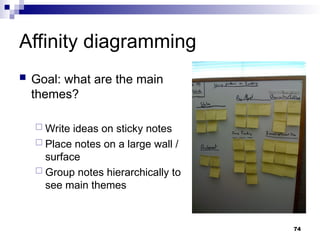
74.
Affinity diagramming
Goal:what are the main
themes?
Write ideas on sticky notes
Place notes on a large wall /
surface
Group notes hierarchically to
see main themes
74
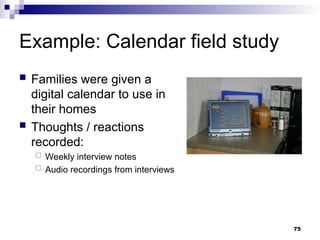
75.
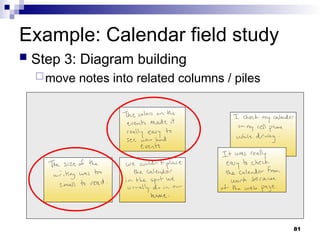
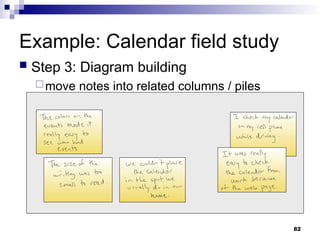
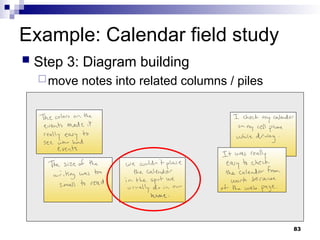
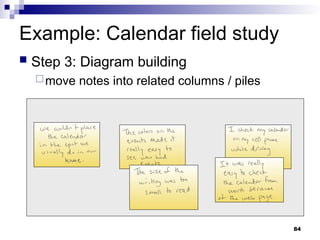
Example: Calendar fieldstudy
Families were given a
digital calendar to use in
their homes
Thoughts / reactions
recorded:
Weekly interview notes
Audio recordings from interviews
75
76.
Example: Calendar fieldstudy
Step 1: Affinity notes
go through data and write observations down
on post-it notes
each note contains one idea
76
77.
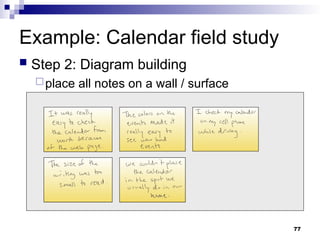
Example: Calendar fieldstudy
Step 2: Diagram building
place all notes on a wall / surface
77
78.
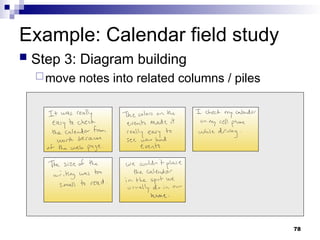
Example: Calendar fieldstudy
Step 3: Diagram building
move notes into related columns / piles
78
79.
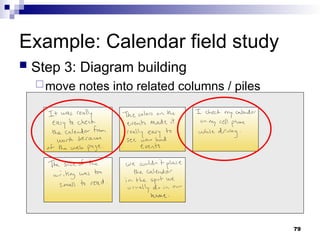
Example: Calendar fieldstudy
Step 3: Diagram building
move notes into related columns / piles
79
80.
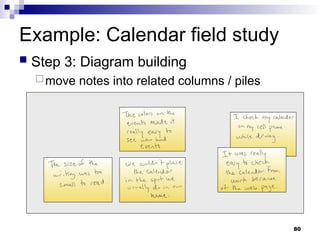
Example: Calendar fieldstudy
Step 3: Diagram building
move notes into related columns / piles
80
81.
Example: Calendar fieldstudy
Step 3: Diagram building
move notes into related columns / piles
81
82.
Example: Calendar fieldstudy
Step 3: Diagram building
move notes into related columns / piles
82
83.
Example: Calendar fieldstudy
Step 3: Diagram building
move notes into related columns / piles
83
84.
Example: Calendar fieldstudy
Step 3: Diagram building
move notes into related columns / piles
84
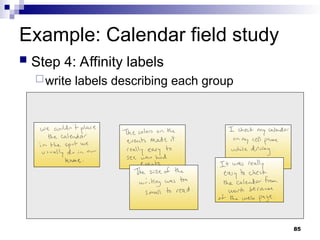
85.
Example: Calendar fieldstudy
Step 4: Affinity labels
write labels describing each group
85
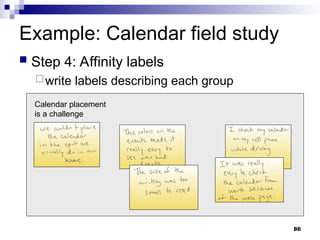
86.
Example: Calendar fieldstudy
Step 4: Affinity labels
write labels describing each group
Calendar placement
is a challenge
86
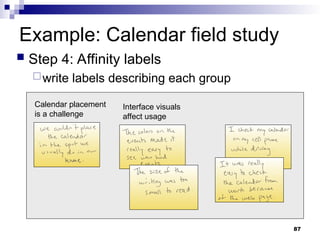
87.
Example: Calendar fieldstudy
Step 4: Affinity labels
write labels describing each group
Calendar placement
is a challenge
Interface visuals
affect usage
87
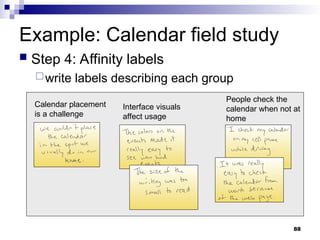
88.
Example: Calendar fieldstudy
Step 4: Affinity labels
write labels describing each group
Calendar placement
is a challenge
Interface visuals
affect usage
People check the
calendar when not at
home
88
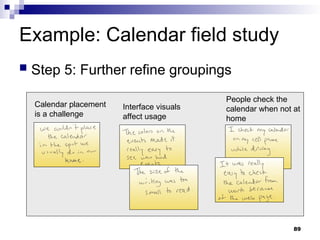
89.
Example: Calendar fieldstudy
Step 5: Further refine groupings
Calendar placement
is a challenge
Interface visuals
affect usage
People check the
calendar when not at
home
89
Threats to validity
Observer bias
Invalid information resulting from the perspective the
researcher brings to the study and imposes upon it
e.g., studying one’s own culture
Observer effects
The impact of the observer’s participation on the
setting or the participants being studied
e.g., people may do things differently
91
92.
Strategies to enhancevalidity
Intensive, long term involvement
more data, repeated observation and interviews
Rich data
full and detailed descriptions
Respondent validation
ask them if the reporting is correct
Intervention
interact with them and see how behavior changes
Searching for negative cases and alternative explanations
Triangulation
collect data from a variety of settings and methods
Quasi-statistics
e.g., frequency counts of the argument
Comparison
multicase, multisite studies
92
93.
Reliability
It isa quantitative measure.
This concept is irrelevant in qualitative
research.
However, to test a qualitative study for
reliability, you need to convert data into
relevant numbers and determine efficacy
based on the results.
93
94.
Generalization
A generalizationis usually thought of as a statement or
claim that applies to more than one individual, group, or
situation.
The value of a generalization is that it allows us to have
expectations about the future.
A limitation of qualitative research is that there is seldom
justification for generalizing the findings of a particular
study.
Due to this problem, replication of qualitative studies
becomes more important than for quantitative studies.
94


![Example: Calendar routines
Step 3: go through data and ask questions
Where do families keep their calendars?
[KI]
Calendar Locations:
[KI] – the kitchen
[KI]
[KI]
58](https://image.slidesharecdn.com/dr-250305035929-f42a6a9d/85/Dr-Khalid-Mehmood_Qualitative-Research-Workshop_Slides-ppt-58-320.jpg)
![Example: Calendar routines
Step 3: go through data and ask questions
Where do families keep their calendars?
[KI]
Calendar Locations:
[KI] – the kitchen
[CR] – child’s room
[CR]
59](https://image.slidesharecdn.com/dr-250305035929-f42a6a9d/85/Dr-Khalid-Mehmood_Qualitative-Research-Workshop_Slides-ppt-59-320.jpg)
![Example: Calendar routines
Step 3: go through data and ask questions
Continue for the remaining questions….
[KI]
Calendar Locations:
[KI] – the kitchen
[CR] – child’s room
[CR]
60](https://image.slidesharecdn.com/dr-250305035929-f42a6a9d/85/Dr-Khalid-Mehmood_Qualitative-Research-Workshop_Slides-ppt-60-320.jpg)
![Example: Calendar contents
Step 2: go through data and ask questions
What types of events are on the calendar?
Types of Events:
[FO] – family outing
[FO]
65](https://image.slidesharecdn.com/dr-250305035929-f42a6a9d/85/Dr-Khalid-Mehmood_Qualitative-Research-Workshop_Slides-ppt-65-320.jpg)
![Example: Calendar contents
Step 2: go through data and ask questions
What types of events are on the calendar?
Types of Events:
[FO] – family outing
[AN] - anniversary
[FO]
[AN]
66](https://image.slidesharecdn.com/dr-250305035929-f42a6a9d/85/Dr-Khalid-Mehmood_Qualitative-Research-Workshop_Slides-ppt-66-320.jpg)
![Example: Calendar contents
Step 2: go through data and ask questions
Continue for the remaining questions….
Types of Events:
[FO] – family outing
[AN] - anniversary
[FO]
[AN]
67](https://image.slidesharecdn.com/dr-250305035929-f42a6a9d/85/Dr-Khalid-Mehmood_Qualitative-Research-Workshop_Slides-ppt-67-320.jpg)