Qualitative Research
concernedwith feelings, ideas, or experiences. Finding
insights that can result in testable hypotheses is the main
goal of the data collection, which is frequently done in
narrative form.
is a method used to explore and understand people's
perspectives, experiences, and behaviours in a natural
setting. Unlike quantitative research, which focuses on
numerical data, qualitative research delves into the "why"
and "how" behind human actions.
3.
3
The aim ofqualitative research is to gain a comprehensive
understanding of social phenomena in their natural environments.
It relies on the direct experiences of people as meaning-making
agents in their daily lives and focuses on the why rather than what
of social phenomena
For the study of human phenomena, qualitative researchers
employ a variety of systems of inquiry, such as biography, case
study, historical analysis, discourse analysis, ethnography,
grounded theory, and phenomenology, as opposed to logical and
statistical methods.
4.
Key Characteristics ofQualitative
Research:
Naturalistic: It occurs in real-world settings,
allowing researchers to observe behaviours in their
natural context.
Exploratory: It aims to discover new insights and
understandings rather than testing specific
hypotheses.
Inductive: Researchers start with observations and
gradually develop theories or explanations.
Subjective: It acknowledges the researcher’s role in
interpreting data and understanding participants’
perspectives.
5.
5
Common Qualitative ResearchDesigns:
1. Ethnography:
is a qualitative research method that involves immersing
oneself in a particular culture or group to understand
their behaviors, beliefs, and values from within. It
provides a rich and detailed understanding of people's
lives and the cultural context in which they live.
6.
6
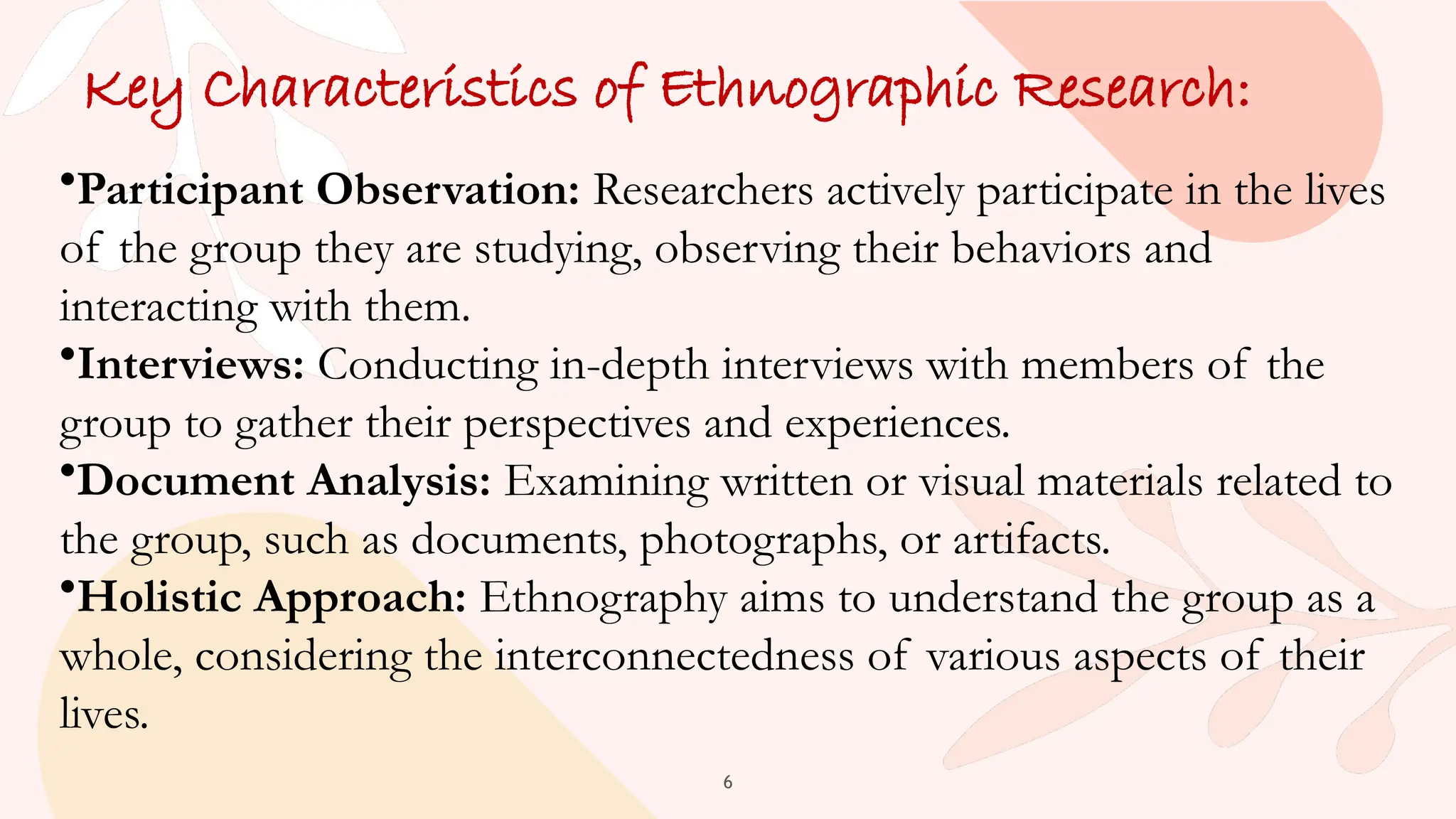
Key Characteristics ofEthnographic Research:
•Participant Observation: Researchers actively participate in the lives
of the group they are studying, observing their behaviors and
interacting with them.
•Interviews: Conducting in-depth interviews with members of the
group to gather their perspectives and experiences.
•Document Analysis: Examining written or visual materials related to
the group, such as documents, photographs, or artifacts.
•Holistic Approach: Ethnography aims to understand the group as a
whole, considering the interconnectedness of various aspects of their
lives.
7.
7
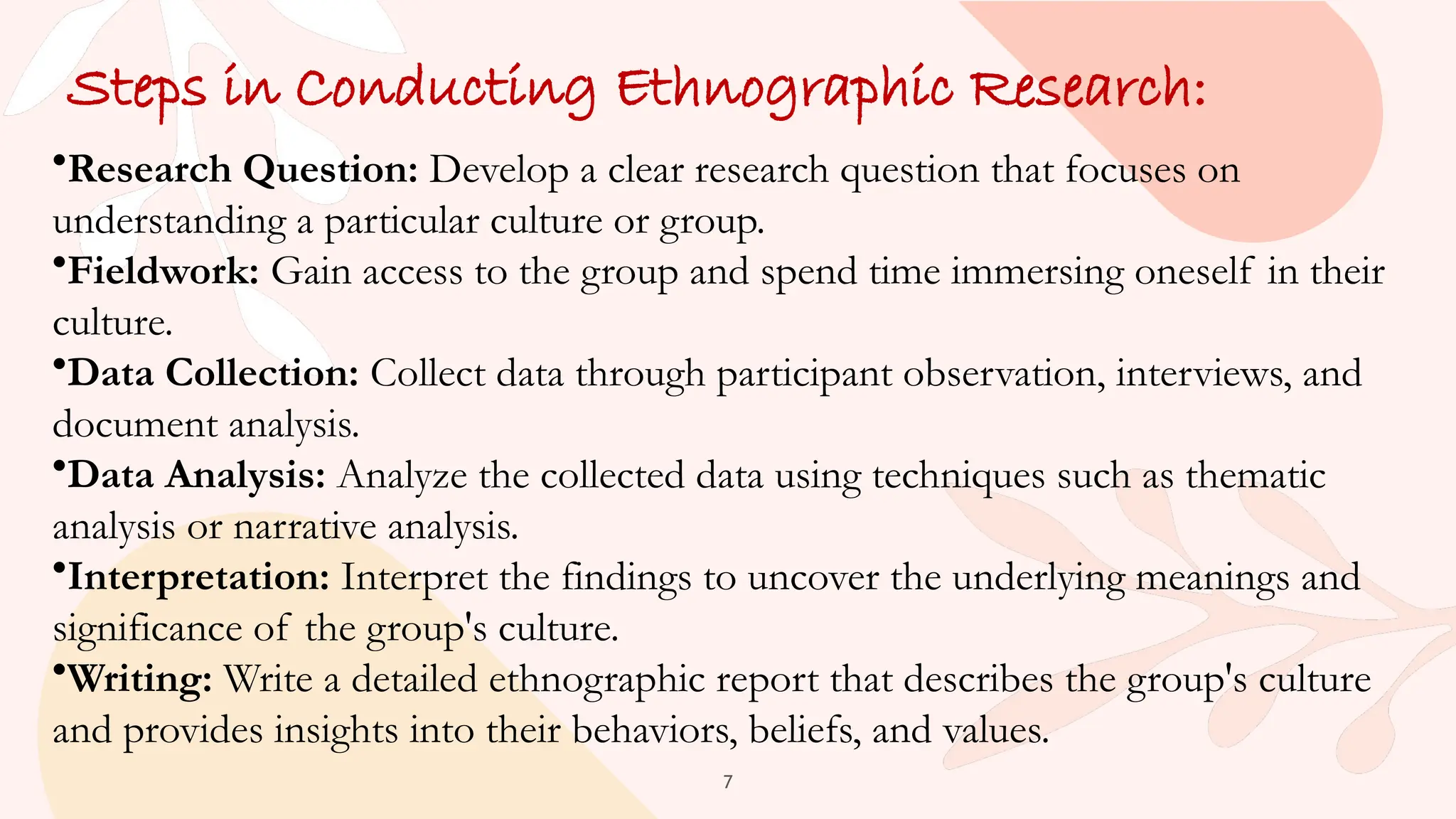
Steps in ConductingEthnographic Research:
•Research Question: Develop a clear research question that focuses on
understanding a particular culture or group.
•Fieldwork: Gain access to the group and spend time immersing oneself in their
culture.
•Data Collection: Collect data through participant observation, interviews, and
document analysis.
•Data Analysis: Analyze the collected data using techniques such as thematic
analysis or narrative analysis.
•Interpretation: Interpret the findings to uncover the underlying meanings and
significance of the group's culture.
•Writing: Write a detailed ethnographic report that describes the group's culture
and provides insights into their behaviors, beliefs, and values.
8.
8
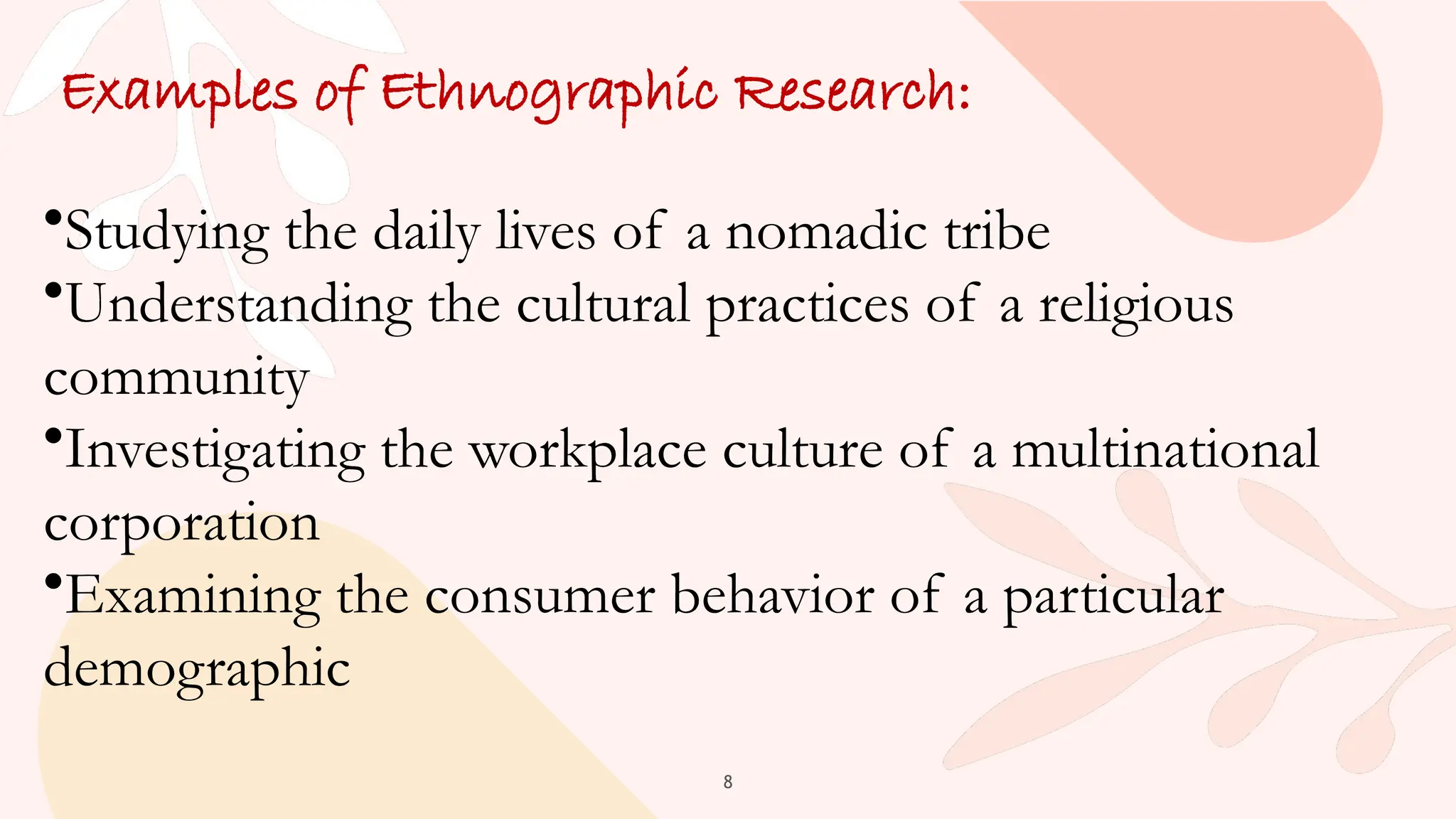
Examples of EthnographicResearch:
•Studying the daily lives of a nomadic tribe
•Understanding the cultural practices of a religious
community
•Investigating the workplace culture of a multinational
corporation
•Examining the consumer behavior of a particular
demographic
9.
9
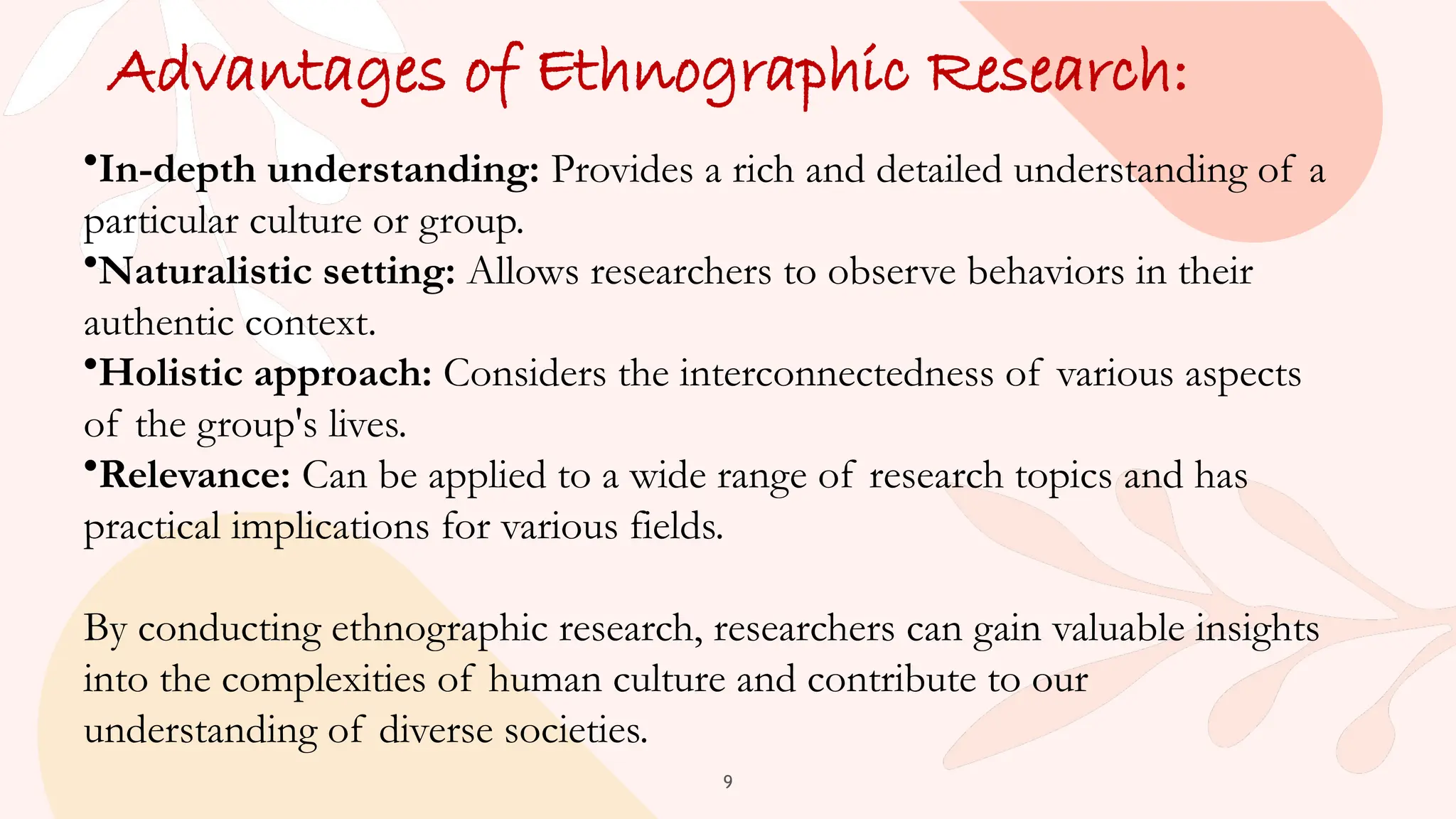
Advantages of EthnographicResearch:
•In-depth understanding: Provides a rich and detailed understanding of a
particular culture or group.
•Naturalistic setting: Allows researchers to observe behaviors in their
authentic context.
•Holistic approach: Considers the interconnectedness of various aspects
of the group's lives.
•Relevance: Can be applied to a wide range of research topics and has
practical implications for various fields.
By conducting ethnographic research, researchers can gain valuable insights
into the complexities of human culture and contribute to our
understanding of diverse societies.
10.
10
2. Phenomenological
is aqualitative research approach that seeks to
understand the lived experiences of individuals. It
aims to uncover the meaning that individuals
ascribe to their experiences and how these
experiences shape their perceptions and behaviors.
11.
11
Key Characteristics ofPhenomenological Studies:
Subjectivity: Focuses on the subjective experiences of individuals
rather than objective facts.
Intentionality: Emphasizes the intentional nature of human
experience, meaning that individuals actively shape their perceptions of
the world.
Bracketing: Involves setting aside preconceived notions and
assumptions to allow participants' experiences to emerge authentically.
Description: Aims to provide a detailed and descriptive account of
participants' experiences.
12.
12
Steps in Conductinga Phenomenological Study:
1. Research Question: Develop a clear research question that focuses on understanding the
lived experiences of individuals.
2. Participant Selection: Recruit participants who have experienced the phenomenon of
interest.
3. Data Collection: Conduct in-depth interviews with participants to gather detailed
accounts of their experiences.
4. Data Analysis: Analyze the interview transcripts using techniques such as thematic analysis
or narrative analysis to identify common themes and patterns.
5. Description: Develop a detailed description of the participants' lived experiences,
highlighting the essential features and meanings.
6. Interpretation: Interpret the findings to uncover the underlying meaning and significance
of the participants' experiences.
13.
13
Examples of PhenomenologicalStudies:
The experience of grief after the loss of a loved
one
The meaning of resilience in individuals who have
overcome adversity
The lived experience of chronic pain
The perception of beauty in different cultures
14.
14
Advantages of PhenomenologicalStudies:
In-depth understanding: Provides a deep and nuanced understanding of
individuals' lived experiences.
Rich data: Generates rich and detailed data that can be used to develop new
insights and theories.
Subjectivity: Acknowledges the subjective nature of human experience and avoids
imposing external interpretations.
Relevance: Can be applied to a wide range of research topics and has practical
implications for various fields.
By conducting phenomenological studies, researchers can gain valuable insights
into the human experience and contribute to our understanding of a variety of
phenomena.
15.
15
3. Grounded Theory:
isa systematic methodology for developing
theories from data. Unlike traditional research
where theory precedes data collection, in
grounded theory, data collection and analysis
occur simultaneously, leading to the
emergence of a theory that is grounded in the
data.
16.
16
Key Characteristics ofGrounded Theory:
•Data-Driven: Theory is derived from the data, not imposed
on it.
•Iterative: Data collection and analysis are ongoing
processes, with new insights leading to revised theoretical
concepts.
•Comparative: Data is compared and contrasted to identify
patterns and relationships.
•Systematic: While flexible, grounded theory follows a
structured approach involving coding, memoing, and
theoretical sampling.
17.
17
Phases of GroundedTheory Research:
•Open Coding: Initial coding of data to identify
concepts and categories.
•Axial Coding: Relating categories to each other and
identifying core categories.
•Selective Coding: Identifying the core category and
developing a theoretical narrative.
18.
18
Techniques Used inGrounded Theory:
•Coding: Assigning labels or codes to segments of
data.
•Memoing: Writing notes and reflections on the data
and analysis.
•Theoretical Sampling: Selecting additional data to
refine and saturate theoretical concepts.
•Constant Comparative Method: Continuously
comparing new data with existing categories to refine
the theory.
19.
19
Advantages of GroundedTheory:
•Flexibility: Adapts to the evolving nature of
the research.
•Richness: Provides detailed insights into the
perspectives of participants.
•Relevance: Generates theories that are
grounded in real-world experiences.
20.
20
Disadvantages of GroundedTheory:
•Time-consuming: Can be a lengthy and labor-intensive process.
•Subjectivity: Researcher bias can influence the analysis.
•Limited generalizability: Theories may not be applicable to
broader populations.
In essence, grounded theory is a powerful tool for generating new
knowledge and understanding complex phenomena. By starting with
data and allowing theory to emerge, researchers can develop rich and
meaningful insights that can inform both academic and practical
applications.
21.
21
4. Case StudyDesign
is a qualitative methodology that
involves an in-depth investigation of
a particular case or phenomenon. It's
often used to explore complex issues
and provide detailed insights into
specific contexts.
22.
22
Key Characteristics ofCase Study Design:
•In-depth exploration: Focuses on a single case or a small
number of cases.
•Contextual understanding: Examines the case within its
specific context.
•Multiple data sources: Combines various data collection
methods, such as interviews, observations, and documents.
•Holistic perspective: Provides a comprehensive view of
the case, including its strengths, weaknesses, and
complexities.
23.
23
Types of CaseStudies:
•Single case study: Focuses on a single instance of a
phenomenon.
•Multiple case study: Examines multiple cases to establish
patterns or variations.
•Instrumental case study: Uses a case to illustrate a theory
or concept.
•Collective case study: Examines a group of cases with
similar characteristics.
24.
24
Data Collection Methods:
•Interviews:Semi-structured or unstructured
interviews with key informants.
•Observations: Direct observation of the case or its
environment.
•Documents: Analysis of relevant documents, such
as reports, memos, or letters.
•Artifacts: Examination of physical objects related
to the case.
25.
25
Data Analysis:
•Thematic analysis:Identifying and analyzing recurring
themes or patterns in the data.
•Narrative analysis: Exploring the stories and narratives
within the data.
•Pattern matching: Comparing the data to theoretical
predictions or patterns.
•Explanation building: Developing explanations for the
observed phenomena.
26.
26
Advantages of CaseStudy Design:
•In-depth understanding: Provides detailed
insights into complex issues.
•Contextual relevance: Examines phenomena
within their specific contexts.
•Flexibility: Adapts to the evolving nature of the
research.
•Richness: Generates detailed and nuanced data.
27.
27
Disadvantages of CaseStudy Design:
•Limited generalizability:
Findings may not be applicable to broader
populations.
•Subjectivity:
Researcher bias can influence the analysis.
•Time-consuming:
Can be a lengthy and labor-intensive
process.
28.
28
5. Historical Researchin Qualitative
Research Designs
is a qualitative methodology that involves the
examination of past events, documents, and
artifacts to understand and interpret the past. It's
often used to study trends, patterns, and causal
relationships over time.
29.
29
Key Characteristics ofHistorical Research:
•Primary sources: Relies primarily on firsthand
accounts, documents, and artifacts.
•Secondary sources: May also use secondary sources,
such as books and articles, for additional context.
•Critical analysis: Involves careful examination and
evaluation of sources to assess their credibility and
reliability.
•Interpretation: Requires interpretation of historical
evidence to draw conclusions and develop theories.
30.
30
Types of HistoricalResearch:
•Narrative history: Focuses on telling a chronological
story of past events.
•Biographical history: Examines the lives and
contributions of individuals.
•Conceptual history: Traces the development of ideas
and concepts over time.
•Comparative history: Compares different historical
periods or cultures.
31.
31
Advantages of HistoricalResearch:
•Unique perspective: Provides a unique
perspective on current issues and trends.
•Longitudinal analysis: Allows for the study
of changes over time.
•Richness: Generates detailed and nuanced
data.
32.
32
Disadvantages of HistoricalResearch:
•Limited data availability: May be difficult to find
sufficient and reliable sources.
•Subjectivity: Researcher bias can influence the
interpretation of historical evidence.
•Complexity: Historical events are often complex
and difficult to understand.
33.
33
Steps in QualitativeResearch Design:
•Research Question: Clearly define the research question that you want
to explore.
•Literature Review: Review existing literature to identify gaps in
knowledge and inform your research design.
•Sampling: Select participants who can provide valuable insights into
your research question.
•Data Collection: Choose appropriate data collection methods, such as
interviews, observations, focus groups, or document analysis.
34.
34
•Data Analysis: Analyzethe collected data using techniques
like coding, thematic analysis, or narrative analysis.
•Interpretation: Interpret the findings and draw conclusions
based on the data.
•Validation: Ensure the validity and reliability of your
findings through methods like member checking or
triangulation.
35.
Advantages of QualitativeResearch:
•Rich and Detailed Data: Provides in-depth
insights into participants' perspectives and
experiences.
•Flexibility: Allows researchers to adapt their
approach as the research progresses.
•Naturalistic Setting: Captures behaviors in
their authentic context.
•Understanding Meaning: Helps to
understand the underlying meanings and
motivations behind human actions.
36.
36
By following theseguidelines, you
can effectively design and conduct
qualitative research that provides
valuable insights into the
complexities of human behavior.