Qualitative Research“A form of social inquiry that focuses on the way people interpret and make sense of their experiences and the world in which they live.”
Qualitative/Quantitative DifferencesThe aim is a detailed description.Researcher may only know roughly in advance what he/she is looking for. The design emerges as the study unfolds. Researcher is the data gathering instrument.Data is in the form of words, pictures or objects.Subjective - individuals’ interpretation of events is important Qualitative data is more 'rich', time consuming, and not generalizable. Researcher tends to become subjectively immersed in the subject matter.The aim is to classify features, count them, and construct statistical models in an attempt to explain what is observed.Researcher knows clearly in advance what he/she is looking for. All aspects of the study are carefully designed before data is collected. Researcher questionnaires or equipment to collect numerical data.Data is numerical in nature. Objective – seeks measurement & analysis of target concepts.Quantitative data is more efficient, able to test hypotheses.Researcher tends to remain separated from the subject matter.
Main Types of Qualitative ResearchAttempts to shed light on a phenomena by studying in depth a single case example of the phenomena.  The case can be an individual person, an event, a group, or an institution. Case StudyGrounded TheoryTheory is developed inductively from a corpus of data acquired by a participant-observer.Describes the structures of experience as they present themselves to consciousness, without recourse to theory, deduction, or assumptions from other disciplinesPhenomenologyFocuses on the sociology of meaning through close field observation of sociocultural phenomena. Typically, the ethnographer focuses on a community.EthnographySystematic collection and objective evaluation of data related to past occurrences in order to test hypotheses concerning causes, effects, or trends of these events that may help to explain present events and anticipate future events.Historical
Main Types of Qualitative Data Collection & Analysis"Those who are not familiar with qualitative methodology may be surprised by the sheer volume of data and the detailed level of analysis that results even when research is confined to a small number of subjects" (Myers, 2002).
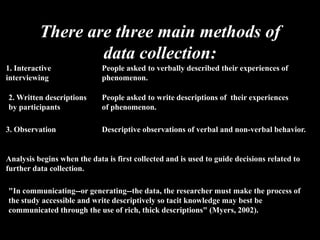
There are three main methods of data collection:1. Interactive interviewingPeople asked to verbally described their experiences of phenomenon.2. Written descriptions by participantsPeople asked to write descriptions of  their experiences of phenomenon.3. ObservationDescriptive observations of verbal and non-verbal behavior.Analysis begins when the data is first collected and is used to guide decisions related to further data collection."In communicating--or generating--the data, the researcher must make the process of the study accessible and write descriptively so tacit knowledge may best be communicated through the use of rich, thick descriptions" (Myers, 2002).
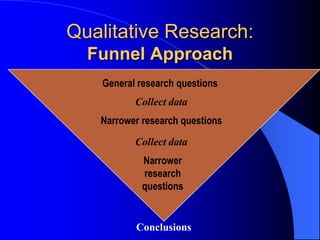
Qualitative Research:Funnel ApproachGeneral research questionsCollect dataNarrower research questionsCollect dataNarrower research questionsConclusions
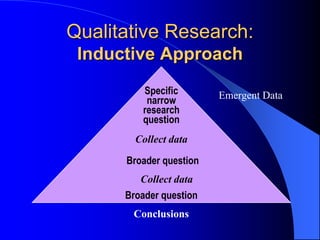
Qualitative Research:Inductive ApproachSpecific narrow research questionEmergent DataCollect dataBroader questionCollect dataBroader questionConclusions
Qualitative Research Methods:TriangulationMethod to enhance the validity & reliability of qualitative researchEnhances accuracy of interpretationConfirms that the data collected is not due to chance or circumstances
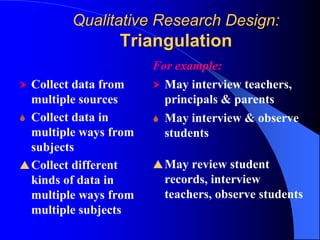
Qualitative Research Design:TriangulationFor example:May interview teachers, principals & parents
May interview & observe students
May review student records, interview teachers, observe students
Collect data from multiple sources
Collect data in multiple ways from subjects
Collect different kinds of data in multiple ways from multiple subjectsMultiple data collection strategiesKinds of dataSubjects(data sources)Data collection strategiesMultiple data sourcesMultiple kinds of dataQualitative Research Design:Triangulation
Strengthsaims to understand meaning interpretation in particular settings, situations and conditionsrigorous and systematic data collection and analysis often concurrentlydata rich in descriptionsconcepts derived from the data itself
Strengthsaims to explore and communicatehypothesis generation need for a reflexive account ‘tell how the study was done’need for triangulation, multiple points of observation
Challengessmall scalenon-representative samplesbiasaccess to samplestime consumingrecord keepingdata reduction

Qualitative Research

  • 1.
    Qualitative Research“A formof social inquiry that focuses on the way people interpret and make sense of their experiences and the world in which they live.”
  • 2.
    Qualitative/Quantitative DifferencesThe aimis a detailed description.Researcher may only know roughly in advance what he/she is looking for. The design emerges as the study unfolds. Researcher is the data gathering instrument.Data is in the form of words, pictures or objects.Subjective - individuals’ interpretation of events is important Qualitative data is more 'rich', time consuming, and not generalizable. Researcher tends to become subjectively immersed in the subject matter.The aim is to classify features, count them, and construct statistical models in an attempt to explain what is observed.Researcher knows clearly in advance what he/she is looking for. All aspects of the study are carefully designed before data is collected. Researcher questionnaires or equipment to collect numerical data.Data is numerical in nature. Objective – seeks measurement & analysis of target concepts.Quantitative data is more efficient, able to test hypotheses.Researcher tends to remain separated from the subject matter.
  • 3.
    Main Types ofQualitative ResearchAttempts to shed light on a phenomena by studying in depth a single case example of the phenomena.  The case can be an individual person, an event, a group, or an institution. Case StudyGrounded TheoryTheory is developed inductively from a corpus of data acquired by a participant-observer.Describes the structures of experience as they present themselves to consciousness, without recourse to theory, deduction, or assumptions from other disciplinesPhenomenologyFocuses on the sociology of meaning through close field observation of sociocultural phenomena. Typically, the ethnographer focuses on a community.EthnographySystematic collection and objective evaluation of data related to past occurrences in order to test hypotheses concerning causes, effects, or trends of these events that may help to explain present events and anticipate future events.Historical
  • 4.
    Main Types ofQualitative Data Collection & Analysis"Those who are not familiar with qualitative methodology may be surprised by the sheer volume of data and the detailed level of analysis that results even when research is confined to a small number of subjects" (Myers, 2002).
  • 5.
    There are threemain methods of data collection:1. Interactive interviewingPeople asked to verbally described their experiences of phenomenon.2. Written descriptions by participantsPeople asked to write descriptions of  their experiences of phenomenon.3. ObservationDescriptive observations of verbal and non-verbal behavior.Analysis begins when the data is first collected and is used to guide decisions related to further data collection."In communicating--or generating--the data, the researcher must make the process of the study accessible and write descriptively so tacit knowledge may best be communicated through the use of rich, thick descriptions" (Myers, 2002).
  • 6.
    Qualitative Research:Funnel ApproachGeneralresearch questionsCollect dataNarrower research questionsCollect dataNarrower research questionsConclusions
  • 7.
    Qualitative Research:Inductive ApproachSpecificnarrow research questionEmergent DataCollect dataBroader questionCollect dataBroader questionConclusions
  • 8.
    Qualitative Research Methods:TriangulationMethodto enhance the validity & reliability of qualitative researchEnhances accuracy of interpretationConfirms that the data collected is not due to chance or circumstances
  • 9.
    Qualitative Research Design:TriangulationForexample:May interview teachers, principals & parents
  • 10.
    May interview &observe students
  • 11.
    May review studentrecords, interview teachers, observe students
  • 12.
    Collect data frommultiple sources
  • 13.
    Collect data inmultiple ways from subjects
  • 14.
    Collect different kindsof data in multiple ways from multiple subjectsMultiple data collection strategiesKinds of dataSubjects(data sources)Data collection strategiesMultiple data sourcesMultiple kinds of dataQualitative Research Design:Triangulation
  • 15.
    Strengthsaims to understandmeaning interpretation in particular settings, situations and conditionsrigorous and systematic data collection and analysis often concurrentlydata rich in descriptionsconcepts derived from the data itself
  • 16.
    Strengthsaims to exploreand communicatehypothesis generation need for a reflexive account ‘tell how the study was done’need for triangulation, multiple points of observation
  • 17.
    Challengessmall scalenon-representative samplesbiasaccessto samplestime consumingrecord keepingdata reduction