Educ.601ResearchMethodology
QUALITATIVEStudies
Reported to: Dr. RufinoTudlasan
Reported by: Emelita P. Lorenzo
Learning
Objectives
Able to know;
 What is Qualitative Studies
 Common types of Qualitative methods and the data collection
strategies
 The features, characteristics of qualitative research
 The importance of qualitative research across field
What is
Qualitative
studies?
Qualitative studies is a type of research that explores and provides
deeper insights into real-world problems.
• Qualitative research is a collecting, analyzing, and interpreting
data by observing what people do and say.
 Qualitative research at its core, ask open-ended questions whose
answers are not easily put into numbers such as ‘how’ and ‘why’.
• Qualitative research refers to the meanings, concepts, definitions,
characteristics, metaphors, symbols, and descriptions of things.
 Types of Qualitative Research Questions
There are three types of qualitative research questions.
 Exploratory Questions: Questions designed to learn more about
something without bias are called exploratory questions.The goal
of asking an exploratory question is to learn more about
something without assuming anything.
 Predictive Questions: This type of question uses past information
to understand future outcomes.
 Ex:What are the potential consequences of providing community
improvement to the village councils in this region?
 Interpretive Questions: Interpretive research studies how people
make sense of their experiences in natural settings.
 Ex:Why did Summer call her mom at the Halloween party?
Methods 0f
Qualitative
Research
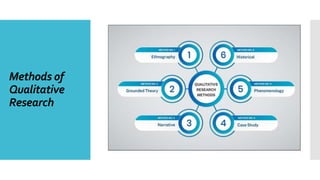
 I.Phenomenological Study
 II. Grounded theory Study
 III. Case Studies
 IV. Ethnographic Study
 VI. Narrative Analysis
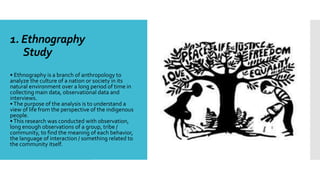
1. Ethnography
Study
• Ethnography is a branch of anthropology to
analyze the culture of a nation or society in its
natural environment over a long period of time in
collecting main data, observational data and
interviews.
•The purpose of the analysis is to understand a
view of life from the perspective of the indigenous
people.
•This research was conducted with observation,
long enough observations of a group, tribe /
community, to find the meaning of each behavior,
the language of interaction / something related to
the community itself.
2.Grounded
Theory

• Researchers produce a general and abstract theory of a
particular action, process, or interaction that comes from
the views of participants.
• Researchers must go through a number of stages of data
collection and filtering categories for the information that
has been obtained.
• It has main characteristics, namely: (1) constant
comparison between data and emerging categories and
(2) theoretical sampling of different groups to maximize
information similarity and difference.
5. Narrative
Analysis
• Researchers investigate the lives of individuals and ask a person or
group of individuals to tell their life.
•This information is retold by the researcher in a narrative
chronology.
• In the final stage of the research, the researcher must combine
with a narrative style his views on the participant’s life with the
views held by the researcher himself.
2.Case studies
• Researchers carefully investigate a program, event, activity, process,
or group of individuals.
• Cases are limited by time and activity, and researchers collect
complete information using time-based procedures.
• Purpose of the case study, to conduct an in-depth analysis of a
specific individual, group, or phenomenon within is real-life context.
3.Phenomenology
Study

• Researchers identify the nature of human
experience about a particular phenomenon.
• Understanding the experience of human
life makes phenomenological philosophy a
research method whose procedures require
the researcher to study a number of
subjects with a relatively long and direct
involvement in it to develop patterns and
meaning relations.
6. Historical
study
 Systematic collection and objective evaluation of data related to
past occurrences in order to test hypothesis concerning causes,
effects, or trends if these events that may help to explain present
events and anticipate future events
Aims of
qualitative
researchers
 In general, this type of research includes information about the
main phenomenon that is being explored in a study, research
participants, and the location of a study. Qualitative research can
also state the research design chosen.
 In the world of education, qualitative research has the objective of
describing the process of educational activities based on what is in
the field as study material to find shortcomings and weaknesses
so that efforts can be determined to improve them; analyzing a
symptom, facts, and educational events in the field; compile a
hypothesis related to the concepts and principles of education
based on information and data that occur in the field.
Features of
Qualitative
Research
1. Naturalistic
 Context-dependent
 Actions are understood within settings
 Circumstances are important
2. Descriptive Data
 Narrative form of reporting is common and quotations are used to illustrate &substantiate.
 Data includes interviews, fieldnotes, photographs video footage, personal documents, memos, etc.
3. Concern with Process
 Process is just as, or more, important than outcomes or products.
 Attention to how meaning is derived and how labels come to be applied and how assumptions are made.
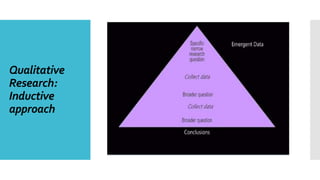
4. Inductive
 Theories develop from the bottom up rather than the top down
 The direction you will travel comes after you have been collecting data & spent time with participants
 “You are not putting together a puzzle whose picture you already know”
 Use parts of the study to learn what the important questions are
5. Meaningful
 Participant perspectives are important
 Accuracy of interpretations can be checked with the participants
 Interplay or dialogue between researchers and participants
Qualitative
Research
Characteristic
s
1. Natural environment (natural setting). Qualitative researchers collect field data at the locations where
participants experience the problem or issue to be studied. Qualitative researchers do not change the environmental
settings and activities of the participants. Information is gathered by talking directly to people and seeing them act
directly in a natural context.
2. Researcher as a key instrument (researcher as key instrument). Qualitative researchers generally collect their
own research data through participant observation, documentation, or direct interviews with participants. These
researchers generally do not use instruments or questionnaires made by other researchers, because they are the
only key to the study.
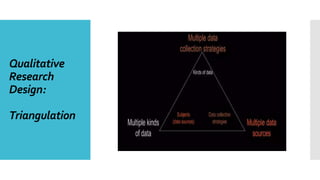
3. Multiple sources of data. Qualitative researchers generally choose to collect the required data from various
sources such as interviews, documentation, and observations, rather than relying only on one source data.
4. Inductive data analysis. Qualitative researchers build categories, patterns and themes from the ground up
(inductive) or from separate data into a complete conclusion.
5. The meaning of the participants (participant’s meaning). In the entire research process, the researcher must
focus on studying the meaning obtained from the participants about the issue or research problem, not the meaning
conveyed by other authors or researchers in certain literatures.
6. Design that develops (emergent design). Qualitative researchers argue that qualitative research is always
evolving and dynamic. This can mean that the initial plan is not a standard that must be adhered to, all stages of
research may change after the researcher goes into the field and collects data. Provided that these changes are still
in line in achieving the research objectives, namely obtaining information about the problem or research issue.
7. Theoretical perspective (theoritical lens). Qualitative researchers often use certain perspectives in conducting
research such as ethnography, cultural concepts, gender differences, race and others.
8. Interpretive. Qualitative researchers make an interpretation of what they see, hear and what they understand.
Usually there are differences in interpretation between researchers and readers and participants, so it appears that
qualitative research offers different views on a content or problem.
9. A holistic account. Qualitative researchers usually try to make a complex picture of a research issue or problem.
Researchers describe the perspectives and factors associated with the problem as a whole.
Data
collection
strategy
:
 1. Qualitative observation
Qualitative observation is an observation in which the researcher goes
directly to the field to observe participant behavior and activities at the
research location. In this observation, the researcher can record and
record both structured and unstructured notes. Usually researchers are
involved in a variety of roles, it can be as a complete participant or non-
participant.
 2. Qualitative interview
In qualitative interviews, qualitative researchers can interview face-to-
face or face to face with participants, by telephone, or can also be
involved in focus group interviews or group interviews.The questions
are unstructured and open questions for the purpose of capturing the
opinions and views of participants on a particular issue.
 3. Quality documents
Qualitative documents can be public documents such as newspapers,
magazines or papers or in the form of personal documents such as
diaries, diaries and e-mails.
 4. Audio and visual material
This data can be in the form of recordings of both sound and images
and printed results such as pictures, photographs and paintings.
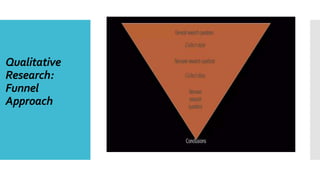
Qualitative
Research:
Funnel
Approach
Qualitative
Research:
Inductive
approach
QualitativeResearchMethods:
Triangulation
Qualitative
Research
Design:
Triangulation
Qualitative
Research
Design:
Triangulation
Strength Challenges
Importance of Qualitative Research
Across of Fields of Inquiry
 1. Understanding complex social phenomena
 2. Informing policy and practice
 3. Identifying gaps in knowledge
 4. Advancing social justice
 5. Enhancing the quality of research
 6. Improving communication and collaboration
References  https://www.oxfordreference.com/display/10.1093/oi/authority.201
10803095825954
• https://lp2m.uma.ac.id/2020/11/21/qualitative-research-methods-
objectives-characteristics-and-strategies/
• https://www.healthknowledge.org.uk/public-health-
textbook/research-methods/1d-qualitative-methods/principles-
qualitative-methods-exercise2answers
• https://collegeessay.org/blog/how-to-write-a-research-paper/types-
of-qualitative-research
Thankyoufor
Listening

research.pptx

  • 1.
    Educ.601ResearchMethodology QUALITATIVEStudies Reported to: Dr.RufinoTudlasan Reported by: Emelita P. Lorenzo
  • 2.
    Learning Objectives Able to know; What is Qualitative Studies  Common types of Qualitative methods and the data collection strategies  The features, characteristics of qualitative research  The importance of qualitative research across field
  • 3.
    What is Qualitative studies? Qualitative studiesis a type of research that explores and provides deeper insights into real-world problems. • Qualitative research is a collecting, analyzing, and interpreting data by observing what people do and say.  Qualitative research at its core, ask open-ended questions whose answers are not easily put into numbers such as ‘how’ and ‘why’. • Qualitative research refers to the meanings, concepts, definitions, characteristics, metaphors, symbols, and descriptions of things.
  • 4.
     Types ofQualitative Research Questions There are three types of qualitative research questions.  Exploratory Questions: Questions designed to learn more about something without bias are called exploratory questions.The goal of asking an exploratory question is to learn more about something without assuming anything.  Predictive Questions: This type of question uses past information to understand future outcomes.  Ex:What are the potential consequences of providing community improvement to the village councils in this region?  Interpretive Questions: Interpretive research studies how people make sense of their experiences in natural settings.  Ex:Why did Summer call her mom at the Halloween party?
  • 5.
    Methods 0f Qualitative Research  I.PhenomenologicalStudy  II. Grounded theory Study  III. Case Studies  IV. Ethnographic Study  VI. Narrative Analysis
  • 6.
    1. Ethnography Study • Ethnographyis a branch of anthropology to analyze the culture of a nation or society in its natural environment over a long period of time in collecting main data, observational data and interviews. •The purpose of the analysis is to understand a view of life from the perspective of the indigenous people. •This research was conducted with observation, long enough observations of a group, tribe / community, to find the meaning of each behavior, the language of interaction / something related to the community itself.
  • 7.
    2.Grounded Theory  • Researchers producea general and abstract theory of a particular action, process, or interaction that comes from the views of participants. • Researchers must go through a number of stages of data collection and filtering categories for the information that has been obtained. • It has main characteristics, namely: (1) constant comparison between data and emerging categories and (2) theoretical sampling of different groups to maximize information similarity and difference.
  • 8.
    5. Narrative Analysis • Researchersinvestigate the lives of individuals and ask a person or group of individuals to tell their life. •This information is retold by the researcher in a narrative chronology. • In the final stage of the research, the researcher must combine with a narrative style his views on the participant’s life with the views held by the researcher himself.
  • 9.
    2.Case studies • Researcherscarefully investigate a program, event, activity, process, or group of individuals. • Cases are limited by time and activity, and researchers collect complete information using time-based procedures. • Purpose of the case study, to conduct an in-depth analysis of a specific individual, group, or phenomenon within is real-life context.
  • 10.
    3.Phenomenology Study  • Researchers identifythe nature of human experience about a particular phenomenon. • Understanding the experience of human life makes phenomenological philosophy a research method whose procedures require the researcher to study a number of subjects with a relatively long and direct involvement in it to develop patterns and meaning relations.
  • 11.
    6. Historical study  Systematiccollection and objective evaluation of data related to past occurrences in order to test hypothesis concerning causes, effects, or trends if these events that may help to explain present events and anticipate future events
  • 12.
    Aims of qualitative researchers  Ingeneral, this type of research includes information about the main phenomenon that is being explored in a study, research participants, and the location of a study. Qualitative research can also state the research design chosen.  In the world of education, qualitative research has the objective of describing the process of educational activities based on what is in the field as study material to find shortcomings and weaknesses so that efforts can be determined to improve them; analyzing a symptom, facts, and educational events in the field; compile a hypothesis related to the concepts and principles of education based on information and data that occur in the field.
  • 13.
    Features of Qualitative Research 1. Naturalistic Context-dependent  Actions are understood within settings  Circumstances are important 2. Descriptive Data  Narrative form of reporting is common and quotations are used to illustrate &substantiate.  Data includes interviews, fieldnotes, photographs video footage, personal documents, memos, etc. 3. Concern with Process  Process is just as, or more, important than outcomes or products.  Attention to how meaning is derived and how labels come to be applied and how assumptions are made. 4. Inductive  Theories develop from the bottom up rather than the top down  The direction you will travel comes after you have been collecting data & spent time with participants  “You are not putting together a puzzle whose picture you already know”  Use parts of the study to learn what the important questions are 5. Meaningful  Participant perspectives are important  Accuracy of interpretations can be checked with the participants  Interplay or dialogue between researchers and participants
  • 14.
    Qualitative Research Characteristic s 1. Natural environment(natural setting). Qualitative researchers collect field data at the locations where participants experience the problem or issue to be studied. Qualitative researchers do not change the environmental settings and activities of the participants. Information is gathered by talking directly to people and seeing them act directly in a natural context. 2. Researcher as a key instrument (researcher as key instrument). Qualitative researchers generally collect their own research data through participant observation, documentation, or direct interviews with participants. These researchers generally do not use instruments or questionnaires made by other researchers, because they are the only key to the study. 3. Multiple sources of data. Qualitative researchers generally choose to collect the required data from various sources such as interviews, documentation, and observations, rather than relying only on one source data. 4. Inductive data analysis. Qualitative researchers build categories, patterns and themes from the ground up (inductive) or from separate data into a complete conclusion. 5. The meaning of the participants (participant’s meaning). In the entire research process, the researcher must focus on studying the meaning obtained from the participants about the issue or research problem, not the meaning conveyed by other authors or researchers in certain literatures. 6. Design that develops (emergent design). Qualitative researchers argue that qualitative research is always evolving and dynamic. This can mean that the initial plan is not a standard that must be adhered to, all stages of research may change after the researcher goes into the field and collects data. Provided that these changes are still in line in achieving the research objectives, namely obtaining information about the problem or research issue. 7. Theoretical perspective (theoritical lens). Qualitative researchers often use certain perspectives in conducting research such as ethnography, cultural concepts, gender differences, race and others. 8. Interpretive. Qualitative researchers make an interpretation of what they see, hear and what they understand. Usually there are differences in interpretation between researchers and readers and participants, so it appears that qualitative research offers different views on a content or problem. 9. A holistic account. Qualitative researchers usually try to make a complex picture of a research issue or problem. Researchers describe the perspectives and factors associated with the problem as a whole.
  • 15.
    Data collection strategy :  1. Qualitativeobservation Qualitative observation is an observation in which the researcher goes directly to the field to observe participant behavior and activities at the research location. In this observation, the researcher can record and record both structured and unstructured notes. Usually researchers are involved in a variety of roles, it can be as a complete participant or non- participant.  2. Qualitative interview In qualitative interviews, qualitative researchers can interview face-to- face or face to face with participants, by telephone, or can also be involved in focus group interviews or group interviews.The questions are unstructured and open questions for the purpose of capturing the opinions and views of participants on a particular issue.  3. Quality documents Qualitative documents can be public documents such as newspapers, magazines or papers or in the form of personal documents such as diaries, diaries and e-mails.  4. Audio and visual material This data can be in the form of recordings of both sound and images and printed results such as pictures, photographs and paintings.
  • 16.
  • 17.
  • 18.
  • 19.
  • 20.
  • 21.
  • 22.
    Importance of QualitativeResearch Across of Fields of Inquiry  1. Understanding complex social phenomena  2. Informing policy and practice  3. Identifying gaps in knowledge  4. Advancing social justice  5. Enhancing the quality of research  6. Improving communication and collaboration
  • 23.
    References  https://www.oxfordreference.com/display/10.1093/oi/authority.201 10803095825954 •https://lp2m.uma.ac.id/2020/11/21/qualitative-research-methods- objectives-characteristics-and-strategies/ • https://www.healthknowledge.org.uk/public-health- textbook/research-methods/1d-qualitative-methods/principles- qualitative-methods-exercise2answers • https://collegeessay.org/blog/how-to-write-a-research-paper/types- of-qualitative-research
  • 24.