FIVE QUALITATIVE
APPROACHES TO
INQUIRY
Presentedby:Group3
Klint
Rosales
OUR TEAM
Jelian
Asigurado
Princess
Vitor
Jc
Almonicar
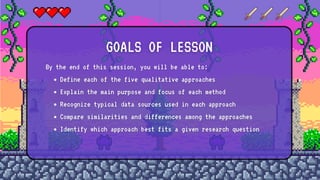
By the end of this session, you will be able to:
Define each of the five qualitative approaches
Explain the main purpose and focus of each method
Recognize typical data sources used in each approach
Compare similarities and differences among the approaches
Identify which approach best fits a given research question
GOALS OF LESSON
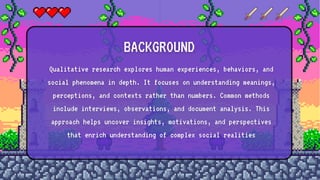
BACKGROUND
Qualitative research explores human experiences, behaviors, and
social phenomena in depth. It focuses on understanding meanings,
perceptions, and contexts rather than numbers. Common methods
include interviews, observations, and document analysis. This
approach helps uncover insights, motivations, and perspectives
that enrich understanding of complex social realities
THE 5
APPROACHES
Narrative Inquiry
Phenomenology
Grounded Theory
Ethnography
Case Study
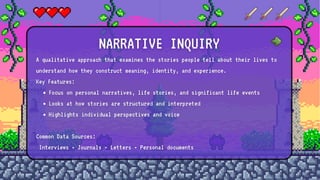
A qualitative approach that examines the stories people tell about their lives to
understand how they construct meaning, identity, and experience.
Key Features:
Focus on personal narratives, life stories, and significant life events
Looks at how stories are structured and interpreted
Highlights individual perspectives and voice
Common Data Sources:
Interviews • Journals • Letters • Personal documents
NARRATIVE INQUIRY
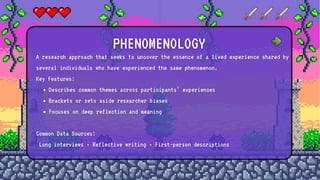
A research approach that seeks to uncover the essence of a lived experience shared by
several individuals who have experienced the same phenomenon.
Key Features:
Describes common themes across participants’ experiences
Brackets or sets aside researcher biases
Focuses on deep reflection and meaning
Common Data Sources:
Long interviews • Reflective writing • First-person descriptions
PHENOMENOLOGY
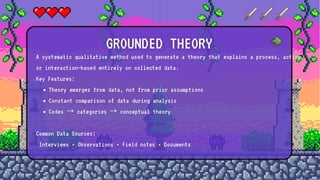
A systematic qualitative method used to generate a theory that explains a process, action,
or interaction—based entirely on collected data.
Key Features:
Theory emerges from data, not from prior assumptions
Constant comparison of data during analysis
Codes → categories → conceptual theory
Common Data Sources:
Interviews • Observations • Field notes • Documents
GROUNDED THEORY
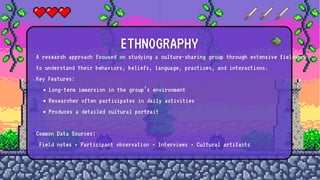
A research approach focused on studying a culture-sharing group through extensive fieldwork
to understand their behaviors, beliefs, language, practices, and interactions.
Key Features:
Long-term immersion in the group’s environment
Researcher often participates in daily activities
Produces a detailed cultural portrait
Common Data Sources:
Field notes • Participant observation • Interviews • Cultural artifacts
ETHNOGRAPHY
An in-depth exploration of a bounded case—a person, group, event, program, or
situation—examined through multiple data sources.
Key Features:
Focuses on a specific, clearly defined case
Provides holistic, detailed understanding
Useful when the case is unique, noteworthy, or complex
Common Data Sources:
Interviews • Observations • Documents • Records • Artifacts
CASE STUDY
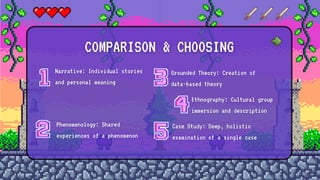
COMPARISON & CHOOSING
Narrative: Individual stories
and personal meaning
Phenomenology: Shared
experiences of a phenomenon
Grounded Theory: Creation of
data-based theory
Ethnography: Cultural group
immersion and description
Case Study: Deep, holistic
examination of a single case
Ask yourself:
1.What is the core question I want to answer?
2.Am I exploring stories, experiences, a process, a culture, or a
case?
3.What type of data is necessary to answer my question?
4.How much time and access can I secure?
5.What role will I take—observer, participant, storyteller, theorist?

ANY
QUESTIONS?
THANK
YOU

Five qualitative approaches to inquiry.pdf

  • 1.
  • 2.
  • 3.
    By the endof this session, you will be able to: Define each of the five qualitative approaches Explain the main purpose and focus of each method Recognize typical data sources used in each approach Compare similarities and differences among the approaches Identify which approach best fits a given research question GOALS OF LESSON
  • 4.
    BACKGROUND Qualitative research exploreshuman experiences, behaviors, and social phenomena in depth. It focuses on understanding meanings, perceptions, and contexts rather than numbers. Common methods include interviews, observations, and document analysis. This approach helps uncover insights, motivations, and perspectives that enrich understanding of complex social realities
  • 5.
  • 6.
    A qualitative approachthat examines the stories people tell about their lives to understand how they construct meaning, identity, and experience. Key Features: Focus on personal narratives, life stories, and significant life events Looks at how stories are structured and interpreted Highlights individual perspectives and voice Common Data Sources: Interviews • Journals • Letters • Personal documents NARRATIVE INQUIRY
  • 7.
    A research approachthat seeks to uncover the essence of a lived experience shared by several individuals who have experienced the same phenomenon. Key Features: Describes common themes across participants’ experiences Brackets or sets aside researcher biases Focuses on deep reflection and meaning Common Data Sources: Long interviews • Reflective writing • First-person descriptions PHENOMENOLOGY
  • 8.
    A systematic qualitativemethod used to generate a theory that explains a process, action, or interaction—based entirely on collected data. Key Features: Theory emerges from data, not from prior assumptions Constant comparison of data during analysis Codes → categories → conceptual theory Common Data Sources: Interviews • Observations • Field notes • Documents GROUNDED THEORY
  • 9.
    A research approachfocused on studying a culture-sharing group through extensive fieldwork to understand their behaviors, beliefs, language, practices, and interactions. Key Features: Long-term immersion in the group’s environment Researcher often participates in daily activities Produces a detailed cultural portrait Common Data Sources: Field notes • Participant observation • Interviews • Cultural artifacts ETHNOGRAPHY
  • 10.
    An in-depth explorationof a bounded case—a person, group, event, program, or situation—examined through multiple data sources. Key Features: Focuses on a specific, clearly defined case Provides holistic, detailed understanding Useful when the case is unique, noteworthy, or complex Common Data Sources: Interviews • Observations • Documents • Records • Artifacts CASE STUDY
  • 11.
    COMPARISON & CHOOSING Narrative:Individual stories and personal meaning Phenomenology: Shared experiences of a phenomenon Grounded Theory: Creation of data-based theory Ethnography: Cultural group immersion and description Case Study: Deep, holistic examination of a single case
  • 12.
    Ask yourself: 1.What isthe core question I want to answer? 2.Am I exploring stories, experiences, a process, a culture, or a case? 3.What type of data is necessary to answer my question? 4.How much time and access can I secure? 5.What role will I take—observer, participant, storyteller, theorist?

  • 13.
  • 14.