4/30/2018
1
Affinity Chromatography
• Affinity chromatography (AC) is a
technique enabling purification of a
biomolecule with respect to biological
function or individual chemical structure.
• AC is designed to purify a particular
molecule from a mixed sample.
Affinity Chromatography
4/30/2018
2
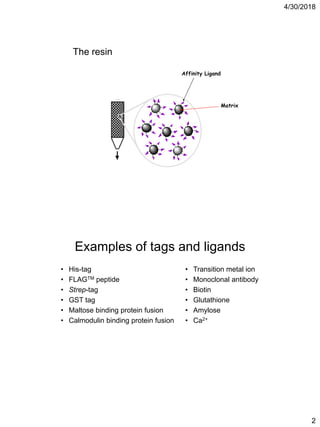
Matrix
Affinity Ligand
The resin
Examples of tags and ligands
• His-tag
• FLAGTM peptide
• Strep-tag
• GST tag
• Maltose binding protein fusion
• Calmodulin binding protein fusion
• Transition metal ion
• Monoclonal antibody
• Biotin
• Glutathione
• Amylose
• Ca2+
4/30/2018
3
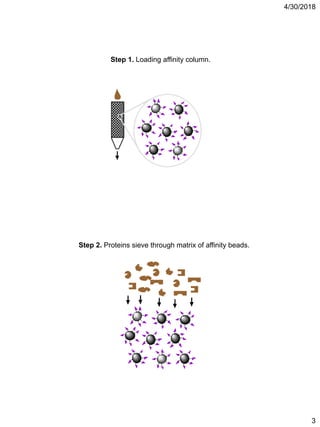
Step 1. Loading affinity column.
Step 2. Proteins sieve through matrix of affinity beads.
4/30/2018
4
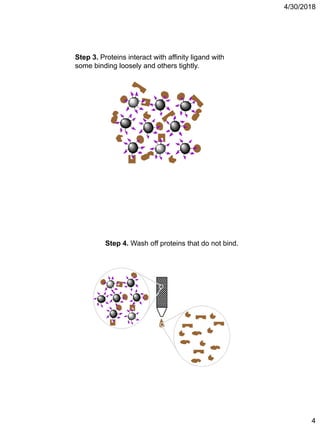
Step 3. Proteins interact with affinity ligand with
some binding loosely and others tightly.
Step 4. Wash off proteins that do not bind.
4/30/2018
5
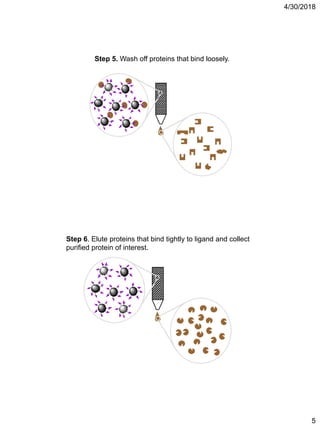
Step 5. Wash off proteins that bind loosely.
Step 6. Elute proteins that bind tightly to ligand and collect
purified protein of interest.
4/30/2018
6
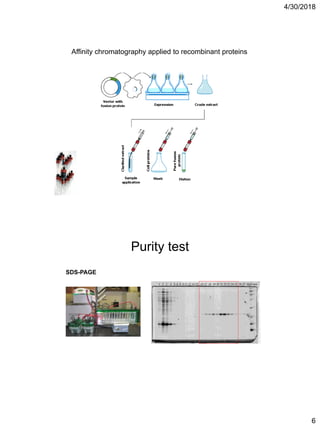
Affinity chromatography applied to recombinant proteins
Purity test
SDS-PAGE
4/30/2018
7
Gel Filtration
Chromatography
Gel Permeation Chromatography
Size Exclusion Chromatography
Molecular Sieve Chromatography
• Gel filtration chromatography separates
molecules according to their size and
shape.
• The stationary phase consists of beads
containing pores that span a relatively
narrow size range.
Gel Filtration Chromatography
4/30/2018
8
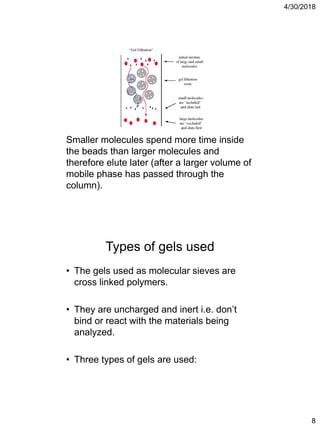
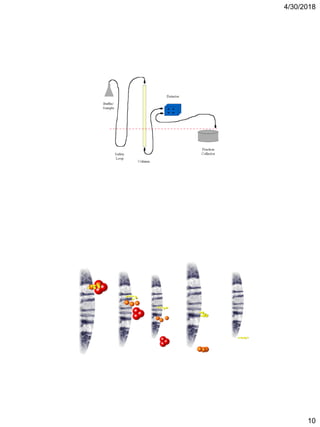
Smaller molecules spend more time inside
the beads than larger molecules and
therefore elute later (after a larger volume of
mobile phase has passed through the
column).
Types of gels used
• The gels used as molecular sieves are
cross linked polymers.
• They are uncharged and inert i.e. don’t
bind or react with the materials being
analyzed.
• Three types of gels are used:
4/30/2018
9
Types of gels cont…
Dextran: is a homopolysaccharide of glucose
residues.
• It’s prepared with various degrees of cross-
linking to control pore size.
• It’s bought as dry beads, the beads swell when
water is added.
• The trade name is sephadex.
• It’s mainly used for separation of small peptides
and globular proteins with small to average
molecular mass.
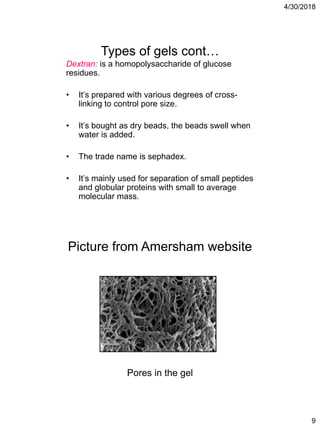
Picture from Amersham website
Pores in the gel
4/30/2018
10
4/30/2018
11
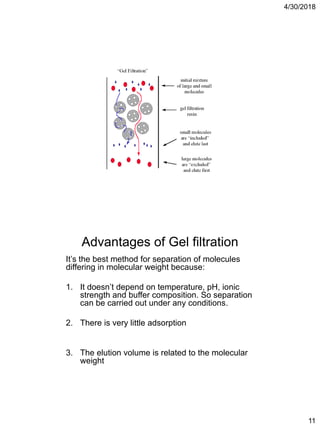
Advantages of Gel filtration
It’s the best method for separation of molecules
differing in molecular weight because:
1. It doesn’t depend on temperature, pH, ionic
strength and buffer composition. So separation
can be carried out under any conditions.
2. There is very little adsorption
3. The elution volume is related to the molecular
weight
4/30/2018
12
Applications of gel filtration
• Purification of enzymes and other proteins.
• Estimation of molecular weight mainly for
globular proteins:

Affinity chromatography and gel filteration

  • 1.
    4/30/2018 1 Affinity Chromatography • Affinitychromatography (AC) is a technique enabling purification of a biomolecule with respect to biological function or individual chemical structure. • AC is designed to purify a particular molecule from a mixed sample. Affinity Chromatography
  • 2.
    4/30/2018 2 Matrix Affinity Ligand The resin Examplesof tags and ligands • His-tag • FLAGTM peptide • Strep-tag • GST tag • Maltose binding protein fusion • Calmodulin binding protein fusion • Transition metal ion • Monoclonal antibody • Biotin • Glutathione • Amylose • Ca2+
  • 3.
    4/30/2018 3 Step 1. Loadingaffinity column. Step 2. Proteins sieve through matrix of affinity beads.
  • 4.
    4/30/2018 4 Step 3. Proteinsinteract with affinity ligand with some binding loosely and others tightly. Step 4. Wash off proteins that do not bind.
  • 5.
    4/30/2018 5 Step 5. Washoff proteins that bind loosely. Step 6. Elute proteins that bind tightly to ligand and collect purified protein of interest.
  • 6.
    4/30/2018 6 Affinity chromatography appliedto recombinant proteins Purity test SDS-PAGE
  • 7.
    4/30/2018 7 Gel Filtration Chromatography Gel PermeationChromatography Size Exclusion Chromatography Molecular Sieve Chromatography • Gel filtration chromatography separates molecules according to their size and shape. • The stationary phase consists of beads containing pores that span a relatively narrow size range. Gel Filtration Chromatography
  • 8.
    4/30/2018 8 Smaller molecules spendmore time inside the beads than larger molecules and therefore elute later (after a larger volume of mobile phase has passed through the column). Types of gels used • The gels used as molecular sieves are cross linked polymers. • They are uncharged and inert i.e. don’t bind or react with the materials being analyzed. • Three types of gels are used:
  • 9.
    4/30/2018 9 Types of gelscont… Dextran: is a homopolysaccharide of glucose residues. • It’s prepared with various degrees of cross- linking to control pore size. • It’s bought as dry beads, the beads swell when water is added. • The trade name is sephadex. • It’s mainly used for separation of small peptides and globular proteins with small to average molecular mass. Picture from Amersham website Pores in the gel
  • 10.
  • 11.
    4/30/2018 11 Advantages of Gelfiltration It’s the best method for separation of molecules differing in molecular weight because: 1. It doesn’t depend on temperature, pH, ionic strength and buffer composition. So separation can be carried out under any conditions. 2. There is very little adsorption 3. The elution volume is related to the molecular weight
  • 12.
    4/30/2018 12 Applications of gelfiltration • Purification of enzymes and other proteins. • Estimation of molecular weight mainly for globular proteins: