Gene$cally	modified	
microorganisms	
Microbial	Biotechnology|Biotech-552|Dr.	Zia|Lec	3
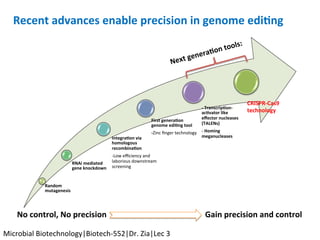
Random	
mutagenesis	
RNAi	mediated	
gene	knockdown	
Integra$on	via	
homologous	
recombina$on	
-Low	efficiency	and	
laborious	downstream	
screening	
First	genera$on	
genome	edi$ng	tool	
-Zinc	finger	technology	
-	Transcrip$on-
ac$vator	like	
effector	nucleases	
(TALENs)	
-	Homing	
meganucleases		
Recent	advances	enable	precision	in	genome	edi$ng	
CRISPR-Cas9		
technology	
Next	genera$on	tools:		
					No	control,	No	precision																																																	Gain	precision	and	control	
Microbial	Biotechnology|Biotech-552|Dr.	Zia|Lec	3
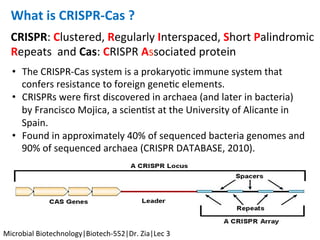
CRISPR:	Clustered,	Regularly	Interspaced,	Short	Palindromic	
Repeats		and	Cas:	CRISPR	Associated	protein	
What	is	CRISPR-Cas	?	
		
•  The	CRISPR-Cas	system	is	a	prokaryoKc	immune	system	that	
confers	resistance	to	foreign	geneKc	elements.	
•  CRISPRs	were	first	discovered	in	archaea	(and	later	in	bacteria)	
by	Francisco	Mojica,	a	scienKst	at	the	University	of	Alicante	in	
Spain.	
•  Found	in	approximately	40%	of	sequenced	bacteria	genomes	and	
90%	of	sequenced	archaea	(CRISPR	DATABASE,	2010).	
	
Microbial	Biotechnology|Biotech-552|Dr.	Zia|Lec	3
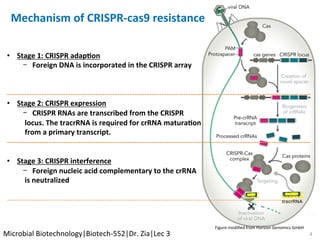
Mechanism	of	CRISPR-cas9	resistance	
		
•  Stage	1:	CRISPR	adap$on	
-  Foreign	DNA	is	incorporated	in	the	CRISPR	array	
	
----------------------------------------------------------------------------------------------------------------------------	
•  Stage	2:	CRISPR	expression	
-  CRISPR	RNAs	are	transcribed	from	the	CRISPR	
	locus.	The	tracrRNA	is	required	for	crRNA	matura$on	
	from	a	primary	transcript.		
----------------------------------------------------------------------------------------------------------------------------	
	
•  Stage	3:	CRISPR	interference	
-  Foreign	nucleic	acid	complementary	to	the	crRNA	
	is	neutralized	
	
----------------------------------------------------------------------------------------------------------------------	


																																																																																																																																																																																						Figure	modified	from	Horizon	Genomics	GmbH	
tracrRNA
4	Microbial	Biotechnology|Biotech-552|Dr.	Zia|Lec	3
•  1987-These	clustered	repeats	were	first	discovered	in	E.coli	(Ishino	et	al.,	1987).	
	
•  2000-	Similar	clustered	repeats	were	iden$fied	in	addi$onal	bacteria	and	archaea	and	
were	termed	Short	Regularly	Spaced	Repeats	(SRSR)	(Mojica	et	al.,	2000).	
	
•  2002-	SRSR	were	renamed	as	CRISPR.	Also	a	set	of	genes,	called	CRISPR-
associated	genes	were	iden$fied	(Jansen	et	al.,	2002).	
•  2007-	Barrangou	and	colleagues	(2007),	demonstrated	that	S.	thermophilus	can	
acquire	resistance	against	a	bacteriophage	by	integra$ng	a	genome	fragment	of	an	
infec$ous	virus	into	its	CRISPR	locus.	
•  2012-	The	poten$al	of	CRISPR-CAs9	as	genome	edi$ng	tool	was	first	revealed	by	Jinek	
et	al.	
•  It	has	since	been	used	in	a	wide	range	of	organisms	including	baker's	yeast	(S.	
cerevisiae),	zebra	fish	(D.	rerio),	flies	(D.	melanogaster),	nematodes	(C.	
elegans),	plants,	mice,	and	several	other	organisms.	
	
History	of	CRISPR-CAs9	as	genome	edi$ng	tool		
Microbial	Biotechnology|Biotech-552|Dr.	Zia|Lec	3
GeneCopoeia,	Inc	
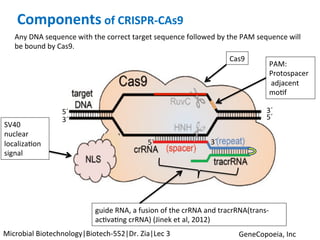
Any	DNA	sequence	with	the	correct	target	sequence	followed	by	the	PAM	sequence	will	
be	bound	by	Cas9.	
Cas9	
PAM:		
Protospacer	
	adjacent	
moKf	
guide	RNA,	a	fusion	of	the	crRNA	and	tracrRNA(trans-
acKvaKng	crRNA)	(Jinek	et	al,	2012)	
Components	of	CRISPR-CAs9	
SV40	
nuclear	
localizaKon	
signal	
5´	 3´	
3´	 5´	
5´	 3´	
Microbial	Biotechnology|Biotech-552|Dr.	Zia|Lec	3
Components	of	CRISPR-CAS9	
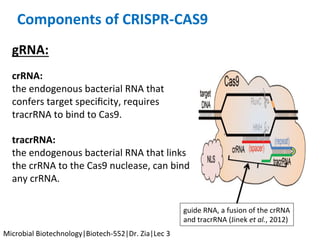
guide	RNA,	a	fusion	of	the	crRNA	
and	tracrRNA	(Jinek	et	al.,	2012)	
gRNA:	


crRNA:	
the	endogenous	bacterial	RNA	that	
confers	target	specificity,	requires	
tracrRNA	to	bind	to	Cas9.	
	
tracrRNA:	
the	endogenous	bacterial	RNA	that	links	
the	crRNA	to	the	Cas9	nuclease,	can	bind	
any	crRNA.	
Microbial	Biotechnology|Biotech-552|Dr.	Zia|Lec	3
Components	of	CRISPR-CAS9	
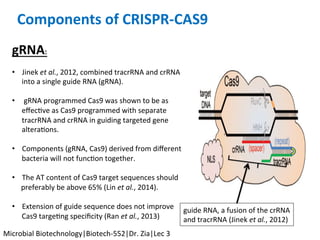
guide	RNA,	a	fusion	of	the	crRNA	
and	tracrRNA	(Jinek	et	al.,	2012)	
gRNA:	
	
•  Jinek	et	al.,	2012,	combined	tracrRNA	and	crRNA	
into	a	single	guide	RNA	(gRNA).	
•  	gRNA	programmed	Cas9	was	shown	to	be	as	
effecKve	as	Cas9	programmed	with	separate	
tracrRNA	and	crRNA	in	guiding	targeted	gene	
alteraKons.	
	
•  Components	(gRNA,	Cas9)	derived	from	different	
bacteria	will	not	funcKon	together.	
	
•  The	AT	content	of	Cas9	target	sequences	should					
					preferably	be	above	65%	(Lin	et	al.,	2014).	
	
•  Extension	of	guide	sequence	does	not	improve	
Cas9	targeKng	specificity	(Ran	et	al.,	2013)	
	
	Microbial	Biotechnology|Biotech-552|Dr.	Zia|Lec	3
9	
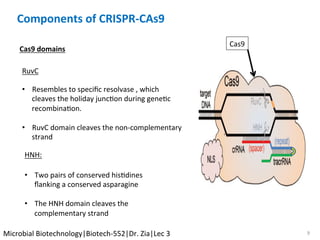
Cas9	
Components	of	CRISPR-CAs9	
	
RuvC	
HNH:	
Cas9	domains	
•  Resembles	to	specific	resolvase	,	which	
cleaves	the	holiday	juncKon	during	geneKc	
recombinaKon.	
•  RuvC	domain	cleaves	the	non-complementary	
strand	
•  Two	pairs	of	conserved	hisKdines	
flanking	a	conserved	asparagine		
•  The	HNH	domain	cleaves	the	
complementary	strand	
Microbial	Biotechnology|Biotech-552|Dr.	Zia|Lec	3
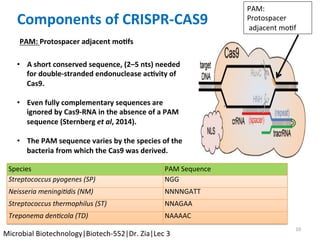
PAM:		
Protospacer	
	adjacent	moKf	
Components	of	CRISPR-CAS9	
Species	 PAM	Sequence	
Streptococcus	pyogenes	(SP)	 NGG	
Neisseria	meningi7dis	(NM)	 NNNNGATT	
Streptococcus	thermophilus	(ST)	 NNAGAA	
Treponema	den7cola	(TD)	 NAAAAC	
10	
PAM:	Protospacer	adjacent	mo$fs	
		
•  A	short	conserved	sequence,	(2–5	nts)	needed	
for	double-stranded	endonuclease	ac$vity	of	
Cas9.	
	
•  Even	fully	complementary	sequences	are	
ignored	by	Cas9-RNA	in	the	absence	of	a	PAM	
sequence	(Sternberg	et	al,	2014).	
	
•  The	PAM	sequence	varies	by	the	species	of	the	
bacteria	from	which	the	Cas9	was	derived.		
Microbial	Biotechnology|Biotech-552|Dr.	Zia|Lec	3
The	resul$ng	DSB	is	then	repaired	by	one	of	two	general	repair	
pathways:	
	
•  The	efficient	but	error-prone	non-homologous	end	joining	
(NHEJ)	pathway	
•  The	less	efficient	but	high-fidelity	homology	directed	repair	
(HDR)	pathway	
Microbial	Biotechnology|Biotech-552|Dr.	Zia|Lec	3
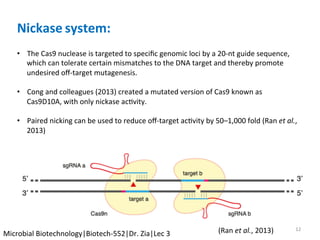
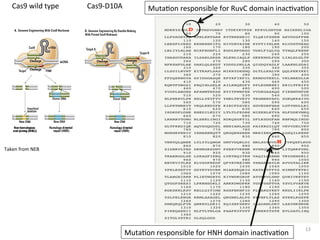
Nickase	system:		
	
•  The	Cas9	nuclease	is	targeted	to	specific	genomic	loci	by	a	20-nt	guide	sequence,	
which	can	tolerate	certain	mismatches	to	the	DNA	target	and	thereby	promote	
undesired	off-target	mutagenesis.	
	
•  Cong	and	colleagues	(2013)	created	a	mutated	version	of	Cas9	known	as	
Cas9D10A,	with	only	nickase	acKvity.	
	
•  Paired	nicking	can	be	used	to	reduce	off-target	acKvity	by	50–1,000	fold	(Ran	et	al.,	
2013)	
12	(Ran	et	al.,	2013)		Microbial	Biotechnology|Biotech-552|Dr.	Zia|Lec	3
13	
Cas9-D10A	Cas9	wild	type	 MutaKon	responsible	for	RuvC	domain	inacKvaKon	
MutaKon	responsible	for	HNH	domain	inacKvaKon	
Taken	from	NEB
14	
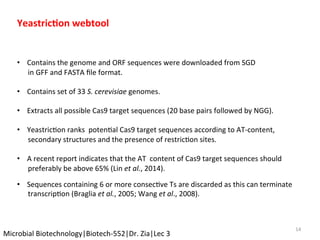
Yeastric$on	webtool		


•  Contains	the	genome	and	ORF	sequences	were	downloaded	from	SGD	
						in	GFF	and	FASTA	file	format.	
•  Contains	set	of	33	S.	cerevisiae	genomes.		
	
•  Extracts	all	possible	Cas9	target	sequences	(20	base	pairs	followed	by	NGG).	
	
•  YeastricKon	ranks		potenKal	Cas9	target	sequences	according	to	AT-content,		
						secondary	structures	and	the	presence	of	restricKon	sites.	
•  A	recent	report	indicates	that	the	AT		content	of	Cas9	target	sequences	should		
						preferably	be	above	65%	(Lin	et	al.,	2014).		
	
•  Sequences	containing	6	or	more	consecKve	Ts	are	discarded	as	this	can	terminate		
						transcripKon	(Braglia	et	al.,	2005;	Wang	et	al.,	2008).		
	
Microbial	Biotechnology|Biotech-552|Dr.	Zia|Lec	3
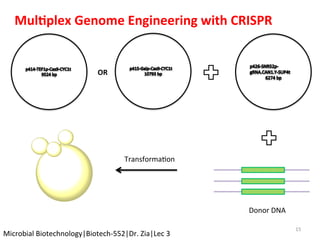
15	
OR	
Donor	DNA	
TransformaKon	
Mul$plex	Genome	Engineering	with	CRISPR	
Microbial	Biotechnology|Biotech-552|Dr.	Zia|Lec	3
16	
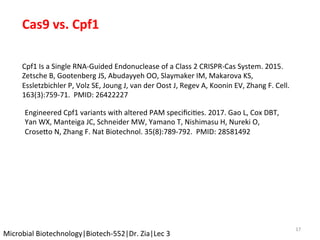
Cas9	vs.	Cpf1	
•  Recognizes	different	PAMs,	enabling	new	
targeKng	possibiliKes.	
•  Creates	4-5	nt	long	sKcky	ends,	instead	of	blunt	
ends	produced	by	Cas9,	enhancing	the	
efficiency	of	geneKc	inserKons	and	specificity	
during	NHEJ	or	HDR.	
•  Cuts	target	DNA	further	away	from	PAM,	
further	away	from	the	Cas9	culng	site,	
enabling	new	possibiliKes	for	cleaving	the	DNA.	
Microbial	Biotechnology|Biotech-552|Dr.	Zia|Lec	3
17	
Cas9	vs.	Cpf1	
Cpf1	Is	a	Single	RNA-Guided	Endonuclease	of	a	Class	2	CRISPR-Cas	System.	2015.	
Zetsche	B,	Gootenberg	JS,	Abudayyeh	OO,	Slaymaker	IM,	Makarova	KS,	
Essletzbichler	P,	Volz	SE,	Joung	J,	van	der	Oost	J,	Regev	A,	Koonin	EV,	Zhang	F.	Cell.	
163(3):759-71.		PMID:	26422227	


Engineered	Cpf1	variants	with	altered	PAM	specificiKes.	2017.	Gao	L,	Cox	DBT,	
Yan	WX,	Manteiga	JC,	Schneider	MW,	Yamano	T,	Nishimasu	H,	Nureki	O,	
Crosepo	N,	Zhang	F.	Nat	Biotechnol.	35(8):789-792.		PMID:	28581492	
Microbial	Biotechnology|Biotech-552|Dr.	Zia|Lec	3
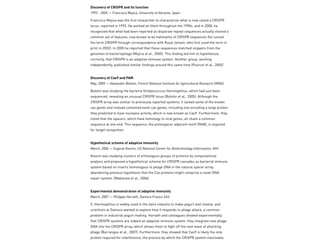
Lecture 5 and 6 microbial_sem_6_20180307

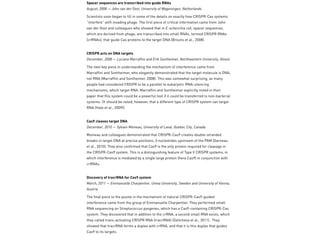
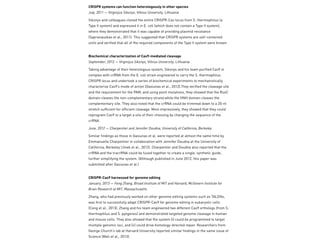
Lecture 5 and 6 microbial_sem_6_20180307