Topics for assignment
1
1. Microbiological mining
2. Use of microbes in petroleum industry
3. Biofuel
4. Bio pesticides
5. Composting
6. Biodegradable plastic
 Mention contribution/individual presentation
 References
 Sending assignment to me
along with the references
2
Microbial Biotechnology|Biotech-552|Dr. Zia|Lec 11 and 12
Significance of microbial biotechnology in
economic development of Pakistan
3
Microbial Biotechnology|Biotech-552|Dr. Zia|Lec 11 and 12
Economic development is the process by which a nation
improves the economic, political, and social well-being
of its people.
Indicator?  GDP per capita
4
Microbial Biotechnology|Biotech-552|Dr. Zia|Lec 11 and 12
Main Industries in Pakistan
Textile Industry
Sports Industry
Sugar Industry
Cement Industry
Fertilizer Industry
5
Microbial Biotechnology|Biotech-552|Dr. Zia|Lec 11 and 12
• Food/beverages produced by microbial activity
• Significance of microbial biotechnology in
industry
• Significance of microbes in agriculture sector
• Alleviation of environmental pollution
• Textile and paper industry
6
Microbial Biotechnology|Biotech-552|Dr. Zia|Lec 11 and 12
Food/beverages produced by microbial activity
• Production of a range of value-added products
• Preservation of food
Target the selection and manipulation of micro-organisms with the
objective of improving process control, product quality, safety,
consistency and yield.
To enhance properties of the food such as taste, aroma, shelf-life,
texture and nutritional value of foods.
7
Microbial Biotechnology|Biotech-552|Dr. Zia|Lec 11 and 12
Food/beverages produced by microbial activity
Yogurt, cheese, chocolate, butter, pickles, sauerkraut, soy sauce,
food supplements (such as vitamins and amino acids), food
thickeners (produced from microbial polysaccharides), alcohol
(beer, whiskeys, and wines), sausages, and silage from animals are
a small sample of products of microbial activity.
8
Microbial Biotechnology|Biotech-552|Dr. Zia|Lec 11 and 12
Food/beverages produced by microbial activity
Food/Beverages Cured or Improved by Microbial Activity:
Production of coffee, tea, cocoa, summer sausage, vanilla, cheese,
olives, and tobacco all require microbial activity and a
microbiologist to insure product quality.
Food Flavoring Agents and Preservatives: Organic acids, such as
citric, malic, and ascorbic acids, and monosodium glutamate are
microbial products commonly used in foods.
Foods: Mushrooms, truffles, and some red and green algae are
consumed directly. Yeasts are used in food supplements for
humans and animals.
9
Microbial Biotechnology|Biotech-552|Dr. Zia|Lec 11 and 12
Significance of microbial biotechnology in
industry TRANSPORTATION SECTOR
Biofuel
Fuel that is produced through contemporary biological processes,
such as agriculture and anaerobic digestion, rather than a fuel
produced by geological processes such as those involved in the
formation of fossil fuels, such as coal and petroleum, from
prehistoric Biological matter.
Main types:
Bioethanol
Biodiesel
Biogas
10
Microbial Biotechnology|Biotech-552|Dr. Zia|Lec 11 and 12
Significance of microbial biotechnology in
industry Pharma industry
30 multinational and more than 334 national/local
pharmaceutical companies are located in Pakistan 759
pharmaceutical manufacturing units
Top 5 MNC’s include: Novartis, Abbott, Pfizer, Sanofi Aventis &
gsk.
Benefits of local pharmaceutical sector:
Self-reliance, employment generation, female employment,
foreign exchange earnings, indirect employment, skill acquisition,
technology spillovers and investment.
11
Microbial Biotechnology|Biotech-552|Dr. Zia|Lec 11 and 12
Significance of microbial biotechnology in
industry Pharma industry
e.g.
• Microbes engineered for low-cost production of anti-cancer
drug, Taxol.
• Researchers have engineered E. coli bacteria to produce large
quantities of a critical compound that is a precursor to the
cancer drug Taxol, originally isolated from the bark of the Pacific
yew tree.
• The bacteria can produce 1,000 times more of the precursor,
known as taxa diene.
12
Microbial Biotechnology|Biotech-552|Dr. Zia|Lec 11 and 12
Significance of microbes in agriculture sector
Agriculture is Dominant sector. It Contributes 24% towards
GDP.
BT RICE:
BT rice is modified to express the cryIA(b) gene of the
Bacillus thuringiensis bacterium. The gene confers resistance
to a variety of pests including the rice borer through the
production of endotoxins.
13
Microbial Biotechnology|Biotech-552|Dr. Zia|Lec 11 and 12
Significance of microbes in agriculture sector
BT RICE:
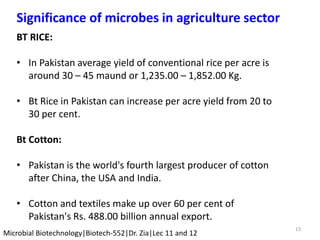
• In Pakistan average yield of conventional rice per acre is
around 30 – 45 maund or 1,235.00 – 1,852.00 Kg.
• Bt Rice in Pakistan can increase per acre yield from 20 to
30 per cent.
Bt Cotton:
• Pakistan is the world's fourth largest producer of cotton
after China, the USA and India.
• Cotton and textiles make up over 60 per cent of
Pakistan's Rs. 488.00 billion annual export.
14
Microbial Biotechnology|Biotech-552|Dr. Zia|Lec 11 and 12
Significance of microbes in agriculture sector
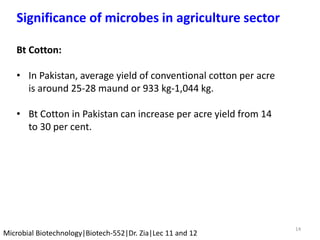
Bt Cotton:
• In Pakistan, average yield of conventional cotton per acre
is around 25-28 maund or 933 kg-1,044 kg.
• Bt Cotton in Pakistan can increase per acre yield from 14
to 30 per cent.
15
Microbial Biotechnology|Biotech-552|Dr. Zia|Lec 11 and 12
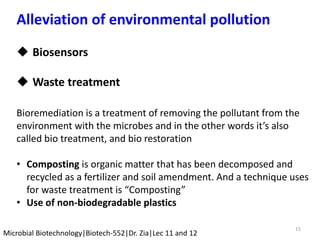
Alleviation of environmental pollution
 Biosensors
 Waste treatment
Bioremediation is a treatment of removing the pollutant from the
environment with the microbes and in the other words it’s also
called bio treatment, and bio restoration
• Composting is organic matter that has been decomposed and
recycled as a fertilizer and soil amendment. And a technique uses
for waste treatment is “Composting”
• Use of non-biodegradable plastics
16
Microbial Biotechnology|Biotech-552|Dr. Zia|Lec 11 and 12
17
Microbial Biotechnology|Biotech-552|Dr. Zia|Lec 11 and 12
Alleviation of environmental pollution
Bio fertilizer
Fertilizer is annually a hundred billion rupees
business, even a 10% contribution by bio
fertilizer can save rupees ~10 billion.
18
Microbial Biotechnology|Biotech-552|Dr. Zia|Lec 11 and 12
Textile and paper industry
• Enzymes like Amylase and Cellulase are frequently
used in the textile industry to achieve certain
characteristics of the fabric.
• Alpha-amylase is especially used for desizing whereas
cellulases are used for polishing and finishing.
• Enzyme are obtained mostly from Bacillus stain
19
Microbial Biotechnology|Biotech-552|Dr. Zia|Lec 11 and 12
Textile and paper industry
Leather tanning
• The hides and skins after drying, salting and clearing are
steeped in fluids containing specific
• bacteria.
• The process of fermentation goes on for some time and
then they are transferred to tanpits and are further
allowed to be fermented.
• Bacteria employed in the process are obtained from cow
dung and the excreta of dogs and poultry.
20
Microbial Biotechnology|Biotech-552|Dr. Zia|Lec 11 and 12
• Inadequate funding
• Lack of human resources incompetent human resources
• Restricted information
• Poor higher education
• Weak links between universities and research
institutions_industry
• Lack of appropriate legal regimes
• Little private sector involvement
Major hamper which is prohibiting biotechnology to flourish in
our country is “the ministry of environment” which is holding bill
of biosafety guidelines from more than one year
Reasons-failure of biotechnology sector in
contributing to Pakistan's economy

Lecture 11 and 12 microbial_sem_6 (1)

  • 1.
    Topics for assignment 1 1.Microbiological mining 2. Use of microbes in petroleum industry 3. Biofuel 4. Bio pesticides 5. Composting 6. Biodegradable plastic  Mention contribution/individual presentation  References  Sending assignment to me along with the references
  • 2.
    2 Microbial Biotechnology|Biotech-552|Dr. Zia|Lec11 and 12 Significance of microbial biotechnology in economic development of Pakistan
  • 3.
    3 Microbial Biotechnology|Biotech-552|Dr. Zia|Lec11 and 12 Economic development is the process by which a nation improves the economic, political, and social well-being of its people. Indicator?  GDP per capita
  • 4.
    4 Microbial Biotechnology|Biotech-552|Dr. Zia|Lec11 and 12 Main Industries in Pakistan Textile Industry Sports Industry Sugar Industry Cement Industry Fertilizer Industry
  • 5.
    5 Microbial Biotechnology|Biotech-552|Dr. Zia|Lec11 and 12 • Food/beverages produced by microbial activity • Significance of microbial biotechnology in industry • Significance of microbes in agriculture sector • Alleviation of environmental pollution • Textile and paper industry
  • 6.
    6 Microbial Biotechnology|Biotech-552|Dr. Zia|Lec11 and 12 Food/beverages produced by microbial activity • Production of a range of value-added products • Preservation of food Target the selection and manipulation of micro-organisms with the objective of improving process control, product quality, safety, consistency and yield. To enhance properties of the food such as taste, aroma, shelf-life, texture and nutritional value of foods.
  • 7.
    7 Microbial Biotechnology|Biotech-552|Dr. Zia|Lec11 and 12 Food/beverages produced by microbial activity Yogurt, cheese, chocolate, butter, pickles, sauerkraut, soy sauce, food supplements (such as vitamins and amino acids), food thickeners (produced from microbial polysaccharides), alcohol (beer, whiskeys, and wines), sausages, and silage from animals are a small sample of products of microbial activity.
  • 8.
    8 Microbial Biotechnology|Biotech-552|Dr. Zia|Lec11 and 12 Food/beverages produced by microbial activity Food/Beverages Cured or Improved by Microbial Activity: Production of coffee, tea, cocoa, summer sausage, vanilla, cheese, olives, and tobacco all require microbial activity and a microbiologist to insure product quality. Food Flavoring Agents and Preservatives: Organic acids, such as citric, malic, and ascorbic acids, and monosodium glutamate are microbial products commonly used in foods. Foods: Mushrooms, truffles, and some red and green algae are consumed directly. Yeasts are used in food supplements for humans and animals.
  • 9.
    9 Microbial Biotechnology|Biotech-552|Dr. Zia|Lec11 and 12 Significance of microbial biotechnology in industry TRANSPORTATION SECTOR Biofuel Fuel that is produced through contemporary biological processes, such as agriculture and anaerobic digestion, rather than a fuel produced by geological processes such as those involved in the formation of fossil fuels, such as coal and petroleum, from prehistoric Biological matter. Main types: Bioethanol Biodiesel Biogas
  • 10.
    10 Microbial Biotechnology|Biotech-552|Dr. Zia|Lec11 and 12 Significance of microbial biotechnology in industry Pharma industry 30 multinational and more than 334 national/local pharmaceutical companies are located in Pakistan 759 pharmaceutical manufacturing units Top 5 MNC’s include: Novartis, Abbott, Pfizer, Sanofi Aventis & gsk. Benefits of local pharmaceutical sector: Self-reliance, employment generation, female employment, foreign exchange earnings, indirect employment, skill acquisition, technology spillovers and investment.
  • 11.
    11 Microbial Biotechnology|Biotech-552|Dr. Zia|Lec11 and 12 Significance of microbial biotechnology in industry Pharma industry e.g. • Microbes engineered for low-cost production of anti-cancer drug, Taxol. • Researchers have engineered E. coli bacteria to produce large quantities of a critical compound that is a precursor to the cancer drug Taxol, originally isolated from the bark of the Pacific yew tree. • The bacteria can produce 1,000 times more of the precursor, known as taxa diene.
  • 12.
    12 Microbial Biotechnology|Biotech-552|Dr. Zia|Lec11 and 12 Significance of microbes in agriculture sector Agriculture is Dominant sector. It Contributes 24% towards GDP. BT RICE: BT rice is modified to express the cryIA(b) gene of the Bacillus thuringiensis bacterium. The gene confers resistance to a variety of pests including the rice borer through the production of endotoxins.
  • 13.
    13 Microbial Biotechnology|Biotech-552|Dr. Zia|Lec11 and 12 Significance of microbes in agriculture sector BT RICE: • In Pakistan average yield of conventional rice per acre is around 30 – 45 maund or 1,235.00 – 1,852.00 Kg. • Bt Rice in Pakistan can increase per acre yield from 20 to 30 per cent. Bt Cotton: • Pakistan is the world's fourth largest producer of cotton after China, the USA and India. • Cotton and textiles make up over 60 per cent of Pakistan's Rs. 488.00 billion annual export.
  • 14.
    14 Microbial Biotechnology|Biotech-552|Dr. Zia|Lec11 and 12 Significance of microbes in agriculture sector Bt Cotton: • In Pakistan, average yield of conventional cotton per acre is around 25-28 maund or 933 kg-1,044 kg. • Bt Cotton in Pakistan can increase per acre yield from 14 to 30 per cent.
  • 15.
    15 Microbial Biotechnology|Biotech-552|Dr. Zia|Lec11 and 12 Alleviation of environmental pollution  Biosensors  Waste treatment Bioremediation is a treatment of removing the pollutant from the environment with the microbes and in the other words it’s also called bio treatment, and bio restoration • Composting is organic matter that has been decomposed and recycled as a fertilizer and soil amendment. And a technique uses for waste treatment is “Composting” • Use of non-biodegradable plastics
  • 16.
  • 17.
    17 Microbial Biotechnology|Biotech-552|Dr. Zia|Lec11 and 12 Alleviation of environmental pollution Bio fertilizer Fertilizer is annually a hundred billion rupees business, even a 10% contribution by bio fertilizer can save rupees ~10 billion.
  • 18.
    18 Microbial Biotechnology|Biotech-552|Dr. Zia|Lec11 and 12 Textile and paper industry • Enzymes like Amylase and Cellulase are frequently used in the textile industry to achieve certain characteristics of the fabric. • Alpha-amylase is especially used for desizing whereas cellulases are used for polishing and finishing. • Enzyme are obtained mostly from Bacillus stain
  • 19.
    19 Microbial Biotechnology|Biotech-552|Dr. Zia|Lec11 and 12 Textile and paper industry Leather tanning • The hides and skins after drying, salting and clearing are steeped in fluids containing specific • bacteria. • The process of fermentation goes on for some time and then they are transferred to tanpits and are further allowed to be fermented. • Bacteria employed in the process are obtained from cow dung and the excreta of dogs and poultry.
  • 20.
    20 Microbial Biotechnology|Biotech-552|Dr. Zia|Lec11 and 12 • Inadequate funding • Lack of human resources incompetent human resources • Restricted information • Poor higher education • Weak links between universities and research institutions_industry • Lack of appropriate legal regimes • Little private sector involvement Major hamper which is prohibiting biotechnology to flourish in our country is “the ministry of environment” which is holding bill of biosafety guidelines from more than one year Reasons-failure of biotechnology sector in contributing to Pakistan's economy