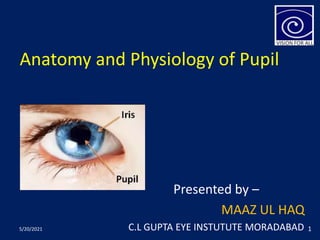
Anatomy and Physiology of Pupil
Presented by –
MAAZ UL HAQ
C.L GUPTA EYE INSTUTUTE MORADABAD
5/20/2021 1
Introduction
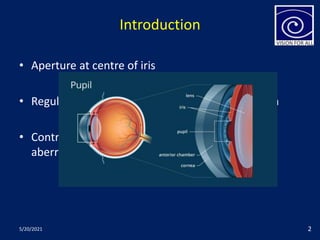
• Aperture at centre of iris
• Regulates the amount of light reaching the retina
• Controls the amount of chromatic & spherical
aberration in retinal image
5/20/2021 2
Anatomy of Pupil
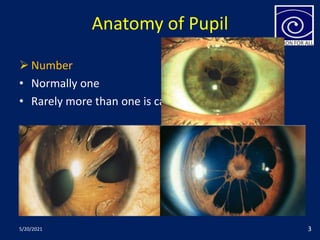
 Number
• Normally one
• Rarely more than one is called polycoria
5/20/2021 3
Cont.
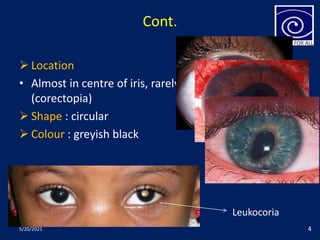
 Location
• Almost in centre of iris, rarely congenitally eccentric
(corectopia)
 Shape : circular
 Colour : greyish black
5/20/2021 4
Leukocoria
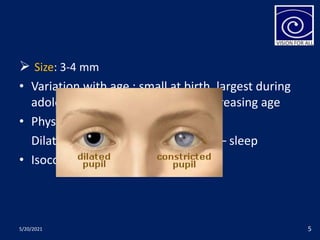
 Size: 3-4 mm
• Variation with age : small at birth, largest during
adolescent, slowly smaller with increasing age
• Physiological changes :
Dilate –emotional stress, Constrict – sleep
• Isocoria : both of equal size
5/20/2021 5
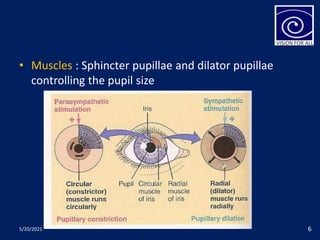
• Muscles : Sphincter pupillae and dilator pupillae
controlling the pupil size
5/20/2021 6
Pupillary reflex
• The size of the pupil is controlled by
involuntary constriction and dilation of the iris
in order to regulate the intensity of light
entering the eye.
This is known as the pupillary reflex.
5/20/2021 7
Pupillary Reflexes
Light reflex
Near reflex
Darkness reflex
Psychosensory reflexes
5/20/2021 8
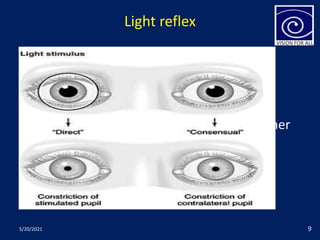
Light reflex
• Direct light reflex : constriction of pupil to
which light is shone
• Consensual light reflex : constriction of other
pupil when light is shone one eye
• Light reflex is initiated by rods &cones
5/20/2021 9
5/20/2021 10
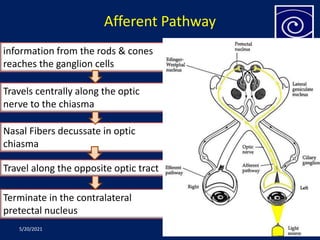
Afferent Pathway
information from the rods & cones
reaches the ganglion cells
Nasal Fibers decussate in optic
chiasma
Travels centrally along the optic
nerve to the chiasma
Terminate in the contralateral
pretectal nucleus
Travel along the opposite optic tract
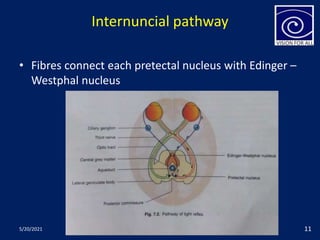
Internuncial pathway
• Fibres connect each pretectal nucleus with Edinger –
Westphal nucleus
5/20/2021 11
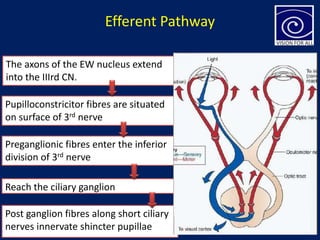
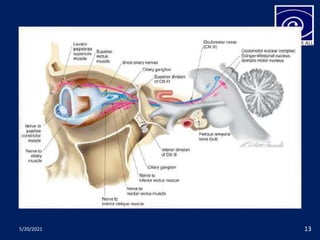
Efferent Pathway
The axons of the EW nucleus extend
into the IIIrd CN.
5/20/2021 12
Pupilloconstricitor fibres are situated
on surface of 3rd nerve
Preganglionic fibres enter the inferior
division of 3rd nerve
Reach the ciliary ganglion
Post ganglion fibres along short ciliary
nerves innervate shincter pupillae
5/20/2021 13
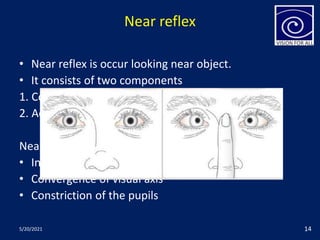
Near reflex
• Near reflex is occur looking near object.
• It consists of two components
1. Convergence reflex
2. Accomodation reflex
Near reflex triad consist of
• Increased accommodation
• Convergence of visual axis
• Constriction of the pupils
5/20/2021 14
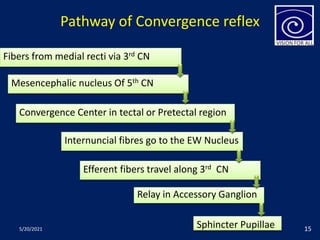
Pathway of Convergence reflex
5/20/2021 15
Fibers from medial recti via 3rd CN
Mesencephalic nucleus Of 5th CN
Convergence Center in tectal or Pretectal region
Internuncial fibres go to the EW Nucleus
Efferent fibers travel along 3rd CN
Relay in Accessory Ganglion
Sphincter Pupillae
5/20/2021 16
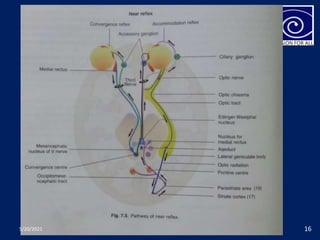
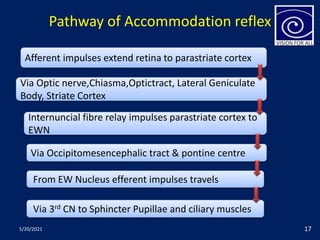
Pathway of Accommodation reflex
5/20/2021 17
Via Optic nerve,Chiasma,Optictract, Lateral Geniculate
Body, Striate Cortex
Afferent impulses extend retina to parastriate cortex
Internuncial fibre relay impulses parastriate cortex to
EWN
Via Occipitomesencephalic tract & pontine centre
From EW Nucleus efferent impulses travels
Via 3rd CN to Sphincter Pupillae and ciliary muscles
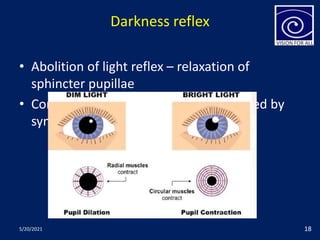
Darkness reflex
• Abolition of light reflex – relaxation of
sphincter pupillae
• Contraction of dilator pupillae – supplied by
sympathetic nervous system
5/20/2021 18
Psychosensory reflex
• Dilatation of pupil in response to sensory and psychic
stimuli.
• The mechanism of psychosensory reflexes is a
cortical one and pupillary dilatation results from
 A sympathetic discharge to the dilator pupillae
 Inhibition of parasympathetic discharge to the
sphincter pupillae
5/20/2021 19
Lid closure reflex
• Non specific term (may be accompanied by pupillary
contraction or dilatation).
• Used for the following entities –
• Constriction of pupil associated with blinking
– type of darkness reflex
• Pupillary dilatation associated with lid-closure on
touching the cornea (oculopupillary reflex) – type of
psychosensory reflex
5/20/2021 20
5/20/2021 21

Pupil ppt

  • 1.
    Anatomy and Physiologyof Pupil Presented by – MAAZ UL HAQ C.L GUPTA EYE INSTUTUTE MORADABAD 5/20/2021 1
  • 2.
    Introduction • Aperture atcentre of iris • Regulates the amount of light reaching the retina • Controls the amount of chromatic & spherical aberration in retinal image 5/20/2021 2
  • 3.
    Anatomy of Pupil Number • Normally one • Rarely more than one is called polycoria 5/20/2021 3
  • 4.
    Cont.  Location • Almostin centre of iris, rarely congenitally eccentric (corectopia)  Shape : circular  Colour : greyish black 5/20/2021 4 Leukocoria
  • 5.
     Size: 3-4mm • Variation with age : small at birth, largest during adolescent, slowly smaller with increasing age • Physiological changes : Dilate –emotional stress, Constrict – sleep • Isocoria : both of equal size 5/20/2021 5
  • 6.
    • Muscles :Sphincter pupillae and dilator pupillae controlling the pupil size 5/20/2021 6
  • 7.
    Pupillary reflex • Thesize of the pupil is controlled by involuntary constriction and dilation of the iris in order to regulate the intensity of light entering the eye. This is known as the pupillary reflex. 5/20/2021 7
  • 8.
    Pupillary Reflexes Light reflex Nearreflex Darkness reflex Psychosensory reflexes 5/20/2021 8
  • 9.
    Light reflex • Directlight reflex : constriction of pupil to which light is shone • Consensual light reflex : constriction of other pupil when light is shone one eye • Light reflex is initiated by rods &cones 5/20/2021 9
  • 10.
    5/20/2021 10 Afferent Pathway informationfrom the rods & cones reaches the ganglion cells Nasal Fibers decussate in optic chiasma Travels centrally along the optic nerve to the chiasma Terminate in the contralateral pretectal nucleus Travel along the opposite optic tract
  • 11.
    Internuncial pathway • Fibresconnect each pretectal nucleus with Edinger – Westphal nucleus 5/20/2021 11
  • 12.
    Efferent Pathway The axonsof the EW nucleus extend into the IIIrd CN. 5/20/2021 12 Pupilloconstricitor fibres are situated on surface of 3rd nerve Preganglionic fibres enter the inferior division of 3rd nerve Reach the ciliary ganglion Post ganglion fibres along short ciliary nerves innervate shincter pupillae
  • 13.
  • 14.
    Near reflex • Nearreflex is occur looking near object. • It consists of two components 1. Convergence reflex 2. Accomodation reflex Near reflex triad consist of • Increased accommodation • Convergence of visual axis • Constriction of the pupils 5/20/2021 14
  • 15.
    Pathway of Convergencereflex 5/20/2021 15 Fibers from medial recti via 3rd CN Mesencephalic nucleus Of 5th CN Convergence Center in tectal or Pretectal region Internuncial fibres go to the EW Nucleus Efferent fibers travel along 3rd CN Relay in Accessory Ganglion Sphincter Pupillae
  • 16.
  • 17.
    Pathway of Accommodationreflex 5/20/2021 17 Via Optic nerve,Chiasma,Optictract, Lateral Geniculate Body, Striate Cortex Afferent impulses extend retina to parastriate cortex Internuncial fibre relay impulses parastriate cortex to EWN Via Occipitomesencephalic tract & pontine centre From EW Nucleus efferent impulses travels Via 3rd CN to Sphincter Pupillae and ciliary muscles
  • 18.
    Darkness reflex • Abolitionof light reflex – relaxation of sphincter pupillae • Contraction of dilator pupillae – supplied by sympathetic nervous system 5/20/2021 18
  • 19.
    Psychosensory reflex • Dilatationof pupil in response to sensory and psychic stimuli. • The mechanism of psychosensory reflexes is a cortical one and pupillary dilatation results from  A sympathetic discharge to the dilator pupillae  Inhibition of parasympathetic discharge to the sphincter pupillae 5/20/2021 19
  • 20.
    Lid closure reflex •Non specific term (may be accompanied by pupillary contraction or dilatation). • Used for the following entities – • Constriction of pupil associated with blinking – type of darkness reflex • Pupillary dilatation associated with lid-closure on touching the cornea (oculopupillary reflex) – type of psychosensory reflex 5/20/2021 20
  • 21.