EXTRAOCULAR
MUSCLES
PHYSIOLOGY
PREPARED BY:
RABIA AMMER
BSC.(OPTOM), M.PHIL.(OPTOM)
GOLD MEDALIST
TERMINOLOGIES USED
FOR EOM
• Agonist
• Any particular EOM producing specific ocular movement
• Ex. Right LR for right eye abduction
• Synergists
• Muscles of the same eye that move the eye in the same direction
• Ex. Right SR and right IO for right eye elevation
TERMINOLOGIES USED
FOR EOM
• Antagonists:
• A pair of muscles in the same eye that move the eye in opposite
directions
• Ex. right LR and right MR.
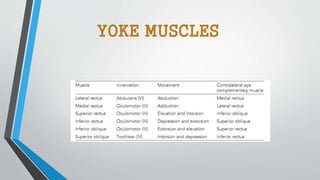
• Yoke Muscles ( Contralateral Synergists):
• Pair of muscles, one in each eye , that produce conjugate ocular
movements
• Ex. right LR and left MR in dextroversion
YOKE MUSCLES
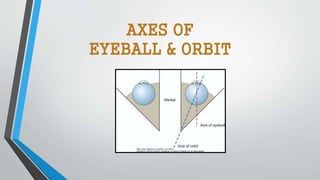
AXES OF
EYEBALL & ORBIT
MOTION OF AN EYE
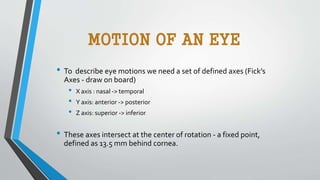
• To describe eye motions we need a set of defined axes (Fick’s
Axes - draw on board)
• X axis : nasal -> temporal
• Y axis: anterior -> posterior
• Z axis: superior -> inferior
• These axes intersect at the center of rotation - a fixed point,
defined as 13.5 mm behind cornea.
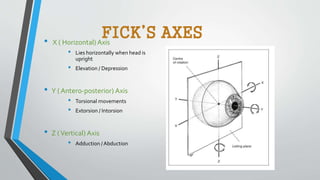
FICK’S AXES• X ( Horizontal) Axis
• Lies horizontally when head is
upright
• Elevation / Depression
• Y ( Antero-posterior) Axis
• Torsional movements
• Extorsion / Intorsion
• Z (Vertical) Axis
• Adduction /Abduction
LISTING’S LAW
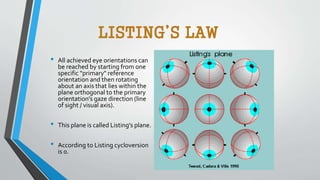
• All achieved eye orientations can
be reached by starting from one
specific "primary" reference
orientation and then rotating
about an axis that lies within the
plane orthogonal to the primary
orientation's gaze direction (line
of sight / visual axis).
• This plane is called Listing's plane.
• According to Listing cycloversion
is 0.
FACTORS INVOLVED IN
MECHANICS OF EOM ACTION
1. Cross sectional area of the muscle
(Muscles exert force in proportion to their cross sectional area)
2. Length of the muscle
3. Distance between the anatomic and physiologic insertion is called
the arc of contact
(The power of the muscle is proportionate to its length and arc of
contact)
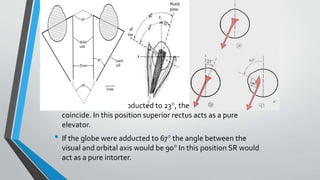
• When the globe is abducted to 23°, the visual and orbital axis
coincide. In this position superior rectus acts as a pure
elevator.
• If the globe were adducted to 67° the angle between the
visual and orbital axis would be 90° In this position SR would
act as a pure intorter.
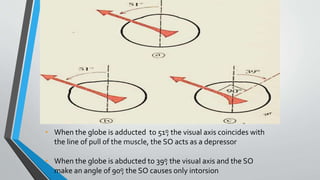
• When the globe is adducted to 51 ͦ, the visual axis coincides with
the line of pull of the muscle, the SO acts as a depressor
• When the globe is abducted to 39 ͦ, the visual axis and the SO
make an angle of 90 ͦ, the SO causes only intorsion
TYPES
• Functionally, they can be divided into two groups:
1. Responsible for eye movement:
• Recti Muscles
• Oblique Muscles.
2. Responsible for superior eyelid Elevation:
• Levator Palpebrae Superioris
• Muller’s Muscle.
MUSCLES RESPONSIBLE
FOR EYE MOVEMENT
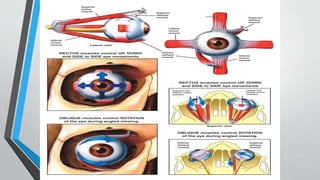
• The actions of the six muscles responsible for eye movement depend on the
position of the eye at the time of muscle contraction.
• Four of the extraocular muscles control the movement of the eye in the four
cardinal directions: up, down, left and right.
• The remaining two muscles control the adjustments involved in counteracting
head movement
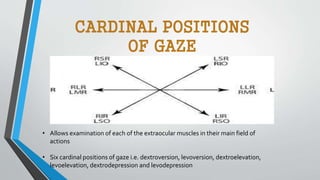
CARDINAL POSITIONS
OF GAZE
• Allows examination of each of the extraocular muscles in their main field of
actions
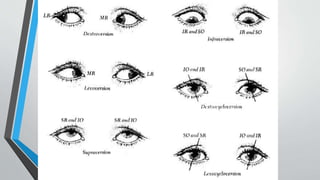
• Six cardinal positions of gaze i.e. dextroversion, levoversion, dextroelevation,
levoelevation, dextrodepression and levodepression
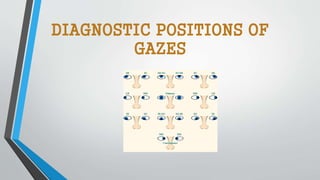
DIAGNOSTIC POSITIONS OF
GAZES
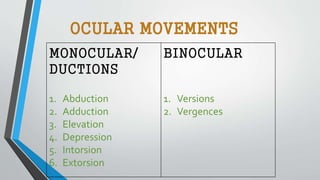
OCULAR MOVEMENTS
MONOCULAR/
DUCTIONS
1. Abduction
2. Adduction
3. Elevation
4. Depression
5. Intorsion
6. Extorsion
BINOCULAR
1. Versions
2. Vergences
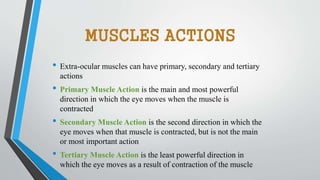
MUSCLES ACTIONS
• Extra-ocular muscles can have primary, secondary and tertiary
actions
• Primary Muscle Action is the main and most powerful
direction in which the eye moves when the muscle is
contracted
• Secondary Muscle Action is the second direction in which the
eye moves when that muscle is contracted, but is not the main
or most important action
• Tertiary Muscle Action is the least powerful direction in
which the eye moves as a result of contraction of the muscle
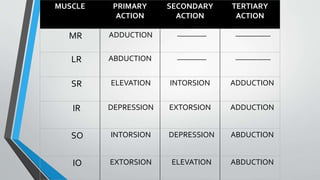
MUSCLE PRIMARY
ACTION
SECONDARY
ACTION
TERTIARY
ACTION
MR ADDUCTION __________ ____________
LR ABDUCTION __________ ____________
SR ELEVATION INTORSION ADDUCTION
IR DEPRESSION EXTORSION ADDUCTION
SO INTORSION DEPRESSION ABDUCTION
IO EXTORSION ELEVATION ABDUCTION
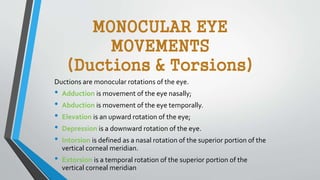
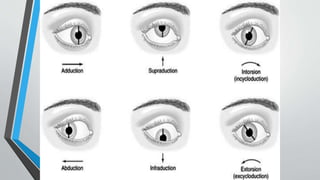
Ductions are monocular rotations of the eye.
• Adduction is movement of the eye nasally;
• Abduction is movement of the eye temporally.
• Elevation is an upward rotation of the eye;
• Depression is a downward rotation of the eye.
• Intorsion is defined as a nasal rotation of the superior portion of the
vertical corneal meridian.
• Extorsion is a temporal rotation of the superior portion of the
vertical corneal meridian
MONOCULAR EYE
MOVEMENTS
(Ductions & Torsions)
DUCTIONS
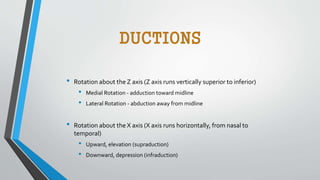
• Rotation about the Z axis (Z axis runs vertically superior to inferior)
• Medial Rotation - adduction toward midline
• Lateral Rotation - abduction away from midline
• Rotation about the X axis (X axis runs horizontally, from nasal to
temporal)
• Upward, elevation (supraduction)
• Downward, depression (infraduction)
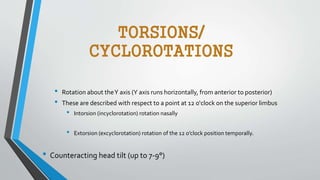
• Rotation about theY axis (Y axis runs horizontally, from anterior to posterior)
• These are described with respect to a point at 12 o‘clock on the superior limbus
• Intorsion (incyclorotation) rotation nasally
• Extorsion (excyclorotation) rotation of the 12 o’clock position temporally.
• Counteracting head tilt (up to 7-9°)
TORSIONS/
CYCLOROTATIONS
SHERRINGTON’S LAW OF
RECIPROCAL INNERVATION
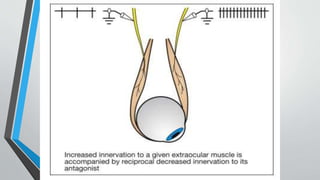
• Sherrington's law of reciprocal states that increased innervation
and contraction of a given EOM are accompanied by a reciprocal
decrease in innervation and contraction of its antagonist.
• Ex. During detroversion there is increased innervation to right LR
and left MR accompanied by decreased flow to right MR and left LR
BINOCULAR EYE MOVEMENTS
Version & Vergences
Version:
• Eye movements are paired, that is both eyes move in the
same direction simultaneously.
Vergence:
• Eyes move in the opposite directions simultaneously.
VERSIONS
(CONJUGATE EYE MOVEMENT)
• Dextroversion - Rightward Gaze
• Levoversion - Leftward Gaze
• Supraversion - Elevation
• Infraversion – Depression
• Dextrocycloversion -Up And Right, Up And Left
• Levocycloversion -Down And Right, Down And Left
ALL BEHAVIOR ISTHAT OFYOLKED EYES
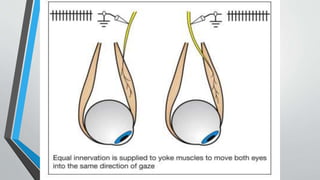
HERING’S LAW OF EQUAL
INNERVATION
• An equal and simultaneous innervation flows from the brain to a
pair of yoke muscles which contracts simultaneously in different
binocular movements
• Ex. Right LR and Left MR during dextroversion
• Applies to all normal eye movements
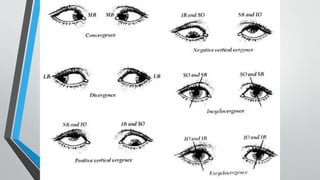
VERGENCES
(DISJUNCTIVE EYE MOVEMENTS)
• Non-yolked motion(opposite left- right movments).
• Convergence - Simultaneous Movement Nasally
• Divergence- SimultaneousTemporal Movement
• Encyclovergence - Intorsion
• Excyclovergence - Extorsion
• Vertical vergence - 1 eye moves upward and the other downward (less frequently
encountered)
FUSIONAL CONVERGENCE
• A movement to converge and position the eyes so that similar retinal
images project on corresponding retinal areas.
• Fusional convergence is accomplished without changing the refractive state
of the eyes and is prompted by bitemporal retinal image disparity
FUSIONAL DIVERGENCE
• The only clinically significant form of divergence.
• It is an optomotor reflex to diverge and align the eyes so that similar retinal
images project on corresponding retinal areas. Fusional divergence is
accomplished without changing the refractive state of the eyes and is
prompted by binasal retinal image disparity.
ACCOMMODATIVE
CONVERGENCE
• Accommodative convergence of the visual axes is part of the synkinetic near reflex.
• A fairly consistent increment of accommodative convergence (AC) occurs for each diopter
of accommodation (A), giving the accommodative convergence/accommodation (AC/A)
ratio.
• Abnormalities of this ratio are common, and they are an important cause of strabismus.
• With an abnormally highAC/A ratio, the excess convergence tends to produce esotropia during
accommodation on near targets.
• An abnormally low AC/A ratio tends to make the eyes exotropic when the person looks at near
targets.
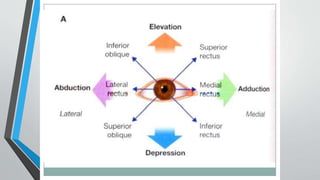
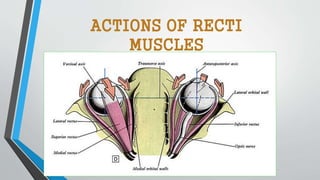
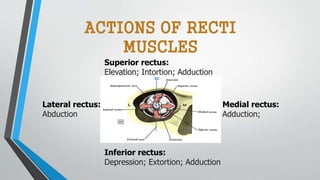
ACTIONS OF RECTI
MUSCLES
Superior rectus:
Elevation; Intortion; Adduction
Inferior rectus:
Depression; Extortion; Adduction
Medial rectus:
Adduction;
Lateral rectus:
Abduction
ACTIONS OF RECTI
MUSCLES
SUPERIOR RECTUS
Actions:
The superior rectus makes the eye look :
i. Upwards
ii. Medially
iii. Wheel-rotates it medially (intorts)
iv. It also helps the levator to lift the upper lid.
INFERIOR RECTUS
Actions:
The inferior rectus makes the eye look :
i. Downwards
ii. Medially
iii. Wheel-rotates it laterally (extorsion).
iv. By means of its fascial expansion it also depresses the lower lid.
(The principal action is depression which increases as the eye is turned out and is nil when the eye is
adducted.The inferior rectus is the only depressor in the abducted position of the eye.)
MEDIAL RECTUS
Actions:
• The medial rectus is a pure adductor – that is, makes the eye look directly
medially/nasally in the horizontal plane.
LATERAL RECTUS
Actions:
i. The lateral rectus is a pure abductor – that is, makes the eye look directly
laterally/temporally in the horizontal plane.
ACTIONS OF OBLIQUE
MUSCLES
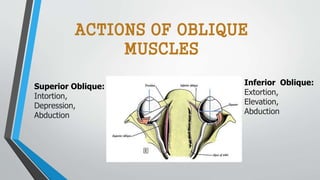
Superior Oblique:
Intortion,
Depression,
Abduction
Inferior Oblique:
Extortion,
Elevation,
Abduction
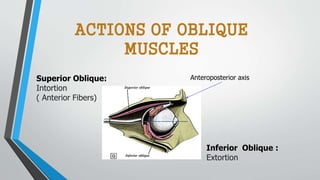
Superior Oblique:
Intortion
( Anterior Fibers)
Inferior Oblique :
Extortion
Anteroposterior axis
ACTIONS OF OBLIQUE
MUSCLES
ACTIONS OF OBLIQUE
MUSCLES
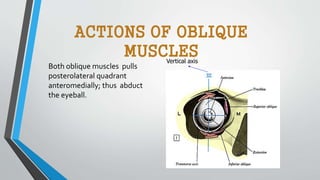
Both oblique muscles pulls
posterolateral quadrant
anteromedially; thus abduct
the eyeball.
Vertical axis
SUPERIOR OBLIQUE
Actions:
The superior oblique moves the eye :
i. Downwards
ii. Laterally
iii. Rotates it inwards (i.e. makes twelve o’clock on the cornea move towards
the nose).
(The principal is the depression, and this increases as the eye is adducted.
The superior oblique is the only muscle which can depress in the adducted
position. Its action is practically nil when the eye is abducted.The
abduction and intorsion are the subsidiary actions, and increase as the eye
turns out.The superior oblique acts with the inferior rectus to make the
eye look directly down.The abductor component of the action of the
oblique muscles is due to their being inserted behind the equator of the
globe.)
INFERIOR OBLIQUE
Actions:
The inferior oblique makes the eye look:
i. Upwards
ii. Laterally
iii. Wheel-rotates it laterally (extorts).
(The principal action is the elevation which increases as the eye is turned in and is nil in
abduction.The inferior oblique is the only elevator in the adducted position.)
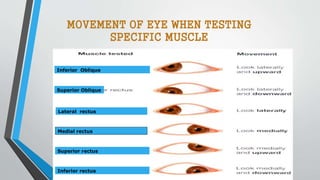
Superior Oblique
Inferior Oblique
Superior rectus
Inferior rectus
Medial rectus
Lateral rectus
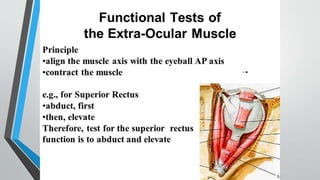
MOVEMENT OF EYE WHEN TESTING
SPECIFIC MUSCLE
MUSCLE RESPONSIBLE FOR
SUPERIOR EYELID ELEVATION
Levator Superiosis :
Actions:
The levator raises the upper eyelid, thus uncovering the cornea
and a portion of the sclera, and deepens the superior
palpebral fold. Its antagonist is the palpebral portion of the
orbicularis.
EXTRA OCULAR MUSCLES PHYSIOLOGY

EXTRA OCULAR MUSCLES PHYSIOLOGY

  • 1.
  • 2.
    TERMINOLOGIES USED FOR EOM •Agonist • Any particular EOM producing specific ocular movement • Ex. Right LR for right eye abduction • Synergists • Muscles of the same eye that move the eye in the same direction • Ex. Right SR and right IO for right eye elevation
  • 3.
    TERMINOLOGIES USED FOR EOM •Antagonists: • A pair of muscles in the same eye that move the eye in opposite directions • Ex. right LR and right MR. • Yoke Muscles ( Contralateral Synergists): • Pair of muscles, one in each eye , that produce conjugate ocular movements • Ex. right LR and left MR in dextroversion
  • 4.
  • 5.
  • 6.
    MOTION OF ANEYE • To describe eye motions we need a set of defined axes (Fick’s Axes - draw on board) • X axis : nasal -> temporal • Y axis: anterior -> posterior • Z axis: superior -> inferior • These axes intersect at the center of rotation - a fixed point, defined as 13.5 mm behind cornea.
  • 7.
    FICK’S AXES• X( Horizontal) Axis • Lies horizontally when head is upright • Elevation / Depression • Y ( Antero-posterior) Axis • Torsional movements • Extorsion / Intorsion • Z (Vertical) Axis • Adduction /Abduction
  • 8.
    LISTING’S LAW • Allachieved eye orientations can be reached by starting from one specific "primary" reference orientation and then rotating about an axis that lies within the plane orthogonal to the primary orientation's gaze direction (line of sight / visual axis). • This plane is called Listing's plane. • According to Listing cycloversion is 0.
  • 9.
    FACTORS INVOLVED IN MECHANICSOF EOM ACTION 1. Cross sectional area of the muscle (Muscles exert force in proportion to their cross sectional area) 2. Length of the muscle 3. Distance between the anatomic and physiologic insertion is called the arc of contact (The power of the muscle is proportionate to its length and arc of contact)
  • 12.
    • When theglobe is abducted to 23°, the visual and orbital axis coincide. In this position superior rectus acts as a pure elevator. • If the globe were adducted to 67° the angle between the visual and orbital axis would be 90° In this position SR would act as a pure intorter.
  • 13.
    • When theglobe is adducted to 51 ͦ, the visual axis coincides with the line of pull of the muscle, the SO acts as a depressor • When the globe is abducted to 39 ͦ, the visual axis and the SO make an angle of 90 ͦ, the SO causes only intorsion
  • 14.
    TYPES • Functionally, theycan be divided into two groups: 1. Responsible for eye movement: • Recti Muscles • Oblique Muscles. 2. Responsible for superior eyelid Elevation: • Levator Palpebrae Superioris • Muller’s Muscle.
  • 15.
    MUSCLES RESPONSIBLE FOR EYEMOVEMENT • The actions of the six muscles responsible for eye movement depend on the position of the eye at the time of muscle contraction. • Four of the extraocular muscles control the movement of the eye in the four cardinal directions: up, down, left and right. • The remaining two muscles control the adjustments involved in counteracting head movement
  • 16.
    CARDINAL POSITIONS OF GAZE •Allows examination of each of the extraocular muscles in their main field of actions • Six cardinal positions of gaze i.e. dextroversion, levoversion, dextroelevation, levoelevation, dextrodepression and levodepression
  • 17.
  • 18.
    OCULAR MOVEMENTS MONOCULAR/ DUCTIONS 1. Abduction 2.Adduction 3. Elevation 4. Depression 5. Intorsion 6. Extorsion BINOCULAR 1. Versions 2. Vergences
  • 19.
    MUSCLES ACTIONS • Extra-ocularmuscles can have primary, secondary and tertiary actions • Primary Muscle Action is the main and most powerful direction in which the eye moves when the muscle is contracted • Secondary Muscle Action is the second direction in which the eye moves when that muscle is contracted, but is not the main or most important action • Tertiary Muscle Action is the least powerful direction in which the eye moves as a result of contraction of the muscle
  • 20.
    MUSCLE PRIMARY ACTION SECONDARY ACTION TERTIARY ACTION MR ADDUCTION__________ ____________ LR ABDUCTION __________ ____________ SR ELEVATION INTORSION ADDUCTION IR DEPRESSION EXTORSION ADDUCTION SO INTORSION DEPRESSION ABDUCTION IO EXTORSION ELEVATION ABDUCTION
  • 21.
    Ductions are monocularrotations of the eye. • Adduction is movement of the eye nasally; • Abduction is movement of the eye temporally. • Elevation is an upward rotation of the eye; • Depression is a downward rotation of the eye. • Intorsion is defined as a nasal rotation of the superior portion of the vertical corneal meridian. • Extorsion is a temporal rotation of the superior portion of the vertical corneal meridian MONOCULAR EYE MOVEMENTS (Ductions & Torsions)
  • 23.
    DUCTIONS • Rotation aboutthe Z axis (Z axis runs vertically superior to inferior) • Medial Rotation - adduction toward midline • Lateral Rotation - abduction away from midline • Rotation about the X axis (X axis runs horizontally, from nasal to temporal) • Upward, elevation (supraduction) • Downward, depression (infraduction)
  • 24.
    • Rotation abouttheY axis (Y axis runs horizontally, from anterior to posterior) • These are described with respect to a point at 12 o‘clock on the superior limbus • Intorsion (incyclorotation) rotation nasally • Extorsion (excyclorotation) rotation of the 12 o’clock position temporally. • Counteracting head tilt (up to 7-9°) TORSIONS/ CYCLOROTATIONS
  • 26.
    SHERRINGTON’S LAW OF RECIPROCALINNERVATION • Sherrington's law of reciprocal states that increased innervation and contraction of a given EOM are accompanied by a reciprocal decrease in innervation and contraction of its antagonist. • Ex. During detroversion there is increased innervation to right LR and left MR accompanied by decreased flow to right MR and left LR
  • 28.
    BINOCULAR EYE MOVEMENTS Version& Vergences Version: • Eye movements are paired, that is both eyes move in the same direction simultaneously. Vergence: • Eyes move in the opposite directions simultaneously.
  • 29.
    VERSIONS (CONJUGATE EYE MOVEMENT) •Dextroversion - Rightward Gaze • Levoversion - Leftward Gaze • Supraversion - Elevation • Infraversion – Depression • Dextrocycloversion -Up And Right, Up And Left • Levocycloversion -Down And Right, Down And Left ALL BEHAVIOR ISTHAT OFYOLKED EYES
  • 31.
    HERING’S LAW OFEQUAL INNERVATION • An equal and simultaneous innervation flows from the brain to a pair of yoke muscles which contracts simultaneously in different binocular movements • Ex. Right LR and Left MR during dextroversion • Applies to all normal eye movements
  • 33.
    VERGENCES (DISJUNCTIVE EYE MOVEMENTS) •Non-yolked motion(opposite left- right movments). • Convergence - Simultaneous Movement Nasally • Divergence- SimultaneousTemporal Movement • Encyclovergence - Intorsion • Excyclovergence - Extorsion • Vertical vergence - 1 eye moves upward and the other downward (less frequently encountered)
  • 35.
    FUSIONAL CONVERGENCE • Amovement to converge and position the eyes so that similar retinal images project on corresponding retinal areas. • Fusional convergence is accomplished without changing the refractive state of the eyes and is prompted by bitemporal retinal image disparity
  • 36.
    FUSIONAL DIVERGENCE • Theonly clinically significant form of divergence. • It is an optomotor reflex to diverge and align the eyes so that similar retinal images project on corresponding retinal areas. Fusional divergence is accomplished without changing the refractive state of the eyes and is prompted by binasal retinal image disparity.
  • 37.
    ACCOMMODATIVE CONVERGENCE • Accommodative convergenceof the visual axes is part of the synkinetic near reflex. • A fairly consistent increment of accommodative convergence (AC) occurs for each diopter of accommodation (A), giving the accommodative convergence/accommodation (AC/A) ratio. • Abnormalities of this ratio are common, and they are an important cause of strabismus. • With an abnormally highAC/A ratio, the excess convergence tends to produce esotropia during accommodation on near targets. • An abnormally low AC/A ratio tends to make the eyes exotropic when the person looks at near targets.
  • 38.
  • 39.
    Superior rectus: Elevation; Intortion;Adduction Inferior rectus: Depression; Extortion; Adduction Medial rectus: Adduction; Lateral rectus: Abduction ACTIONS OF RECTI MUSCLES
  • 40.
    SUPERIOR RECTUS Actions: The superiorrectus makes the eye look : i. Upwards ii. Medially iii. Wheel-rotates it medially (intorts) iv. It also helps the levator to lift the upper lid.
  • 41.
    INFERIOR RECTUS Actions: The inferiorrectus makes the eye look : i. Downwards ii. Medially iii. Wheel-rotates it laterally (extorsion). iv. By means of its fascial expansion it also depresses the lower lid. (The principal action is depression which increases as the eye is turned out and is nil when the eye is adducted.The inferior rectus is the only depressor in the abducted position of the eye.)
  • 42.
    MEDIAL RECTUS Actions: • Themedial rectus is a pure adductor – that is, makes the eye look directly medially/nasally in the horizontal plane.
  • 43.
    LATERAL RECTUS Actions: i. Thelateral rectus is a pure abductor – that is, makes the eye look directly laterally/temporally in the horizontal plane.
  • 44.
    ACTIONS OF OBLIQUE MUSCLES SuperiorOblique: Intortion, Depression, Abduction Inferior Oblique: Extortion, Elevation, Abduction
  • 45.
    Superior Oblique: Intortion ( AnteriorFibers) Inferior Oblique : Extortion Anteroposterior axis ACTIONS OF OBLIQUE MUSCLES
  • 46.
    ACTIONS OF OBLIQUE MUSCLES Bothoblique muscles pulls posterolateral quadrant anteromedially; thus abduct the eyeball. Vertical axis
  • 47.
    SUPERIOR OBLIQUE Actions: The superioroblique moves the eye : i. Downwards ii. Laterally iii. Rotates it inwards (i.e. makes twelve o’clock on the cornea move towards the nose). (The principal is the depression, and this increases as the eye is adducted. The superior oblique is the only muscle which can depress in the adducted position. Its action is practically nil when the eye is abducted.The abduction and intorsion are the subsidiary actions, and increase as the eye turns out.The superior oblique acts with the inferior rectus to make the eye look directly down.The abductor component of the action of the oblique muscles is due to their being inserted behind the equator of the globe.)
  • 48.
    INFERIOR OBLIQUE Actions: The inferioroblique makes the eye look: i. Upwards ii. Laterally iii. Wheel-rotates it laterally (extorts). (The principal action is the elevation which increases as the eye is turned in and is nil in abduction.The inferior oblique is the only elevator in the adducted position.)
  • 49.
    Superior Oblique Inferior Oblique Superiorrectus Inferior rectus Medial rectus Lateral rectus MOVEMENT OF EYE WHEN TESTING SPECIFIC MUSCLE
  • 50.
    MUSCLE RESPONSIBLE FOR SUPERIOREYELID ELEVATION Levator Superiosis : Actions: The levator raises the upper eyelid, thus uncovering the cornea and a portion of the sclera, and deepens the superior palpebral fold. Its antagonist is the palpebral portion of the orbicularis.

Editor's Notes

  • #19 Versions – Conjugate, synchronous, symmetric movements of both eyes in same direction Vergence – Disjugate, synchronous, symmetric movements of two eyes in opposite direction