PULMONARY
EMBOLISM
Dr.B.SELVARAJ MS;Mch;FICS;
Professor Of Surgery
Melaka Manipal Medical College
Melaka 75150 Malaysia
PULMONARY EMBOLISM
OBJECTIVES
 Etiopathogenesis
 Clinical Features Symptoms & Signs
 Investigations
 Differential Diagnosis
 Wells Scoring
 Treatment
- Prophylactic
- Definitive
PULMONARY EMBOLISM
ETIOPATHOGENESIS
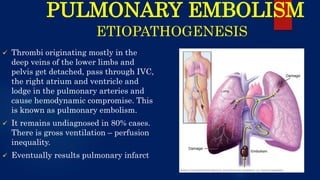
 Thrombi originating mostly in the
deep veins of the lower limbs and
pelvis get detached, pass through IVC,
the right atrium and ventricle and
lodge in the pulmonary arteries and
cause hemodynamic compromise. This
is known as pulmonary embolism.
 It remains undiagnosed in 80% cases.
There is gross ventilation – perfusion
inequality.
 Eventually results pulmonary infarct
PULMONARY EMBOLISM
CLINICAL FEATURES
 The patient will complain of dyspnea,
chest pain and hemoptysis- the triad
for Pulmonary Embolism
 Symptoms may vary from sudden
catastrophic hemodynamic collapse to
gradually progressive dyspnea.
 Atypical symptoms, such as Seizures,
Syncope, Wheezing and Delirium
SYMPTOMS
 The most consistent finding is
tachycardia and tachypnea.
 Shock and Cyanosis are ominous
signs and only seen in massive
embolus.
 Rales: 58%
 Accentuated second heart sound:
53%
 Diaphoresis: 36%
SIGNS
PULMONARY EMBOLISM
INVESTIGATIONS
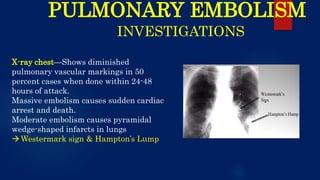
X-ray chest—Shows diminished
pulmonary vascular markings in 50
percent cases when done within 24-48
hours of attack.
Massive embolism causes sudden cardiac
arrest and death.
Moderate embolism causes pyramidal
wedge-shaped infarcts in lungs
Westermark sign & Hampton’s Lump
PULMONARY EMBOLISM
INVESTIGATIONS
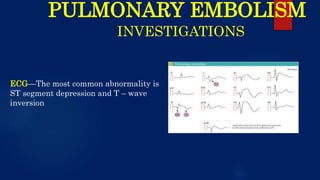
ECG—The most common abnormality is
ST segment depression and T – wave
inversion
PULMONARY EMBOLISM
INVESTIGATIONS
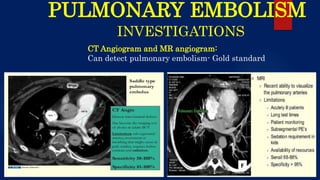
CT Angiogram and MR angiogram:
Can detect pulmonary embolism- Gold standard
PULMONARY EMBOLISM
INVESTIGATIONS
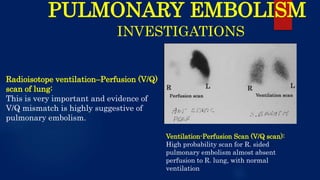
Radioisotope ventilation–Perfusion (V/Q)
scan of lung:
This is very important and evidence of
V/Q mismatch is highly suggestive of
pulmonary embolism.
Ventilation-Perfusion Scan (V/Q scan):
High probability scan for R. sided
pulmonary embolism almost absent
perfusion to R. lung, with normal
ventilation
PULMONARY EMBOLISM
DIFFERENTIAL DIAGNOSIS
Pulmonary embolism is a great masquerader
and can mimic
Acute myocardial infarction,
Pneumonia
and Musculoskeletal disorders.
PULMONARY EMBOLISM
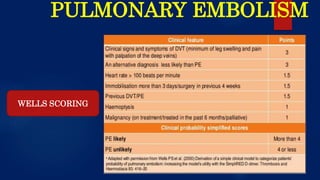
WELLS SCORING
PULMONARY EMBOLISM
TREATMENT
 Anticoagulation with LMWH viz.
enoxaparin for 3 to 6 months.
 Thrombolysis with streptokinase 6
lakh units to begin with and later one
lakh unit hourly. Heparin should not
be combined with thrombolytics.
 Thrombolysis with tPA- Alteplase
100mgm IV infusion
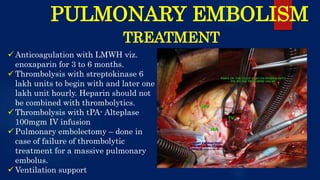
 Pulmonary embolectomy – done in
case of failure of thrombolytic
treatment for a massive pulmonary
embolus.
 Ventilation support
PULMONARY EMBOLISM
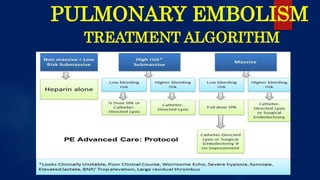
TREATMENT ALGORITHM
Pulmonary embolism- Venous diseases

Pulmonary embolism- Venous diseases