ENTERIC FEVER IN
PEDIATRICS
Dr.Padmesh.V
 ETIOLOGY:
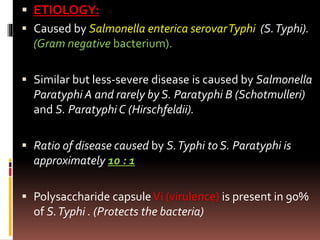
 Caused by Salmonella enterica serovarTyphi (S.Typhi).
(Gram negative bacterium).
 Similar but less-severe disease is caused by Salmonella
Paratyphi A and rarely by S. Paratyphi B (Schotmulleri)
and S. Paratyphi C (Hirschfeldii).
 Ratio of disease caused by S.Typhi to S. Paratyphi is
approximately 10 : 1
 Polysaccharide capsuleVi (virulence) is present in 90%
of S.Typhi . (Protects the bacteria)
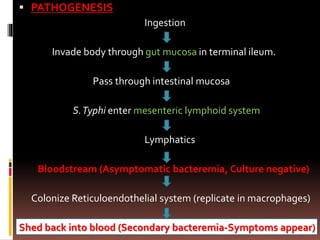
 PATHOGENESIS
Ingestion
Invade body through gut mucosa in terminal ileum.
Pass through intestinal mucosa
S.Typhi enter mesenteric lymphoid system
Lymphatics
Bloodstream (Asymptomatic bacteremia, Culture negative)
Colonize Reticuloendothelial system (replicate in macrophages)
Shed back into blood (Secondary bacteremia-Symptoms appear)
 PATHOGENESIS
 SurfaceVi polysaccharide capsular antigen interferes with
phagocytosis by preventing binding of C3 to bacterial
surface.
 Ability to survive within macrophages is an important
virulence trait encoded by PhoP regulon.
 Occasional occurrence of diarrhea: Due to presence of a
toxin, related to cholera toxin and E.coli heat-labile
enterotoxin.
 Clinical syndrome of fever and systemic symptoms: Due to
release of proinflammatory cytokines (IL-6, IL-1β, andTNF-
α) from infected cells.
 Patients with Helicobacter pylori infection have an
increased risk of acquiring typhoid fever.
 CLINICAL FEATURES:
 Incubation period: 7 - 14 days (3-30 days)
 Clinical presentation varies from mild illness with low-grade
fever, malaise, and slight, dry cough
to
Severe clinical picture with abdominal discomfort &
multiple complications.
 Diarrhea, toxicity, & complications such as disseminated
intravascular coagulopathy are more common in infancy.
(increased fatality)
 However, some features & complications seen in adults,
like relative bradycardia,neurologic manifestations,and
gastrointestinal bleeding are rare in children.
 CLINICAL FEATURES:
 FEATURE RATE (%)
 High-grade fever 95
 Coated tongue 76
 Anorexia 70
 Vomiting 39
 Hepatomegaly 37
 Diarrhea 36
 Toxicity 29
 Abdominal pain 21
 Pallor 20
 Splenomegaly 17
 Constipation 7
 Headache 4
 Jaundice 2
 Obtundation 2
 Ileus 1
 Intestinal perforation 0.5
 CLINICAL FEATURES:
 In children diarrhea may occur in earlier stages and
may be followed by constipation.
 Classic stepladder rise of fever is rare.
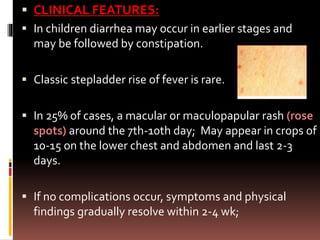
 In 25% of cases, a macular or maculopapular rash (rose
spots) around the 7th-10th day; May appear in crops of
10-15 on the lower chest and abdomen and last 2-3
days.
 If no complications occur, symptoms and physical
findings gradually resolve within 2-4 wk;
 COMPLICATIONS:
 Altered liver function is found in many patients.
 However, clinically significant hepatitis, jaundice, and
cholecystitis are rare.
 COMPLICATIONS:
 Extra intestinal complications:
 Central nervous system (3-35%): Encephalopathy, cerebral
edema, subdural empyema, cerebral abscess, meningitis,
ventriculitis, transient parkinsonism, motor neuron disorders,
ataxia, seizures, Guillain-Barré syndrome, psychosis.
 Cardiovascular system (1-5%): Endocarditis,
myocarditis,pericarditis, arteritis, congestive heart failure.
 Pulmonary system (1-6%): Pneumonia, empyema,
bronchopleural fistula.
 Hepatobiliary system (1-26%): Cholecystitis, hepatitis,
hepatic abscesses, splenic abscess,peritonitis, paralytic ileus
 DIAGNOSIS
 Mainstay: Culture from blood or another anatomic
site.
 Blood cultures are positive in 40-60% , early in the
course.
 Stool & urine culture become positive after 1st wk.
 DIAGNOSIS
 Results of other lab investigations are nonspecific.
 AlthoughWBC counts are frequently low in relation to fever
and toxicity, there is a wide range in counts; in younger
children leukocytosis is common & may reach 20,000-25,000
cells/μL.
 Thrombocytopenia may be a marker of severe illness &
may accompany disseminated intravascular coagulopathy.
 Liver function test results may be deranged, but significant
hepatic dysfunction is rare.
 DIAGNOSIS
 Widal test measures antibodies against O and H
antigens of S.Typhi but lacks sensitivity and specificity in
endemic areas.
 O antibodies appear on days 6-8 and
 H antibodies on days 10-12 after the onset of the
disease.
 'O' titer is considered to be of greater diagnostic
significance.
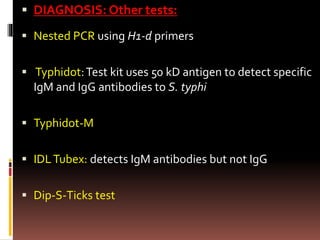
 DIAGNOSIS: Other tests:
 Nested PCR using H1-d primers
 Typhidot:Test kit uses 50 kD antigen to detect specific
IgM and IgG antibodies to S. typhi
 Typhidot-M
 IDLTubex: detects IgM antibodies but not IgG
 Dip-S-Ticks test
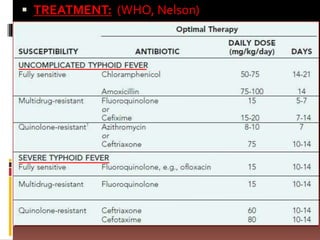
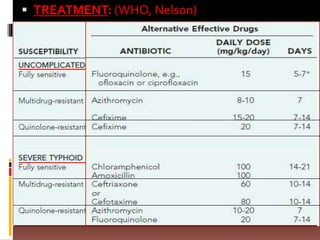
 TREATMENT: (WHO, Nelson)
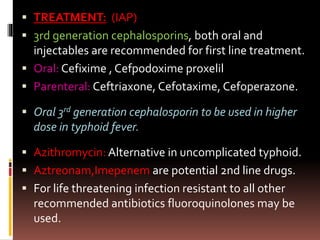
 TREATMENT: (IAP)
 3rd generation cephalosporins, both oral and
injectables are recommended for first line treatment.
 Oral: Cefixime , Cefpodoxime proxelil
 Parenteral: Ceftriaxone, Cefotaxime, Cefoperazone.
 Oral 3rd generation cephalosporin to be used in higher
dose in typhoid fever.
 Azithromycin: Alternative in uncomplicated typhoid.
 Aztreonam,Imepenem are potential 2nd line drugs.
 For life threatening infection resistant to all other
recommended antibiotics fluoroquinolones may be
used.
 PROGNOSIS:
 2-4% of infected children may experience relapse after
initial clinical response to treatment.
 Individuals who excrete S.Typhi for 3 months or longer
after infection are regarded as chronic carriers. The risk
for becoming a carrier is low in children (<2% for all
infected children) and increases with age.
 A chronic urinary carrier state can develop in children
with schistosomiasis.
 PREVENTION: Vaccines:
 Oral, live-attenuatedTy21a strain of S.Typhi has
good efficacy (67-82%) for up to 5 yr.
 Vi capsular polysaccharide for 2 yr of age and older.
Booster every 2 yr. Protective efficacy of 70-80%.
 Vi-conjugate vaccine has a protective efficacy
> 90% in younger children.
www.slideshare.net/Dr_Padmesh
dnbpediatricstheory.blogspot.com/
oscepediatrics.blogspot.com/

Enteric Fever in Pediatrics ( Typhoid ) Dr Padmesh

  • 1.
  • 2.
     ETIOLOGY:  Causedby Salmonella enterica serovarTyphi (S.Typhi). (Gram negative bacterium).  Similar but less-severe disease is caused by Salmonella Paratyphi A and rarely by S. Paratyphi B (Schotmulleri) and S. Paratyphi C (Hirschfeldii).  Ratio of disease caused by S.Typhi to S. Paratyphi is approximately 10 : 1  Polysaccharide capsuleVi (virulence) is present in 90% of S.Typhi . (Protects the bacteria)
  • 3.
     PATHOGENESIS Ingestion Invade bodythrough gut mucosa in terminal ileum. Pass through intestinal mucosa S.Typhi enter mesenteric lymphoid system Lymphatics Bloodstream (Asymptomatic bacteremia, Culture negative) Colonize Reticuloendothelial system (replicate in macrophages) Shed back into blood (Secondary bacteremia-Symptoms appear)
  • 4.
     PATHOGENESIS  SurfaceVipolysaccharide capsular antigen interferes with phagocytosis by preventing binding of C3 to bacterial surface.  Ability to survive within macrophages is an important virulence trait encoded by PhoP regulon.  Occasional occurrence of diarrhea: Due to presence of a toxin, related to cholera toxin and E.coli heat-labile enterotoxin.  Clinical syndrome of fever and systemic symptoms: Due to release of proinflammatory cytokines (IL-6, IL-1β, andTNF- α) from infected cells.  Patients with Helicobacter pylori infection have an increased risk of acquiring typhoid fever.
  • 5.
     CLINICAL FEATURES: Incubation period: 7 - 14 days (3-30 days)  Clinical presentation varies from mild illness with low-grade fever, malaise, and slight, dry cough to Severe clinical picture with abdominal discomfort & multiple complications.  Diarrhea, toxicity, & complications such as disseminated intravascular coagulopathy are more common in infancy. (increased fatality)  However, some features & complications seen in adults, like relative bradycardia,neurologic manifestations,and gastrointestinal bleeding are rare in children.
  • 6.
     CLINICAL FEATURES: FEATURE RATE (%)  High-grade fever 95  Coated tongue 76  Anorexia 70  Vomiting 39  Hepatomegaly 37  Diarrhea 36  Toxicity 29  Abdominal pain 21  Pallor 20  Splenomegaly 17  Constipation 7  Headache 4  Jaundice 2  Obtundation 2  Ileus 1  Intestinal perforation 0.5
  • 7.
     CLINICAL FEATURES: In children diarrhea may occur in earlier stages and may be followed by constipation.  Classic stepladder rise of fever is rare.  In 25% of cases, a macular or maculopapular rash (rose spots) around the 7th-10th day; May appear in crops of 10-15 on the lower chest and abdomen and last 2-3 days.  If no complications occur, symptoms and physical findings gradually resolve within 2-4 wk;
  • 8.
     COMPLICATIONS:  Alteredliver function is found in many patients.  However, clinically significant hepatitis, jaundice, and cholecystitis are rare.
  • 9.
     COMPLICATIONS:  Extraintestinal complications:  Central nervous system (3-35%): Encephalopathy, cerebral edema, subdural empyema, cerebral abscess, meningitis, ventriculitis, transient parkinsonism, motor neuron disorders, ataxia, seizures, Guillain-Barré syndrome, psychosis.  Cardiovascular system (1-5%): Endocarditis, myocarditis,pericarditis, arteritis, congestive heart failure.  Pulmonary system (1-6%): Pneumonia, empyema, bronchopleural fistula.  Hepatobiliary system (1-26%): Cholecystitis, hepatitis, hepatic abscesses, splenic abscess,peritonitis, paralytic ileus
  • 10.
     DIAGNOSIS  Mainstay:Culture from blood or another anatomic site.  Blood cultures are positive in 40-60% , early in the course.  Stool & urine culture become positive after 1st wk.
  • 11.
     DIAGNOSIS  Resultsof other lab investigations are nonspecific.  AlthoughWBC counts are frequently low in relation to fever and toxicity, there is a wide range in counts; in younger children leukocytosis is common & may reach 20,000-25,000 cells/μL.  Thrombocytopenia may be a marker of severe illness & may accompany disseminated intravascular coagulopathy.  Liver function test results may be deranged, but significant hepatic dysfunction is rare.
  • 12.
     DIAGNOSIS  Widaltest measures antibodies against O and H antigens of S.Typhi but lacks sensitivity and specificity in endemic areas.  O antibodies appear on days 6-8 and  H antibodies on days 10-12 after the onset of the disease.  'O' titer is considered to be of greater diagnostic significance.
  • 13.
     DIAGNOSIS: Othertests:  Nested PCR using H1-d primers  Typhidot:Test kit uses 50 kD antigen to detect specific IgM and IgG antibodies to S. typhi  Typhidot-M  IDLTubex: detects IgM antibodies but not IgG  Dip-S-Ticks test
  • 14.
  • 15.
  • 16.
     TREATMENT: (IAP) 3rd generation cephalosporins, both oral and injectables are recommended for first line treatment.  Oral: Cefixime , Cefpodoxime proxelil  Parenteral: Ceftriaxone, Cefotaxime, Cefoperazone.  Oral 3rd generation cephalosporin to be used in higher dose in typhoid fever.  Azithromycin: Alternative in uncomplicated typhoid.  Aztreonam,Imepenem are potential 2nd line drugs.  For life threatening infection resistant to all other recommended antibiotics fluoroquinolones may be used.
  • 17.
     PROGNOSIS:  2-4%of infected children may experience relapse after initial clinical response to treatment.  Individuals who excrete S.Typhi for 3 months or longer after infection are regarded as chronic carriers. The risk for becoming a carrier is low in children (<2% for all infected children) and increases with age.  A chronic urinary carrier state can develop in children with schistosomiasis.
  • 18.
     PREVENTION: Vaccines: Oral, live-attenuatedTy21a strain of S.Typhi has good efficacy (67-82%) for up to 5 yr.  Vi capsular polysaccharide for 2 yr of age and older. Booster every 2 yr. Protective efficacy of 70-80%.  Vi-conjugate vaccine has a protective efficacy > 90% in younger children.
  • 19.