Cystic Fibrosis
Lee Mei Gie
Group 88
5th course
• Cystic fibrosis is an inherited disease of the exocrine
glands affecting primarily the GI and respiratory
systems.
• It leads to chronic lung disease, exocrine pancreatic
insufficiency, hepatobiliary disease, and abnormally
high sweat electrolytes.
Definition
Etiology
• CF is carried as an autosomal recessive trait by about
3% of the white population.
• The responsible gene has been localized on the long
arm of chromosome 7. It encodes a membrane-
associated protein called the cystic fibrosis
transmembrane conductance regulator (CFTR).
• CFTR is a cAMP-regulated Cl channel, regulating Cl
and Na transport across epithelial membranes.
• Mutation of that certain gene leads to cystic fibrosis.
Disease manifests only in homozygotes.
Epidemiology
• If both parents are heterozygote , there is 25%
possibility of their children are homozygote and
develop cystic fibrosis.
• White population > Black and Asian population
• Ratio male to female is 1:1
• Females with cystic fibrosis have greater
deterioration of pulmonary function with increasing
age and younger mean age at death due to increase
in hormone secretion during puberty may interfere
the defense mechanisms of the immune system.
Pathophysiology
Nearly all exocrine glands are affected in varying distribution and
degree of severity. Glands may :
• Become obstructed by viscid or solid eosinophilic material in
the lumen (pancreas, intestinal glands, intrahepatic bile ducts,
gallbladder, and submaxillary glands).
• Appear histologically abnormal and produce excessive
secretions (tracheobronchial and Brunner glands).
• Appear histologically normal but secrete excessive Na and Cl
(sweat, parotid, and small salivary glands).
Signs and symptoms
Specific target organ
1. Gastrointestinal tract
• Meconium ileus
• Abdominal distention
• Intestinal obstruction
• Increased frequency of stools
• Failure to thrive (despite adequate appetite)
• Flatulence or foul-smelling flatus, steatorrhea
• Recurrent abdominal pain
• Jaundice
• GI bleeding
2. Respiratory system
• Cough
• Recurrent wheezing
• Recurrent pneumonia
• Atypical asthma
• Dyspnea on exertion
• Chest pain
3. Genitourinary tract
• Undescended testicles or hydrocele
• Delayed secondary sexual development
• Amenorrhea
Physical examination
Findings related to the pulmonary system may include the following:
• Tachypnea
• Respiratory distress with retractions
• Wheeze or crackles
• Cough (dry or productive of mucoid or purulent sputum)
• Increased anteroposterior diameter of chest
• Clubbing
• Cyanosis
• Hyperresonant chest upon percussion (crackles are heard acutely in
associated pneumonitis or bronchitis and chronically with
bronchiectasis)
Findings related to the GI tract include the following:
• Abdominal distention
• Hepatosplenomegaly (fatty liver and portal hypertension)
• Rectal prolapse
• Dry skin (vitamin A deficiency)
• Cheilosis (vitamin B complex deficiency)
Examination of other systems may reveal the following:
• Scoliosis
• Kyphosis
• Swelling of submandibular gland or parotid gland
• Aquagenic wrinkling of the palms (AWP)
Complication
Bronchiectasis
Atelectasis
Pneumothorax
Hemoptysis
Hypertrophic pulmonary osteoarthropathy
Allergic bronchopulmonary aspergillosis (ABPA)
Gastroesophageal reflux
Pulmonary hypertension
Cor pulmonale
Pancreatitis
Cystic fibrosis–related diabetes mellitus
Meconium ileus
Distal intestinal obstruction syndrome
Rectal prolapse
Vitamin deficiency (especially fat-soluble vitamins)
Fatty liver
Focal biliary cirrhosis
Portal hypertension
Liver failure
Cholecystitis and cholelithiasis
Rickets
Osteoporosis
Diagnosis
The diagnosis of cystic fibrosis (CF) is based on
• Typical pulmonary manifestations, GI tract
manifestations
• Family history
• Universal newborn screening
• Prenatal screening test
• Sweat test results
Requirements for a CF diagnosis include either positive
genetic testing or positive sweat chloride test findings
(>60 mEq/L) and 1 of the following:
• Typical chronic obstructive pulmonary disease
• Documented exocrine pancreatic insufficiency
• Positive family history (usually affected sibling)
Cl concentration for infants
(up to 6 months)
Result
0-29 mmol/L CF is unlikely
30-59 mmol/L intermediate
≥ 60 mmol/L Indicative of CF
Cl concentration for
infants older than 6
months, child and adult
Result
0-39 mmol/L CF is unlikely
40-59 mmol/L intermediate
≥ 60mmol/L Indicative of CF
*The sweat test must be performed at least
twice in each patient, preferably several
weeks apart.
Other examinations
• Imaging test (X-ray, US, CT, MRI)
• Genotyping
• Pulmonary function test
• Bronchoalveolar lavage and sputum microbiology
• Immunoreactive trypsinogen
• Contrast barium enema
Hyperinflation and predominantly upper lobe bronchiectasis.
Complete right lung
atelectasis with extreme
bronchiectasis. Marked
hyperinflation of the left
lung is noted.
High-resolution CT image shows bronchial wall thickening (tram
lines), predominantly in the upper lobes.
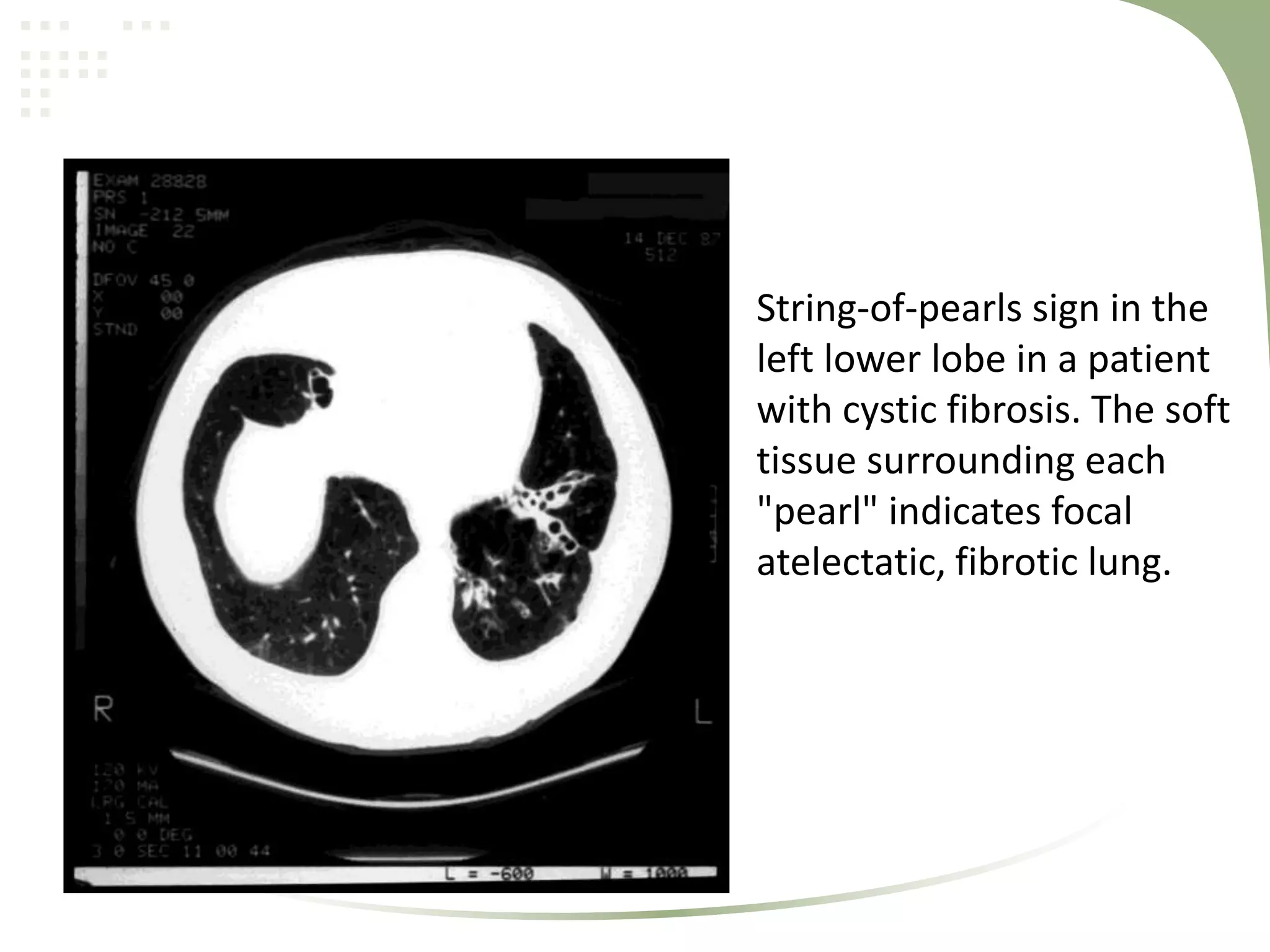
String-of-pearls sign in the
left lower lobe in a patient
with cystic fibrosis. The soft
tissue surrounding each
"pearl" indicates focal
atelectatic, fibrotic lung.
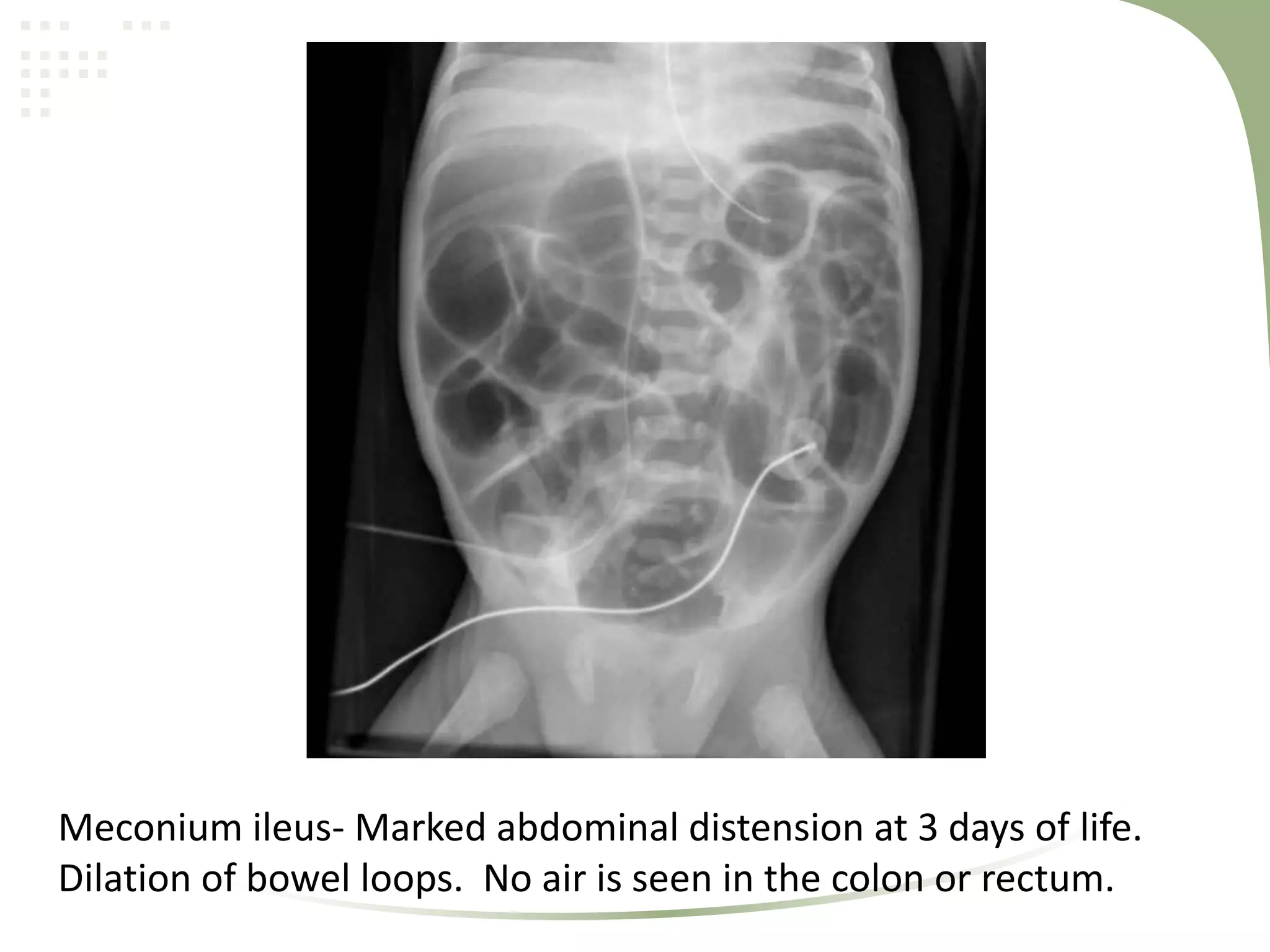
Meconium ileus- Marked abdominal distension at 3 days of life.
Dilation of bowel loops. No air is seen in the colon or rectum.
Progression to
perforation, with overt
free air under the
diaphragm and a
double air-contrast of
bowel.
There is also free air in the scrotum, from tracking of air into the
processus vaginalis. At laparotomy, a meconium plug was found.
Raised volume rapid thoracic compression
(RVRTC)
Sputum microbiology
The most common bacterial pathogens in the sputum of patients
with cystic fibrosis are as follows:
• Haemophilus influenzae
• Staphylococcus aureus
• Pseudomonas aeruginosa
• Burkholderia cepacia
• Escherichia coli
• Klebsiella pneumoniae
Immunoreactive trypsinogen (IRT)
• is a pancreatic enzyme that can help with diagnosing CF in
neonates with meconium ileus when IRT relative ratios are
elevated greater than the 99th percentile.
• IRT plus sweat test was shown to increase sensitivity and
specificity in screening.
Management
The primary goals of CF treatment include the following:
• Maintaining lung function as near to normal as possible by
controlling respiratory infection and clearing airways of mucus
• Administering nutritional therapy (ie, enzyme supplements,
multivitamin and mineral supplements) to maintain adequate
growth
• Managing complications
Mild acute pulmonary exacerbations of cystic fibrosis can be
treated successfully at home with the following measures:
• Increasing the frequency of airway clearance
• Inhaled bronchodilator treatment (especially if bronchial
hyperresponsiveness is present or as part of airway clearance
[inhaled bronchodilator followed by chest physical therapy
and postural drainage)
• Chest physical therapy and postural drainage
• Increasing the dose of the mucolytic agent dornase alfa
(Pulmozyme)
• Use of oral antibiotics (eg, oral fluoroquinolones)
Medications used to treat patients with cystic fibrosis may
include the following:
• Pancreatic enzyme supplements
• Multivitamins (including fat-soluble vitamins)
• Mucolytics
• Nebulized, inhaled, oral, or intravenous antibiotics
• Bronchodilators
• Anti-inflammatory agents
• Agents to treat associated conditions or complications (eg,
insulin, bisphosphonates)
• Agents devised to potentially reverse the abnormalities in
chloride transport (eg, ivacaftor)
Pancreatic enzyme supplements
• Pancrelipase (Creon, Pancreaze, Ultresa, Zenpep)
Mucolytics
• Dornase alpha (Pulmozyme)
Bronchodilators
• Inhaled beta2-agonist : Albuterol (AccuNeb, ProAir, Proventil
HFA, VoSpire ER, Ventolin HFA)
Vaccination
• Vaccination against Pertussis, Haemophilus influenzae,
Varicella, Streptococcus pneumoniae, and measles and annual
influenza vaccination.
Airway clearance
• Postural drainage, percussion, vibration, and assisted coughing are
recommended at the time of diagnosis and should be done on a
regular basis
Antibiotics (oral, intravenous, or inhalation)
• Aerosolized form : gentamicin, aztreonam, colistin, and
preservative-free high-dose tobramycin especially formulated for
inhalation.
• First-generation to third-generation cephalosporins gives increasing
gram-negative coverage and less gram-positive coverage, effective
against Staphylococci and Haemophilus influenza
• Fluoroquinolones are effective against most gram-positive and
gram-negative organisms, effective against P aeruginosa.
• Gentamicin is usually combined with one of the penicillins used to
treat pseudomonad infections in patients with CF.
• Aztreonam is a monobactam antibiotic that elicits activity in vitro
against gram-negative aerobic pathogens, including P aeruginosa.
Vitamins
• Fat soluble vitamins A, D, E, and K and water soluble biotin,
folic acid, niacin, pantothenic acid, B vitamins (ie, B-1, B-2, B-
6, B-12), and vitamin C.
CFTR Potentiators
• Cystic fibrosis transmembrane conductance regulator (CFTR)
potentiators are the first available treatment that targets the
defective CFTR protein.
• Ivacaftor (Kalydeco) - facilitates increased chloride transport
by potentiating the channel-open probability (or gating) of
certain CFTR gene mutations.
Surgical therapy may be required for the treatment of the
following respiratory complications:
• Pneumothorax
• Massive recurrent or persistent hemoptysis
• Nasal polyps
• Persistent and chronic sinusitis
GI tract complications requiring surgical therapy are as follows:
• Meconium ileus
• Intussusception
• Gastrostomy tube placement for supplemental feeding
• Rectal prolapse
*Lung transplantation is indicated for the treatment of end-stage
lung disease
Thank you!

Paediatric Cystic Fibrosis

  • 1.
    Cystic Fibrosis Lee MeiGie Group 88 5th course
  • 2.
    • Cystic fibrosisis an inherited disease of the exocrine glands affecting primarily the GI and respiratory systems. • It leads to chronic lung disease, exocrine pancreatic insufficiency, hepatobiliary disease, and abnormally high sweat electrolytes. Definition
  • 3.
    Etiology • CF iscarried as an autosomal recessive trait by about 3% of the white population. • The responsible gene has been localized on the long arm of chromosome 7. It encodes a membrane- associated protein called the cystic fibrosis transmembrane conductance regulator (CFTR). • CFTR is a cAMP-regulated Cl channel, regulating Cl and Na transport across epithelial membranes. • Mutation of that certain gene leads to cystic fibrosis. Disease manifests only in homozygotes.
  • 4.
    Epidemiology • If bothparents are heterozygote , there is 25% possibility of their children are homozygote and develop cystic fibrosis. • White population > Black and Asian population • Ratio male to female is 1:1 • Females with cystic fibrosis have greater deterioration of pulmonary function with increasing age and younger mean age at death due to increase in hormone secretion during puberty may interfere the defense mechanisms of the immune system.
  • 5.
    Pathophysiology Nearly all exocrineglands are affected in varying distribution and degree of severity. Glands may : • Become obstructed by viscid or solid eosinophilic material in the lumen (pancreas, intestinal glands, intrahepatic bile ducts, gallbladder, and submaxillary glands). • Appear histologically abnormal and produce excessive secretions (tracheobronchial and Brunner glands). • Appear histologically normal but secrete excessive Na and Cl (sweat, parotid, and small salivary glands).
  • 6.
    Signs and symptoms Specifictarget organ 1. Gastrointestinal tract • Meconium ileus • Abdominal distention • Intestinal obstruction • Increased frequency of stools • Failure to thrive (despite adequate appetite) • Flatulence or foul-smelling flatus, steatorrhea • Recurrent abdominal pain • Jaundice • GI bleeding
  • 7.
    2. Respiratory system •Cough • Recurrent wheezing • Recurrent pneumonia • Atypical asthma • Dyspnea on exertion • Chest pain 3. Genitourinary tract • Undescended testicles or hydrocele • Delayed secondary sexual development • Amenorrhea
  • 8.
    Physical examination Findings relatedto the pulmonary system may include the following: • Tachypnea • Respiratory distress with retractions • Wheeze or crackles • Cough (dry or productive of mucoid or purulent sputum) • Increased anteroposterior diameter of chest • Clubbing • Cyanosis • Hyperresonant chest upon percussion (crackles are heard acutely in associated pneumonitis or bronchitis and chronically with bronchiectasis)
  • 9.
    Findings related tothe GI tract include the following: • Abdominal distention • Hepatosplenomegaly (fatty liver and portal hypertension) • Rectal prolapse • Dry skin (vitamin A deficiency) • Cheilosis (vitamin B complex deficiency) Examination of other systems may reveal the following: • Scoliosis • Kyphosis • Swelling of submandibular gland or parotid gland • Aquagenic wrinkling of the palms (AWP)
  • 10.
    Complication Bronchiectasis Atelectasis Pneumothorax Hemoptysis Hypertrophic pulmonary osteoarthropathy Allergicbronchopulmonary aspergillosis (ABPA) Gastroesophageal reflux Pulmonary hypertension Cor pulmonale Pancreatitis Cystic fibrosis–related diabetes mellitus Meconium ileus Distal intestinal obstruction syndrome Rectal prolapse Vitamin deficiency (especially fat-soluble vitamins) Fatty liver Focal biliary cirrhosis Portal hypertension Liver failure Cholecystitis and cholelithiasis Rickets Osteoporosis
  • 11.
    Diagnosis The diagnosis ofcystic fibrosis (CF) is based on • Typical pulmonary manifestations, GI tract manifestations • Family history • Universal newborn screening • Prenatal screening test • Sweat test results
  • 12.
    Requirements for aCF diagnosis include either positive genetic testing or positive sweat chloride test findings (>60 mEq/L) and 1 of the following: • Typical chronic obstructive pulmonary disease • Documented exocrine pancreatic insufficiency • Positive family history (usually affected sibling)
  • 13.
    Cl concentration forinfants (up to 6 months) Result 0-29 mmol/L CF is unlikely 30-59 mmol/L intermediate ≥ 60 mmol/L Indicative of CF Cl concentration for infants older than 6 months, child and adult Result 0-39 mmol/L CF is unlikely 40-59 mmol/L intermediate ≥ 60mmol/L Indicative of CF *The sweat test must be performed at least twice in each patient, preferably several weeks apart.
  • 14.
    Other examinations • Imagingtest (X-ray, US, CT, MRI) • Genotyping • Pulmonary function test • Bronchoalveolar lavage and sputum microbiology • Immunoreactive trypsinogen • Contrast barium enema
  • 15.
    Hyperinflation and predominantlyupper lobe bronchiectasis.
  • 16.
    Complete right lung atelectasiswith extreme bronchiectasis. Marked hyperinflation of the left lung is noted.
  • 17.
    High-resolution CT imageshows bronchial wall thickening (tram lines), predominantly in the upper lobes.
  • 18.
    String-of-pearls sign inthe left lower lobe in a patient with cystic fibrosis. The soft tissue surrounding each "pearl" indicates focal atelectatic, fibrotic lung.
  • 19.
    Meconium ileus- Markedabdominal distension at 3 days of life. Dilation of bowel loops. No air is seen in the colon or rectum.
  • 21.
    Progression to perforation, withovert free air under the diaphragm and a double air-contrast of bowel.
  • 22.
    There is alsofree air in the scrotum, from tracking of air into the processus vaginalis. At laparotomy, a meconium plug was found.
  • 23.
    Raised volume rapidthoracic compression (RVRTC)
  • 24.
    Sputum microbiology The mostcommon bacterial pathogens in the sputum of patients with cystic fibrosis are as follows: • Haemophilus influenzae • Staphylococcus aureus • Pseudomonas aeruginosa • Burkholderia cepacia • Escherichia coli • Klebsiella pneumoniae
  • 25.
    Immunoreactive trypsinogen (IRT) •is a pancreatic enzyme that can help with diagnosing CF in neonates with meconium ileus when IRT relative ratios are elevated greater than the 99th percentile. • IRT plus sweat test was shown to increase sensitivity and specificity in screening.
  • 26.
    Management The primary goalsof CF treatment include the following: • Maintaining lung function as near to normal as possible by controlling respiratory infection and clearing airways of mucus • Administering nutritional therapy (ie, enzyme supplements, multivitamin and mineral supplements) to maintain adequate growth • Managing complications
  • 27.
    Mild acute pulmonaryexacerbations of cystic fibrosis can be treated successfully at home with the following measures: • Increasing the frequency of airway clearance • Inhaled bronchodilator treatment (especially if bronchial hyperresponsiveness is present or as part of airway clearance [inhaled bronchodilator followed by chest physical therapy and postural drainage) • Chest physical therapy and postural drainage • Increasing the dose of the mucolytic agent dornase alfa (Pulmozyme) • Use of oral antibiotics (eg, oral fluoroquinolones)
  • 28.
    Medications used totreat patients with cystic fibrosis may include the following: • Pancreatic enzyme supplements • Multivitamins (including fat-soluble vitamins) • Mucolytics • Nebulized, inhaled, oral, or intravenous antibiotics • Bronchodilators • Anti-inflammatory agents • Agents to treat associated conditions or complications (eg, insulin, bisphosphonates) • Agents devised to potentially reverse the abnormalities in chloride transport (eg, ivacaftor)
  • 29.
    Pancreatic enzyme supplements •Pancrelipase (Creon, Pancreaze, Ultresa, Zenpep) Mucolytics • Dornase alpha (Pulmozyme) Bronchodilators • Inhaled beta2-agonist : Albuterol (AccuNeb, ProAir, Proventil HFA, VoSpire ER, Ventolin HFA) Vaccination • Vaccination against Pertussis, Haemophilus influenzae, Varicella, Streptococcus pneumoniae, and measles and annual influenza vaccination.
  • 30.
    Airway clearance • Posturaldrainage, percussion, vibration, and assisted coughing are recommended at the time of diagnosis and should be done on a regular basis Antibiotics (oral, intravenous, or inhalation) • Aerosolized form : gentamicin, aztreonam, colistin, and preservative-free high-dose tobramycin especially formulated for inhalation. • First-generation to third-generation cephalosporins gives increasing gram-negative coverage and less gram-positive coverage, effective against Staphylococci and Haemophilus influenza • Fluoroquinolones are effective against most gram-positive and gram-negative organisms, effective against P aeruginosa. • Gentamicin is usually combined with one of the penicillins used to treat pseudomonad infections in patients with CF. • Aztreonam is a monobactam antibiotic that elicits activity in vitro against gram-negative aerobic pathogens, including P aeruginosa.
  • 31.
    Vitamins • Fat solublevitamins A, D, E, and K and water soluble biotin, folic acid, niacin, pantothenic acid, B vitamins (ie, B-1, B-2, B- 6, B-12), and vitamin C. CFTR Potentiators • Cystic fibrosis transmembrane conductance regulator (CFTR) potentiators are the first available treatment that targets the defective CFTR protein. • Ivacaftor (Kalydeco) - facilitates increased chloride transport by potentiating the channel-open probability (or gating) of certain CFTR gene mutations.
  • 32.
    Surgical therapy maybe required for the treatment of the following respiratory complications: • Pneumothorax • Massive recurrent or persistent hemoptysis • Nasal polyps • Persistent and chronic sinusitis GI tract complications requiring surgical therapy are as follows: • Meconium ileus • Intussusception • Gastrostomy tube placement for supplemental feeding • Rectal prolapse *Lung transplantation is indicated for the treatment of end-stage lung disease
  • 33.