Lung Abscess
Dr. Ammar Sabir Sididqui
MD Medicine
Assistant Professor, Department of Medicine
• Lung abscess represents necrosis and cavitation of the lung following
microbial infection
• Lung abscesses can be single or multiple but usually are marked by a
single dominant cavity >2 cm in diameter
• Types
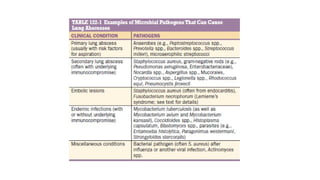
• Primary : ( 80 %)
• Lung abscesses usually arise from aspiration.
• Often caused principally by anaerobic bacteria
• Occur in the absence of an underlying pulmonary or systemic
condition
• Secondary :
• Lung abscesses arise in the setting of an underlying condition
• As a post obstructive process as a bronchial foreign body or tumor
OR
• A systemic process as HIV infection or other immunocompromised
condition
• Acute :
• Duration : < 4-6 weeks
• Chronic :
• Duration : > 6weeks
• Comprises 40% of cases
• Epidemiology
• Middle-aged men are more commonly affected than women
• Incidence of lung abscess acquired in the community is unknown but
common clinical problem seen in developing countries
• Incidence was high in pre-antibiotic era but the advent of susceptible
antibiotics has reduced the mortality to 8.7%
• Risk factors :
• Patients on risk of aspiration
• With altered mental abscess, alcoholism, seizures
• With cerebrovascular or cardiovascular events
• With esophageal disabilities as dysmotility , strictures or
gastroesophageal reflux who spend most time in the recumbent
position
• Patients with gingivitis and periodontal disease
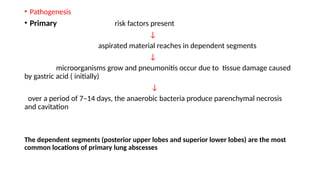
• Pathogenesis
• Primary risk factors present
↓
aspirated material reaches in dependent segments
↓
microorganisms grow and pneumonitis occur due to tissue damage caused
by gastric acid ( initially)
↓
over a period of 7–14 days, the anaerobic bacteria produce parenchymal necrosis
and cavitation
The dependent segments (posterior upper lobes and superior lower lobes) are the most
common locations of primary lung abscesses
• Continue..
• Secondary
• The pathogenesis depends on the predisposing factor
• As in cases of bronchial obstruction from malignancy or a foreign
body, the obstructing lesion prevents clearance of oropharyngeal
secretions, leading to abscess development.
• Continue ..
• Immunosuppression after bone marrow or organ transplantation leads to
impaired host defense mechanisms lead to increased susceptibility to the
development of lung abscesses
• Lung abscesses also arise from septic emboli, either in tricuspid valve
endocarditis (often involving Staphylococcus aureus) or in Lemierre’s
syndrome, in which an infection begins in the pharynx (classically involving
Fusobacterium necrophorum) and then spreads to the neck and the
carotid sheath (which contains the jugular vein) to cause septic
thrombophlebitis.
• Pathology and microorganism
• Primary
• The dependent segments (posterior upper lobes and superior lower
lobes) are the most common locations of primary lung abscesses for
aspirated materials to be deposited.
• Generally, the right lung is affected more commonly than the left
because the right mainstem bronchus is less angulated
• The microbiology of primary lung abscesses is often polymicrobial,
primarily including anaerobic organisms as well as microaerophilic
streptococci
• Continue ..
• Nearly in 40% cases no pathogen is isolated from a primary lung
abscess,it is termed a nonspecific lung abscess, and the presence of
anaerobes is often presumed.
• A putrid lung abscess refers to cases with foul-smelling breath,
sputum, or empyema; these manifestations are essentially diagnostic
of an anaerobic lung abscess
• Continue ..
• Secondary
• The location of secondary abscesses may vary with the underlying
cause.
• Infection by Pseudomonas aeruginosa and other gram-negative rods
most common.
• In immunocompromised patients and patients from certain endemic
areas may be affected by broad range of organisms
• Clinical manifestations:
• Fever
• Cough with sputum production ( may be discoloured and foul smelling)
• Night sweats, fatigue
• Hemoptysis
• Chest pain
• Patients with lung abscesses due to non-anaerobic organisms, such as S.
aureus, may present with a more fulminant course characterized by high
fevers and rapid progression
• Investigations
• CBC – may show anaemia
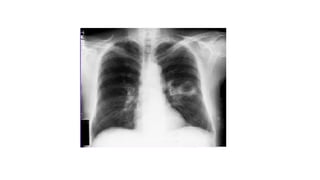
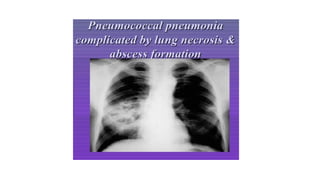
• Chest Xray
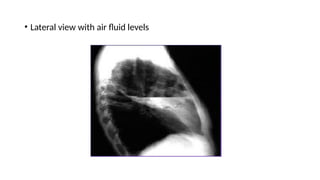
• Thick-walled cavity with an air-fluid level is seen
• As surrounding infection involves ,thicknesss of abcess wall is reduced
• Cavity wall can be smooth or ragged but if nodular, suspicion of
carcinoma is raised
• Lateral view with air fluid levels
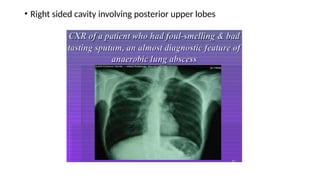
• Right sided cavity involving posterior upper lobes
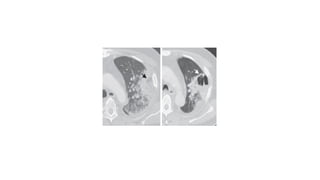
• CT scan
• CT permits better definition and may provide earlier evidence of
cavitation.
• CT may also yield additional information regarding a possible
underlying cause of lung abscess, such as malignancy, and may help
distinguish a peripheral lung abscess from a pleural infection.
• This distinction has important implications for treatment because a
pleural space infection, such as an empyema, may require urgent
drainage.
• Continue …
• Trans tracheal aspirate may provide microbiologic diagnosis
• Flexible fibreoptic bronchoscopy, bronchoalveolar lavage and CT-
guided percutaneous needle aspiration, can be undertaken.
• Continue ..
• When a secondary lung abscess is present or empirical therapy fails to
elicit a response, sputum and blood cultures are advised in addition to
serologic studies for opportunistic pathogens (e.g., viruses and
fungi )causing infections in immunocompromised hosts
• However risk of spillage of abscess contents into the other lung (with
bronchoscopy) and pneumothorax and bronchopleural fistula
development is associated with invasive procedures
• Treatment
• Primary lung abscess
• (1) clindamycin (600 mg IV three times daily; then, with the
disappearance of fever and clinical improvement, 300 mg PO four
times daily) or
• (2) an IV-administered β-lactam/β-lactamase combination, followed—
once the patient’s condition is stable—by orally administered
amoxicillin-clavulanate.
• This therapy should be continued until imaging demonstrates that the
lung abscess has cleared or regressed
• Duration 3-4 weeks
• Continue ..
• Secondary lung abscess
• Mainly depends on treat the underlying cause
• Treatment of identified specific organism
• Prolong course of therapy may be needed
• An abscess > 6–8 cm in diameter is less likely to respond to antibiotic
therapy ,surgical intervention may be needed
• Complications
• Empyema
• Fibrosis
• Bronchopleural fistula
• Percutaneous needle fistula
• Respiratory failure
lung abscess-types, clinical features, treatment

lung abscess-types, clinical features, treatment

  • 1.
    Lung Abscess Dr. AmmarSabir Sididqui MD Medicine Assistant Professor, Department of Medicine
  • 2.
    • Lung abscessrepresents necrosis and cavitation of the lung following microbial infection • Lung abscesses can be single or multiple but usually are marked by a single dominant cavity >2 cm in diameter
  • 3.
    • Types • Primary: ( 80 %) • Lung abscesses usually arise from aspiration. • Often caused principally by anaerobic bacteria • Occur in the absence of an underlying pulmonary or systemic condition
  • 4.
    • Secondary : •Lung abscesses arise in the setting of an underlying condition • As a post obstructive process as a bronchial foreign body or tumor OR • A systemic process as HIV infection or other immunocompromised condition
  • 5.
    • Acute : •Duration : < 4-6 weeks • Chronic : • Duration : > 6weeks • Comprises 40% of cases
  • 6.
    • Epidemiology • Middle-agedmen are more commonly affected than women • Incidence of lung abscess acquired in the community is unknown but common clinical problem seen in developing countries • Incidence was high in pre-antibiotic era but the advent of susceptible antibiotics has reduced the mortality to 8.7%
  • 7.
    • Risk factors: • Patients on risk of aspiration • With altered mental abscess, alcoholism, seizures • With cerebrovascular or cardiovascular events • With esophageal disabilities as dysmotility , strictures or gastroesophageal reflux who spend most time in the recumbent position • Patients with gingivitis and periodontal disease
  • 8.
    • Pathogenesis • Primaryrisk factors present ↓ aspirated material reaches in dependent segments ↓ microorganisms grow and pneumonitis occur due to tissue damage caused by gastric acid ( initially) ↓ over a period of 7–14 days, the anaerobic bacteria produce parenchymal necrosis and cavitation The dependent segments (posterior upper lobes and superior lower lobes) are the most common locations of primary lung abscesses
  • 9.
    • Continue.. • Secondary •The pathogenesis depends on the predisposing factor • As in cases of bronchial obstruction from malignancy or a foreign body, the obstructing lesion prevents clearance of oropharyngeal secretions, leading to abscess development.
  • 10.
    • Continue .. •Immunosuppression after bone marrow or organ transplantation leads to impaired host defense mechanisms lead to increased susceptibility to the development of lung abscesses • Lung abscesses also arise from septic emboli, either in tricuspid valve endocarditis (often involving Staphylococcus aureus) or in Lemierre’s syndrome, in which an infection begins in the pharynx (classically involving Fusobacterium necrophorum) and then spreads to the neck and the carotid sheath (which contains the jugular vein) to cause septic thrombophlebitis.
  • 12.
    • Pathology andmicroorganism • Primary • The dependent segments (posterior upper lobes and superior lower lobes) are the most common locations of primary lung abscesses for aspirated materials to be deposited. • Generally, the right lung is affected more commonly than the left because the right mainstem bronchus is less angulated • The microbiology of primary lung abscesses is often polymicrobial, primarily including anaerobic organisms as well as microaerophilic streptococci
  • 13.
    • Continue .. •Nearly in 40% cases no pathogen is isolated from a primary lung abscess,it is termed a nonspecific lung abscess, and the presence of anaerobes is often presumed. • A putrid lung abscess refers to cases with foul-smelling breath, sputum, or empyema; these manifestations are essentially diagnostic of an anaerobic lung abscess
  • 14.
    • Continue .. •Secondary • The location of secondary abscesses may vary with the underlying cause. • Infection by Pseudomonas aeruginosa and other gram-negative rods most common. • In immunocompromised patients and patients from certain endemic areas may be affected by broad range of organisms
  • 15.
    • Clinical manifestations: •Fever • Cough with sputum production ( may be discoloured and foul smelling) • Night sweats, fatigue • Hemoptysis • Chest pain • Patients with lung abscesses due to non-anaerobic organisms, such as S. aureus, may present with a more fulminant course characterized by high fevers and rapid progression
  • 16.
    • Investigations • CBC– may show anaemia • Chest Xray • Thick-walled cavity with an air-fluid level is seen • As surrounding infection involves ,thicknesss of abcess wall is reduced • Cavity wall can be smooth or ragged but if nodular, suspicion of carcinoma is raised
  • 17.
    • Lateral viewwith air fluid levels
  • 20.
    • Right sidedcavity involving posterior upper lobes
  • 21.
    • CT scan •CT permits better definition and may provide earlier evidence of cavitation. • CT may also yield additional information regarding a possible underlying cause of lung abscess, such as malignancy, and may help distinguish a peripheral lung abscess from a pleural infection. • This distinction has important implications for treatment because a pleural space infection, such as an empyema, may require urgent drainage.
  • 23.
    • Continue … •Trans tracheal aspirate may provide microbiologic diagnosis • Flexible fibreoptic bronchoscopy, bronchoalveolar lavage and CT- guided percutaneous needle aspiration, can be undertaken.
  • 24.
    • Continue .. •When a secondary lung abscess is present or empirical therapy fails to elicit a response, sputum and blood cultures are advised in addition to serologic studies for opportunistic pathogens (e.g., viruses and fungi )causing infections in immunocompromised hosts • However risk of spillage of abscess contents into the other lung (with bronchoscopy) and pneumothorax and bronchopleural fistula development is associated with invasive procedures
  • 25.
    • Treatment • Primarylung abscess • (1) clindamycin (600 mg IV three times daily; then, with the disappearance of fever and clinical improvement, 300 mg PO four times daily) or • (2) an IV-administered β-lactam/β-lactamase combination, followed— once the patient’s condition is stable—by orally administered amoxicillin-clavulanate. • This therapy should be continued until imaging demonstrates that the lung abscess has cleared or regressed • Duration 3-4 weeks
  • 26.
    • Continue .. •Secondary lung abscess • Mainly depends on treat the underlying cause • Treatment of identified specific organism • Prolong course of therapy may be needed • An abscess > 6–8 cm in diameter is less likely to respond to antibiotic therapy ,surgical intervention may be needed
  • 27.
    • Complications • Empyema •Fibrosis • Bronchopleural fistula • Percutaneous needle fistula • Respiratory failure