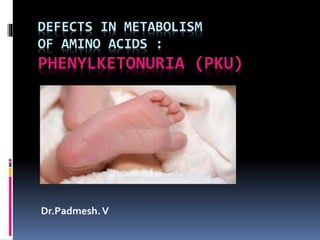
DEFECTS IN METABOLISM
OF AMINO ACIDS :
PHENYLKETONURIA (PKU)
Dr.Padmesh.V
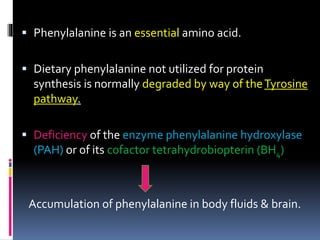
 Phenylalanine is an essential amino acid.
 Dietary phenylalanine not utilized for protein
synthesis is normally degraded by way of theTyrosine
pathway.
 Deficiency of the enzyme phenylalanine hydroxylase
(PAH) or of its cofactor tetrahydrobiopterin (BH4)
Accumulation of phenylalanine in body fluids & brain.
 The severity of hyperphenylalaninemia depends on the
degree of enzyme deficiency .
 May vary from very high plasma concentrations
( >20 mg/dL, classic phenylketonuria [PKU] ) to
mildly elevated levels, hyperphenylalaninemia
(2-6 mg/dL).
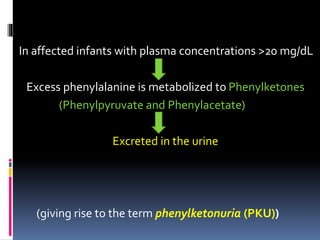
In affected infants with plasma concentrations >20 mg/dL
Excess phenylalanine is metabolized to Phenylketones
(Phenylpyruvate and Phenylacetate)
Excreted in the urine
(giving rise to the term phenylketonuria (PKU))
 The brain is the main organ affected by
hyperphenylalaninemia.
 The CNS damage in affected patients is caused by the
elevated concentration of phenylalanine in brain
tissue.
 The high blood levels of phenylalanine in PKU saturate
the transport system across the blood-brain barrier
causing inhibition of the cerebral uptake of other large
neutral amino acids such as tyrosine and tryptophan.
 All defects causing hyperphenylalaninemia are
inherited as autosomal recessive traits.
 Prenatal diagnosis is possible using specific
genetic probes in cells obtained from chorionic
villi biopsy.
Classic Phenylketonuria
(Plasma phenylalanine levels >20 mg/dL)
 Clinical Manifestations
 The affected infant is normal at birth.
 Profound mental retardation develops gradually if
the infant remains untreated.
 Cognitive delay may not be evident for the 1st few
months.
 In untreated patients, 50-70% will have an IQ
below 35, and 88-90% below 65.
Only 2-5% of untreated patients will have normal
intelligence.
 Clinical Manifestations
 Vomiting, sometimes severe enough to be
misdiagnosed as pyloric stenosis, may be an early
symptom.
 Older untreated children become hyperactive
with autistic behaviors, including purposeless
hand movements, rhythmic rocking, and
athetosis.
 Clinical Manifestations
 The infants are lighter in their complexion than
unaffected siblings.
 Some may have a seborrheic or eczematoid rash,
(mild and disappears as the child grows older).
 These children have an unpleasant MUSTY or
MOUSEY odour of phenylacetic acid.
 Clinical Manifestations
 Neurologic signs : Seizures (≈25%), spasticity,
hyperreflexia, and tremors.
 More than 50% have EEG abnormalities.
 Microcephaly, prominent maxillae with widely
spaced teeth, enamel hypoplasia, and growth
retardation.
Milder Forms of
Hyperphenylalaninemia /
Non-PKU Hyperphenylalaninemias
(Plasma phenylalanine levels >2 mg/dL,
but <20 mg/dL)
 These infants do not excrete phenylketones.
 But may still require dietary interventions.
 Possibility of deficiency of BH4 should be
investigated in all infants with the milder forms of
hyperphenylalaninemia.
 Diagnosis :
 Usually diagnosed through Newborn screening.
 If screening is positive  diagnosis should be
confirmed by quantitative measurement of plasma
phenylalanine concentration.
 Identification and measurement of phenylketones in
the urine has no place in any screening program.
 In countries where such programs are not in effect,
identification of phenylketones in the urine by ferric
chloride may offer a simple test for diagnosis of
infants with developmental and neurologic
abnormalities.
 Diagnosis :
 Once hyperphenylalaninemia is diagnosed,
additional studies for biopterin metabolism should
be performed to rule out biopterin deficiency as
the cause of hyperphenylalaninemia.
 Neonatal Screening for Hyperphenylalaninemia :
 The method of choice isTandem mass
spectrometry (MS/MS), which identifies all forms
of hyperphenyalaninemia with a low false-positive
rate, and excellent accuracy and precision.
 The addition of the phenylalanine/tyrosine molar
ratio has further reduced the number of false-
positive results.
 Diagnosis must be confirmed by measurement of
plasma phenylalanine concentration.
 Blood phenylalanine in affected infants with PKU
may rise to diagnostic levels as early as 4 hr after
birth even in the absence of protein feeding.
 It is recommended that the blood for screening be
obtained in the FIRST 24-48 hr of life after feeding
protein to reduce the possibility of false-negative
results, especially in the milder forms of the
condition.
 Treatment
 Goal of therapy:To reduce phenylalanine levels in plasma
& brain.
 Infants with persistent (more than a few days) plasma
levels of phenylalanine >6 mg/dL should be treated with a
phenylalanine-restricted diet similar to that for classic
PKU.
 Formulas low in or free of phenylalanine.
 The diet should be started as soon as diagnosis is
established.
 Treatment
 Because phenylalanine is not synthesized endogenously,
small amounts of phenylalanine should be added to the
diet to prevent phenylalanine deficiency.
 Dietary deficiency of phenylalanine is manifested by
lethargy, failure to thrive, anorexia, anemia, rashes,
diarrhea, and even death.
 Tyrosine becomes an essential amino acid in this disorder
and its adequate intake must be ensured.
 Treatment
 Plasma phenylalanine levels to be maintained:
 In neonates through 12 yr of age: Between 2 - 6 mg/dL
 In older individuals: Between 2 - 10 mg/dL
 Discontinuation of therapy, even in adulthood, may cause
deterioration of IQ and cognitive performance 
Therefore phenylalanine-restricted diet should be
continued for life.
 Treatment
 Oral administration of Tetrahydrobiopterin (BH4) may
result in reduction of plasma levels of phenylalanine in
some patients with PAH deficiency.
 Sapropterin, a synthetic form of BH4 is approved by
the Food and Drug Administration (FDA) to reduce
phenylalanine levels in PKU.
At a dose of 10 mg/kg/day, it reduces phenylalanine
levels in up to 50% of patients.
Hyperphenylalaninemia
due to Deficiency of
the Cofactor BH4
 In 1-3% of infants with hyperphenylalaninemia, the defect
resides in 1 of the enzymes necessary for production or recycling
of the cofactor BH4.
 If these infants are misdiagnosed as having PKU, they may
deteriorate neurologically despite adequate control of plasma
phenylalanine.
 In addition to acting as a cofactor for PAH, BH4 is also a cofactor
for tyrosine hydroxylase and tryptophan hydroxylase, which are
involved in the biosynthesis of dopamine and serotonin.
 Therefore, patients with hyperphenylalaninemia due to BH4
deficiency also manifest neurologic findings related to
deficiencies of the neurotransmitters dopamine and serotonin.
 Clinical Manifestations
 Clinical manifestations of the neurotransmitter disorders
differ greatly from those of PKU.
 Neurologic symptoms of the neurotransmitter disorders
often manifest in the 1st few months of life.
 Include extrapyramidal signs with choreoathetotic or
dystonic limb movements, axial and truncal hypotonia,
hypokinesia, feeding difficulties, and autonomic problems.
 Mental retardation, seizures, hypersalivation, and
swallowing difficulties are also seen.
 The symptoms are usually progressive and often have a
marked diurnal fluctuation.
 Diagnosis
 1. Measurement of neopterin and biopterin in body
fluids, especially urine.
 In addition, examination of cerebrospinal fluid (CSF) reveals
decreased levels of dopamine, serotonin, and their
metabolites in all patients with BH4 deficiency.
 2. BH4 loading test;
 3. Enzyme assay: The activity of dihydropteridine
reductase can be measured in the dry blood spots on
the filter paper used for screening purposes.
 Treatment
 The goals of therapy are:
 To correct hyperphenylalaninemia, and
 To restore neurotransmitter deficiencies in the CNS.
 Plasma phenylalanine should be maintained as close to normal
as possible (<6 mg/dL).
 This can be achieved by a combination of a low phenylalanine
diet and oral supplementation of BH4.
 Infants with GTP cyclohydrolase or 6-PTS deficiencies respond
more readily to BH4 therapy (5-10 mg/kg/day) than those with
dihydropteridine reductase deficiency. In the latter patients,
doses as high as 20 mg/kg/day may be required.
 Treatment
 Lifelong supplementation with neurotransmitter
precursors such as L-dopa and 5-hydroxytryptophan,
along with carbidopa.
 Supplementation with folinic acid in patients with
dihydropteridine reductase deficiency.
 Some drugs such as trimethoprim-sulfamethoxazole,
methotrexate, and other antileukemic agents are known to
inhibit dihydropteridine reductase enzyme activity and
should be used with great caution in patients with BH4
deficiency.
www.slideshare.net/Dr_Padmesh
dnbpediatricstheory.blogspot.com/
oscepediatrics.blogspot.com/

Phenylketonuria ( PKU) - Dr Padmesh

  • 1.
    DEFECTS IN METABOLISM OFAMINO ACIDS : PHENYLKETONURIA (PKU) Dr.Padmesh.V
  • 2.
     Phenylalanine isan essential amino acid.  Dietary phenylalanine not utilized for protein synthesis is normally degraded by way of theTyrosine pathway.  Deficiency of the enzyme phenylalanine hydroxylase (PAH) or of its cofactor tetrahydrobiopterin (BH4) Accumulation of phenylalanine in body fluids & brain.
  • 3.
     The severityof hyperphenylalaninemia depends on the degree of enzyme deficiency .  May vary from very high plasma concentrations ( >20 mg/dL, classic phenylketonuria [PKU] ) to mildly elevated levels, hyperphenylalaninemia (2-6 mg/dL).
  • 4.
    In affected infantswith plasma concentrations >20 mg/dL Excess phenylalanine is metabolized to Phenylketones (Phenylpyruvate and Phenylacetate) Excreted in the urine (giving rise to the term phenylketonuria (PKU))
  • 5.
     The brainis the main organ affected by hyperphenylalaninemia.  The CNS damage in affected patients is caused by the elevated concentration of phenylalanine in brain tissue.  The high blood levels of phenylalanine in PKU saturate the transport system across the blood-brain barrier causing inhibition of the cerebral uptake of other large neutral amino acids such as tyrosine and tryptophan.
  • 6.
     All defectscausing hyperphenylalaninemia are inherited as autosomal recessive traits.  Prenatal diagnosis is possible using specific genetic probes in cells obtained from chorionic villi biopsy.
  • 7.
  • 8.
     Clinical Manifestations The affected infant is normal at birth.  Profound mental retardation develops gradually if the infant remains untreated.  Cognitive delay may not be evident for the 1st few months.  In untreated patients, 50-70% will have an IQ below 35, and 88-90% below 65. Only 2-5% of untreated patients will have normal intelligence.
  • 9.
     Clinical Manifestations Vomiting, sometimes severe enough to be misdiagnosed as pyloric stenosis, may be an early symptom.  Older untreated children become hyperactive with autistic behaviors, including purposeless hand movements, rhythmic rocking, and athetosis.
  • 10.
     Clinical Manifestations The infants are lighter in their complexion than unaffected siblings.  Some may have a seborrheic or eczematoid rash, (mild and disappears as the child grows older).  These children have an unpleasant MUSTY or MOUSEY odour of phenylacetic acid.
  • 11.
     Clinical Manifestations Neurologic signs : Seizures (≈25%), spasticity, hyperreflexia, and tremors.  More than 50% have EEG abnormalities.  Microcephaly, prominent maxillae with widely spaced teeth, enamel hypoplasia, and growth retardation.
  • 12.
    Milder Forms of Hyperphenylalaninemia/ Non-PKU Hyperphenylalaninemias (Plasma phenylalanine levels >2 mg/dL, but <20 mg/dL)
  • 13.
     These infantsdo not excrete phenylketones.  But may still require dietary interventions.  Possibility of deficiency of BH4 should be investigated in all infants with the milder forms of hyperphenylalaninemia.
  • 14.
     Diagnosis : Usually diagnosed through Newborn screening.  If screening is positive  diagnosis should be confirmed by quantitative measurement of plasma phenylalanine concentration.  Identification and measurement of phenylketones in the urine has no place in any screening program.  In countries where such programs are not in effect, identification of phenylketones in the urine by ferric chloride may offer a simple test for diagnosis of infants with developmental and neurologic abnormalities.
  • 15.
     Diagnosis : Once hyperphenylalaninemia is diagnosed, additional studies for biopterin metabolism should be performed to rule out biopterin deficiency as the cause of hyperphenylalaninemia.
  • 16.
     Neonatal Screeningfor Hyperphenylalaninemia :  The method of choice isTandem mass spectrometry (MS/MS), which identifies all forms of hyperphenyalaninemia with a low false-positive rate, and excellent accuracy and precision.  The addition of the phenylalanine/tyrosine molar ratio has further reduced the number of false- positive results.  Diagnosis must be confirmed by measurement of plasma phenylalanine concentration.
  • 17.
     Blood phenylalaninein affected infants with PKU may rise to diagnostic levels as early as 4 hr after birth even in the absence of protein feeding.  It is recommended that the blood for screening be obtained in the FIRST 24-48 hr of life after feeding protein to reduce the possibility of false-negative results, especially in the milder forms of the condition.
  • 18.
     Treatment  Goalof therapy:To reduce phenylalanine levels in plasma & brain.  Infants with persistent (more than a few days) plasma levels of phenylalanine >6 mg/dL should be treated with a phenylalanine-restricted diet similar to that for classic PKU.  Formulas low in or free of phenylalanine.  The diet should be started as soon as diagnosis is established.
  • 19.
     Treatment  Becausephenylalanine is not synthesized endogenously, small amounts of phenylalanine should be added to the diet to prevent phenylalanine deficiency.  Dietary deficiency of phenylalanine is manifested by lethargy, failure to thrive, anorexia, anemia, rashes, diarrhea, and even death.  Tyrosine becomes an essential amino acid in this disorder and its adequate intake must be ensured.
  • 20.
     Treatment  Plasmaphenylalanine levels to be maintained:  In neonates through 12 yr of age: Between 2 - 6 mg/dL  In older individuals: Between 2 - 10 mg/dL  Discontinuation of therapy, even in adulthood, may cause deterioration of IQ and cognitive performance  Therefore phenylalanine-restricted diet should be continued for life.
  • 21.
     Treatment  Oraladministration of Tetrahydrobiopterin (BH4) may result in reduction of plasma levels of phenylalanine in some patients with PAH deficiency.  Sapropterin, a synthetic form of BH4 is approved by the Food and Drug Administration (FDA) to reduce phenylalanine levels in PKU. At a dose of 10 mg/kg/day, it reduces phenylalanine levels in up to 50% of patients.
  • 22.
  • 23.
     In 1-3%of infants with hyperphenylalaninemia, the defect resides in 1 of the enzymes necessary for production or recycling of the cofactor BH4.  If these infants are misdiagnosed as having PKU, they may deteriorate neurologically despite adequate control of plasma phenylalanine.  In addition to acting as a cofactor for PAH, BH4 is also a cofactor for tyrosine hydroxylase and tryptophan hydroxylase, which are involved in the biosynthesis of dopamine and serotonin.  Therefore, patients with hyperphenylalaninemia due to BH4 deficiency also manifest neurologic findings related to deficiencies of the neurotransmitters dopamine and serotonin.
  • 24.
     Clinical Manifestations Clinical manifestations of the neurotransmitter disorders differ greatly from those of PKU.  Neurologic symptoms of the neurotransmitter disorders often manifest in the 1st few months of life.  Include extrapyramidal signs with choreoathetotic or dystonic limb movements, axial and truncal hypotonia, hypokinesia, feeding difficulties, and autonomic problems.  Mental retardation, seizures, hypersalivation, and swallowing difficulties are also seen.  The symptoms are usually progressive and often have a marked diurnal fluctuation.
  • 25.
     Diagnosis  1.Measurement of neopterin and biopterin in body fluids, especially urine.  In addition, examination of cerebrospinal fluid (CSF) reveals decreased levels of dopamine, serotonin, and their metabolites in all patients with BH4 deficiency.  2. BH4 loading test;  3. Enzyme assay: The activity of dihydropteridine reductase can be measured in the dry blood spots on the filter paper used for screening purposes.
  • 26.
     Treatment  Thegoals of therapy are:  To correct hyperphenylalaninemia, and  To restore neurotransmitter deficiencies in the CNS.  Plasma phenylalanine should be maintained as close to normal as possible (<6 mg/dL).  This can be achieved by a combination of a low phenylalanine diet and oral supplementation of BH4.  Infants with GTP cyclohydrolase or 6-PTS deficiencies respond more readily to BH4 therapy (5-10 mg/kg/day) than those with dihydropteridine reductase deficiency. In the latter patients, doses as high as 20 mg/kg/day may be required.
  • 27.
     Treatment  Lifelongsupplementation with neurotransmitter precursors such as L-dopa and 5-hydroxytryptophan, along with carbidopa.  Supplementation with folinic acid in patients with dihydropteridine reductase deficiency.  Some drugs such as trimethoprim-sulfamethoxazole, methotrexate, and other antileukemic agents are known to inhibit dihydropteridine reductase enzyme activity and should be used with great caution in patients with BH4 deficiency.
  • 28.