


MPEP1305: ENVIRONMENTAL ECONOMICS AND PROJECT APPRAISAL
HRISHIKESH SATPUTE (2019MEP012)
THE KALDOR-HICKS COMPENSATION PRINCIPLE
NICHOLAS KALDOR AND JOHN HICKS
1. Background
2. Concept
3. Examples
4. Discussion
5. Conclusion
6. References
CONTENTS
BACKGROUND
The two approaches to address the inability of Pareto
criterion to handle mixed outcomes as:
a) Compensation Principle
b) Social Welfare Function
Economists like Kaldor, Hicks and Scitovsky have made
efforts to evaluate the changes in social welfare resulting
from any economic re-organisation which harms somebody
and benefits the others. These economists have sought to
remove indeterminacy in the analysis of Pareto optimality.
1. An individual himself is the best judge of his
satisfaction which is independent of the satisfaction of
others.
2. There is constancy of the tastes of the individuals.
3. There can be ordinal measurement of utility.
4. The inter-personal utilities comparisons are not
possible.
5. There is an absence of externalities in production and
consumption.
Assumptions:
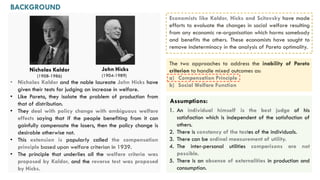
John Hicks
(1904-1989)
Nicholas Kaldor
(1908-1986)
• Nicholas Kaldor and the noble laureate John Hicks have
given their tests for judging an increase in welfare.
• Like Pareto, they isolate the problem of production from
that of distribution.
• They deal with policy change with ambiguous welfare
effects saying that if the people benefiting from it can
gainfully compensate the losers, then the policy change is
desirable otherwise not.
• This extension is popularly called the compensation
principle based upon welfare criterion in 1939.
• The principle that underlies all the welfare criteria was
proposed by Kaldor, and the reverse test was proposed
by Hicks.
▪ If a change in allocations or economic policy
makes A better off, without making B worse off,
then Social Welfare (SW) will increase if A can
compensate (hypothetically) B for his loss, and
still be better off, leading to the Pareto
improved outcome.
Example: If fishing is prohibited in a lake, but
swimming and boating are allowed, then fishermen
are worse off, but tourists are better off. Has
social welfare increased or decreased?
▪ If the latter pay compensation to the fishermen
for the loss of their income due to the new law,
then social welfare can remain constant.
Compensation Principle
CONCEPT
Kaldor Compensation Criterion
The project is desirable according to Kaldor
compensation criterion if gainers can compensate
losers in state B in such a way that everyone
becomes better off compared to state A.
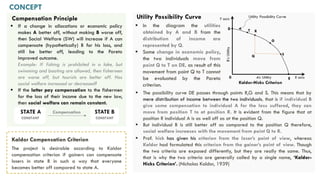
▪ The possibility curve DE passes through points R,G and S. This means that by
mere distribution of income between the two individuals, that is if individual B
give some compensation to individual A for the loss suffered, they can
move from position T to at position R. It is evident from the figure that at
position R individual A is as well off as at the position Q.
▪ But individual B is still better off as compared to the position Q therefore,
social welfare increases with the movement from point Q to R.
Utility Possibility Curve
STATE A
GAINER
STATE B
LOSER
Compensation
▪ In the diagram the utilities
obtained by A and B from the
distribution of income are
represented by Q.
▪ Some change in economic policy,
the two individuals move from
point Q to T on DE, as result of this
movement from point Q to T cannot
be evaluated by the Pareto
criterion.
▪ Prof. hick has given his criterion from the loser’s point of view, whereas
Kaldor had formulated this criterion from the gainer’s point of view. Though
the two criteria are exposed differently, but they are really the same. Thus,
that is why the two criteria are generally called by a single name, ‘Kaldor-
Hicks Criterion’. (Nicholas Kaldor, 1939)
STATE B
CONSTANT
STATE A
CONSTANT
EXAMPLE
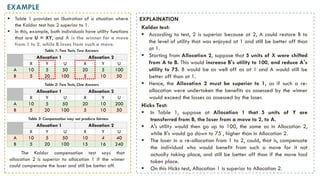
▪ Table 1 provides an illustration of a situation where
the Kaldor test has 2 superior to 1.
▪ In this, example, both individuals have utility functions
that are U = XY, and A is the winner for a move
from 1 to 2, while B loses from such a move.
EXPLAINATION
Allocation 1 Allocation 2
X Y U X Y U
A 10 5 50 20 5 100
B 5 20 100 5 10 50
Allocation 1 Allocation 2
X Y U X Y U
A 10 5 50 20 10 200
B 5 20 100 5 10 50
Allocation 1 Allocation 2
X Y U X Y U
A 10 5 50 10 4 40
B 5 20 100 15 16 240
Kaldor test:
▪ According to test, 2 is superior because at 2, A could restore B to
the level of utility that was enjoyed at 1 and still be better off than
at 1.
▪ Starting from Allocation 2, suppose that 5 units of X were shifted
from A to B. This would increase B's utility to 100, and reduce A's
utility to 75. B would be as well off as at 1 and A would still be
better off than at 1.
▪ Hence, the Allocation 2 must be superior to 1, as if such a re-
allocation were undertaken the benefits as assessed by the winner
would exceed the losses as assessed by the loser.
Hicks Test:
▪ In Table 1, suppose at Allocation 1 that 5 units of Y are
transferred from B, the loser from a move to 2, to A.
▪ A's utility would then go up to 100, the same as in Allocation 2,
while B's would go down to 75 , higher than in Allocation 2.
▪ The loser in a re-allocation from 1 to 2, could, that is, compensate
the individual who would benefit from such a move for it not
actually taking place, and still be better off than if the move had
taken place.
▪ On this Hicks test, Allocation 1 is superior to Allocation 2.
Table 1: Two Tests, Two Answers
Table 2: Two Tests, One Answers
Table 3: Compensation may not produce fairness
The Kaldor compensation test says that
allocation 2 is superior to allocation 1 if the winner
could compensate the loser and still be better off.
CRITICISM
▪ This criterion implicitly assumes that marginal utility of
money is the same for all the individuals in the society.
▪ It suggested potential compensation rather than actual
compensation. In case the potential compensation is not paid,
the welfare would be measured only in terms of utility and
that would require the inter personal comparisons of utility
and value judgements.
▪ It evaluates the gains and losses due to an economic change
in money terms, overlooking the real value of gains and
losses.
▪ It ignores the existing distribution of income of the
community. If the income distribution is unequal, the
compensation by the gainers (the rich) paid out to losers (the
poor) will fail to offset the loss on account of the differences
in the marginal utility of money in case of the rich and the
poor.
▪ This theory involves interpersonal comparison the welfare
economists wanted to avoid.
▪ This theory isolated the production and exchange from
distribution and this ignores distribution.
▪ Economic welfare could not be increased by a resource
reallocation unless the compensation is actually paid.
DISCUSSION AND CONCLUSION
▪ The compensation principle is stated in terms of potential
compensation rather than actual compensation
▪ If compensation were required, the compensation principle would
be equivalent to Pareto principle (consider example for Kaldor
compensation criterion)
▪ Considering the hypothetical compensation allows one to focus
on the efficiency aspects of the policy change
▪ In other words, a policy change is desirable according to the
compensation criterion if total revenue resulting from the policy
change exceeds total cost
▪ Through each Pareto improvement could be Kaldor-Hicks
improvement, but most of the Kaldor-Hicks improvements don’t
seem to be Pareto improvements.
▪ The Pareto improvements are a small part of Kaldor-Hicks
improvements; it also reflects the most flexibility and applicability
of the Kaldor-Hicks criterion.
▪ The Kaldor-Hicks methods are usually used as tests of Pareto
criterion instead of as efficiency goals themselves.
▪ They’re used to verify whether or not an activity is moving the
economy towards the Pareto criterion.
▪ Any change typically makes some individuals better off at the
same time making others worse off, so these tests ask what would
happen if the gainer were to compensate the losers.
CONCLUSIONS
REFERENCES
▪ Bossert, W. (1996). The Kaldor compensation test and rational choice. Journal of Public Economics, 59(2),
265–276. https://doi.org/10.1016/0047-2727(95)01497-7
▪ Price, C. M. (1939). Chapter 2 The Compensation Principle.
▪ Martin, S. (2019). The Kaldor–Hicks Potential Compensation Principle and the Constant Marginal Utility of
Income. Review of Industrial Organization, 55(3), 493–513. https://doi.org/10.1007/s11151-019-09716-
3
▪ Feldman, A. M. (2002). Kaldor-Hicks compensation. The New Palgrave Dictionary of Economics and the Law.
https://doi.org/10.1007/978-1-349-74173-1_203
▪ Kaldor, N. (1939). The Kaldor-Hicks Compensation Principle Assumptions : -, 1–4.
▪ Isa, S. S., Lima, O. F., & Fioravanti, R. D. (2020). The Kaldor-Hicks Criterion Applied to Economic Evaluation
of Urban Consolidation Centers. Transportation Research Procedia, 48(2019), 416–427.
https://doi.org/10.1016/j.trpro.2020.08.049
THANK YOU…

The Kaldor Hicks Compensation Principle

  • 1.
    MPEP1305: ENVIRONMENTAL ECONOMICSAND PROJECT APPRAISAL HRISHIKESH SATPUTE (2019MEP012) THE KALDOR-HICKS COMPENSATION PRINCIPLE NICHOLAS KALDOR AND JOHN HICKS
  • 2.
    1. Background 2. Concept 3.Examples 4. Discussion 5. Conclusion 6. References CONTENTS
  • 3.
    BACKGROUND The two approachesto address the inability of Pareto criterion to handle mixed outcomes as: a) Compensation Principle b) Social Welfare Function Economists like Kaldor, Hicks and Scitovsky have made efforts to evaluate the changes in social welfare resulting from any economic re-organisation which harms somebody and benefits the others. These economists have sought to remove indeterminacy in the analysis of Pareto optimality. 1. An individual himself is the best judge of his satisfaction which is independent of the satisfaction of others. 2. There is constancy of the tastes of the individuals. 3. There can be ordinal measurement of utility. 4. The inter-personal utilities comparisons are not possible. 5. There is an absence of externalities in production and consumption. Assumptions: John Hicks (1904-1989) Nicholas Kaldor (1908-1986) • Nicholas Kaldor and the noble laureate John Hicks have given their tests for judging an increase in welfare. • Like Pareto, they isolate the problem of production from that of distribution. • They deal with policy change with ambiguous welfare effects saying that if the people benefiting from it can gainfully compensate the losers, then the policy change is desirable otherwise not. • This extension is popularly called the compensation principle based upon welfare criterion in 1939. • The principle that underlies all the welfare criteria was proposed by Kaldor, and the reverse test was proposed by Hicks.
  • 4.
    ▪ If achange in allocations or economic policy makes A better off, without making B worse off, then Social Welfare (SW) will increase if A can compensate (hypothetically) B for his loss, and still be better off, leading to the Pareto improved outcome. Example: If fishing is prohibited in a lake, but swimming and boating are allowed, then fishermen are worse off, but tourists are better off. Has social welfare increased or decreased? ▪ If the latter pay compensation to the fishermen for the loss of their income due to the new law, then social welfare can remain constant. Compensation Principle CONCEPT Kaldor Compensation Criterion The project is desirable according to Kaldor compensation criterion if gainers can compensate losers in state B in such a way that everyone becomes better off compared to state A. ▪ The possibility curve DE passes through points R,G and S. This means that by mere distribution of income between the two individuals, that is if individual B give some compensation to individual A for the loss suffered, they can move from position T to at position R. It is evident from the figure that at position R individual A is as well off as at the position Q. ▪ But individual B is still better off as compared to the position Q therefore, social welfare increases with the movement from point Q to R. Utility Possibility Curve STATE A GAINER STATE B LOSER Compensation ▪ In the diagram the utilities obtained by A and B from the distribution of income are represented by Q. ▪ Some change in economic policy, the two individuals move from point Q to T on DE, as result of this movement from point Q to T cannot be evaluated by the Pareto criterion. ▪ Prof. hick has given his criterion from the loser’s point of view, whereas Kaldor had formulated this criterion from the gainer’s point of view. Though the two criteria are exposed differently, but they are really the same. Thus, that is why the two criteria are generally called by a single name, ‘Kaldor- Hicks Criterion’. (Nicholas Kaldor, 1939) STATE B CONSTANT STATE A CONSTANT
  • 5.
    EXAMPLE ▪ Table 1provides an illustration of a situation where the Kaldor test has 2 superior to 1. ▪ In this, example, both individuals have utility functions that are U = XY, and A is the winner for a move from 1 to 2, while B loses from such a move. EXPLAINATION Allocation 1 Allocation 2 X Y U X Y U A 10 5 50 20 5 100 B 5 20 100 5 10 50 Allocation 1 Allocation 2 X Y U X Y U A 10 5 50 20 10 200 B 5 20 100 5 10 50 Allocation 1 Allocation 2 X Y U X Y U A 10 5 50 10 4 40 B 5 20 100 15 16 240 Kaldor test: ▪ According to test, 2 is superior because at 2, A could restore B to the level of utility that was enjoyed at 1 and still be better off than at 1. ▪ Starting from Allocation 2, suppose that 5 units of X were shifted from A to B. This would increase B's utility to 100, and reduce A's utility to 75. B would be as well off as at 1 and A would still be better off than at 1. ▪ Hence, the Allocation 2 must be superior to 1, as if such a re- allocation were undertaken the benefits as assessed by the winner would exceed the losses as assessed by the loser. Hicks Test: ▪ In Table 1, suppose at Allocation 1 that 5 units of Y are transferred from B, the loser from a move to 2, to A. ▪ A's utility would then go up to 100, the same as in Allocation 2, while B's would go down to 75 , higher than in Allocation 2. ▪ The loser in a re-allocation from 1 to 2, could, that is, compensate the individual who would benefit from such a move for it not actually taking place, and still be better off than if the move had taken place. ▪ On this Hicks test, Allocation 1 is superior to Allocation 2. Table 1: Two Tests, Two Answers Table 2: Two Tests, One Answers Table 3: Compensation may not produce fairness The Kaldor compensation test says that allocation 2 is superior to allocation 1 if the winner could compensate the loser and still be better off.
  • 6.
    CRITICISM ▪ This criterionimplicitly assumes that marginal utility of money is the same for all the individuals in the society. ▪ It suggested potential compensation rather than actual compensation. In case the potential compensation is not paid, the welfare would be measured only in terms of utility and that would require the inter personal comparisons of utility and value judgements. ▪ It evaluates the gains and losses due to an economic change in money terms, overlooking the real value of gains and losses. ▪ It ignores the existing distribution of income of the community. If the income distribution is unequal, the compensation by the gainers (the rich) paid out to losers (the poor) will fail to offset the loss on account of the differences in the marginal utility of money in case of the rich and the poor. ▪ This theory involves interpersonal comparison the welfare economists wanted to avoid. ▪ This theory isolated the production and exchange from distribution and this ignores distribution. ▪ Economic welfare could not be increased by a resource reallocation unless the compensation is actually paid. DISCUSSION AND CONCLUSION ▪ The compensation principle is stated in terms of potential compensation rather than actual compensation ▪ If compensation were required, the compensation principle would be equivalent to Pareto principle (consider example for Kaldor compensation criterion) ▪ Considering the hypothetical compensation allows one to focus on the efficiency aspects of the policy change ▪ In other words, a policy change is desirable according to the compensation criterion if total revenue resulting from the policy change exceeds total cost ▪ Through each Pareto improvement could be Kaldor-Hicks improvement, but most of the Kaldor-Hicks improvements don’t seem to be Pareto improvements. ▪ The Pareto improvements are a small part of Kaldor-Hicks improvements; it also reflects the most flexibility and applicability of the Kaldor-Hicks criterion. ▪ The Kaldor-Hicks methods are usually used as tests of Pareto criterion instead of as efficiency goals themselves. ▪ They’re used to verify whether or not an activity is moving the economy towards the Pareto criterion. ▪ Any change typically makes some individuals better off at the same time making others worse off, so these tests ask what would happen if the gainer were to compensate the losers. CONCLUSIONS
  • 7.
    REFERENCES ▪ Bossert, W.(1996). The Kaldor compensation test and rational choice. Journal of Public Economics, 59(2), 265–276. https://doi.org/10.1016/0047-2727(95)01497-7 ▪ Price, C. M. (1939). Chapter 2 The Compensation Principle. ▪ Martin, S. (2019). The Kaldor–Hicks Potential Compensation Principle and the Constant Marginal Utility of Income. Review of Industrial Organization, 55(3), 493–513. https://doi.org/10.1007/s11151-019-09716- 3 ▪ Feldman, A. M. (2002). Kaldor-Hicks compensation. The New Palgrave Dictionary of Economics and the Law. https://doi.org/10.1007/978-1-349-74173-1_203 ▪ Kaldor, N. (1939). The Kaldor-Hicks Compensation Principle Assumptions : -, 1–4. ▪ Isa, S. S., Lima, O. F., & Fioravanti, R. D. (2020). The Kaldor-Hicks Criterion Applied to Economic Evaluation of Urban Consolidation Centers. Transportation Research Procedia, 48(2019), 416–427. https://doi.org/10.1016/j.trpro.2020.08.049
  • 8.