Part 2: A Framework for the
Analysis of Public
Expenditure
Part 1 discussed WHEN to have government
intervention.
Part 2 discusses HOW government can
intervene.
Chapter 4: Public Goods
Chapter 5: Externalities
Chapter 6: Income Redistribution
Chapter 7: Cost-Benefit Analysis
Part 2: A Framework for the
Analysis of Public
Expenditure
3
Chapter 4: Public Goods
Public Goods – no one wants to pay for
them, but everyone benefits from them.
How does the government decide WHICH
public goods are provided and HOW
MUCH IS provided?
Should the private market be used to
provide or produce government
commodities?
Chapter 4: Public Goods
What is a Public Good?
Efficient Provision of Public Goods
The Efficiency Conditions
Public Goods and Distortionary Taxation
Private Provision of Public Goods
Free-Riders
Privatization
5
Theory - What is a Public Good?
A PURE PUBLIC GOOD has two features:
1) Nonrival – once provided, another
person can consume it at no additional
cost
2) Nonexcludable – once provided, it is
impossible or highly expensive to
prevent anyone from consuming it
6
Pure Public Good Examples
National Defense is a good example of a
pure public good:
1) Nonrival – all Canadians benefit
2) Nonexcludable – it’s impossible to
prevent a Canadian from benefitting
Other examples: Conventional Radio, A
Beautiful View, A Canada-Wide
Sunglass dome designed to block
harmful sun rays (Canadome)
7
What is a Private Good?
A PRIAVATE GOOD has two features:
1) Rival – once consumed, another person
cannot consume it
2) Excludable – others can be prevented
from consuming it
Food (ie: pizza or sushi) is a good example
of a private good. Once I eat it, it’s gone
and you’re left hungry.
8
Pure Public Good Issues
6 Issues arise out of Pure Public Goods:
1) Different Values
2) Public Goods Aren’t Absolute
3) NONRIVAL ≠ NONEXCLUDABLE
4) Unconventional Public Good
5) Private Provision
6) Private Production
9
-National defense protects everyone
equally. Paranoid people love it and
peace activists hate it.
-The Canadome is popular among people
concerned with cancer and unpopular
with people wanting tans. It affects
everyone, however
1) WHILE EVERYONE
CONSUMES THE SAME
AMOUNT, PEOPLE MAY VALUE
IT DIFFERENTLY
10
2) PUBLIC GOODS ARE NOT ABSOLUTE
-technology and the market can affect a
public good. A free TV station becomes
private if you need a decoder. A view
becomes rival if too many people crowd.
-An IMPURE PUBLIC GOOD is to some
extent rival or to some extent excludable
-most public goods are impure, but analysis
of pure public goods still gives valuable
results for impure public goods
11
3) NONRIVAL ≠ NONEXCLUDABLE
-National parks are excludable if they have
gates, but practically nonrival as they are
so big
-My office hours are nonexcludable, as
everyone is welcome, but rival if too
many people are waiting in line
12
4) VARIOUS THINGS HAVE
SIMILARITIES WITH PUBLIC GOODS
-Inspiration can be nonrival and
nonexcludable (such as coming from a
sunset)
-Fear is nonrival, as one person being afraid
doesn’t prevent others. Fear is also
nonexcludable, as its hard to prevent.
-Income distribution or honesty are public
goods as everyone benefits
13
5) THE PUBLIC SECTOR CAN PROVIDE
PRIVATE GOODS
-Medical services, housing, licenses, and
utilities can all be provided by the
government and/or private sector
-The label public or private doesn’t
indicate what sector provides the item
14
6) PUBLIC PROVISION ≠> PUBLIC
PRODUCTION
-Some public services are contracted out to
private contractors
-For example, the City of Edmonton
contracts out much of its snow removal
business
-it provides the public service through
private contractors
15
Efficient Provision of Private Goods
-To cover efficient provision of public
goods, we first look at efficient provision
of private goods
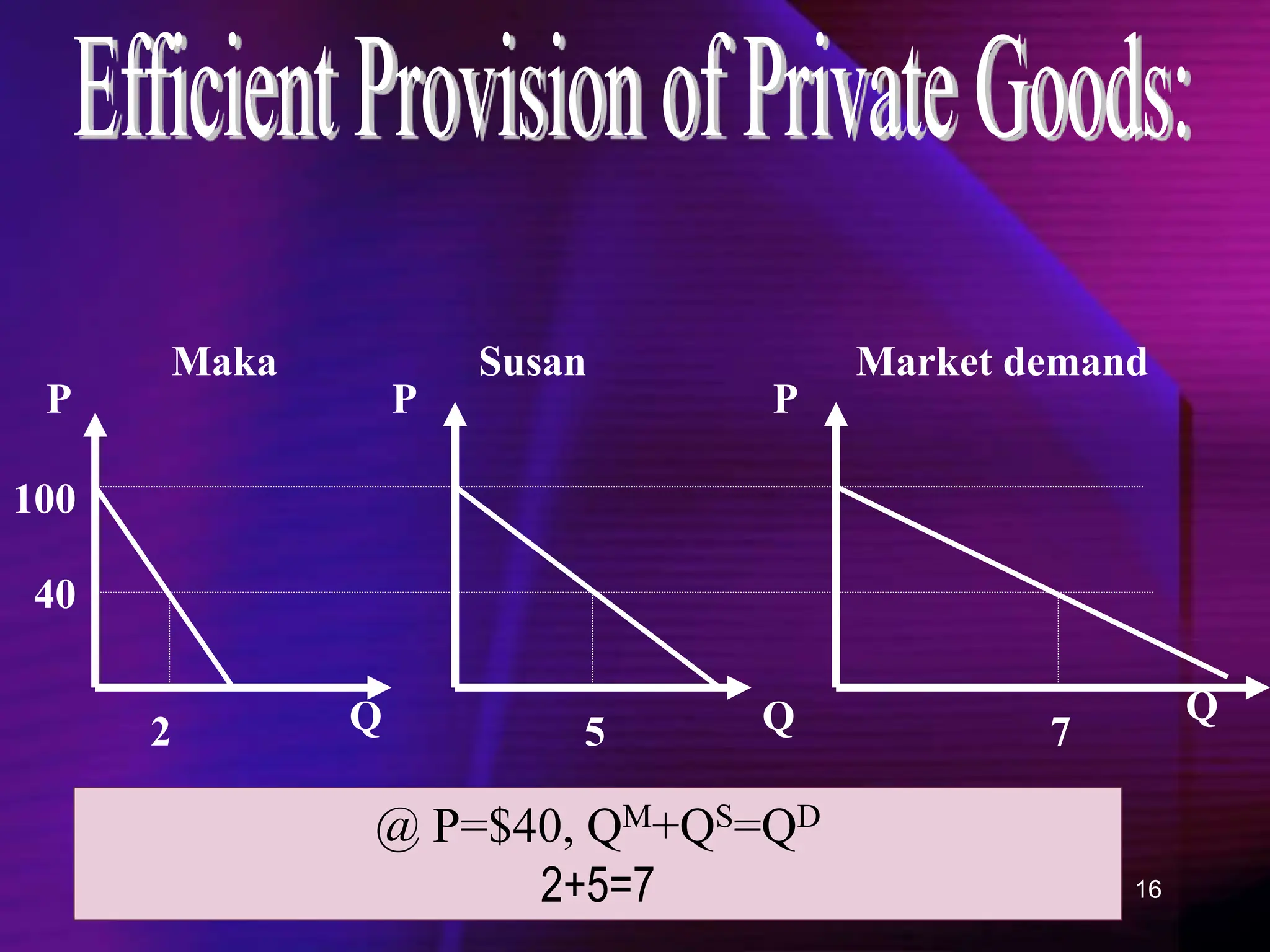
-Consider Maka and Susan’s individual
demands for video games
-At a market price, we add up Maka and
Susan’s quantity demanded for video
games to find market demand
-This results in a HORIZONTAL
SUMMATION
16
2
Maka Susan Market demand
40
100
Q Q Q
P P P
@ P=$40, QM+QS=QD
2+5=7
5 7
17
2
Maka Susan Market
40
100
Q Q Q
P P P
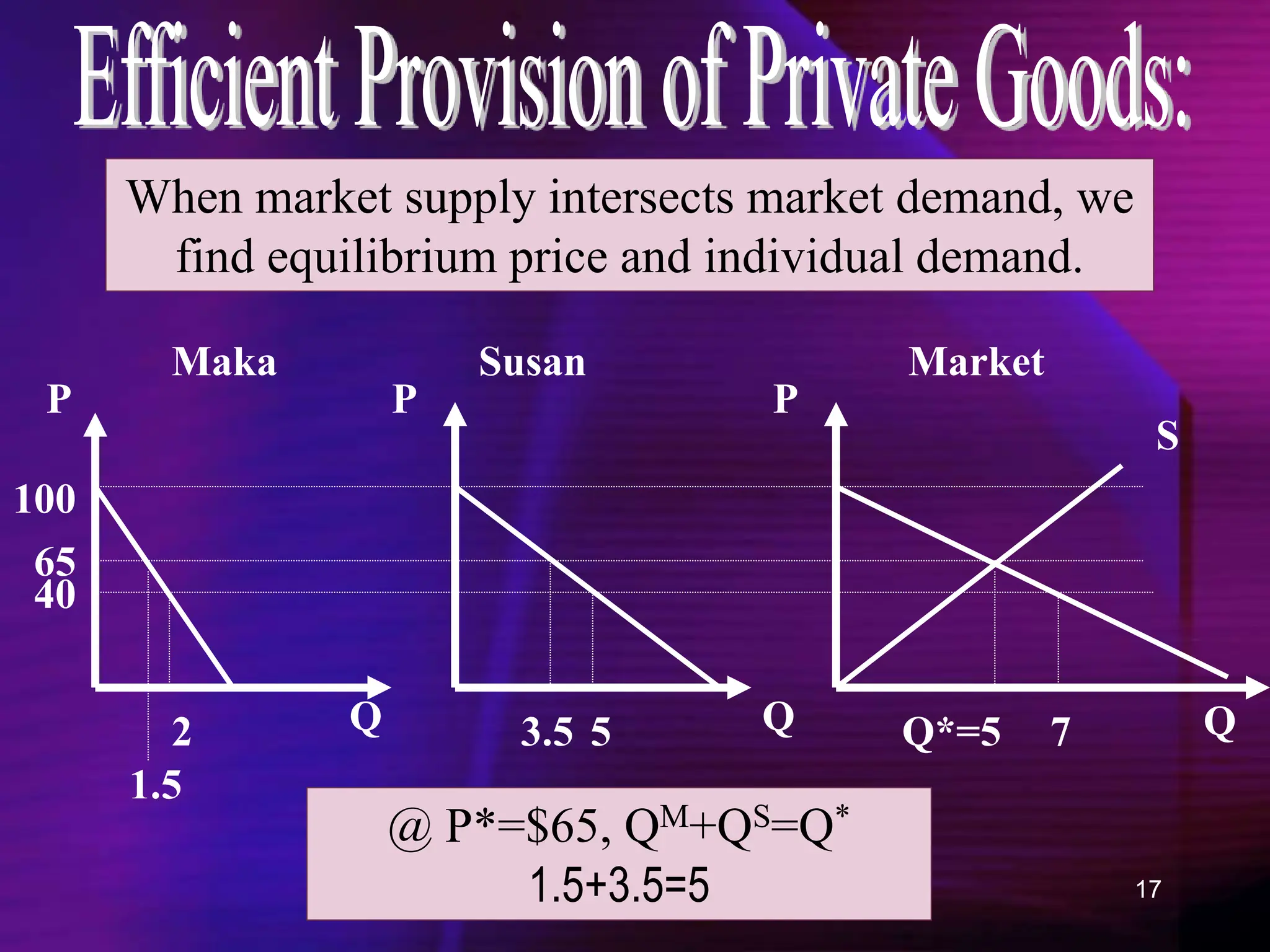
When market supply intersects market demand, we
find equilibrium price and individual demand.
5 7
S
Q*=5
1.5
3.5
@ P*=$65, QM+QS=Q*
1.5+3.5=5
65
18
Efficient Provision of Private Goods
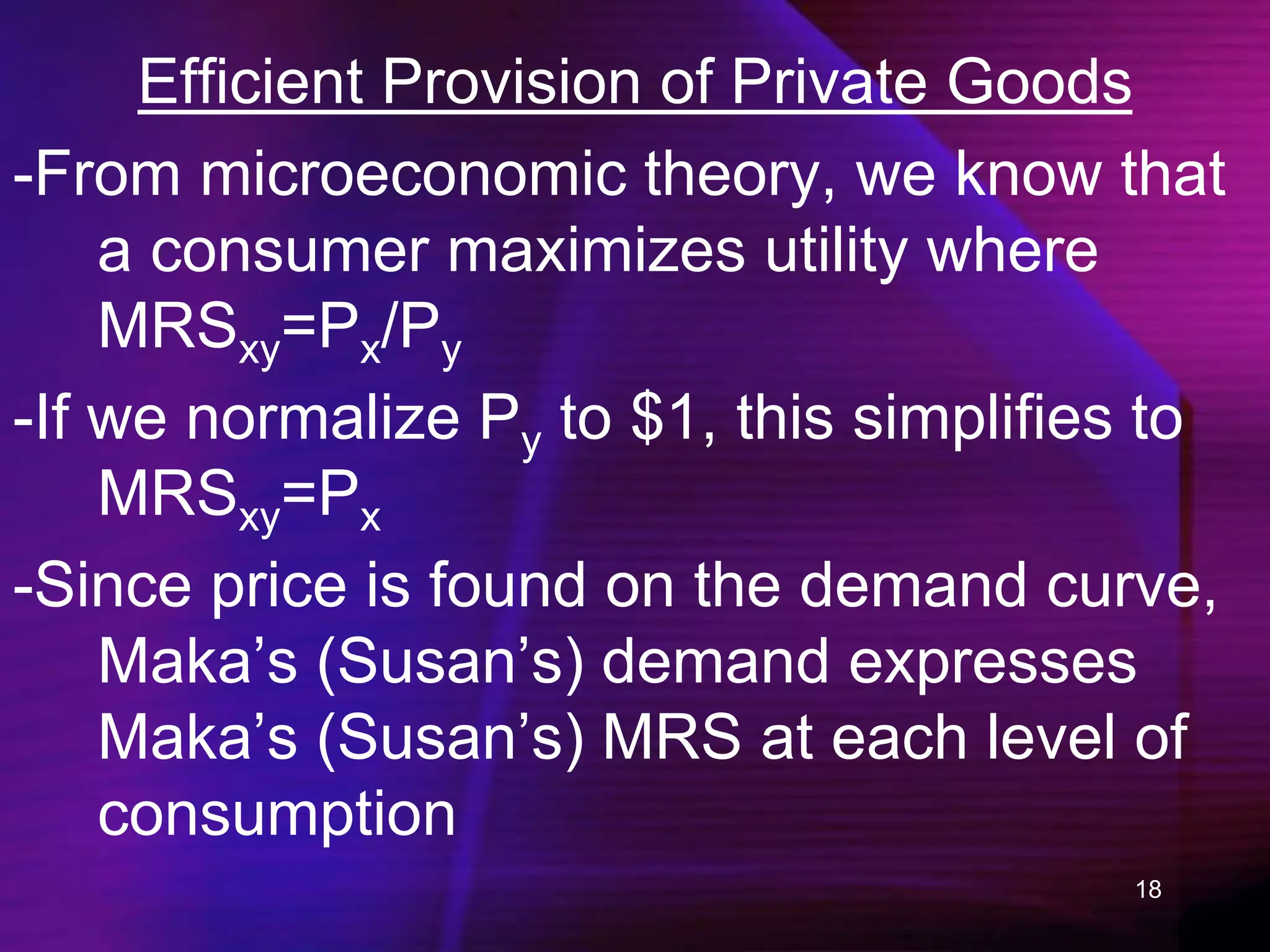
-From microeconomic theory, we know that
a consumer maximizes utility where
MRSxy=Px/Py
-If we normalize Py to $1, this simplifies to
MRSxy=Px
-Since price is found on the demand curve,
Maka’s (Susan’s) demand expresses
Maka’s (Susan’s) MRS at each level of
consumption
19
Efficient Provision of Private Goods
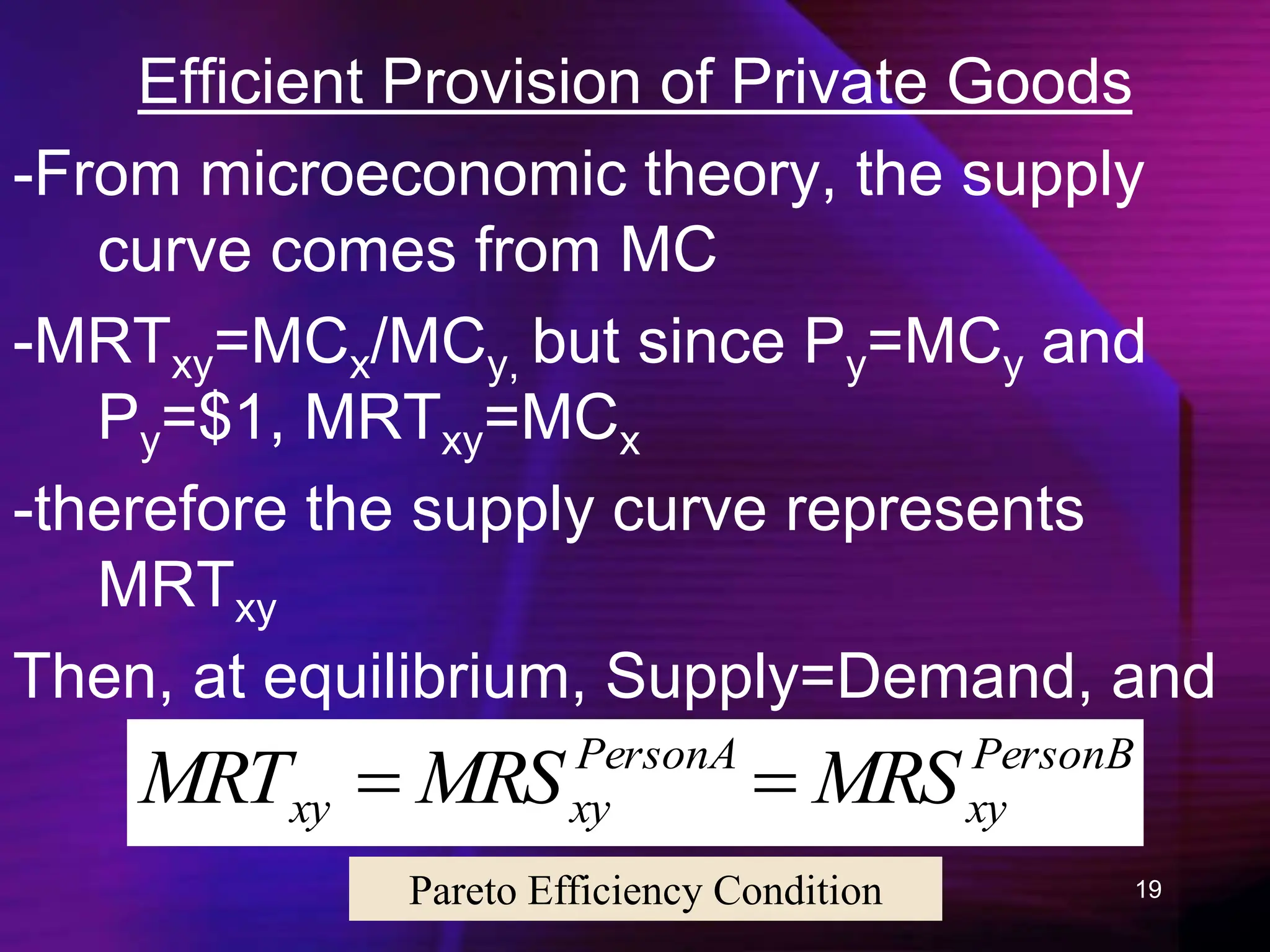
-From microeconomic theory, the supply
curve comes from MC
-MRTxy=MCx/MCy, but since Py=MCy and
Py=$1, MRTxy=MCx
-therefore the supply curve represents
MRTxy
Then, at equilibrium, Supply=Demand, and
PersonB
xy
PersonA
xy
xy MRS
MRS
MRT 

Pareto Efficiency Condition
20
Efficient Provision of PUBLIC GOODS
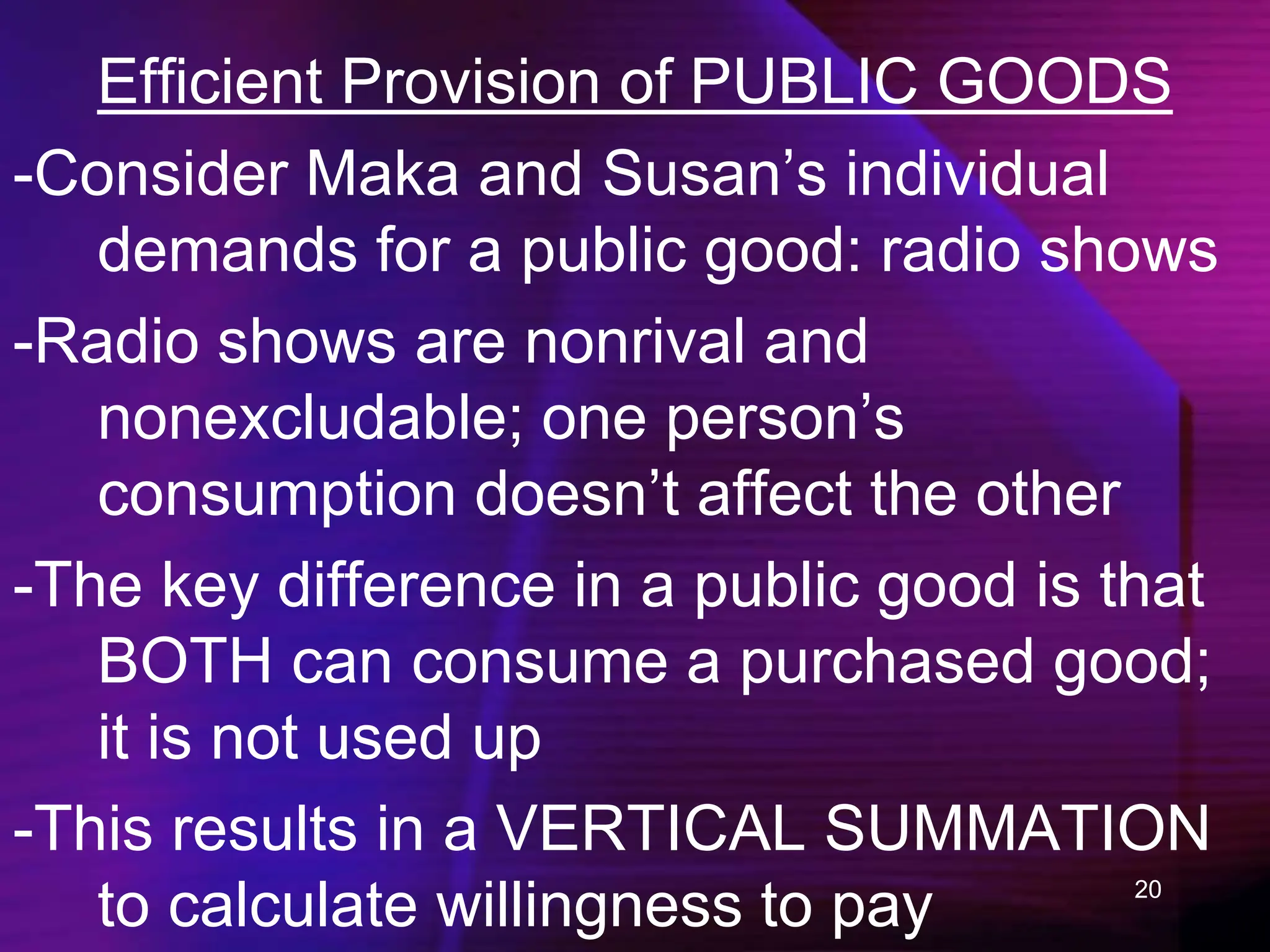
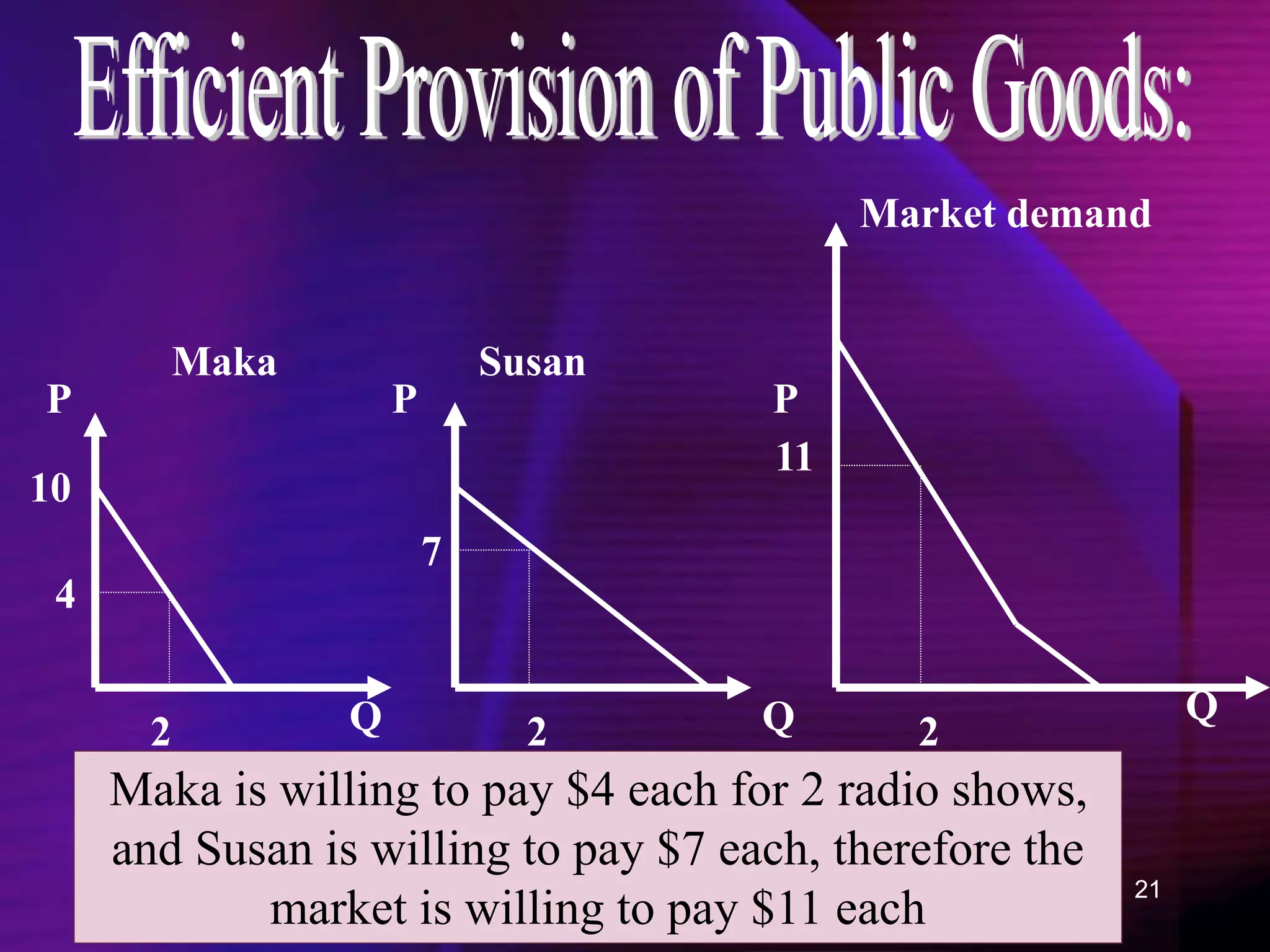
-Consider Maka and Susan’s individual
demands for a public good: radio shows
-Radio shows are nonrival and
nonexcludable; one person’s
consumption doesn’t affect the other
-The key difference in a public good is that
BOTH can consume a purchased good;
it is not used up
-This results in a VERTICAL SUMMATION
to calculate willingness to pay
21
2
Maka Susan
Market demand
4
10
Q Q Q
P P P
Maka is willing to pay $4 each for 2 radio shows,
and Susan is willing to pay $7 each, therefore the
market is willing to pay $11 each
7
2
11
2
22
2
Maka Susan
Market demand
4
10
Q Q Q
P P P
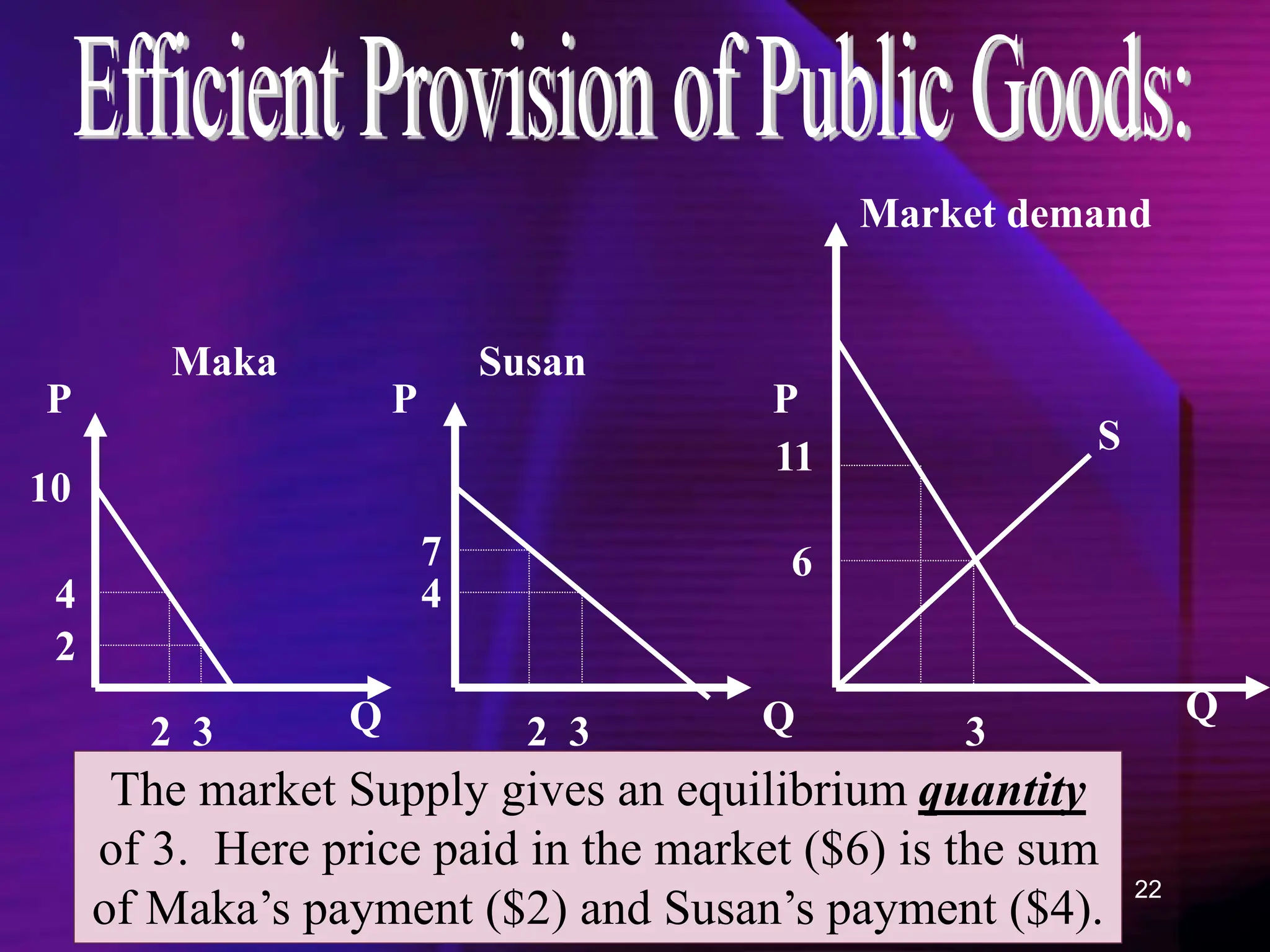
The market Supply gives an equilibrium quantity
of 3. Here price paid in the market ($6) is the sum
of Maka’s payment ($2) and Susan’s payment ($4).
7
3
2
11
3
3
S
6
4
2
23
Efficient Provision of Public Goods
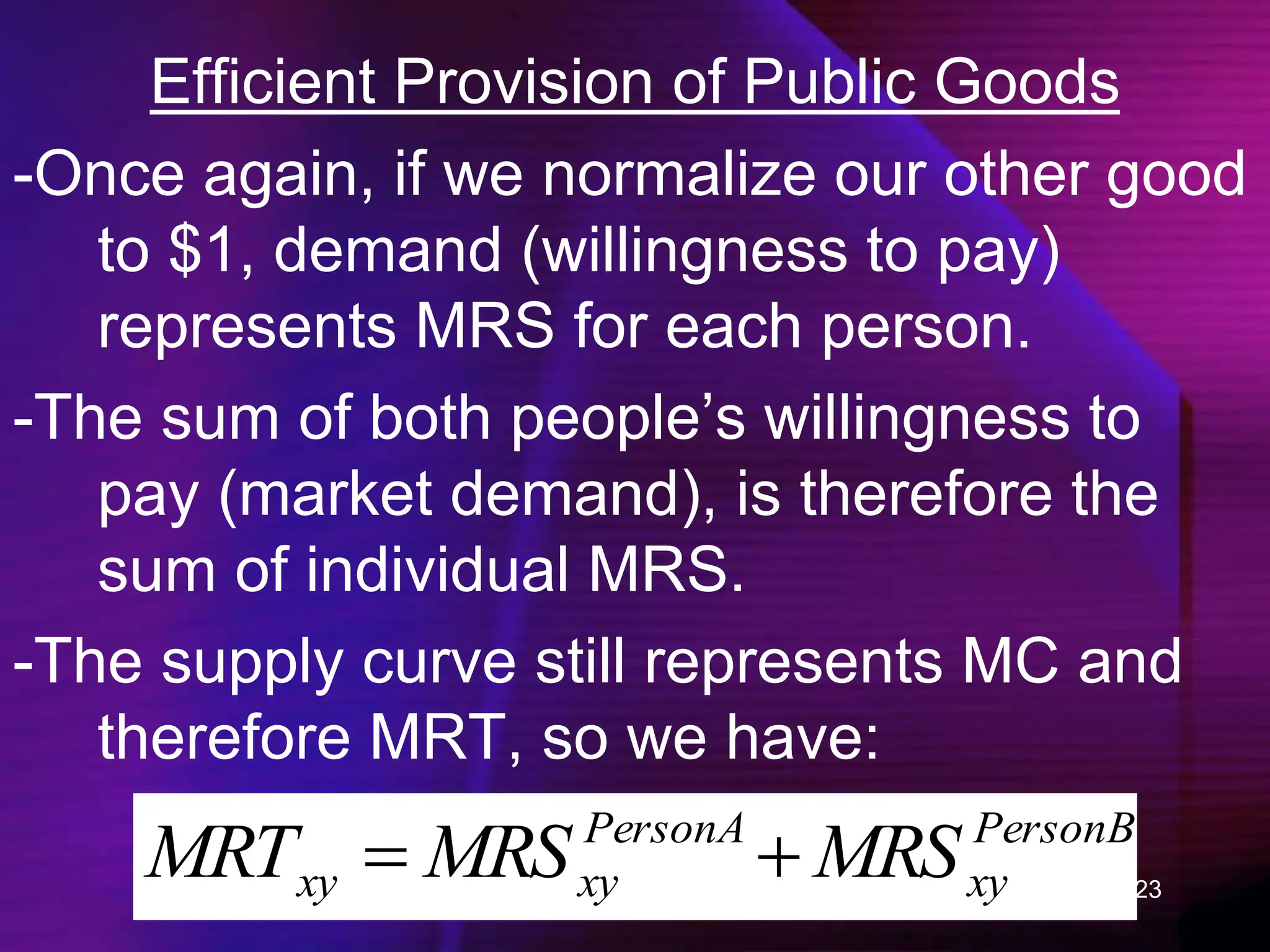
-Once again, if we normalize our other good
to $1, demand (willingness to pay)
represents MRS for each person.
-The sum of both people’s willingness to
pay (market demand), is therefore the
sum of individual MRS.
-The supply curve still represents MC and
therefore MRT, so we have:
PersonB
xy
PersonA
xy
xy MRS
MRS
MRT 

24
Efficient Provision of Public Goods
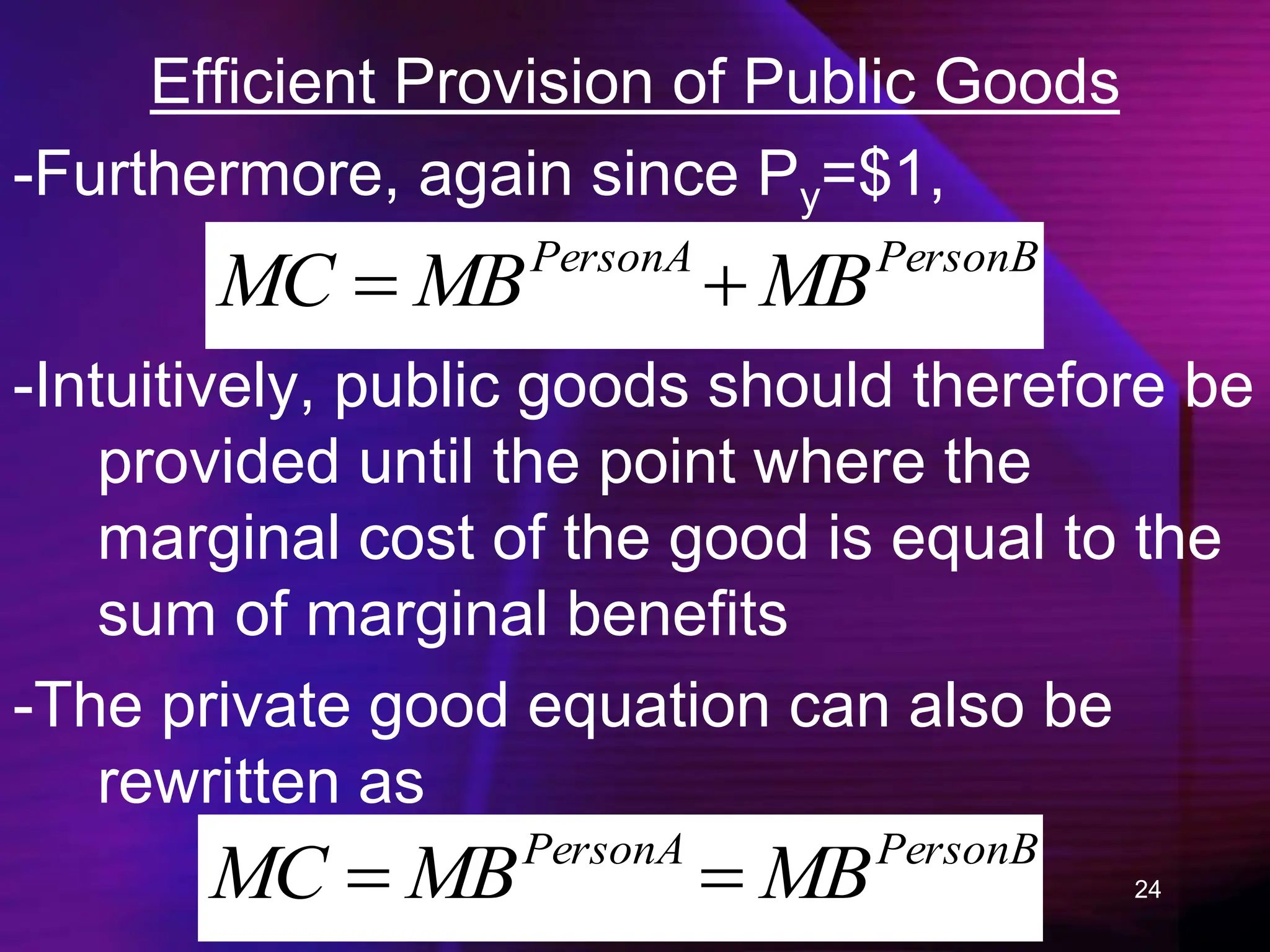
-Furthermore, again since Py=$1,
PersonB
PersonA
MB
MB
MC 

-Intuitively, public goods should therefore be
provided until the point where the
marginal cost of the good is equal to the
sum of marginal benefits
-The private good equation can also be
rewritten as
PersonB
PersonA
MB
MB
MC 

25
THEORY - Distortionary Taxes
and Public Goods
If Public Goods are funded by distortionary
taxation, we have two additional effects:
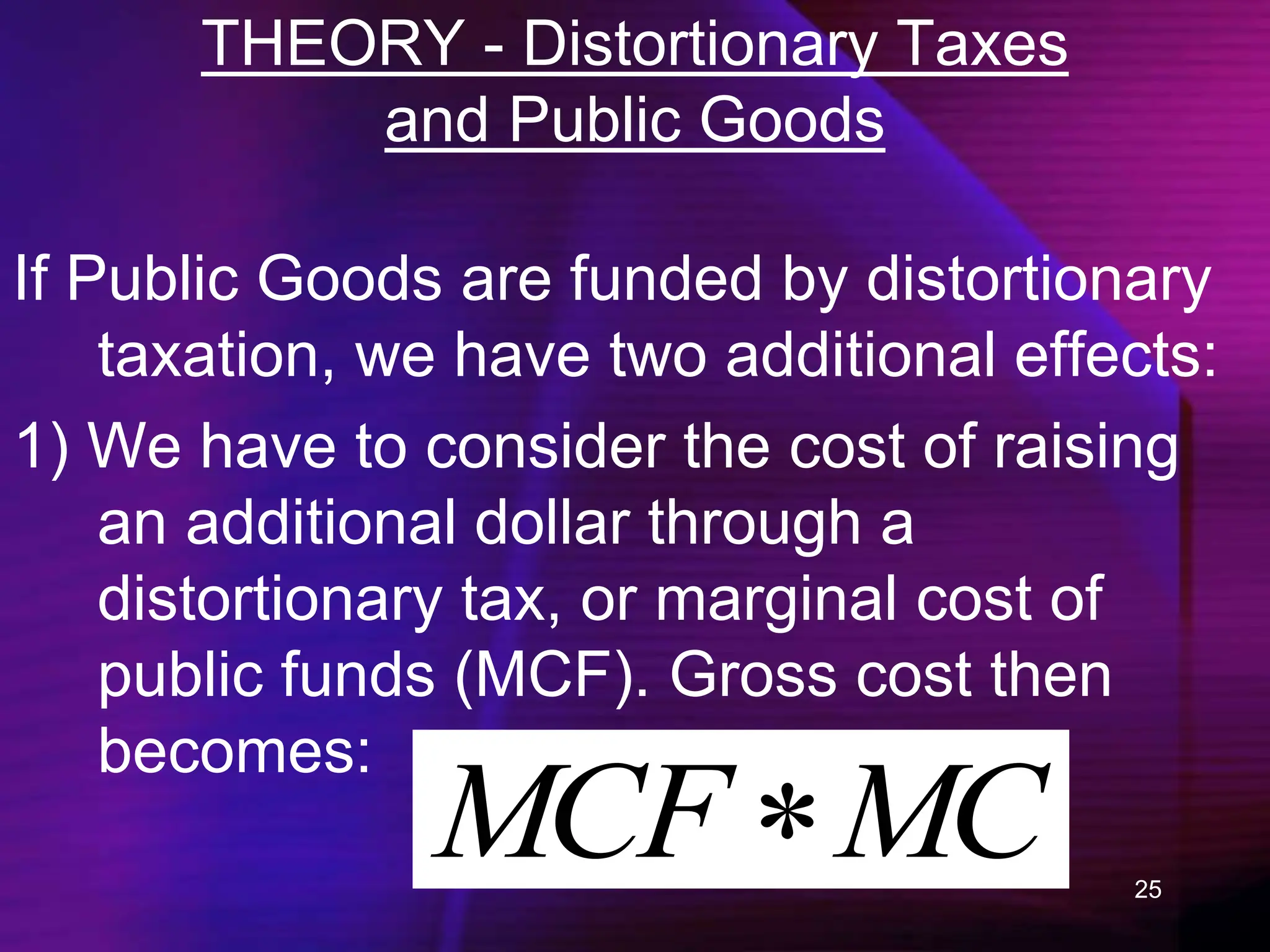
1) We have to consider the cost of raising
an additional dollar through a
distortionary tax, or marginal cost of
public funds (MCF). Gross cost then
becomes:
MC
MCF 
26
Distortionary Taxes and Public Goods
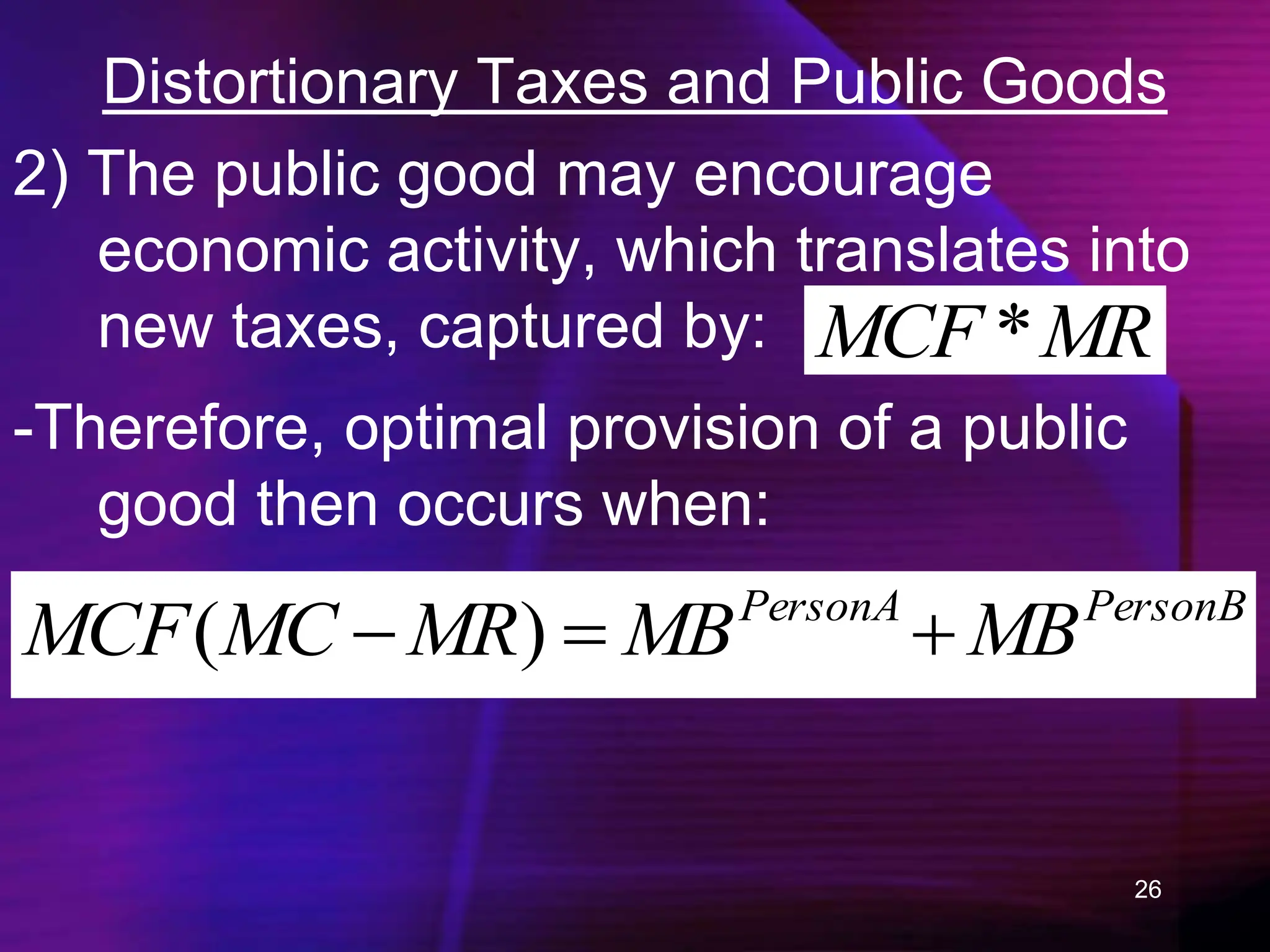
2) The public good may encourage
economic activity, which translates into
new taxes, captured by: MR
MCF *
-Therefore, optimal provision of a public
good then occurs when:
PersonB
PersonA
MB
MB
MR
MC
MCF 

 )
(
27
Distortionary Taxes and Public Goods
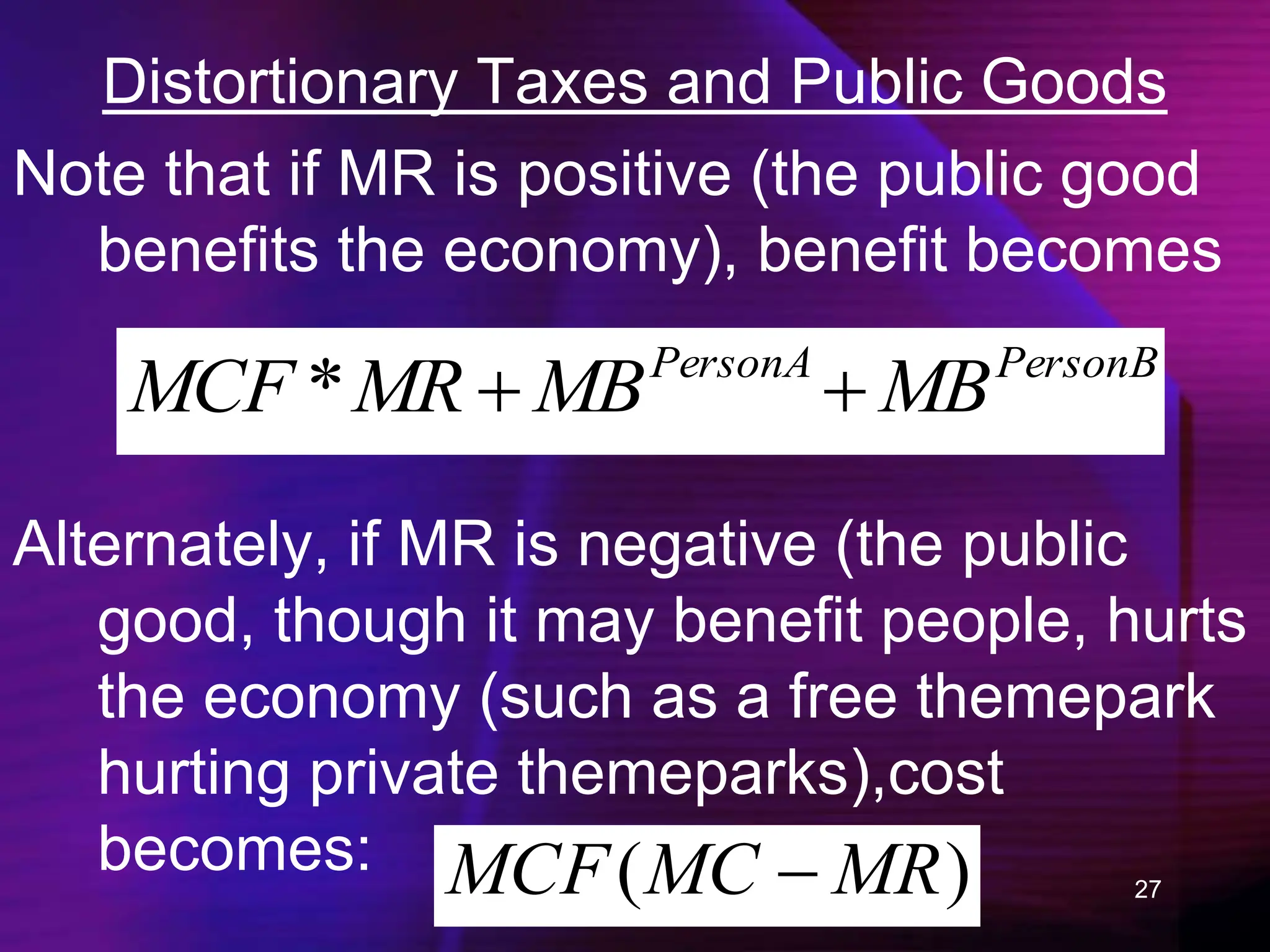
Note that if MR is positive (the public good
benefits the economy), benefit becomes
PersonB
PersonA
MB
MB
MR
MCF 

*
Alternately, if MR is negative (the public
good, though it may benefit people, hurts
the economy (such as a free themepark
hurting private themeparks),cost
becomes: )
( MR
MC
MCF 
28
Public Goods Conclusion
In short, public goods are always best
provided where
Total Marginal Benefit = Marginal Cost
Providing a public good through
distortionary taxes may increase or
decrease its provision when compared
to lump-sum taxation funding
29
Theory - Private Provision of Public Goods
If a public good is provided privately, its
efficiency depend on how people
represent their willingness to pay
-For private goods, people have no
incentive to misrepresent their
willingness to pay
-if the price is $10, and that lies in their
willingness to pay, they will pay the $10,
consume the good and be happy
30
Private Provision of Public Goods
-For public goods, people have an incentive
to misrepresent their willingness to pay
-if the price is $10, a person could hope
someone else pays the price, then they
get to enjoy it (they are a FREE RIDER)
-for example, at an alligator reserve, people
can pay money to throw meat into the water
and watch the alligators go, and often wait for
someone else to buy and throw the meat
31
Private Provision of Public Goods
-If the public good can be made excludable
(ie: entrance fee), it is still provided
inefficiently, as the MC of an additional
consumer is zero, therefore P>MC
-The one way to avoid the free rider
problem is through PERFECT PRICE
DISCRIMINATION – everyone pays their
willingness to pay
-this requires full information, therefore private
provision is often doomed to be inefficient
32
The Free Rider Problem
THE FREE RIDER PROBLEM comes from
the incentive to let others pay while you
enjoy the benefits
-Yet empirically, people do band together to
raise funds for public goods such as
libraries
-Studies have shown that although people
may be willing to contribute some
towards public goods, this contribution
generally falls short
33
The Free Rider Problem Example
Many people are willing to help construct
homes for low income families.
People go to great lengths to help construct
these homes, and one low income family
is very happy.
-But the project never continues until a
city reaches zero homelessness
-Similarly, private provision of public goods
only goes so far
34
Privatization of Government Functions
Government functions (both public and
private commodities) can be provided
privately IF THEY ARE EXCLUDABLE:
Privatization has 2 LEVELS:
1) Private Provision – private firms provide
the good or service
2) Private Production – private firms
produce the good or service, which can
then be provided by the government
35
Private Provision Debate
Many government functions can be and are
provided privately IF THEY ARE
EXCLUDABLE:
Home/private schooling vs. public schooling
Police force vs. Private security
Private swimming pool vs. Public lake
-To debate the merits of private provision of
government functions, a variety of issues
need be examined:
36
Private Provision Debate
1) Input costs
-Do private firms or the government pay lower
input costs (wages, materials, etc) for the
good or service?
-Are there unions or unique suppliers involved?
2) Administrative Costs
-Typically, government can reduce
administration costs through size and
economies of scale
-This is not always the case
37
Provision Debate
3) Diversity of Tastes
-If people have a variety of tastes (quality,
quantity, environmental footprint, etc),
private provision allows for variety
4) Quality of Information
-If individuals are poorly informed about the
quality of the good, government provision may
be best
-sofa selection is a lot easier than healthcare
selection
38
Provision Debate
5) Distributional Issues
-Does fairness imply that some goods and
services should be available to
EVERYONE, (COMMODITY
EGALITARIANISM (Tobin, 1970))
-This argument is often made for healthcare
39
Public Production Debate
The argument about who should
PRODUCE public goods often hinges on
two concepts:
Cost vs. Quality
-private companies
often have lower
costs due to a focus
on profit and lack of
unions
-private companies
often produce inferior
products (as in US
health insurance
refusing coverage or
charging high
premiums)
40
Production Debate
Some argue that quality can be maintained
through good contracts
-Some contracts are straightforward: cut
the park lawn once a week
-Some contracts are near impossible:
treat this yet-to-be-discovered disease
with the following yet-to-be-discovered
drugs
41
Production Debate
Market structure also needs to be
considered:
-If the government has a monopoly, is lack
of competition causing inefficiency?
-If privatization creates a monopoly or
oligopoly, will market power cause
inefficiency?
42
Case Study: Alberta Liquor Privatization
West (1997) studied the 1993 privatization
of Alberta liquor stores and learned the
following:
-the number of liquor stores rose from 258
to 604, and although selection and
individual stores fell, overall selection
increased
-liquor prices rose between 8.5% and 10%
(compared to 5% inflation)
43
Case Study: Alberta Liquor Privatization
-Liquor store employment tripled as wages
fell by up to 50% (the union was replaced)
-There was no evidence of increased
alcohol consumption or alcohol-related
crimes
44
Case Study: Alberta Liquor Privatization
Was privatization good?
More stores vs. poorer selection
Liquor Price Increases
More employment vs. Lower wages
If this privatization is so complex, what does
that say about privatizing healthcare,
utilities or schools?
45
Chapter 4 Summary
 Public goods are nonrival and nonexcludable
 With lump-sum taxation:
 Public Goods are efficiently provided where
∑MRS=MRT or ∑MB=MC
 (Private goods are efficiently provided
where MRSA = MRSB = MRT)
 With distortionary taxes, the marginal cost of
public funds (MCF) and the tax revenue effect
of the public good must be taken into account
 Efficient provision still occurs where
Total Benefit = Total cost
46
Chapter 4 Summary
 It is unlikely that markets would provide public
goods efficiently, even if they are excludable
 Free-riding limits private provision of public
goods
 Privatization entails private provision or
production of a government function
 5 issues were raised in the debate between
public or private provision
 Two issues with public production are
efficiency and quality

Econoomics pptttttttttttttt350 Chapter04

  • 1.
    Part 2: AFramework for the Analysis of Public Expenditure Part 1 discussed WHEN to have government intervention. Part 2 discusses HOW government can intervene.
  • 2.
    Chapter 4: PublicGoods Chapter 5: Externalities Chapter 6: Income Redistribution Chapter 7: Cost-Benefit Analysis Part 2: A Framework for the Analysis of Public Expenditure
  • 3.
    3 Chapter 4: PublicGoods Public Goods – no one wants to pay for them, but everyone benefits from them. How does the government decide WHICH public goods are provided and HOW MUCH IS provided? Should the private market be used to provide or produce government commodities?
  • 4.
    Chapter 4: PublicGoods What is a Public Good? Efficient Provision of Public Goods The Efficiency Conditions Public Goods and Distortionary Taxation Private Provision of Public Goods Free-Riders Privatization
  • 5.
    5 Theory - Whatis a Public Good? A PURE PUBLIC GOOD has two features: 1) Nonrival – once provided, another person can consume it at no additional cost 2) Nonexcludable – once provided, it is impossible or highly expensive to prevent anyone from consuming it
  • 6.
    6 Pure Public GoodExamples National Defense is a good example of a pure public good: 1) Nonrival – all Canadians benefit 2) Nonexcludable – it’s impossible to prevent a Canadian from benefitting Other examples: Conventional Radio, A Beautiful View, A Canada-Wide Sunglass dome designed to block harmful sun rays (Canadome)
  • 7.
    7 What is aPrivate Good? A PRIAVATE GOOD has two features: 1) Rival – once consumed, another person cannot consume it 2) Excludable – others can be prevented from consuming it Food (ie: pizza or sushi) is a good example of a private good. Once I eat it, it’s gone and you’re left hungry.
  • 8.
    8 Pure Public GoodIssues 6 Issues arise out of Pure Public Goods: 1) Different Values 2) Public Goods Aren’t Absolute 3) NONRIVAL ≠ NONEXCLUDABLE 4) Unconventional Public Good 5) Private Provision 6) Private Production
  • 9.
    9 -National defense protectseveryone equally. Paranoid people love it and peace activists hate it. -The Canadome is popular among people concerned with cancer and unpopular with people wanting tans. It affects everyone, however 1) WHILE EVERYONE CONSUMES THE SAME AMOUNT, PEOPLE MAY VALUE IT DIFFERENTLY
  • 10.
    10 2) PUBLIC GOODSARE NOT ABSOLUTE -technology and the market can affect a public good. A free TV station becomes private if you need a decoder. A view becomes rival if too many people crowd. -An IMPURE PUBLIC GOOD is to some extent rival or to some extent excludable -most public goods are impure, but analysis of pure public goods still gives valuable results for impure public goods
  • 11.
    11 3) NONRIVAL ≠NONEXCLUDABLE -National parks are excludable if they have gates, but practically nonrival as they are so big -My office hours are nonexcludable, as everyone is welcome, but rival if too many people are waiting in line
  • 12.
    12 4) VARIOUS THINGSHAVE SIMILARITIES WITH PUBLIC GOODS -Inspiration can be nonrival and nonexcludable (such as coming from a sunset) -Fear is nonrival, as one person being afraid doesn’t prevent others. Fear is also nonexcludable, as its hard to prevent. -Income distribution or honesty are public goods as everyone benefits
  • 13.
    13 5) THE PUBLICSECTOR CAN PROVIDE PRIVATE GOODS -Medical services, housing, licenses, and utilities can all be provided by the government and/or private sector -The label public or private doesn’t indicate what sector provides the item
  • 14.
    14 6) PUBLIC PROVISION≠> PUBLIC PRODUCTION -Some public services are contracted out to private contractors -For example, the City of Edmonton contracts out much of its snow removal business -it provides the public service through private contractors
  • 15.
    15 Efficient Provision ofPrivate Goods -To cover efficient provision of public goods, we first look at efficient provision of private goods -Consider Maka and Susan’s individual demands for video games -At a market price, we add up Maka and Susan’s quantity demanded for video games to find market demand -This results in a HORIZONTAL SUMMATION
  • 16.
    16 2 Maka Susan Marketdemand 40 100 Q Q Q P P P @ P=$40, QM+QS=QD 2+5=7 5 7
  • 17.
    17 2 Maka Susan Market 40 100 QQ Q P P P When market supply intersects market demand, we find equilibrium price and individual demand. 5 7 S Q*=5 1.5 3.5 @ P*=$65, QM+QS=Q* 1.5+3.5=5 65
  • 18.
    18 Efficient Provision ofPrivate Goods -From microeconomic theory, we know that a consumer maximizes utility where MRSxy=Px/Py -If we normalize Py to $1, this simplifies to MRSxy=Px -Since price is found on the demand curve, Maka’s (Susan’s) demand expresses Maka’s (Susan’s) MRS at each level of consumption
  • 19.
    19 Efficient Provision ofPrivate Goods -From microeconomic theory, the supply curve comes from MC -MRTxy=MCx/MCy, but since Py=MCy and Py=$1, MRTxy=MCx -therefore the supply curve represents MRTxy Then, at equilibrium, Supply=Demand, and PersonB xy PersonA xy xy MRS MRS MRT   Pareto Efficiency Condition
  • 20.
    20 Efficient Provision ofPUBLIC GOODS -Consider Maka and Susan’s individual demands for a public good: radio shows -Radio shows are nonrival and nonexcludable; one person’s consumption doesn’t affect the other -The key difference in a public good is that BOTH can consume a purchased good; it is not used up -This results in a VERTICAL SUMMATION to calculate willingness to pay
  • 21.
    21 2 Maka Susan Market demand 4 10 QQ Q P P P Maka is willing to pay $4 each for 2 radio shows, and Susan is willing to pay $7 each, therefore the market is willing to pay $11 each 7 2 11 2
  • 22.
    22 2 Maka Susan Market demand 4 10 QQ Q P P P The market Supply gives an equilibrium quantity of 3. Here price paid in the market ($6) is the sum of Maka’s payment ($2) and Susan’s payment ($4). 7 3 2 11 3 3 S 6 4 2
  • 23.
    23 Efficient Provision ofPublic Goods -Once again, if we normalize our other good to $1, demand (willingness to pay) represents MRS for each person. -The sum of both people’s willingness to pay (market demand), is therefore the sum of individual MRS. -The supply curve still represents MC and therefore MRT, so we have: PersonB xy PersonA xy xy MRS MRS MRT  
  • 24.
    24 Efficient Provision ofPublic Goods -Furthermore, again since Py=$1, PersonB PersonA MB MB MC   -Intuitively, public goods should therefore be provided until the point where the marginal cost of the good is equal to the sum of marginal benefits -The private good equation can also be rewritten as PersonB PersonA MB MB MC  
  • 25.
    25 THEORY - DistortionaryTaxes and Public Goods If Public Goods are funded by distortionary taxation, we have two additional effects: 1) We have to consider the cost of raising an additional dollar through a distortionary tax, or marginal cost of public funds (MCF). Gross cost then becomes: MC MCF 
  • 26.
    26 Distortionary Taxes andPublic Goods 2) The public good may encourage economic activity, which translates into new taxes, captured by: MR MCF * -Therefore, optimal provision of a public good then occurs when: PersonB PersonA MB MB MR MC MCF    ) (
  • 27.
    27 Distortionary Taxes andPublic Goods Note that if MR is positive (the public good benefits the economy), benefit becomes PersonB PersonA MB MB MR MCF   * Alternately, if MR is negative (the public good, though it may benefit people, hurts the economy (such as a free themepark hurting private themeparks),cost becomes: ) ( MR MC MCF 
  • 28.
    28 Public Goods Conclusion Inshort, public goods are always best provided where Total Marginal Benefit = Marginal Cost Providing a public good through distortionary taxes may increase or decrease its provision when compared to lump-sum taxation funding
  • 29.
    29 Theory - PrivateProvision of Public Goods If a public good is provided privately, its efficiency depend on how people represent their willingness to pay -For private goods, people have no incentive to misrepresent their willingness to pay -if the price is $10, and that lies in their willingness to pay, they will pay the $10, consume the good and be happy
  • 30.
    30 Private Provision ofPublic Goods -For public goods, people have an incentive to misrepresent their willingness to pay -if the price is $10, a person could hope someone else pays the price, then they get to enjoy it (they are a FREE RIDER) -for example, at an alligator reserve, people can pay money to throw meat into the water and watch the alligators go, and often wait for someone else to buy and throw the meat
  • 31.
    31 Private Provision ofPublic Goods -If the public good can be made excludable (ie: entrance fee), it is still provided inefficiently, as the MC of an additional consumer is zero, therefore P>MC -The one way to avoid the free rider problem is through PERFECT PRICE DISCRIMINATION – everyone pays their willingness to pay -this requires full information, therefore private provision is often doomed to be inefficient
  • 32.
    32 The Free RiderProblem THE FREE RIDER PROBLEM comes from the incentive to let others pay while you enjoy the benefits -Yet empirically, people do band together to raise funds for public goods such as libraries -Studies have shown that although people may be willing to contribute some towards public goods, this contribution generally falls short
  • 33.
    33 The Free RiderProblem Example Many people are willing to help construct homes for low income families. People go to great lengths to help construct these homes, and one low income family is very happy. -But the project never continues until a city reaches zero homelessness -Similarly, private provision of public goods only goes so far
  • 34.
    34 Privatization of GovernmentFunctions Government functions (both public and private commodities) can be provided privately IF THEY ARE EXCLUDABLE: Privatization has 2 LEVELS: 1) Private Provision – private firms provide the good or service 2) Private Production – private firms produce the good or service, which can then be provided by the government
  • 35.
    35 Private Provision Debate Manygovernment functions can be and are provided privately IF THEY ARE EXCLUDABLE: Home/private schooling vs. public schooling Police force vs. Private security Private swimming pool vs. Public lake -To debate the merits of private provision of government functions, a variety of issues need be examined:
  • 36.
    36 Private Provision Debate 1)Input costs -Do private firms or the government pay lower input costs (wages, materials, etc) for the good or service? -Are there unions or unique suppliers involved? 2) Administrative Costs -Typically, government can reduce administration costs through size and economies of scale -This is not always the case
  • 37.
    37 Provision Debate 3) Diversityof Tastes -If people have a variety of tastes (quality, quantity, environmental footprint, etc), private provision allows for variety 4) Quality of Information -If individuals are poorly informed about the quality of the good, government provision may be best -sofa selection is a lot easier than healthcare selection
  • 38.
    38 Provision Debate 5) DistributionalIssues -Does fairness imply that some goods and services should be available to EVERYONE, (COMMODITY EGALITARIANISM (Tobin, 1970)) -This argument is often made for healthcare
  • 39.
    39 Public Production Debate Theargument about who should PRODUCE public goods often hinges on two concepts: Cost vs. Quality -private companies often have lower costs due to a focus on profit and lack of unions -private companies often produce inferior products (as in US health insurance refusing coverage or charging high premiums)
  • 40.
    40 Production Debate Some arguethat quality can be maintained through good contracts -Some contracts are straightforward: cut the park lawn once a week -Some contracts are near impossible: treat this yet-to-be-discovered disease with the following yet-to-be-discovered drugs
  • 41.
    41 Production Debate Market structurealso needs to be considered: -If the government has a monopoly, is lack of competition causing inefficiency? -If privatization creates a monopoly or oligopoly, will market power cause inefficiency?
  • 42.
    42 Case Study: AlbertaLiquor Privatization West (1997) studied the 1993 privatization of Alberta liquor stores and learned the following: -the number of liquor stores rose from 258 to 604, and although selection and individual stores fell, overall selection increased -liquor prices rose between 8.5% and 10% (compared to 5% inflation)
  • 43.
    43 Case Study: AlbertaLiquor Privatization -Liquor store employment tripled as wages fell by up to 50% (the union was replaced) -There was no evidence of increased alcohol consumption or alcohol-related crimes
  • 44.
    44 Case Study: AlbertaLiquor Privatization Was privatization good? More stores vs. poorer selection Liquor Price Increases More employment vs. Lower wages If this privatization is so complex, what does that say about privatizing healthcare, utilities or schools?
  • 45.
    45 Chapter 4 Summary Public goods are nonrival and nonexcludable  With lump-sum taxation:  Public Goods are efficiently provided where ∑MRS=MRT or ∑MB=MC  (Private goods are efficiently provided where MRSA = MRSB = MRT)  With distortionary taxes, the marginal cost of public funds (MCF) and the tax revenue effect of the public good must be taken into account  Efficient provision still occurs where Total Benefit = Total cost
  • 46.
    46 Chapter 4 Summary It is unlikely that markets would provide public goods efficiently, even if they are excludable  Free-riding limits private provision of public goods  Privatization entails private provision or production of a government function  5 issues were raised in the debate between public or private provision  Two issues with public production are efficiency and quality