OPTIMAL PROVISION OF PUBLICAND
PRIVATEGOODS
BY:
BINDU H A
Public and Private Goods:
A Public Good is a product that one individual can consume without
reducing its availability to others and from which no one is deprived.
Characteristics:
Non-excludability: once a public good has been provided, the
producer cannot prevent people who have not paid for it from
receiving the benefits
Non-rivalry: one person’s consumption of a public good does not
prevent someone else from consuming it.
Private good is a product where consumption by one individual
prevents another individual from consuming it.
Characteristics:
Excludable
Rival.
Categories of goods
Excludable Non Excludable
Rivalrous
Private good
(ice cream, cheese,
cars)
Common resources
(ocean, timber, pasture)
Non-rivalrous
Club goods
(toll roads)
Public good
(National defense)
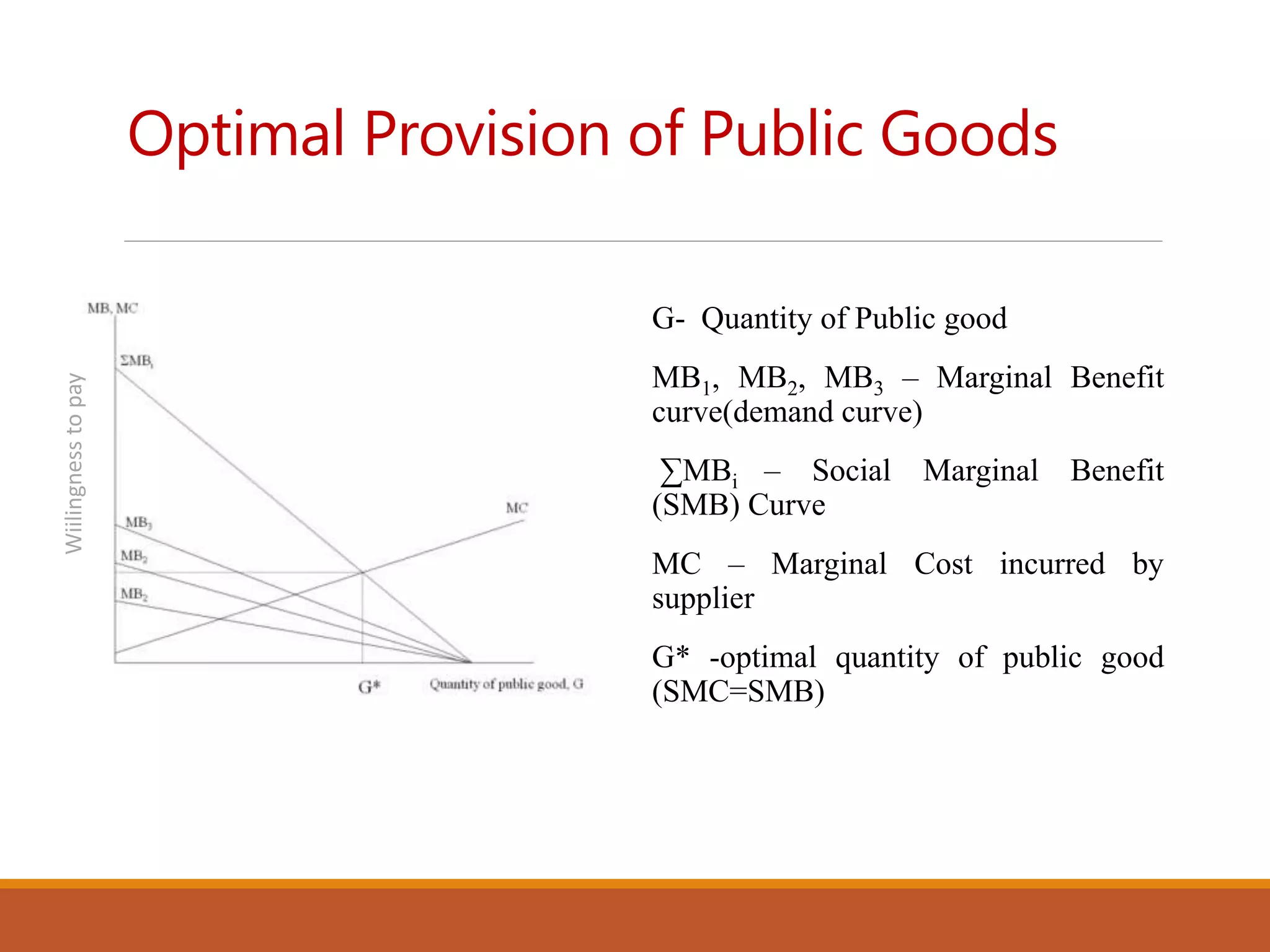
Optimal Provision of Public Goods
G- Quantity of Public good
MB1, MB2, MB3 – Marginal Benefit
curve(demand curve)
∑MBi – Social Marginal Benefit
(SMB) Curve
MC – Marginal Cost incurred by
supplier
G* -optimal quantity of public good
(SMC=SMB)
Wiilingness
to
pay
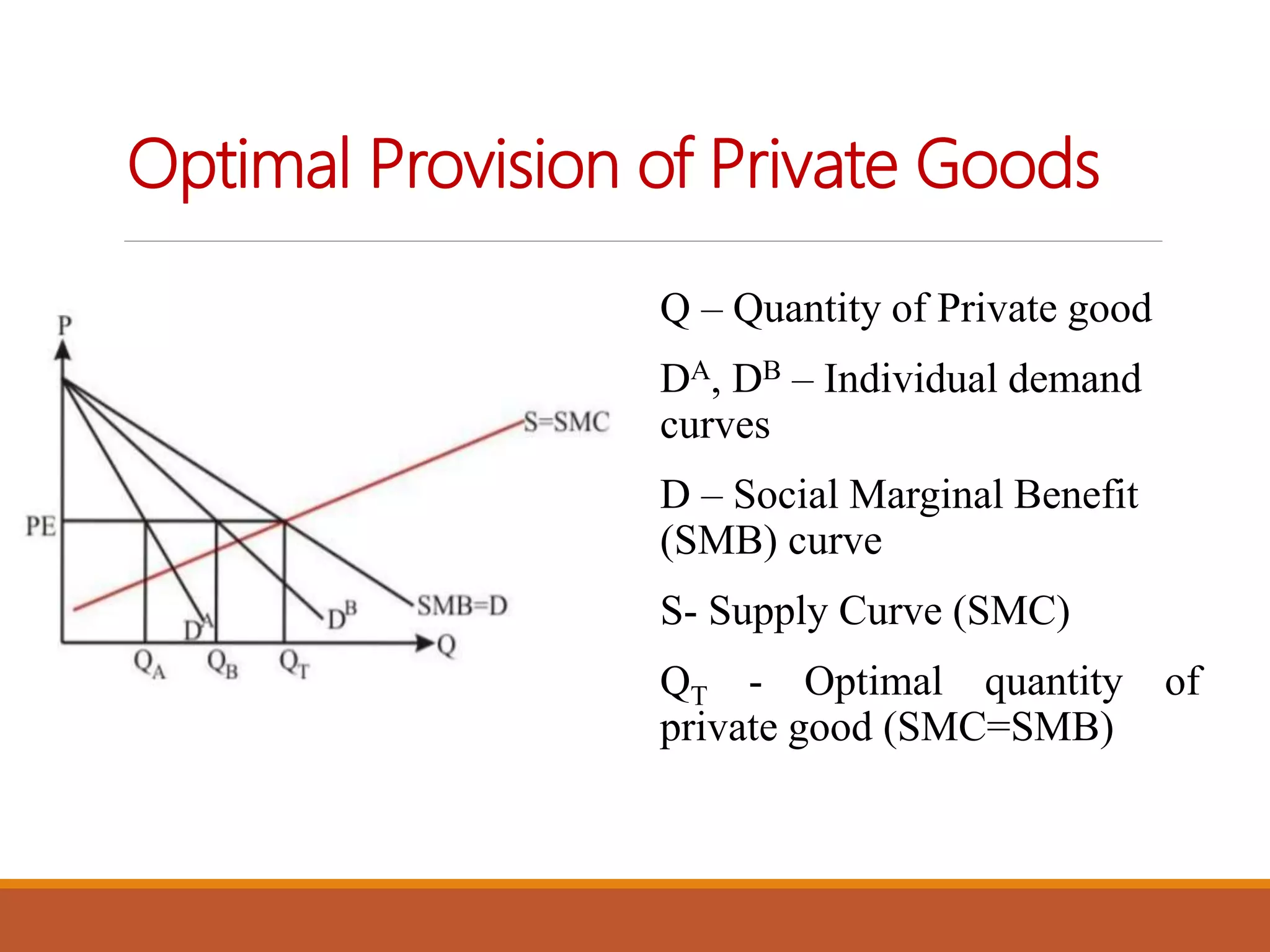
Optimal Provision of Private Goods
Q – Quantity of Private good
DA, DB – Individual demand
curves
D – Social Marginal Benefit
(SMB) curve
S- Supply Curve (SMC)
QT - Optimal quantity of
private good (SMC=SMB)
Samuelson rule: optimal provision of public goods
∑ MRSG P = MRTG P
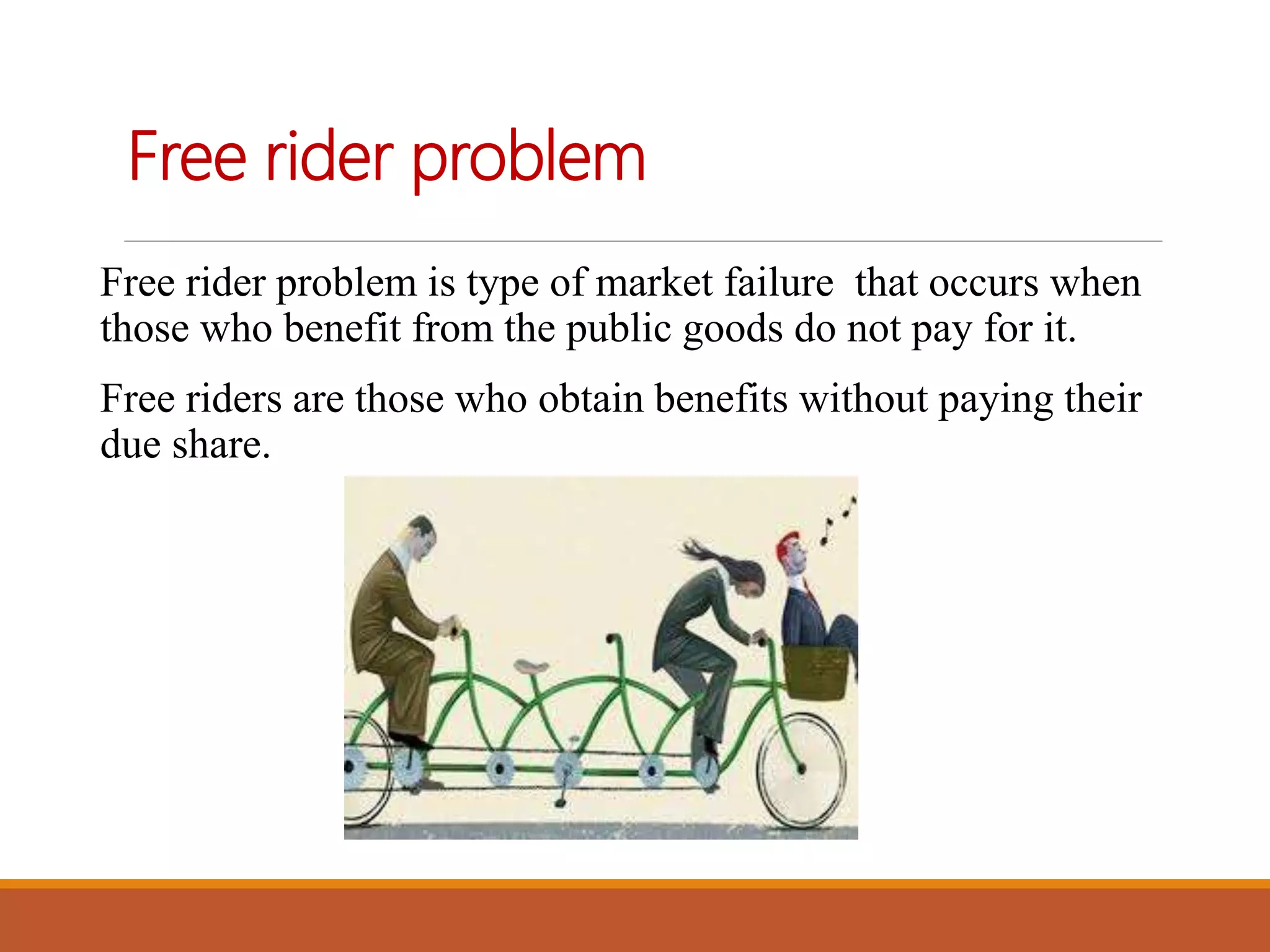
Free rider problem
Free rider problem is type of market failure that occurs when
those who benefit from the public goods do not pay for it.
Free riders are those who obtain benefits without paying their
due share.
Private Provision of Public Goods
Application
Example
Q. A beekeeper lives adjacent to the apple orchard. The orchard
owner benefit from bees because each hive pollinates about one
hectare of apple trees. The orchard owner pays nothing for this
service, however, because bees comes to orchard without his
having to do anything. Because there are not enough bees to
pollinate entire orchard, the orchard owner must complete the
pollination by artificial means, at a cost of Rs. 100 per hectare of
trees.
Beekeeping has a marginal cost MC = 100 + 50Q, where Q
is number of beehives. Each hive yields Rs.400 worth of honey.
a. How many beehives will bee keeper maintain?
b. Is this economically efficient number of hives?
References
Pindyck, R. S., Rubinfeld, D. L. and Mehta, P.L., 2014, Microeconomics,
Dorling Kindsley Pvt. Ltd, pp: 557-563.
www.nptel.ac.in
www.courses.lumenlearning.com
THANK YOU

Optimal Provision of Public and Private Goods

  • 1.
    OPTIMAL PROVISION OFPUBLICAND PRIVATEGOODS BY: BINDU H A
  • 2.
    Public and PrivateGoods: A Public Good is a product that one individual can consume without reducing its availability to others and from which no one is deprived. Characteristics: Non-excludability: once a public good has been provided, the producer cannot prevent people who have not paid for it from receiving the benefits Non-rivalry: one person’s consumption of a public good does not prevent someone else from consuming it. Private good is a product where consumption by one individual prevents another individual from consuming it. Characteristics: Excludable Rival.
  • 3.
    Categories of goods ExcludableNon Excludable Rivalrous Private good (ice cream, cheese, cars) Common resources (ocean, timber, pasture) Non-rivalrous Club goods (toll roads) Public good (National defense)
  • 4.
    Optimal Provision ofPublic Goods G- Quantity of Public good MB1, MB2, MB3 – Marginal Benefit curve(demand curve) ∑MBi – Social Marginal Benefit (SMB) Curve MC – Marginal Cost incurred by supplier G* -optimal quantity of public good (SMC=SMB) Wiilingness to pay
  • 5.
    Optimal Provision ofPrivate Goods Q – Quantity of Private good DA, DB – Individual demand curves D – Social Marginal Benefit (SMB) curve S- Supply Curve (SMC) QT - Optimal quantity of private good (SMC=SMB)
  • 6.
    Samuelson rule: optimalprovision of public goods
  • 7.
    ∑ MRSG P= MRTG P
  • 8.
    Free rider problem Freerider problem is type of market failure that occurs when those who benefit from the public goods do not pay for it. Free riders are those who obtain benefits without paying their due share.
  • 9.
  • 10.
  • 11.
    Example Q. A beekeeperlives adjacent to the apple orchard. The orchard owner benefit from bees because each hive pollinates about one hectare of apple trees. The orchard owner pays nothing for this service, however, because bees comes to orchard without his having to do anything. Because there are not enough bees to pollinate entire orchard, the orchard owner must complete the pollination by artificial means, at a cost of Rs. 100 per hectare of trees. Beekeeping has a marginal cost MC = 100 + 50Q, where Q is number of beehives. Each hive yields Rs.400 worth of honey. a. How many beehives will bee keeper maintain? b. Is this economically efficient number of hives?
  • 12.
    References Pindyck, R. S.,Rubinfeld, D. L. and Mehta, P.L., 2014, Microeconomics, Dorling Kindsley Pvt. Ltd, pp: 557-563. www.nptel.ac.in www.courses.lumenlearning.com
  • 13.