Public Goods
EdExcel Economics 1.3.3
What are Public Goods?
1. Non-excludability: Benefits derived from pure public goods cannot
be confined solely to those who have paid for it. Non-payers can
enjoy the benefits of consumption at no financial cost to
themselves – economists call this the ‘free-rider’ problem
2. Non-rival consumption: Each party’s enjoyment of the good or
service does not diminish others’ enjoyment– in other words the
marginal cost of supplying a public good to an extra person is zero.
If a public good is supplied to one person, it is available to all.
3. Non-rejectable: The collective supply of a pure public good for all
means that it cannot be rejected by people, an example is a
national nuclear defence system or major flood defence projects.
The nature of public goods is that it is hard to protect property rights
Public goods cause market failure due to the problem of missing
markets – the main characteristics of public goods are as follows:
Characteristics of Public Goods
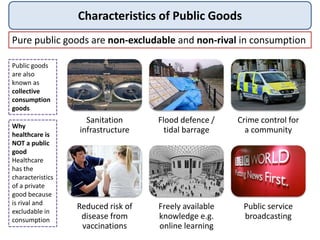
Pure public goods are non-excludable and non-rival in consumption
Sanitation
infrastructure
Flood defence /
tidal barrage
Crime control for
a community
Reduced risk of
disease from
vaccinations
Freely available
knowledge e.g.
online learning
Public service
broadcasting
Why
healthcare is
NOT a public
good
Healthcare
has the
characteristics
of a private
good because
is rival and
excludable in
consumption
Public goods
are also
known as
collective
consumption
goods
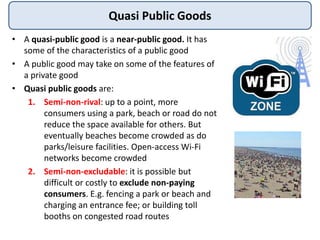
Quasi Public Goods
• A quasi-public good is a near-public good. It has
some of the characteristics of a public good
• A public good may take on some of the features of
a private good
• Quasi public goods are:
1. Semi-non-rival: up to a point, more
consumers using a park, beach or road do not
reduce the space available for others. But
eventually beaches become crowded as do
parks/leisure facilities. Open-access Wi-Fi
networks become crowded
2. Semi-non-excludable: it is possible but
difficult or costly to exclude non-paying
consumers. E.g. fencing a park or beach and
charging an entrance fee; or building toll
booths on congested road routes
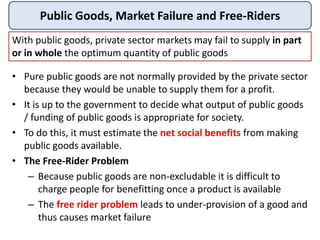
Public Goods, Market Failure and Free-Riders
• Pure public goods are not normally provided by the private sector
because they would be unable to supply them for a profit.
• It is up to the government to decide what output of public goods
/ funding of public goods is appropriate for society.
• To do this, it must estimate the net social benefits from making
public goods available.
• The Free-Rider Problem
– Because public goods are non-excludable it is difficult to
charge people for benefitting once a product is available
– The free rider problem leads to under-provision of a good and
thus causes market failure
With public goods, private sector markets may fail to supply in part
or in whole the optimum quantity of public goods
The Changing Nature of Public Goods
Advances in technology are causing a blurring of the distinction
between public and private goods. Here are some examples.
Encryption
devices
Smart Electronic
Road Pricing
Open Source
Software
Live Streaming
of Events
• In some cases, encryption
allows suppliers to exclude
non-payers – although the
product remains non-rival
• Technological progress
reduces the cost of smart-
metering used in road pricing
– this makes roads more of a
private (excludable) good
• The open source / creative
commons movement has
made much information
public good in nature
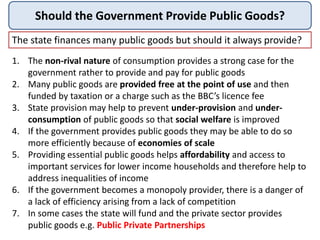
Should the Government Provide Public Goods?
The state finances many public goods but should it always provide?
1. The non-rival nature of consumption provides a strong case for the
government rather to provide and pay for public goods
2. Many public goods are provided free at the point of use and then
funded by taxation or a charge such as the BBC’s licence fee
3. State provision may help to prevent under-provision and under-
consumption of public goods so that social welfare is improved
4. If the government provides public goods they may be able to do so
more efficiently because of economies of scale
5. Providing essential public goods helps affordability and access to
important services for lower income households and therefore help to
address inequalities of income
6. If the government becomes a monopoly provider, there is a danger of
a lack of efficiency arising from a lack of competition
7. In some cases the state will fund and the private sector provides
public goods e.g. Public Private Partnerships
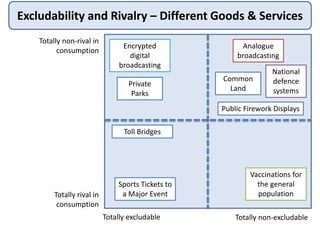
Excludability and Rivalry – Different Goods & Services
Totally non-rival in
consumption
Totally rival in
consumption
Totally excludable Totally non-excludable
Encrypted
digital
broadcasting
Analogue
broadcasting
National
defence
systems
Toll Bridges
Vaccinations for
the general
population
Common
Land
Private
Parks
Public Firework Displays
Sports Tickets to
a Major Event
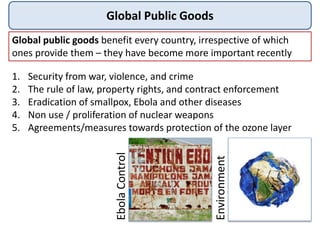
Global Public Goods
Global public goods benefit every country, irrespective of which
ones provide them – they have become more important recently
1. Security from war, violence, and crime
2. The rule of law, property rights, and contract enforcement
3. Eradication of smallpox, Ebola and other diseases
4. Non use / proliferation of nuclear weapons
5. Agreements/measures towards protection of the ozone layer
EbolaControl
Environment
Public Bads
• A public bad has negative effects (externalities) on people and their
communities leading to a significant loss of social welfare
• Examples of public bads:
1. Spread of infectious diseases such as Ebola
2. Unauthorized / illegal surveillance by the state
3. Modern slavery / human trafficking
4. Environmental threats to the global commons
5. Gender and other forms of discrimination in labour markets
6. Disposal of household and commercial waste
7. Web viruses / denial of service attacks
8. High rates of global inequalities of income and wealth
9. Endemic corruption within organisations and societies
10. Externalities from banking crises / financial mismanagement
Key Point: Arguments about whether market activity lead to public bads almost
inevitably involves making normative statements that carry value judgements
The Tragedy of the Commons
• The pursuit of individual self-interest is often not good for social
efficiency leading to the long term depletion of resources
• Consider the example of a stock of common grazing land used by
all livestock farmers in a small village.
• Each farmer keeps adding more livestock to graze on the
Commons, because the marginal cost of doing so is zero.
• But because the commonly own resource is then over-used the
result is a depletion of the soil, lower productivity and thus a fall
in the market value of the resource for all users.
• The resource may become irretrievably damaged.
• The contribution of each agent is minute, but summed over all
agents, these actions cause long term damage
Key Point: The Tragedy of the Commons is caused mainly by the lack of property
rights meaning that a government / community cannot protect the resource
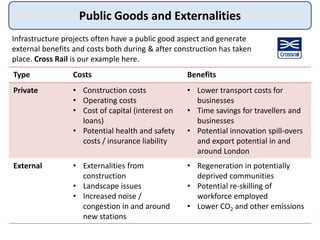
Public Goods and Externalities
Infrastructure projects often have a public good aspect and generate
external benefits and costs both during & after construction has taken
place. Cross Rail is our example here.
Type Costs Benefits
Private • Construction costs
• Operating costs
• Cost of capital (interest on
loans)
• Potential health and safety
costs / insurance liability
• Lower transport costs for
businesses
• Time savings for travellers and
businesses
• Potential innovation spill-overs
and export potential in and
around London
External • Externalities from
construction
• Landscape issues
• Increased noise /
congestion in and around
new stations
• Regeneration in potentially
deprived communities
• Potential re-skilling of
workforce employed
• Lower CO2 and other emissions
Public Goods
EdExcel Economics 1.3.3

Public goods

  • 1.
  • 2.
    What are PublicGoods? 1. Non-excludability: Benefits derived from pure public goods cannot be confined solely to those who have paid for it. Non-payers can enjoy the benefits of consumption at no financial cost to themselves – economists call this the ‘free-rider’ problem 2. Non-rival consumption: Each party’s enjoyment of the good or service does not diminish others’ enjoyment– in other words the marginal cost of supplying a public good to an extra person is zero. If a public good is supplied to one person, it is available to all. 3. Non-rejectable: The collective supply of a pure public good for all means that it cannot be rejected by people, an example is a national nuclear defence system or major flood defence projects. The nature of public goods is that it is hard to protect property rights Public goods cause market failure due to the problem of missing markets – the main characteristics of public goods are as follows:
  • 3.
    Characteristics of PublicGoods Pure public goods are non-excludable and non-rival in consumption Sanitation infrastructure Flood defence / tidal barrage Crime control for a community Reduced risk of disease from vaccinations Freely available knowledge e.g. online learning Public service broadcasting Why healthcare is NOT a public good Healthcare has the characteristics of a private good because is rival and excludable in consumption Public goods are also known as collective consumption goods
  • 4.
    Quasi Public Goods •A quasi-public good is a near-public good. It has some of the characteristics of a public good • A public good may take on some of the features of a private good • Quasi public goods are: 1. Semi-non-rival: up to a point, more consumers using a park, beach or road do not reduce the space available for others. But eventually beaches become crowded as do parks/leisure facilities. Open-access Wi-Fi networks become crowded 2. Semi-non-excludable: it is possible but difficult or costly to exclude non-paying consumers. E.g. fencing a park or beach and charging an entrance fee; or building toll booths on congested road routes
  • 5.
    Public Goods, MarketFailure and Free-Riders • Pure public goods are not normally provided by the private sector because they would be unable to supply them for a profit. • It is up to the government to decide what output of public goods / funding of public goods is appropriate for society. • To do this, it must estimate the net social benefits from making public goods available. • The Free-Rider Problem – Because public goods are non-excludable it is difficult to charge people for benefitting once a product is available – The free rider problem leads to under-provision of a good and thus causes market failure With public goods, private sector markets may fail to supply in part or in whole the optimum quantity of public goods
  • 6.
    The Changing Natureof Public Goods Advances in technology are causing a blurring of the distinction between public and private goods. Here are some examples. Encryption devices Smart Electronic Road Pricing Open Source Software Live Streaming of Events • In some cases, encryption allows suppliers to exclude non-payers – although the product remains non-rival • Technological progress reduces the cost of smart- metering used in road pricing – this makes roads more of a private (excludable) good • The open source / creative commons movement has made much information public good in nature
  • 7.
    Should the GovernmentProvide Public Goods? The state finances many public goods but should it always provide? 1. The non-rival nature of consumption provides a strong case for the government rather to provide and pay for public goods 2. Many public goods are provided free at the point of use and then funded by taxation or a charge such as the BBC’s licence fee 3. State provision may help to prevent under-provision and under- consumption of public goods so that social welfare is improved 4. If the government provides public goods they may be able to do so more efficiently because of economies of scale 5. Providing essential public goods helps affordability and access to important services for lower income households and therefore help to address inequalities of income 6. If the government becomes a monopoly provider, there is a danger of a lack of efficiency arising from a lack of competition 7. In some cases the state will fund and the private sector provides public goods e.g. Public Private Partnerships
  • 8.
    Excludability and Rivalry– Different Goods & Services Totally non-rival in consumption Totally rival in consumption Totally excludable Totally non-excludable Encrypted digital broadcasting Analogue broadcasting National defence systems Toll Bridges Vaccinations for the general population Common Land Private Parks Public Firework Displays Sports Tickets to a Major Event
  • 9.
    Global Public Goods Globalpublic goods benefit every country, irrespective of which ones provide them – they have become more important recently 1. Security from war, violence, and crime 2. The rule of law, property rights, and contract enforcement 3. Eradication of smallpox, Ebola and other diseases 4. Non use / proliferation of nuclear weapons 5. Agreements/measures towards protection of the ozone layer EbolaControl Environment
  • 10.
    Public Bads • Apublic bad has negative effects (externalities) on people and their communities leading to a significant loss of social welfare • Examples of public bads: 1. Spread of infectious diseases such as Ebola 2. Unauthorized / illegal surveillance by the state 3. Modern slavery / human trafficking 4. Environmental threats to the global commons 5. Gender and other forms of discrimination in labour markets 6. Disposal of household and commercial waste 7. Web viruses / denial of service attacks 8. High rates of global inequalities of income and wealth 9. Endemic corruption within organisations and societies 10. Externalities from banking crises / financial mismanagement Key Point: Arguments about whether market activity lead to public bads almost inevitably involves making normative statements that carry value judgements
  • 11.
    The Tragedy ofthe Commons • The pursuit of individual self-interest is often not good for social efficiency leading to the long term depletion of resources • Consider the example of a stock of common grazing land used by all livestock farmers in a small village. • Each farmer keeps adding more livestock to graze on the Commons, because the marginal cost of doing so is zero. • But because the commonly own resource is then over-used the result is a depletion of the soil, lower productivity and thus a fall in the market value of the resource for all users. • The resource may become irretrievably damaged. • The contribution of each agent is minute, but summed over all agents, these actions cause long term damage Key Point: The Tragedy of the Commons is caused mainly by the lack of property rights meaning that a government / community cannot protect the resource
  • 12.
    Public Goods andExternalities Infrastructure projects often have a public good aspect and generate external benefits and costs both during & after construction has taken place. Cross Rail is our example here. Type Costs Benefits Private • Construction costs • Operating costs • Cost of capital (interest on loans) • Potential health and safety costs / insurance liability • Lower transport costs for businesses • Time savings for travellers and businesses • Potential innovation spill-overs and export potential in and around London External • Externalities from construction • Landscape issues • Increased noise / congestion in and around new stations • Regeneration in potentially deprived communities • Potential re-skilling of workforce employed • Lower CO2 and other emissions
  • 13.