
FREE-RIDER 
PROBLEM 
-Explain the free-rider 
problem 
-How public provision can 
help to overcome that 
problem
DEFINITION 
 Public good is both nonrival and 
nonexcludable. A public good benefits 
everyone, and no one can be excluded 
from its benefits
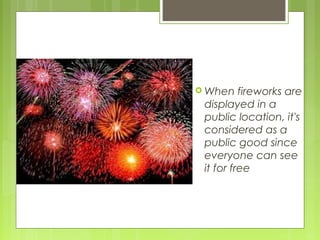
When fireworks are 
displayed in a 
public location, it's 
considered as a 
public good since 
everyone can see 
it for free
DEFINITION 
 A free rider is a person who enjoys the 
benefits of a good or service without 
paying for it.
DEFINITION 
 Marginal social benefit is the sum of the 
marginal benefits of all the individuals at 
each quantity. 
 Marginal social cost is the sum of the 
marginal costs of all individuals at each 
quantity
FREE RIDER PROBLEM 
 A free rider problem is a situation in which 
individuals or businesses are receiving 
benefits without actually contributing 
anything, thus creating an unfair balance 
in the distribution of revenues or other 
resources 
- Non -production 
- Under – production 
- Excessive
FREE RIDER PROBLEM 
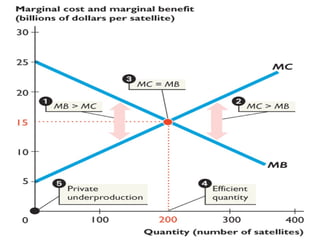
 The free rider problem is that the 
economy would provide an inefficiently 
small quantity of a public good 
Marginal social benefit from the public 
good would exceed its marginal social 
cost 
 Resources can be used more efficiently 
by increasing a number of goods
FREE RIDER PROBLEM
SOLUTIONS 
 Tax 
 Appealing To People’s Altruism. 
 Make A Public Good private 
 Legislation
TAX 
 Treat the many 
beneficiaries as one 
consumer and then 
divide the cost 
equally.
2. Appealing 
To People’s 
Altruism 
 For services which 
have relatively low 
cost, asking for 
donations to raise 
funds
3. Make A Public 
Goods private 
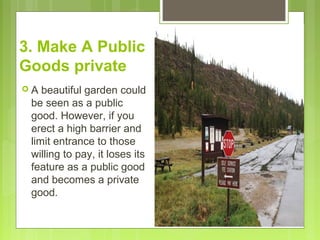
 A beautiful garden could 
be seen as a public 
good. However, if you 
erect a high barrier and 
limit entrance to those 
willing to pay, it loses its 
feature as a public good 
and becomes a private 
good.
4 .Legislation 
 The government 
have tried various 
options such as: 
 Quotes 
 Legislation 
 Compensation
THANK YOU 
FOR 
LISTENING!

Free rider problem

  • 1.
    FREE-RIDER PROBLEM -Explainthe free-rider problem -How public provision can help to overcome that problem
  • 2.
    DEFINITION  Publicgood is both nonrival and nonexcludable. A public good benefits everyone, and no one can be excluded from its benefits
  • 3.
    When fireworks are displayed in a public location, it's considered as a public good since everyone can see it for free
  • 4.
    DEFINITION  Afree rider is a person who enjoys the benefits of a good or service without paying for it.
  • 5.
    DEFINITION  Marginalsocial benefit is the sum of the marginal benefits of all the individuals at each quantity.  Marginal social cost is the sum of the marginal costs of all individuals at each quantity
  • 6.
    FREE RIDER PROBLEM  A free rider problem is a situation in which individuals or businesses are receiving benefits without actually contributing anything, thus creating an unfair balance in the distribution of revenues or other resources - Non -production - Under – production - Excessive
  • 7.
    FREE RIDER PROBLEM  The free rider problem is that the economy would provide an inefficiently small quantity of a public good Marginal social benefit from the public good would exceed its marginal social cost  Resources can be used more efficiently by increasing a number of goods
  • 8.
  • 9.
    SOLUTIONS  Tax  Appealing To People’s Altruism.  Make A Public Good private  Legislation
  • 10.
    TAX  Treatthe many beneficiaries as one consumer and then divide the cost equally.
  • 11.
    2. Appealing ToPeople’s Altruism  For services which have relatively low cost, asking for donations to raise funds
  • 12.
    3. Make APublic Goods private  A beautiful garden could be seen as a public good. However, if you erect a high barrier and limit entrance to those willing to pay, it loses its feature as a public good and becomes a private good.
  • 13.
    4 .Legislation The government have tried various options such as:  Quotes  Legislation  Compensation
  • 14.
    THANK YOU FOR LISTENING!