PUBLIC GOODS
Chapter 4
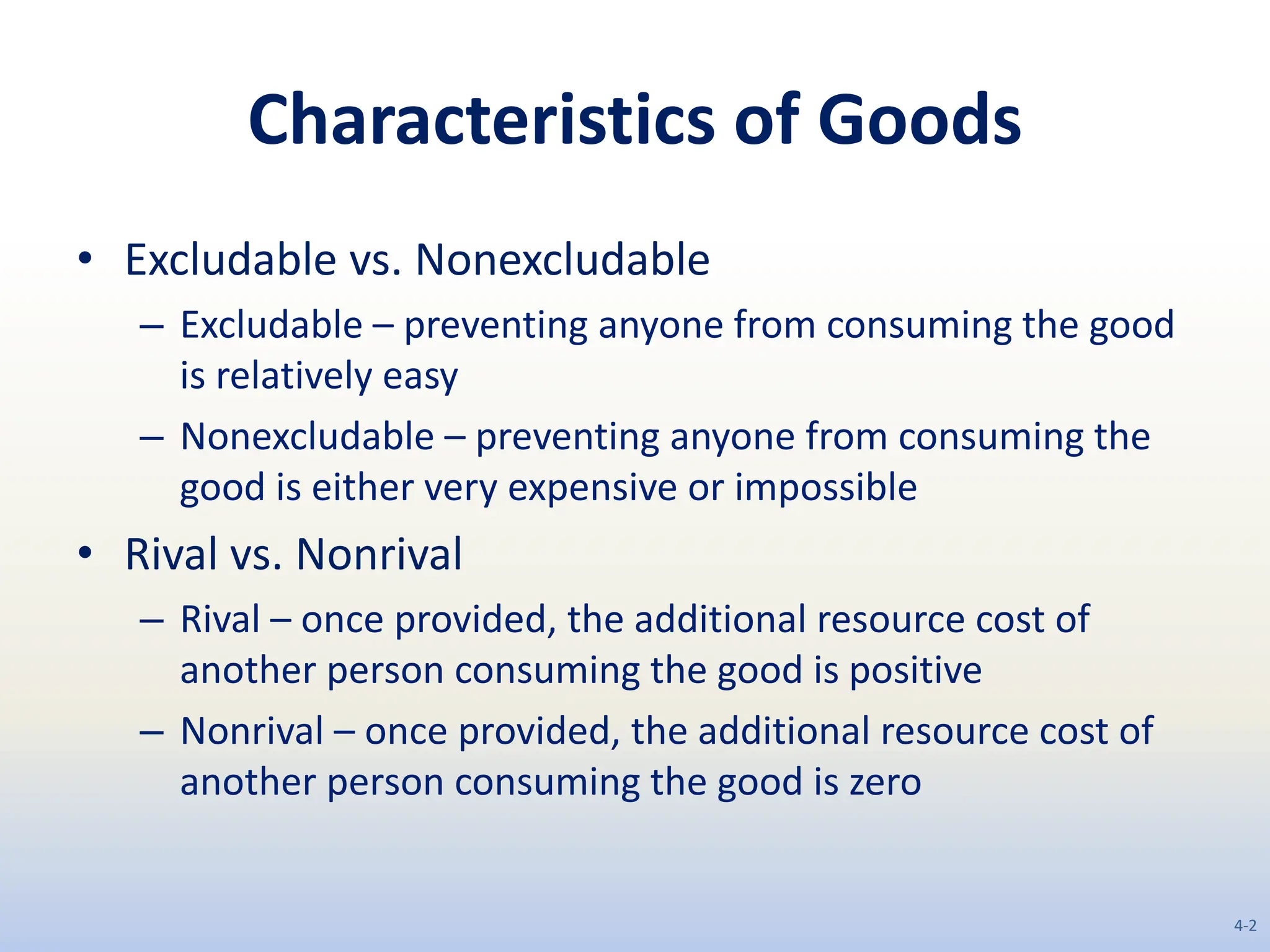
Characteristics of Goods
• Excludable vs. Nonexcludable
– Excludable – preventing anyone from consuming the good
is relatively easy
– Nonexcludable – preventing anyone from consuming the
good is either very expensive or impossible
• Rival vs. Nonrival
– Rival – once provided, the additional resource cost of
another person consuming the good is positive
– Nonrival – once provided, the additional resource cost of
another person consuming the good is zero
4-2
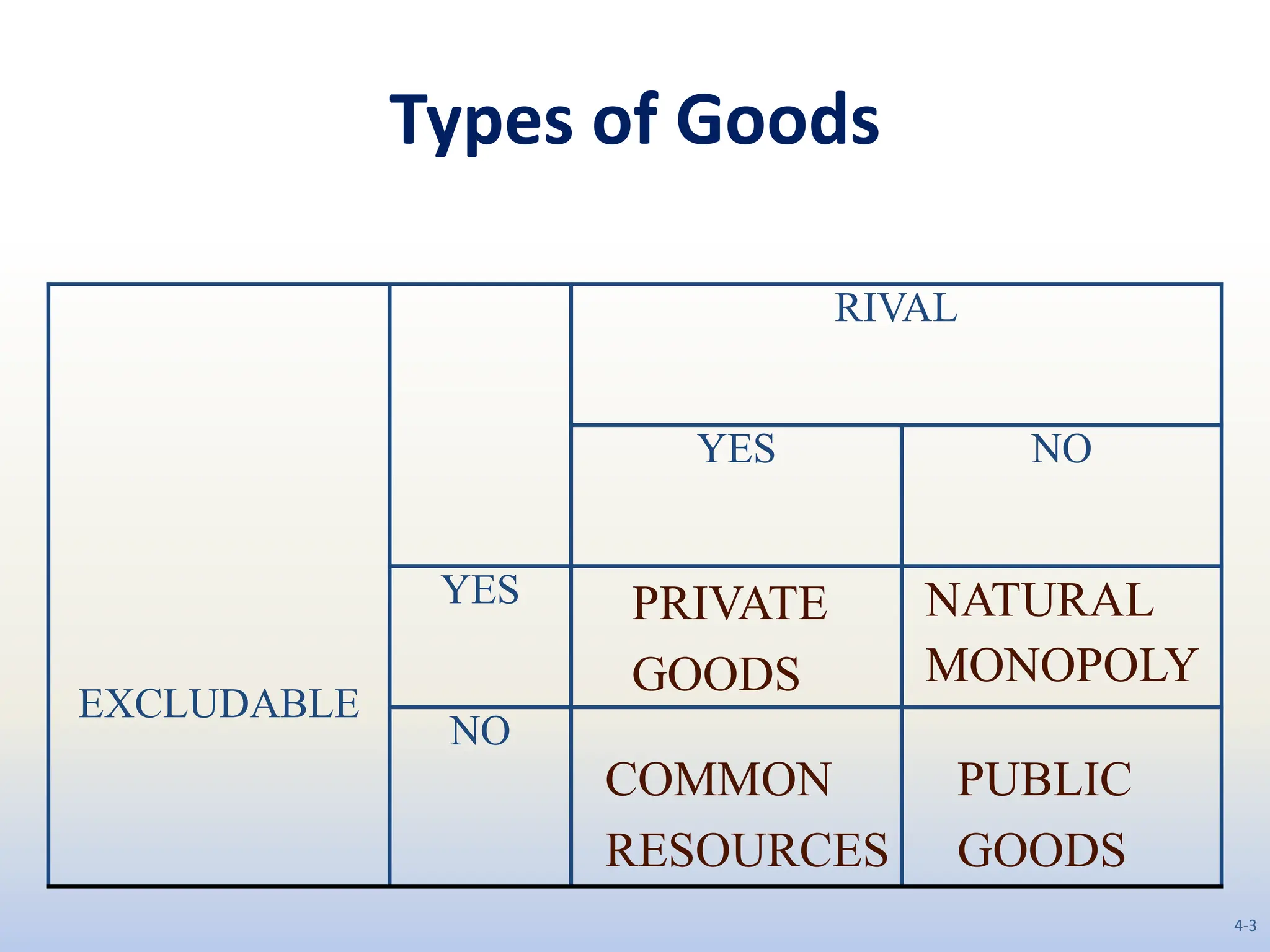
Types of Goods
EXCLUDABLE
RIVAL
YES NO
YES
NO
PRIVATE
GOODS
PUBLIC
GOODS
COMMON
RESOURCES
NATURAL
MONOPOLY
4-3
Noteworthy Aspects of Public Goods
• Even though everyone consumes the same quantity of the good, it need not
be valued equally by all
• Classification as a public good is not absolute; it depends on market conditions
and the state of technology
– A commodity can satisfy one part of the definition of a public good but not the
other
– Impure public good: rival or excludable
• Some things that are not conventionally thought of as commodities have
public good characteristics
• Private goods are not always provided only by the private sector
– publicly provided private goods: rival and excludable goods provided by govt
• Public provision of a good does not necessarily mean that it is also produced
by the public sector (e.g. garbage collection)
4-4
Some Public Goods
• Basic research
• Programs to fight poverty
• Uncongested non-toll roads
• Fireworks display
• Honesty
• National Defense
4-5
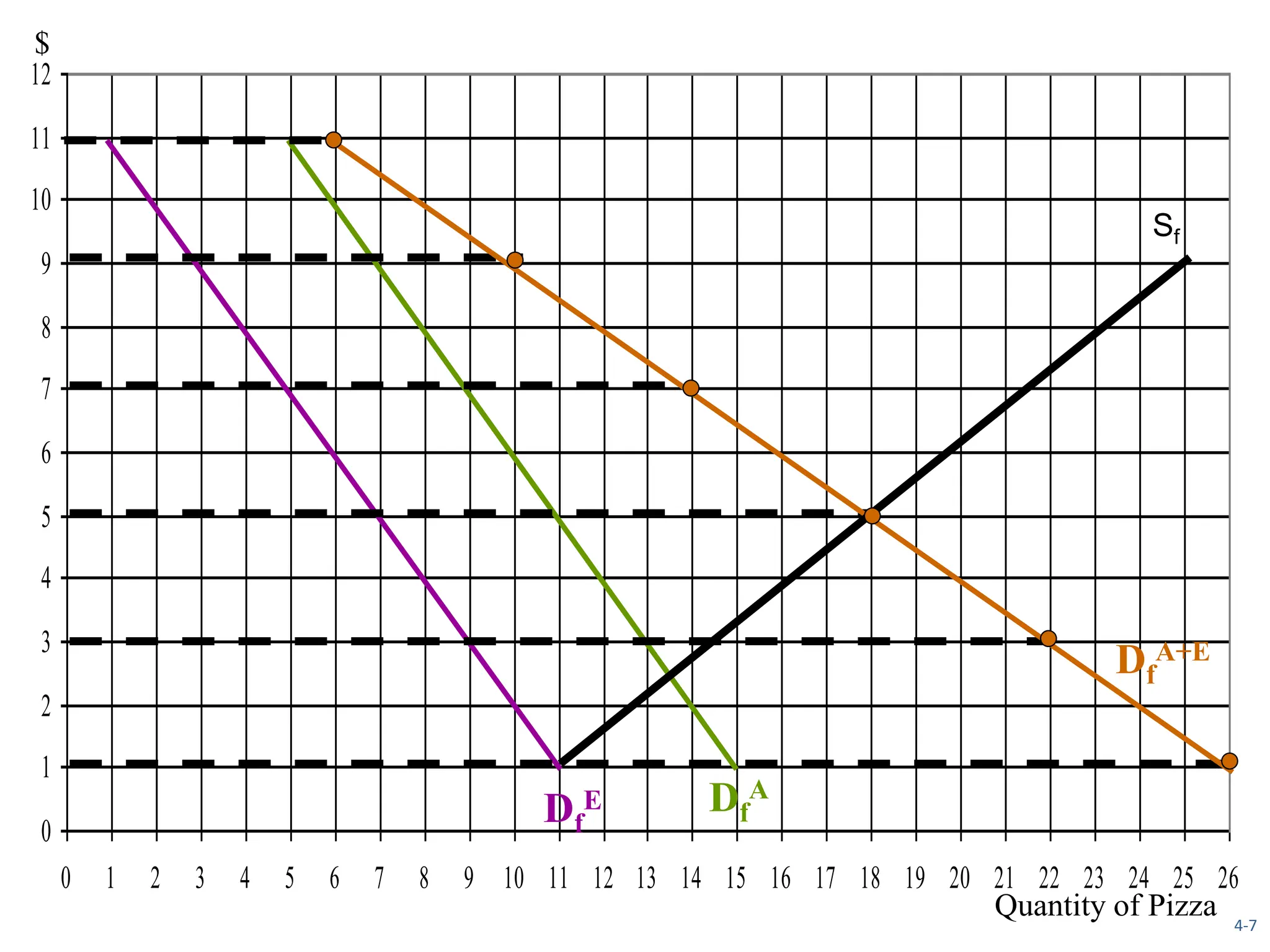
Efficient Provision of Private Goods
Price Adam
(Df
A)
Eve
(Df
E)
Market
(Df
A+E)
$11 5 1 6
$9 7 3 10
$7 9 5 14
$5 11 7 18
$3 13 9 22
$1 15 11 26
4-6
0
1
2
3
4
5
6
7
8
9
10
11
12
0 1 2 3 4 5 6 7 8 9 10 11 12 13 14 15 16 17 18 19 20 21 22 23 24 25 26
Df
A
Df
E
Df
A+E
Sf
$
Quantity of Pizza 4-7
Pareto Efficiency – Private Goods Case
• MRSfa = Pf/Pa
• Set Pa = $1
• MRSfa = Pf
• Df
A shows MRSfa for Adam
• Df
E shows MRSfa for Eve
• Sf shows MRTfa
• Necessary condition for Pareto efficiency:
MRSfa
Adam = MRSfa
Eve = MRTfa
4-8
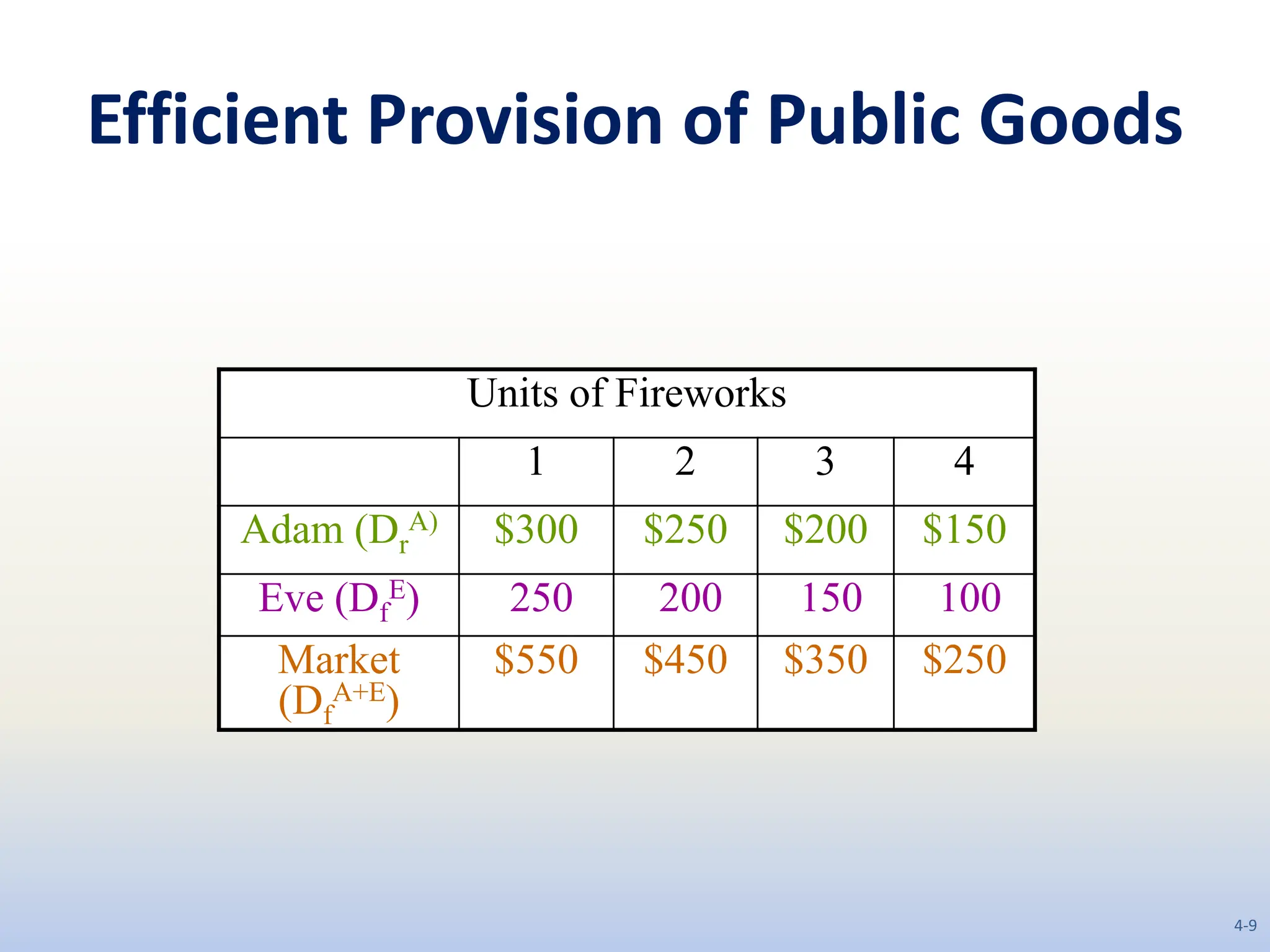
Efficient Provision of Public Goods
Units of Fireworks
1 2 3 4
Adam (Dr
A) $300 $250 $200 $150
Eve (Df
E) 250 200 150 100
Market
(Df
A+E)
$550 $450 $350 $250
4-9
0
50
100
150
200
250
300
350
400
450
500
550
600
650
700
750
800
1 2 3 4
Dr
A
DrE
Dr
A+E
Sr
Quantity of Fireworks
$
4-10
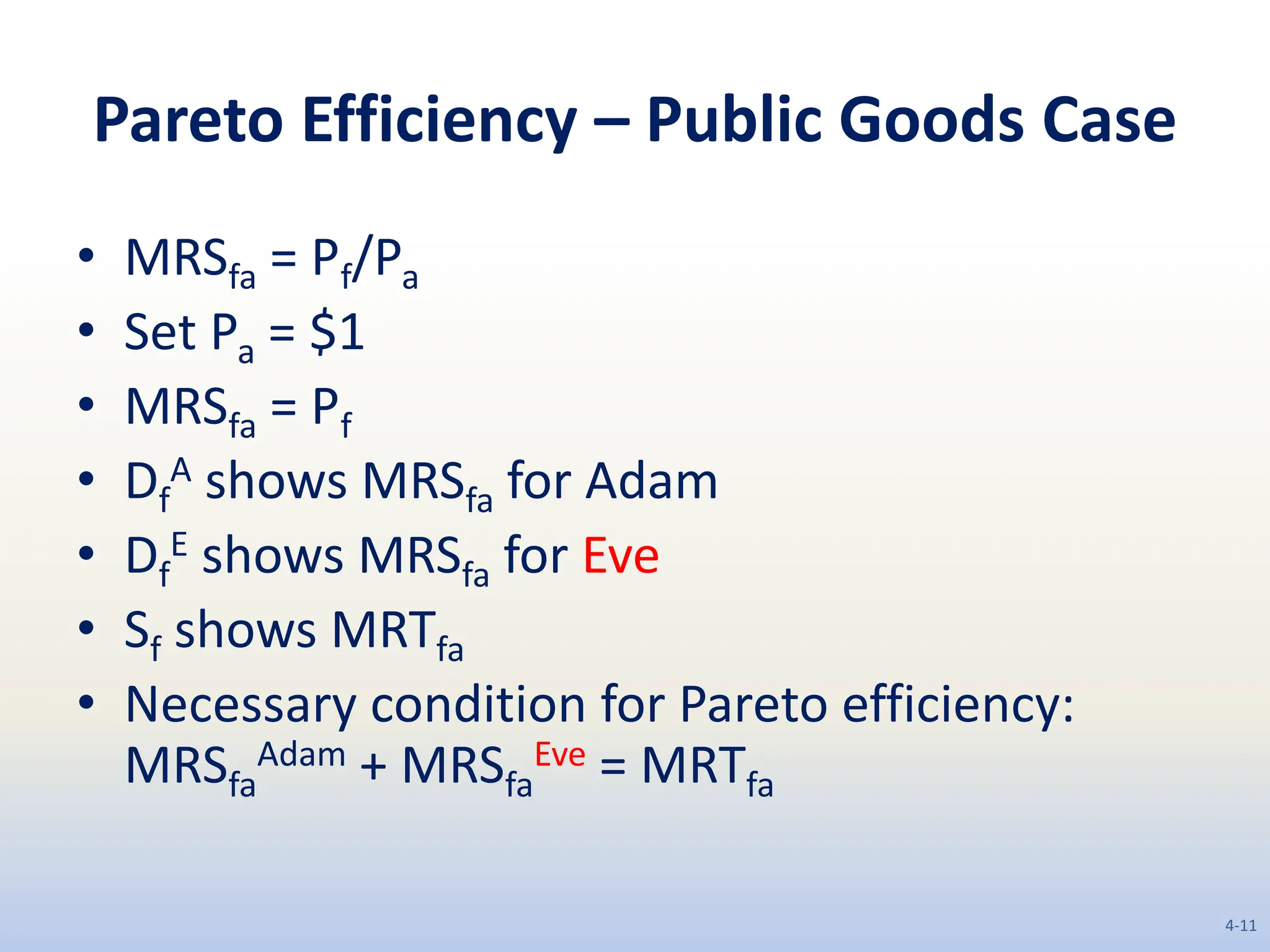
Pareto Efficiency – Public Goods Case
• MRSfa = Pf/Pa
• Set Pa = $1
• MRSfa = Pf
• Df
A shows MRSfa for Adam
• Df
E shows MRSfa for Eve
• Sf shows MRTfa
• Necessary condition for Pareto efficiency:
MRSfa
Adam + MRSfa
Eve = MRTfa
4-11
Problems Achieving Efficiency
• The Free-Rider Problem
• Solutions to the free-rider problem
– Perfect price discrimination
• Policy Perspective: GPS is non-rival but
excludable since technology exist to scramble
signals
4-12
Laboratory Experiments: Do People Free-Ride?
• How a typical experiment works
• Typical results
– People contribute about 50% of resources to provision of
public good
– Contributions fall the more often the game is repeated
– Cooperation fostered by prior communication
– Contribution rates decline when opportunity cost of giving
goes up
• “Warm-glow” giving
4-13
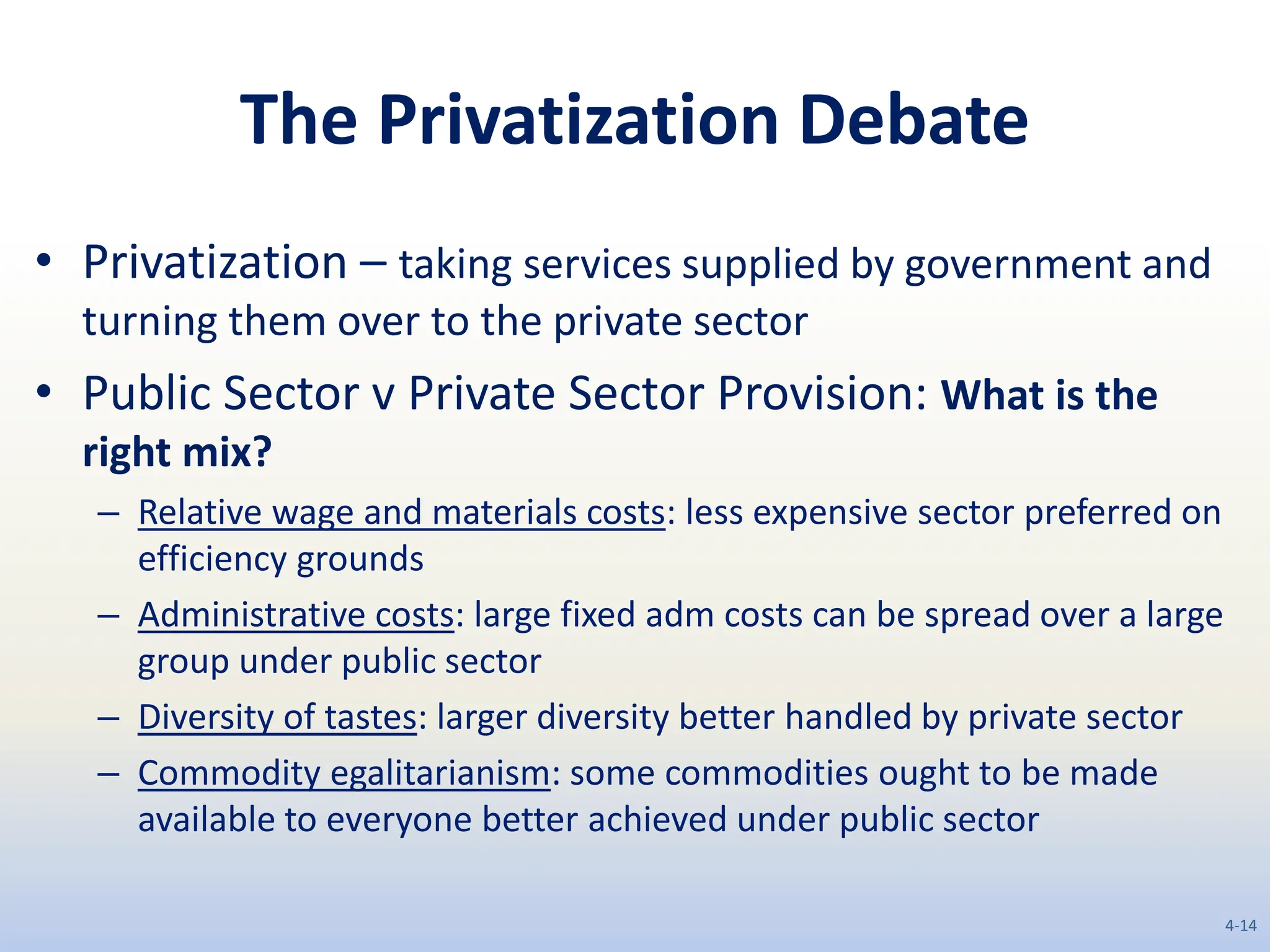
The Privatization Debate
• Privatization – taking services supplied by government and
turning them over to the private sector
• Public Sector v Private Sector Provision: What is the
right mix?
– Relative wage and materials costs: less expensive sector preferred on
efficiency grounds
– Administrative costs: large fixed adm costs can be spread over a large
group under public sector
– Diversity of tastes: larger diversity better handled by private sector
– Commodity egalitarianism: some commodities ought to be made
available to everyone better achieved under public sector
4-14
Public vs Private Production Debate
• Which sector is more efficient?
– Theory that public sector managers have little
incentive to be efficient
– However, problems in comparing cost differences
since quality of services offered by public and private
sectors can differ. (e.g., hospitals)
• Incomplete contracts
• Competition to supply good or service
• Reputation building
• Ultimately depends on Market Environment
facing the providers
4-15
Chapter 4 Summary
• Public goods are nonrival and nonexcludable in
consumption
– Impure public goods exhibit some qualities of private
and public goods
• Efficient provision of public goods:
– ∑MRSi
xy= MRTxy i=person i…..n
• An incentive exists to free-ride in the payment of
public goods
• Public goods can be provided privately; private
goods can be provided publicly
4-16
Appendix: Preference Revelation
Mechanisms for Public Goods
• ∆TEve = MRTra – (MRSra
Total – MRSra
Eve)
• Eve’s choice: ∆TEve = MRSra
Eve
• By substitution:
MRTra – (MRSra
Total – MRSra
Eve) = MRSra
Eve
• Add (MRSra
Total – MRSra
Eve) to both sides:
MRTra = MRSra
Total
4-17

SPPTChap004.ppt

  • 1.
  • 2.
    Characteristics of Goods •Excludable vs. Nonexcludable – Excludable – preventing anyone from consuming the good is relatively easy – Nonexcludable – preventing anyone from consuming the good is either very expensive or impossible • Rival vs. Nonrival – Rival – once provided, the additional resource cost of another person consuming the good is positive – Nonrival – once provided, the additional resource cost of another person consuming the good is zero 4-2
  • 3.
    Types of Goods EXCLUDABLE RIVAL YESNO YES NO PRIVATE GOODS PUBLIC GOODS COMMON RESOURCES NATURAL MONOPOLY 4-3
  • 4.
    Noteworthy Aspects ofPublic Goods • Even though everyone consumes the same quantity of the good, it need not be valued equally by all • Classification as a public good is not absolute; it depends on market conditions and the state of technology – A commodity can satisfy one part of the definition of a public good but not the other – Impure public good: rival or excludable • Some things that are not conventionally thought of as commodities have public good characteristics • Private goods are not always provided only by the private sector – publicly provided private goods: rival and excludable goods provided by govt • Public provision of a good does not necessarily mean that it is also produced by the public sector (e.g. garbage collection) 4-4
  • 5.
    Some Public Goods •Basic research • Programs to fight poverty • Uncongested non-toll roads • Fireworks display • Honesty • National Defense 4-5
  • 6.
    Efficient Provision ofPrivate Goods Price Adam (Df A) Eve (Df E) Market (Df A+E) $11 5 1 6 $9 7 3 10 $7 9 5 14 $5 11 7 18 $3 13 9 22 $1 15 11 26 4-6
  • 7.
    0 1 2 3 4 5 6 7 8 9 10 11 12 0 1 23 4 5 6 7 8 9 10 11 12 13 14 15 16 17 18 19 20 21 22 23 24 25 26 Df A Df E Df A+E Sf $ Quantity of Pizza 4-7
  • 8.
    Pareto Efficiency –Private Goods Case • MRSfa = Pf/Pa • Set Pa = $1 • MRSfa = Pf • Df A shows MRSfa for Adam • Df E shows MRSfa for Eve • Sf shows MRTfa • Necessary condition for Pareto efficiency: MRSfa Adam = MRSfa Eve = MRTfa 4-8
  • 9.
    Efficient Provision ofPublic Goods Units of Fireworks 1 2 3 4 Adam (Dr A) $300 $250 $200 $150 Eve (Df E) 250 200 150 100 Market (Df A+E) $550 $450 $350 $250 4-9
  • 10.
    0 50 100 150 200 250 300 350 400 450 500 550 600 650 700 750 800 1 2 34 Dr A DrE Dr A+E Sr Quantity of Fireworks $ 4-10
  • 11.
    Pareto Efficiency –Public Goods Case • MRSfa = Pf/Pa • Set Pa = $1 • MRSfa = Pf • Df A shows MRSfa for Adam • Df E shows MRSfa for Eve • Sf shows MRTfa • Necessary condition for Pareto efficiency: MRSfa Adam + MRSfa Eve = MRTfa 4-11
  • 12.
    Problems Achieving Efficiency •The Free-Rider Problem • Solutions to the free-rider problem – Perfect price discrimination • Policy Perspective: GPS is non-rival but excludable since technology exist to scramble signals 4-12
  • 13.
    Laboratory Experiments: DoPeople Free-Ride? • How a typical experiment works • Typical results – People contribute about 50% of resources to provision of public good – Contributions fall the more often the game is repeated – Cooperation fostered by prior communication – Contribution rates decline when opportunity cost of giving goes up • “Warm-glow” giving 4-13
  • 14.
    The Privatization Debate •Privatization – taking services supplied by government and turning them over to the private sector • Public Sector v Private Sector Provision: What is the right mix? – Relative wage and materials costs: less expensive sector preferred on efficiency grounds – Administrative costs: large fixed adm costs can be spread over a large group under public sector – Diversity of tastes: larger diversity better handled by private sector – Commodity egalitarianism: some commodities ought to be made available to everyone better achieved under public sector 4-14
  • 15.
    Public vs PrivateProduction Debate • Which sector is more efficient? – Theory that public sector managers have little incentive to be efficient – However, problems in comparing cost differences since quality of services offered by public and private sectors can differ. (e.g., hospitals) • Incomplete contracts • Competition to supply good or service • Reputation building • Ultimately depends on Market Environment facing the providers 4-15
  • 16.
    Chapter 4 Summary •Public goods are nonrival and nonexcludable in consumption – Impure public goods exhibit some qualities of private and public goods • Efficient provision of public goods: – ∑MRSi xy= MRTxy i=person i…..n • An incentive exists to free-ride in the payment of public goods • Public goods can be provided privately; private goods can be provided publicly 4-16
  • 17.
    Appendix: Preference Revelation Mechanismsfor Public Goods • ∆TEve = MRTra – (MRSra Total – MRSra Eve) • Eve’s choice: ∆TEve = MRSra Eve • By substitution: MRTra – (MRSra Total – MRSra Eve) = MRSra Eve • Add (MRSra Total – MRSra Eve) to both sides: MRTra = MRSra Total 4-17