Copyright©2004 South-Western
1111Public Goods and
Common Resource
Copyright © 2004 South-Western
“The best things in life are free. . .”
• Free goods provide a special challenge for
economic analysis.
• Most goods in our economy are allocated in
markets…
Copyright © 2004 South-Western
“The best things in life are free. . .”
• When goods are available free of charge, the
market forces that normally allocate resources
in our economy are absent.
Copyright © 2004 South-Western
“The best things in life are free. . .”
• When a good does not have a price attached to
it, private markets cannot ensure that the good
is produced and consumed in the proper
amounts.
Copyright © 2004 South-Western
“The best things in life are free. . .”
• In such cases, government policy can
potentially remedy the market failure that
results, and raise economic well-being.
Copyright © 2004 South-Western
THE DIFFERENT
KINDS OF GOODS
• When thinking about the various goods in the
economy, it is useful to group them according
to two characteristics:
• Is the good excludable?
• Is the good rival?
Copyright © 2004 South-Western
THE DIFFERENT
KINDS OF GOODS
• Excludability
• Excludability refers to the property of a good
whereby a person can be prevented from using it.
• Rivalry
• Rivalry refers to the property of a good whereby
one person’s use diminishes other people’s use.
Copyright © 2004 South-Western
THE DIFFERENT
KINDS OF GOODS
• Four Types of Goods
• Private Goods
• Public Goods
• Common Resources
• Natural Monopolies
Copyright © 2004 South-Western
THE DIFFERENT
KINDS OF GOODS
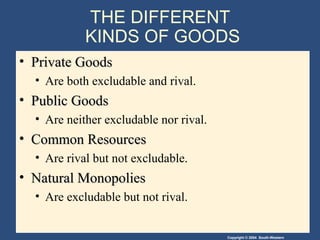
• Private GoodsPrivate Goods
• Are both excludable and rival.
• Public GoodsPublic Goods
• Are neither excludable nor rival.
• Common ResourcesCommon Resources
• Are rival but not excludable.
• Natural MonopoliesNatural Monopolies
• Are excludable but not rival.
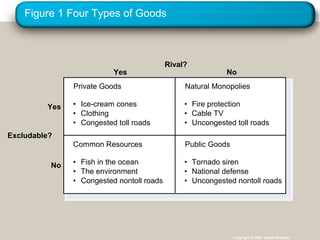
Figure 1 Four Types of Goods
Copyright © 2004 South-Western
Rival?
Yes
Yes
• Ice-cream cones
• Clothing
• Congested toll roads
• Fire protection
• Cable TV
• Uncongested toll roads
No
Private Goods Natural Monopolies
No
Excludable?
• Fish in the ocean
• The environment
• Congested nontoll roads
• Tornado siren
• National defense
• Uncongested nontoll roads
Common Resources Public Goods
Copyright © 2004 South-Western
PUBLIC GOODS
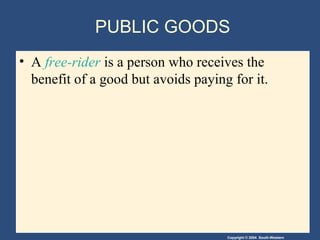
• A free-rider is a person who receives the
benefit of a good but avoids paying for it.
Copyright © 2004 South-Western
The Free-Rider Problem
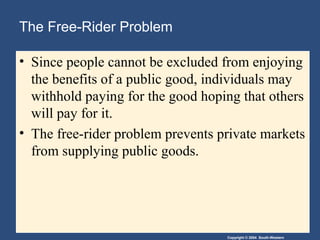
• Since people cannot be excluded from enjoying
the benefits of a public good, individuals may
withhold paying for the good hoping that others
will pay for it.
• The free-rider problem prevents private markets
from supplying public goods.
Copyright © 2004 South-Western
The Free-Rider Problem
• Solving the Free-Rider Problem
• The government can decide to provide the public
good if the total benefits exceed the costs.
• The government can make everyone better off by
providing the public good and paying for it with tax
revenue.
Copyright © 2004 South-Western
Some Important Public Goods
• National Defense
• Basic Research
• Fighting Poverty
Copyright © 2004 South-Western
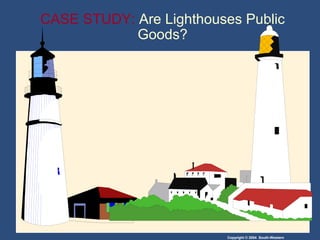
CASE STUDY: Are Lighthouses Public
Goods?
Copyright © 2004 South-Western
The Difficult Job of Cost-Benefit Analysis
• Cost benefit analysis refers to a study that
compares the costs and benefits to society of
providing a public good.
• In order to decide whether to provide a public
good or not, the total benefits of all those who
use the good must be compared to the costs of
providing and maintaining the public good.
Copyright © 2004 South-Western
The Difficult Job of Cost-Benefit Analysis
• A cost-benefit analysis would be used to
estimate the total costs and benefits of the
project to society as a whole.
• It is difficult to do because of the absence of prices
needed to estimate social benefits and resource
costs.
• The value of life, the consumer’s time, and
aesthetics are difficult to assess.
Copyright © 2004 South-Western
COMMON RESOURCES
• Common resources, like public goods, are not
excludable. They are available free of charge to
anyone who wishes to use them.
Copyright © 2004 South-Western
COMMON RESOURCES
• Common resources are rival goods because one
person’s use of the common resource reduces
other people’s use.
Copyright © 2004 South-Western
Tragedy of the Commons
• The Tragedy of the Commons is a parable that
illustrates why common resources get used
more than is desirable from the standpoint of
society as a whole.
• Common resources tend to be used excessively
when individuals are not charged for their usage.
• This is similar to a negative externality.
Copyright © 2004 South-Western
Some Important Common Resources
• Clean air and water
• Congested roads
• Fish, whales, and other wildlife
Copyright © 2004 South-Western
CASE STUDY: Why Isn’t the Cow Extinct?
• Will the market protect me?
Private
Ownership and
the Profit
Motive!
Copyright © 2004 South-Western
CONCLUSION: THE IMPORTANCE OF
PROPERTY RIGHTS
• The market fails to allocate resources
efficiently when property rights are not well-
established (i.e. some item of value does not
have an owner with the legal authority to
control it).
Copyright © 2004 South-Western
CONCLUSION: THE IMPORTANCE OF
PROPERTY RIGHTS
• When the absence of property rights causes a
market failure, the government can potentially
solve the problem.
Copyright © 2004 South-Western
Summary
• Goods differ in whether they are excludable
and whether they are rival.
• A good is excludable if it is possible to prevent
someone from using it.
• A good is rival if one person’s enjoyment of the
good prevents other people from enjoying the same
unit of the good.
Copyright © 2004 South-Western
Summary
• Public goods are neither rival nor excludable.
• Because people are not charged for their use of
public goods, they have an incentive to free ride
when the good is provided privately.
• Governments provide public goods, making
quantity decisions based upon cost-benefit
analysis.
Copyright © 2004 South-Western
Summary
• Common resources are rival but not excludable.
• Because people are not charged for their use of
common resources, they tend to use them
excessively.
• Governments tend to try to limit the use of
common resources.

Public Goods and Common Resources

  • 1.
  • 2.
    Copyright © 2004South-Western “The best things in life are free. . .” • Free goods provide a special challenge for economic analysis. • Most goods in our economy are allocated in markets…
  • 3.
    Copyright © 2004South-Western “The best things in life are free. . .” • When goods are available free of charge, the market forces that normally allocate resources in our economy are absent.
  • 4.
    Copyright © 2004South-Western “The best things in life are free. . .” • When a good does not have a price attached to it, private markets cannot ensure that the good is produced and consumed in the proper amounts.
  • 5.
    Copyright © 2004South-Western “The best things in life are free. . .” • In such cases, government policy can potentially remedy the market failure that results, and raise economic well-being.
  • 6.
    Copyright © 2004South-Western THE DIFFERENT KINDS OF GOODS • When thinking about the various goods in the economy, it is useful to group them according to two characteristics: • Is the good excludable? • Is the good rival?
  • 7.
    Copyright © 2004South-Western THE DIFFERENT KINDS OF GOODS • Excludability • Excludability refers to the property of a good whereby a person can be prevented from using it. • Rivalry • Rivalry refers to the property of a good whereby one person’s use diminishes other people’s use.
  • 8.
    Copyright © 2004South-Western THE DIFFERENT KINDS OF GOODS • Four Types of Goods • Private Goods • Public Goods • Common Resources • Natural Monopolies
  • 9.
    Copyright © 2004South-Western THE DIFFERENT KINDS OF GOODS • Private GoodsPrivate Goods • Are both excludable and rival. • Public GoodsPublic Goods • Are neither excludable nor rival. • Common ResourcesCommon Resources • Are rival but not excludable. • Natural MonopoliesNatural Monopolies • Are excludable but not rival.
  • 10.
    Figure 1 FourTypes of Goods Copyright © 2004 South-Western Rival? Yes Yes • Ice-cream cones • Clothing • Congested toll roads • Fire protection • Cable TV • Uncongested toll roads No Private Goods Natural Monopolies No Excludable? • Fish in the ocean • The environment • Congested nontoll roads • Tornado siren • National defense • Uncongested nontoll roads Common Resources Public Goods
  • 11.
    Copyright © 2004South-Western PUBLIC GOODS • A free-rider is a person who receives the benefit of a good but avoids paying for it.
  • 12.
    Copyright © 2004South-Western The Free-Rider Problem • Since people cannot be excluded from enjoying the benefits of a public good, individuals may withhold paying for the good hoping that others will pay for it. • The free-rider problem prevents private markets from supplying public goods.
  • 13.
    Copyright © 2004South-Western The Free-Rider Problem • Solving the Free-Rider Problem • The government can decide to provide the public good if the total benefits exceed the costs. • The government can make everyone better off by providing the public good and paying for it with tax revenue.
  • 14.
    Copyright © 2004South-Western Some Important Public Goods • National Defense • Basic Research • Fighting Poverty
  • 15.
    Copyright © 2004South-Western CASE STUDY: Are Lighthouses Public Goods?
  • 16.
    Copyright © 2004South-Western The Difficult Job of Cost-Benefit Analysis • Cost benefit analysis refers to a study that compares the costs and benefits to society of providing a public good. • In order to decide whether to provide a public good or not, the total benefits of all those who use the good must be compared to the costs of providing and maintaining the public good.
  • 17.
    Copyright © 2004South-Western The Difficult Job of Cost-Benefit Analysis • A cost-benefit analysis would be used to estimate the total costs and benefits of the project to society as a whole. • It is difficult to do because of the absence of prices needed to estimate social benefits and resource costs. • The value of life, the consumer’s time, and aesthetics are difficult to assess.
  • 18.
    Copyright © 2004South-Western COMMON RESOURCES • Common resources, like public goods, are not excludable. They are available free of charge to anyone who wishes to use them.
  • 19.
    Copyright © 2004South-Western COMMON RESOURCES • Common resources are rival goods because one person’s use of the common resource reduces other people’s use.
  • 20.
    Copyright © 2004South-Western Tragedy of the Commons • The Tragedy of the Commons is a parable that illustrates why common resources get used more than is desirable from the standpoint of society as a whole. • Common resources tend to be used excessively when individuals are not charged for their usage. • This is similar to a negative externality.
  • 21.
    Copyright © 2004South-Western Some Important Common Resources • Clean air and water • Congested roads • Fish, whales, and other wildlife
  • 22.
    Copyright © 2004South-Western CASE STUDY: Why Isn’t the Cow Extinct? • Will the market protect me? Private Ownership and the Profit Motive!
  • 23.
    Copyright © 2004South-Western CONCLUSION: THE IMPORTANCE OF PROPERTY RIGHTS • The market fails to allocate resources efficiently when property rights are not well- established (i.e. some item of value does not have an owner with the legal authority to control it).
  • 24.
    Copyright © 2004South-Western CONCLUSION: THE IMPORTANCE OF PROPERTY RIGHTS • When the absence of property rights causes a market failure, the government can potentially solve the problem.
  • 25.
    Copyright © 2004South-Western Summary • Goods differ in whether they are excludable and whether they are rival. • A good is excludable if it is possible to prevent someone from using it. • A good is rival if one person’s enjoyment of the good prevents other people from enjoying the same unit of the good.
  • 26.
    Copyright © 2004South-Western Summary • Public goods are neither rival nor excludable. • Because people are not charged for their use of public goods, they have an incentive to free ride when the good is provided privately. • Governments provide public goods, making quantity decisions based upon cost-benefit analysis.
  • 27.
    Copyright © 2004South-Western Summary • Common resources are rival but not excludable. • Because people are not charged for their use of common resources, they tend to use them excessively. • Governments tend to try to limit the use of common resources.