10Externalities
Recall:  Adam Smith’s “invisible hand” of the marketplace leads self-interested buyers and sellers in a market to maximize the total benefit that society can derive from a market. But market failures can still happen.
EXTERNALITIES AND MARKET INEFFICIENCY An externality refers to the uncompensated impact of one person’s actions on the well-being of a bystander.Externalities cause markets to be inefficient, and thus fail to maximize total surplus.
EXTERNALITIES AND MARKET INEFFICIENCYAn externality arises.... . . when a person engages in an activity that influences the well-being of a bystander and yet neither pays nor receives any compensation  for that effect.
EXTERNALITIES AND MARKET INEFFICIENCYWhen the impact on the bystander is adverse, the externality is called a negative externality.When the impact on the bystander is beneficial, the externality is called a positive externality.
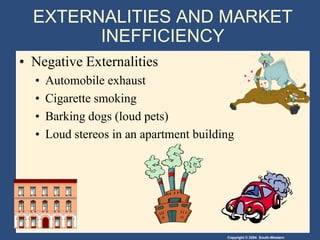
EXTERNALITIES AND MARKET INEFFICIENCY Negative ExternalitiesAutomobile exhaustCigarette smokingBarking dogs (loud pets)Loud stereos in an apartment building
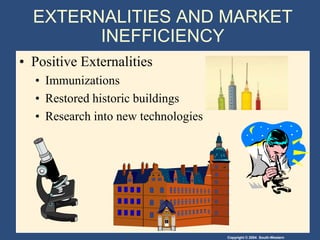
EXTERNALITIES AND MARKET INEFFICIENCY Positive ExternalitiesImmunizationsRestored historic buildingsResearch into new technologies
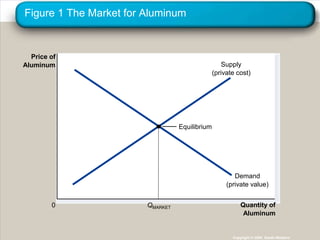
Supply(private cost)EquilibriumDemand(private value)QMARKETFigure 1 The Market for AluminumPrice ofAluminumQuantity of0AluminumCopyright © 2004  South-Western
EXTERNALITIES AND MARKET INEFFICIENCYNegative externalities lead markets to produce a larger quantity than is socially desirable.Positive externalities lead markets to produce a smaller quantity than is socially desirable.
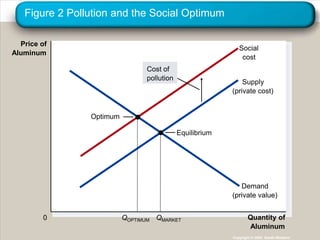
Welfare Economics: A RecapThe Market for Aluminum The quantity produced and consumed in the market equilibrium is efficient in the sense that it maximizes the sum of producer and consumer surplus.If the aluminum factories emit pollution (a negative externality), then the cost to society of producing aluminum is larger than the cost to aluminum producers.
Welfare Economics: A RecapThe Market for Aluminum For each unit of aluminum produced, the social cost includes the private costs of the producers plus the cost to those bystanders adversely affected by the pollution.
SocialcostCost ofpollutionSupply(private cost)OptimumEquilibriumDemand(private value)QOPTIMUMQMARKETFigure 2 Pollution and the Social OptimumPrice ofAluminumQuantity of0AluminumCopyright © 2004  South-Western
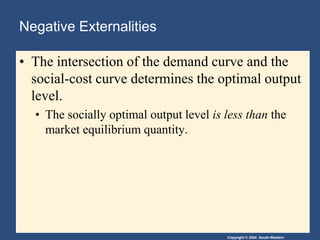
Negative Externalities The intersection of the demand curve and the social-cost curve determines the optimal output level.The socially optimal output level is less than the market equilibrium quantity.
Negative ExternalitiesInternalizing an externality involves altering incentives so that people take account of the external effects of their actions.
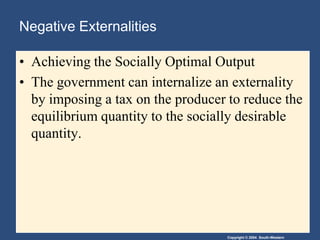
Negative Externalities Achieving the Socially Optimal OutputThe government can internalize an externality by imposing a tax on the producer to reduce the equilibrium quantity to the socially desirable quantity.
Positive ExternalitiesWhen an externality benefits the bystanders, a positive externality exists.The social value of the good exceeds the private value.
Positive ExternalitiesA technology spillover is a type of positive externality that exists when a firm’s innovation or design not only benefits the firm, but enters society’s pool of technological knowledge and benefits society as a whole.
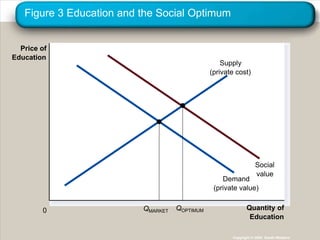
Supply(private cost)SocialvalueDemand(private value)QOPTIMUMQMARKETFigure 3 Education and the Social OptimumPrice ofEducationQuantity of0EducationCopyright © 2004  South-Western
Positive ExternalitiesThe intersection of the supply curve and the social-value curve determines the optimal output level.The optimal output level is more than the equilibrium quantity.The market produces asmaller quantity than is socially desirable. The social value of the good exceeds the private value of the good.
Positive Externalities Internalizing Externalities:  SubsidiesUsed as the primary method for attempting to internalize positive externalities.Industrial PolicyGovernment intervention in the economy that aims to promote technology-enhancing industriesPatent laws are a form of technology policy that give the individual (or firm) with patent protection a property right over its invention.  The patent is then said to internalize the externality.
PRIVATE SOLUTIONS TO EXTERNALITIESGovernment action is not always needed to solve the problem of externalities.
PRIVATE SOLUTIONS TO EXTERNALITIESMoral codes and social sanctionsCharitable organizationsIntegrating different types of businessesContracting between parties
The Coase TheoremThe Coase Theorem is a proposition that if private parties can bargain without cost over the allocation of resources, they can solve the problem of externalities on their own.Transactions CostsTransaction costs are the costs that parties incur in the process of agreeing to and following through on a bargain.
Why Private Solutions Do Not Always WorkSometimes the private solution approach fails because transaction costs can be so high that private agreement is not possible.
PUBLIC POLICY TOWARD EXTERNALITIESWhen externalities are significant and private solutions are not found, government may attempt to solve the problem through . . .command-and-control policies.market-based policies.
PUBLIC POLICY TOWARD EXTERNALITIESCommand-and-Control PoliciesUsually take the form of regulations: Forbid certain behaviors.Require certain behaviors.Examples:Requirements that all students be immunized.Stipulations on pollution emission levels set by the Environmental Protection Agency (EPA).
PUBLIC POLICY TOWARD EXTERNALITIES Market-Based PoliciesGovernment uses taxes and subsidies to align private incentives with social efficiency.Pigovian taxes are taxes enacted to correct the effects of a negative externality.
PUBLIC POLICY TOWARD EXTERNALITIESExamples of Regulation versus Pigovian Tax If the EPA decides it wants to reduce the amount of pollution coming from a specific plant.  The EPA could…tell the firm to reduce its pollution by a specific amount (i.e. regulation).levy a tax of a given amount for each unit of pollution the firm emits (i.e. Pigovian tax).
PUBLIC POLICY TOWARD EXTERNALITIES Market-Based PoliciesTradable pollution permitsallow thevoluntary transfer of the right to pollute from one firm to another. A market for these permits will eventually develop.A firm that can reduce pollution at a low cost may prefer to sell its permit to a firm that can reduce pollution only at a high cost.
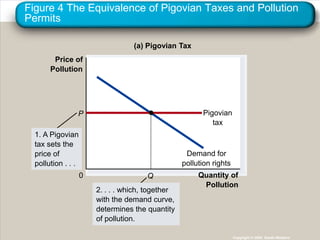
PigovianPtax1. A Pigoviantax sets theDemand forprice ofpollution rightspollution . . .Q2. . . . which, togetherwith the demand curve,determines the quantityof pollution.Figure 4 The Equivalence of Pigovian Taxes and Pollution Permits(a) Pigovian TaxPrice ofPollutionQuantity of0PollutionCopyright © 2004  South-Western
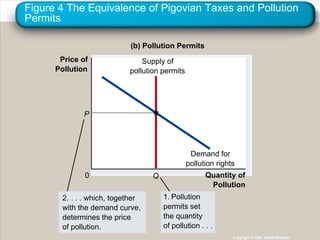
Supply ofpollution permitsPDemand forpollution rightsQ1. Pollution2. . . . which, togetherpermits setwith the demand curve,the quantitydetermines the priceof pollution . . .of pollution.Figure 4 The Equivalence of Pigovian Taxes and Pollution Permits(b) Pollution PermitsPrice ofPollutionQuantity of0PollutionCopyright © 2004  South-Western
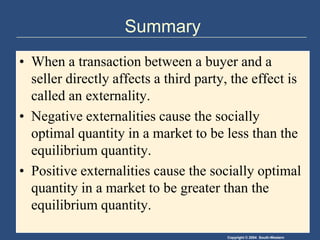
SummaryWhen a transaction between a buyer and a seller directly affects a third party, the effect is called an externality.Negative externalities cause the socially optimal quantity in a market to be less than the equilibrium quantity.Positive externalities cause the socially optimal quantity in a market to be greater than the equilibrium quantity.
SummaryThose affected by externalities can sometimes solve the problem privately.The Coase theorem states that if people can bargain without a cost, then they can always reach an agreement in which resources are allocated efficiently.
SummaryWhen private parties cannot adequately deal with externalities, then the government steps in.The government can either regulate behavior or internalize the externality by using Pigovian taxes or by issuing pollution permits.

Externalities

  • 1.
  • 2.
    Recall: AdamSmith’s “invisible hand” of the marketplace leads self-interested buyers and sellers in a market to maximize the total benefit that society can derive from a market. But market failures can still happen.
  • 3.
    EXTERNALITIES AND MARKETINEFFICIENCY An externality refers to the uncompensated impact of one person’s actions on the well-being of a bystander.Externalities cause markets to be inefficient, and thus fail to maximize total surplus.
  • 4.
    EXTERNALITIES AND MARKETINEFFICIENCYAn externality arises.... . . when a person engages in an activity that influences the well-being of a bystander and yet neither pays nor receives any compensation for that effect.
  • 5.
    EXTERNALITIES AND MARKETINEFFICIENCYWhen the impact on the bystander is adverse, the externality is called a negative externality.When the impact on the bystander is beneficial, the externality is called a positive externality.
  • 6.
    EXTERNALITIES AND MARKETINEFFICIENCY Negative ExternalitiesAutomobile exhaustCigarette smokingBarking dogs (loud pets)Loud stereos in an apartment building
  • 7.
    EXTERNALITIES AND MARKETINEFFICIENCY Positive ExternalitiesImmunizationsRestored historic buildingsResearch into new technologies
  • 8.
    Supply(private cost)EquilibriumDemand(private value)QMARKETFigure1 The Market for AluminumPrice ofAluminumQuantity of0AluminumCopyright © 2004 South-Western
  • 9.
    EXTERNALITIES AND MARKETINEFFICIENCYNegative externalities lead markets to produce a larger quantity than is socially desirable.Positive externalities lead markets to produce a smaller quantity than is socially desirable.
  • 10.
    Welfare Economics: ARecapThe Market for Aluminum The quantity produced and consumed in the market equilibrium is efficient in the sense that it maximizes the sum of producer and consumer surplus.If the aluminum factories emit pollution (a negative externality), then the cost to society of producing aluminum is larger than the cost to aluminum producers.
  • 11.
    Welfare Economics: ARecapThe Market for Aluminum For each unit of aluminum produced, the social cost includes the private costs of the producers plus the cost to those bystanders adversely affected by the pollution.
  • 12.
    SocialcostCost ofpollutionSupply(private cost)OptimumEquilibriumDemand(privatevalue)QOPTIMUMQMARKETFigure 2 Pollution and the Social OptimumPrice ofAluminumQuantity of0AluminumCopyright © 2004 South-Western
  • 13.
    Negative Externalities Theintersection of the demand curve and the social-cost curve determines the optimal output level.The socially optimal output level is less than the market equilibrium quantity.
  • 14.
    Negative ExternalitiesInternalizing anexternality involves altering incentives so that people take account of the external effects of their actions.
  • 15.
    Negative Externalities Achievingthe Socially Optimal OutputThe government can internalize an externality by imposing a tax on the producer to reduce the equilibrium quantity to the socially desirable quantity.
  • 16.
    Positive ExternalitiesWhen anexternality benefits the bystanders, a positive externality exists.The social value of the good exceeds the private value.
  • 17.
    Positive ExternalitiesA technologyspillover is a type of positive externality that exists when a firm’s innovation or design not only benefits the firm, but enters society’s pool of technological knowledge and benefits society as a whole.
  • 18.
    Supply(private cost)SocialvalueDemand(private value)QOPTIMUMQMARKETFigure3 Education and the Social OptimumPrice ofEducationQuantity of0EducationCopyright © 2004 South-Western
  • 19.
    Positive ExternalitiesThe intersectionof the supply curve and the social-value curve determines the optimal output level.The optimal output level is more than the equilibrium quantity.The market produces asmaller quantity than is socially desirable. The social value of the good exceeds the private value of the good.
  • 20.
    Positive Externalities InternalizingExternalities: SubsidiesUsed as the primary method for attempting to internalize positive externalities.Industrial PolicyGovernment intervention in the economy that aims to promote technology-enhancing industriesPatent laws are a form of technology policy that give the individual (or firm) with patent protection a property right over its invention. The patent is then said to internalize the externality.
  • 21.
    PRIVATE SOLUTIONS TOEXTERNALITIESGovernment action is not always needed to solve the problem of externalities.
  • 22.
    PRIVATE SOLUTIONS TOEXTERNALITIESMoral codes and social sanctionsCharitable organizationsIntegrating different types of businessesContracting between parties
  • 23.
    The Coase TheoremTheCoase Theorem is a proposition that if private parties can bargain without cost over the allocation of resources, they can solve the problem of externalities on their own.Transactions CostsTransaction costs are the costs that parties incur in the process of agreeing to and following through on a bargain.
  • 24.
    Why Private SolutionsDo Not Always WorkSometimes the private solution approach fails because transaction costs can be so high that private agreement is not possible.
  • 25.
    PUBLIC POLICY TOWARDEXTERNALITIESWhen externalities are significant and private solutions are not found, government may attempt to solve the problem through . . .command-and-control policies.market-based policies.
  • 26.
    PUBLIC POLICY TOWARDEXTERNALITIESCommand-and-Control PoliciesUsually take the form of regulations: Forbid certain behaviors.Require certain behaviors.Examples:Requirements that all students be immunized.Stipulations on pollution emission levels set by the Environmental Protection Agency (EPA).
  • 27.
    PUBLIC POLICY TOWARDEXTERNALITIES Market-Based PoliciesGovernment uses taxes and subsidies to align private incentives with social efficiency.Pigovian taxes are taxes enacted to correct the effects of a negative externality.
  • 28.
    PUBLIC POLICY TOWARDEXTERNALITIESExamples of Regulation versus Pigovian Tax If the EPA decides it wants to reduce the amount of pollution coming from a specific plant. The EPA could…tell the firm to reduce its pollution by a specific amount (i.e. regulation).levy a tax of a given amount for each unit of pollution the firm emits (i.e. Pigovian tax).
  • 29.
    PUBLIC POLICY TOWARDEXTERNALITIES Market-Based PoliciesTradable pollution permitsallow thevoluntary transfer of the right to pollute from one firm to another. A market for these permits will eventually develop.A firm that can reduce pollution at a low cost may prefer to sell its permit to a firm that can reduce pollution only at a high cost.
  • 30.
    PigovianPtax1. A Pigoviantaxsets theDemand forprice ofpollution rightspollution . . .Q2. . . . which, togetherwith the demand curve,determines the quantityof pollution.Figure 4 The Equivalence of Pigovian Taxes and Pollution Permits(a) Pigovian TaxPrice ofPollutionQuantity of0PollutionCopyright © 2004 South-Western
  • 31.
    Supply ofpollution permitsPDemandforpollution rightsQ1. Pollution2. . . . which, togetherpermits setwith the demand curve,the quantitydetermines the priceof pollution . . .of pollution.Figure 4 The Equivalence of Pigovian Taxes and Pollution Permits(b) Pollution PermitsPrice ofPollutionQuantity of0PollutionCopyright © 2004 South-Western
  • 32.
    SummaryWhen a transactionbetween a buyer and a seller directly affects a third party, the effect is called an externality.Negative externalities cause the socially optimal quantity in a market to be less than the equilibrium quantity.Positive externalities cause the socially optimal quantity in a market to be greater than the equilibrium quantity.
  • 33.
    SummaryThose affected byexternalities can sometimes solve the problem privately.The Coase theorem states that if people can bargain without a cost, then they can always reach an agreement in which resources are allocated efficiently.
  • 34.
    SummaryWhen private partiescannot adequately deal with externalities, then the government steps in.The government can either regulate behavior or internalize the externality by using Pigovian taxes or by issuing pollution permits.