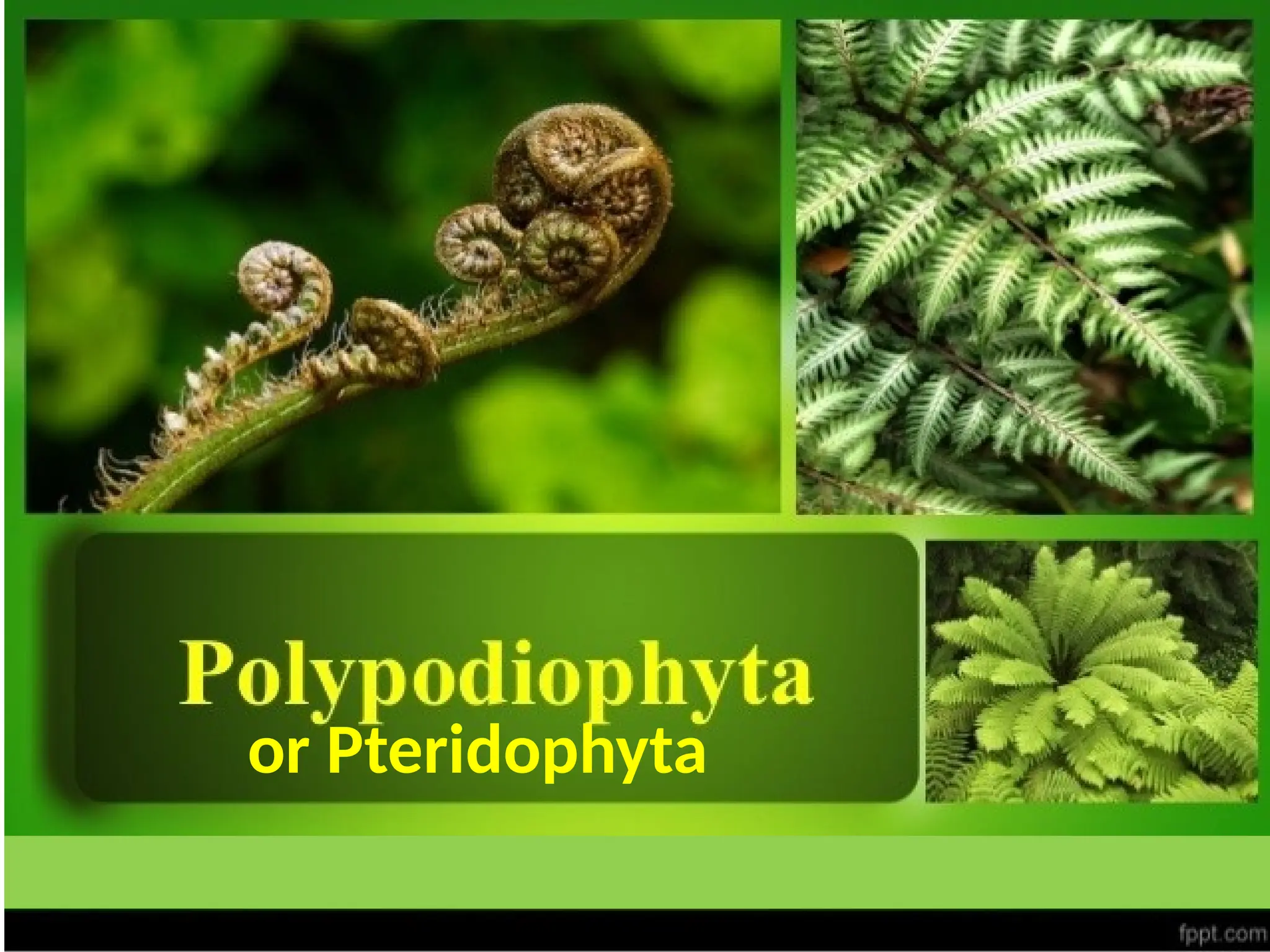
or Pteridophyta
Pteridophyta division
Plan
1.General characteristics of division
2.Polypodiopsida class,
characteristics and representatives
3. Marsiliidae subclass
4. Salviniidae subclass
Termins
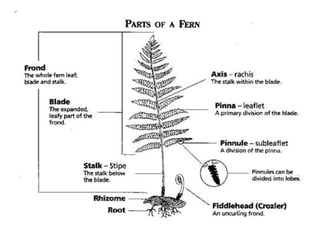
Frond
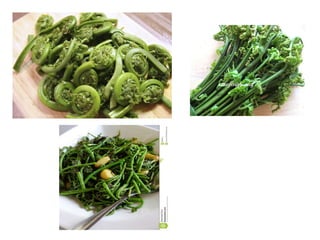
Fiddlehead
Sorus
Fern
Indusium
Annulus
Sporocarp
General characteristics of Pteridophyta
 Since Pteridophyra have lignified xylem vessels and phloem
vessels they belong to the vascular plants.
 Pteridophyta may also develop stems, often as rhizomes, true
leaves, called frond, and simple roots. There are, however, no
flowers in their life cycle, and thus they also lack fruits and
seeds.
 Their sexual reproduction is done through spores.
Pteridophyta have also a vegetative propagation path by
means of rhizomes.
 Ferns first appear in the fossil record 360 million years ago in
the late Devonian period but many of the current families and
species did not appear until roughly 145 million years ago in
the early Cretaceous, after flowering plants came to dominate
many environments.
Pteridophyta division (about 10 000 species)
has 5 classes:
Zygopteridopsida
Cladoxylopsida
Ophioglossopsida
Marattiopsida
Polypodiopsida
Polypodiopsida (ferns) class
The class Polypodiopsida encompasses both wholly fossil and
also living representatives, many of which have a long fossil
history.
The general features of the class can be summarized as follows:
- Sporophyte herbaceous or arborescent, in many forms
rhizomatous.
- Leaves often compound (megaphylls).
- Vascular system of tracheids and phloem, usually lacking
clearly defined secondary tissue.
- Sporangia borne on leaves
- Mostly homosporous; a few (living and fossil) heterosporous.
- Gametophytes (known only in living forms) simple, usually
autotrophic, lacking vascular tissue.
-Spermatozoids multiflagellate. Embryogeny typically
endoscopic.
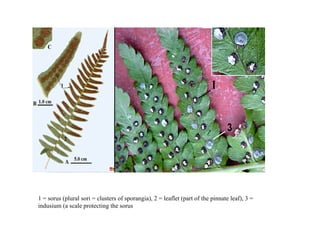
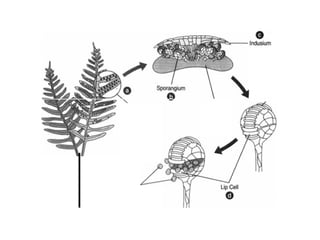
1 = sorus (plural sori = clusters of sporangia), 2 = leaflet (part of the pinnate leaf), 3 =
indusium (a scale protecting the sorus
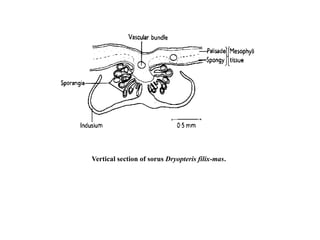
Vertical section of sorus Dryopteris filix-mas.
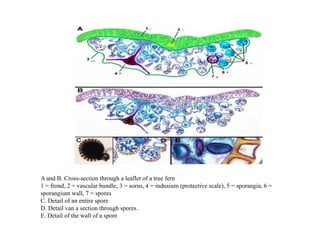
A and B. Cross-section through a leaflet of a true fern
1 = frond, 2 = vascular bundle, 3 = sorus, 4 = indusium (protective scale), 5 = sporangia, 6 =
sporangium wall, 7 = spores
C. Detail of an entire spore
D. Detail van a section through spores.
E. Detail of the wall of a spore
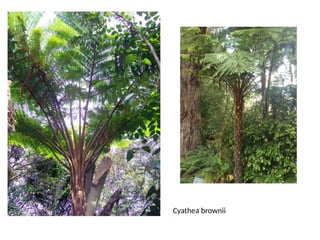
Cyathea brownii
Division: Pteridophyta və ya Polypodiophyta
Class: Polypodiopsida
Subclass: Polypodiidae
Order: Polypodiales
Family: Polypodiaceae
Genus: Dryopteris
Species: Dryopteris filix mas
A - D. Prothallium with antheridia.
Zoom view of antheria and sperms.
A en B. 1 = antheridia, 2 = sperms in the
antheridia
C. Detail of sperms (with flagella)
D. Detail of antheridia filled up with sperms
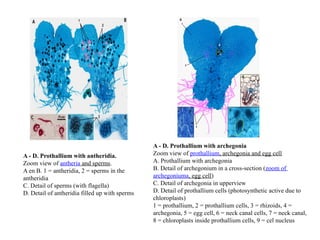
A - D. Prothallium with archegonia
Zoom view of prothallium, archegonia and egg cell
A. Prothallium with archegonia
B. Detail of archegonium in a cross-section (zoom of
archegoniuma, egg cell)
C. Detail of archegonia in upperview
D. Detail of prothallium cells (photosynthetic active due to
chloroplasts)
1 = prothallium, 2 = prothallium cells, 3 = rhizoids, 4 =
archegonia, 5 = egg cell, 6 = neck canal cells, 7 = neck canal,
8 = chloroplasts inside prothallium cells, 9 = cel nucleus
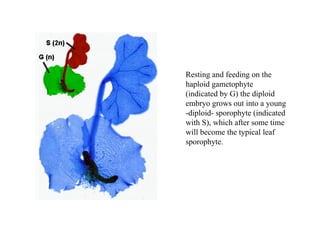
Resting and feeding on the
haploid gametophyte
(indicated by G) the diploid
embryo grows out into a young
-diploid- sporophyte (indicated
with S), which after some time
will become the typical leaf
sporophyte.
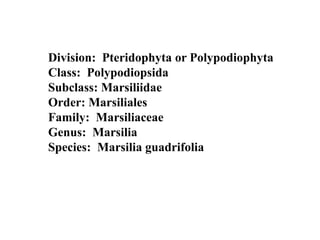
Division: Pteridophyta or Polypodiophyta
Class: Polypodiopsida
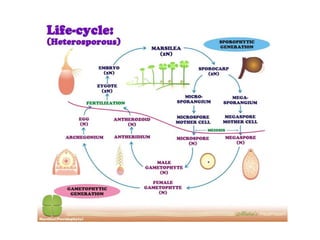
Subclass: Marsiliidae
Order: Marsiliales
Family: Marsiliaceae
Genus: Marsilia
Species: Marsilia guadrifolia
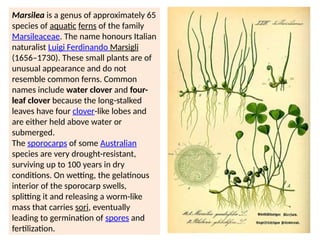
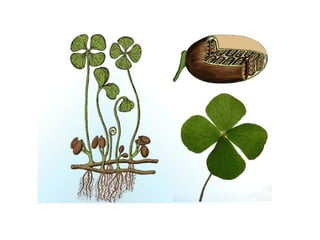
Marsilea is a genus of approximately 65
species of aquatic ferns of the family
Marsileaceae. The name honours Italian
naturalist Luigi Ferdinando Marsigli
(1656–1730). These small plants are of
unusual appearance and do not
resemble common ferns. Common
names include water clover and four-
leaf clover because the long-stalked
leaves have four clover-like lobes and
are either held above water or
submerged.
The sporocarps of some Australian
species are very drought-resistant,
surviving up to 100 years in dry
conditions. On wetting, the gelatinous
interior of the sporocarp swells,
splitting it and releasing a worm-like
mass that carries sori, eventually
leading to germination of spores and
fertilization.
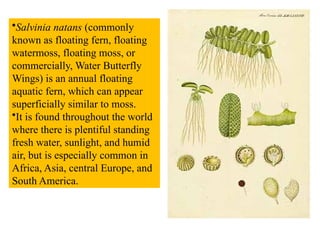
•Salvinia natans (commonly
known as floating fern, floating
watermoss, floating moss, or
commercially, Water Butterfly
Wings) is an annual floating
aquatic fern, which can appear
superficially similar to moss.
•It is found throughout the world
where there is plentiful standing
fresh water, sunlight, and humid
air, but is especially common in
Africa, Asia, central Europe, and
South America.
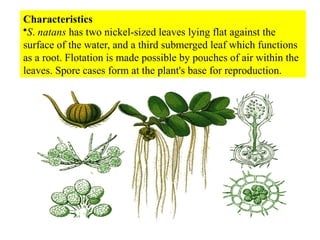
Characteristics
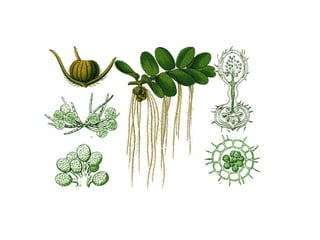
•S. natans has two nickel-sized leaves lying flat against the
surface of the water, and a third submerged leaf which functions
as a root. Flotation is made possible by pouches of air within the
leaves. Spore cases form at the plant's base for reproduction.
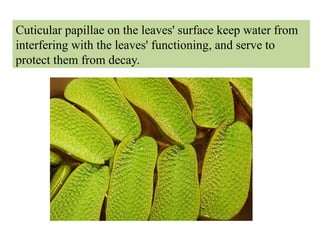
Cuticular papillae on the leaves' surface keep water from
interfering with the leaves' functioning, and serve to
protect them from decay.
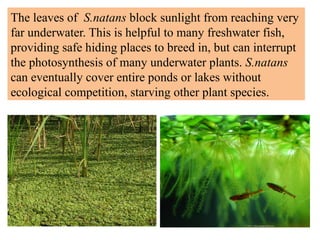
The leaves of S.natans block sunlight from reaching very
far underwater. This is helpful to many freshwater fish,
providing safe hiding places to breed in, but can interrupt
the photosynthesis of many underwater plants. S.natans
can eventually cover entire ponds or lakes without
ecological competition, starving other plant species.
Presentation-ferns-last_045122.pptxd3drdüdc

Presentation-ferns-last_045122.pptxd3drdüdc

  • 1.
  • 2.
    Pteridophyta division Plan 1.General characteristicsof division 2.Polypodiopsida class, characteristics and representatives 3. Marsiliidae subclass 4. Salviniidae subclass
  • 3.
  • 4.
    General characteristics ofPteridophyta  Since Pteridophyra have lignified xylem vessels and phloem vessels they belong to the vascular plants.  Pteridophyta may also develop stems, often as rhizomes, true leaves, called frond, and simple roots. There are, however, no flowers in their life cycle, and thus they also lack fruits and seeds.  Their sexual reproduction is done through spores. Pteridophyta have also a vegetative propagation path by means of rhizomes.  Ferns first appear in the fossil record 360 million years ago in the late Devonian period but many of the current families and species did not appear until roughly 145 million years ago in the early Cretaceous, after flowering plants came to dominate many environments.
  • 5.
    Pteridophyta division (about10 000 species) has 5 classes: Zygopteridopsida Cladoxylopsida Ophioglossopsida Marattiopsida Polypodiopsida
  • 6.
    Polypodiopsida (ferns) class Theclass Polypodiopsida encompasses both wholly fossil and also living representatives, many of which have a long fossil history. The general features of the class can be summarized as follows: - Sporophyte herbaceous or arborescent, in many forms rhizomatous. - Leaves often compound (megaphylls). - Vascular system of tracheids and phloem, usually lacking clearly defined secondary tissue. - Sporangia borne on leaves - Mostly homosporous; a few (living and fossil) heterosporous. - Gametophytes (known only in living forms) simple, usually autotrophic, lacking vascular tissue. -Spermatozoids multiflagellate. Embryogeny typically endoscopic.
  • 8.
    1 = sorus(plural sori = clusters of sporangia), 2 = leaflet (part of the pinnate leaf), 3 = indusium (a scale protecting the sorus
  • 9.
    Vertical section ofsorus Dryopteris filix-mas.
  • 10.
    A and B.Cross-section through a leaflet of a true fern 1 = frond, 2 = vascular bundle, 3 = sorus, 4 = indusium (protective scale), 5 = sporangia, 6 = sporangium wall, 7 = spores C. Detail of an entire spore D. Detail van a section through spores. E. Detail of the wall of a spore
  • 12.
  • 13.
    Division: Pteridophyta vəya Polypodiophyta Class: Polypodiopsida Subclass: Polypodiidae Order: Polypodiales Family: Polypodiaceae Genus: Dryopteris Species: Dryopteris filix mas
  • 14.
    A - D.Prothallium with antheridia. Zoom view of antheria and sperms. A en B. 1 = antheridia, 2 = sperms in the antheridia C. Detail of sperms (with flagella) D. Detail of antheridia filled up with sperms A - D. Prothallium with archegonia Zoom view of prothallium, archegonia and egg cell A. Prothallium with archegonia B. Detail of archegonium in a cross-section (zoom of archegoniuma, egg cell) C. Detail of archegonia in upperview D. Detail of prothallium cells (photosynthetic active due to chloroplasts) 1 = prothallium, 2 = prothallium cells, 3 = rhizoids, 4 = archegonia, 5 = egg cell, 6 = neck canal cells, 7 = neck canal, 8 = chloroplasts inside prothallium cells, 9 = cel nucleus
  • 15.
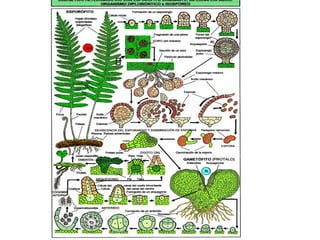
    Resting and feedingon the haploid gametophyte (indicated by G) the diploid embryo grows out into a young -diploid- sporophyte (indicated with S), which after some time will become the typical leaf sporophyte.
  • 19.
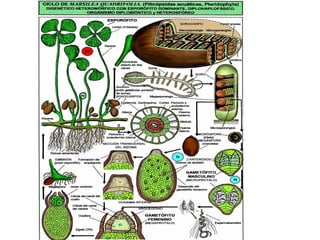
    Division: Pteridophyta orPolypodiophyta Class: Polypodiopsida Subclass: Marsiliidae Order: Marsiliales Family: Marsiliaceae Genus: Marsilia Species: Marsilia guadrifolia
  • 20.
    Marsilea is agenus of approximately 65 species of aquatic ferns of the family Marsileaceae. The name honours Italian naturalist Luigi Ferdinando Marsigli (1656–1730). These small plants are of unusual appearance and do not resemble common ferns. Common names include water clover and four- leaf clover because the long-stalked leaves have four clover-like lobes and are either held above water or submerged. The sporocarps of some Australian species are very drought-resistant, surviving up to 100 years in dry conditions. On wetting, the gelatinous interior of the sporocarp swells, splitting it and releasing a worm-like mass that carries sori, eventually leading to germination of spores and fertilization.
  • 24.
    •Salvinia natans (commonly knownas floating fern, floating watermoss, floating moss, or commercially, Water Butterfly Wings) is an annual floating aquatic fern, which can appear superficially similar to moss. •It is found throughout the world where there is plentiful standing fresh water, sunlight, and humid air, but is especially common in Africa, Asia, central Europe, and South America.
  • 25.
    Characteristics •S. natans hastwo nickel-sized leaves lying flat against the surface of the water, and a third submerged leaf which functions as a root. Flotation is made possible by pouches of air within the leaves. Spore cases form at the plant's base for reproduction.
  • 26.
    Cuticular papillae onthe leaves' surface keep water from interfering with the leaves' functioning, and serve to protect them from decay.
  • 27.
    The leaves ofS.natans block sunlight from reaching very far underwater. This is helpful to many freshwater fish, providing safe hiding places to breed in, but can interrupt the photosynthesis of many underwater plants. S.natans can eventually cover entire ponds or lakes without ecological competition, starving other plant species.