Bryophytes &Pteridophytes
General Characteristics
Hornworts, such as this Phaeoceros laevis,
typically grow in disturbed open places.
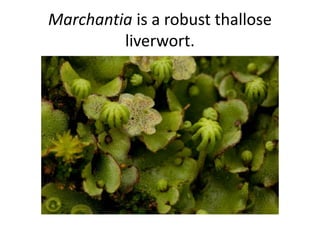
Marchantia is a robust thallose
liverwort.
Hypnum curvifolium is a moss with a
pleurocarpous growth form.
General Characteristics of Bryophytes
1. All of these are land plants (terrestrial) with
some aquatic forms.
2. They are very small. The sporophyte and
gametophyte have very different
morphologies (heteromorphic generations)
and the sporophyte is usually partly
dependent on the gametophyte.
3. Photosynthetic, non-vascular plants
General Characteristics of Bryophytes
• Plant body is either :-
– Thalloid and attached to the substratum by hair-
like structures called rhizoids (true roots are
absent)
or
– is differentiated into stem-like and leaf-like
structures , true stems and leaves lacking.
• Cuticle and stomata are absent
General Characteristics of Bryophytes
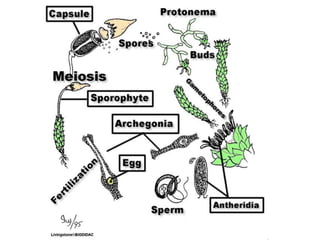
• The bryophytes show alternation of
generations - the haploid gametophyte
(producing gametes for sexual reproduction)
alternates with diploid sporophyte (producing
spores for asexual reproduction).
General Characteristics of Bryophytes
• Gametophytes homothallic or heterothallic.
• The gametophyte generation is dominant,
conspicuous and independent.
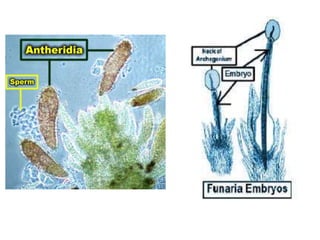
• The female sex organ is the archegonium.
• The male sex organs are antheridia.
General Characteristics of Bryophytes
• The ovum remains in the archegonium and
spermatozoids swim to it by chemotaxis.
• Although bryophytes are land plants, they
are still dependent upon water for
fertilization, as the sperm swim in a water
film.
General Characteristics of Bryophytes
• The sporophyte is attached and dependent upon
the gametophyte for nutrition i.e. is parasitic on
the gametophyte
• The diploid sporophyte usually consists of a basal
foot, an elevating seta and a terminal
sporangium - the capsule
• Spores are produced as a direct result of meiosis.
• Spores dispersed by a mechanism which ensures
dispersal in dry weather only.
General Characteristics of Bryophytes
• These plants (in either generation) lack
specialized cells for the transport of materials
(vascular tissue). Absence of vascular tissue
limits bryophytes to moist habitats and small
size.
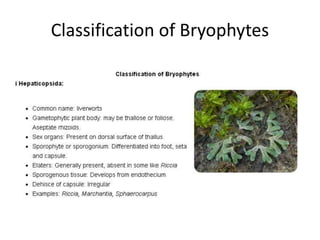
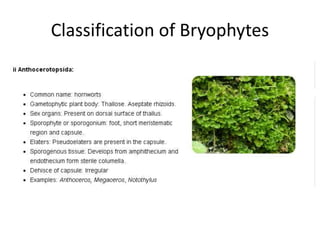
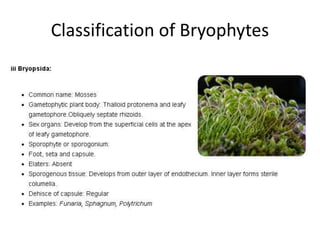
Classification of Bryophytes
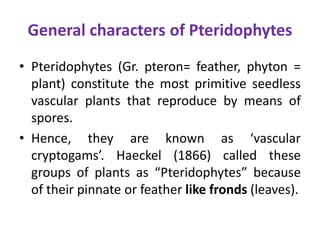
General characters of Pteridophytes
• Pteridophytes (Gr. pteron= feather, phyton =
plant) constitute the most primitive seedless
vascular plants that reproduce by means of
spores.
• Hence, they are known as ‘vascular
cryptogams’. Haeckel (1866) called these
groups of plants as “Pteridophytes” because
of their pinnate or feather like fronds (leaves).
Habitats:-
• Pteridophytes occur in both hills as well as in
plains in cold, moist and shady places.
• They also occur in humid and tropical
climates and usually grow on soil, rocks, in
ponds and as epiphytes on other plants.
Common Pteridophytes
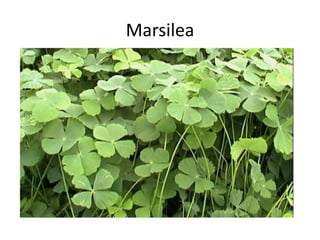
Marsilea
Fern - Dryopteris
Adiantum - Maidenhair fern
General characters of Pteridophytes
• The plant body of pteridophytes varies in two
distinct phases during their life cycle:- The
Gametophytic Phase and the Sporophytic
Phase.
• The diploid sporophyte is the dominant
phase in the life cycle and the sporophyte is
independent of gametophyte.
Sporophyte & gametophte
The Sporophytic Plant Body:-
1) The sporophyte is generally herbaceous and is
differentiated into true roots (adventitious), stem
and leaves. The leaves may be small microphyllous
or large macrophyllous (fronds).
2) They are chlorophyllous and Autotrophic.
3) All vegetative parts possess vascular tissues
organized into steles or vascular bundles. So,
pteridophytes are are first tracheophytes in
evolution of plant kingdom.
4) The sporophyte performs vegetative reproduction
and asexual reproduction.
The Sporophytic Plant Body:-
1) Vegetative reproduction takes place by vegetative
buds that develop on the rhizome or by
fragmentation of rhizome.
2) Asexual reproduction takes place by means of
spores produced inside the sporangia.
3) The sporangia are borne on lower surface or in axils
of fertile leaves called sporophylls.
4) The sporangia are borne singly or in groups called
Sori.
Sporangia
The Sporophytic Plant Body:-
1) Plants may be Homosporous i.e., they produce only
one type of spores or may be Heterosporous i.e.,
produce two different types of spores-Smaller
Microspores and Larger Megaspores.
2) A sporophyte (diploid) phase produces haploid
spores by meiosis.
3) These spores germinate to produce haploid
Gametophyte
4)
The Gametophytic Plant Body:-
• The gametophyte is called Prothallus,they are all small
,they have simple structure and short life cycle,and are all
produced by germination of haploid spore .
• Homosporous species produce bisexual gametophytes
whereas heterosporous species produce unisexual
gametophytes.
• Microspore germinates to produce male gametophyte
and megaspore female gametophyte.
• Gametophytes show the ventral and dorsal differentiation.
• The gametophyteis usually photosynthetic (not in
heterosporous members) and reproduces sexually, that is
oogamous.
The Gametophytic Plant Body:-
• The male sex organs are Antheridia that produces sperm by
mitosis
• Female sex organs are Archegonia produces eggs by mitosis
They are multicellular with sterile jacket, but without stalks.
• Fertilization occurs in presence of water and takes place in
the venter of archegonium.
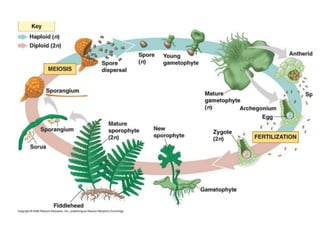
• The diploid zygote develops into embryo in archegonial
venter. The embryo grows by mitosis into a sporophyte (the
typical "fern" plant).
• The life cycle is diplohaplontic that shows heteromorphic
alternation of sporophyte and gametophyte which are
independent of each other.
Affinities of pteridophytes:
• The pteridophytes occupy an intermediate
place between bryophytes and
spermatophytes.
• They represent affinities with both the
groups.
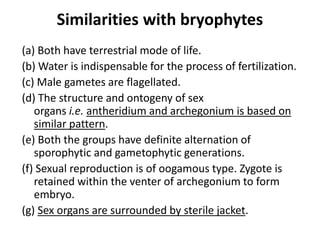
Similarities with bryophytes
(a) Both have terrestrial mode of life.
(b) Water is indispensable for the process of fertilization.
(c) Male gametes are flagellated.
(d) The structure and ontogeny of sex
organs i.e. antheridium and archegonium is based on
similar pattern.
(e) Both the groups have definite alternation of
sporophytic and gametophytic generations.
(f) Sexual reproduction is of oogamous type. Zygote is
retained within the venter of archegonium to form
embryo.
(g) Sex organs are surrounded by sterile jacket.
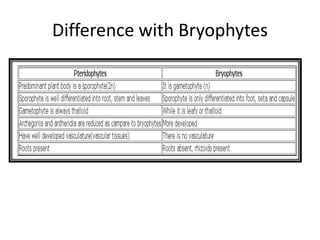
Difference with Bryophytes
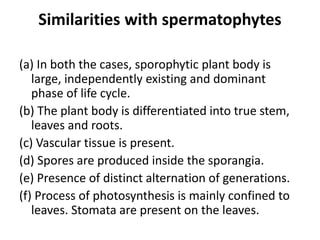
Similarities with spermatophytes
(a) In both the cases, sporophytic plant body is
large, independently existing and dominant
phase of life cycle.
(b) The plant body is differentiated into true stem,
leaves and roots.
(c) Vascular tissue is present.
(d) Spores are produced inside the sporangia.
(e) Presence of distinct alternation of generations.
(f) Process of photosynthesis is mainly confined to
leaves. Stomata are present on the leaves.
Classification of Pteridophytes

Bryophytes,Pteridophytes

  • 1.
  • 3.
    Hornworts, such asthis Phaeoceros laevis, typically grow in disturbed open places.
  • 4.
    Marchantia is arobust thallose liverwort.
  • 5.
    Hypnum curvifolium isa moss with a pleurocarpous growth form.
  • 6.
    General Characteristics ofBryophytes 1. All of these are land plants (terrestrial) with some aquatic forms. 2. They are very small. The sporophyte and gametophyte have very different morphologies (heteromorphic generations) and the sporophyte is usually partly dependent on the gametophyte. 3. Photosynthetic, non-vascular plants
  • 7.
    General Characteristics ofBryophytes • Plant body is either :- – Thalloid and attached to the substratum by hair- like structures called rhizoids (true roots are absent) or – is differentiated into stem-like and leaf-like structures , true stems and leaves lacking. • Cuticle and stomata are absent
  • 8.
    General Characteristics ofBryophytes • The bryophytes show alternation of generations - the haploid gametophyte (producing gametes for sexual reproduction) alternates with diploid sporophyte (producing spores for asexual reproduction).
  • 9.
    General Characteristics ofBryophytes • Gametophytes homothallic or heterothallic. • The gametophyte generation is dominant, conspicuous and independent. • The female sex organ is the archegonium. • The male sex organs are antheridia.
  • 10.
    General Characteristics ofBryophytes • The ovum remains in the archegonium and spermatozoids swim to it by chemotaxis. • Although bryophytes are land plants, they are still dependent upon water for fertilization, as the sperm swim in a water film.
  • 13.
    General Characteristics ofBryophytes • The sporophyte is attached and dependent upon the gametophyte for nutrition i.e. is parasitic on the gametophyte • The diploid sporophyte usually consists of a basal foot, an elevating seta and a terminal sporangium - the capsule • Spores are produced as a direct result of meiosis. • Spores dispersed by a mechanism which ensures dispersal in dry weather only.
  • 17.
    General Characteristics ofBryophytes • These plants (in either generation) lack specialized cells for the transport of materials (vascular tissue). Absence of vascular tissue limits bryophytes to moist habitats and small size.
  • 19.
  • 20.
  • 21.
  • 22.
    General characters ofPteridophytes • Pteridophytes (Gr. pteron= feather, phyton = plant) constitute the most primitive seedless vascular plants that reproduce by means of spores. • Hence, they are known as ‘vascular cryptogams’. Haeckel (1866) called these groups of plants as “Pteridophytes” because of their pinnate or feather like fronds (leaves).
  • 24.
    Habitats:- • Pteridophytes occurin both hills as well as in plains in cold, moist and shady places. • They also occur in humid and tropical climates and usually grow on soil, rocks, in ponds and as epiphytes on other plants.
  • 25.
  • 26.
  • 27.
  • 28.
  • 29.
    General characters ofPteridophytes • The plant body of pteridophytes varies in two distinct phases during their life cycle:- The Gametophytic Phase and the Sporophytic Phase. • The diploid sporophyte is the dominant phase in the life cycle and the sporophyte is independent of gametophyte.
  • 30.
  • 31.
    The Sporophytic PlantBody:- 1) The sporophyte is generally herbaceous and is differentiated into true roots (adventitious), stem and leaves. The leaves may be small microphyllous or large macrophyllous (fronds). 2) They are chlorophyllous and Autotrophic. 3) All vegetative parts possess vascular tissues organized into steles or vascular bundles. So, pteridophytes are are first tracheophytes in evolution of plant kingdom. 4) The sporophyte performs vegetative reproduction and asexual reproduction.
  • 32.
    The Sporophytic PlantBody:- 1) Vegetative reproduction takes place by vegetative buds that develop on the rhizome or by fragmentation of rhizome. 2) Asexual reproduction takes place by means of spores produced inside the sporangia. 3) The sporangia are borne on lower surface or in axils of fertile leaves called sporophylls. 4) The sporangia are borne singly or in groups called Sori.
  • 33.
  • 34.
    The Sporophytic PlantBody:- 1) Plants may be Homosporous i.e., they produce only one type of spores or may be Heterosporous i.e., produce two different types of spores-Smaller Microspores and Larger Megaspores. 2) A sporophyte (diploid) phase produces haploid spores by meiosis. 3) These spores germinate to produce haploid Gametophyte 4)
  • 36.
    The Gametophytic PlantBody:- • The gametophyte is called Prothallus,they are all small ,they have simple structure and short life cycle,and are all produced by germination of haploid spore . • Homosporous species produce bisexual gametophytes whereas heterosporous species produce unisexual gametophytes. • Microspore germinates to produce male gametophyte and megaspore female gametophyte. • Gametophytes show the ventral and dorsal differentiation. • The gametophyteis usually photosynthetic (not in heterosporous members) and reproduces sexually, that is oogamous.
  • 37.
    The Gametophytic PlantBody:- • The male sex organs are Antheridia that produces sperm by mitosis • Female sex organs are Archegonia produces eggs by mitosis They are multicellular with sterile jacket, but without stalks. • Fertilization occurs in presence of water and takes place in the venter of archegonium. • The diploid zygote develops into embryo in archegonial venter. The embryo grows by mitosis into a sporophyte (the typical "fern" plant). • The life cycle is diplohaplontic that shows heteromorphic alternation of sporophyte and gametophyte which are independent of each other.
  • 41.
    Affinities of pteridophytes: •The pteridophytes occupy an intermediate place between bryophytes and spermatophytes. • They represent affinities with both the groups.
  • 42.
    Similarities with bryophytes (a)Both have terrestrial mode of life. (b) Water is indispensable for the process of fertilization. (c) Male gametes are flagellated. (d) The structure and ontogeny of sex organs i.e. antheridium and archegonium is based on similar pattern. (e) Both the groups have definite alternation of sporophytic and gametophytic generations. (f) Sexual reproduction is of oogamous type. Zygote is retained within the venter of archegonium to form embryo. (g) Sex organs are surrounded by sterile jacket.
  • 43.
  • 44.
    Similarities with spermatophytes (a)In both the cases, sporophytic plant body is large, independently existing and dominant phase of life cycle. (b) The plant body is differentiated into true stem, leaves and roots. (c) Vascular tissue is present. (d) Spores are produced inside the sporangia. (e) Presence of distinct alternation of generations. (f) Process of photosynthesis is mainly confined to leaves. Stomata are present on the leaves.
  • 45.