Vanessa Rogers
 To identify personal patterns of behaviour and
responses to others
 To consider the difference between assertive,
passive & aggressive
 To explore giving and receiving criticism:
developing feedback skills
 To increase confidence in coping with challenging
situations
What is ‘assertive',' aggressive’
and ‘passive’ behaviour?
 Give in and say ‘yes’ even when they don’t want
to
 Put the feelings and concerns of others before
their own
 Keep their concerns to themselves
  Go along with the crowd even if they know it is
wrong
 Think of themselves first, at the expense of others
 Dominate others
 Use threats or force
 Don’t respect personal space
 Get what they want, regardless of the cost
 Stand up for their rights without denying other
people theirs
 Respect themselves as well as others
 Ask for what they want in a straightforward
manner
 Express their emotions (both positive and
negative) in a healthy manner
CAN look like CAN sound like
 Slapping or hitting
 Red faced
 Pointing fingers
 Body tense
 Fists clench
 Closed body language
 No consideration of
others
 Shouting
 Yelling
 Angry voice
 Name calling
 Threatening
 Sarcastic comments
 Mocking or belittling
CAN look like CAN sound like
 Shy
 Hiding face
 Smiling when you don’t
mean it
 Nodding
 Doing things you know
are wrong
 Quiet voice
 Not saying what you
really think or believe in
 Not sticking up for
yourself
 Apologetic
CAN look like CAN sound like
 Direct and honest
communication
 In control
 Diplomatic
 Open body language
 Confident
 Saying what you think,
respectfully
 Calm voice
 Firm
 Direct
 Gets the point across
The ability to;
 Express your opinion and feelings.
 Say “no” without feeling guilty.
 Set your own priorities.
 Ask for what you want.
 Take reasonable risks.
‘Being assertive is the art of getting
understood by others by being neither
aggressive nor passive, but by stating
your needs clearly and effectively
whilst respecting others right to the
same.’
 Passive behaviour – I lose, you win
 Aggressive behaviour – you lose, I
win
 Assertive behaviour – I win, you win
Iceberg Model
 What are your triggers?
 How do you feel?
 How do you behave?
TRIGGERS
FEELINGS AFTERWARDS
THOUGHTS AFTERWARDS
FEELINGS
THOUGHTSBEHAVIOUR
What affects the result is our response
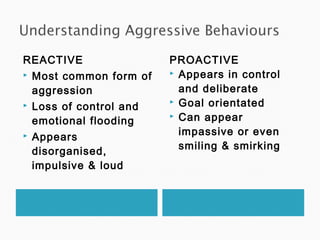
REACTIVE
 Most common form of
aggression
 Loss of control and
emotional flooding
 Appears
disorganised,
impulsive & loud
PROACTIVE
 Appears in control
and deliberate
 Goal orientated
 Can appear
impassive or even
smiling & smirking
Situational
 External stressful events
Maturational
 Stress produced from
progression through
developmental stages
In small groups draw a gingerbread person
 On the inside write down all the maturational
stress that a young person might be experiencing
 On the outside, all that which might be described
as ‘situational’
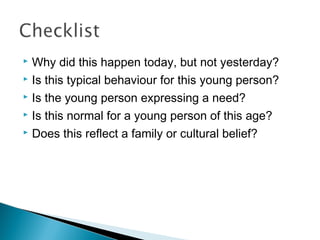
 Why did this happen today, but not yesterday?
 Is this typical behaviour for this young person?
 Is the young person expressing a need?
 Is this normal for a young person of this age?
 Does this reflect a family or cultural belief?
 What am I feeling?
 What does the young person feel/need/want?
 How is the environment affecting the young
person
 How do I respond?
 Avoid conflict – simply withdraw from the situation
 Smooth it over – pretend there is no conflict and
everything is OK
 Win at all costs – Get what you want; the other person
loses
 Compromise – give up something you want to get
something else you want
 Win / win negotiation – use creative problem solving to
give both people what they want or need
 Are there some areas that you are more
comfortable being assertive in than others?
 
 Consider areas that you feel most assertive in and
areas where you feel least.
 Face the other person.
 Listen carefully to what they say.
 Have a pleasant facial expression.
 Keep your voice calm and pleasant.
 Make sure that your body language supports what
you are saying
7% of message pertaining to feelings and attitudes is in the words that are
spoken.
38% of message pertaining to feelings and attitudes is paralinguistic (the
way that the words are said).
55% of message pertaining to feelings and attitudes is in facial
expression.
Professor Albert Mehrabian (1981) Silent messages: Implicit communication of emotions and
attitudes
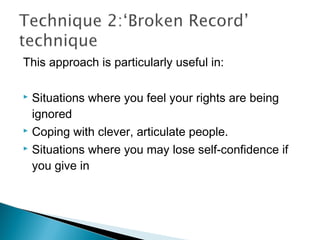
This approach is particularly useful in:
 Situations where you feel your rights are being
ignored
 Coping with clever, articulate people.
 Situations where you may lose self-confidence if
you give in
 Work out what you want to say and rehearse it.
 Repeat your reply, using exactly the same words, over
and over again and stick to what you have decided.
 Keep repeating your point, using a calm, pleasant voice.
 Don't be put off by clever arguments or by what the other
person says.
 Don't be pulled into an argument or having to explain
your decision.
 There is nothing that can defeat this tactic.
“I feel / felt.........when........because..............”
Say: 'I feel upset when you interrupt me because I
can't finish what I am saying.'
Instead of: 'You're always interrupting me!'
 Be straightforward and honest so that you can
make your point effectively
 Don't feel you have to say 'sorry' or give elaborate
reasons for saying "No”
 Offer a compromise if you want to
 It is better in the long run to be honest rather than
feel resentment for not being able to say "No"
Example 1.
 Say: "Will you please . . . .?" Instead of "Would
you mind . . . . ?”
Example 2.
 Say: "I won't be able to...."instead of 'I'm not sure
if I can...."
Example 3.
 Say: "I've decided not to…” instead of 'I don't think
I can...."
 In three’s practice assertiveness techniques
 Observer to note technique used and
effectiveness
 Individual to fit the specific person and situation
 Focused on the behavior or action you are
concerned with, not on the person or their
personality;
 Delivered as soon as possible after the positive or
negative action and before the next performance.
What is the difference between
‘feedback’ and ‘criticism’
 Assume positive intent
 Listen and make sure you understand
 Don’t take it personally or overeact
 Acknowledge and apologise
 Clarify and specify
 Set boundaries
 VALID criticism - criticism which we know is
true
 INVALID criticism - criticism which we know is
not true (one mistake doesn’t mean we are
incompetent!)
 PUT-DOWNS - a word, phrase, look or gesture
that feels like a blow.
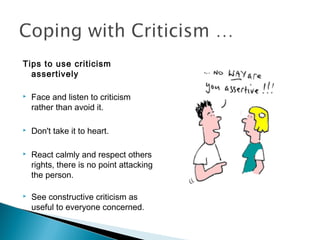
Tips to use criticism
assertively
 Face and listen to criticism
rather than avoid it.
 Don't take it to heart.
 React calmly and respect others
rights, there is no point attacking
the person.
 See constructive criticism as
useful to everyone concerned.
 Make intermittent eye
contact
 Make sure you’ve been
heard
 Use "I" statements to
express your feelings
or make a request
 Don't "yes, but" them

Assertiveness & Confidence Building with Young People

  • 1.
  • 2.
     To identifypersonal patterns of behaviour and responses to others  To consider the difference between assertive, passive & aggressive  To explore giving and receiving criticism: developing feedback skills  To increase confidence in coping with challenging situations
  • 3.
    What is ‘assertive','aggressive’ and ‘passive’ behaviour?
  • 4.
     Give inand say ‘yes’ even when they don’t want to  Put the feelings and concerns of others before their own  Keep their concerns to themselves   Go along with the crowd even if they know it is wrong
  • 5.
     Think ofthemselves first, at the expense of others  Dominate others  Use threats or force  Don’t respect personal space  Get what they want, regardless of the cost
  • 6.
     Stand upfor their rights without denying other people theirs  Respect themselves as well as others  Ask for what they want in a straightforward manner  Express their emotions (both positive and negative) in a healthy manner
  • 7.
    CAN look likeCAN sound like  Slapping or hitting  Red faced  Pointing fingers  Body tense  Fists clench  Closed body language  No consideration of others  Shouting  Yelling  Angry voice  Name calling  Threatening  Sarcastic comments  Mocking or belittling
  • 8.
    CAN look likeCAN sound like  Shy  Hiding face  Smiling when you don’t mean it  Nodding  Doing things you know are wrong  Quiet voice  Not saying what you really think or believe in  Not sticking up for yourself  Apologetic
  • 9.
    CAN look likeCAN sound like  Direct and honest communication  In control  Diplomatic  Open body language  Confident  Saying what you think, respectfully  Calm voice  Firm  Direct  Gets the point across
  • 10.
    The ability to; Express your opinion and feelings.  Say “no” without feeling guilty.  Set your own priorities.  Ask for what you want.  Take reasonable risks.
  • 11.
    ‘Being assertive isthe art of getting understood by others by being neither aggressive nor passive, but by stating your needs clearly and effectively whilst respecting others right to the same.’
  • 12.
     Passive behaviour– I lose, you win  Aggressive behaviour – you lose, I win  Assertive behaviour – I win, you win
  • 13.
  • 14.
     What areyour triggers?  How do you feel?  How do you behave?
  • 15.
  • 16.
    REACTIVE  Most commonform of aggression  Loss of control and emotional flooding  Appears disorganised, impulsive & loud PROACTIVE  Appears in control and deliberate  Goal orientated  Can appear impassive or even smiling & smirking
  • 17.
    Situational  External stressfulevents Maturational  Stress produced from progression through developmental stages
  • 18.
    In small groupsdraw a gingerbread person  On the inside write down all the maturational stress that a young person might be experiencing  On the outside, all that which might be described as ‘situational’
  • 19.
     Why didthis happen today, but not yesterday?  Is this typical behaviour for this young person?  Is the young person expressing a need?  Is this normal for a young person of this age?  Does this reflect a family or cultural belief?
  • 20.
     What amI feeling?  What does the young person feel/need/want?  How is the environment affecting the young person  How do I respond?
  • 21.
     Avoid conflict– simply withdraw from the situation  Smooth it over – pretend there is no conflict and everything is OK  Win at all costs – Get what you want; the other person loses  Compromise – give up something you want to get something else you want  Win / win negotiation – use creative problem solving to give both people what they want or need
  • 23.
     Are theresome areas that you are more comfortable being assertive in than others?    Consider areas that you feel most assertive in and areas where you feel least.
  • 24.
     Face theother person.  Listen carefully to what they say.  Have a pleasant facial expression.  Keep your voice calm and pleasant.  Make sure that your body language supports what you are saying
  • 25.
    7% of messagepertaining to feelings and attitudes is in the words that are spoken. 38% of message pertaining to feelings and attitudes is paralinguistic (the way that the words are said). 55% of message pertaining to feelings and attitudes is in facial expression. Professor Albert Mehrabian (1981) Silent messages: Implicit communication of emotions and attitudes
  • 26.
    This approach isparticularly useful in:  Situations where you feel your rights are being ignored  Coping with clever, articulate people.  Situations where you may lose self-confidence if you give in
  • 27.
     Work outwhat you want to say and rehearse it.  Repeat your reply, using exactly the same words, over and over again and stick to what you have decided.  Keep repeating your point, using a calm, pleasant voice.  Don't be put off by clever arguments or by what the other person says.  Don't be pulled into an argument or having to explain your decision.  There is nothing that can defeat this tactic.
  • 28.
    “I feel /felt.........when........because..............” Say: 'I feel upset when you interrupt me because I can't finish what I am saying.' Instead of: 'You're always interrupting me!'
  • 29.
     Be straightforwardand honest so that you can make your point effectively  Don't feel you have to say 'sorry' or give elaborate reasons for saying "No”  Offer a compromise if you want to  It is better in the long run to be honest rather than feel resentment for not being able to say "No"
  • 30.
    Example 1.  Say:"Will you please . . . .?" Instead of "Would you mind . . . . ?” Example 2.  Say: "I won't be able to...."instead of 'I'm not sure if I can...." Example 3.  Say: "I've decided not to…” instead of 'I don't think I can...."
  • 31.
     In three’spractice assertiveness techniques  Observer to note technique used and effectiveness
  • 32.
     Individual tofit the specific person and situation  Focused on the behavior or action you are concerned with, not on the person or their personality;  Delivered as soon as possible after the positive or negative action and before the next performance.
  • 33.
    What is thedifference between ‘feedback’ and ‘criticism’
  • 34.
     Assume positiveintent  Listen and make sure you understand  Don’t take it personally or overeact  Acknowledge and apologise  Clarify and specify  Set boundaries
  • 35.
     VALID criticism- criticism which we know is true  INVALID criticism - criticism which we know is not true (one mistake doesn’t mean we are incompetent!)  PUT-DOWNS - a word, phrase, look or gesture that feels like a blow.
  • 36.
    Tips to usecriticism assertively  Face and listen to criticism rather than avoid it.  Don't take it to heart.  React calmly and respect others rights, there is no point attacking the person.  See constructive criticism as useful to everyone concerned.
  • 37.
     Make intermittenteye contact  Make sure you’ve been heard  Use "I" statements to express your feelings or make a request  Don't "yes, but" them

Editor's Notes

  • #3 Warm up – introduce yourself to person sitting next to you by telling them 3 really good things about you. Then get people to introduce their partners back to the whole group. Write up on flipchart – comment how great we all are etc… Knowing a person's name is an ice-breaker and opens the way for further conversation, in the work place or in social groups. Forgetting someone's name immediately after an introduction isn't necessarily an indication that you have a bad memory, or that there is nothing worthwhile remembering about the other person. Most people do forget. It is okay to ask again. Reasons why we forget: shy (nervous) - concentrating on other things - forget - more nervous - don't follow the conversation - forget more - nervous. This becomes a cycle. Be assertive - Just ask again. Brainstorm how to remember names. Examples: repeat it immediately; use it in the conversation; attach something to it; think and remember it later; constant contact; write it down.
  • #4 Divide into three groups and come up with definitions
  • #11 Priorities – ie deciding how you want to spend your time, not feeling pressured into things.
  • #12 Soap Opera characters Situation response cards to reinforce difference. Give handout
  • #15 Start off individual – then in small groups. Think of last time you got into a challenging situation with a young person. Choose one and work through this - What was the trigger? How did you feel? How did you behave? What was the outcome? How did you feel afterwards?
  • #18 Situational – Events, everyday ones as well as major one can trigger challenging behaviour. Some we can anticipate – for example situations which have caused tensions before - and intervene early to prevent it escalating. Some will be unknown to us – for example we won’t know if the young person has just argued with a parent before coming out. Maturational – crisis and stress experienced as young people move from one developmental stage to another. E.g relationship building, periods, body image etc..
  • #19 Get them to feedback and then describe what possible indicators are that a young person is about to lose their temper – record on flipchart.
  • #21 When you are faced with a situation learn to stop and reflect before responding: Immediately stop how you are thinking and acting at the first sign you are getting angry. If imagery helps you, imagine a big red stop sign. Practice deep breathing and/or repeat a relaxation cue Reflect and try to identify the emotional trigger that has set you off. Ask yourself: What thoughts are going through my head? How am I feeling? What is my body doing? Am I responding to a real problem or to an incomplete first impression? What do I want from the situation I'm faced with? (If your answer is "revenge", then ask yourself if the situation is really worth getting worked up about) What would the likely consequences be if I act out in an aggressive, angry way? What are alternative ways I could respond to this situation that might help resolve it rather than make it worse? Choose how you want to respond. Work to come up with an assertive response rather than an aggressive one. Then (and only then) ... Respond  
  • #22 Which is the passive, aggressive and assertive approach? When would these be useful?
  • #23 Then read Gingernuts story
  • #24 Do quiz individually and then in pairs/ small groups look at areas where they feel most/least assertive. Place on a grid on flipchart – one end showing most other least. Feedback and discuss.
  • #25 (e.g. some people make the mistake of nodding their head when they are trying to say "No"!).
  • #26 Active Listening activity first
  • #28 Example 1: being asked to lend money Sarah: Jasmine: Sarah: Jasmine: Sarah: Jasmine:"Jane, can you lend me £10?""I can't lend you any money. I've run out.""I really need it, I'll pay you back.""I can't lend you any money. I've run out."I thought you were my friend.""I am your friend, but I can't lend you any money. I've run out."8 Example 2: returning faulty goodsShop assistant:Maya:Shop assistant: Maya: Shop assistant: Maya:"Good morning. How can I help you?" "Good morning. These trousers are faulty and I wouldlike a refund.""Do you want to change them for another pair?""No thank you. I would like a refund.""I can give you a credit note, is that O.K?""No thank you. These trousers are faulty and I would like a refund."
  • #32 Divide into 3’s – take turns in using one of the five techniques to be assertive in a situation. Observer watches and gives feedback on technique used and effectiveness.
  • #37 Usually people react to criticism by avoiding it, taking it to heart or reacting aggressively to it. Criticism can be helpful if it is specific, acknowledges positives, is calm, to the point, doesn't stereotype or label people and is focused on a person's behaviour rather than an attack on the person. Constructive criticism - Being open to constructive criticism can be tough at first. Remember, you too can make constructive criticism. This does not include blaming, put-downs or attempting to hurt someone to get what you want.
  • #38 If you can't take a break while under pressure, try these steps: Make intermittent eye contact with the person you're confronting. Don't stare. Staring is often perceived as aggressive.   Use "I" statements to express your feelings or make a request. The goal is to let the other person know where you stand.   When you're listening to what someone else has to say, listen actively. Don't "yes, but" them. When you "yes, but" someone, you turn the spotlight away from the person you are responding to and back onto yourself.   State your needs and your common goals with the person. This can be difficult when feeling angry and defensive, but it is vital for creating an empathetic mood.   Assess whether or not you've been heard. Did the person hear and understand what you? If so, continue your conversation. If not try restating yourself in a different way. Keep in mind that the person you are talking to may also have a problem controlling their anger, and may not be able to use the same control techniques you are using. If it seems that communication is impossible, disengage until another time.   Refuse to be pushed into a premature reaction. If you need more time, buy that time by stalling. If your choice is to either lose control, or leave the situation, then choose to leave the situation. It is better to remain in control.