Communications, Emotions,
& Criticism
Matthew L. Eisenhard, Psy.D.
Week 5: Psychology for Business & Industry
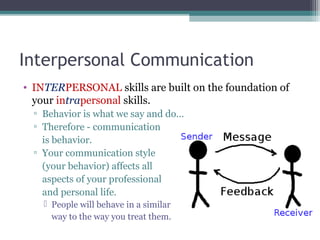
Interpersonal Communication
• INTERPERSONAL skills are built on the foundation of
your intrapersonal skills.
▫ Behavior is what we say and do…
▫ Therefore - communication
is behavior.
▫ Your communication style
(your behavior) affects all
aspects of your professional
and personal life.
 People will behave in a similar
way to the way you treat them.
Organizational Structure
• Refers to the way management designs a firm in order to meet
their mission and goals.
• Structure Determines:
▫ Who works together.
▫ How communication flows.
▫ What the policies, procedures, and rules will be.
• Current Structural Trends:
▫ Organizations are redesigning their processes.
▫ “Streamlining” is taking place (getting rid of layers of management).
▫ Going to team-based structures.
▫ Making being a team-player more important than ever.
▫ Multinational Companies (MNC’s) have many companies within their
structure – called Business Units (BU’s) – creating M-Form structures
that focus on particular products, customers, or geographies.
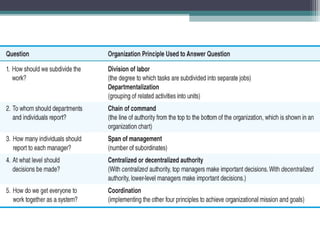
Principles of Organization
• In order to design a successful organization you must determine
the following:
▫ What the division of labor is– how are jobs sub-divided.
 And departmentalization - grouping related activities into
units.
▫ What the chain of command is- who is accountable to who.
▫ What the span of management is – how many workers are
under each management position.
▫ Where the decisions are finalized – who is the final
authority – where does the buck stop – is it…
 Centralized – top management makes the decisions, or…
 Decentralized – lower-level management makes decisions.
▫ How you coordinate it to all work together in a smooth
system.
Organizational Communication
• Is the compounded interpersonal communication across the
whole organization.
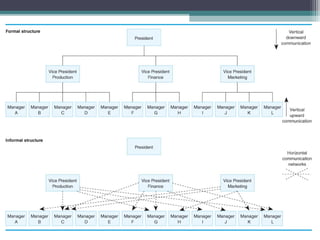
▫ VERTICAL COMMUNICATION (FORMAL)
 Up and down the chain of command .
 Downward = upper level tells lower level management what
to do.
 Upward = lower levels send messages to upper level – it is
vital to success of business.
▫ HORIZONTAL COMMUNICATION (LATERAL)
 Information flow between coworkers & peers.
▫ GRAPEVINE COMMUNICATION
 Informal flow of information thru the whole org.
 Gossip/rumors and inaccurate reports are a danger.
 http://www.youtube.com/watch?v=LImUb_yf_ps
Digital Information Technology
• New communication technologies have changed the way we
communicate in our professional and personal lives.
• INTERNET, E-MAIL, TEXTING, WIRELESS
▫ Internet (www) is global connection of computer networks.
▫ Accessed by computers, phones, and hand-held devices.
▫ E-mail most common form of communication on the job.
▫ E-mail & texting replacing the U.S. Postal system.
• E-COMMERCE, MOBILE WORKERS, M-COMMERCE
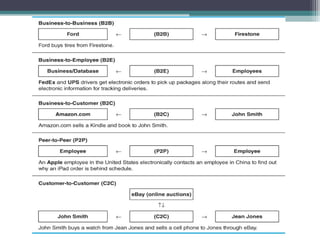
▫ Business is conducted electronically – see exhibit 5-3.
▫ New trend is M2M (machine to machine) connecting all digital
devices.
▫ Today many people don’t work in an office – they are mobile and use
electronic devices to communicate – even laptops are outdated.
▫ Mobile technology will be most influential in next 15 years –
shopping by using m-commerce devices.
Digital Information
Technology
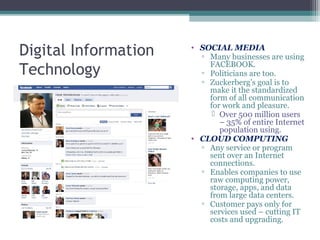
• SOCIAL MEDIA
▫ Many businesses are using
FACEBOOK.
▫ Politicians are too.
▫ Zuckerberg’s goal is to
make it the standardized
form of all communication
for work and pleasure.
 Over 500 million users
– 35% of entire Internet
population using.
• CLOUD COMPUTING
▫ Any service or program
sent over an Internet
connections.
▫ Enables companies to use
raw computing power,
storage, apps, and data
from large data centers.
▫ Customer pays only for
services used – cutting IT
costs and upgrading.
The Communication Process
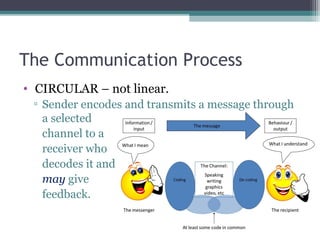
• CIRCULAR – not linear.
▫ Sender encodes and transmits a message through
a selected
channel to a
receiver who
decodes it and
may give
feedback.
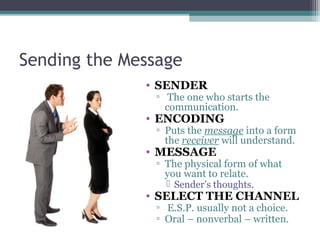
Sending the Message
• SENDER
▫ The one who starts the
communication.
• ENCODING
▫ Puts the message into a form
the receiver will understand.
• MESSAGE
▫ The physical form of what
you want to relate.
 Sender’s thoughts.
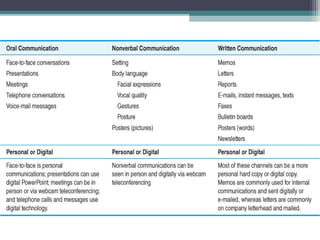
• SELECT THE CHANNEL
▫ E.S.P. usually not a choice.
▫ Oral – nonverbal – written.
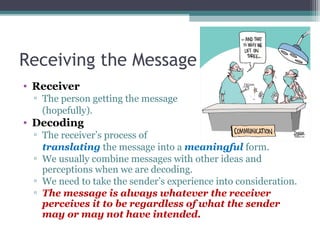
Receiving the Message
• Receiver
▫ The person getting the message
(hopefully).
• Decoding
▫ The receiver’s process of
translating the message into a meaningful form.
▫ We usually combine messages with other ideas and
perceptions when we are decoding.
▫ We need to take the sender’s experience into consideration.
▫ The message is always whatever the receiver
perceives it to be regardless of what the sender
may or may not have intended.
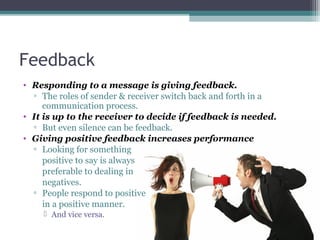
Feedback
• Responding to a message is giving feedback.
▫ The roles of sender & receiver switch back and forth in a
communication process.
• It is up to the receiver to decide if feedback is needed.
▫ But even silence can be feedback.
• Giving positive feedback increases performance
▫ Looking for something
positive to say is always
preferable to dealing in
negatives.
▫ People respond to positive
in a positive manner.
 And vice versa.
Problems with Communication
• Perception - choice of words – language
▫ Semantics = choosing the right word.
 What a word means to one may not be the same to another.
▫ Jargon = special terms of a certain group.
 Also beware acronyms.
• Information overload
▫ Too much information.
 Like a clogged drain – nothing gets through.
 Tune-out time!
• Using a wrong channel
▫ How you deliver the message is as important as what it is.
 A wrong channel can result in a wrong message.
▫ What is most effective for the situation.
 Do I call – write – email – send smoke signals - or chat in person?
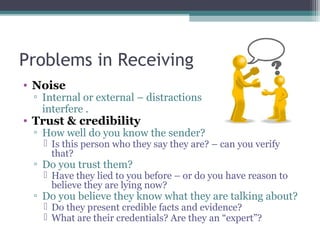
Problems in Receiving
• Noise
▫ Internal or external – distractions
interfere .
• Trust & credibility
▫ How well do you know the sender?
 Is this person who they say they are? – can you verify
that?
▫ Do you trust them?
 Have they lied to you before – or do you have reason to
believe they are lying now?
▫ Do you believe they know what they are talking about?
 Do they present credible facts and evidence?
 What are their credentials? Are they an “expert”?
Problems in Receiving
• Not-listening
▫ Hearing is the physical process – we assume here that the
receiver can “hear.”
 When the receiver is deaf - how does that affect the process?
▫ Listening is much more complex.
 It is a mental function – not physical.
• Emotional interference
▫ Emotions are by nature not logical or rational – you can’t be
objective when you are emotional.
 Anger – fear – sorrow – hurt – shock – happy & beyond.
▫ They can and do interfere in how someone translates an
incoming message.
▫ Senders should be calm and not provoke emotions in the
receivers…. (unless that is the message).
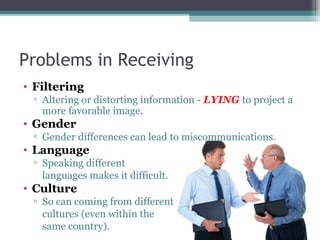
Problems in Receiving
• Filtering
▫ Altering or distorting information - LYING to project a
more favorable image.
• Gender
▫ Gender differences can lead to miscommunications.
• Language
▫ Speaking different
languages makes it difficult.
• Culture
▫ So can coming from different
cultures (even within the
same country).
Gender Differences
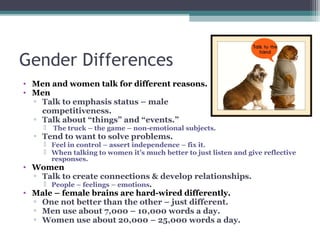
• Men and women talk for different reasons.
• Men
▫ Talk to emphasis status – male
competitiveness.
▫ Talk about “things” and “events.”
 The truck – the game – non-emotional subjects.
▫ Tend to want to solve problems.
 Feel in control – assert independence – fix it.
 When talking to women it’s much better to just listen and give reflective
responses.
• Women
▫ Talk to create connections & develop relationships.
 People – feelings – emotions.
• Male – female brains are hard-wired differently.
▫ One not better than the other – just different.
▫ Men use about 7,000 – 10,000 words a day.
▫ Women use about 20,000 – 25,000 words a day.
Cross-Cultural Differences
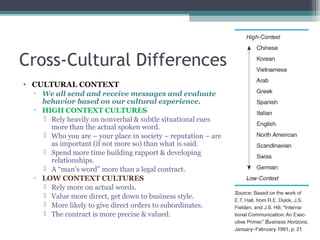
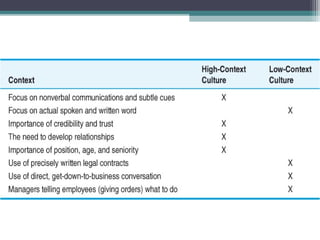
• CULTURAL CONTEXT
▫ We all send and receive messages and evaluate
behavior based on our cultural experience.
▫ HIGH CONTEXT CULTURES
 Rely heavily on nonverbal & subtle situational cues
more than the actual spoken word.
 Who you are – your place in society – reputation – are
as important (if not more so) than what is said.
 Spend more time building rapport & developing
relationships.
 A “man’s word” more than a legal contract.
▫ LOW CONTEXT CULTURES
 Rely more on actual words.
 Value more direct, get down to business style.
 More likely to give direct orders to subordinates.
 The contract is more precise & valued.
Cross-Cultural
Differences
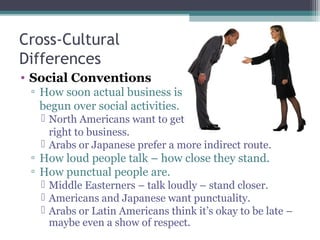
• Social Conventions
▫ How soon actual business is
begun over social activities.
 North Americans want to get
right to business.
 Arabs or Japanese prefer a more indirect route.
▫ How loud people talk – how close they stand.
▫ How punctual people are.
 Middle Easterners – talk loudly – stand closer.
 Americans and Japanese want punctuality.
 Arabs or Latin Americans think it’s okay to be late –
maybe even a show of respect.
Cross-Cultural Differences
• Language, etiquette, politeness
▫ Even if you are speaking the same language there are still
different usages depending on where you are.
▫ What is considered rude in one place is not in another.
▫ When in Rome – do as the Romans do.
• Nonverbal communication
▫ Messages that are sent without words.
▫ Gestures do not cross cultures very well because we do not all
share the same symbolism.
▫ But facial gestures are more universal.
 Eye contact is expected in some cultures – but rude in others.
▫ Touching can be a big issue.
 North Americans & N. Europeans don’t like it so much.
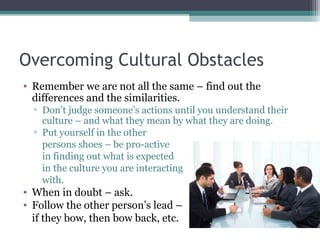
Overcoming Cultural Obstacles
• Remember we are not all the same – find out the
differences and the similarities.
▫ Don’t judge someone’s actions until you understand their
culture – and what they mean by what they are doing.
▫ Put yourself in the other
persons shoes – be pro-active
in finding out what is expected
in the culture you are interacting
with.
• When in doubt – ask.
• Follow the other person’s lead –
if they bow, then bow back, etc.
Planning the Message
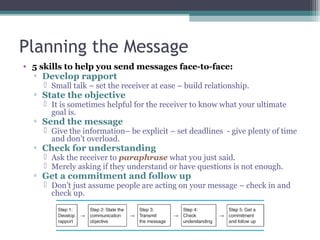
• 5 skills to help you send messages face-to-face:
▫ Develop rapport
 Small talk – set the receiver at ease – build relationship.
▫ State the objective
 It is sometimes helpful for the receiver to know what your ultimate
goal is.
▫ Send the message
 Give the information– be explicit – set deadlines - give plenty of time
and don’t overload.
▫ Check for understanding
 Ask the receiver to paraphrase what you just said.
 Merely asking if they understand or have questions is not enough.
▫ Get a commitment and follow up
 Don’t just assume people are acting on your message – check in and
check up.
Checking for Understanding
• FEEDBACK
▫ Is a process to verify messages.
• BIGGEST MISTAKE
▫ Is asking if there “are any questions?”
▫ People have a tendency NOT to ask questions.
▫ Senders then assume the message was understood.
▫ It often is not.
• WHAT WORKS
▫ Be open and responsive and patient.
▫ Be aware of nonverbal communication.
▫ Ask direct questions about what you just said.
▫ Ask the receiver to paraphrase what you just said.
Most Used & Least Effective
Communication Skill
• LISTENING IS THE COMMUNICATION SKILL WE USE
THE MOST
▫ 70 – 80 % of our waking hours are spent in some
sort of communication.
 9% writing – 16% reading – 30% talking.
 45% listening.
 But it is the skill we perform the poorest.
• WHY IS THAT???
▫ Lack of training.
 Not typically taught in school - & not many
workshops available.
Listening: Least Effective
Communication Skill
• WHY IS THAT??
▫ Thinking is faster than speaking.
 Rate of speech = average = 125 wpm.
 Mental capacity to understand 400 /600 wpm.
 When listening to average speaker – use about 25%
mental capacity – leaves 75% of the mind to wander… and it
does.
 Americans perceive fast talkers (200+wpm) as more credible
– smarter – and are more persuaded by them.
 Alternatively other research says – slow down – people will
understand you better.
 So…leaves you with the choice of being more credible and
convincing or being more correctly understood – depends on
your agenda.
Listening: Least Effective
Communication Skill
• WHY IS THAT??
▫ We are inefficient at listening – not focusing – not paying
attention – memory functions.
 After listening to a 10 min. oral presentation…
 Average listener understands and retains 50%.
 After 48 hours – it drops to 25%.
 After a week we retain only about 10%.
 We can keep only about 5-7 bits of information in
our short term memory.
 After that we must commit it to long term
memory.
 Many things affect what we decide to save as
permanent.
Listening: Least Effective
Communication Skill
• WHY IS THAT??
▫ AGE RELATED
 Listening skills diminish with advancing age.
 First & second graders listen about 90% of the
time.
 By junior high = only 44% are listening.
 In high school the average
drops to 28%.
 Senior citizens have hearing
problems that interfere.
▫ IT’S HARD WORK TO LISTEN
 Intense concentration over an
extended period of time produces
both physical and mental
exhaustion.
Active Listening
• Hearing what people are really saying.
• Listening is one of the most
important skills you can have.
• How well you listen has a major impact on your job
success and on the quality of your personal relationships,
not to mention your grades.
• By becoming a better listener you can:
▫ Improve your productivity, ability to influence,
persuade, and negotiate.
▫ Improve management of conflict and avoid
misunderstandings.
▫ http://www.youtube.com/watch?v=aP55nA8fQ9I
Tips for Active Listening
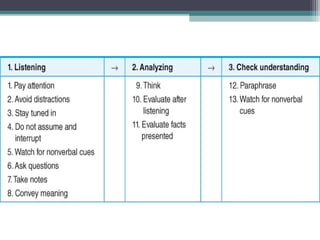
• Pay attention
▫ Their lips are moving….
• Avoid distractions
▫ Turn off the cell phone – look at the speaker.
• Stay tuned in
▫ Don’t let your mind wander – don’t plan what
you are going to say… just listen first.
• Do not assume and interrupt
▫ Wait until you hear the whole message.
• Watch for nonverbal cues
▫ Do the words match the nonverbal cues.
Tips for Active Listening
• Ask questions
▫ If you don’t understand ask for
clarification.
• Take notes
▫ Especially needed when getting
instructions.
• Convey meaning
▫ Let the speaker know when you
do understand.
• Analyze – think
▫ Organize and repeat in your mind
what you heard.
Tips for Active Listening
• Evaluate after listening
▫ Wait until the speaker is finished before you make a
judgment.
• Evaluate facts
▫ Base your conclusions on facts not
opinions or generalities.
• Check for understanding – paraphrase
▫ Consistently paraphrase – it is a
fail-safe checking device.
• Watch for nonverbal cues
▫ Again – read nonverbal for clues to
understanding.
Response Styles
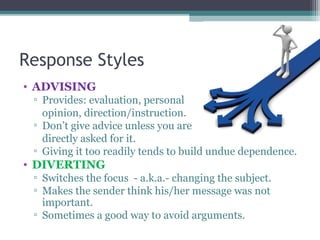
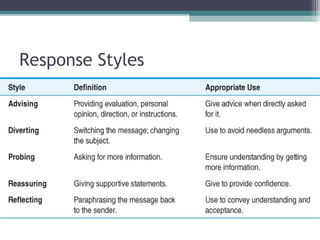
• ADVISING
▫ Provides: evaluation, personal
opinion, direction/instruction.
▫ Don’t give advice unless you are
directly asked for it.
▫ Giving it too readily tends to build undue dependence.
• DIVERTING
▫ Switches the focus - a.k.a.- changing the subject.
▫ Makes the sender think his/her message was not
important.
▫ Sometimes a good way to avoid arguments.
Response Styles
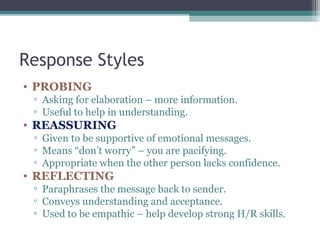
• PROBING
▫ Asking for elaboration – more information.
▫ Useful to help in understanding.
• REASSURING
▫ Given to be supportive of emotional messages.
▫ Means “don’t worry” – you are pacifying.
▫ Appropriate when the other person lacks confidence.
• REFLECTING
▫ Paraphrases the message back to sender.
▫ Conveys understanding and acceptance.
▫ Used to be empathic – help develop strong H/R skills.
Response Styles
Situational Communication Styles
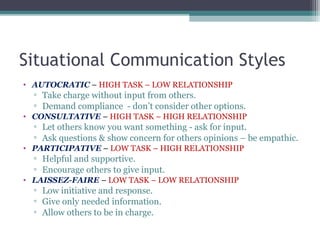
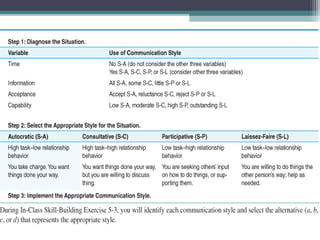
• AUTOCRATIC – HIGH TASK – LOW RELATIONSHIP
▫ Take charge without input from others.
▫ Demand compliance - don’t consider other options.
• CONSULTATIVE – HIGH TASK – HIGH RELATIONSHIP
▫ Let others know you want something - ask for input.
▫ Ask questions & show concern for others opinions – be empathic.
• PARTICIPATIVE – LOW TASK – HIGH RELATIONSHIP
▫ Helpful and supportive.
▫ Encourage others to give input.
• LAISSEZ-FAIRE – LOW TASK – LOW RELATIONSHIP
▫ Low initiative and response.
▫ Give only needed information.
▫ Allow others to be in charge.
Situational Variables
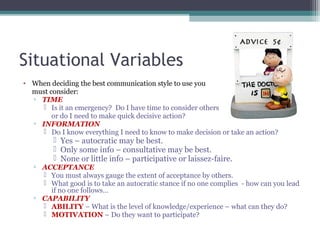
• When deciding the best communication style to use you
must consider:
▫ TIME
 Is it an emergency? Do I have time to consider others
or do I need to make quick decisive action?
▫ INFORMATION
 Do I know everything I need to know to make decision or take an action?
 Yes – autocratic may be best.
 Only some info – consultative may be best.
 None or little info – participative or laissez-faire.
▫ ACCEPTANCE
 You must always gauge the extent of acceptance by others.
 What good is to take an autocratic stance if no one complies - how can you lead
if no one follows…
▫ CAPABILITY
 ABILITY – What is the level of knowledge/experience – what can they do?
 MOTIVATION – Do they want to participate?
Understanding Emotions
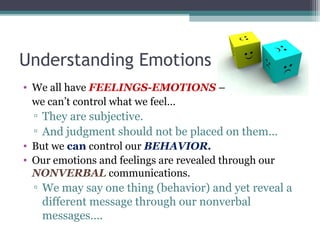
• We all have FEELINGS-EMOTIONS –
we can’t control what we feel…
▫ They are subjective.
▫ And judgment should not be placed on them…
• But we can control our BEHAVIOR.
• Our emotions and feelings are revealed through our
NONVERBAL communications.
▫ We may say one thing (behavior) and yet reveal a
different message through our nonverbal
messages….
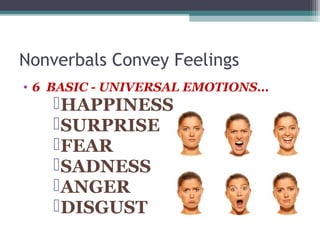
Nonverbals Convey Feelings
• 6 BASIC - UNIVERSAL EMOTIONS…
HAPPINESS
SURPRISE
FEAR
SADNESS
ANGER
DISGUST
Emotional Labor
• Requires the expression of feeling through
desired behavior.
• Emotional regulation
▫ Important for good H/R skills and job performance.
▫ Management should encourage POSITIVE emotional
expression.
▫ Lack of ability to control NEGATIVE emotional behavior
is contributing to an increase in workplace violence.
▫ It is important to not get caught up in other peoples
emotional outbursts.
 If someone yells at you…don’t yell back.
 Meeting negativity with negativity only increases it.
Cultural Differences
• Remember – what is
acceptable in one culture
may not be in others.
• Emotional labor expectations vary across cultures.
▫ Some cultures lack words to express certain emotions.
▫ And then interpret emotional displays differently.
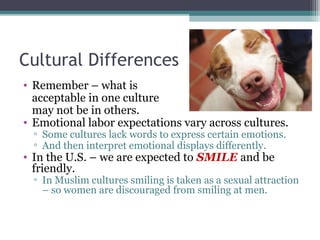
• In the U.S. – we are expected to SMILE and be
friendly.
▫ In Muslim cultures smiling is taken as a sexual attraction
– so women are discouraged from smiling at men.
Dealing with Emotional People
• Remember…emotions can be a barrier to effective communication.
• CALMING THE EMOTIONAL PERSON
▫ Don’t Argue, Mirror Negativity, or Belittle.
 Never use “put-downs.”
 Don’t try to make them feel guilty.
 These only cause more negative feelings and nothing gets resolved.
▫ Do be Empathetic and use Reflecting Statements.
 Use EMPATHIC LISTENING = the ability to understand and relate
to another’s situation and feelings.
 You don’t have to agree with them – but just try to put yourself in their
shoes.
 Use REFLECTIVE STATEMENTS = paraphrase feeling back to the
person – it validates their right to have their feelings.
 This allows the person to calm down, and then you can work on
resolving the problems.
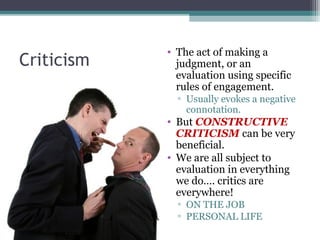
Criticism
• The act of making a
judgment, or an
evaluation using specific
rules of engagement.
▫ Usually evokes a negative
connotation.
• But CONSTRUCTIVE
CRITICISM can be very
beneficial.
• We are all subject to
evaluation in everything
we do…. critics are
everywhere!
▫ ON THE JOB
▫ PERSONAL LIFE
Receiving Criticism
• Getting criticized is always painful.
• No one likes to have their shortcomings pointed out
(especially if they don’t think they have any!)
• DO’S and DON’TS when you are being criticized:
▫ Accept that we can learn and improve from it.
▫ Don’t make excuses for your behaviors.
▫ Don’t be defensive or get emotional – listen.
▫ Use it as a learning opportunity.
▫ Even if you don’t agree with the criticism – remember
it’s how others are perceiving you.
▫ Take action – make a plan to improve and share it with
your boss – it shows your initiative and intentions to
improve.
Giving Constructive Criticism
• The purpose of the critic is to alter/change/improve
the behavior of the person they are criticizing…
▫ Punishment does not work!
 Chastising – being sarcastic – bad language – brunt of
bad joke….
▫ Only positive reinforcement works
▫ So handing out criticism in a negative and non-
productive way can even be counter-productive.
▫ Be supportive and offer suggestions and constructive
help to the person – make sure they know what type of
behavior you expect to see… give specific goals.
Summary of Key Concepts
▫ How communication flows through organizations.
▫ The 4 steps in the communication process.
▫ The 5 steps in the message-sending process.
▫ How to get feedback.
▫ The 3 steps in the message-receiving process.
▫ 5 response styles.
▫ 4 situational supervisory styles and 4 variables to
consider in selecting appropriate communication styles.

PSY 126 Week 5: Communications, Emotions, & Criticism

  • 1.
    Communications, Emotions, & Criticism MatthewL. Eisenhard, Psy.D. Week 5: Psychology for Business & Industry
  • 2.
    Interpersonal Communication • INTERPERSONALskills are built on the foundation of your intrapersonal skills. ▫ Behavior is what we say and do… ▫ Therefore - communication is behavior. ▫ Your communication style (your behavior) affects all aspects of your professional and personal life.  People will behave in a similar way to the way you treat them.
  • 3.
    Organizational Structure • Refersto the way management designs a firm in order to meet their mission and goals. • Structure Determines: ▫ Who works together. ▫ How communication flows. ▫ What the policies, procedures, and rules will be. • Current Structural Trends: ▫ Organizations are redesigning their processes. ▫ “Streamlining” is taking place (getting rid of layers of management). ▫ Going to team-based structures. ▫ Making being a team-player more important than ever. ▫ Multinational Companies (MNC’s) have many companies within their structure – called Business Units (BU’s) – creating M-Form structures that focus on particular products, customers, or geographies.
  • 4.
    Principles of Organization •In order to design a successful organization you must determine the following: ▫ What the division of labor is– how are jobs sub-divided.  And departmentalization - grouping related activities into units. ▫ What the chain of command is- who is accountable to who. ▫ What the span of management is – how many workers are under each management position. ▫ Where the decisions are finalized – who is the final authority – where does the buck stop – is it…  Centralized – top management makes the decisions, or…  Decentralized – lower-level management makes decisions. ▫ How you coordinate it to all work together in a smooth system.
  • 6.
    Organizational Communication • Isthe compounded interpersonal communication across the whole organization. ▫ VERTICAL COMMUNICATION (FORMAL)  Up and down the chain of command .  Downward = upper level tells lower level management what to do.  Upward = lower levels send messages to upper level – it is vital to success of business. ▫ HORIZONTAL COMMUNICATION (LATERAL)  Information flow between coworkers & peers. ▫ GRAPEVINE COMMUNICATION  Informal flow of information thru the whole org.  Gossip/rumors and inaccurate reports are a danger.  http://www.youtube.com/watch?v=LImUb_yf_ps
  • 8.
    Digital Information Technology •New communication technologies have changed the way we communicate in our professional and personal lives. • INTERNET, E-MAIL, TEXTING, WIRELESS ▫ Internet (www) is global connection of computer networks. ▫ Accessed by computers, phones, and hand-held devices. ▫ E-mail most common form of communication on the job. ▫ E-mail & texting replacing the U.S. Postal system. • E-COMMERCE, MOBILE WORKERS, M-COMMERCE ▫ Business is conducted electronically – see exhibit 5-3. ▫ New trend is M2M (machine to machine) connecting all digital devices. ▫ Today many people don’t work in an office – they are mobile and use electronic devices to communicate – even laptops are outdated. ▫ Mobile technology will be most influential in next 15 years – shopping by using m-commerce devices.
  • 10.
    Digital Information Technology • SOCIALMEDIA ▫ Many businesses are using FACEBOOK. ▫ Politicians are too. ▫ Zuckerberg’s goal is to make it the standardized form of all communication for work and pleasure.  Over 500 million users – 35% of entire Internet population using. • CLOUD COMPUTING ▫ Any service or program sent over an Internet connections. ▫ Enables companies to use raw computing power, storage, apps, and data from large data centers. ▫ Customer pays only for services used – cutting IT costs and upgrading.
  • 11.
    The Communication Process •CIRCULAR – not linear. ▫ Sender encodes and transmits a message through a selected channel to a receiver who decodes it and may give feedback.
  • 12.
    Sending the Message •SENDER ▫ The one who starts the communication. • ENCODING ▫ Puts the message into a form the receiver will understand. • MESSAGE ▫ The physical form of what you want to relate.  Sender’s thoughts. • SELECT THE CHANNEL ▫ E.S.P. usually not a choice. ▫ Oral – nonverbal – written.
  • 14.
    Receiving the Message •Receiver ▫ The person getting the message (hopefully). • Decoding ▫ The receiver’s process of translating the message into a meaningful form. ▫ We usually combine messages with other ideas and perceptions when we are decoding. ▫ We need to take the sender’s experience into consideration. ▫ The message is always whatever the receiver perceives it to be regardless of what the sender may or may not have intended.
  • 15.
    Feedback • Responding toa message is giving feedback. ▫ The roles of sender & receiver switch back and forth in a communication process. • It is up to the receiver to decide if feedback is needed. ▫ But even silence can be feedback. • Giving positive feedback increases performance ▫ Looking for something positive to say is always preferable to dealing in negatives. ▫ People respond to positive in a positive manner.  And vice versa.
  • 16.
    Problems with Communication •Perception - choice of words – language ▫ Semantics = choosing the right word.  What a word means to one may not be the same to another. ▫ Jargon = special terms of a certain group.  Also beware acronyms. • Information overload ▫ Too much information.  Like a clogged drain – nothing gets through.  Tune-out time! • Using a wrong channel ▫ How you deliver the message is as important as what it is.  A wrong channel can result in a wrong message. ▫ What is most effective for the situation.  Do I call – write – email – send smoke signals - or chat in person?
  • 17.
    Problems in Receiving •Noise ▫ Internal or external – distractions interfere . • Trust & credibility ▫ How well do you know the sender?  Is this person who they say they are? – can you verify that? ▫ Do you trust them?  Have they lied to you before – or do you have reason to believe they are lying now? ▫ Do you believe they know what they are talking about?  Do they present credible facts and evidence?  What are their credentials? Are they an “expert”?
  • 18.
    Problems in Receiving •Not-listening ▫ Hearing is the physical process – we assume here that the receiver can “hear.”  When the receiver is deaf - how does that affect the process? ▫ Listening is much more complex.  It is a mental function – not physical. • Emotional interference ▫ Emotions are by nature not logical or rational – you can’t be objective when you are emotional.  Anger – fear – sorrow – hurt – shock – happy & beyond. ▫ They can and do interfere in how someone translates an incoming message. ▫ Senders should be calm and not provoke emotions in the receivers…. (unless that is the message).
  • 19.
    Problems in Receiving •Filtering ▫ Altering or distorting information - LYING to project a more favorable image. • Gender ▫ Gender differences can lead to miscommunications. • Language ▫ Speaking different languages makes it difficult. • Culture ▫ So can coming from different cultures (even within the same country).
  • 20.
    Gender Differences • Menand women talk for different reasons. • Men ▫ Talk to emphasis status – male competitiveness. ▫ Talk about “things” and “events.”  The truck – the game – non-emotional subjects. ▫ Tend to want to solve problems.  Feel in control – assert independence – fix it.  When talking to women it’s much better to just listen and give reflective responses. • Women ▫ Talk to create connections & develop relationships.  People – feelings – emotions. • Male – female brains are hard-wired differently. ▫ One not better than the other – just different. ▫ Men use about 7,000 – 10,000 words a day. ▫ Women use about 20,000 – 25,000 words a day.
  • 21.
    Cross-Cultural Differences • CULTURALCONTEXT ▫ We all send and receive messages and evaluate behavior based on our cultural experience. ▫ HIGH CONTEXT CULTURES  Rely heavily on nonverbal & subtle situational cues more than the actual spoken word.  Who you are – your place in society – reputation – are as important (if not more so) than what is said.  Spend more time building rapport & developing relationships.  A “man’s word” more than a legal contract. ▫ LOW CONTEXT CULTURES  Rely more on actual words.  Value more direct, get down to business style.  More likely to give direct orders to subordinates.  The contract is more precise & valued.
  • 22.
    Cross-Cultural Differences • Social Conventions ▫How soon actual business is begun over social activities.  North Americans want to get right to business.  Arabs or Japanese prefer a more indirect route. ▫ How loud people talk – how close they stand. ▫ How punctual people are.  Middle Easterners – talk loudly – stand closer.  Americans and Japanese want punctuality.  Arabs or Latin Americans think it’s okay to be late – maybe even a show of respect.
  • 23.
    Cross-Cultural Differences • Language,etiquette, politeness ▫ Even if you are speaking the same language there are still different usages depending on where you are. ▫ What is considered rude in one place is not in another. ▫ When in Rome – do as the Romans do. • Nonverbal communication ▫ Messages that are sent without words. ▫ Gestures do not cross cultures very well because we do not all share the same symbolism. ▫ But facial gestures are more universal.  Eye contact is expected in some cultures – but rude in others. ▫ Touching can be a big issue.  North Americans & N. Europeans don’t like it so much.
  • 24.
    Overcoming Cultural Obstacles •Remember we are not all the same – find out the differences and the similarities. ▫ Don’t judge someone’s actions until you understand their culture – and what they mean by what they are doing. ▫ Put yourself in the other persons shoes – be pro-active in finding out what is expected in the culture you are interacting with. • When in doubt – ask. • Follow the other person’s lead – if they bow, then bow back, etc.
  • 26.
    Planning the Message •5 skills to help you send messages face-to-face: ▫ Develop rapport  Small talk – set the receiver at ease – build relationship. ▫ State the objective  It is sometimes helpful for the receiver to know what your ultimate goal is. ▫ Send the message  Give the information– be explicit – set deadlines - give plenty of time and don’t overload. ▫ Check for understanding  Ask the receiver to paraphrase what you just said.  Merely asking if they understand or have questions is not enough. ▫ Get a commitment and follow up  Don’t just assume people are acting on your message – check in and check up.
  • 27.
    Checking for Understanding •FEEDBACK ▫ Is a process to verify messages. • BIGGEST MISTAKE ▫ Is asking if there “are any questions?” ▫ People have a tendency NOT to ask questions. ▫ Senders then assume the message was understood. ▫ It often is not. • WHAT WORKS ▫ Be open and responsive and patient. ▫ Be aware of nonverbal communication. ▫ Ask direct questions about what you just said. ▫ Ask the receiver to paraphrase what you just said.
  • 28.
    Most Used &Least Effective Communication Skill • LISTENING IS THE COMMUNICATION SKILL WE USE THE MOST ▫ 70 – 80 % of our waking hours are spent in some sort of communication.  9% writing – 16% reading – 30% talking.  45% listening.  But it is the skill we perform the poorest. • WHY IS THAT??? ▫ Lack of training.  Not typically taught in school - & not many workshops available.
  • 29.
    Listening: Least Effective CommunicationSkill • WHY IS THAT?? ▫ Thinking is faster than speaking.  Rate of speech = average = 125 wpm.  Mental capacity to understand 400 /600 wpm.  When listening to average speaker – use about 25% mental capacity – leaves 75% of the mind to wander… and it does.  Americans perceive fast talkers (200+wpm) as more credible – smarter – and are more persuaded by them.  Alternatively other research says – slow down – people will understand you better.  So…leaves you with the choice of being more credible and convincing or being more correctly understood – depends on your agenda.
  • 30.
    Listening: Least Effective CommunicationSkill • WHY IS THAT?? ▫ We are inefficient at listening – not focusing – not paying attention – memory functions.  After listening to a 10 min. oral presentation…  Average listener understands and retains 50%.  After 48 hours – it drops to 25%.  After a week we retain only about 10%.  We can keep only about 5-7 bits of information in our short term memory.  After that we must commit it to long term memory.  Many things affect what we decide to save as permanent.
  • 31.
    Listening: Least Effective CommunicationSkill • WHY IS THAT?? ▫ AGE RELATED  Listening skills diminish with advancing age.  First & second graders listen about 90% of the time.  By junior high = only 44% are listening.  In high school the average drops to 28%.  Senior citizens have hearing problems that interfere. ▫ IT’S HARD WORK TO LISTEN  Intense concentration over an extended period of time produces both physical and mental exhaustion.
  • 32.
    Active Listening • Hearingwhat people are really saying. • Listening is one of the most important skills you can have. • How well you listen has a major impact on your job success and on the quality of your personal relationships, not to mention your grades. • By becoming a better listener you can: ▫ Improve your productivity, ability to influence, persuade, and negotiate. ▫ Improve management of conflict and avoid misunderstandings. ▫ http://www.youtube.com/watch?v=aP55nA8fQ9I
  • 33.
    Tips for ActiveListening • Pay attention ▫ Their lips are moving…. • Avoid distractions ▫ Turn off the cell phone – look at the speaker. • Stay tuned in ▫ Don’t let your mind wander – don’t plan what you are going to say… just listen first. • Do not assume and interrupt ▫ Wait until you hear the whole message. • Watch for nonverbal cues ▫ Do the words match the nonverbal cues.
  • 34.
    Tips for ActiveListening • Ask questions ▫ If you don’t understand ask for clarification. • Take notes ▫ Especially needed when getting instructions. • Convey meaning ▫ Let the speaker know when you do understand. • Analyze – think ▫ Organize and repeat in your mind what you heard.
  • 35.
    Tips for ActiveListening • Evaluate after listening ▫ Wait until the speaker is finished before you make a judgment. • Evaluate facts ▫ Base your conclusions on facts not opinions or generalities. • Check for understanding – paraphrase ▫ Consistently paraphrase – it is a fail-safe checking device. • Watch for nonverbal cues ▫ Again – read nonverbal for clues to understanding.
  • 37.
    Response Styles • ADVISING ▫Provides: evaluation, personal opinion, direction/instruction. ▫ Don’t give advice unless you are directly asked for it. ▫ Giving it too readily tends to build undue dependence. • DIVERTING ▫ Switches the focus - a.k.a.- changing the subject. ▫ Makes the sender think his/her message was not important. ▫ Sometimes a good way to avoid arguments.
  • 38.
    Response Styles • PROBING ▫Asking for elaboration – more information. ▫ Useful to help in understanding. • REASSURING ▫ Given to be supportive of emotional messages. ▫ Means “don’t worry” – you are pacifying. ▫ Appropriate when the other person lacks confidence. • REFLECTING ▫ Paraphrases the message back to sender. ▫ Conveys understanding and acceptance. ▫ Used to be empathic – help develop strong H/R skills.
  • 39.
  • 40.
    Situational Communication Styles •AUTOCRATIC – HIGH TASK – LOW RELATIONSHIP ▫ Take charge without input from others. ▫ Demand compliance - don’t consider other options. • CONSULTATIVE – HIGH TASK – HIGH RELATIONSHIP ▫ Let others know you want something - ask for input. ▫ Ask questions & show concern for others opinions – be empathic. • PARTICIPATIVE – LOW TASK – HIGH RELATIONSHIP ▫ Helpful and supportive. ▫ Encourage others to give input. • LAISSEZ-FAIRE – LOW TASK – LOW RELATIONSHIP ▫ Low initiative and response. ▫ Give only needed information. ▫ Allow others to be in charge.
  • 41.
    Situational Variables • Whendeciding the best communication style to use you must consider: ▫ TIME  Is it an emergency? Do I have time to consider others or do I need to make quick decisive action? ▫ INFORMATION  Do I know everything I need to know to make decision or take an action?  Yes – autocratic may be best.  Only some info – consultative may be best.  None or little info – participative or laissez-faire. ▫ ACCEPTANCE  You must always gauge the extent of acceptance by others.  What good is to take an autocratic stance if no one complies - how can you lead if no one follows… ▫ CAPABILITY  ABILITY – What is the level of knowledge/experience – what can they do?  MOTIVATION – Do they want to participate?
  • 43.
    Understanding Emotions • Weall have FEELINGS-EMOTIONS – we can’t control what we feel… ▫ They are subjective. ▫ And judgment should not be placed on them… • But we can control our BEHAVIOR. • Our emotions and feelings are revealed through our NONVERBAL communications. ▫ We may say one thing (behavior) and yet reveal a different message through our nonverbal messages….
  • 44.
    Nonverbals Convey Feelings •6 BASIC - UNIVERSAL EMOTIONS… HAPPINESS SURPRISE FEAR SADNESS ANGER DISGUST
  • 45.
    Emotional Labor • Requiresthe expression of feeling through desired behavior. • Emotional regulation ▫ Important for good H/R skills and job performance. ▫ Management should encourage POSITIVE emotional expression. ▫ Lack of ability to control NEGATIVE emotional behavior is contributing to an increase in workplace violence. ▫ It is important to not get caught up in other peoples emotional outbursts.  If someone yells at you…don’t yell back.  Meeting negativity with negativity only increases it.
  • 46.
    Cultural Differences • Remember– what is acceptable in one culture may not be in others. • Emotional labor expectations vary across cultures. ▫ Some cultures lack words to express certain emotions. ▫ And then interpret emotional displays differently. • In the U.S. – we are expected to SMILE and be friendly. ▫ In Muslim cultures smiling is taken as a sexual attraction – so women are discouraged from smiling at men.
  • 47.
    Dealing with EmotionalPeople • Remember…emotions can be a barrier to effective communication. • CALMING THE EMOTIONAL PERSON ▫ Don’t Argue, Mirror Negativity, or Belittle.  Never use “put-downs.”  Don’t try to make them feel guilty.  These only cause more negative feelings and nothing gets resolved. ▫ Do be Empathetic and use Reflecting Statements.  Use EMPATHIC LISTENING = the ability to understand and relate to another’s situation and feelings.  You don’t have to agree with them – but just try to put yourself in their shoes.  Use REFLECTIVE STATEMENTS = paraphrase feeling back to the person – it validates their right to have their feelings.  This allows the person to calm down, and then you can work on resolving the problems.
  • 48.
    Criticism • The actof making a judgment, or an evaluation using specific rules of engagement. ▫ Usually evokes a negative connotation. • But CONSTRUCTIVE CRITICISM can be very beneficial. • We are all subject to evaluation in everything we do…. critics are everywhere! ▫ ON THE JOB ▫ PERSONAL LIFE
  • 49.
    Receiving Criticism • Gettingcriticized is always painful. • No one likes to have their shortcomings pointed out (especially if they don’t think they have any!) • DO’S and DON’TS when you are being criticized: ▫ Accept that we can learn and improve from it. ▫ Don’t make excuses for your behaviors. ▫ Don’t be defensive or get emotional – listen. ▫ Use it as a learning opportunity. ▫ Even if you don’t agree with the criticism – remember it’s how others are perceiving you. ▫ Take action – make a plan to improve and share it with your boss – it shows your initiative and intentions to improve.
  • 50.
    Giving Constructive Criticism •The purpose of the critic is to alter/change/improve the behavior of the person they are criticizing… ▫ Punishment does not work!  Chastising – being sarcastic – bad language – brunt of bad joke…. ▫ Only positive reinforcement works ▫ So handing out criticism in a negative and non- productive way can even be counter-productive. ▫ Be supportive and offer suggestions and constructive help to the person – make sure they know what type of behavior you expect to see… give specific goals.
  • 51.
    Summary of KeyConcepts ▫ How communication flows through organizations. ▫ The 4 steps in the communication process. ▫ The 5 steps in the message-sending process. ▫ How to get feedback. ▫ The 3 steps in the message-receiving process. ▫ 5 response styles. ▫ 4 situational supervisory styles and 4 variables to consider in selecting appropriate communication styles.