How to Deal With Difficult People
Timothy Dimoff
TADimoff@sacsconsulting.comTADimoff@sacsconsulting.com
Introduction
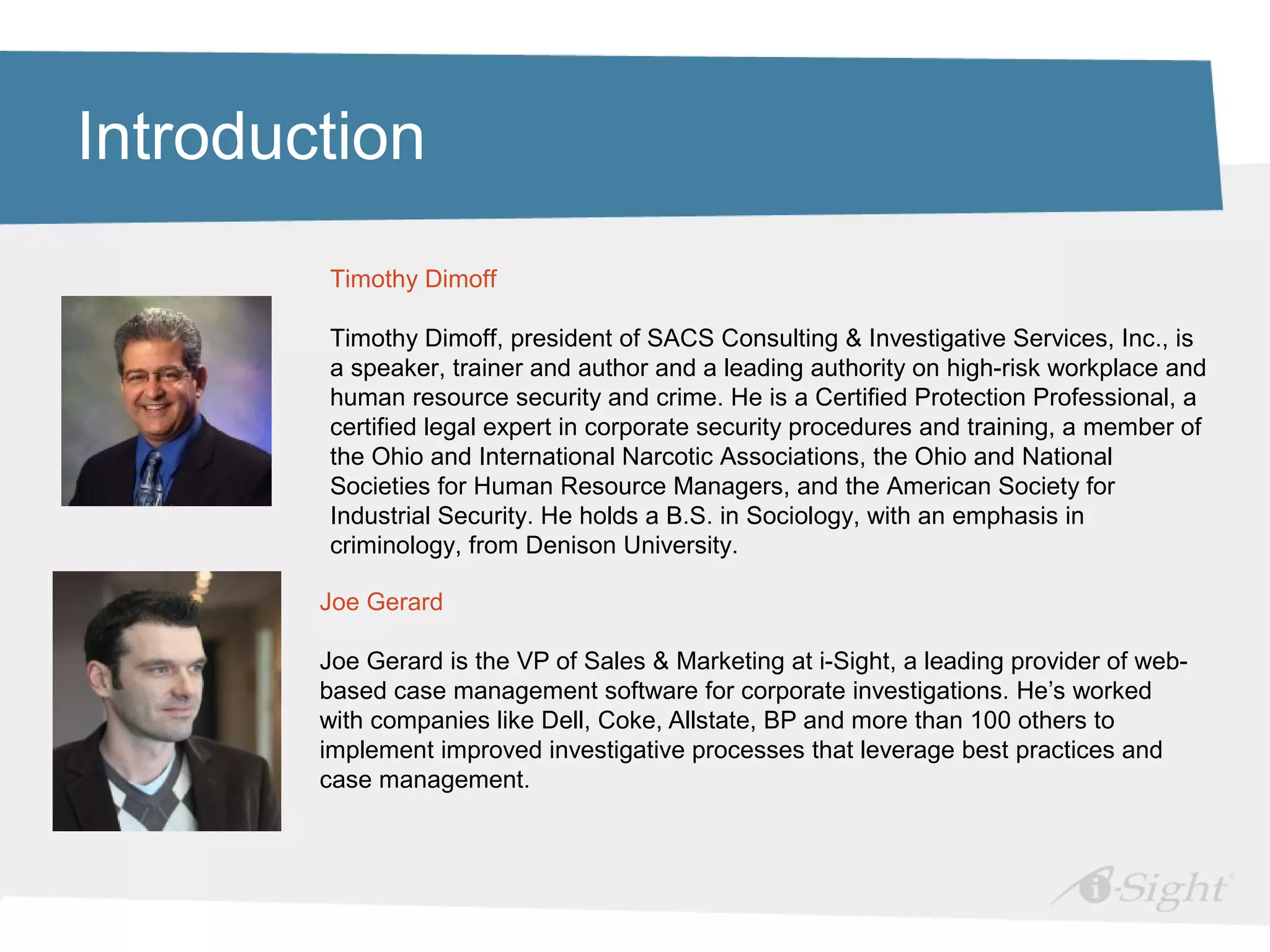
Timothy Dimoff
Timothy Dimoff, president of SACS Consulting & Investigative Services, Inc., is
a speaker, trainer and author and a leading authority on high-risk workplace and
human resource security and crime. He is a Certified Protection Professional, a
certified legal expert in corporate security procedures and training, a member of
the Ohio and International Narcotic Associations, the Ohio and National
Societies for Human Resource Managers, and the American Society for
Industrial Security. He holds a B.S. in Sociology, with an emphasis in
criminology, from Denison University.
Joe Gerard
Joe Gerard is the VP of Sales & Marketing at i-Sight, a leading provider of web-
based case management software for corporate investigations. He’s worked
with companies like Dell, Coke, Allstate, BP and more than 100 others to
implement improved investigative processes that leverage best practices and
case management.
The Reality of Life Rage
• Tension, violence, bullying,
rage and negative
encounters exist in all
aspects of daily life
• We live in a 24/7 “pressure
cooker” society
• Abnormal behavior has now
become the norm
Objectives
• Aggressive vs. Assertive Behavior
• Reacting vs. Responding
• How we communicate
• Causes of outbursts
Objectives
• Stages of aggression
• De-escalating aggression
• Things never to say to someone
• Verbal judo
• Speaking “Peace Language”
Confrontation
Is confrontation an
inevitable part of
your job?
Employees/Customers Expect
Managers to Have…
• Communication skills
• Listening skills
• Interpersonal skills and compassion
• Professionalism
• Community awareness
Tipping the Scale…
• Reason vs. Emotion
–When a person is reasonable they are
less emotional and reactive
–When a person is emotional and
reactive, they are less reasonable
• GOAL: reduce emotion to regain
reasonableness
Reasonable
Reactive
ReasonableReactive
Be the Model
Assertive Behavior:
When one individual is able to
communicate their needs, desires, and
expectations while still respecting
another individual’s rights.
Aggressive vs. Assertive
Behaviors…
• Aggressive managers/supervisors
RE-act to events.
• Assertive managers/supervisors RE-
spond to events
REacting vs. REsponding
• When upset, people never say what they
mean!
• When a manager reacts to the words,
he/she is incapable of responding to the
underlying meanings.
• When we REact, the “act” controls us.
• When we REspond, we re-answer,
suggesting control and assertiveness
Benefits of REspect
If we treat people well when they do not
handle themselves well…
…
How We Communicate is Key
• Although we communicate verbally—we
also communicate non-verbally.
• Vocal tone and body language contribute
significantly to the message you send.
• You can say the right thing—but if you
come off meek or hostile, your words may
not achieve the desired outcome.
Don’t Confuse Sympathy with
Empathy
Sympathy means to share feelings.
Empathy is when you momentarily
stand in another’s shoes.
TACTICAL EMPATHY is a strategic skill
managers/supervisors must learn and practice.
The Stages of Aggression
Stage 1: Initial tension and
frustration
Help person vent, reflect on the situation
and devise their own solution.
Stage 2: Verbal Attack
Emotion begins to overwhelm reason and
they go on the offensive with verbal
attacks
The Stages of Aggression
Stage 3: Loss of Control
Individual loses control over their anger
and are close to acting out through violent
behaviors.
Your Best Response?
Deny aggressor what he/she seeks:
When you deny the aggressor the fear
response...
…the threat’s potency withers.
Your Best Response?
Many people think it best to ignore the
comment. But that suggests fear.
Do not laugh it off, or counter with a threat
of your own. Such responses often
motivate an escalation.
Your best response should suggest
confidence—not fear.
What Happens to YOU?
When someone is angry at you…
…many people tend to get angry right
back.
Or...
…your mind goes blank so you can’t
think of what to say or do.
De-escalating Aggression
Step 1: Identify Yourself
• If a first-meeting, offer your first name.
• It demonstrates confidence.
• Establishes the beginnings of rapport. You are a
person—not an organizational figurehead.
• Find out who’s confronting you—ask for the
other person’s name.
• If you get it—use it.
De-escalating Aggression
Step 2: Hear Them Out
• People who are upset want to be heard. Let
them say their piece.
• Let them vent, scream and rant. When finished
you are more likely to engage in a reasonable
conversation.
• However—if the person has a violent history,
or intuition tells you the situation is escalating
—you may need to take a different approach.
De-escalating Aggression
Step 3: Paraphrase
• If you can, quote the person exactly.
• Open with something like: “Let me be sure I
understand what you said.”
• Include an emotional component—but avoid
aggressive words ( use “frustrated” not “angry”).
De-escalating Aggression
Step 4: Explain Your Position
• You ask the person to do what you want.
• Tighten the noose with the “yes set.”
– 2 to 3 yeses to set the tone
– A fact
– Your request
De-escalating Aggression
Step 5: Explain Positive Options
• By nature, people are self-centered—so exploit it.
• Describe 2 or 3 positive reasons why the person
should cooperate.
• Then make your request again.
De-escalating Aggression
Step 6: Explain Negative Options
• This step highlights what the person stands to
lose by not cooperating.
• Psychologically, people are often more
motivated to avoid loss than gain reward.
• Identify 2 to 3 negatives.
• Turn the tables: “You tell me, what do you
think will happen if we can’t resolve the
situation?”
De-escalating Aggression
Step 7: Last Chance
• Give the person one final opportunity to
cooperate.
• “Is there anything I can say or do that will get
you to cooperate?”
How to Work Face-to-Face
Do:
• Work on being respectful. Even if the person is
insulting you, they may just need to vent.
• Even when being yelled at: maintain poise and
self-control. Keep voice low and calm.
• Be matter of fact. Use short, simple statements.
• Keep hands in view—at sides or slightly out to
the side.
How to Work Face-to-Face
Do:
• Set guidelines on behavior.
• Allow a person to yell—but let them know threats
are not allowed.
• Tell them you understand why they are angry.
• Give person ample time to vent. It does not hurt
you and can help them.
• However, if a person seems to get more
aggressive by their words, try to calm them
down!
Understand Predisposition Factors
• Why is the person behaving in this
manner?
– Are they just angry at the situation—or do they
need something in particular?
– Does person have mental illness?
• Are drugs or alcohol involved? If so, be
especially watchful of the person!
Understand Predisposition Factors
• Understanding reasons for the person’s
anger is essential to helping them find a
solution.
• We can always help them accomplish
something!
– It may not be what they initially want, but try to
help them find some relief.
• These factors are vital in preparing for a
potentially violent episode.
Don’t Do This!
• Do not make sudden movements.
• Do not use threats or sharp commands—
this will further exacerbate the situation!
• Do not challenge a person—verbally or
physically.
Don’t Do This!
• Do not argue, criticize or be judgmental of
their situation, even if you think someone
should.
• Always remain calm. You are the one who
can diffuse the potentially dangerous
situation.
Don’t Do This!
• Don’t make promises you cannot keep.
– Be upfront with information, but find another
solution to present before delivering bad news.
– This helps the person see you understand
his/her problem and want to help.
• Don’t take anger personally.
Don’t Do This!
• Avoid joking or laughing in an angry
person’s presence or showing signs of
being impatient.
• Don’t use statements such as:
– “You need to sit down, calm down, and stop
yelling.” This fuels the fire.
How to Protect Yourself
• Do not touch an angry person.
• Do not invade their personal space—provide at
least 4 feet of space.
• Give the person an escape route that does not
involve coming close to you (they may knock you
down getting out).
Verbal Judo
Seven things never to say to anyone
and why!
Verbal Judo
“Hey you! Come here!”
• To you, “come here” means “Over here.
You are under my authority.”
• To the person, it means: “Go away quickly!”
Verbal Judo
“Hey, calm down!”
• To the person, it is a criticism of their
behavior.
• Suggests they have no legitimate right to be
upset.
• Not only is there the problem they were
upset about—now they need to defend their
reaction to you.
Verbal Judo
Instead gently say…
• “It’s going to be all right. Talk to me. What’s
the matter?”
• Softens person up to talk.
• “Calm down” hardens their resistance.
Verbal Judo
“I’m not going to tell you again!”
• Repetition is weakness.
• Places you in position where you must act.
Verbal Judo
Instead say…
• “Sir, is there anything I could say that would
get you to do A, B, and C? I’d like to think
so.”
• If answer is “no”, we act while individual is
still talking. We do not threaten people, but
we do act when verbal persuasion fails.”
Verbal Judo
“Be more reasonable!”
• Everyone believes they are being
reasonable given present circumstances.
• You only invite conflict.
Verbal Judo
Instead say…
• “Let me see if I understand your position.”
• Paraphrase their response in your own
words.
• This will calm them because your words will
be more professional and less emotional.
Verbal Judo
“Because those are the rules!”
Or…
“Because that’s the law!”
• The phrase irritates people and puts you in
a position of weakness.
Verbal Judo
Instead…
• Tell people why.
• At least 70% of resistant or difficult people will
do what you want if you just tell them why.
• You establish ground to stand on and give the
other good reason for complying—not just
because you said so.
Verbal Judo
“What’s your problem?”
• This useless phrase puts the problem back
on the person needing assistance.
• Nobody likes to admit he/she has a
problem.
Verbal Judo
Instead…
• Substitute tactical phrases designed to soften
and open someone up, like...
– “What’s the matter?”
– “How can I help?”
– “I see you’re upset, let me suggest…”
Verbal Judo
“What do you want me to do about it?”
• A sarcastic question.
• An evasion of your responsibility.
• You now have two problems: the original one
and the one you just created by appearing to
duck responsibility.
Verbal Judo
Instead…
• Offer to help sort out the problem and
work out a solution.
• Insult strengthens resistance and shuts
the eyes.
• Civility weakens resistance and opens
the eyes!
Speaking “Peace Language”
• “Peace Language” is professional because
it enhances opportunities for achieving
voluntary compliance.
• Masks inner feelings that might be naturally
negative.
• Language that stimulates conflict is
unprofessional.
Speaking “Peace Language”
• Become expert at finding ways to help
others save personal face.
• How you deal with confrontation will be
easier if you learn how to handle it in an
assertive manner.
• If you can help someone save face—you
almost never have to fight them!
End Result…
The professional manager/supervisor
anticipates trouble and moves to prevent it…
…rather than expecting it and provoking
trouble.
Questions
If you have any questions, please submit them now.
Thank you for taking the time to attend today’s webinar.
If you have any questions about the information covered in the webinar,
please contact:
Joe Gerard
jgerard@i-sight.com
Timothy Dimoff
TADimoff@sacsconsulting.com

How to deal with difficult people - Timothy Dimoff

  • 1.
    How to DealWith Difficult People Timothy Dimoff TADimoff@sacsconsulting.comTADimoff@sacsconsulting.com
  • 2.
    Introduction Timothy Dimoff Timothy Dimoff,president of SACS Consulting & Investigative Services, Inc., is a speaker, trainer and author and a leading authority on high-risk workplace and human resource security and crime. He is a Certified Protection Professional, a certified legal expert in corporate security procedures and training, a member of the Ohio and International Narcotic Associations, the Ohio and National Societies for Human Resource Managers, and the American Society for Industrial Security. He holds a B.S. in Sociology, with an emphasis in criminology, from Denison University. Joe Gerard Joe Gerard is the VP of Sales & Marketing at i-Sight, a leading provider of web- based case management software for corporate investigations. He’s worked with companies like Dell, Coke, Allstate, BP and more than 100 others to implement improved investigative processes that leverage best practices and case management.
  • 3.
    The Reality ofLife Rage • Tension, violence, bullying, rage and negative encounters exist in all aspects of daily life • We live in a 24/7 “pressure cooker” society • Abnormal behavior has now become the norm
  • 4.
    Objectives • Aggressive vs.Assertive Behavior • Reacting vs. Responding • How we communicate • Causes of outbursts
  • 5.
    Objectives • Stages ofaggression • De-escalating aggression • Things never to say to someone • Verbal judo • Speaking “Peace Language”
  • 6.
  • 7.
    Employees/Customers Expect Managers toHave… • Communication skills • Listening skills • Interpersonal skills and compassion • Professionalism • Community awareness
  • 8.
    Tipping the Scale… •Reason vs. Emotion –When a person is reasonable they are less emotional and reactive –When a person is emotional and reactive, they are less reasonable • GOAL: reduce emotion to regain reasonableness
  • 9.
  • 10.
  • 11.
    Be the Model AssertiveBehavior: When one individual is able to communicate their needs, desires, and expectations while still respecting another individual’s rights.
  • 12.
    Aggressive vs. Assertive Behaviors… •Aggressive managers/supervisors RE-act to events. • Assertive managers/supervisors RE- spond to events
  • 13.
    REacting vs. REsponding •When upset, people never say what they mean! • When a manager reacts to the words, he/she is incapable of responding to the underlying meanings. • When we REact, the “act” controls us. • When we REspond, we re-answer, suggesting control and assertiveness
  • 14.
    Benefits of REspect Ifwe treat people well when they do not handle themselves well… …
  • 15.
    How We Communicateis Key • Although we communicate verbally—we also communicate non-verbally. • Vocal tone and body language contribute significantly to the message you send. • You can say the right thing—but if you come off meek or hostile, your words may not achieve the desired outcome.
  • 16.
    Don’t Confuse Sympathywith Empathy Sympathy means to share feelings. Empathy is when you momentarily stand in another’s shoes. TACTICAL EMPATHY is a strategic skill managers/supervisors must learn and practice.
  • 17.
    The Stages ofAggression Stage 1: Initial tension and frustration Help person vent, reflect on the situation and devise their own solution. Stage 2: Verbal Attack Emotion begins to overwhelm reason and they go on the offensive with verbal attacks
  • 18.
    The Stages ofAggression Stage 3: Loss of Control Individual loses control over their anger and are close to acting out through violent behaviors.
  • 19.
    Your Best Response? Denyaggressor what he/she seeks: When you deny the aggressor the fear response... …the threat’s potency withers.
  • 20.
    Your Best Response? Manypeople think it best to ignore the comment. But that suggests fear. Do not laugh it off, or counter with a threat of your own. Such responses often motivate an escalation. Your best response should suggest confidence—not fear.
  • 21.
    What Happens toYOU? When someone is angry at you… …many people tend to get angry right back. Or... …your mind goes blank so you can’t think of what to say or do.
  • 22.
    De-escalating Aggression Step 1:Identify Yourself • If a first-meeting, offer your first name. • It demonstrates confidence. • Establishes the beginnings of rapport. You are a person—not an organizational figurehead. • Find out who’s confronting you—ask for the other person’s name. • If you get it—use it.
  • 23.
    De-escalating Aggression Step 2:Hear Them Out • People who are upset want to be heard. Let them say their piece. • Let them vent, scream and rant. When finished you are more likely to engage in a reasonable conversation. • However—if the person has a violent history, or intuition tells you the situation is escalating —you may need to take a different approach.
  • 24.
    De-escalating Aggression Step 3:Paraphrase • If you can, quote the person exactly. • Open with something like: “Let me be sure I understand what you said.” • Include an emotional component—but avoid aggressive words ( use “frustrated” not “angry”).
  • 25.
    De-escalating Aggression Step 4:Explain Your Position • You ask the person to do what you want. • Tighten the noose with the “yes set.” – 2 to 3 yeses to set the tone – A fact – Your request
  • 26.
    De-escalating Aggression Step 5:Explain Positive Options • By nature, people are self-centered—so exploit it. • Describe 2 or 3 positive reasons why the person should cooperate. • Then make your request again.
  • 27.
    De-escalating Aggression Step 6:Explain Negative Options • This step highlights what the person stands to lose by not cooperating. • Psychologically, people are often more motivated to avoid loss than gain reward. • Identify 2 to 3 negatives. • Turn the tables: “You tell me, what do you think will happen if we can’t resolve the situation?”
  • 28.
    De-escalating Aggression Step 7:Last Chance • Give the person one final opportunity to cooperate. • “Is there anything I can say or do that will get you to cooperate?”
  • 29.
    How to WorkFace-to-Face Do: • Work on being respectful. Even if the person is insulting you, they may just need to vent. • Even when being yelled at: maintain poise and self-control. Keep voice low and calm. • Be matter of fact. Use short, simple statements. • Keep hands in view—at sides or slightly out to the side.
  • 30.
    How to WorkFace-to-Face Do: • Set guidelines on behavior. • Allow a person to yell—but let them know threats are not allowed. • Tell them you understand why they are angry. • Give person ample time to vent. It does not hurt you and can help them. • However, if a person seems to get more aggressive by their words, try to calm them down!
  • 31.
    Understand Predisposition Factors •Why is the person behaving in this manner? – Are they just angry at the situation—or do they need something in particular? – Does person have mental illness? • Are drugs or alcohol involved? If so, be especially watchful of the person!
  • 32.
    Understand Predisposition Factors •Understanding reasons for the person’s anger is essential to helping them find a solution. • We can always help them accomplish something! – It may not be what they initially want, but try to help them find some relief. • These factors are vital in preparing for a potentially violent episode.
  • 33.
    Don’t Do This! •Do not make sudden movements. • Do not use threats or sharp commands— this will further exacerbate the situation! • Do not challenge a person—verbally or physically.
  • 34.
    Don’t Do This! •Do not argue, criticize or be judgmental of their situation, even if you think someone should. • Always remain calm. You are the one who can diffuse the potentially dangerous situation.
  • 35.
    Don’t Do This! •Don’t make promises you cannot keep. – Be upfront with information, but find another solution to present before delivering bad news. – This helps the person see you understand his/her problem and want to help. • Don’t take anger personally.
  • 36.
    Don’t Do This! •Avoid joking or laughing in an angry person’s presence or showing signs of being impatient. • Don’t use statements such as: – “You need to sit down, calm down, and stop yelling.” This fuels the fire.
  • 37.
    How to ProtectYourself • Do not touch an angry person. • Do not invade their personal space—provide at least 4 feet of space. • Give the person an escape route that does not involve coming close to you (they may knock you down getting out).
  • 38.
    Verbal Judo Seven thingsnever to say to anyone and why!
  • 39.
    Verbal Judo “Hey you!Come here!” • To you, “come here” means “Over here. You are under my authority.” • To the person, it means: “Go away quickly!”
  • 40.
    Verbal Judo “Hey, calmdown!” • To the person, it is a criticism of their behavior. • Suggests they have no legitimate right to be upset. • Not only is there the problem they were upset about—now they need to defend their reaction to you.
  • 41.
    Verbal Judo Instead gentlysay… • “It’s going to be all right. Talk to me. What’s the matter?” • Softens person up to talk. • “Calm down” hardens their resistance.
  • 42.
    Verbal Judo “I’m notgoing to tell you again!” • Repetition is weakness. • Places you in position where you must act.
  • 43.
    Verbal Judo Instead say… •“Sir, is there anything I could say that would get you to do A, B, and C? I’d like to think so.” • If answer is “no”, we act while individual is still talking. We do not threaten people, but we do act when verbal persuasion fails.”
  • 44.
    Verbal Judo “Be morereasonable!” • Everyone believes they are being reasonable given present circumstances. • You only invite conflict.
  • 45.
    Verbal Judo Instead say… •“Let me see if I understand your position.” • Paraphrase their response in your own words. • This will calm them because your words will be more professional and less emotional.
  • 46.
    Verbal Judo “Because thoseare the rules!” Or… “Because that’s the law!” • The phrase irritates people and puts you in a position of weakness.
  • 47.
    Verbal Judo Instead… • Tellpeople why. • At least 70% of resistant or difficult people will do what you want if you just tell them why. • You establish ground to stand on and give the other good reason for complying—not just because you said so.
  • 48.
    Verbal Judo “What’s yourproblem?” • This useless phrase puts the problem back on the person needing assistance. • Nobody likes to admit he/she has a problem.
  • 49.
    Verbal Judo Instead… • Substitutetactical phrases designed to soften and open someone up, like... – “What’s the matter?” – “How can I help?” – “I see you’re upset, let me suggest…”
  • 50.
    Verbal Judo “What doyou want me to do about it?” • A sarcastic question. • An evasion of your responsibility. • You now have two problems: the original one and the one you just created by appearing to duck responsibility.
  • 51.
    Verbal Judo Instead… • Offerto help sort out the problem and work out a solution. • Insult strengthens resistance and shuts the eyes. • Civility weakens resistance and opens the eyes!
  • 52.
    Speaking “Peace Language” •“Peace Language” is professional because it enhances opportunities for achieving voluntary compliance. • Masks inner feelings that might be naturally negative. • Language that stimulates conflict is unprofessional.
  • 53.
    Speaking “Peace Language” •Become expert at finding ways to help others save personal face. • How you deal with confrontation will be easier if you learn how to handle it in an assertive manner. • If you can help someone save face—you almost never have to fight them!
  • 54.
    End Result… The professionalmanager/supervisor anticipates trouble and moves to prevent it… …rather than expecting it and provoking trouble.
  • 55.
    Questions If you haveany questions, please submit them now. Thank you for taking the time to attend today’s webinar. If you have any questions about the information covered in the webinar, please contact: Joe Gerard jgerard@i-sight.com Timothy Dimoff TADimoff@sacsconsulting.com