
Attitudes, Self-Concept,
Values, & Ethics
Matthew L. Eisenhard, Psy.D.
Week 3: Psychology for Business & Industry
In this chapter we will…
• Continue to focus on and develop
INTRAPERSONAL skills that affect behavior,
relationships, & performance
▫ ATTITUDES
▫ JOB SATISFACTION
▫ SELF-CONCEPT
▫ VALUES
▫ PERSONAL MORALS & ETHICS
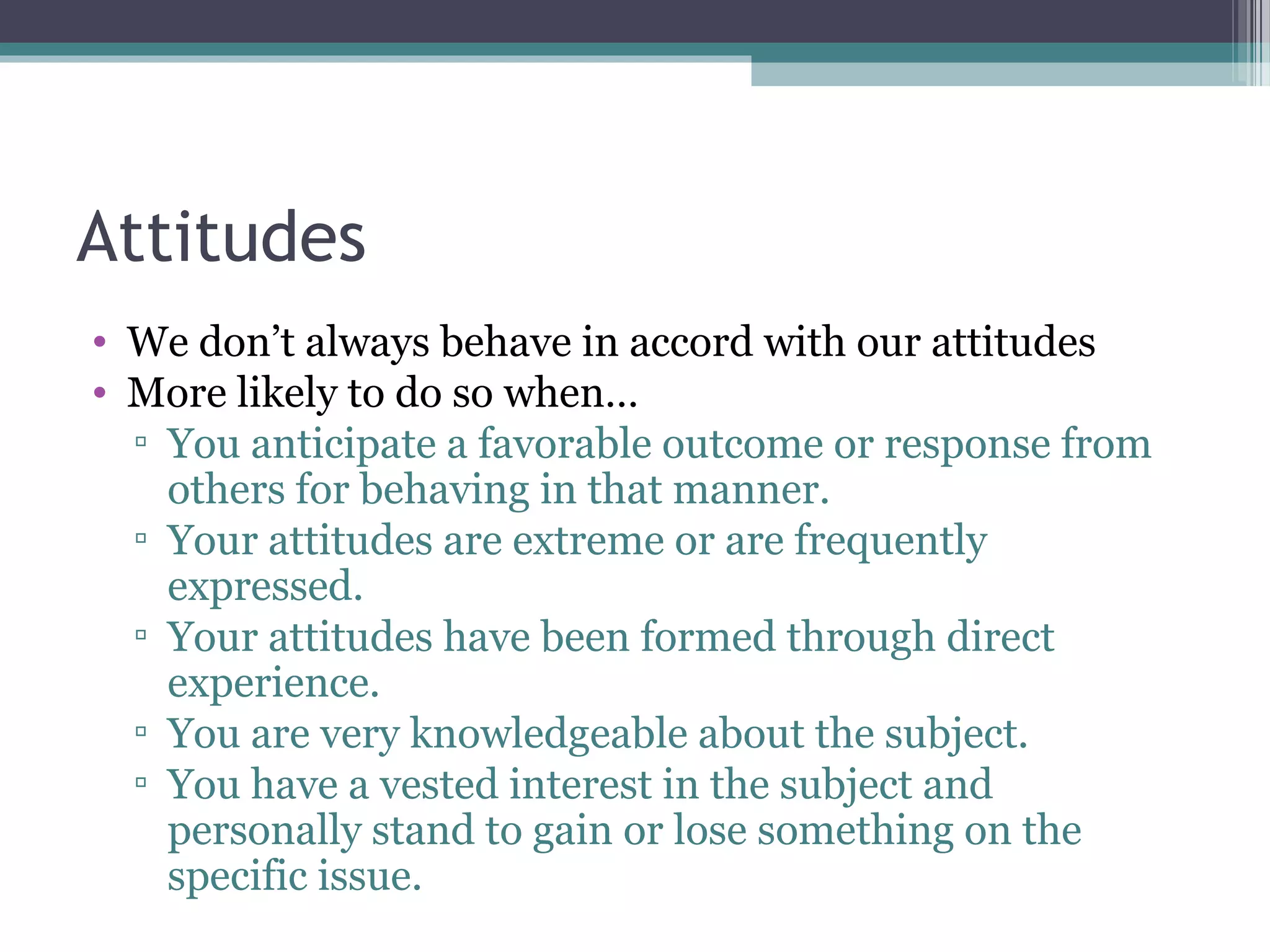
Attitudes
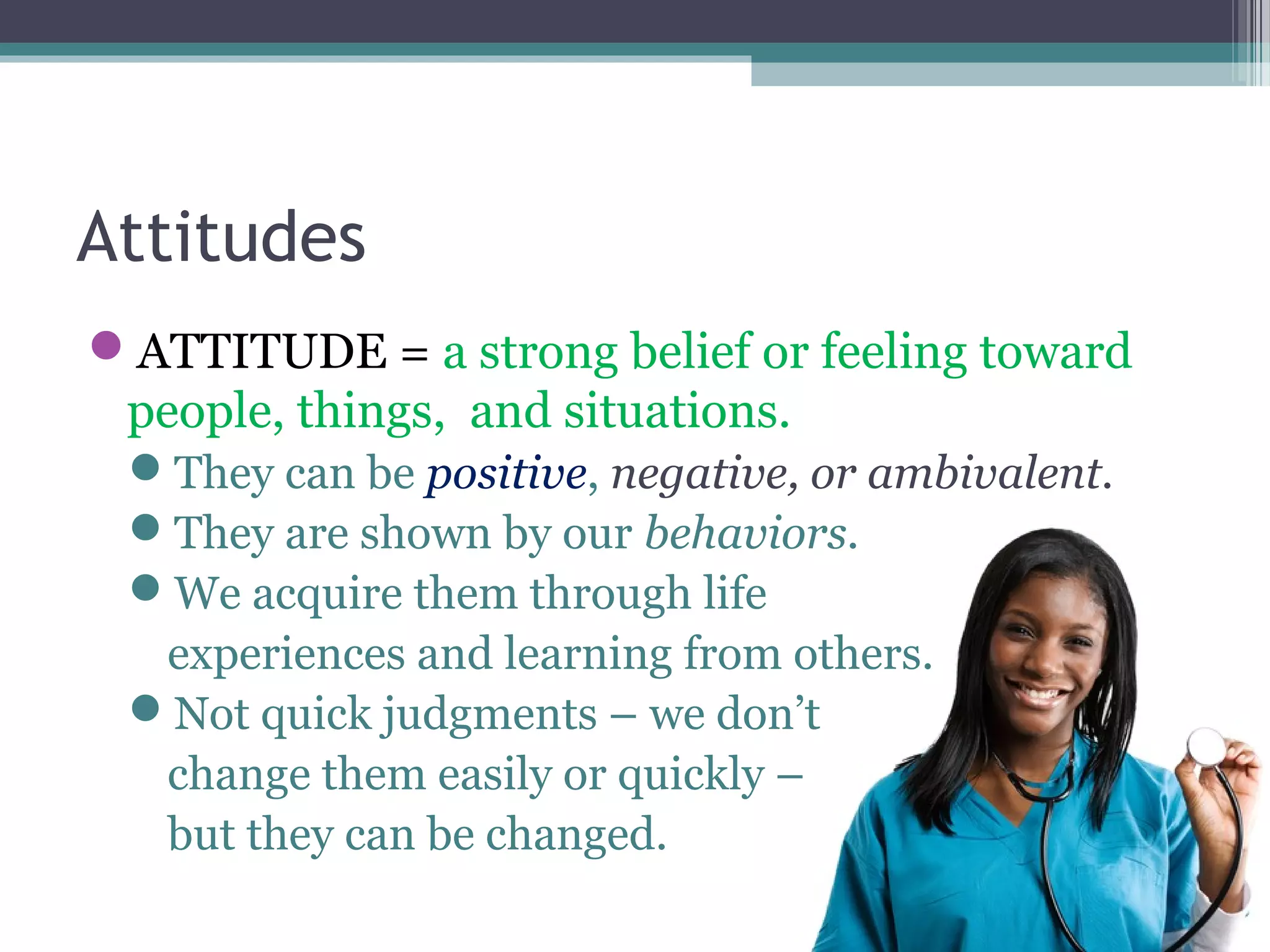
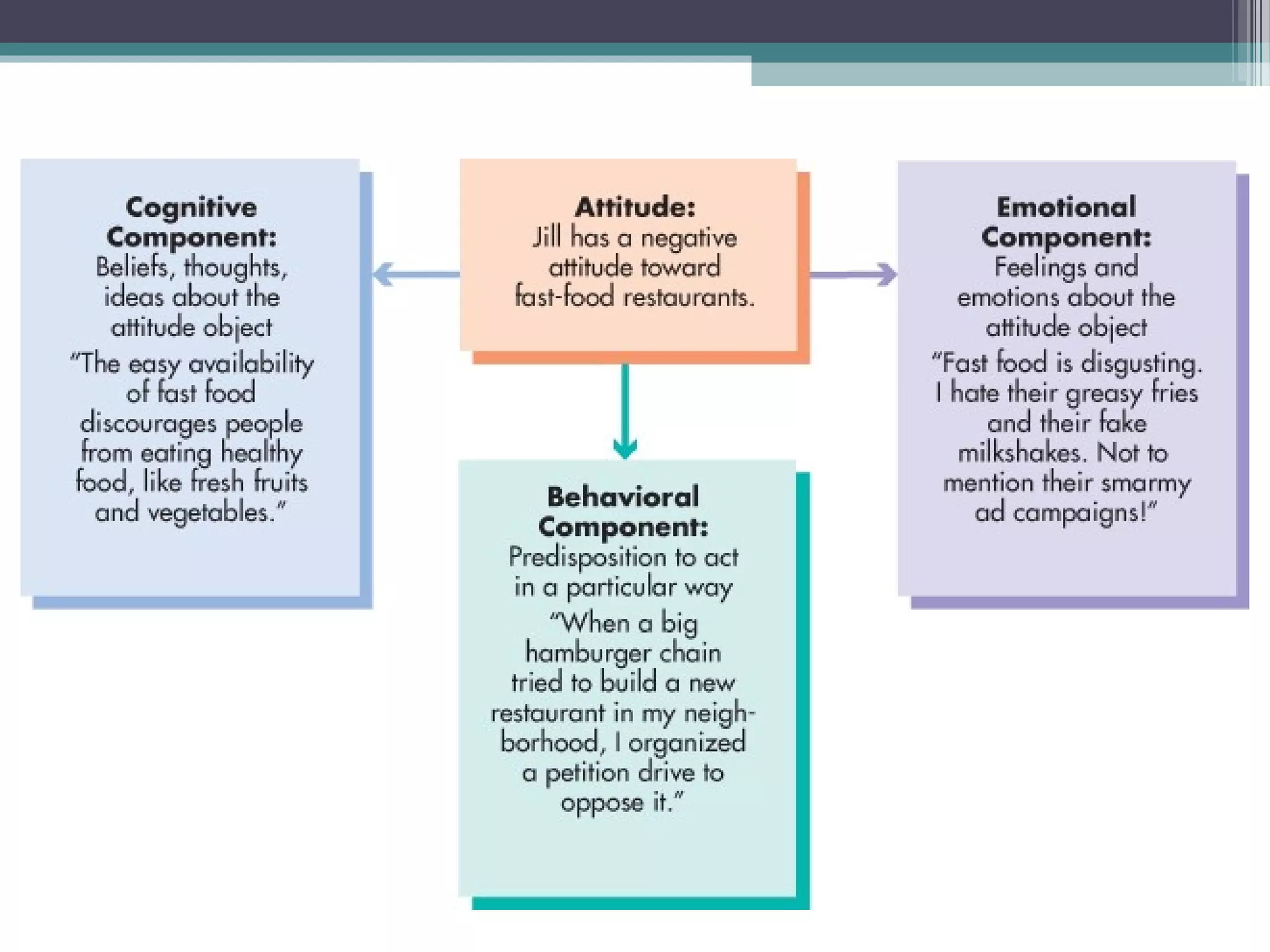
ATTITUDE = a strong belief or feeling toward
people, things, and situations.
They can be positive, negative, or ambivalent.
They are shown by our behaviors.
We acquire them through life
experiences and learning from others.
Not quick judgments – we don’t
change them easily or quickly –
but they can be changed.
Attitudes
• We don’t always behave in accord with our attitudes
• More likely to do so when…
▫ You anticipate a favorable outcome or response from
others for behaving in that manner.
▫ Your attitudes are extreme or are frequently
expressed.
▫ Your attitudes have been formed through direct
experience.
▫ You are very knowledgeable about the subject.
▫ You have a vested interest in the subject and
personally stand to gain or lose something on the
specific issue.
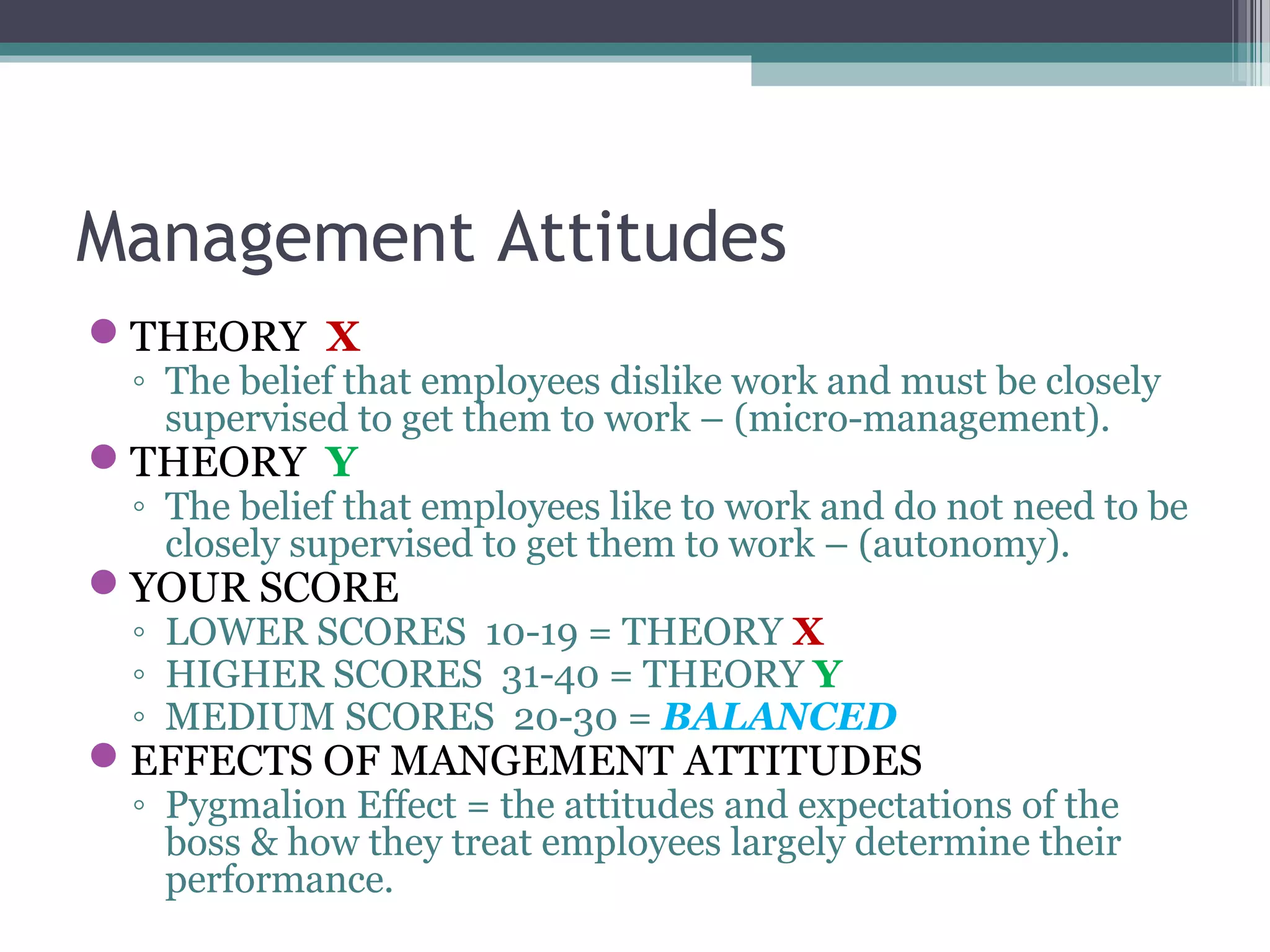
Management Attitudes
THEORY X
◦ The belief that employees dislike work and must be closely
supervised to get them to work – (micro-management).
THEORY Y
◦ The belief that employees like to work and do not need to be
closely supervised to get them to work – (autonomy).
YOUR SCORE
◦ LOWER SCORES 10-19 = THEORY X
◦ HIGHER SCORES 31-40 = THEORY Y
◦ MEDIUM SCORES 20-30 = BALANCED
EFFECTS OF MANGEMENT ATTITUDES
◦ Pygmalion Effect = the attitudes and expectations of the
boss & how they treat employees largely determine their
performance.
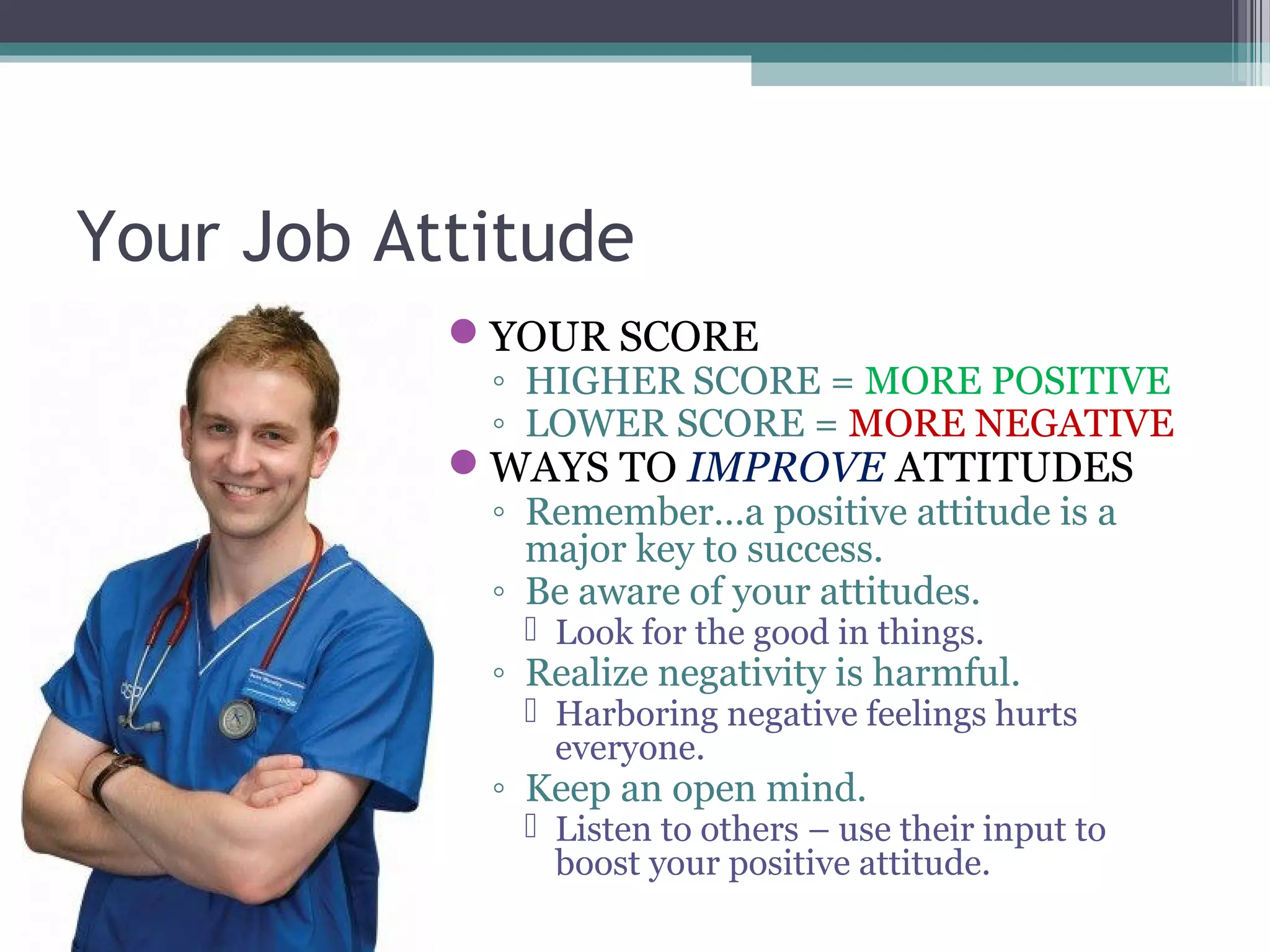
Your Job Attitude
YOUR SCORE
◦ HIGHER SCORE = MORE POSITIVE
◦ LOWER SCORE = MORE NEGATIVE
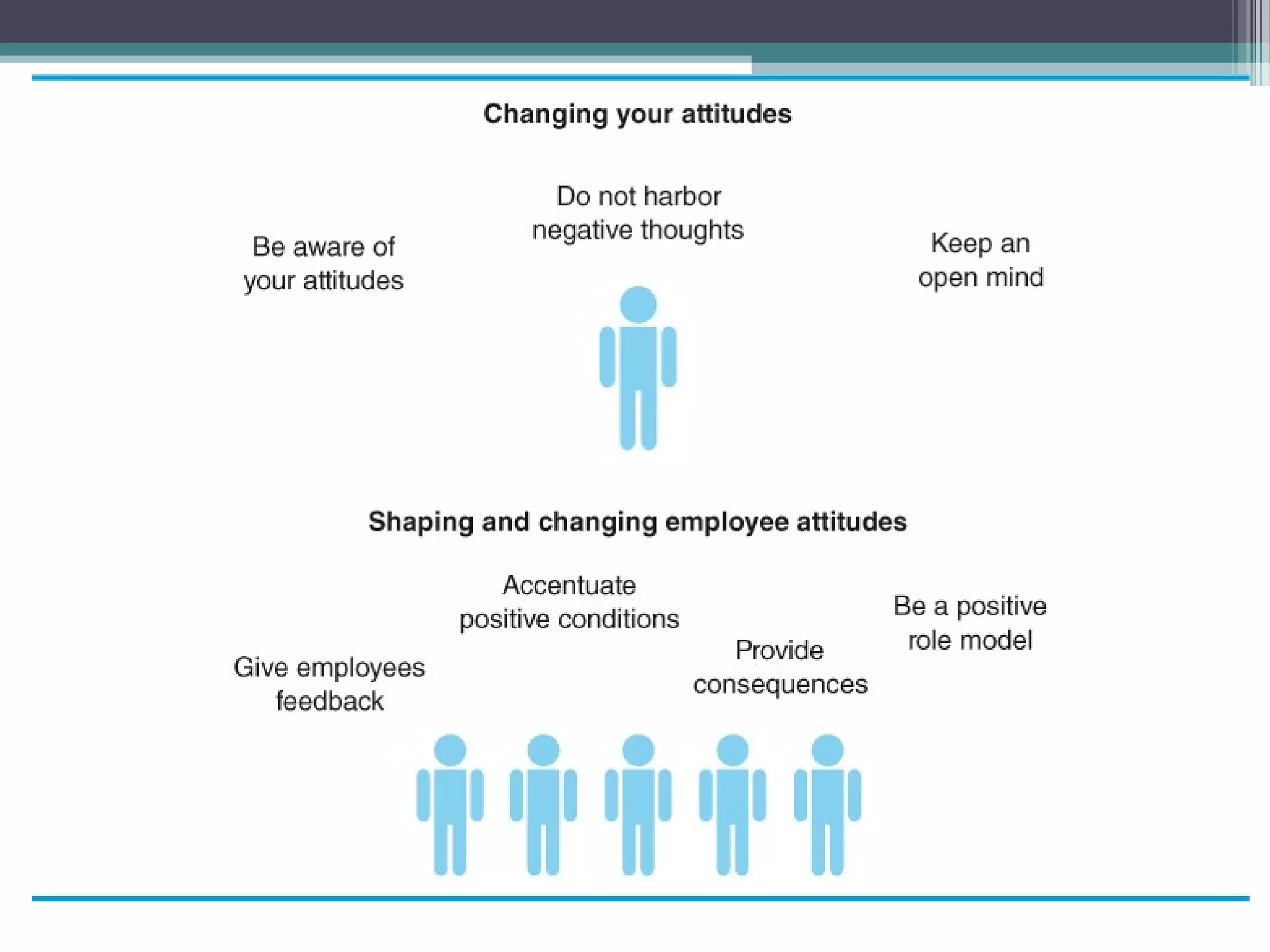
WAYS TO IMPROVE ATTITUDES
◦ Remember…a positive attitude is a
major key to success.
◦ Be aware of your attitudes.
 Look for the good in things.
◦ Realize negativity is harmful.
 Harboring negative feelings hurts
everyone.
◦ Keep an open mind.
 Listen to others – use their input to
boost your positive attitude.
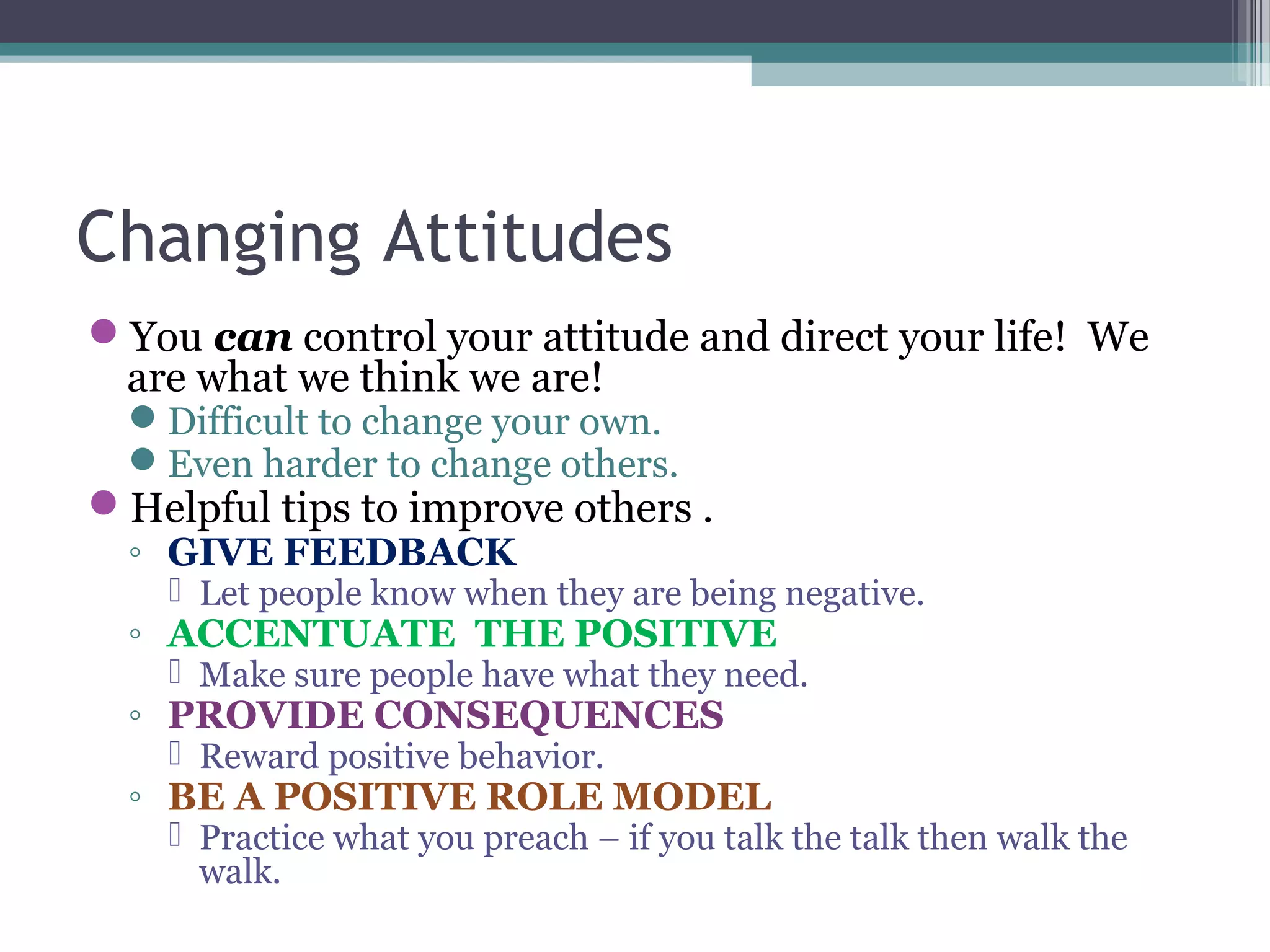
Changing Attitudes
You can control your attitude and direct your life! We
are what we think we are!
Difficult to change your own.
Even harder to change others.
Helpful tips to improve others .
◦ GIVE FEEDBACK
 Let people know when they are being negative.
◦ ACCENTUATE THE POSITIVE
 Make sure people have what they need.
◦ PROVIDE CONSEQUENCES
 Reward positive behavior.
◦ BE A POSITIVE ROLE MODEL
 Practice what you preach – if you talk the talk then walk the
walk.
Job Satisfaction
Is a set of attitudes toward work.
Satisfaction is what more people seek on the job –
over security or higher pay.
Satisfied people stay longer - are absent less & are
generally happier and better workers.
Job satisfaction surveys…
◦ Are a process of determining employee attitudes about
the job and work environment.
◦ Currently we see a decline in worker’s dedication,
attendance, and punctuality.
◦ Why do you think that is so?
◦ What are you looking for in a job?
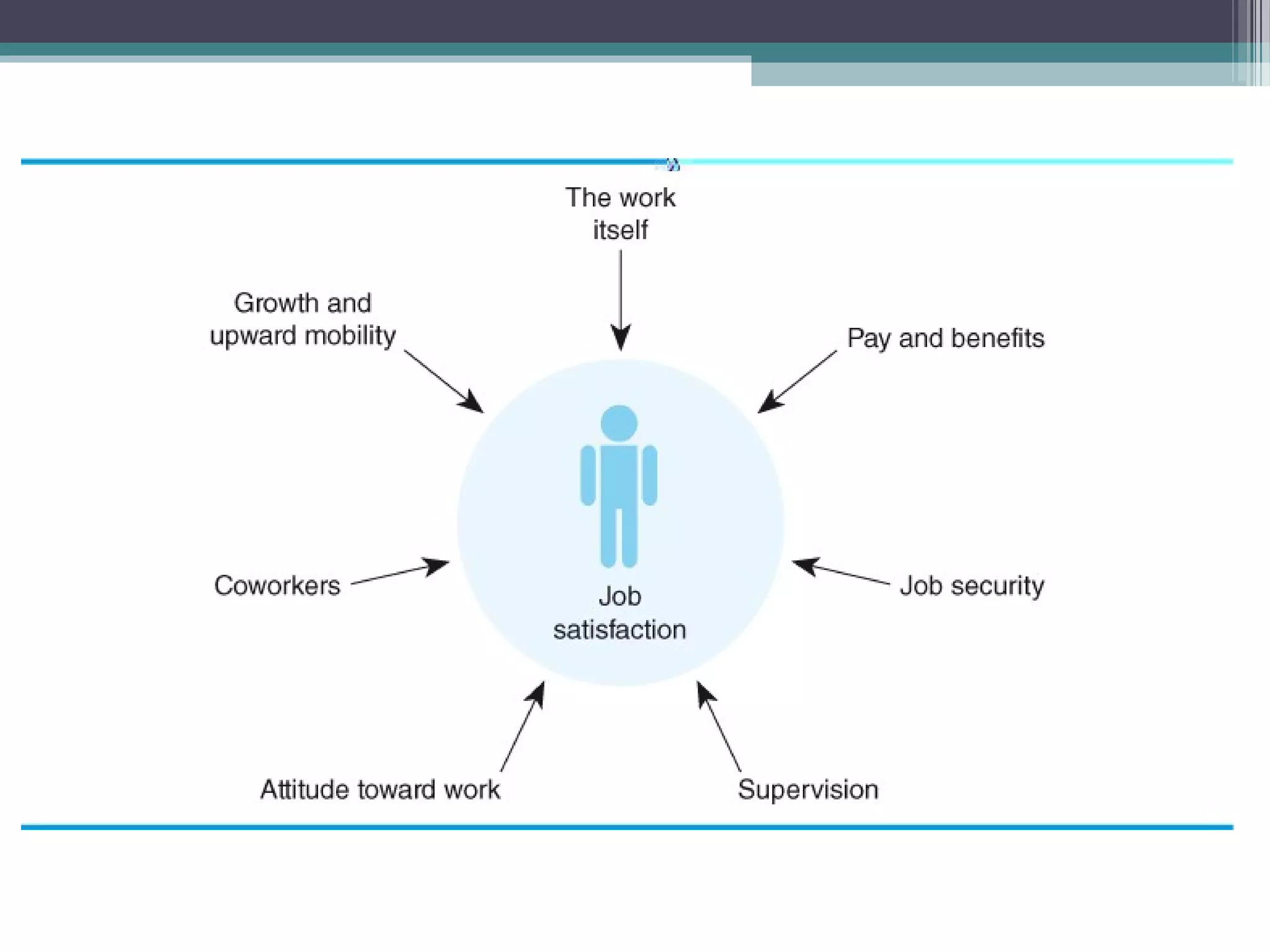
7 Important Factors in Job Satisfaction
 THE WORK ITSELF
◦ Do you think it is important – interesting – valuable to society?
 PAY & BENEFITS
◦ We need to feel valued – if we feel underpaid it leads to negative
behaviors – today’s issues of health care & faltering retirement
benefits play a big role in satisfaction.
 GROWTH & UPWARD MOBILITY
◦ Does it have a future – does it provide challenges for growth - raises –
promotions?
 SUPERVISION
◦ Personal relationship with boss – good or bad can impact.
 COWORKERS
◦ Relationship with co-workers – do you like the people you work with?
 JOB SECURITY
◦ During times of high unemployment – like now – stress about being
laid off can affect job satisfaction.
 ATTITUDE TOWARD JOB
◦ Is it something you love to do?
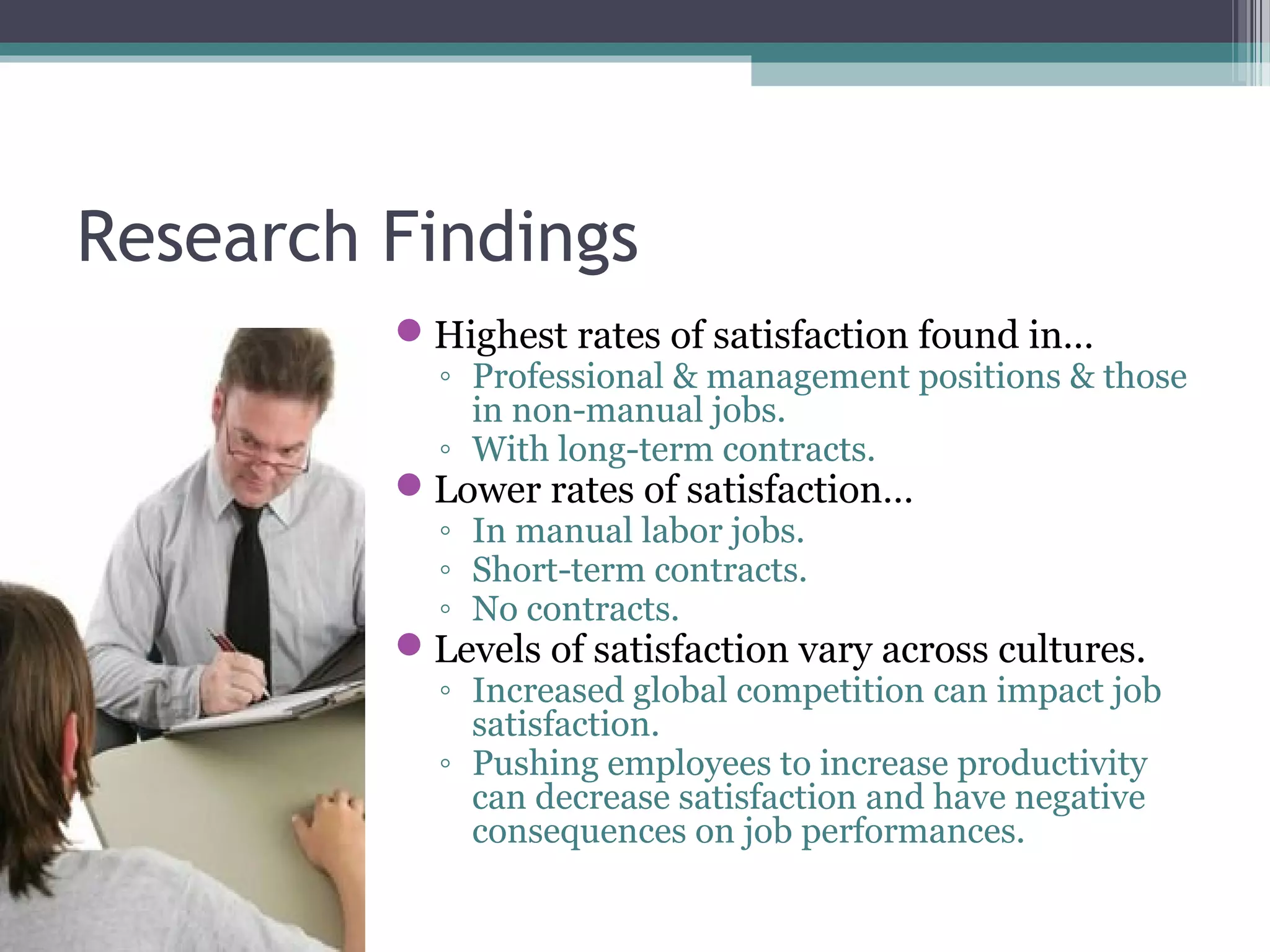
Research Findings
Highest rates of satisfaction found in…
◦ Professional & management positions & those
in non-manual jobs.
◦ With long-term contracts.
Lower rates of satisfaction…
◦ In manual labor jobs.
◦ Short-term contracts.
◦ No contracts.
Levels of satisfaction vary across cultures.
◦ Increased global competition can impact job
satisfaction.
◦ Pushing employees to increase productivity
can decrease satisfaction and have negative
consequences on job performances.
Self-Concept
• YOUR OVERALL ATTITUDE
ABOUT YOURSELF
▫ Do you like yourself?
▫ Do you think you are a valued person?
▫ Are you happy with the way you live
your life?
▫ Do believe you can meet the challenges in your life?
▫ Your thoughts & feelings about yourself have more
influence on your self-concept than your behaviors.
▫ Other people also influence your self-concept.
Self-Concept
• SELF-EFFICACY
▫ Your belief in your capability to perform
in a specific situation.
▫ Self-fulfilling prophecy
 Occurs when your expectations affect your SUCCESS
OR FAILURE.
• ATTRIBUTION
▫ One’s perception that the cause of behavior
is either internal or external.
▫ We do not really know the cause of someone’s
behavior – all we see is the result – the behavior.
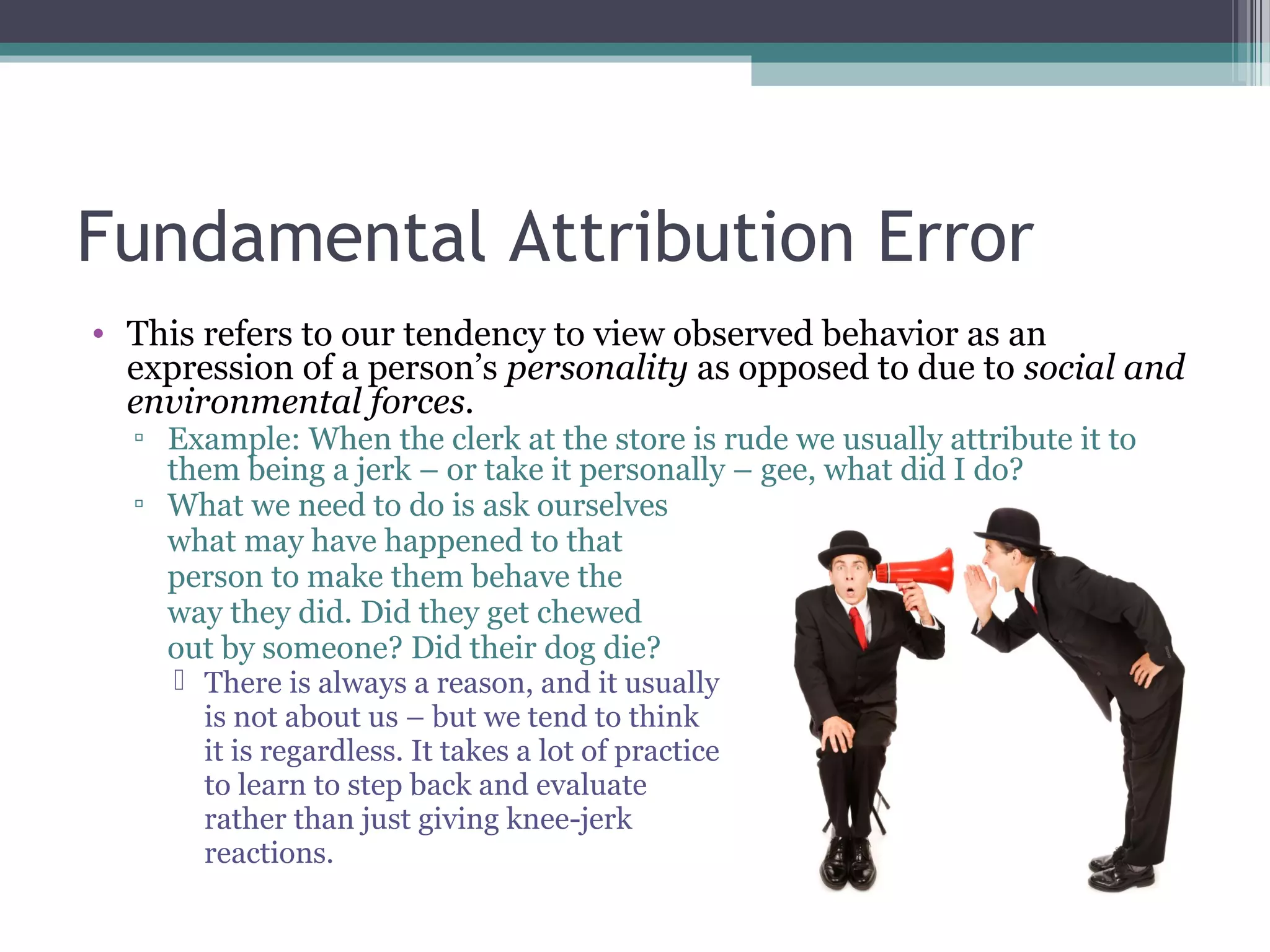
Fundamental Attribution Error
• This refers to our tendency to view observed behavior as an
expression of a person’s personality as opposed to due to social and
environmental forces.
▫ Example: When the clerk at the store is rude we usually attribute it to
them being a jerk – or take it personally – gee, what did I do?
▫ What we need to do is ask ourselves
what may have happened to that
person to make them behave the
way they did. Did they get chewed
out by someone? Did their dog die?
 There is always a reason, and it usually
is not about us – but we tend to think
it is regardless. It takes a lot of practice
to learn to step back and evaluate
rather than just giving knee-jerk
reactions.
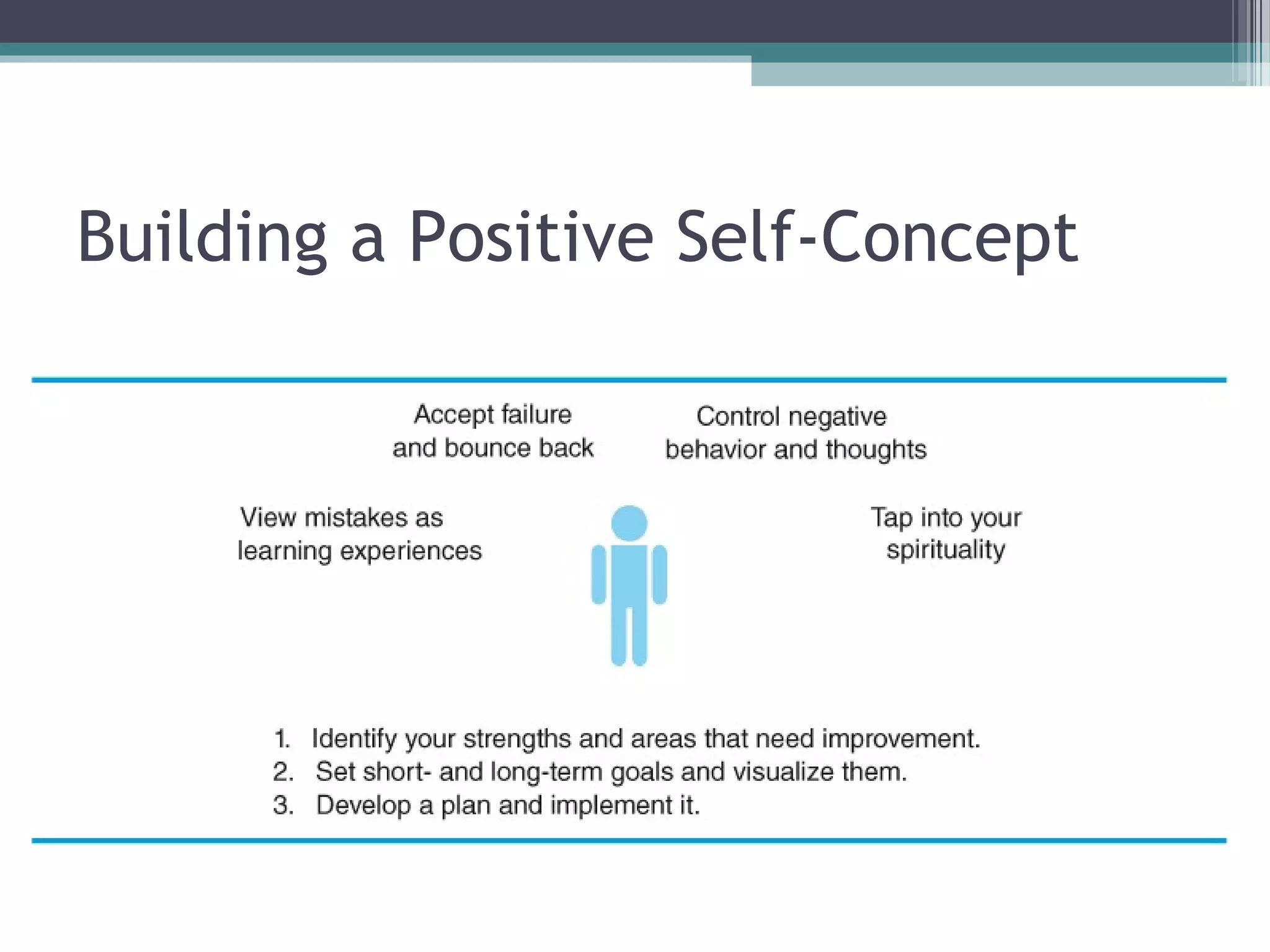
Building a Positive Self-Concept
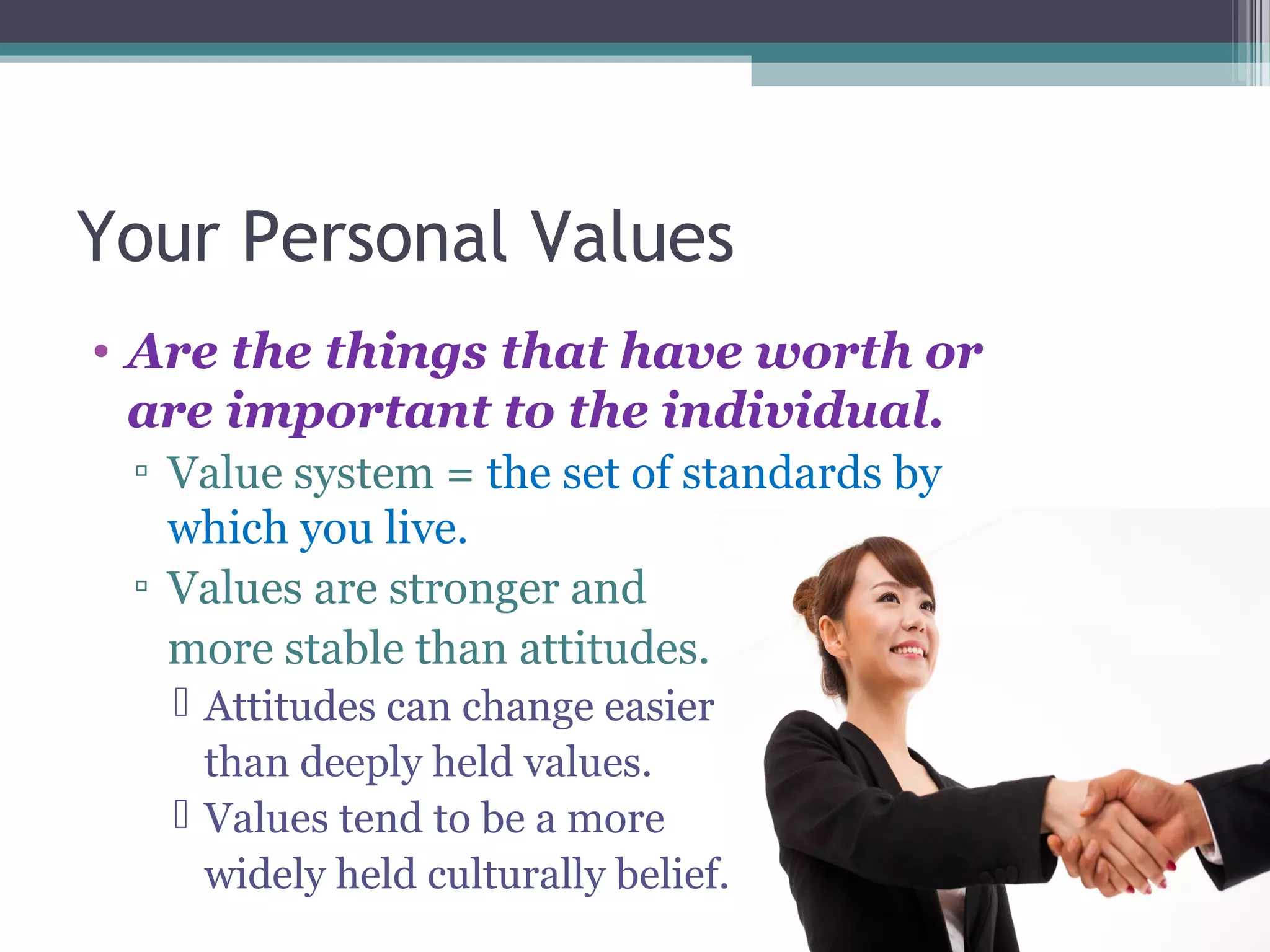
Your Personal Values
• Are the things that have worth or
are important to the individual.
▫ Value system = the set of standards by
which you live.
▫ Values are stronger and
more stable than attitudes.
 Attitudes can change easier
than deeply held values.
 Values tend to be a more
widely held culturally belief.
Spirituality in the Workplace
• Seeing your work as a spiritual path.
▫ Opportunity to grow & contribute in meaningful ways.
▫ Learning to be caring & compassionate toward others.
▫ Having integrity.
▫ Very individual and personal matter.
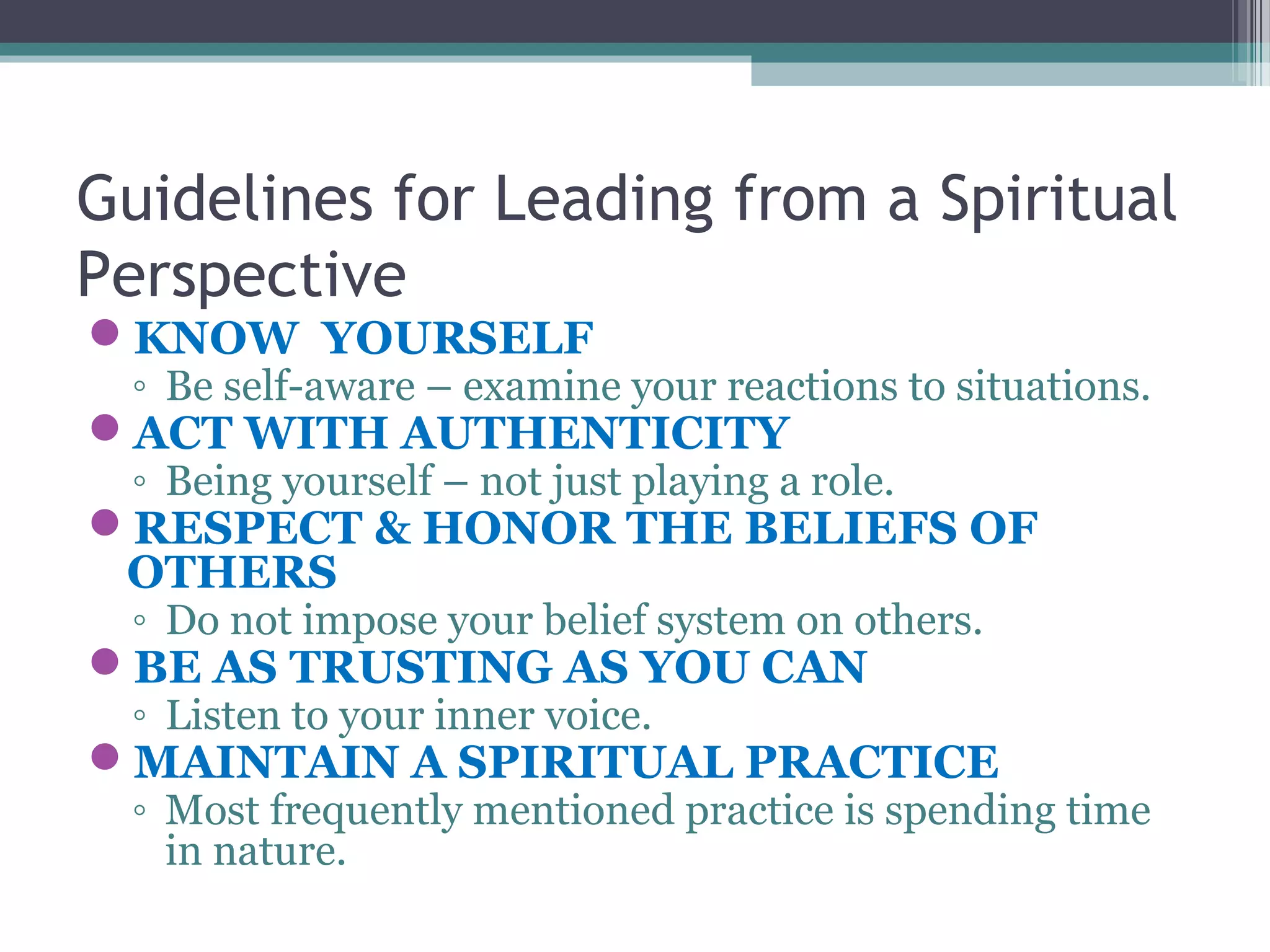
Guidelines for Leading from a Spiritual
Perspective
KNOW YOURSELF
◦ Be self-aware – examine your reactions to situations.
ACT WITH AUTHENTICITY
◦ Being yourself – not just playing a role.
RESPECT & HONOR THE BELIEFS OF
OTHERS
◦ Do not impose your belief system on others.
BE AS TRUSTING AS YOU CAN
◦ Listen to your inner voice.
MAINTAIN A SPIRITUAL PRACTICE
◦ Most frequently mentioned practice is spending time
in nature.
Ethics
The moral standard of right and wrong
behavior.
This instrument in the text is designed only to
make you more aware and get you thinking
about your own ethical conduct and that of
others around you.
◦ HIGHER SCORES = HIGHER ETHICS
◦ LOWER SCORES = LOWER ETHICS
Does ethical behavior pay?
APA Code of Ethics for Psychology
 http://www.apa.org/ethics/code/index.aspx?item=1
Personality, Attitudes, Situations,
& Ethical Behavior
Leaders with SURGENCY
◦ Two choices – help others or personal gain.
To gain power and be CONSCIENCIOUS
◦ High achievers will sometimes cut corners.
AGREEABLE personalities
◦ Will sometimes follow the crowd, even if wrong.
EMOTIONALLY UNSTABLE people
◦ And those with EXTERNAL locus of control are more likely
to be unethical.
People OPEN TO NEW EXPERIENCES
◦ Are most likely to behave ethically.
People with POSITIVE ATTITUDES
◦ Tend to also behave more ethically.
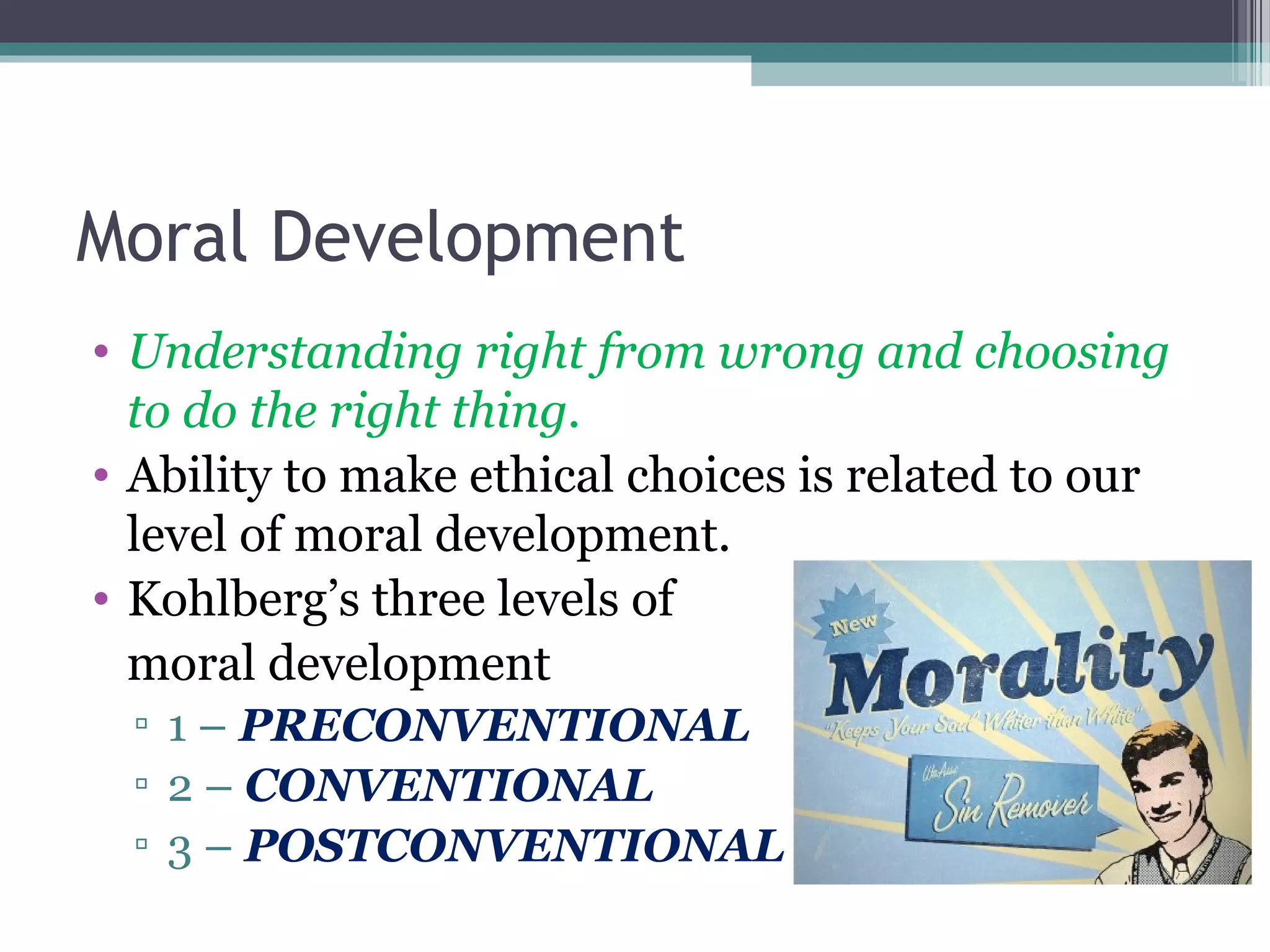
Moral Development
• Understanding right from wrong and choosing
to do the right thing.
• Ability to make ethical choices is related to our
level of moral development.
• Kohlberg’s three levels of
moral development
▫ 1 – PRECONVENTIONAL
▫ 2 – CONVENTIONAL
▫ 3 – POSTCONVENTIONAL
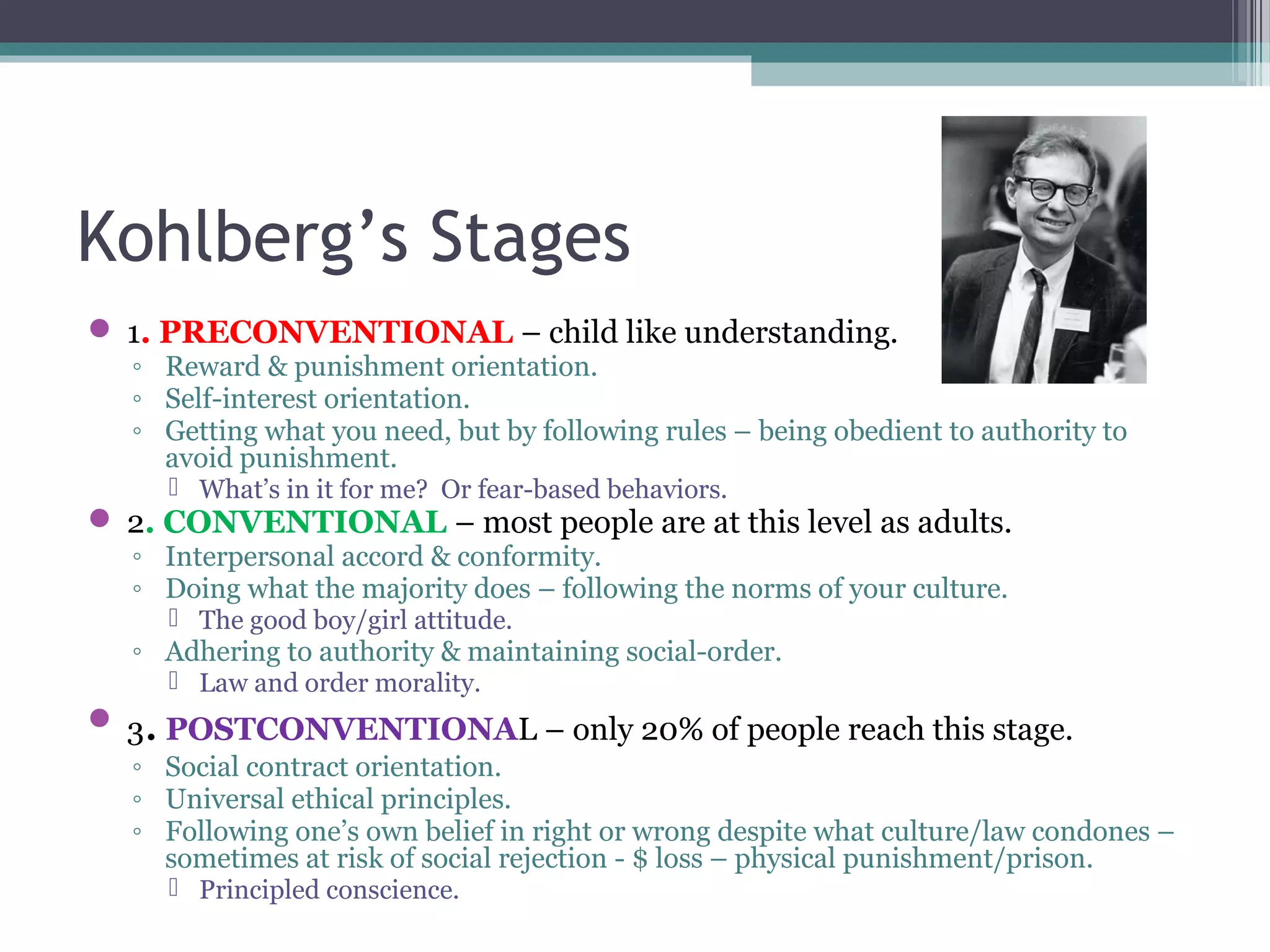
Kohlberg’s Stages
 1. PRECONVENTIONAL – child like understanding.
◦ Reward & punishment orientation.
◦ Self-interest orientation.
◦ Getting what you need, but by following rules – being obedient to authority to
avoid punishment.
 What’s in it for me? Or fear-based behaviors.
 2. CONVENTIONAL – most people are at this level as adults.
◦ Interpersonal accord & conformity.
◦ Doing what the majority does – following the norms of your culture.
 The good boy/girl attitude.
◦ Adhering to authority & maintaining social-order.
 Law and order morality.
 3. POSTCONVENTIONAL – only 20% of people reach this stage.
◦ Social contract orientation.
◦ Universal ethical principles.
◦ Following one’s own belief in right or wrong despite what culture/law condones –
sometimes at risk of social rejection - $ loss – physical punishment/prison.
 Principled conscience.
Heinz Dilemma
• A woman was near death from a special kind of cancer. There was
one drug that the doctors thought might save her. It was a form of
radium that a pharmacist in the same town had recently discovered.
The drug was expensive to make, but the druggist was charging ten
times what the drug cost him to produce. He paid $200.00 for the
radium and charged $2,000.00 for a small dose of the drug. The
sick woman’s husband, Heinz, went to everyone he knew to borrow
the money, but he could only get together about $1,000.00 which
was only half the cost. He told the pharmacist that his wife was
dying and asked him to sell it cheaper or let him pay later. But the
pharmacist said: “No, I discovered the drug and I’m going to make
money from it.” So Heinz got desperate and broke into the man’s lab
to steal the drug for his wife.
▫ SHOULD HEINZ HAVE BROKEN INTO THE LAB TO STEAL THE
DRUG FOR HIS WIFE? WHY OR WHY NOT?
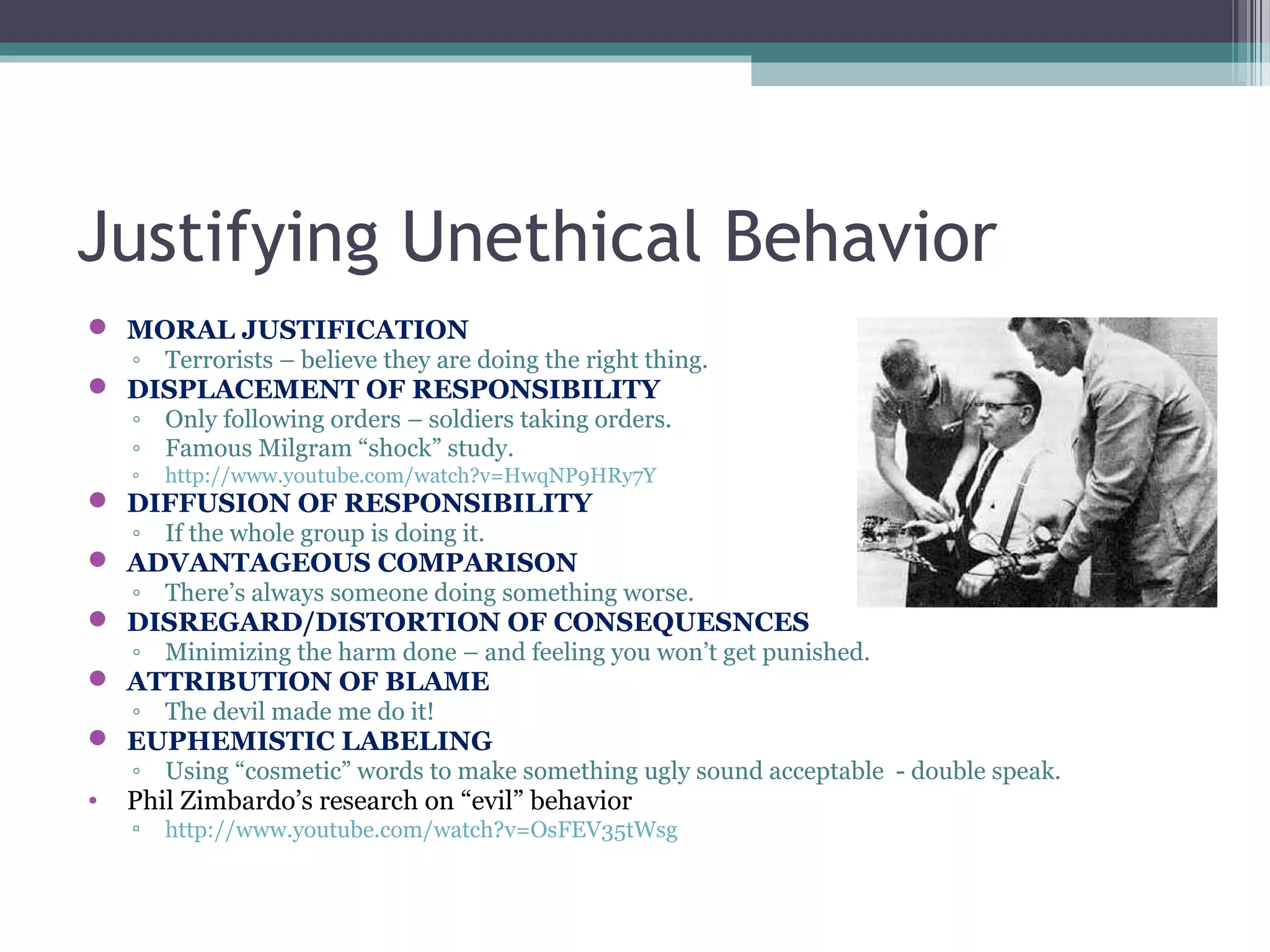
Justifying Unethical Behavior
 MORAL JUSTIFICATION
◦ Terrorists – believe they are doing the right thing.
 DISPLACEMENT OF RESPONSIBILITY
◦ Only following orders – soldiers taking orders.
◦ Famous Milgram “shock” study.
◦ http://www.youtube.com/watch?v=HwqNP9HRy7Y
 DIFFUSION OF RESPONSIBILITY
◦ If the whole group is doing it.
 ADVANTAGEOUS COMPARISON
◦ There’s always someone doing something worse.
 DISREGARD/DISTORTION OF CONSEQUESNCES
◦ Minimizing the harm done – and feeling you won’t get punished.
 ATTRIBUTION OF BLAME
◦ The devil made me do it!
 EUPHEMISTIC LABELING
◦ Using “cosmetic” words to make something ugly sound acceptable - double speak.
• Phil Zimbardo’s research on “evil” behavior
▫ http://www.youtube.com/watch?v=OsFEV35tWsg
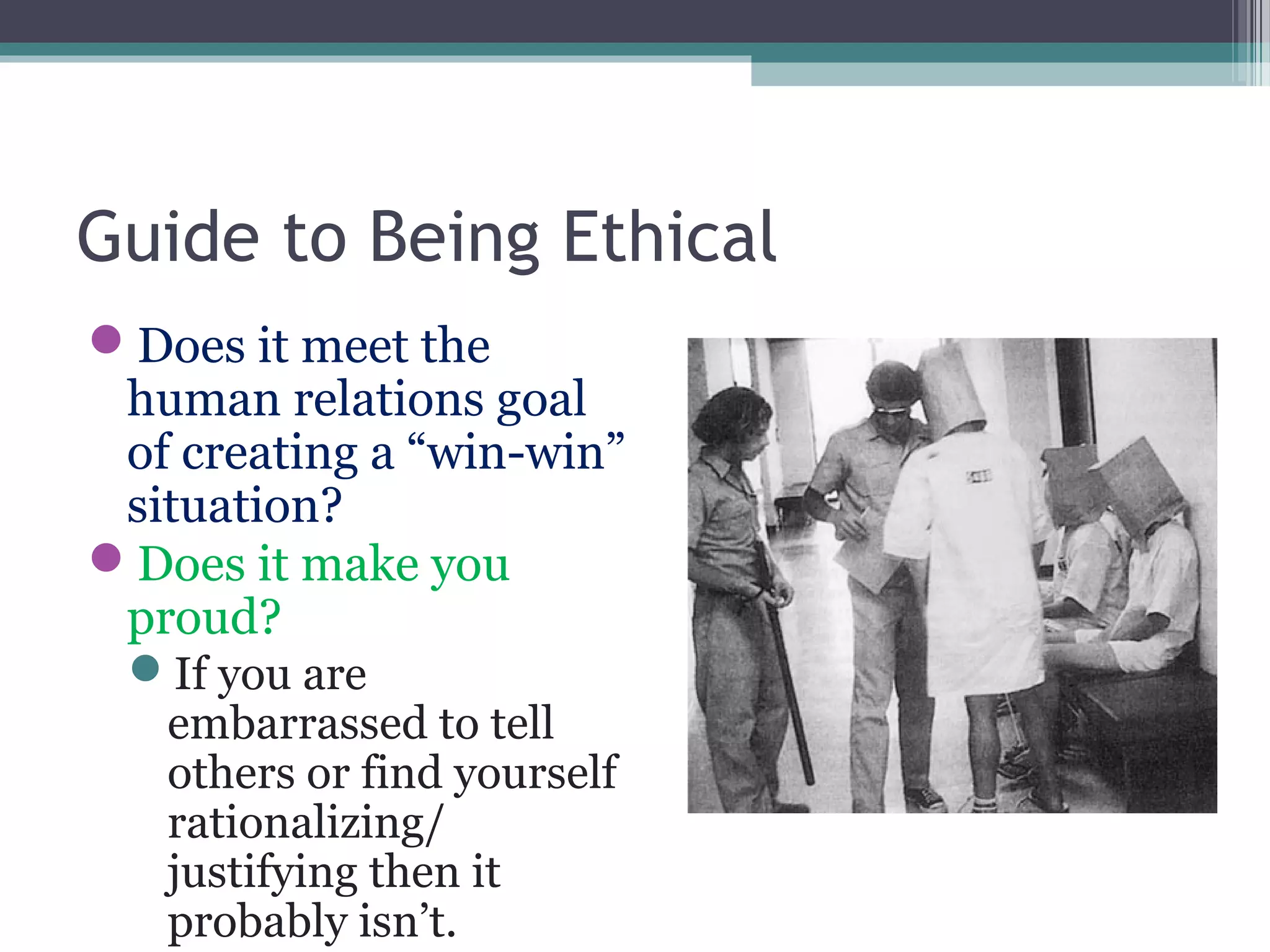
Guide to Being Ethical
Does it meet the
human relations goal
of creating a “win-win”
situation?
Does it make you
proud?
If you are
embarrassed to tell
others or find yourself
rationalizing/
justifying then it
probably isn’t.
Global Ethics
• Globalization presents challenges to
multinational corporations.
• Different countries have different levels and
standards of “ethical behaviors.”
▫ Relativism = decisions made based on the
standard of that country.
 Some countries think bribes are okay and are
common practice.
▫ Universalism = one standard fits all.
 We are striving to attain this standard.
Global Ethics
Summary of Key Concepts
• Attitudes
▫ Theory X & Theory Y
▫ Ways to change attitudes
• Job Satisfaction
• Self-Concept
▫ Self-efficacy
▫ Attributions
• Values
▫ Spiritual Leading
• Ethics
▫ Moral development
▫ Justifying unethical behavior
▫ Global ethics

PSY 126 Week 3: Attitudes, Self-Concept, Values, & Ethics

  • 1.
    Attitudes, Self-Concept, Values, &Ethics Matthew L. Eisenhard, Psy.D. Week 3: Psychology for Business & Industry
  • 2.
    In this chapterwe will… • Continue to focus on and develop INTRAPERSONAL skills that affect behavior, relationships, & performance ▫ ATTITUDES ▫ JOB SATISFACTION ▫ SELF-CONCEPT ▫ VALUES ▫ PERSONAL MORALS & ETHICS
  • 3.
    Attitudes ATTITUDE = astrong belief or feeling toward people, things, and situations. They can be positive, negative, or ambivalent. They are shown by our behaviors. We acquire them through life experiences and learning from others. Not quick judgments – we don’t change them easily or quickly – but they can be changed.
  • 5.
    Attitudes • We don’talways behave in accord with our attitudes • More likely to do so when… ▫ You anticipate a favorable outcome or response from others for behaving in that manner. ▫ Your attitudes are extreme or are frequently expressed. ▫ Your attitudes have been formed through direct experience. ▫ You are very knowledgeable about the subject. ▫ You have a vested interest in the subject and personally stand to gain or lose something on the specific issue.
  • 6.
    Management Attitudes THEORY X ◦The belief that employees dislike work and must be closely supervised to get them to work – (micro-management). THEORY Y ◦ The belief that employees like to work and do not need to be closely supervised to get them to work – (autonomy). YOUR SCORE ◦ LOWER SCORES 10-19 = THEORY X ◦ HIGHER SCORES 31-40 = THEORY Y ◦ MEDIUM SCORES 20-30 = BALANCED EFFECTS OF MANGEMENT ATTITUDES ◦ Pygmalion Effect = the attitudes and expectations of the boss & how they treat employees largely determine their performance.
  • 7.
    Your Job Attitude YOURSCORE ◦ HIGHER SCORE = MORE POSITIVE ◦ LOWER SCORE = MORE NEGATIVE WAYS TO IMPROVE ATTITUDES ◦ Remember…a positive attitude is a major key to success. ◦ Be aware of your attitudes.  Look for the good in things. ◦ Realize negativity is harmful.  Harboring negative feelings hurts everyone. ◦ Keep an open mind.  Listen to others – use their input to boost your positive attitude.
  • 8.
    Changing Attitudes You cancontrol your attitude and direct your life! We are what we think we are! Difficult to change your own. Even harder to change others. Helpful tips to improve others . ◦ GIVE FEEDBACK  Let people know when they are being negative. ◦ ACCENTUATE THE POSITIVE  Make sure people have what they need. ◦ PROVIDE CONSEQUENCES  Reward positive behavior. ◦ BE A POSITIVE ROLE MODEL  Practice what you preach – if you talk the talk then walk the walk.
  • 10.
    Job Satisfaction Is aset of attitudes toward work. Satisfaction is what more people seek on the job – over security or higher pay. Satisfied people stay longer - are absent less & are generally happier and better workers. Job satisfaction surveys… ◦ Are a process of determining employee attitudes about the job and work environment. ◦ Currently we see a decline in worker’s dedication, attendance, and punctuality. ◦ Why do you think that is so? ◦ What are you looking for in a job?
  • 12.
    7 Important Factorsin Job Satisfaction  THE WORK ITSELF ◦ Do you think it is important – interesting – valuable to society?  PAY & BENEFITS ◦ We need to feel valued – if we feel underpaid it leads to negative behaviors – today’s issues of health care & faltering retirement benefits play a big role in satisfaction.  GROWTH & UPWARD MOBILITY ◦ Does it have a future – does it provide challenges for growth - raises – promotions?  SUPERVISION ◦ Personal relationship with boss – good or bad can impact.  COWORKERS ◦ Relationship with co-workers – do you like the people you work with?  JOB SECURITY ◦ During times of high unemployment – like now – stress about being laid off can affect job satisfaction.  ATTITUDE TOWARD JOB ◦ Is it something you love to do?
  • 13.
    Research Findings Highest ratesof satisfaction found in… ◦ Professional & management positions & those in non-manual jobs. ◦ With long-term contracts. Lower rates of satisfaction… ◦ In manual labor jobs. ◦ Short-term contracts. ◦ No contracts. Levels of satisfaction vary across cultures. ◦ Increased global competition can impact job satisfaction. ◦ Pushing employees to increase productivity can decrease satisfaction and have negative consequences on job performances.
  • 14.
    Self-Concept • YOUR OVERALLATTITUDE ABOUT YOURSELF ▫ Do you like yourself? ▫ Do you think you are a valued person? ▫ Are you happy with the way you live your life? ▫ Do believe you can meet the challenges in your life? ▫ Your thoughts & feelings about yourself have more influence on your self-concept than your behaviors. ▫ Other people also influence your self-concept.
  • 15.
    Self-Concept • SELF-EFFICACY ▫ Yourbelief in your capability to perform in a specific situation. ▫ Self-fulfilling prophecy  Occurs when your expectations affect your SUCCESS OR FAILURE. • ATTRIBUTION ▫ One’s perception that the cause of behavior is either internal or external. ▫ We do not really know the cause of someone’s behavior – all we see is the result – the behavior.
  • 16.
    Fundamental Attribution Error •This refers to our tendency to view observed behavior as an expression of a person’s personality as opposed to due to social and environmental forces. ▫ Example: When the clerk at the store is rude we usually attribute it to them being a jerk – or take it personally – gee, what did I do? ▫ What we need to do is ask ourselves what may have happened to that person to make them behave the way they did. Did they get chewed out by someone? Did their dog die?  There is always a reason, and it usually is not about us – but we tend to think it is regardless. It takes a lot of practice to learn to step back and evaluate rather than just giving knee-jerk reactions.
  • 17.
    Building a PositiveSelf-Concept
  • 18.
    Your Personal Values •Are the things that have worth or are important to the individual. ▫ Value system = the set of standards by which you live. ▫ Values are stronger and more stable than attitudes.  Attitudes can change easier than deeply held values.  Values tend to be a more widely held culturally belief.
  • 19.
    Spirituality in theWorkplace • Seeing your work as a spiritual path. ▫ Opportunity to grow & contribute in meaningful ways. ▫ Learning to be caring & compassionate toward others. ▫ Having integrity. ▫ Very individual and personal matter.
  • 20.
    Guidelines for Leadingfrom a Spiritual Perspective KNOW YOURSELF ◦ Be self-aware – examine your reactions to situations. ACT WITH AUTHENTICITY ◦ Being yourself – not just playing a role. RESPECT & HONOR THE BELIEFS OF OTHERS ◦ Do not impose your belief system on others. BE AS TRUSTING AS YOU CAN ◦ Listen to your inner voice. MAINTAIN A SPIRITUAL PRACTICE ◦ Most frequently mentioned practice is spending time in nature.
  • 21.
    Ethics The moral standardof right and wrong behavior. This instrument in the text is designed only to make you more aware and get you thinking about your own ethical conduct and that of others around you. ◦ HIGHER SCORES = HIGHER ETHICS ◦ LOWER SCORES = LOWER ETHICS Does ethical behavior pay? APA Code of Ethics for Psychology  http://www.apa.org/ethics/code/index.aspx?item=1
  • 22.
    Personality, Attitudes, Situations, &Ethical Behavior Leaders with SURGENCY ◦ Two choices – help others or personal gain. To gain power and be CONSCIENCIOUS ◦ High achievers will sometimes cut corners. AGREEABLE personalities ◦ Will sometimes follow the crowd, even if wrong. EMOTIONALLY UNSTABLE people ◦ And those with EXTERNAL locus of control are more likely to be unethical. People OPEN TO NEW EXPERIENCES ◦ Are most likely to behave ethically. People with POSITIVE ATTITUDES ◦ Tend to also behave more ethically.
  • 23.
    Moral Development • Understandingright from wrong and choosing to do the right thing. • Ability to make ethical choices is related to our level of moral development. • Kohlberg’s three levels of moral development ▫ 1 – PRECONVENTIONAL ▫ 2 – CONVENTIONAL ▫ 3 – POSTCONVENTIONAL
  • 24.
    Kohlberg’s Stages  1.PRECONVENTIONAL – child like understanding. ◦ Reward & punishment orientation. ◦ Self-interest orientation. ◦ Getting what you need, but by following rules – being obedient to authority to avoid punishment.  What’s in it for me? Or fear-based behaviors.  2. CONVENTIONAL – most people are at this level as adults. ◦ Interpersonal accord & conformity. ◦ Doing what the majority does – following the norms of your culture.  The good boy/girl attitude. ◦ Adhering to authority & maintaining social-order.  Law and order morality.  3. POSTCONVENTIONAL – only 20% of people reach this stage. ◦ Social contract orientation. ◦ Universal ethical principles. ◦ Following one’s own belief in right or wrong despite what culture/law condones – sometimes at risk of social rejection - $ loss – physical punishment/prison.  Principled conscience.
  • 25.
    Heinz Dilemma • Awoman was near death from a special kind of cancer. There was one drug that the doctors thought might save her. It was a form of radium that a pharmacist in the same town had recently discovered. The drug was expensive to make, but the druggist was charging ten times what the drug cost him to produce. He paid $200.00 for the radium and charged $2,000.00 for a small dose of the drug. The sick woman’s husband, Heinz, went to everyone he knew to borrow the money, but he could only get together about $1,000.00 which was only half the cost. He told the pharmacist that his wife was dying and asked him to sell it cheaper or let him pay later. But the pharmacist said: “No, I discovered the drug and I’m going to make money from it.” So Heinz got desperate and broke into the man’s lab to steal the drug for his wife. ▫ SHOULD HEINZ HAVE BROKEN INTO THE LAB TO STEAL THE DRUG FOR HIS WIFE? WHY OR WHY NOT?
  • 26.
    Justifying Unethical Behavior MORAL JUSTIFICATION ◦ Terrorists – believe they are doing the right thing.  DISPLACEMENT OF RESPONSIBILITY ◦ Only following orders – soldiers taking orders. ◦ Famous Milgram “shock” study. ◦ http://www.youtube.com/watch?v=HwqNP9HRy7Y  DIFFUSION OF RESPONSIBILITY ◦ If the whole group is doing it.  ADVANTAGEOUS COMPARISON ◦ There’s always someone doing something worse.  DISREGARD/DISTORTION OF CONSEQUESNCES ◦ Minimizing the harm done – and feeling you won’t get punished.  ATTRIBUTION OF BLAME ◦ The devil made me do it!  EUPHEMISTIC LABELING ◦ Using “cosmetic” words to make something ugly sound acceptable - double speak. • Phil Zimbardo’s research on “evil” behavior ▫ http://www.youtube.com/watch?v=OsFEV35tWsg
  • 27.
    Guide to BeingEthical Does it meet the human relations goal of creating a “win-win” situation? Does it make you proud? If you are embarrassed to tell others or find yourself rationalizing/ justifying then it probably isn’t.
  • 28.
    Global Ethics • Globalizationpresents challenges to multinational corporations. • Different countries have different levels and standards of “ethical behaviors.” ▫ Relativism = decisions made based on the standard of that country.  Some countries think bribes are okay and are common practice. ▫ Universalism = one standard fits all.  We are striving to attain this standard.
  • 29.
  • 30.
    Summary of KeyConcepts • Attitudes ▫ Theory X & Theory Y ▫ Ways to change attitudes • Job Satisfaction • Self-Concept ▫ Self-efficacy ▫ Attributions • Values ▫ Spiritual Leading • Ethics ▫ Moral development ▫ Justifying unethical behavior ▫ Global ethics