

Pseudomonas
Dr Kamlesh Patel
MBBS MD DCP
Asst Prof, Microbiology, SAIMS
Founder director, www.jaailab.com
Pseudomonas
• Aerobic,
• Non spore forming
• Gram negative bacilli
• Causing opportunistic infections in human, animals,
plants and insects.
• Common species responsible for human infections are:
– Pseudomonas aeruginosa,
– Burkholderia
– Stenotropomonas
Pseudomonas aeruginosa
• Aerobic, GNB
• Size 1.5- 3 microns x 1.5microns.
• Motile by polar Flagella.
• Found In nature water, soil, other moist
Environments
• Common cause of nosocomial infections
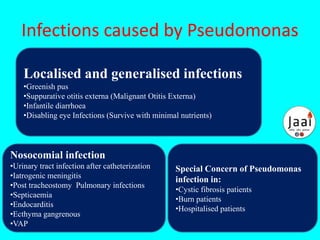
Infections caused by Pseudomonas
Localised and generalised infections
•Greenish pus
•Suppurative otitis externa (Malignant Otitis Externa)
•Infantile diarrhoea
•Disabling eye Infections (Survive with minimal nutrients)
Nosocomial infection
•Urinary tract infection after catheterization
•Iatrogenic meningitis
•Post tracheostomy Pulmonary infections
•Septicaemia
•Endocarditis
•Ecthyma gangrenous
•VAP
Special Concern of Pseudomonas
infection in:
•Cystic fibrosis patients
•Burn patients
•Hospitalised patients
Greenish pus
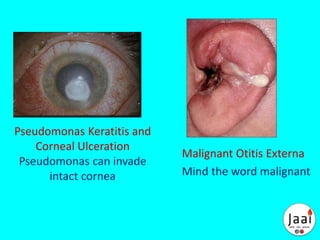
Pseudomonas Keratitis and
Corneal Ulceration
Pseudomonas can invade
intact cornea
Malignant Otitis Externa
Mind the word malignant
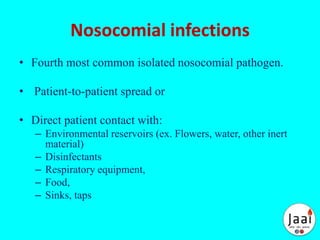
Nosocomial infections
• Fourth most common isolated nosocomial pathogen.
• Patient-to-patient spread or
• Direct patient contact with:
– Environmental reservoirs (ex. Flowers, water, other inert
material)
– Disinfectants
– Respiratory equipment,
– Food,
– Sinks, taps
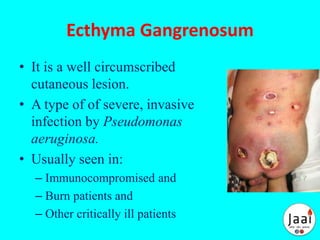
Ecthyma Gangrenosum
• It is a well circumscribed
cutaneous lesion.
• A type of of severe, invasive
infection by Pseudomonas
aeruginosa.
• Usually seen in:
– Immunocompromised and
– Burn patients and
– Other critically ill patients
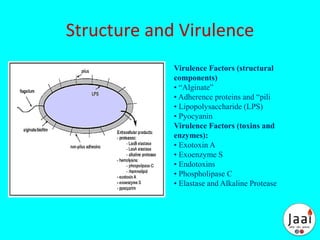
Structure and Virulence
Virulence Factors (structural
components)
• “Alginate”
• Adherence proteins and “pili
• Lipopolysaccharide (LPS)
• Pyocyanin
Virulence Factors (toxins and
enzymes):
• Exotoxin A
• Exoenzyme S
• Endotoxins
• Phospholipase C
• Elastase and Alkaline Protease
Mechanism of pathogenesis
Adhesion
– Pile, flagella and fimbriae
Invasion
– Extracellular enzymes and toxins (proteases, elastase,
phospholipases, Exotoxin A)
Dissemination
– Leukocidin, inhibits neutrophils und leukocytes
Protection
– Capsule (Alginate): Mucoid strain specially causes infection in
Cystic fibrosis patients.
Diagnosis
• Samples:
– Urine
– Pus
– Sputum
– Implant
– Swab
• Like any other infections by bacteria the modes of diagnosis
are same:
1. Microscopy: Gram stain, Motility.
2. Culture and Sensitivity (C/S).
3. Serological evaluation of toxins and enzymes or antigens.
4. Molecular diagnosis.
1. Microscopy
• Gram Stain:??
• Motility:??
Culture and Sensitivity
Growth requirements:
• Obligate aerobe, Wide range of temperature 5°c- 42°c, optimum 37°c
• Can grow anywhere even in antiseptic solutions. (Hence, no special requirements)
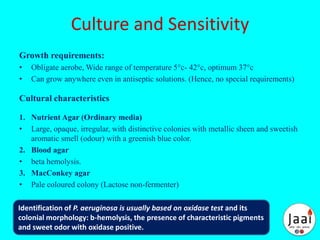
Cultural characteristics
1. Nutrient Agar (Ordinary media)
• Large, opaque, irregular, with distinctive colonies with metallic sheen and sweetish
aromatic smell (odour) with a greenish blue color.
2. Blood agar
• beta hemolysis.
3. MacConkey agar
• Pale coloured colony (Lactose non-fermenter)
Identification of P. aeruginosa is usually based on oxidase test and its
colonial morphology: b-hemolysis, the presence of characteristic pigments
and sweet odor with oxidase positive.
Pigments
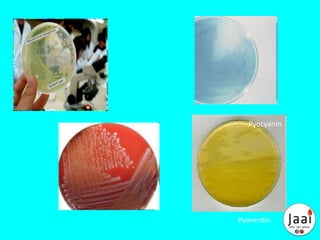
Pyocyanin
– Bluish green phenazine pigment
– Soluble in chloroform and water
– Only produced by P aeruginosa
Pyoverdin(fluorescein)
– It is a greenish yellow pigment
– Insoluble in chloroform but soluble in water
– Produced by many other species (ex. P aeruginosa and P putida)
Pyorubin
– Reddish brown pigment
– Insoluble in chloroform but soluble in water
pyomelanin
– Brown to black pigment
– Production is uncommon
Pyocyanin
Pyoverdin
Biochemical reaction
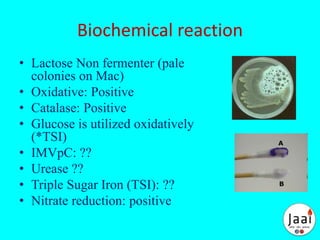
• Lactose Non fermenter (pale
colonies on Mac)
• Oxidative: Positive
• Catalase: Positive
• Glucose is utilized oxidatively
(*TSI)
• IMVpC: ??
• Urease ??
• Triple Sugar Iron (TSI): ??
• Nitrate reduction: positive
Sensitivity
• High resistance to chemical agents like:
– Quaternary ammonium compounds.Chlor-xylenol
– Resistant to Hexachlorophenes
– Hence, can grow in antiseptic bottles
• Sensitive to acids silver salts, beta glutaraldehyde
Antibiotic Sensitivity
• Pseudomonas aeruginosa a resistant
pathogen
– resistant to many commonly used antibiotics.
– List of antipseudomonal antibiotics
– Although many strains are susceptible to
gentamicin, tobramycin, colistin, and amikacin,
resistant forms have developed.
– The combination of gentamicin and carbenicillin
is frequently used to treat severe Pseudomonas
infections.
www.jaailab.com
Thank you

Pseudomonas aeruginosa [autosaved]

  • 1.
    Pseudomonas Dr Kamlesh Patel MBBSMD DCP Asst Prof, Microbiology, SAIMS Founder director, www.jaailab.com
  • 2.
    Pseudomonas • Aerobic, • Nonspore forming • Gram negative bacilli • Causing opportunistic infections in human, animals, plants and insects. • Common species responsible for human infections are: – Pseudomonas aeruginosa, – Burkholderia – Stenotropomonas
  • 3.
    Pseudomonas aeruginosa • Aerobic,GNB • Size 1.5- 3 microns x 1.5microns. • Motile by polar Flagella. • Found In nature water, soil, other moist Environments • Common cause of nosocomial infections
  • 4.
    Infections caused byPseudomonas Localised and generalised infections •Greenish pus •Suppurative otitis externa (Malignant Otitis Externa) •Infantile diarrhoea •Disabling eye Infections (Survive with minimal nutrients) Nosocomial infection •Urinary tract infection after catheterization •Iatrogenic meningitis •Post tracheostomy Pulmonary infections •Septicaemia •Endocarditis •Ecthyma gangrenous •VAP Special Concern of Pseudomonas infection in: •Cystic fibrosis patients •Burn patients •Hospitalised patients
  • 5.
  • 6.
    Pseudomonas Keratitis and CornealUlceration Pseudomonas can invade intact cornea Malignant Otitis Externa Mind the word malignant
  • 7.
    Nosocomial infections • Fourthmost common isolated nosocomial pathogen. • Patient-to-patient spread or • Direct patient contact with: – Environmental reservoirs (ex. Flowers, water, other inert material) – Disinfectants – Respiratory equipment, – Food, – Sinks, taps
  • 8.
    Ecthyma Gangrenosum • Itis a well circumscribed cutaneous lesion. • A type of of severe, invasive infection by Pseudomonas aeruginosa. • Usually seen in: – Immunocompromised and – Burn patients and – Other critically ill patients
  • 9.
    Structure and Virulence VirulenceFactors (structural components) • “Alginate” • Adherence proteins and “pili • Lipopolysaccharide (LPS) • Pyocyanin Virulence Factors (toxins and enzymes): • Exotoxin A • Exoenzyme S • Endotoxins • Phospholipase C • Elastase and Alkaline Protease
  • 10.
    Mechanism of pathogenesis Adhesion –Pile, flagella and fimbriae Invasion – Extracellular enzymes and toxins (proteases, elastase, phospholipases, Exotoxin A) Dissemination – Leukocidin, inhibits neutrophils und leukocytes Protection – Capsule (Alginate): Mucoid strain specially causes infection in Cystic fibrosis patients.
  • 11.
    Diagnosis • Samples: – Urine –Pus – Sputum – Implant – Swab • Like any other infections by bacteria the modes of diagnosis are same: 1. Microscopy: Gram stain, Motility. 2. Culture and Sensitivity (C/S). 3. Serological evaluation of toxins and enzymes or antigens. 4. Molecular diagnosis.
  • 12.
    1. Microscopy • GramStain:?? • Motility:??
  • 13.
    Culture and Sensitivity Growthrequirements: • Obligate aerobe, Wide range of temperature 5°c- 42°c, optimum 37°c • Can grow anywhere even in antiseptic solutions. (Hence, no special requirements) Cultural characteristics 1. Nutrient Agar (Ordinary media) • Large, opaque, irregular, with distinctive colonies with metallic sheen and sweetish aromatic smell (odour) with a greenish blue color. 2. Blood agar • beta hemolysis. 3. MacConkey agar • Pale coloured colony (Lactose non-fermenter) Identification of P. aeruginosa is usually based on oxidase test and its colonial morphology: b-hemolysis, the presence of characteristic pigments and sweet odor with oxidase positive.
  • 14.
    Pigments Pyocyanin – Bluish greenphenazine pigment – Soluble in chloroform and water – Only produced by P aeruginosa Pyoverdin(fluorescein) – It is a greenish yellow pigment – Insoluble in chloroform but soluble in water – Produced by many other species (ex. P aeruginosa and P putida) Pyorubin – Reddish brown pigment – Insoluble in chloroform but soluble in water pyomelanin – Brown to black pigment – Production is uncommon
  • 15.
  • 16.
    Biochemical reaction • LactoseNon fermenter (pale colonies on Mac) • Oxidative: Positive • Catalase: Positive • Glucose is utilized oxidatively (*TSI) • IMVpC: ?? • Urease ?? • Triple Sugar Iron (TSI): ?? • Nitrate reduction: positive
  • 17.
    Sensitivity • High resistanceto chemical agents like: – Quaternary ammonium compounds.Chlor-xylenol – Resistant to Hexachlorophenes – Hence, can grow in antiseptic bottles • Sensitive to acids silver salts, beta glutaraldehyde
  • 18.
    Antibiotic Sensitivity • Pseudomonasaeruginosa a resistant pathogen – resistant to many commonly used antibiotics. – List of antipseudomonal antibiotics – Although many strains are susceptible to gentamicin, tobramycin, colistin, and amikacin, resistant forms have developed. – The combination of gentamicin and carbenicillin is frequently used to treat severe Pseudomonas infections.
  • 19.