Order: Pseudomonadales
.
F: Pseudomonadaceae
G: Pseudomonas
Pseudomonaceae
•
It’s a family widely distributed in nature
contains several genera like Pseudomonace
and the important medical species is
P.aeruginosa which present in soil, water and
sometime colonizes human and is considered
as a major human pathogen
.
Pseudomonas aeruginosa
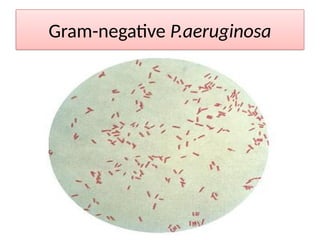
• It is motile bacterium rod shape, Gram-negative, measuring about 0.6 × 2 µm and
occurs as single bacteria, in pairs and occasionally in short chain.
• Growth and culturing characteristics:
• 1- P. aeruginosa is an obligate aerobe that grows easily on many types of culturing
media
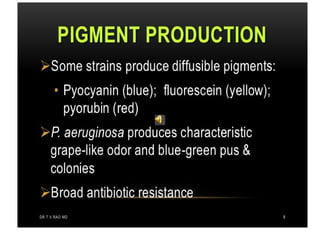
• 2- producing specific odor like sweet or grap-like odor.
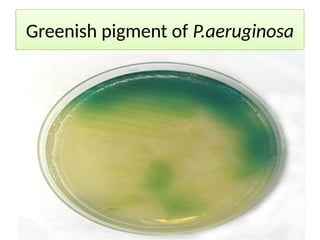
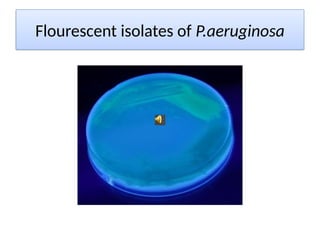
• 3- its form smooth, round colonies with fluorescent greenish color or non
fluorescent bluish color (pyocyanine) which diffuse into the agar (characteristic
feature). Other species produce dark red color pigment (pyorubin or black pigment
which is pyomelanin.
• 4- some strains produce hemolysis on blood agar.
• 5- cultures from patients with cystic fibrosis produce P.aeruginosa with mucoid
colonies as a results of overproduction of alginate (an exopolysaccharide)
• 6- its grows well at 37-40 C°, oxidase test positive, it does not ferment CHO, but
many strains oxidize glucose
Gram-negative P.aeruginosa
Greenish pigment of P.aeruginosa
Flourescent isolates of P.aeruginosa
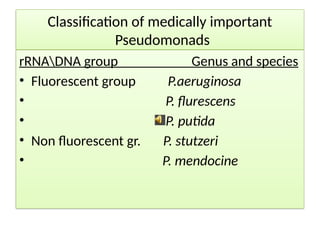
Classification of medically important
Pseudomonads
rRNADNA group Genus and species
• Fluorescent group P.aeruginosa
• P. flurescens
• P. putida
• Non fluorescent gr. P. stutzeri
• P. mendocine
Pathogenesis
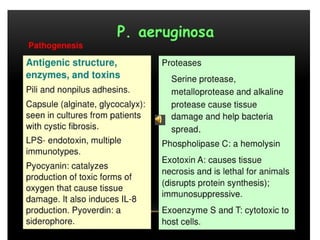
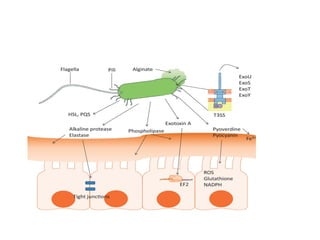
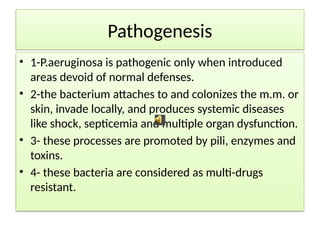
• 1-P.aeruginosa is pathogenic only when introduced
areas devoid of normal defenses.
• 2-the bacterium attaches to and colonizes the m.m. or
skin, invade locally, and produces systemic diseases
like shock, septicemia and multiple organ dysfunction.
• 3- these processes are promoted by pili, enzymes and
toxins.
• 4- these bacteria are considered as multi-drugs
resistant.
Clinical signs
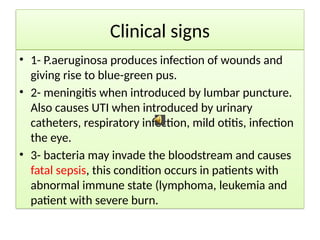
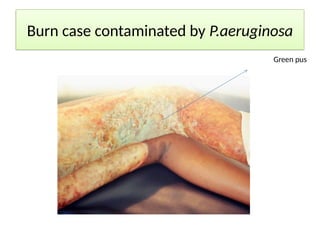
• 1- P.aeruginosa produces infection of wounds and
giving rise to blue-green pus.
• 2- meningitis when introduced by lumbar puncture.
Also causes UTI when introduced by urinary
catheters, respiratory infection, mild otitis, infection
the eye.
• 3- bacteria may invade the bloodstream and causes
fatal sepsis, this condition occurs in patients with
abnormal immune state (lymphoma, leukemia and
patient with severe burn.
Burn case contaminated by P.aeruginosa
Green pus
Diagnosis
• 1- specimens from skin, pus, blood, spinal fluid,
sputum are cultured on blood agar, differential
media like macConkey agar.
• 2- production of specific odor and pigment on
culturing media.
• 3- gram stain
• 4- biochemical reactions like culturing on TSI
(alkaline/alkaline), IMVC (-,-,-,+), Oxidase test +
• 5- identification by API NE System.
Treatment
• 1- Treatment of P. aeruginosa should be not
occure by one antimicrobial agent due to the
high rate of resistant pattern, therefor beta
lactam drugs plus aminoglycoside usually
useful in the treatment.
pseudomonas 2015.pptx12345678909trty7uio987

pseudomonas 2015.pptx12345678909trty7uio987

  • 1.
  • 2.
    Pseudomonaceae • It’s a familywidely distributed in nature contains several genera like Pseudomonace and the important medical species is P.aeruginosa which present in soil, water and sometime colonizes human and is considered as a major human pathogen .
  • 3.
    Pseudomonas aeruginosa • Itis motile bacterium rod shape, Gram-negative, measuring about 0.6 × 2 µm and occurs as single bacteria, in pairs and occasionally in short chain. • Growth and culturing characteristics: • 1- P. aeruginosa is an obligate aerobe that grows easily on many types of culturing media • 2- producing specific odor like sweet or grap-like odor. • 3- its form smooth, round colonies with fluorescent greenish color or non fluorescent bluish color (pyocyanine) which diffuse into the agar (characteristic feature). Other species produce dark red color pigment (pyorubin or black pigment which is pyomelanin. • 4- some strains produce hemolysis on blood agar. • 5- cultures from patients with cystic fibrosis produce P.aeruginosa with mucoid colonies as a results of overproduction of alginate (an exopolysaccharide) • 6- its grows well at 37-40 C°, oxidase test positive, it does not ferment CHO, but many strains oxidize glucose
  • 4.
  • 5.
    Greenish pigment ofP.aeruginosa
  • 7.
  • 8.
    Classification of medicallyimportant Pseudomonads rRNADNA group Genus and species • Fluorescent group P.aeruginosa • P. flurescens • P. putida • Non fluorescent gr. P. stutzeri • P. mendocine
  • 11.
    Pathogenesis • 1-P.aeruginosa ispathogenic only when introduced areas devoid of normal defenses. • 2-the bacterium attaches to and colonizes the m.m. or skin, invade locally, and produces systemic diseases like shock, septicemia and multiple organ dysfunction. • 3- these processes are promoted by pili, enzymes and toxins. • 4- these bacteria are considered as multi-drugs resistant.
  • 12.
    Clinical signs • 1-P.aeruginosa produces infection of wounds and giving rise to blue-green pus. • 2- meningitis when introduced by lumbar puncture. Also causes UTI when introduced by urinary catheters, respiratory infection, mild otitis, infection the eye. • 3- bacteria may invade the bloodstream and causes fatal sepsis, this condition occurs in patients with abnormal immune state (lymphoma, leukemia and patient with severe burn.
  • 13.
    Burn case contaminatedby P.aeruginosa Green pus
  • 14.
    Diagnosis • 1- specimensfrom skin, pus, blood, spinal fluid, sputum are cultured on blood agar, differential media like macConkey agar. • 2- production of specific odor and pigment on culturing media. • 3- gram stain • 4- biochemical reactions like culturing on TSI (alkaline/alkaline), IMVC (-,-,-,+), Oxidase test + • 5- identification by API NE System.
  • 15.
    Treatment • 1- Treatmentof P. aeruginosa should be not occure by one antimicrobial agent due to the high rate of resistant pattern, therefor beta lactam drugs plus aminoglycoside usually useful in the treatment.