Bergey’s manual of bacterial
classification
Presented by:
Kanta Yadav
Noopur Joshi
Department of:
Biotechnology
INTRODUCTION TO
MICROBIAL TAXONOMY AND
CLASSIFICATION
TAXONOMY
• Is defined as the science of biological classification.
•It consists of 3 separate but interrelated parts:
•Classification
•Nomenclature
•Identification
•Once a classification scheme is selected, it is used to group
organisms into groups called “taxa” based on mutual
similarity.
NOMENCLATURE
• It is the branch of taxonomy concerned with
the assignment of names to taxonomic groups
in agreement with published rules.
IDENTIFICATION
It is the practical side of taxonomy,
the process of determining if a
particular isolate belongs to a
recognized taxon.
SYSTEMATICS
• This term is often used for taxonomy.
• Many taxonomists define systematics as “ The
scientific studies of organisms with the
ultimate object of characterizing and
arranging them in an orderly manner.”
• Thus it ecompasses disciplines such as
‘morphology’, ‘ecology’, ‘epidemiology’,
‘biochemistry’, ‘molecular biology’ and
‘physiology’.
• One of the oldest classification systems was the
“ the natural classification”.
• It included arrangement of organisms into
groups whose members share many characteristc
and reflect as much as possible the biological
nature of the organism.
• CAROLUS LINNAEUS developed the first
natural classification, based largely on
anatomical characteristics, in the mid 18thC.
• In practice, the determination of the genusand
the species of a newly discovered prokaryote is
based on polyphasic taxonomy.
• It includes the following approaches:
• Phenetic classification
• Phylogenetic classification
• Genotypic classification
PHYLOGENETIC CLASSIFICATION
• It groups organisms together based on the
mutual similarity of their phenotypic
characteristics.
• The term “phylogeny” is a Greek word where
phylon=tribe or race; and genesis= generation
or origin.
• It sought to compare organisms based on their
evolutionary relationships.
GENOTYPIC CLASSIFICATION
• It seeks to compare thee genetic similarity
between organisms by comparing either
individual genes or whole genomes.
BEGERY’S MANUAL OF
BACTERIAL
CLASSIFICATION
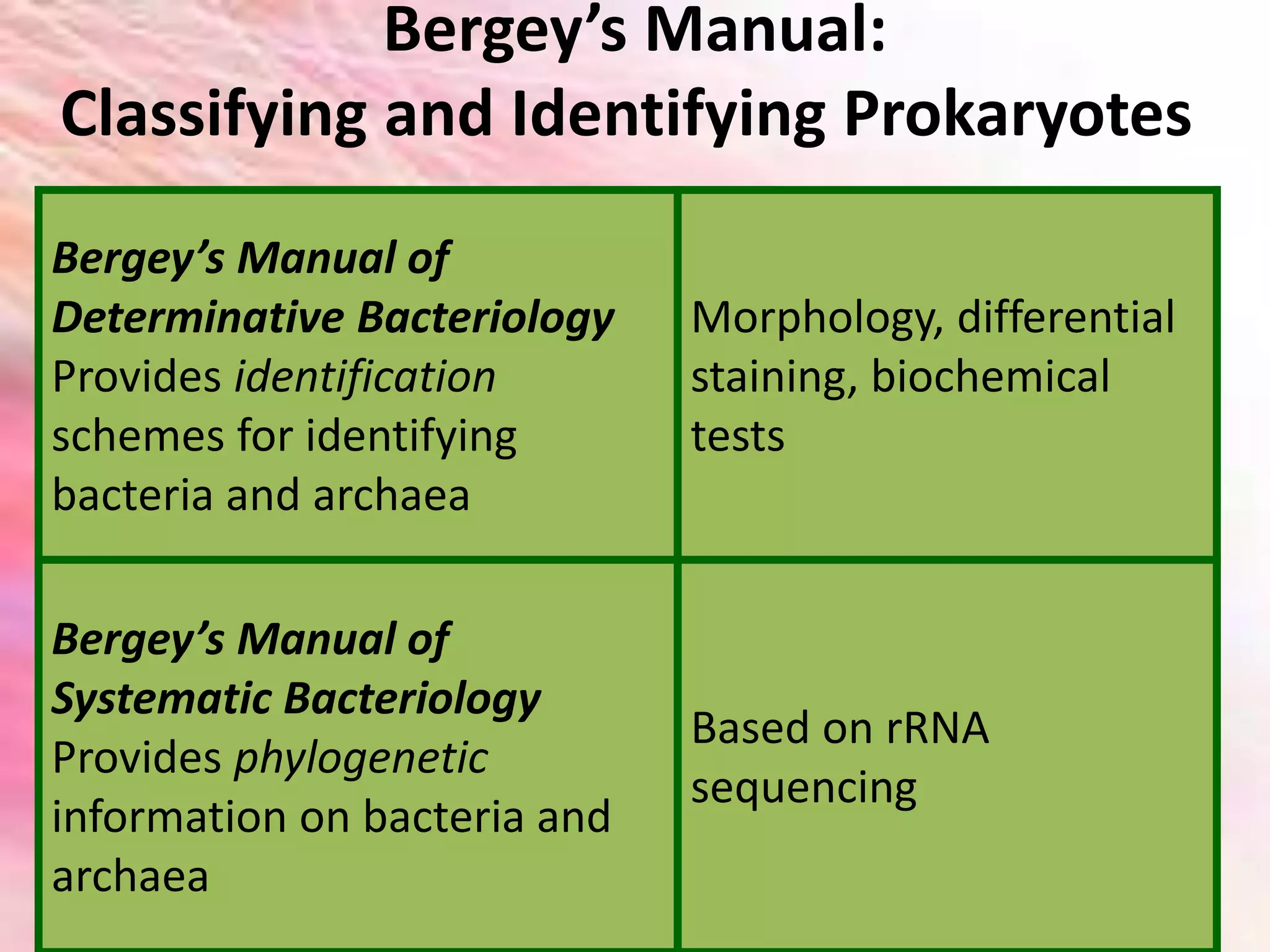
Bergey’s Manual:
Classifying and Identifying Prokaryotes
Bergey’s Manual of
Determinative Bacteriology
Provides identification
schemes for identifying
bacteria and archaea
Morphology, differential
staining, biochemical
tests
Bergey’s Manual of
Systematic Bacteriology
Provides phylogenetic
information on bacteria and
archaea
Based on rRNA
sequencing
• 1923, David Bergey and 4 collegues published a
classificationof bacteria that could be used for
identification of bacterial species:
“THE BERGEY’S MANUAL OF
DETERMINATIVE BACTERIOLOGY.”
• The first edition of Bergey’s Manual of Systemic
Bacteriology had its classification done on basis of
phenetics; but the now present editions are based on
phylogenetic studies.
THE SECOND EDITION OF THE BERGEY’S MANUAL has
the following volumes where it doesn’t group all
the clinically important prokaryotes together as the
1stdeition does, here the pathogenic bacteria are
placed phylogenetically, and so are distributed
throughtout in all the volumes:
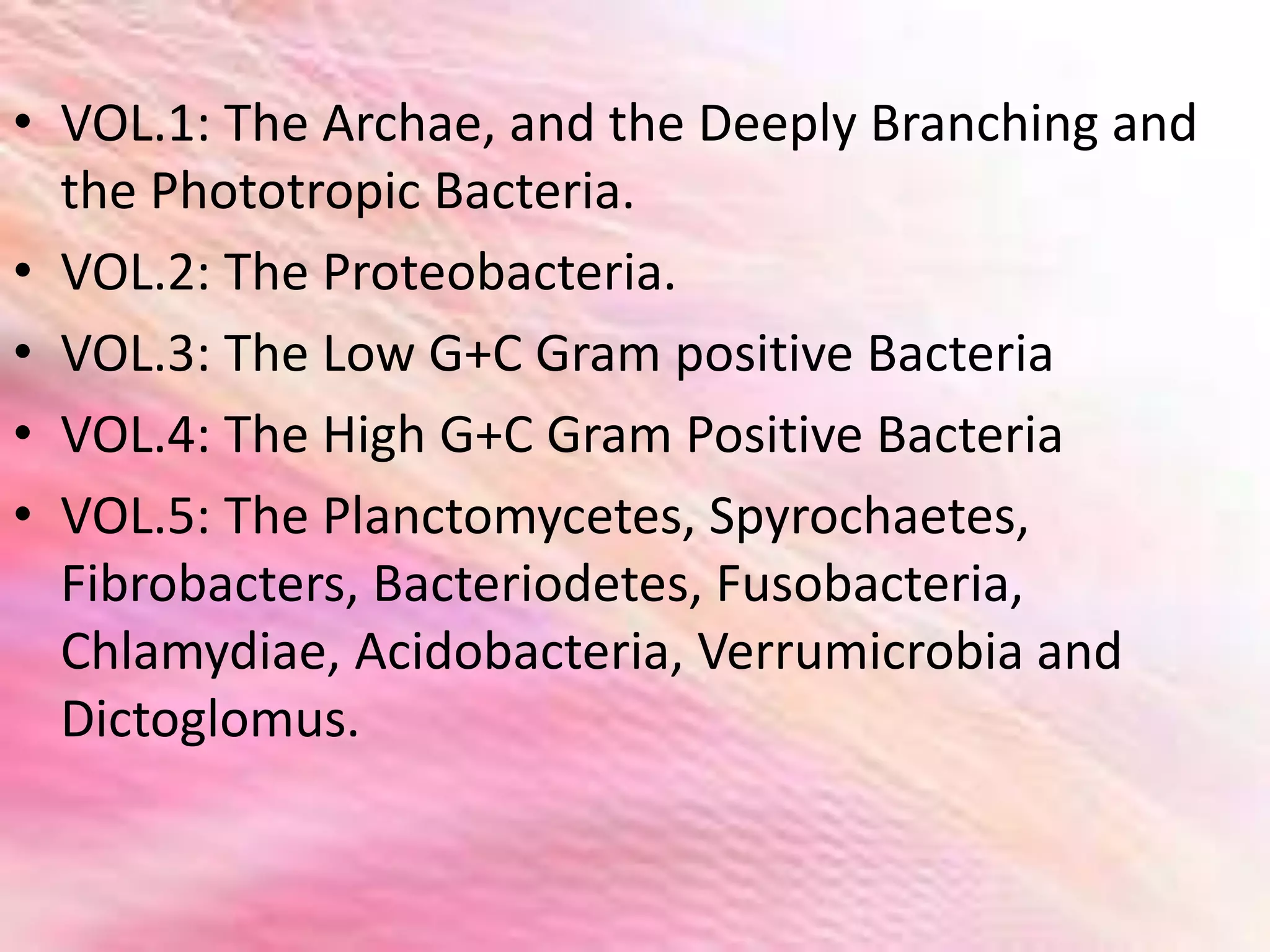
• VOL.1: The Archae, and the Deeply Branching and
the Phototropic Bacteria.
• VOL.2: The Proteobacteria.
• VOL.3: The Low G+C Gram positive Bacteria
• VOL.4: The High G+C Gram Positive Bacteria
• VOL.5: The Planctomycetes, Spyrochaetes,
Fibrobacters, Bacteriodetes, Fusobacteria,
Chlamydiae, Acidobacteria, Verrumicrobia and
Dictoglomus.
Bergey’s manual of bacterial classification

Bergey’s manual of bacterial classification

  • 1.
    Bergey’s manual ofbacterial classification Presented by: Kanta Yadav Noopur Joshi Department of: Biotechnology
  • 2.
  • 3.
    TAXONOMY • Is definedas the science of biological classification. •It consists of 3 separate but interrelated parts: •Classification •Nomenclature •Identification •Once a classification scheme is selected, it is used to group organisms into groups called “taxa” based on mutual similarity.
  • 4.
    NOMENCLATURE • It isthe branch of taxonomy concerned with the assignment of names to taxonomic groups in agreement with published rules.
  • 5.
    IDENTIFICATION It is thepractical side of taxonomy, the process of determining if a particular isolate belongs to a recognized taxon.
  • 6.
    SYSTEMATICS • This termis often used for taxonomy. • Many taxonomists define systematics as “ The scientific studies of organisms with the ultimate object of characterizing and arranging them in an orderly manner.” • Thus it ecompasses disciplines such as ‘morphology’, ‘ecology’, ‘epidemiology’, ‘biochemistry’, ‘molecular biology’ and ‘physiology’.
  • 7.
    • One ofthe oldest classification systems was the “ the natural classification”. • It included arrangement of organisms into groups whose members share many characteristc and reflect as much as possible the biological nature of the organism. • CAROLUS LINNAEUS developed the first natural classification, based largely on anatomical characteristics, in the mid 18thC.
  • 8.
    • In practice,the determination of the genusand the species of a newly discovered prokaryote is based on polyphasic taxonomy. • It includes the following approaches: • Phenetic classification • Phylogenetic classification • Genotypic classification
  • 9.
    PHYLOGENETIC CLASSIFICATION • Itgroups organisms together based on the mutual similarity of their phenotypic characteristics. • The term “phylogeny” is a Greek word where phylon=tribe or race; and genesis= generation or origin. • It sought to compare organisms based on their evolutionary relationships.
  • 10.
    GENOTYPIC CLASSIFICATION • Itseeks to compare thee genetic similarity between organisms by comparing either individual genes or whole genomes.
  • 11.
  • 12.
    Bergey’s Manual: Classifying andIdentifying Prokaryotes Bergey’s Manual of Determinative Bacteriology Provides identification schemes for identifying bacteria and archaea Morphology, differential staining, biochemical tests Bergey’s Manual of Systematic Bacteriology Provides phylogenetic information on bacteria and archaea Based on rRNA sequencing
  • 13.
    • 1923, DavidBergey and 4 collegues published a classificationof bacteria that could be used for identification of bacterial species: “THE BERGEY’S MANUAL OF DETERMINATIVE BACTERIOLOGY.” • The first edition of Bergey’s Manual of Systemic Bacteriology had its classification done on basis of phenetics; but the now present editions are based on phylogenetic studies.
  • 14.
    THE SECOND EDITIONOF THE BERGEY’S MANUAL has the following volumes where it doesn’t group all the clinically important prokaryotes together as the 1stdeition does, here the pathogenic bacteria are placed phylogenetically, and so are distributed throughtout in all the volumes:
  • 15.
    • VOL.1: TheArchae, and the Deeply Branching and the Phototropic Bacteria. • VOL.2: The Proteobacteria. • VOL.3: The Low G+C Gram positive Bacteria • VOL.4: The High G+C Gram Positive Bacteria • VOL.5: The Planctomycetes, Spyrochaetes, Fibrobacters, Bacteriodetes, Fusobacteria, Chlamydiae, Acidobacteria, Verrumicrobia and Dictoglomus.